Protective Effect of Lonicerae Flos Aqueous Extracts on a Pressure Overload-induced Heart Failure Model
Jae-wook Shin, Woo-seok Jang, Kyung-min Baek
Dept. of Cardiovascular and Neurologic Diseases of Korean Internal Medicine, Daegu Oriental Hospital of Daegu Haany University
Protective Effect of Lonicerae Flos Aqueous Extracts on a Pressure Overload-induced Heart Failure Model
Jae-wook Shin, Woo-seok Jang, Kyung-min Baek
Dept. of Cardiovascular and Neurologic Diseases of Korean Internal Medicine, Daegu Oriental Hospital of Daegu Haany University
ABSTRACT
Objectives:
Lonicerae flos (LF), a dried flower part ofLonicera japonica Thunb., has been widely used in Korean medicine as anti-inflammatory and antioxidative agent. The purpose of this study was to determine the cardioprotective effects of LF, through potential antioxidant effects, on the pressure overload (PO)-induced heart failure (HF) in C57BL/6 mice after transverse aortic constriction (TAC) surgery.Methods:
Resveratrol (10 mg/kg body weight) or LF (125, 250 or 500 mg/kg body weight) was orally administered, once daily for 14 days, starting 14 days after TAC surgery. Changes in the mortality, body weights, heart weights, histopathology of the heart, and antioxidant defense systems of the heart were analyzed.Results:
Marked and noticeable increases of heart weights, mortalities, and hypertrophic, focal, and lytic fibrotic histological changes in the LVs were observed, with destruction of heart antioxidant defense systems after surgery. However, HF signs, induced by TAC surgery through PO, and destruction of heart antioxidant defense systems were significantly and dose-dependently inhibited by 14 days of maintained oral treatment with LF 500, 250 or 125 mg/kg. Treatment with 250 mg/kg LF was comparable to treatment with 10 mg/kg resveratrol.Conclusions:
The results in this study suggest that oral administration of LF favorably relieves PO-induced HF following TAC, through increase of heart antioxidant defense systems. The overall effects of 250 mg/kg LF were similar to those of 10 mg/kg resveratrol. More detailed mechanistic studies should be conducted in the future, with screening of the biologically active compounds in LF.Key words:
heart failure, Lonicerae flos, pressure overload, cardioprotectiveⅠ. Introduction
Heart failure (HF) is a global problem with an estimated prevalence of 38 million patients worldwide, a number that is increasing with the aging of the population
1. HF is an important healthcare issue
․투고일: 2017.09.11, 심사일: 2017.11.27, 게재확정일: 2017.12.17
․Corresponding author: Kyung-min Baek Dept of Cardiovascular and Neurologic Diseases of Korean Internal Medicine 2
ndfloor, Daegu Oriental Hospital, 136 Sinchendong-ro, Suseong-gu, Daegu, Republic of Korea
TEL: +82-53-770-2118 FAX: +82-53-770-2055 E-mail: [email protected]
․이 논문은 2016년도 대구한의대학교 대학원 한의학 석사학위
논문임.
because of its high prevalence, mortality, morbidity, and cost of care
2. HF can be caused by disease such as ischemic heart disease, hypertension, valve or myocardium structural defects and arrhythmias
3. The classic clinical syndrome of HF is characterized by fluid retention leading to pulmonary congestion and peripheral edema and by low cardiac output, that combined may cause a severe limitation of exercise capacity
4. Conventional treatment of HF involves oxygen therapy, diet, angiotensin-convertising enzyme inhibitors (ACEI), diuretics, anti platelets or beta-blockers, etc
5. Despite existing therapies for HF, the current 1-year mortality rate after diagnosis of symptomatic HF remains at 25% to 40%
6. Accordingly, there are a few efforts in domestic and foreign to find other treatment for HF. However, there are little research on the mechanisms how these treatment can control heart damage and on optimal stage to use.
Lonicerae Flos ( Lonicerae japonica Thunb, LF), also called Jinyinhua (金銀花) is a widely used herb prescribed in many Korean herbal formulas against gastroesophageal reflux disease, lung disease, carcinoma, etc. Pharmacological studies show that LF possessed various actions, such as anti-inflammatory, antiviral, antidiabetic, antiallergic, and antioxidants
7-9. Because LF has beneficial effect on oxidative damages and cytoprotective action, we hypothesized that LF could also have positive effects in PO induced HF by antioxidant mechanism. And therefore there are no studies about effects of LF on heart.
So this study performed for the cardioprotective effects of LF on the PO-induced HF by TAC in mice, with antioxidant effects. The changes on the mortality, body weight, heart weights, indicators of antioxidant defense system and histopathology of heart were investigated.
Ⅱ. Materials and methods
1. Animals and husbandry
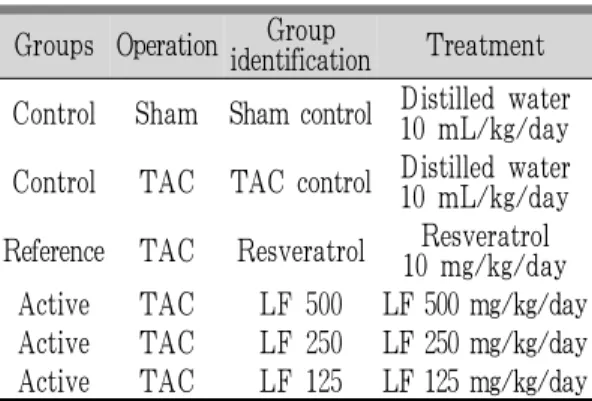
One hundred 6-week old male SPF/VAF inbred C57BL/6NCrljOri [C57BL/6] mice (OrientBio, Seungnam, Korea) were used after acclimatization for 7 days. In this study, forty transverse aortic constriction (TAC) and eight sham operated mice were sorted out based on the weights at two weeks after TAC surgery (mean weights: 21.60±0.74 g), and divided into six groups (Table 1).
2. Preparations and administration of test materials Three different dosages, 50, 25 and 12.5 mg of LF were directly dissolved in distilled water 1 ml, and administered in a volume of 10 ml/kg as equivalence to 500, 250 and 125 mg/kg using gastric gavages by oral, once a day for 14 days from 14 days after TAC operation, and resveratrol also dissolved in distilled water and orally administered at a dose level of 10 mg/kg, in a volume of 10 ml/kg.
In sham and TAC control mice, instead of test materials, same volumes of distilled water as vehicle were administered once a day for 14 days from 14 days by oral after TAC surgery, respectively (Table 1).
Groups Operation Group
identification Treatment Control Sham Sham control Distilled water 10 mL/kg/day Control TAC TAC control Distilled water 10 mL/kg/day Reference TAC Resveratrol Resveratrol
10 mg/kg/day Active TAC LF 500 LF 500 mg/kg/day Active TAC LF 250 LF 250 mg/kg/day Active TAC LF 125 LF 125 mg/kg/day LF : Lonicerae Flos aqueous extracts, TAC : transverse aortic constriction
Table 1. Experimental Design Used in the Present
Study
3. TAC operation
The mice were intubated with tubing by oral and ventilated at 0.2 mL tidal air volume. A 3 mm center thoracotomy was treated. The transverse aortic arch was tied (7-0 Prolene) between the innominate artery and left common carotid artery using an overlying 28-gauge needle. After that, the needle was eliminated, leaving a detached region of stenosis. The chest was closed. The pneumothorax was clearly evacuated.
Some mice underwent a sham operation in which the aortic arch was visualized but not ligated.
4. Mortalities
Based on the Functional Observational Battery (FOB), all abnormal mortalities were represented before and after administration twice a day during the first day of administration to the last day of drug treatment.
5. Body weight measurements
Changes in weight of body were evaluated at one day before initial resveratrol or LF administration, the day of first administration, 1, 7, 13 and 14 days after initial test material administration with an automatic electronic balance (Precisa Instrument, Dietikon, Switzland).
6. Heart weight measurements
At sacrifice, the heart weights in all survived animals were evaluated at gram levels, separately with an automatic electronic balance (Precisa Instrument, Dietikon, Switzland).
To reduce individual differences, the relative weights (percentage of body weights) were calculated using weight of body at sacrifice and absolute weight of heart as following equation : (absolute weights of heart/weight of body at sacrifice)×100.
7. Analysis of Antioxidant defence system
The total protein amount for the determination of enzyme antioxidant, GSH, and lipid peroxidation assays was refered to the Lowry protein assay.
1) Analysis of lipid peroxidation
Quantifying levels of lipid peroxidation, thiobarbituric acid reactive substances (TBARS) made due to acid-heating reactions were evaluated. TBARS absorbance was analyzed spectrophotometrically at 535 nm of optical density (OD) with a UV/VIS spectrophotometer (OPTIZEN POP, Mecasys, Daejeon, Korea) and findings are demonstrated as MDA equivalents (nM/g of protein).
2) Analysis of CAT and SOD activity
The CAT activity level was evaluated by the corrosion of the hydrogen peroxide at OD 240 nm using a UV/VIS spectrophotometer (OPTIZEN POP, Mecasys, Daejeon, Korea). Results were observed as U/g protein. SOD activity was measured at 560 nm of OD by the degree of inhibition of this reaction, and was observed as U/g protein.
3) Analysis of GSH levels
Reduced and disulphide forms of GSH levels in tissue homogenate samples were estimated with the method depicted by Tietze. Reduced GSH is recycled with glutathione reductase and nicotinamide adenine dinucleotide phosphate (NADPH), which is related to the absorption change at 412 nm, related with the reduction of diothio-bis-(2-nitrobenzoic acid) (DTNB). This analysis was modified for the use in a microplate reader (Tecan, Männedorf, Switzerland).
8. Histological process
Approximately corresponding regions of individual
hearts, taken from survived mice at sacrifice (five
in each group), were obliquely cut based upon the
ventricles as one part of each heart. To investigate
more specific changes, total thicknesses of endocardium
to pericardium (μm/heart) in left ventricle (LV), mean numbers of lytic necrotic muscle fibers of heart (myofibers/1000 myofibers) and diameters of muscle fibers of heart (μm/fiber) were evaluated using a computer-assisted progrom (iSolution FL ver 9.1, IMT i-solution INC., Quebec, Canade) for image anlysis under H&E stain with the mean percentages of perivascular and interstitial collagen fiber occupied parts in LV (%/mm
2of field) under Sirius red (SR) stain.
9. Statistical analyses
All Data were displayed as mean±standard deviations (SD). Multiple comparison tests for the different dose groups were prosecuted. Variance homogeneity was examined using the Levene test.
If the Levene test exhibited no significant deviations from variance homogeneity, the obtained data were analyzed by one way ANOVA test and least-significant differences (LSD) multi-comparison test to determine which pairs of group comparison were clearly different.
When great deviations from variance homogeneity were detected at Levene test, Kruskal-Wallis H test, a non-parametric comparison test, was done. If an important difference was detected in the Kruskal-Wallis
H test, the Mann-Whitney U (MW) test was conducted to determine the specific pairs of group comparison that are considerably different. Statistical analyses were conducted using SPSS for Windows (Release 14.0K, IBM SPSS Inc., Armonk, NY, USA).
Ⅲ. Results
1. Survivability
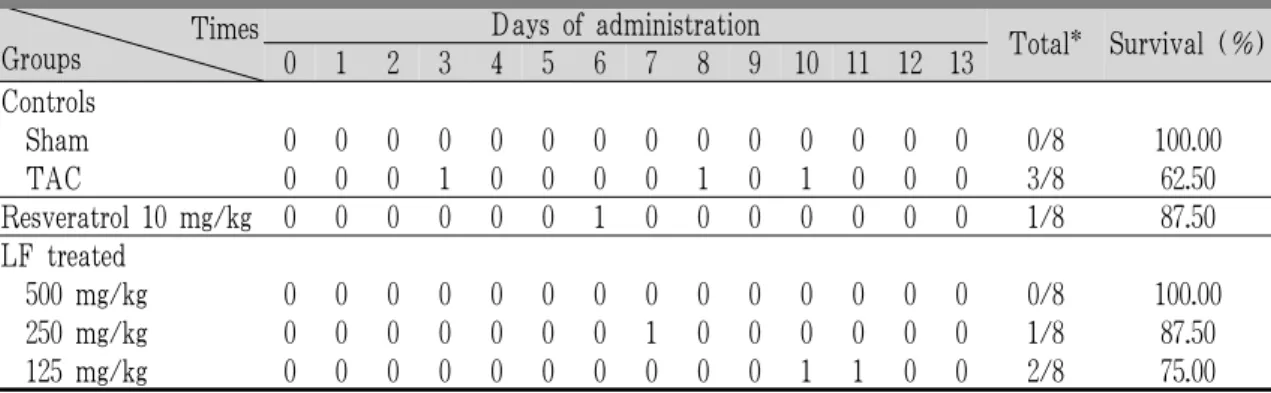
Unscheduled mortalities were not demonstrated in sham-operated control mice throughout the whole experimental periods, but three mice (3/8;
37.5%) in TAC control died within 14 days of experimental periods; each of one mouse died at 3, 8 and 10 days after initial administration, respectively.
In addition, one mouse (1/8; 12.5%) administered with resveratrol 10 mg/kg were died at 6 days after initial administration, and also one mouse (1/8; 12.5%) at 7 days after initial administration in LF 250 mg/kg treated mice. Two mice (2/8; 25.0%) among LF 125 mg/kg treated mice died; each of one at 10 and 11 days after initial administration. However, no unscheduled mortalities were demonstrated in LF 500 mg/kg treated mice throughout the whole 14 days of experimental periods in this experiment (Table 2).
Times
Groups 0 1 2 3 Days of administration 4 5 6 7 8 9 10 11 12 13 Total* Survival (%) Controls
Sham 0 0 0 0 0 0 0 0 0 0 0 0 0 0 0/8 100.00
TAC 0 0 0 1 0 0 0 0 1 0 1 0 0 0 3/8 62.50
Resveratrol 10 mg/kg 0 0 0 0 0 0 1 0 0 0 0 0 0 0 1/8 87.50
LF treated
500 mg/kg 0 0 0 0 0 0 0 0 0 0 0 0 0 0 0/8 100.00
250 mg/kg 0 0 0 0 0 0 0 1 0 0 0 0 0 0 1/8 87.50
125 mg/kg 0 0 0 0 0 0 0 0 0 0 1 1 0 0 2/8 75.00
Values are expressed as number of expired animals.
* Total mortalities for 14 days of observation periods-expired animals/total animals (eight mice in each group) TAC : transverse aortic constriction, LF : Lonicerae flos aqueous extracts
Table 2. Mortalities in Sham or TAC Operated Mice
2. Changes on the body weight
Significant changes on the weight of body for 14 days of experimental periods were not detected in all TAC operated mice as compared to sham control mice,
and also marked changes on the body weight and gains were not detected in all three different dosages of LF or resveratrol 10 mg/kg administrated mice as compared to TAC control mice, respectively (Table 3).
Times Groups
Body weights at
Weight gains [B-A]
First administration [A] Sacrifice [B]
Controls
Sham 19.59±0.75 20.73±0.96 1.14±0.48
TAC 19.56±0.67 20.62±1.00 1.18±0.66
Resveratrol 10 mg/kg 19.45±0.75 20.56±1.01 1.24±0.45
LF treated
500 mg/kg 19.70±0.73 20.83±1.12 1.13±0.66
250 mg/kg 19.68±1.05 20.73±1.22 1.16±1.00
125 mg/kg 19.58±0.52 20.77±1.11 1.22±0.81
Values are expressed as Mean±S.D. of variable numbers of the animals according to mortality (see Table 2), g.
TAC : transverse aortic constriction, LF : Lonicerae flos aqueous extracts Table 3. Body Weight Gains Observed in Sham or TAC Operated Mice
3. Changes on the heart weight
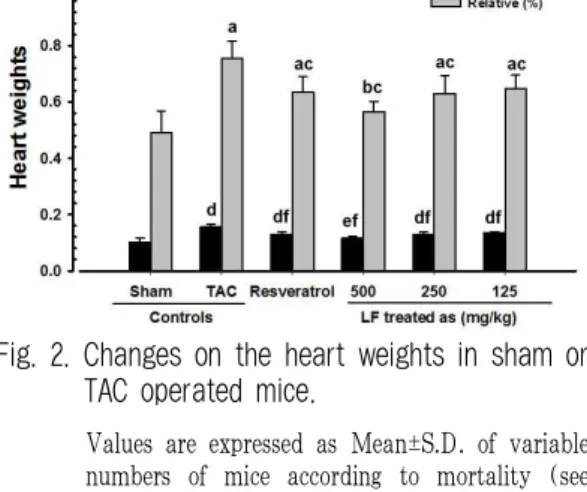
Noticeable hypertrophic changes were demonstrated in TAC control mice as compared to sham control mice; as a result, significant (p<0.01) increases of relative and absolute weights of heart were demonstrated in TAC control mice at 14 days after the end of administration (28 days after TAC surgery). However, these heart hypertrophic changes induced by TAC were remarkably inhibited by treatment of LF 500, 250 and 125 mg/kg, and by resveratrol 10 mg/kg, dose dependantly, as compared with TAC control;
significant (p<0.01) and dose-dependent decreases of absolute and relative weights of heart were noticed in all three different dosages of LF administered mice,
and in resveratrol 10 mg/kg treated mice (Fig. 1, 2). Fig. 1. The representative gross images of heart, selected from sham or TAC operated mice.
A : sham control, B : TAC control, C : resveratrol 10 mg/kg, D : LF 500 mg/kg, E : LF 250 mg/kg, F : LF 125 mg/kg
LF : Lonicerae flos aqueous extracts, TAC : transverse aortic constriction
Scale bars : 5 mm
Fig. 2. Changes on the heart weights in sham or TAC operated mice.
Values are expressed as Mean±S.D. of variable numbers of mice according to mortality (see Table 2), g.
TAC : transverse aortic constriction LF : Lonicerae flos aqueous extracts
a
p <0.01 and
bp <0.05 as compared to sham control by LSD test
c
p <0.01 as compared to TAC control by LSD test
d
p <0.01 and
ep <0.05 as compared to sham control by MW test
f
p <0.01 as compared to TAC control by MW test 4. Effects on the heart antioxidant defense system
1) Changes on the heart MDA levels
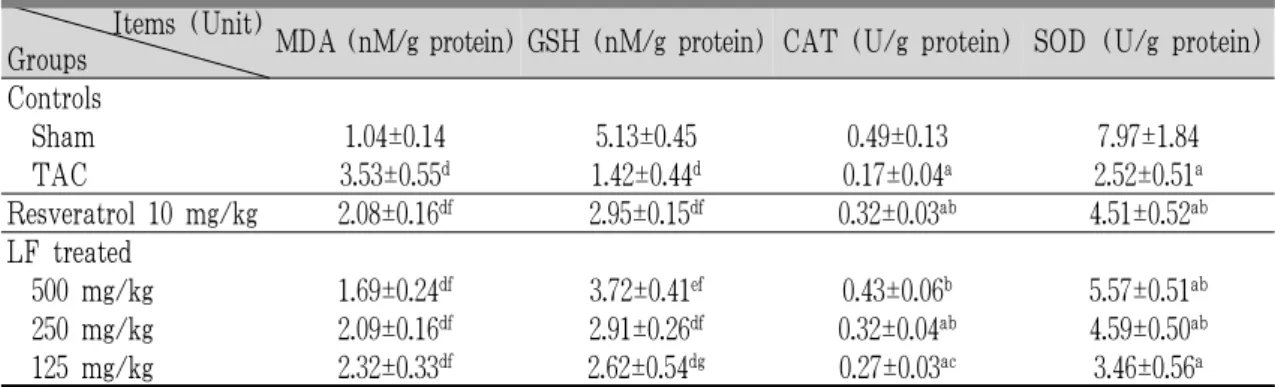
Significant ( p <0.01) increases of cardiac lipid peroxidation, elevation of the MDA levels, were observed in TAC control mice, as compared with sham control mice. However, these increase of MDA levels were remarkably ( p <0.01) decreased by treatment of LF, dose-dependently. In addition, the heart lipid peroxidation in resveratrol 10 mg/kg treated mice were also significantly ( p <0.01) decreased as compared with TAC control mice (Table 4).
2) Changes on the heart GSH contents
Significant ( p <0.01) decrease of heart endogenous antioxidant, the GSH content, were detected in TAC control mice as compared with sham control mice.
However, these decreases of cardiac GSH contents induced by TAC operation were significantly ( p <0.01 or p <0.05) and dose-dependently inhibited by treatment of 14 days continuous oral treatment of LF 500, 250 and 125 mg/kg, respectively. In addition, the heart GSH contents in resverastrol 10 mg/kg treated mice were also significantly ( p <0.01) and remarkably increased as compared with TAC control mice (Table 4).
3) Changes on the heart CAT activity
Significant ( p <0.01) decreases of heart endogenous antioxidative enzyme, the CAT activity were detected in TAC control mice as compared with sham control mice. However, these decreases of cardiac CAT activities were markedly (p<0.01 or p<0.05) and dose-dependently inhibited by treatment of 14 days continues oral treatment of LF at any dose examined.
In addition, the heart CAT activities in resveratrol 10 mg/kg treated mice were also significantly (p<0.01) increased as compared to TAC control mice (Table 4).
4) Changes on the heart SOD activity
Significant ( p <0.01) decrease of heart endogenous
antioxidative enzyme, the SOD activities were
detected in TAC control mice as compared with
sham control mice, but noticeable increases of SOD
activities were observed in resveratrol 10 mg/kg,
LF 500, 250 and 125 mg/kg administrated mice as
compared with TAC control mice, respectively (Table 4).
Items (Unit)
Groups MDA (nM/g protein) GSH (nM/g protein) CAT (U/g protein) SOD (U/g protein) Controls
Sham 1.04±0.14 5.13±0.45 0.49±0.13 7.97±1.84
TAC 3.53±0.55
d1.42±0.44
d0.17±0.04
a2.52±0.51
aResveratrol 10 mg/kg 2.08±0.16
df2.95±0.15
df0.32±0.03
ab4.51±0.52
abLF treated
500 mg/kg 1.69±0.24
df3.72±0.41
ef0.43±0.06
b5.57±0.51
ab250 mg/kg 2.09±0.16
df2.91±0.26
df0.32±0.04
ab4.59±0.50
ab125 mg/kg 2.32±0.33
df2.62±0.54
dg0.27±0.03
ac3.46±0.56
aValues are expressed as Mean±S.D. of five mice, g.
TAC : transverse aortic constriction, LF : Lonicerae flos aqueous extracts, MDA : malondialdehyde, GSH : glutathione, CAT : catalase, SOD : superoxide dismutase
a
p <0.01 as compared to sham control by LSD test
b
p <0.01 and
cp<0.05 as compared to TAC control by LSD test
d
p <0.01 and
ep<0.05 as compared to sham control by MW test
f
p <0.01 and
gp<0.05 as compared to TAC control by MW test
Table 4. Heart Antioxidant Defense Systems Detected in Sham or TAC Operated Mice
5. Effects on the heart histopathology
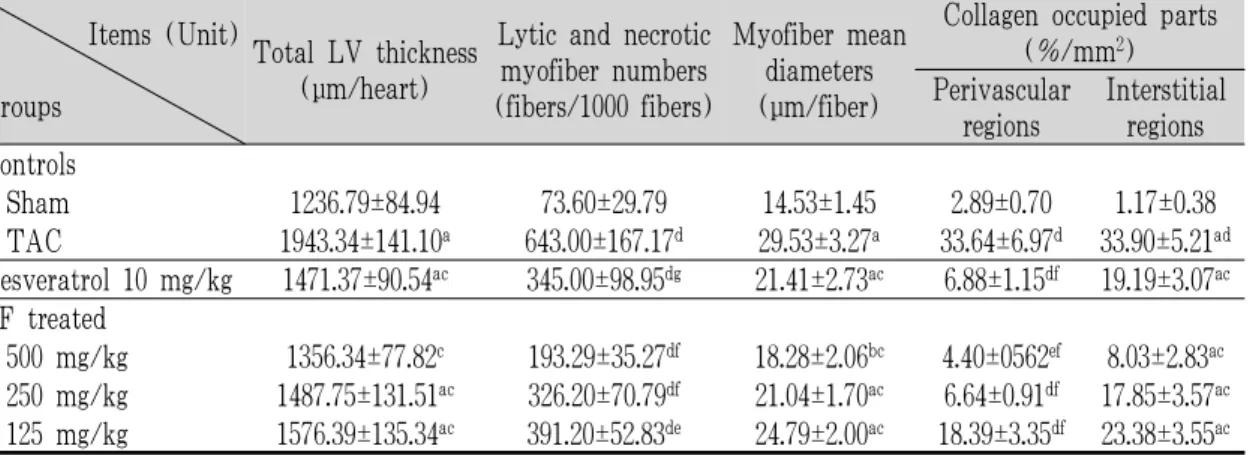
The total thicknesses of LV from endocardium to pericardium (μm/heart), mean numbers of lytic necrotic cardiac muscle fibers (myofibers/1000 myofibers) and diameters of cardiac muscle fibers (μm/fiber) were calculated to observe the heart damages as histomorphometrical analysis with the mean percentages of perivascular and interstitial collagen fiber occupied parts in LV (%/mm
2of field), respectively.
1) Changes on the total thicknesses of left ventricle
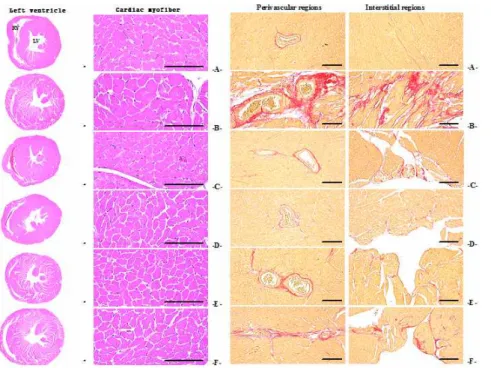
In TAC control mice, significantly (p<0.01) increased total thicknesses of the LV from endocardium to pericardium were detected. However, 14 days sustained oral treatment of resveratrol 10 mg/kg, LF 500, 250 and 125 mg/kg in TAC-operated mice significantly (p<0.01) inhibited the TAC related ventricle hypertrophic changes. In addition, LF showed clear dose-dependent effects (Table 5, Fig 3).
2) Changes on the mean numbers of lytic necrotic
cardiac muscle fibers in left ventricle
In TAC control mice, significantly ( p <0.01) increased mean numbers of lytic and necrotic muscle fibers in heart among 1000 myofibers were observed. However, 14 days sustained oral treatment of resveratrol 10 mg/kg, LF 500, 250 and 125 mg/kg in TAC-operated mice significantly (p<0.01 or p<0.05) inhibited the TAC related increases of degenerative myofibers as compared with TAC control mice, respectively. In addition, LF showed clear dose-dependent effects (Table 5, Fig 3).
3) Changes on the diameters of cardiac muscle fibers in left ventricle
In TAC control mice, markedly ( p <0.01) increased mean diameters of cardiac muscle fibers were demonstrated. However, 14 days sustained oral treatment of resveratrol 10 mg/kg, LF 500, 250 and 125 mg/kg in TAC-operated mice significantly ( p <0.01) inhibited the TAC related increases of the diameters of muscle fibers in heart, respectively.
In addition, LF detected clear dose-dependent effects
(Table 5, Fig 3).
4) Changes on the mean percentages of perivascular collagen fiber occupied parts in left ventricle
The mean percentages of perivascular collagen fiber occupied parts in LV were significantly ( p <0.01) increased in TAC control mice. These TAC-related perivascular fibrosis were dose-dependently and markedly ( p <0.01 or p <0.05) restored by LF treatment.
Furthermore, the mean percentages of perivascular collagen fiber occupied parts in LV were significantly ( p <0.01) decreased in resveratrol 10 mg/kg treated group (Table 5, Fig 3).
5) Changes on the mean percentages of interstitial collagen fiber occupied parts in left ventricle
The mean percentages of interstitial collagen fiber occupied parts in LV were significantly and markedly ( p <0.01) increased in TAC control mice. These TAC-related interstitial fibrosis were dose-dependently and markedly (p<0.01 or p<0.05) restored by LF treatment. Furthermore, the mean percentages of interstitial collagen fiber occupied parts in LV were markedly (p<0.01) decreased in resveratrol 10 mg/kg treated group (Table 5, Fig 3).
Items (Unit) Groups
Total LV thickness (μm/heart)
Lytic and necrotic myofiber numbers (fibers/1000 fibers)
Myofiber mean diameters (μm/fiber)
Collagen occupied parts (%/mm
2) Perivascular
regions Interstitial regions Controls
Sham 1236.79±84.94 73.60±29.79 14.53±1.45 2.89±0.70 1.17±0.38
TAC 1943.34±141.10
a643.00±167.17
d29.53±3.27
a33.64±6.97
d33.90±5.21
adResveratrol 10 mg/kg 1471.37±90.54
ac345.00±98.95
dg21.41±2.73
ac6.88±1.15
df19.19±3.07
acLF treated
500 mg/kg 1356.34±77.82
c193.29±35.27
df18.28±2.06
bc4.40±0562
ef8.03±2.83
ac250 mg/kg 1487.75±131.51
ac326.20±70.79
df21.04±1.70
ac6.64±0.91
df17.85±3.57
ac125 mg/kg 1576.39±135.34
ac391.20±52.83
de24.79±2.00
ac18.39±3.35
df23.38±3.55
acValues are expressed as Mean±S.D. of five mice, g.
LF : Lonicerae flos aqueous extracts, TAC : transverse aortic constriction, LV : left ventricle
a
p <0.01 and
bp<0.05 as compared to sham control by LSD test
c
p <0.01 as compared to TAC control by LSD test
d
p <0.01 and
ep<0.05 as compared to sham control by MW test
f