Korean J Environ Agric (2011) Online ISSN: 2233-4173 Vol. 30, No. 4, pp. 409-413 http://dx.doi.org/10.5338/KJEA.2011.30.4.409 Print ISSN: 1225-3537
곡류 도정에 따른 지방산 조성 변화 연구
조영숙, 김유나, 김수연, 김정봉,* 김헌웅, 김세나, 김소영, 박홍주, 김재현
농촌진흥청 국립농업과학원
Changes in Fatty Acid Composition of Grain after Milling
Young-Sook Cho, Yu-Na Kim, Su-Yeon Kim, Jung-Bong Kim,
*Heon-Woong Kim, Se-Na Kim, So-Young Kim, Hong-Ju Park, and Jae-Hyun Kim (Functional Food and Nutrition Division, National Academy of Agricultural Science (NAAS), Rural Development Administration (RDA), Suwon, 249, Korea)
Received: 29 November 2011 / Accepted: 26 December 2011
ⓒ 2011 The Korean Society of Environmental Agriculture
*교신저자(Corresponding author),
Phone: +82-31-299-0511; Fax:+82-31-299-6054;
E-mail: [email protected]
409
Abstract
BACKGROUND: Cereals, especially rice is the staple food of oriental nations and because it is very important for Korean food, to determine the extent of nutrient losses due to milling, we analyzed the fatty acid using by GC-FID(Gas Chromatography-Flame Ionization Detector). Experimented rice cereals were rice, glutinous rice, Heuinchalssalbori, Seodunchalbori, Saessalbori, Keunalbori No.1, barnyard millet produced in Korea.
METHODS AND RESULTS: After milling, the contents of fatty acids in the rice, glutinous rice, Heuinchalssalbori, and Seodunchalbori, Keunalbori No.1 rather decreased, but in the Saessalbori, and barnyard mille increased. Particularly, fatty acid content of the rice decreased from 24.8 ㎎/g to 6.4
㎎/g, glutinous rice decreased from 29.4 mg/g to 11.7 ㎎/g after milling. There were also significant changes in the compositions of fatty acid among samples. Stearic acid (C
18:0) increased from 5% to 15%, but oleic acid (C
18:1) and linoleic acid (C
18:2) decreased in the rice after milling.
CONCLUSION(s):In the brown rice, 11 different types of fatty acids were detected, and its highest content was found in grains. However, milled grain was observed only seven fatty acids in the case of rice. This result insisted that a portion of the lipid layer was significantly lost during the
milling operation in rice.
Key Words: Fatty acid compositions, Gas chromatography, Milled grain, Whole grain
서 론
한국을 비롯하여 전 세계에서 중요한 작물인 곡류는 미곡, 맥류, 잡곡으로 나눌 수 있으며 탄수화물, 단백질, 비타민, 무 기질 등의 다양한 영양소를 비롯하여 phenolic compounds, flavonoids, lignans, phytic acids와 같은 기능성 성분을 포함하고 있다 (Lee et. al., 2006). 이러한 성분 외에 지방질 이 포함되어 있는데 곡류 내 지방질 성분에 관한 연구는 Chun et. al. (1984)이 한국산 보리 가루의 지방질을 유리지방질과 결합지방질로 나누어 각종 지방산 성분을 분리, 동정, 정량한 바 있으며, Gaydou 등(1980)은 말레이시아산 벼 품종에 따 른 미강유의 지방산 조성과 sterol성분을 연구보고 하였다.
또한, 멥쌀과 찹쌀의 총 지방질 함량과 지방산 조성을 분석한 연구가 있다(Shin et. al., 1986).
지방산은 체내에서 주로 free acid 형태가 아닌 triglyceride 형태로 존재하면서 생체막의 구조나 에너지 대사에 관여하는 지질의 구성성분을 이룬다(Hudson et. al., 1984). 불포화지 방산 중에서도 필수지방산은 인지질의 필수요소로 prostaglandin 과 thromboxane의 전구물질이며, 사람의 체내에서 합성할 수 없으므로 식사로 섭취해 주어야 한다. 이들 불포화지방산 의 첫 번째 이중결합의 위치에 따라 α-linolenic acid는 ω-3 지방산으로, linoleic acid와 γ-linolenic acid는 ω-6지방산 으로 분류되며 이들의 영양학적 효과가 일찍이 밝혀졌다. 대 표적으로 ω-3계 α-linolenic acid, eicosapentaenoic acid
Open Access
Research Article
(EPA), docosahexaenoic acid (DHA)와 ω-6계 linoleic acid 등이 허혈성 심장질환(coronary heart disease: CHD) 예방에 유효하다고 알려져 있다 (Simopoulos et. al., 1988).
한편, 현미ㆍ보리 등 곡립의 등겨층 (과피, 종피, 외배유, 호분층을 합한 것)을 벗기는 조작을 ‘도정’ 이라고 한다. 곡물 의 겨층과 배아의 박리 정도를 ‘도정도’ 또는 ‘정백도’라고 하 여, 완전히 겨층이 제거된 상태를 10분 도정으로 하고, 1/2 정도의 것을 5분 도정, 약 70% 제거된 것을 7분 도정 등으로 부르고 있다. 곡류는 주로 겨층에 영양소가 많이 포함되어 있 기 때문에 도정도가 증가할수록 단백질, 회분, 조지방 등 영 양소가 감소된다(Kim et. al., 1996).
이러한 도정에 의해 변화하는 지방산 조성을 비교하는 것 은 흥미로운 주제라고 생각되나 이에 대한 연구는 거의 이루 어지지 않았고, 이미 행해진 연구도 현미와 백미의 지질함량 조성에 관한 연구(Lee et. al., 1988) 등 단일 종류 곡류의 성 분변화에 대한 것이 있을 뿐이다.
따라서 본 연구에서는 7종의 곡류를 도정별(알곡, 도정곡) 로 달리하여 이에 함유된 지방산 함량을 GC-FID (Gas Chromatography-Flame Ionization Detector)로 분석하 여 식품으로서 이용시에 영양적, 가공 및 저장을 위한 자료를 제공하는 한편, 지방산 함량의 도정별, 품종별 차이점을 알아 보고자 하였다.
재료 및 방법
실험재료
실험에 사용한 시료는 2009년 국립식량과학원에서 제공받 은 것으로 7종의 국내산 곡류(멥쌀, 찹쌀, 흰찰쌀보리, 서둔찰 보리, 새쌀보리, 큰알보리1호, 피)를 각각 알곡과 도정곡의 총 14가지로 구분하여 실험에 사용하였다. 지방산 성분 분석을 위해 사용한 표준지방산 methyl ester는 FAME Mix C
4-C
24(Supelco, USA)을 사용하였다.
추출
시료 0.2 g에 추출용매(chloroform:methanol=2:1) 5 ㎖ 와 내부표준물질 PDA (pentadecanoic acid in MeOH) 1000 ppm 1 ㎖을 넣고 실온에서 초음파로 40분간 추출하였 으며, 0.58% NaCl 용액 5 ㎖를 넣어 희석한 후에 다시 10분 간 초음파로 추출하였다. 이를 원심분리하여 상등액을 제거하 고 질소가스로 건조시켜 유도체 합성시료로 이용하였다. 건조 된 시료에 toluene 0.5 ㎖, NaOH 2 ㎖를 가하여 85℃에서 5분간 반응 후 방냉하고, 14% BF
32 ㎖를 넣고 같은 조건에 서 반응시켜 15 ㎖의 증류수와 10 ㎖의 petroleum ether를 넣어 층 분리 한 다음 상등액에 분리된 지방산 유도체를 수거 하여 sodium sulfate로 습기를 제거한 다음 GC-FID를 이 용하여 지방산을 분리 정량하였다(Kim et. al., 2007).
지방산 분석
분석에 사용한 기기는 Varian GC, CP-3800으로서 분석
조건은 detector, FID (Flame Ionization Detector); column, Agilent J&W DB-WAX capillary (60 m×0.25×0.25 ㎛);
injector temperature, 250℃; detector temperature, 25 0℃; carrier gas, He; flow rate, 1.5 ㎖/min 이었다.
지방산의 정량은 내부표준물질 pentadecanoic acid (C
15:0) 의 면적에 기준하여 계산하였으며 반응지수(response factor) 는 고려하지 않았다.
결과 및 고찰
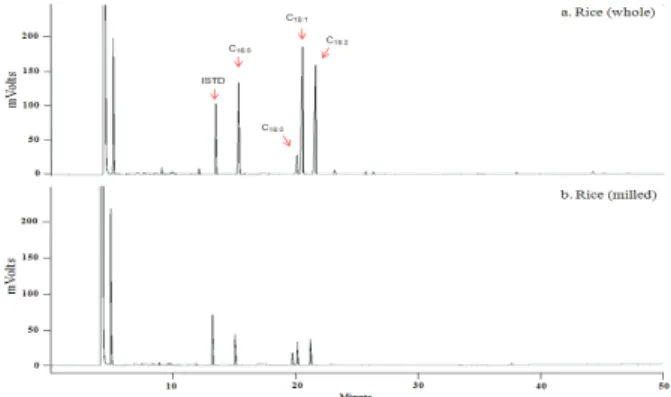
식물체에 주로 존재하는 지방산의 형태는 palmitic acid, stearic acid, oleic acid, linoleic acid, linolenic acid 등으 로 이 5가지 지방산이 주류를 이루며 표준품 및 시료에 대한 GC chromatogram은 Fig. 1과 2와 같다.
Fig. 1. GC chromatogram of the fatty acid standard solution.
(a), GC analysis of fatty acid methyl esters prepared from whole rice grain ; (b), GC analysis of fatty acid methyl esters prepared from milled rice grain.
Fig. 2. GC chromatogram of individual fatty acids extracted in rice grain.
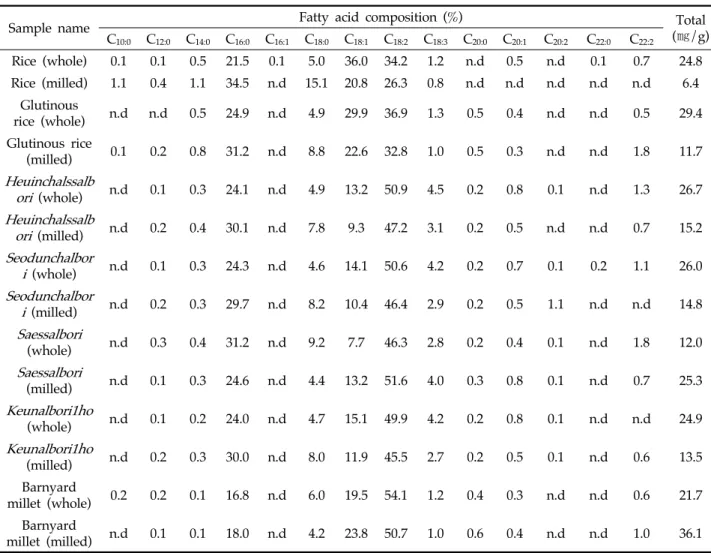
알곡과 도정곡의 전체 지방산 조성은 Table 1과 같으며 지방산의 조성비 분포는 전체적으로 보았을 때 0.01∼54.0%
범위의 분포를 보였다. 또한 알곡에서는 총지방산의 함량은 평균 23.6 ㎎/g 도정곡에서는 18.3 ㎎/g으로 겨에 함유된 지방산이 도정으로 인해 손실되어 지방산 총량이 감소된다는 사실을 알 수 있었다. 이러한 결과는 Lee 등(1988)의 현미의 총 지질함량은 2.33∼2.97%범위였고, 백미는 0.87∼1.36%
로 도정 전의 함량이 높다는 측면에서 유사했다.
Sample name Fatty acid composition (%) Total (㎎/g) C10:0 C12:0 C14:0 C16:0 C16:1 C18:0 C18:1 C18:2 C18:3 C20:0 C20:1 C20:2 C22:0 C22:2
Rice (whole) 0.1 0.1 0.5 21.5 0.1 5.0 36.0 34.2 1.2 n.d 0.5 n.d 0.1 0.7 24.8 Rice (milled) 1.1 0.4 1.1 34.5 n.d 15.1 20.8 26.3 0.8 n.d n.d n.d n.d n.d 6.4
Glutinous
rice (whole) n.d n.d 0.5 24.9 n.d 4.9 29.9 36.9 1.3 0.5 0.4 n.d n.d 0.5 29.4 Glutinous rice
(milled) 0.1 0.2 0.8 31.2 n.d 8.8 22.6 32.8 1.0 0.5 0.3 n.d n.d 1.8 11.7
Heuinchalssalb
ori
(whole) n.d 0.1 0.3 24.1 n.d 4.9 13.2 50.9 4.5 0.2 0.8 0.1 n.d 1.3 26.7Heuinchalssalb
ori
(milled) n.d 0.2 0.4 30.1 n.d 7.8 9.3 47.2 3.1 0.2 0.5 n.d n.d 0.7 15.2Seodunchalbor
i
(whole) n.d 0.1 0.3 24.3 n.d 4.6 14.1 50.6 4.2 0.2 0.7 0.1 0.2 1.1 26.0Seodunchalbor
i
(milled) n.d 0.2 0.3 29.7 n.d 8.2 10.4 46.4 2.9 0.2 0.5 1.1 n.d n.d 14.8Saessalbori
(whole) n.d 0.3 0.4 31.2 n.d 9.2 7.7 46.3 2.8 0.2 0.4 0.1 n.d 1.8 12.0
Saessalbori
(milled) n.d 0.1 0.3 24.6 n.d 4.4 13.2 51.6 4.0 0.3 0.8 0.1 n.d 0.7 25.3
Keunalbori1ho
(whole) n.d 0.1 0.2 24.0 n.d 4.7 15.1 49.9 4.2 0.2 0.8 0.1 n.d n.d 24.9
Keunalbori1ho
(milled) n.d 0.2 0.3 30.0 n.d 8.0 11.9 45.5 2.7 0.2 0.5 0.1 n.d 0.6 13.5
Barnyard
millet (whole) 0.2 0.2 0.1 16.8 n.d 6.0 19.5 54.1 1.2 0.4 0.3 n.d n.d 0.6 21.7 Barnyard
millet (milled) n.d 0.1 0.1 18.0 n.d 4.2 23.8 50.7 1.0 0.6 0.4 n.d n.d 1.0 36.1 n.d. : not dectected
Table 1. Compositions of fatty acids in whole and milled grains.
도정곡과 알곡의 포화지방산량과 불포화지방산은 Table 2와 같은 결과를 보였다. 포화지방산은 도정곡에서 더 높은 함량을 보였고, 불포화지방산은 알곡에서 더 높은 함량을 보였다. 이것은 알곡상태의 곡류가 도정으로 인해 겨와 같은 부분이 깎여나가서 불포화지방산이 손실되었던 것으로 생각된다. Lugay와 Juliano (Lugay et. al., 1964)는 쌀겨의 지방질은 백미의 지방질에 비해 linoleic acid, linolenic acid의 함량이 높은 반면에 palmitic acid와 palmitoleic acid의 함량이 낮다고 보고하였다.
Sample name
Fatty acid (%) Saturated fatty
acid; SFA
Unsaturated fatty acid
Rice (whole) 27.2 72.8
Rice (milled) 52.1 47.9
Glutinous rice
(whole) 30.9 69.1
Glutinous rice
(milled) 41.5 58.5
Table 2. Comparisons of saturated and unsaturated fatty acid compositions in whole and milled grains
Heuinchalssalbor
i
(whole) 29.6 72.8Heuinchalssalbor
i
(milled) 38.7 61.3Seodunchalbori
(whole) 29.6 70.4
Seodunchalbori
(milled) 38.7 61.3
Saessalbori
(whole) 41.2 58.8
Saessalbori
(milled) 29.7 70.3
Keunalbori1ho
(whole) 29.3 70.7
Keunalbori1ho
(milled) 38.8 61.2
Barnyard millet
(whole) 23.8 76.2
Barnyard millet
(milled) 23.1 76.9
곡류시료의 주요 구성 지방산은 palmitic acid, oleic acid, linoleic acid였으며 그 중에서 linoleic acid의 함량이 44.5%로 가장 높고 palmitic acid 26.1%, oleic acid 17.7%
의 순으로 총 지방산의 약 89%를 차지하고 있었다. 이상과 같은 결과는 Choe 등(2005)의 연구에서 밀의 지방산 조성 순서(linoleic acid 33∼46%, palmitic acid 25∼32%, oleic acid 20∼26%)와 일치하는 경향을 보여주었으나, Kim 등 (2004)이 보고한 쌀의 도정정도에 따른 주요 지방산의 조성 이 linoleic acid (39.58∼42.22%) oleic acid (34.04∼
36.62%) palmitic acid (22.06∼25.76%) 라는 결과와는 oleic acid함량에서 다소 차이가 있었다.
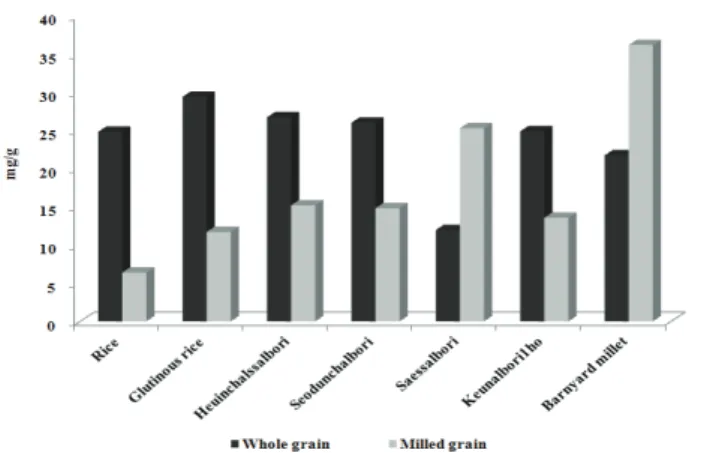
한편, Fig. 3에서 총 지방산량의 결과를 제시하였다. 시료 의 대부분에서 총 지방산량이 알곡이 더 많은 것에 비해 새쌀 보리와 피에서는 이와 반대로 도정곡이 더 많은 것이 특이한 점으로 보였다. 같은 보리라고 해도 이와 같이 특정 품종에서 만 지방산 조성에 차이가 나는 것은 보리의 외층과 배유 부분 의 지방산 분포가 품종별로 차이가 있기 때문이라고 사료된 다. 즉 곡류 내 구조의 차이라 할 수 있다. 이것은 이미 Choe 등(2002)에 의한 쌀의 품종별 백미와 현미의 지방산 분석 결 과에서도 현미일 때 추청 품종일 경우 포화지방산이 24.25%, 불포화지방산이 73.25%였으나 도정 후 백미에서는 품종별로 포화 지방산이 19.03%, 불포화지방산이 77.30%로 특히 포화 지방산과 불포화 지방산간의 조성에 차이가 많았으며 조지방 함량도 백미의 특정 품종(화성, 일품)에서 차이가 크게 나타 났다고 보고된 바 있다. 또 지방산 함량에 대한 비교 외에도 다른 성분을 비교했을 때 Sullivan 등(2010)의 실험에서 β -glucan의 함량이 알곡에서 100 g당 3.09 g인데 비해 도정 곡에서는 100g당 3.49g으로 알곡에서 더 높은 성분함량을 보 여 본 실험의 새쌀보리와 피의 총 지방산량의 경향과 유사한 결과를 나타내었다. 그리고 새쌀보리를 70∼100%로 5%씩 정맥한 Park 등(1989)의 보고에서도 쌀보리 (100%)에서 단 백질은 9.93%, 지방은 2.03%, 회분은 1.72%, 각 무기질 함 량이 가장 높은데 비해 정맥수율 70%일 때 단백질은 8.63%, 지방은 1.09%, 회분은 0.86%, 무기질 함량이 가장 낮아 도정 별로 성분함량이 달라진다는 측면에서 같은 경향이었다.
이러한 결과에 관해서는 향후 곡류의 구조별로 지방산 조 성에 대한 추가 연구가 필요하다고 생각된다.
Fig. 3. Total fatty acid in whole and milled grains.
요 약
곡류의 도정별 지방산 함량을 분석, 비교하였다. 지방산의 조성비는 시료 전체에서 0.01∼54.0%범위의 분포를 보였다.
알곡에서는 총 지방산의 함량은 평균적으로 알곡에서는 23.6
㎎/g, 도정곡에서는 18.3 ㎎/g인 것으로 나타났다. 포화지 방산은 대체적으로 일부 시료를 제외하고는 도정곡보다 알곡 에서 더 높은 경향을 보였으며, 반대로 불포화지방산은 알곡 보다 도정곡에서 더 높은 경향을 보였다. 포화지방산량과 불 포화지방산량을 비교 시 거의 모든 시료에서 불포화 지방산 이 더 많은 비율을 차지하고 있었다.
총 지질의 지방산 조성은 linoleic acid가 44.5%로 가장 높았고, 다음이 palmitic acid로 26.1%, 그리고 oleic acid 가 17.7%를 차지했다. 이 세 가지 지방산은 총 지방산량의 약 89%를 차지하고 있었다. 총 지방산량은 대부분의 시료에 서 알곡이 도정곡보다 더 높은 반면, 새쌀보리와 피에서는 도 정곡에서 더 높게 나타났다.
감사의 글
This study was carried out with the support of
“Research Program for Agricultural Science & Technology Development (Project No. PJ006488)”, National Academy of Agricultural Science, Rural Development Administration, Republic of Korea.
참고문헌