Print ISSN: 2288-4637 / Online ISSN 2288-4645 doi:10.13106/jafeb.2020.vol7.no11.967
The Effect of Service Quality and Value of Five-Star Hotel Services on Behavioral Intentions with the Role of Consumer Satisfaction as Mediator
Vasco Adato H. GOELTOM
1, Yustisia KRISTIANA
2, J. JULIANA
3, Innocentius BERNATO
4, Rudy PRAMONO
5Received: August 01, 2020 Revised: October 05, 2020 Accepted: October 15, 2020
Abstract
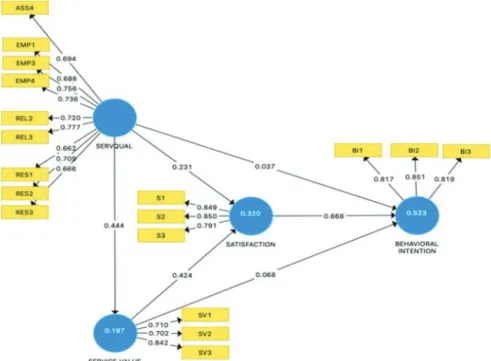
This study aims to improve knowledge of consumers’ decision-making by testing a conceptual model that considers the hotel’s service quality and service value toward customers’ behavioral intentions using a mediator, which is the role of consumers’ satisfaction. The object of this research is five-star hotels, which has become a significant segment of the general hotel industry and is undergoing rapid expansion.
This research is a quantitative research using questionnaire as the sampling method answered by people who have stayed at five-star hotels before. The total of 150 valid respondents were used in this study. The collected data was processed by a statistical tool software, Partial Least Square (PLS). The major findings of this research showed that the relations between service quality and service value of five-star hotels do not have significant positive impact on consumers’ behavioral intention, nonetheless the mediation analysis shows that customers’
satisfaction partially mediates service quality and service value with consumers’ behavioral intentions to stay. It means that in this case, consumers’ satisfaction has an important role to mediate service value quality and service value. As a result, the study shows that four out of six hypotheses are supported. A couple of recommendations are suggested for further research.
Keywords: Hotel Service, Service Quality, Service Value, Customer Satisfaction, Behavioral Intention JEL Classification Code: L00, L83, Z31
Ozment, 1994; Mulyono et al., 2020). Providing excellent services to consumers is very important for the viability of hotels, so it is necessary to understand what consumers expect from their services. Therefore, behavioral intention is key for hotel management to ascertain whether customer would deal with the firm itself (Tran, 2020).
The hotel is a company that provides accommodations that give guests ‘home’ when away from their homes. Now, five-star hotels are very important in any economy because most international tourists and well-known domestic tourists stay at this hotel. The attractiveness of Indonesian tourism encourages many foreign and domestic players to set up their operational facilities in the country. Therefore, all hotels need to make sure customer satisfaction through providing high quality services to their guests meet their financial and strategic goals. Providing high quality services to guests is very important for the survival of the hotel. Improving employee performance is one of the most important and productive ways for hotels to stay competitive.
On the other hand, given that providing quality service and satisfying consumers has become the purpose of the service provide, service quality and customer satisfaction need to be investigated to find out where the hotel is located
1. Introduction
Quality of service, consumer satisfaction, and loyalty in the hotel business are main principles for building a long-term relationship between customer and organization. However, service quality conditions affect the company’s competitive advantage by maintaining customer protection, and with this, emerging market contribution (Park et al., 2004; Morash &
1
First Author. Pelita Harapan University, Indonesia.
Email: [email protected]
2
Pelita Harapan University Indonesia.
Email: [email protected]
3
Pelita Harapan University, Indonesia. Email: [email protected]
4
Pelita Harapan University, Indonesia.
Email: [email protected]
5
Corresponding Author. Lecturer, Pelita Harapan University, Indonesia [Postal Address: MH Thamrin Boulevard 1100, Klp. Dua, Kec. Klp. Dua, Tangerang, Banten 15811, Indonesia]
Email: [email protected]
© Copyright: The Author(s)
This is an Open Access article distributed under the terms of the Creative Commons Attribution Non-Commercial License (https://creativecommons.org/licenses/by-nc/4.0/) which permits unrestricted non-commercial use, distribution, and reproduction in any medium, provided the original work is properly cited.