• 검색 결과가 없습니다.

Static or Dynamic Capital Structure Policy Behavior: Empirical Evidence from Indonesia

N/A
N/A
Protected

Academic year: 2021

Share "Static or Dynamic Capital Structure Policy Behavior: Empirical Evidence from Indonesia"

Copied!
9
0
0

로드 중.... (전체 텍스트 보기)

전체 글

(1)

Print ISSN: 2288-4637 / Online ISSN 2288-4645 doi:10.13106/jafeb.2021.vol8.no1.071

Static or Dynamic Capital Structure Policy Behavior: Empirical Evidence from Indonesia

Elok Sri UTAMI

1

, Tatang Ary GUMANTI

2

, Bambang SUBROTO

3

, Umrotul KHASANAH

4

Received: September 30, 2020 Revised: November 22, 2020 Accepted: December 05, 2020

Abstract

This study investigates the capital structure policy among Indonesian public companies. Previous studies suggest that capital structure policy could follow either static or dynamic behavior. The sample data used in this study was companies in the manufacturing sector, divided into three sub-sectors: the basic and chemical industry, miscellaneous industry, and the consumer goods industry. This study uses panel data from 2010 to 2018, with the Generalized Least Square (GLS) method and compared whether the fixed effect model is better than the common effect model. The results show that the dynamic and non-linear model tests can explain the capital structure determinants than the static and linear models. The dynamic model shows that the capital structure of a certain year is influenced by the capital structure of the previous year. The findings indicate that the company performs some adjustments in its capital structure policy by referring to the previous debt ratio, which implies support to the trade-off theory (TOT). The study also shows that profitability, tangible assets, size, and age explain the variation of capital structure policy. The patterns on the dynamic and non-linear confirm that capital structure runs in a non- linear pattern, based on the sector, company condition, and the dynamic environment.

Keywords: Capital Structure, Static, Dynamic, Linear, Non-Linear JEL Classification Code: G30, G32, O16

value while minimizing its capital cost. The source of funding can be fulfilled from the internal source such as retained earnings and external sources in the form of debt and equity. Each of the funding sources causes burdens, where the retained earnings and equity burdens are equal to the opportunity costs while the debts cause burdens in the form of interest which can be protected by tax saving. The literature suggests that two major theories explain the capital structure - the pecking order theory (POT) and the trade-off theory (TOT).

POT states that the cost of financing increases with asymmetric information. This theory states that a company should finance itself first internally through ‘retained earnings’. If this source of financing is unavailable, a company should then finance itself through ‘debt’. Finally, and as a last resort, a company should finance itself through the ‘issuing of new equity’ (Myers & Majluf, 1984). TOT states that the company chooses its source of funding based on the targeted capital structure or optimum capital structure, by balancing the benefit and risk. That is, the TOT of capital structure is the idea that a company chooses how much debt finance and how much equity finance to use by balancing the costs and benefits. Therefore the company will consciously

1

First Author and Corresponding Author. Associate Professor, Department of Management, Faculty of Economics and Business, Universitas Jember, Indonesia [Postal Address: Kampus Tegalboto, Jl. Kalimantan No.37, Kabupaten Jember, Jawa Timur 68121, Indonesia] Email: [email protected]

2

Professor, Department of Management, Faculty of Economics and Business, Universitas Bhayangkara Jakarta Raya, Indonesia.

Email: [email protected]

3

Professor, Department of Accounting, Faculty of Economics and Business, Universitas Brawijaya, Indonesia. Email: [email protected]

4

Associate Professor, Department of Management, Faculty of Economics, Universitas Islam Negeri (UIN) Maulana Malik Ibrahim Malang, Indonesia. Email: [email protected]

© Copyright: The Author(s)

This is an Open Access article distributed under the terms of the Creative Commons Attribution Non-Commercial License (https://creativecommons.org/licenses/by-nc/4.0/) which permits unrestricted non-commercial use, distribution, and reproduction in any medium, provided the original work is properly cited.

1. Introduction

Funding policy or often called capital structure policy plays an important role in creating company value and determining the long-term debt composition and equity. The

‘optimal capital structure’ of a firm is the best combination

of debt and equity financing that maximizes a firm’s market

(2)

maintain the optimum capital structure which can maximize the company value.

Since the mid-’90s, there have been many studies testing the leverage determinants with a proxy for leverage, such as the influence of profitability, liquidity, collateral in the form of fixed assets, growth probability, tax, and risk factors (income volatility). Other determinants are treated as control variables since this factor can also trigger the fixed cost (FC) and the macro-economic factor which can also be considered within the funding policy.

Previous studies examining capital structure show inconsistent results either in developed or developing countries. There have been several studies conducted on the capital structure that considered the influence of different factors such as management, industrial dynamics, capital market condition, economy, government regulation, and social trend on the capital structure of a company. Based on previous related studies, this study tries to re-test the capital structure determinants by focusing on companies in the manufacturing sector in Indonesia. This sector plays an important role in driving economic development in Indonesia because it has the maximum number of companies listed on the Indonesian Stock Exchange (IDX) and is the biggest contribution to the GDP and income tax in Indonesia.

As per the report of the United Nations Statistics Division (UNSD), the Indonesian manufacturing sector was placed fourth among 15 countries in the world and contributed to more than 10 percent of Gross Domestic Product (GDP) in the year 2016. GDP is the standard measure of the value- added created through the production of goods and services in a country during a certain period. Indonesia contributed 22 percent of the country’s GDP after South Korea with 29 percent, China 27 percent, and Germany 23 percent.

However, in 2018 there was a decline in the manufacturing sector’s contribution to GDP from 22 percent to 19.86 percent or IDR 2,950 trillion (www.kemenperin.go.id).

Besides being the biggest contributor to the national GDP, the manufacturing industry is also the highest corporate taxpayer with a contribution of IDR 596.89 trillion (www.

ekonomi.kompas.com, 2018)

The manufacturing industry also has stable growth as per the Purchasing Manager Index (PMI) indicator. Based on the annual report of Bank Indonesia in 2018, the manufacturing industry was in the expansion phase and data showed that the manufacturing PMI was 51.2 points, surpassing market expectations of 50 points. This shows that the manufacturing company is expanding driven by the domestic or export market demands. Considering the rapid expansion condu- cted by a company and the higher competitiveness in incre- asing the company’s value, a company will surely need an additional source of funding which causes new problems related to the funding. The needs of funding can be fulfilled by the internal source in the form of retained earnings or

the external source in the form of creditors, investors, and issuing debt or equity.

Based on the conditions above, this study has two aims.

First, it investigates the determinants of capital structure.

Second, it tests the dynamic model to answer whether the capital structure decision is influenced by profitability, non- debt tax shields, liquidity, earnings volatility, tangible assets, company growth, and the control variables. The findings of this research indicate that the determinants of the capital structure of manufacturing companies in Indonesia move dynamically. This is evident since the level of debt in the previous year affected the current level of debt. Capital structure is also influenced by profitability and non-debt tax shields, company size, and market capitalization.

The paper is structured as follows. Section two discusses the literature on the issue of the dynamism of the capital structure and hypotheses development. Section three presents the research methodology with econometric models and data. Section four explains the results of the analysis and discussion. The final section concludes this paper.

2. Literature Review and Hypotheses

The empirical studies on capital structure with a proxy for the level of debt have been done by examining the level of debt in a company, which will lead to optimal debt (Booth et al., 2001; De Jong, Kabir, & Nguyen, 2008; Rajan

& Zingales, 1995). In the framework of the static capital structure concept, there are weaknesses because the use of debt as optimal debt is not always the case. The level of debt will vary from time to time; therefore, there is a dynamic level of debt. The capital structure may not exactly correspond to the target. The theory states that the capital structure behaves dynamically and will adjust to debt targets in the long run, with a certain speed of adjustment (Jalilvand

& Harris, 1984).

Three major theories emerged over the years following the assumption of the perfect capital market of capital structure irrelevance model. TOT assumes that firms have one optimal debt ratio and the firm trades off the benefit and cost of debt and equity financing. POT assumes that firms following a financing hierarchy minimizes the problem of information asymmetry. However, neither of these two theories provide a complete description of why some firms prefer debt and others prefer equity finance under different circumstances (Myers, 1984)

Gaud et al. (2005) analyzed the determinants of the capital structure for a panel of 104 Swiss companies listed in the Swiss stock exchange. They found that the companies’

size, the significance of tangible assets, and business risk

are positively related to leverage, while profitability and

growth are negatively related to leverage. This indicates that

both the POT and TOT explain the capital structure of the

(3)

companies, though more evidence exists to validate the latter theory. Their analysis also showed that firms adjust toward a target debt ratio; however, the adjustment process is much slower than in most other countries.

Flannery and Rangan (2006) considered a new aspect in the literature on the capital structure that relates financial constraints to the speed of adjustment to a target debt ratio.

They examined the speed of capital structure adjustment toward the target level and finds the costs and benefits of rebalancing are significant determinants of the observed adjustment process. They presented a theory of capital structure adjustment speed and model the main factors in this process with a modified partial adjustment model.

Getzmann, Lang, and Spremann (2014) tested relationships that are typical of the TOT and the POT and analyzed the speed of adjustment toward target capital structures for companies from different industrial sectors and listed on the Asian stock exchanges. They found evidence that companies in Asia pursue target capital structures, as predicted by the TOT. Only in one respect does the POT demonstrate superior explanatory power. They further showed that the convergence to target capital structures is consistent with international evidence, estimated at an annual adjustment speed of 24–45% of original leverage levels.

2.1. Profitability and Capital Structure

POT states that higher profitability of the company means higher the retained earnings potential to be the internal source of funding such that the company debts will be lower (Baskin, 1989; Nguyen & Tran, 2020; Rajan

& Zingales, 1995; Rani, Yadav, & Tripathy, 2019; Titman

& Wessels, 1988; Vu et al., 2020). On the other hand, the TOT states that higher company profit means higher debts with tax-saving which could be enjoyed by the company.

Several studies found the positive influence of profitability on the leverage level (Bradley, Jarrell, & Kim, 1984). The profitability variable is measured using Return on Assets (ROA) and Return on Equity (ROE). According to the POT, profit has a negative influence on debt, while according to the TOT, profit has a positive influence on debt. Thus, the following hypothesis is proposed.

H1: Profitability influences debt.

2.2. Non-Debt Tax Shields (NDTS) and Capital Structure

TOT predicts the negative relationship between NDTS and leverage (Bradley et al., 1984; Cortez & Susanto, 2012; De Jong, Kabir, & Nguyen, 2008; Memon, Rus, &

Ghazali, 2015; Rani et al., 2019). Titman and Wessels (1988) presented a model of optimal capital structure that

integrates the influence of corporate and personal taxes and NDTS. They argued that tax deductions for investment tax credits and depreciation are substitutes for the tax benefits of debt financing. Therefore, a firm with large NDTS compared with their expected cash flow include less debt in its capital structure. Indonesia provides tax reduction facility to the company as stated in Article 6 Law no. 36 of 2008, concerning the costs which can reduce the gross income such as reduced cost expense (for the tangible property) or amortization (for the intangible property) on the asset which has a more than one year of useful life. A company with a higher NDTS amount will reduce the external source of funding from debt. Indicators of NDTS include the ratios of investment tax credits over total assets, depreciation over total assets (D/TA), and a direct estimate of NDTS over total assets. Several researchers used the depreciation over total assets ratio to measure NDTS. Consistent with the expectation, the proposed hypothesis is:

H2: Non-Debt Tax Shield has a negative influence on debt 2.3. Liquidity (LIQ) and Capital Structure

POT explains that a company with high liquid assets will probably use the assets to fund the investment such that the higher liquidity means the lower debt (Ozkan, 2011). On other hand, the TOT states that a company with a higher liquidity ratio will choose a higher debt ratio due to its ability to pay short-term liabilities. Liquidity ratios measure a company’s ability to pay short-term obligations of one year or less. This variable is measured by dividing the liquid assets and liquid debt (LIQ) (Handoo & Sharma, 2014). According to the POT, liquidity has a negative influence on debt, while according to the TOT, liquidity has a positive influence on debt. Accordingly, the following hypothesis is tested:

H3: Liquidity influences debt

2.4. Earnings Volatility (EVOL) and Capital Structure

The POT and TOT suggest that earnings volatility has

a negative relationship with debt. The higher earnings

volatility (profit or income) means the higher uncertainty of

cash flow on investment. Earnings volatility can be defined

as a business risk. The higher business risk means a higher

desire of the company not to use the debt since the use of

debts will cause interest which causes financial distress

even the possibility of bankruptcy. Several studies found a

negative relationship between earnings volatility and debt

such as Bradley et al. (1984), De Jong, Kabir, and Nguyen

(2008), and Koksal and Orman (2015). This variable, that is,

the effect of earnings volatility is measured by the standard

(4)

deviation of earnings before interest, taxes, depreciation, and amortization (EBITDA) on the cost of debt. The proposed hypothesis is:

H4: Earnings volatility has a negative influence on debt.

2.5. Tangible Assets (TA) and Capital Structure Both the POT and TOT argue that tangible assets have a positive influence on debts. Higher tangible assets mean it is easier for the company to obtain external fund loans since the tangible assets can be used as collateral (TG) (Kabeer & Rafique, 2018; Nguyen & Tran, 2020; Rehman, Wang, & Yu, 2016). Several studies used this measurement (Carpentier & Suret, 1999). This variable is measured as the ratio of tangible assets (plant and equipment, property) in the t period with tangible assets of the t-1 period.

H5: The tangible assets has a positive influence on capital structure

2.6. The Relationship of Company Growth (GO) and Capital Structure

POT advocates that a company with higher growth will have a higher debt to fund growth. It means company growth has a positive influence on debt (Dinh & Pham, 2020;

Nguyen & Tran, 2020; Vu et al., 2020). On the other hand, the TOT argued that a company with higher growth will have lower debt to avoid the possibility of financial distress. There are several ways to measure company growth. Growth is the ratio of total assets change in period t with total assets t-1 (Titman & Wessels, 1988). The idea above leads to propose the following hypothesis:

H6: Company growth influences debt 2.7. Control Variables

This study uses several control variables which will possibly explain the relationship with the dependent variable.

Size is to see how the company provides collateral to their use of debts (Koksal & Orman, 2015; Memon et al., 2015).

The size of the company is measured by 1n. total assets.

The age of the company is used as the company’s ability to sustain.

3. Research Methods and Materials 3.1. Econometric Model

This study used two econometric approaches; Linear and Non-Linear to explain the capital structure determinant. Data used was the panel data, to make the estimation result becomes

Best Linear Unbiased Estimation (BLUE). “Best” refers to the minimum variance or the narrowest sampling distribution.

Gauss–Markov theorem states that the ordinary least squares (OLS) estimator has the lowest sampling variance within the class of linear unbiased estimators, if the errors in the linear regression model are uncorrelated, have equal variances, and the expectation value of zero. Autocorrelation refers to the degree of correlation between the values of the same variables across different observations in the data.

Autocorrelation occurs when the Gauss-Markov assumption of uncorrelated error terms is violated. Several researchers stated that if the number of companies is smaller than the amount of observation time, (time series) the random effect model is more suitable to use. Research conducted by Gaud et al. (2005) (2005) shows that capital structure is a dynamic process since the capital structure is the reflection of the funding policy which can be fulfilled through the previous year’s retained earnings and the previously existing debt. Model 1 Approach is the linear model.

Equation Model 1:

DERijt = α + b

1

ROA

ijt

+b

2

ROE

ijt

+ b

3

GO

ijt

+ b

4

TG

ijt

+ b

5

NDTS

ijt

+ b

6

EVOL

ijt

+ b

7

LIQ

ijt

+ b

8

SZ

ijt

+ b

9

Age

ijt

+ e

it

(1)

Where DER

ijt

is capital structure measured by the debt to equity ratio sector I, company j, at the time t, profitability by using two sizes, they are ROA

ijt

and ROE

ijt

, GO

ijt

is growth opportunities, TG

ijt

is collaterals, NDTS

ijt

is the non-debt shield, EVOL

ijt

is the earnings volatility, LIQ

ijt

is liquidity, SZ

ijt

is the natural algorithm of total assets, Age

ijt

is the amount of year, and MC

ijt

is Market Capitalization.

Equation Model 2. is the dynamic model equation to solve that static model with the fixed and random effect panel can still be biased since residual is correlated to the previous variable.

DER

ijt

= α + b

1

DER

ijt-1

+ b

1

ROA

ijt-2

+b

3

ROE

ijt-2

+ b

4

GO

ijt

+ b

5

TG

ijt

+ b

6

NDTS

ijt

+ b

7

EVOL

ijt

+ b

8

LIQ

ijt

+ b

9

SZ

ijt

+ b

10

Age

ijt

+ e

it

(2) Equation Model 3 is the non-linear approach with quadratic regression to test the relationship between profitability and debt.

1 2 3 2

4 2 5 6

7 8 9

10 11

ijt ijt ijt ijt

ijt ijt ijt

ijt ijt ijt

ijt ijt it

DER b ROA b ROE b ROA b ROE b GO b TG b NDTS b EVOL b LIQ b SZ b Age e

α

= + + +

+ + +

+ + +

+ + + (3)

(5)

Equation Model 4 is the non-linear (quadratic regression) with a dynamic concept.

1 1 1 2 3 2

2 2

4 5 6 7

8 9 10

11 11

ijt ijt ijt ijt

ijt ijt ijt ijt

ijt ijt ijt

ijt ijt it
DER b DER b ROA b ROE b ROA b ROE b GO b TG b NDTS b EVOL b LIQ b SZ b Age e

α

= + + +

+ + + +

+ + +

+ + + (4)

3.2. Data

The sample data in this study was 154 manufacturing companies comprising three sub-sectors such as 69 companies of the basic and chemical industry, 43 companies of the miscellaneous industry, and 42 companies of the consumer goods industry. This study used panel data from 2010 to 2018.

The sample was taken through purposive sampling with the criterion of the company which did not perform the corporate action (Listing, Relisting, Delisting, Right Issue, Stock Split, Tender Offer, Merger, Acquisition, Buyback). The research data was in the form of a financial report such as the balance sheet and the profit and loss statement of each company. The source of data was obtained from www.idx.co.id.

4. Analysis Result And Discussion 4.1. Multiple Linear Regression Analysis

Before performing multiple linear regression, all data were tested for normality using the Kolmogorov-Smirnov test. The outliers were removed to obtain normally distributed data.

4.1.1. Descriptive Statistics

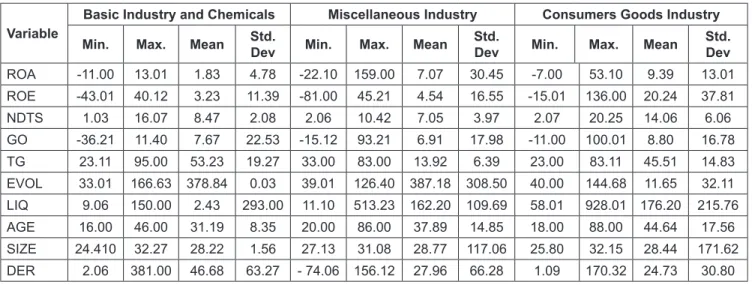
The descriptive statistic and research variables can be seen in Table 1.

In Table 1, the descriptive statistics show the mean value of profitability of the consumer goods industry is the highest compared to the two other sub-sectors. The ROA and ROE of the consumer goods industry are 9.39 and 20.24 respectively;

the ROA and ROE for the miscellaneous industry are 7.07 and 4.54 respectively, and the ROA and ROE for the basic and chemical industry are 1.83 and 3.23 respectively. This result showed that the consumer goods industry is more promising since it has a better return rate than the other two sub-sectors.

The tangible assets ratio showed that the basic and chemical industry has the highest mean value of 53.23 percent compared to the other two sub-sectors. The income volatility description showed that the average value of the basic and chemical industry is higher by 378.84 compared to the other two sub- sectors. This described that this sector has a higher risk. The companies’ sizes in the three sectors are similar.

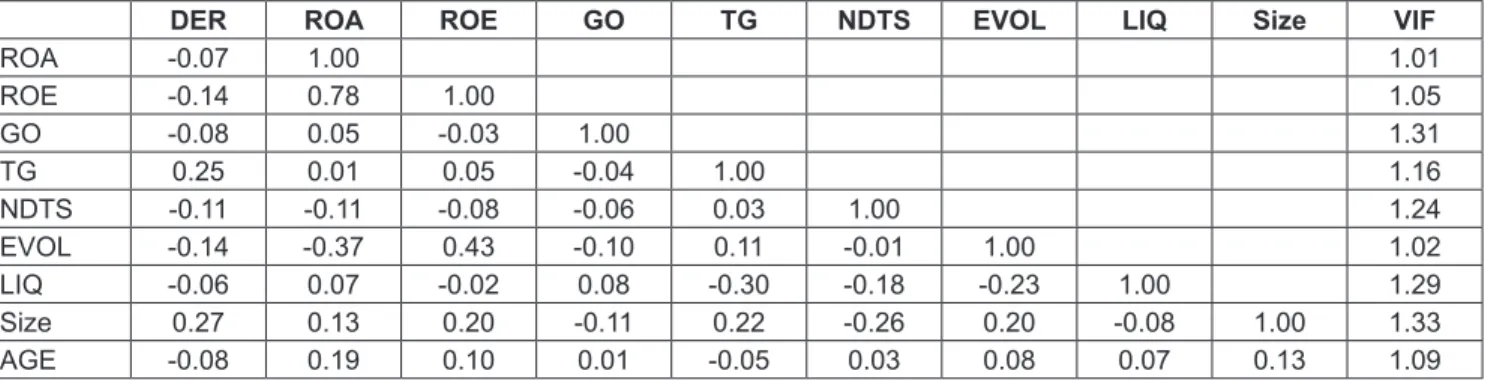
Table 2 is the correlation matrix of the variables which describes the relationship function among variables.

Leverage has a negative correlation with ROA, ROE, GO, NDTS, EVOL, LIQ, and AGE, while having a positive correlation with TG and SIZE. Profitability, ROA has a reverse correlation with NDTS and EVOL, while having a positive correlation with ROE, GO, TG, SIZE, LIQ, and AGE. ROE has a negative correlation with GO, NDTS, LIQ while having a positive correlation with TG, SIZE, EVOL, and AGE. GO has a reverse correlation with TG, EVOL, and SIZE. TG has a negative correlation with LIQ and AGE while having a positive correlation with NDTS, EVOL, and SIZE.

Table 1: Descriptive Statistic of Variables

Variable Basic Industry and Chemicals Miscellaneous Industry Consumers Goods Industry Min. Max. Mean Std.

Dev Min. Max. Mean Std.

Dev Min. Max. Mean Std.

Dev

ROA -11.00 13.01 1.83 4.78 -22.10 159.00 7.07 30.45 -7.00 53.10 9.39 13.01

ROE -43.01 40.12 3.23 11.39 -81.00 45.21 4.54 16.55 -15.01 136.00 20.24 37.81

NDTS 1.03 16.07 8.47 2.08 2.06 10.42 7.05 3.97 2.07 20.25 14.06 6.06

GO -36.21 11.40 7.67 22.53 -15.12 93.21 6.91 17.98 -11.00 100.01 8.80 16.78

TG 23.11 95.00 53.23 19.27 33.00 83.00 13.92 6.39 23.00 83.11 45.51 14.83

EVOL 33.01 166.63 378.84 0.03 39.01 126.40 387.18 308.50 40.00 144.68 11.65 32.11 LIQ 9.06 150.00 2.43 293.00 11.10 513.23 162.20 109.69 58.01 928.01 176.20 215.76

AGE 16.00 46.00 31.19 8.35 20.00 86.00 37.89 14.85 18.00 88.00 44.64 17.56

SIZE 24.410 32.27 28.22 1.56 27.13 31.08 28.77 117.06 25.80 32.15 28.44 171.62

DER 2.06 381.00 46.68 63.27 - 74.06 156.12 27.96 66.28 1.09 170.32 24.73 30.80

Note: ROA (Return on assets, ROE (return on equity), GO (growth opportunities), TG (Tangible), NDTS (non-debt tax shield), EVOL

(earnings volatility), LIQ (liquidity), SIZE (Ln. total assets), AGE (the year in operation), and DER (debt to equity ratio).

(6)

NDTS has a positive correlation with AGE while having a reverse correlation with EVOL, LIQ, and SIZE. EVOL has a positive correlation with SIZE and AGE. LIQ has a negative correlation with SIZE, and on the other hand, it has a positive correlation with AGE. Meanwhile, SIZE has a positive correlation with AGE. The correlation coefficient value above 0.8 indicates that those two variables have multicollinearity. In Table 4, the coefficient of ROA and ROE is 0.78 percent which means there was multicollinearity;

therefore, ROA is ruled out of this study.

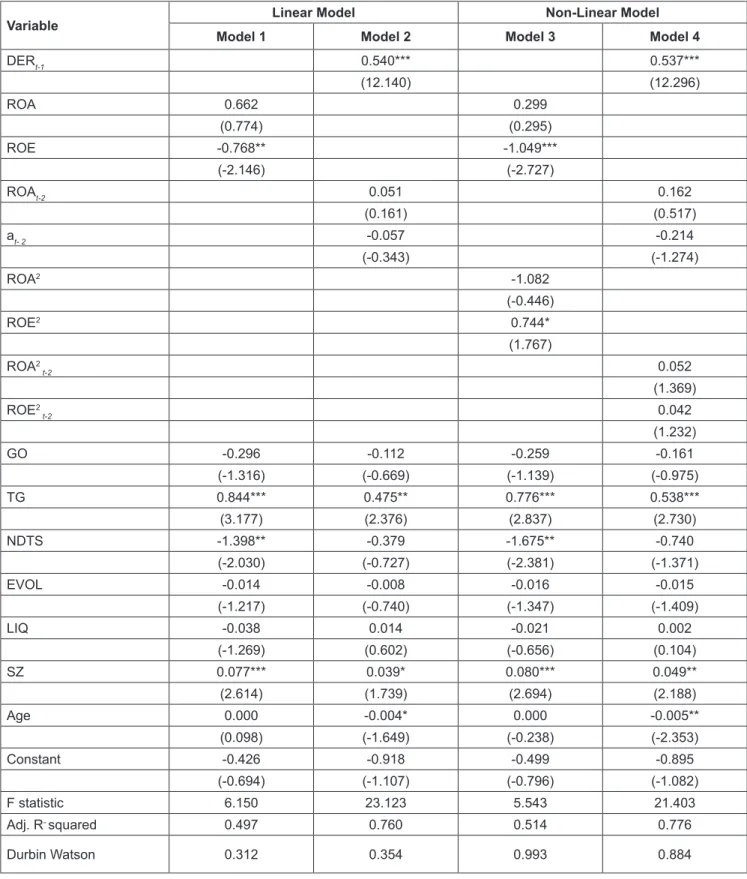
Determinants of capital structure are shown in Table 3, where the coefficient of DER

t-1

has a positive and significant direction at 1 percent (Model 2 and 4); this showed that the previous debt ratio influences the current leverage. This result is different from the finding of Rani et al. (2019), where the previous debt ratio has a negative influence on the current debt ratio. This result shows that the company adds to their debt due to the belief of profitable return, which is in line with the TOT, where the company will use the debt by considering the higher benefit of taking debt than its expense.

Profitability with ROE proxy has a negative influence on the debt ratio compared to the equity (models 1 and 3). This showed that higher profitability on equity means a lower debt ratio. This is in line with the POT since the profit will be the internal source of funding which will result in a low debt ratio. TG was found to be having a positive impact on debt and significant at 1% (models 1, 2, 3, and 4), which implied that higher TG means the creditor will give higher debt which is in line with POT (Myers, 1984). TG can also be used to decrease the risk; that creditors will give higher debt which is in line with the TOT (Jensen & Meckling, 1976).

Assessment Long term Debt to Equity: Study of relationship by different methods.

Company size is found to be having a positive and significant influence on the debt ratio, which showed the bigger size of a company will encourage them to take more debts; this was triggered not only by the belief in their huge assets but also the huge collateral as the result of having huge assets. This result is in line with the findings of Cempakasari, Firdaus, and Hardiyanto (2019), Kumar, Colombage, and Rao, (2017), and Rani et al. (2019). The company’s age has a negative significant

influence on Models 2 and 4 which explained that the longer the age of a company means the lower the debt ratio. A company that has been operating for a long time has greater retained earnings that will reduce the external source of funding. This is in line with the philosophy of POT, where the company prefers the internal source of funding (Myers & Majluf, 1984).

The simultaneous test results show that on the static model (models 1 and 3), the debt ratio determinant is profitability, GO, TG, NDTS, EVOL, LIQ, SIZE, and AG.

In the same year, the static model (quadratic) showed R Square was 49,7% (Model 1) and 51,4% (Model 3) which were lower than the dynamic model with R Square of 76%

(Model 2) and 77,6% (Model 4). This result clarifies that the dynamic model can explain that the capital structure policy runs dynamically; the adjustment is not static but the process showed some of the leverage levels runs in a non-linear way, and this result is supported by model 4.

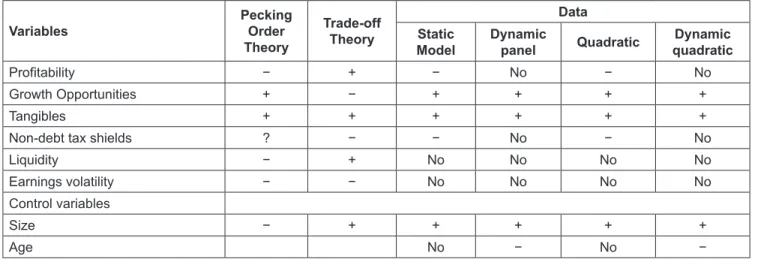
Panel data tests suggest that the fixed effect can explain the random effect and the common effect. This explains that the intercept of each individual is different but the slope between the individuals is the same. The summary of the test results of the two capital structure theories, POT and TOT, is shown in Table 4.

As shown in Table 4, the results on the manufacturing sector in Indonesia show that POT was better in explaining the debt ratio determinant in the form of variables such as profitability, growth opportunity, and collateral (tangible assets) which has significant influence, while the non-debt tax shield variable is considered in determining the leverage which reflects the TOT. The negative direction of the profitability implied the POT implementation which showed that this theory is completely relevant to the developing countries, while TOT more explains the capital structure decision in developed countries. For the growth opportunity variable, showing the positive direction also implied that a company with a significant growth will have a great number of debts to fund its growth. The research result of the capital structure explained that the decision taken did not purely refer to one of the theories, but runs consecutively, either the POT or TOT. Both take roles in each sector, company condition, financial environment, and country.

Table 2: Correlation Matrix and VIF Coefficients

DER ROA ROE GO TG NDTS EVOL LIQ Size VIF

ROA -0.07 1.00 1.01

ROE -0.14 0.78 1.00 1.05

GO -0.08 0.05 -0.03 1.00 1.31

TG 0.25 0.01 0.05 -0.04 1.00 1.16

NDTS -0.11 -0.11 -0.08 -0.06 0.03 1.00 1.24

EVOL -0.14 -0.37 0.43 -0.10 0.11 -0.01 1.00 1.02

LIQ -0.06 0.07 -0.02 0.08 -0.30 -0.18 -0.23 1.00 1.29

Size 0.27 0.13 0.20 -0.11 0.22 -0.26 0.20 -0.08 1.00 1.33

AGE -0.08 0.19 0.10 0.01 -0.05 0.03 0.08 0.07 0.13 1.09

(7)

Table 3: Pooling Data for Determinants of Long Term Debt to Equity (n=154)

Variable Linear Model Non-Linear Model

Model 1 Model 2 Model 3 Model 4

DER

t-1

0.540*** 0.537***

(12.140) (12.296)

ROA 0.662 0.299

(0.774) (0.295)

ROE -0.768** -1.049***

(-2.146) (-2.727)

ROA

t-2

0.051 0.162

(0.161) (0.517)

a

t- 2

-0.057 -0.214

(-0.343) (-1.274)

ROA

2

-1.082

(-0.446)

ROE

2

0.744*

(1.767)

ROA

2 t-2

0.052

(1.369)

ROE

2 t-2

0.042

(1.232)

GO -0.296 -0.112 -0.259 -0.161

(-1.316) (-0.669) (-1.139) (-0.975)

TG 0.844*** 0.475** 0.776*** 0.538***

(3.177) (2.376) (2.837) (2.730)

NDTS -1.398** -0.379 -1.675** -0.740

(-2.030) (-0.727) (-2.381) (-1.371)

EVOL -0.014 -0.008 -0.016 -0.015

(-1.217) (-0.740) (-1.347) (-1.409)

LIQ -0.038 0.014 -0.021 0.002

(-1.269) (0.602) (-0.656) (0.104)

SZ 0.077*** 0.039* 0.080*** 0.049**

(2.614) (1.739) (2.694) (2.188)

Age 0.000 -0.004* 0.000 -0.005**

(0.098) (-1.649) (-0.238) (-2.353)

Constant -0.426 -0.918 -0.499 -0.895

(-0.694) (-1.107) (-0.796) (-1.082)

F statistic 6.150 23.123 5.543 21.403

Adj. R

-

squared 0.497 0.760 0.514 0.776

Durbin Watson 0.312 0.354 0.993 0.884

Note: *, **, *** denote significant level at 10%, 5%, and 1%, respectively. The t-values are given in parentheses. Models 1 and 3 are the

regressions of the static concept, while models 2 and 4 are the regressions of the dynamic model.

(8)

5. Conclusion

This study investigates 154 public companies in the manufacturing industry listed on the IDX from 2010-2018.

The study uses static and dynamic approaches along with the linear and non-linear patterns. The results confirm that the dynamic and non-linear model tests can explain the capital structure determinants than the static and linear models.

The findings imply that the management always performs adjustment at a non-linear level in making the policy.

In the static and linear model, the policy pattern in Indonesia refers to the POT from the ROE on leverage, besides, TG, NDTS, SIZE, and MC. GO, EVOL, LIQ, and AGE have no influences. On the dynamic model, it shows that the leverage of period t is influenced by the leverage t-1.

It indicates that the company performs some adjustments in its capital structure policy by referring to the previous debt ratio, which implies the TOT. The patterns on the dynamic and non-linear show that capital structure runs in a non- linear pattern, based on the sector, company condition, and the dynamic environment.

References

Baskin, J. (1989). An empirical investigation of the pecking order hypothesis. Financial Management, 18(1), 26–35. https://doi.

org/10.2307/3665695

Booth, L., Aivazian, V., Demirguc-Kunt, A., & Maksimovic, V. (2001). The measurement and antecedents of affective, continuance, and normative commitment to the organization.

The Journal of Finance, 56(1), 87–130.

Bradley, M., Jarrell, G. A., & Kim, E. H. (1984). On the existence of an optimal capital structure: Theory and evidence. The Journal of Finance, 29(3), 857–878. https://doi.org/10.2307/2327950

Carpentier, J. M. S., & Suret, J. M. (1999). Financing strategies of French companies: An empirical analysis. CIRANO Working Papers 99s-09, CIRANO.

Cempakasari, E. P., Firdaus, M., & Hardiyanto, A. T. (2019).

Dynamics of the firm’s capital structure along the life cycle of Indonesian manufacturing firms. Indonesian Journal of Business and Entrepreneurship, 5(1), 21–31. https://doi.

org/10.17358/ijbe.5.1.21

Cortez, M. A., & Susanto, S. (2012). The determinants of corporate capital structure: Evidence from Japanese manufacturing companies. Journal of International Business Research, 11(3), 122–134. https://doi.org/10.1.1.1079.5738

De Jong, A., Kabir, R., & Nguyen, T. T. (2008). The capital structure around the world: The roles of firm- and country- specific determinants. Journal of Banking and Finance, 32(9), 1954–1969. https://doi.org/10.1016/j.jbankfin.2007.12.034 Dinh, H. T., & Pham, C. D. (2020). The effect of capital structure on

the financial performance of Vietnamese listing pharmaceutical enterprises. Journal of Asian Finance, Economics, and Business, 7(9), 329–340. https://doi.org/10.13106/jafeb.2020.

vol7.no9.329

Flannery, M. J., & Rangan, K. P. (2006). Partial adjustment toward target capital structures. Journal of Financial Economics, 79(3), 469–506. https://doi.org/10.1016/j.jfineco.2005.03.004 Gaud, P., Jani, E., Hoesli, M., & Bender, A. (2005). The capital

structure of Swiss companies: An empirical analysis using dynamic panel data. European Financial Management, 11(1), 51–69. https://doi.org/10.1111/j.1354-7798.2005.00275.x Getzmann, A., Lang, S., & Spremann, K. (2014). Target capital

structure and adjustment speed in Asia. Asia-Pacific Journal of Financial Studies, 43, 1–30. https://doi.org/10.1111/ajfs.12038 Handoo, A., & Sharma, K. (2014). A study on the determinants of

capital structure in India. IIMB Management Review, 26(3), 170–182. https://doi.org/10.1016/j.iimb.2014.07.009

Table 4: Comparison of the Pecking Order Theory and Trade-off Theory Tests

Variables Pecking

Order Theory

Trade-off Theory

Data Static

Model Dynamic

panel Quadratic Dynamic quadratic

Profitability − + − No − No

Growth Opportunities + − + + + +

Tangibles + + + + + +

Non-debt tax shields ? − − No − No

Liquidity − + No No No No

Earnings volatility − − No No No No

Control variables

Size − + + + + +

Age No − No −

(9)

Jalilvand, A., & Harris, R. S. (1984). Corporate Behavior in Adjusting to Capital Structure and Dividend Targets: An Econometric Study. The Journal of Finance, 39(1), 127–145.

https://doi.org/10.2307/2327672

Jensen, M. C., & Meckling, W. H. (1976). Theory of the firm:

Managerial behavior, agency costs, and ownership structure.

Journal of Financial Economics, 3, 305–360. https://doi.

org/10.1016/0304-405X(76)90026-X

Kabeer, M. A., & Rafique, S. (2018). The determinants of capital structure: Evidence from Pakistani manufacturing companies.

Journal of Banking and Finance Management, 74(294), 152–172.

Koksal, B., & Orman, C. (2015). Determinants of capital structure:

Evidence from a major developing economy. Small Business Economics, 44(2), 255–282. https://doi.org/10.1007/s11187- 014-9597-x

Kumar, S., Colombage, S., & Rao, P. (2017). Research on capital structure determinants: A review and future directions.

International Journal of Managerial Finance, 13(2), 106–132.

https://doi.org/10.1108/IJMF-09-2014-0135

Memon, P. A., Rus, D. R. B. M., & Ghazali, D. Z. B. (2015).

The dynamism of Capital Structure: Evidence from Pakistan.

Journal of International Business and Economics, 3(1), 52–63.

https://doi.org/10.15640/jibe.v3n1a7

Myers, S. C. (1984). The capital structure puzzle. The Journal of Finance, 39(3), 574–592. https://doi.

org/10.1111/j.1540-6261.1984.tb03646.x

Myers, S. C., & Majluf, N. S. (1984). Corporate financing and investment decisions when firms have information that investors do not have. Journal of Financial Economics, 13, 187–222. https://doi.org/10.1016/0304-405X(84)90023-0 Nguyen, N. M., & Tran, K. T. (2020). Factors affecting the capital

structure of the banks listed on the Iraqi Stock Exchange.

Journal of Asian Finance, Economics, and Business, 7(11), 689–698. https://doi.org/10.13106/jafeb.2020.vol7.

no11.689

Ozkan, N. (2011). CEO compensation and firm performance: An empirical investigation of UK panel data. European Financial Management, 17(2), 260–285. https://doi.org/10.1111/j.1468- 036X.2009.00511.x

Rajan, R. G., & Zingales, L. (1995). What do we know about capital structure? Some evidence from international data.

The Journal of Finance, 50(5), 1421–1460. https://doi.

org/10.2307/2329322

Rani, N., Yadav, S. S., & Tripathy, N. (2019). Capital structure dynamics of Indian corporates. Journal of Advances in Management Research, 17(2), 212–225. https://doi.

org/10.1108/JAMR-12-2017-0125

Rehman, A. U., Wang, M., & Yu, H. (2016). Dynamics of financial leverage across the firm life cycle in Chinese firms: An empirical investigation using a dynamic panel data model.

China Finance and Economic Review, 4(9), 1–22. https://doi.

org/10.1186/s40589-016-0041-z

Titman, S., & Wessels, R. (1988). The determinants of capital structure choice. The Journal of Finance, 43(1), 1–19. https://

doi.org/10.2307/2328319

Vu, T. M. T., Tran, C. Q., Doan, D. T., & Le, T. N. (2020).

Determinants of capital structure: The case in Vietnam. Journal of Asian Finance, Economics, and Business, 7(9), 159–168.

https://doi.org/10.13106/jafeb.2020.vol7.no9.159

www.ekonomi.kompas.com. (2018). The ministry of industry and manufacturing industry is the largest contributor to tax. Retrieved from https://ekonomi.kompas.com/

read/2018/01/09/211727326/kemenperin-industri-manufaktur-

penyumbang-pajak-terbesar

수치

Table 2 is the correlation matrix of the variables which  describes the relationship function among variables
Table 2: Correlation Matrix and VIF Coefficients
Table 3: Pooling Data for Determinants of Long Term Debt to Equity (n=154)
Table 4: Comparison of the Pecking Order Theory and Trade-off Theory Tests

참조

관련 문서

 Students needing additional information about grading policies and procedures should meet with their faculty advisor, Executive Director/Chairperson or a

For this study—our third on global workforce trends, follow- ing studies in 2014 and 2018—Boston Consulting Group and The Network surveyed some 209,000 people in 190 countries

Basic aspects of AUTOSAR architecture and methodology Safety mechanisms supported by AUTOSAR.. Technical safety concepts supported by AUTOSAR Relationship to ISO

GDP impact of COVID-19 spread, public health response, and economic policies. Virus spread and public

Micro- and nano-sized pores were formed on the surface of the alloy using PEO and anodization methods, and the pore shape change according to the Zr

그러나 우리나라를 포함한 많은 나라가 전력시장에 경쟁을 도입하고, 원전의 설계, 건설, 관련 기자재 및 핵연료 시장에도 경쟁을 도입함에 따라 경쟁과

Granger causality tests shaw that agriculture and transport storage industry are affected loan but the loan of restaurants and hotel industry and

The resolved-rate control method [9] is based on the manipulator velocity equation kX = kje where kj is the Jacobian matrix, e is the vector of relative joint rates, kX is the