Veterinary Science
http://dx.doi.org/10.4142/jvs.2013.14.3.291
Received: 6 Feb. 2012, Revised: 28 Aug. 2012, Accepted: 23 Oct. 2012
Original Article
*Corresponding author: Tel: +82-31-467-1821; Fax: +82-31-467-1814; E-mail: [email protected]
†Present address: Food Standard Division, Ministry of Food and Drug Safety, Osong 363-700, Korea
ⓒ 2013 The Korean Society of Veterinary Science.
This is an Open Access article distributed under the terms of the Creative Commons Attribution Non-Commercial License (http://creativecommons.org/licenses/by-nc/3.0) which permits
unrestricted non-commercial use, distribution, and reproduction in any medium, provided the original work is properly cited.
Preparation and diagnostic utility of a hemagglutination inhibition test antigen derived from the baculovirus-expressed
hemagglutinin-neuraminidase protein gene of Newcastle disease virus
Kang-Seuk Choi*, Soo-Jeong Kye, Woo-Jin Jeon
†, Mi-Ja Park, Saeromi Kim, Hee-Jung Seul, Jun-Hun Kwon Avian Diseases Division, Animal and Plant Quarantine Agency, Anyang 430-757, Korea
A recombinant hemagglutinin-neuraminidase (rHN) protein from Newcastle disease virus (NDV) with hemagglutination (HA) activity was expressed in Spodoptera frugiperda cells using a baculovirus expression system. The rHN protein extracted from infected cells was used as an antigen in a hemagglutination inhibition (HI) test for the detection and titration of NDV-specific antibodies present in chicken sera.
The rHN antigen produced high HA titers of 2
13 per 25 μL, which were similar to those of the NDV antigen produced using chicken eggs, and it remained stable without significant loss of the HA activity for at least 12 weeks at 4
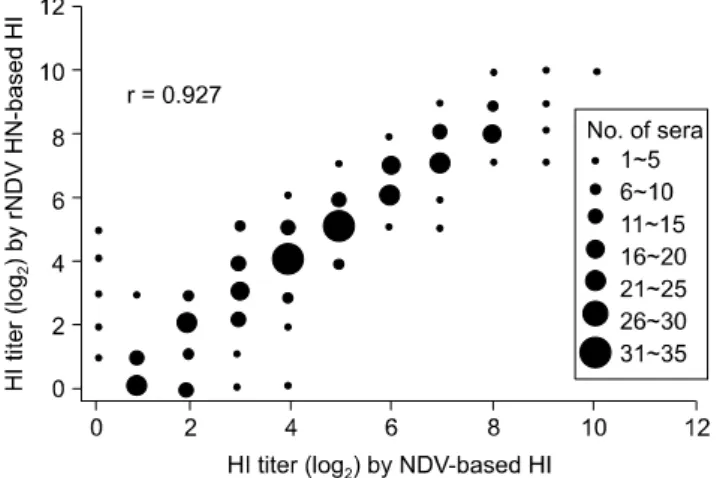
oC. The rHN-based HI assay specifically detected NDV antibodies, but not the sera of other avian pathogens, with a specificity and sensitivity of 100% and 98.0%, respectively, in known positive and negative chicken sera (n = 430). Compared with an NDV-based HI assay, the rHN-based HI assay had a relative sensitivity and specificity of 96.1% and 95.5%, respectively, when applied to field chicken sera. The HI titers of the rHN-based HI assay were highly correlated with those in an NDV-based HI assay (r = 0.927). Overall, these results indicate that rHN protein provides a useful alternative to NDV antigen in HI assays.
Keywords: antibody detection, hemagglutinin-neuraminidase protein, hemagglutination inhibition, Newcastle disease virus
Introduction
Newcastle disease virus (NDV) is the only avian paramyxovirus type 1 in the genus Avulavirus of the family Paramyxoviridae [22]. NDV contains two surface glycoproteins, hemagglutinin-neuraminidase (HN) and
fusion (F) protein. The HN protein mediates virus attachment to sialic acid-containing receptor molecules on host cell surfaces, which promotes fusion activity by F protein activation, while it also acts as a neuraminidase during virus budding via its receptor-destroying activity [6,19,35,37]. Additionally, the HN protein has the ability to agglutinate chicken red blood cells and it apparently reverses the elution of agglutinated cells. In addition to its roles in viral infectivity, the HN protein is critical to the protective immunity of vaccinated birds [10,28,29].
NDV is the causative agent of Newcastle disease (ND), which is a highly contagious and fatal viral disease characterized by respiratory, digestive, reproductive, and nervous clinical symptoms in chicken. Infection of non-immunized chickens with the highly virulent NDV may result in morbidity and mortality rates of up to 100%
following introduction into a chicken flock. ND is endemic in poultry in many countries throughout Asia, the Middle East, Africa, the European Union, Central and South America, and parts of Mexico [2,3,21]. Vaccination is a control measure used in endemic regions to protect susceptible chickens from the disease, thereby containing the spread of the disease. Many diagnostic laboratories have routinely used serological tests to assess protective immunity after vaccination or for serological monitoring of virulent NDV infection among vaccinated birds [1]. The hemagglutination inhibition (HI) assay is a commonly used immunoassay for the detection of NDV antibodies in poultry in many laboratories worldwide. The antigens used in the HI assay are prepared from live whole viruses or viruses killed with formalin or beta-propiolactone after the propagation of NDV in chicken embryonated eggs [1,5].
The HI assay is based on the detection of NDV antibodies