Veterinary Science
*Corresponding author
Tel: +82-2-450-3712; Fax: +82-2-455-3712 E-mail: [email protected]
Protection of chickens from Newcastle disease with a recombinant baculovirus subunit vaccine expressing the fusion and hemagglutinin- neuraminidase proteins
Youn-Jeong Lee
1, Haan-Woo Sung
2, Jun-Gu Choi
1, Eun-Kyoung Lee
1, Hachung Yoon
1, Jae-Hong Kim
3, Chang-Seon Song
4,*
1
National Veterinary Research and Quarantine Service, Anyang 430-824, Korea
2
School of Veterinary Medicine, Kangwon National University, Chunchon 200-701, Korea
3
College of Veterinary Medicine, Seoul National University, Seoul 151-742, Korea
4
College of Veterinary Medicine, Konkuk Univdersity, Seoul 143-701, Korea
Recombinant baculoviruses containing the fusion (F) and hemagglutinin-neuraminidase (HN) glycoprotein gene of the viscerotropic velogenic (vv) Newcastle disease virus (NDV) isolate, Kr-005/00, and a lentogenic La Sota strain of the NDV were constructed in an attempt to develop an effective subunit vaccine to the recent epizootic vvNDV.
The level of protection was determined by evaluating the clinical signs, mortality, and virus shedding from the oropharynx and cloaca of chickens after a challenge with vvNDV Kr-005/00. The recombinant ND F (rND F) and recombinant HN (rND HN) glycoproteins derived from the velogenic strain provided good protection against the clinical signs and mortality, showing a 0.00 PI value and 100% protection after a booster immunization. On the other hand, the combined rND F + HN glycoprotein derived from the velogenic strain induced complete protection (0.00 PI value and 100% protection) and significantly reduced the amount of virus shedding even after a single immunization. The rND F and rND HN glycoproteins derived from the velogenic strain had a slightly, but not significantly, greater protective effect than the lentogenic strain. These results suggest that the combined rND F + HN glycoprotein derived from vvNDV can be an ideal subunit marker vaccine candidate in chickens in a future ND eradication program.
Keywords: Newcastle disease, recombinant protein, subunit vaccine
Introduction
Newcastle disease (ND) is a highly contagious disease in poultry that is characterized by respiratory, nervous, enteric, and reproductive infections. ND can be divided into five pathotypes in chickens according to the severity of the disease: viscerotropic velogenic, neurotropic velogenic, mesogenic, lentogenic or respiratory, and asymptomatic enteric [2]. ND causes serious economic losses in poultry farms and is one of the most important diseases in the poultry industry.
The ND virus (NDV) is a member of the genus Avulavirus and the family Paramyxoviridae [13,14]. The viral genome encodes six proteins from the 5' terminus to the 3' terminus: RNA-directed RNA polymerase (L gene), hemagglutinin-neuraminidase (HN gene), fusion (F gene), matrix (M gene), phosphoprotein (P gene), and nucleocapsid (NP) protein [2]. The HN and F glycoprotein on the surface of NDV are important for virus infectivity and pathogenicity, and either of these proteins can induce protective immunity [8,15,20,21,24,30].
A number of live and inactivated ND vaccines are used to
control ND. However, for commercially available ND
vaccines, serological differentiation between birds naturally
infected and vaccinated is impossible using a qualitative
assay. To overcome this disadvantage, attempts have been
made to develop a recombinant virus expressing either the
F or HN glycoprotein of NDV in fowl poxvirus
[3,4,7,9,10,24,27,28], vaccinia virus [16], and herpesvirus
[6,17-19]. The recombinant ND F (rND F) or recombinant
HN (rND HN) glycoproteins provided protective immunity
against a NDV challenge. Makkay et al. [12] also
suggested the possibility of serological differentiation
between birds naturally infected with a virulent strain of
NDV and those vaccinated with the recombinant subunit
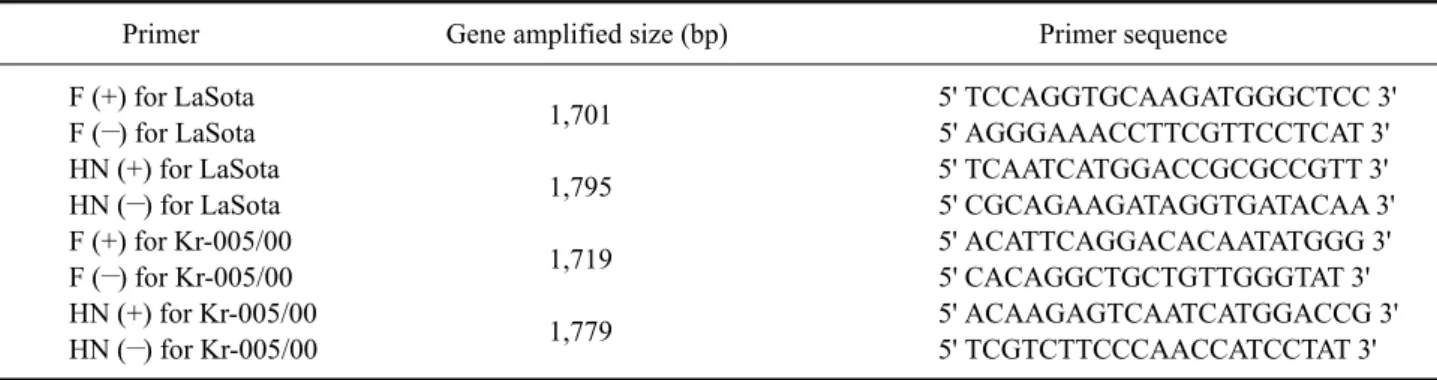
Table 1. Primer sequences
Primer Gene amplified size (bp) Primer sequence
F (+) for LaSota 5' TCCAGGTGCAAGATGGGCTCC 3'
1,701
F (−) for LaSota 5' AGGGAAACCTTCGTTCCTCAT 3'
HN (+) for LaSota 5' TCAATCATGGACCGCGCCGTT 3'
1,795
HN (−) for LaSota 5' CGCAGAAGATAGGTGATACAA 3'
F (+) for Kr-005/00 5' ACATTCAGGACACAATATGGG 3'
1,719
F (−) for Kr-005/00 5' CACAGGCTGCTGTTGGGTAT 3'
HN (+) for Kr-005/00 5' ACAAGAGTCAATCATGGACCG 3'
1,779
HN (−) for Kr-005/00 5' TCGTCTTCCCAACCATCCTAT 3'
vaccine using rND F or rND HN glycoproteins.
Kamiya et al. [8] also reported the protective effects and antibody response of rND F and rND HN derived from the virulent and avirulent NDV strains. They used the D26 and Miyadera strains as avirulent and virulent strains, respectively, to evaluate the protective effects and the rND F glycoprotein derived from the avirulent strain had a lower protective effect.
Here, we expressed the rND F and rND HN glycoproteins derived from the lentogenic La Sota strain and the Korean vvNDV Kr-005/00 strain, respectively, using a recombinant baculovirus. The synergistic effects of the combined rND F and rND HN glycoproteins were also compared. The efficacy of the recombinant baculovirus vaccine was evaluated in more detail by comparing the clinical signs, mortality, and amount of virus shedding from the oropharynx and cloaca of vaccinated chickens after a challenge. The aim of this study was to develop a more effective vaccine to prevent ND and to minimize the amount of virus shedding and spreading after a challenge with vvNDV in vaccinated birds. The combined rND F and rND HN glycoproteins derived from vvNDV were evaluated as subunit marker vaccines that might be used as an effective monitoring tool by differentiating the antibodies produced by natural NDV infections from those produced by vaccination.
Materials and Methods Viruses and cells
The Korean viscerotropic velogenic (vv) NDV Kr-005/00 strain and the lentogenic La Sota strain of NDV were grown in 10-day-old specific pathogen free (SPF) embryonated chicken eggs. The Autographa californica nucleopolyhedrovirus (AcNPV) and recombinant baculo- viruses were grown and assayed in either Spodoptera frugiperda 21 (Sf21) cells or Trichoplusia ni High Five (Hi5) cells in Grace’s medium (GibcoBRL, USA) supplemented with 10% fetal bovine serum. The virus re-isolation of the challenge virus was performed in
primary chicken embryo fibroblast (CEF) cell cultures.
Construction of the transfer vectors pBacF and pBacHN
Viral RNA was extracted directly from the infective allantoic fluid using an RNeasy kit (Qiagen, USA) according to the manufacturer’s recommendations. Four paired primers were used to amplify the complete coding sequence of the fusion (F) and Hemagglutination- Neuraminidase (HN) genes of the La Sota and Kr-005/00 strains (primer sequences, Table 1).
The purified reverse transcription-polymerase chain reaction products of each gene were cloned into a cloning vector, pCR 2.1 (Invitrogen, USA). To construct the transfer vectors pBacF(V) and pBacHN(V), the F and HN genes of the Kr-005/00 strain were excised by digestion with EcoR I and inserted into the EcoR I site of pBacPAK9 (Clontech, USA). The F gene of the La Sota strain was excised by digestion with Xho I and BamH I, and the HN gene of the La Sota strain was excised by digestion with Not I and BamH I. The excised fragments were repaired with T4 polymerase and inserted into the Sma I site of pBacPAK9. The resulting transfer vectors were pBacF(L) and pBacHN(L). All transfer vectors contained the upstream polyhedron promoter of the inserted gene and the downstream polyadenylation sequences. The orientation of the inserted gene was examined by a restriction enzyme treatment and by sequencing the 5' junction region.
Transfection and selection of recombinant virus
Sf21 cells were transfected with 0.5 μg of the transfer
vector plasmid DNA (four each) and BacPAK6 viral DNA
(Bsu36 I digest) using the BacPAK baculovirus expression
system (Clontech, USA) according to the manufacturer’s
instructions. After 72 h incubation at 27
oC, the culture
supernatants were subjected to a plaque assay to isolate the
recombinant viruses. The selected plaque was examined to
confirm that the target gene had been inserted into the viral
genome using polymerase chain reaction with the Bac1
and Bac2 primers (Clontech, USA). Four recombinant
viruses, rND F induced from vvNDV rNDF(V), rND F from La Sota strain rNDF(L), rND HN from vvNDV rNDHN(V), and rND HN from La Sota rNDHN(L), were prepared using pBacF(V), pBacF(L), pBacHN(V), and pBacHN(L), respectively. Recombinant viruses were stored at 4
oC until needed.
Immunofluorescence assay
An immunofluorescence assay was performed without prior fixation, as described previously [22]. Briefly, the Sf21 cells were infected with the recombinant at an MOI of 5 and incubated at 27
oC for 48 h. The unfixed infected cells were washed with phosphate-buffered saline (PBS) and incubated with polyclonal chicken anti-NDV sera or monoclonal antibodies specific to the NDV HN glycoprotein for 1 h at room temperature. After washing with PBS, the cells were incubated with fluorescein isothiocyanate-conjugated anti-chicken or anti-mouse immuno-globulin (Cappel, USA) for 1 h at room temperature. The cells were washed again with PBS and examined for fluorescence.
Chickens
All chickens were derived from SPF eggs of White Leghorn parents (Lohmann, Germany). The animals were housed and reared in positive-pressure isolators until they were immunized.
Immunization of chickens and challenge
Sf21 cells infected with recombinant viruses were sonicated with Soniprep 150 (Sanyo, UK) at 18 Khz for 5 min, clarified by centrifugation, mixed thoroughly using an Omnimixer with Montanide Incomplete Seppic Adjuvant (ISA-70; Seppic, France) at a ratio of 3 : 7, and used as antigens for immunization. For vaccination, chickens were inoculated intramuscularly with the Seppic-adjuvanted antigen (detailed doses are described in each Table). Each group of vaccinated and unvaccinated chickens was challenged with the vvNDV Kr-005/00 strain through an intraocular inoculation with an 10
5.5EID
50per bird. vvNDV Kr-005/00 was the representative strain of genotype VII, which is the dominant epizootic genotype in Korea [11]. The chickens were kept under observation for 14 days after infection.
Protection assay
To examine the protective effect of each recombinant glycoprotein, the SPF chickens were immunized with infected cells containing rNDF(V), rNDF(L), rNDHN(V), or rNDHN(L) and the Seppic-adjuvant. In Experiment 1, fifty-five 5-week-old chickens were divided into 11 groups, in which rNDF(V) and rNDHN(V) were subdivided into 4 groups based on the inoculum dose. Five chickens from each group were housed in separate isolators. All chickens
were immunized twice at 3-week intervals and challenged 3 weeks after the second immunization.
In Experiment 2, 120 3-week-old chickens were divided into 8 groups. Four groups were immunized with 1 × 10
6cells of the infected lysate with an adjuvant of rNDF(V), rNDF(L), rNDHN(V), or rNDHN(L). Two groups were immunized with a half dose (0.5 × 10
6cells) of rNDF(V) and rNDHN(V), and the last group was immunized with the combined rNDF(V) and rNDHN(V)-infected cells.
The remaining group was used as the non-immunized control. Fifteen chickens in each group were housed in separated isolators. Three weeks after the first immunization, seven chickens from each group were challenged to evaluate the level of immunity, and the remaining eight chickens were given a booster immunization with the same antigen. Three weeks after the second immunization, the chickens were challenged. The protective effect was evaluated by observing the chickens for any clinical signs and mortality. The re-isolation of the challenge virus was carried out in CEF cells with the oropharyngeal and cloacal swab samples 5 day after the challenge infection. All chickens were sampled at 5 d post infection (dpi) including three dead chickens at 4 dpi, one chicken from the rND F(V) group and two chickens from the control group, after the 1st immunization in Experiment 2 (Table 3). For virus isolation, the swab samples were suspended in 1 ml of cell culture medium with antibiotics. And then the clarified supernatants were titrated for virus infectivity in CEF cells.
Serological assays
The Hemagglutination inhibition (HI) test was performed as described in the OIE manual of standard diagnostic tests [23]. The level of agglutination was assessed by titling the plates. Only those wells in which the RBCs streamed at the same rate as the control wells were considered to exhibit hemagglutination inhibition. ELISA was performed using the Newcastle disease antibody detection kit (IDEXX Laboratories, USA) according to manufacturer’s instructions.
Statistical analyses
For statistical analyses, the two-tailed Fisher’s exact test and the Student’s t-test were used for the protective immunity and antibody response, respectively. A p-value
<0.05 was considered significant.
Results
The nucleotide sequence of the 5' junction region of the
transfer vector indicated that the plasmid contained the
inserted gene in the proper orientation for expression. The
target gene inserted in the viral genome as assessed by
polymerase chain reaction of the selected recombinant
virus plaques (data not shown). The expression of the NDV
glycoprotein was confirmed by indirect immunofluorescence
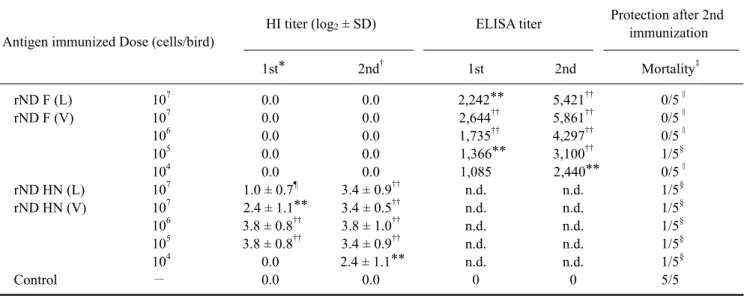
Table 2. Protective effect and antibody response after immunization with the recombinant baculovirus glycoproteins derived from the lentogenic and velogenic Newcastle disease viruses (Experiment 1)
Antigen immunized Dose (cells/bird)
Protection after 2nd HI titer (log
2± SD) ELISA titer
immunization
1st* 2nd
†1st 2nd Mortality
‡rND F (L) 10
70.0 0.0 2,242** 5,421
††0/5
∥rND F (V) 10
70.0 0.0 2,644
††5,861
††0/5
∥10
60.0 0.0 1,735
††4,297
††0/5
∥10
50.0 0.0 1,366** 3,100
††1/5
§10
40.0 0.0 1,085 2,440** 0/5
∥rND HN (L) 10
71.0 ± 0.7
¶3.4 ± 0.9
††n.d. n.d. 1/5
§rND HN (V) 10
72.4 ± 1.1** 3.4 ± 0.5
††n.d. n.d. 1/5
§10
63.8 ± 0.8
††3.8 ± 1.0
††n.d. n.d. 1/5
§10
53.8 ± 0.8
††3.4 ± 0.9
††n.d. n.d. 1/5
§10
40.0 2.4 ± 1.1** n.d. n.d. 1/5
§Control − 0.0 0.0 0 0 5/5
*3 weeks after the first immunization. †3 weeks after the second immunization. ‡Number died over the number tested. §p < 0.05 by Fisher’s exact test. ∥p < 0.01 by Fisher’s exact test. ¶p < 0.05 by Student’s t-test. **p < 0.01 by Student’s t-test. ††p < 0.001 by Student’s t-test. n.d.:
not done.
analysis (IFA) using the NDV antiserum or monoclonal antibodies specific to the NDV HN glycoprotein. Using IFA, the expressed glycoproteins were localized to the cell surface of the Sf21 cells infected with the recombinant baculovirus, rNDF(V), rNDF(L), rNDHN(V), and rNDHN(L) (data not shown).
In Experiment 1, chickens inoculated with the crude extracts of Sf21 cells infected with the recombinant baculoviruses exhibited serological responses against NDV according to HI and ELISA (Table 2). The HI and ELISA titers of the first immunized groups were significantly higher than those of the non-immunized control except for the 10
4.0dose of rNDHN(V) and rNDF(V) (Table 2). The HI titer of the 10
7.0dose of rNDHN(L) was significantly lower than those of the 10
7.0(p <0.05), 10
6.0, and 10
5.0doses (p <0.001) of rNDHN(V) after the first immunization. The 10
7.0dose of rNDHN(V) induced a lower HI titer than those of the 10
6.0and 10
5.0doses, but these differences were not statistically significant (p > 0.05). The HI titers after the second immunization were similar. However, the 10
7.0dose of rNDHN(L) and the 10
4.0dose of rNDHN(V) groups showed significantly higher titers than the first immunization (p <0.01). The ELISA titers of each group after the second immunization were significantly higher than the first immunization (Table 2), showing p <0.01 in groups given the 107.0 dose of rNDF(L) and the 10
6.0and 10
5.0doses of rNDF(V), and p <0.05 in the group given the 10
7.0dose of rNDF(V). The protection efficacy of the recombinant glycoprotein was evaluated by a challenge
after the second immunization (Table 2). Of the chickens immunized twice with each recombinant glycoprotein, 80% (p <0.05) or 100% (p < 0.01) survived the NDV challenge, whereas all unvaccinated birds died.
In Experiment 2, further protective effects of each recombinant glycoprotein were examined (Tables 3 and 4).
Although all the second immunized groups exhibited a similar protective effect as in Experiment 1, a 10
6.0dose of the infected cells with the adjuvant was chosen to immunize the chickens based on the serological response and protective effect. The protective efficacy of a single dose of each of the four recombinant glycoproteins, a half dose of the two recombinant glycoproteins derived from vvNDV and the combined half dose of rNDF(V) and rNDHN(V)-infected cells were examined.
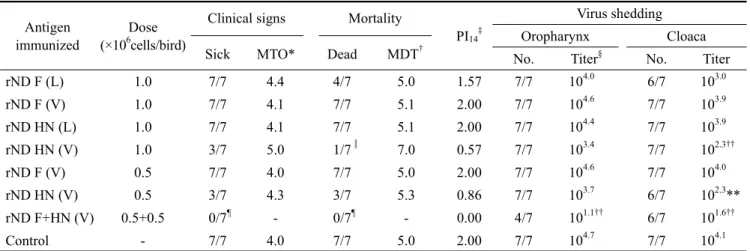
Protective efficacy tests were performed after the first and
second immunizations (Tables 3 and 4). The individual
recombinant glycoproteins did not prevent clinical signs
and mortality after the first immunization, except for the
single dose of rNDHN(V), which had a protective effect
against mortality (Table 3, p <0.01). The groups given the
single dose of rNDHN(V) and half dose of rNDHN(V)
showed a partial protective effect in terms of the clinical
signs, but these were not statistically significant (p >
0.05). On the other hand, the group given the two
glycoproteins, rNDF + HN(V), showed complete
protection against the clinical signs and mortality (p <
0.001) following only the first immunization. The
combined group did not show complete prevention from
virus shedding from the oropharynx and cloaca, but the
Table 3. Protective effect in chickens after the 1st immunization with the recombinant baculovirus glycoproteins derived from the lentogenic and velogenic Newcastle disease viruses (Experiment 2)
Antigen immunized
Dose (×10
6cells/bird)
Clinical signs Sick MTO*
Mortality
Dead MDT
†PI
14‡Virus shedding
Oropharynx Cloaca
No. Titer
§No. Titer
rND F (L) 1.0 7/7 4.4 4/7 5.0 1.57 7/7 10
4.06/7 10
3.0rND F (V) 1.0 7/7 4.1 7/7 5.1 2.00 7/7 10
4.67/7 10
3.9rND HN (L) 1.0 7/7 4.1 7/7 5.1 2.00 7/7 10
4.47/7 10
3.9rND HN (V) 1.0 3/7 5.0 1/7
║7.0 0.57 7/7 10
3.47/7 10
2.3††rND F (V) 0.5 7/7 4.0 7/7 5.0 2.00 7/7 10
4.67/7 10
4.0rND HN (V) 0.5 3/7 4.3 3/7 5.3 0.86 7/7 10
3.76/7 10
2.3**
rND F+HN (V) 0.5+0.5 0/7
¶- 0/7
¶- 0.00 4/7 10
1.1††6/7 10
1.6††Control - 7/7 4.0 7/7 5.0 2.00 7/7 10
4.77/7 10
4.1*Mean time for the onset of clinical signs or death.
†Mean death time.
‡Pathogenicity index: the mean score per bird per observation over a 14 day period when each day the birds were scored 0 if normal, 1 if sick, and 2 if dead.
§Geometric mean titer (log10 TCID
50/0.1 ml).
∥p <0.01 by Fisher’s exact test. ¶p <0.001 by Fisher’s exact test. **p <0.05 by Student’s t-test. ††p <0.001 by Student’s t-test.Table 4. Protective effect in chickens after the 2nd immunization with the recombinant baculovirus glycoproteins derived from the lentogenic and velogenic Newcastle disease viruses (Experiment 2)
Antigen immunized
Dose (×10
6cells/bird)
Clinical signs Sick MTO*
Mortality
Dead MDT
†PI
14‡Virus shedding
Oropharynx Cloaca
No. Titer
§No. Titer
rND F (L) 1.0 1/8** 7.0 1/8** 8.0 0.25 7/8 10
2.6††7/8 10
2.4rND F (V) 1.0 0/7** - 0/7** - 0.00 7/7 10
2.4††5/7 10
1.6††rND HN (L) 1.0 3/8
∥5.7 2/8
¶5.0 0.63 7/8 10
2.4††7/8 10
2.0††rND HN (V) 1.0 0/8** - 0/8** - 0.00 7/8 10
2.96/8 10
1.5‡‡rND F (V) 0.5 3/8
∥4.3 3/8
∥5.0 0.75 8/8 10
3.88/8 10
2.6rND HN (V) 0.5 0/8** - 0/8** - 0.00 7/8 10
1.8‡‡7/8 10
1.3***
rND F+HN (V) 0.5+0.5 0/8** - 0/8** - 0.00 6/8 10
1.6*** 5/8 10
1.1‡‡Control - 8/8 4.4 8/8 5.3 2.00 8/8 10
4.08/8 10
3.1*Mean time for the onset of clinical signs or death.
†Mean death time.
‡Pathogenicity index: the mean score per bird per observation over a 14 day period when each day the birds were scored 0 if normal, 1 if sick, and 2 if dead.
§Geometric mean titer (log10 TCID
50/0.1 ml).
∥p <0.05 by Fisher’s exact test. ¶p < 0.01 by Fisher’s exact test. **p < 0.001 by Fisher’s exact test. ††p < 0.05 by Student’s t-test.‡‡p < 0.01 by Student’s t-test. ***p < 0.001 by Student’s t-test.