WWW.KJOG.ORG 206
HAIR TOURNIQUET SYNDROME OF THE LABIUM MINORA IN AN 11-YEAR-OLD GIRL: A CASE REPORT
Dae Hyung Lee, MD, Min Whan Koh, MD, PhD
Department of Obstetrics and Gynecology, Yeungnam University School of Medicine, Daegu, Korea
Hair tourniquet syndrome refers to the strangulation of appendages by a thread of human hair. This condition can lead to ischemic injury of these appendages. Thus, to avoid constrictive injury, prompt recognition and treatment are very important. Affected areas include fi ngers, toes, and genitalia. Hair tourniquet syndrome involving the labium minora is extremely rare. We here report a case of hair tourniquet syndrome involving the labia minora in an 11-year-old girl.
Keywords:
Hair tourniquet syndrome, Labium minora, Strangulation
Received: 2011.11.1. Accepted: 2012.1.14.
Corresponding author: Min Whan Koh, MD, PhD
Department of Obstetrics and Gynecology, Yeungnam University School of Medicine, 170 Hyeonchung-ro, Nam-gu, Daegu 705-717, Korea
Tel: +82-53-620-3433 Fax: +82-53-654-0676 E-mail: [email protected]
Th is is an Open Access article distributed under the terms of the Creative Commons Attribution Non-Commercial License (http://creativecommons.org/licenses/
by-nc/3.0/) which permits unrestricted non-commercial use, distribution, and reproduction in any medium, provided the original work is properly cited.
Copyright © 2012. Korean Society of Obstetrics and Gynecology
Several reports of hair tourniquet syndrome have appeared in the literature. Guillimeau fi rst described tissue strangulation by a thread of hair in 1612 [1,2], and the fi rst documented report of the condition was published in the Lancet in 1832. However, no such report has been published in Korea. Hair tourniquet syndrome refers to the strangulation of appendages by a thread of human hair, which may lead to ischemic injury of these appendages. This condition typically involves the digits and genitalia of infants and children. Commonly, ischemic injury by strangulation occurs in the fi ngers and toes [3,4]. Constrictive injury of the penis and clitoris is rare. It is clear that prompt recognition and treatment is very important to avoid serious injury. We here report a case of hair tourniquet syndrome involving the labia minora in an 11-year-old girl.
Case Report
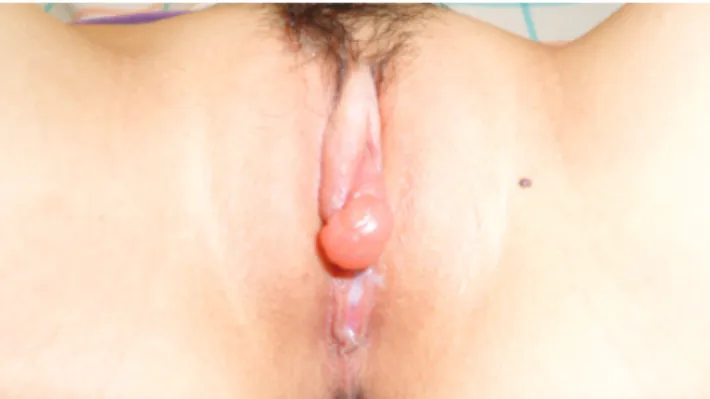
An 11-year-old girl child presented at our hospital complaining of a mass in the right labium minora. The patient had experienced a vulvar mass and pain for 3 days and had visited a local gyneco- logic clinic. At the local clinic, the doctor diagnosed a vulvar mass with severe pain, and referred the patient to our hospital for treat- ment. The patient had no history of trauma. Examination revealed a half-amputated swollen left labium minora (Fig. 1). The lesion was tender, erythematous, and indurated. A strand of hair was found to be wrapped around the labium minora, thereby inducing
accidental strangulation (Fig. 2). The patient’s hymen was normal, without irregularity or scarring, and no further lesions were de- tected. The hair tourniquet was removed immediately using fi ne- toothed forceps and a Metzenbaum scissor. The patient’s pain disappeared immediately.
Discussion
Hair-thread tourniquet syndrome is a condition that induces isch- emic strangulation of appendages by a hair thread. Several organs may be damaged by strangulation via a hair thread or strings of hair, causing ischemia and necrosis. A hair thread may wrap around appendages such as fi ngers, toes, the penis, clitoris, and
CASE REPORT
Korean J Obstet Gynecol 2012;55(3):206-208 http://dx.doi.org/10.5468/KJOG.2012.55.3.206 pISSN 2233-5188 · eISSN 2233-5196
WWW.KJOG.ORG 207
Dae Hyung Lee, et al. Hair tourniquet syndrome of the labium minora
labium and strangulate these appendages in infants and children [1,2,5,6]. The condition may cause pain, edema, and ischemic ne- crosis, and may at worst lead to amputation [1,3,4]. Therefore, this condition requires prompt recognition and treatment to ensure viability of the affected appendages.
Hair tourniquet syndrome is uncommon in general, but this syn- drome has been described in detail in the literature, including sporadic case reports [1-4,7,8]. Guillimeau fi rst described tissue strangulation by a thread of hair in 1612, and the first docu- mented report on hair tourniquet syndrome was published in the Lancet in 1832 [5,6]. In 1988, Barton et al. [9] described 66 cases of hair-thread tourniquet syndrome in children between the ages of 8 and 11 years. Most cases of hair tourniquet syndrome occur in young children, with fi nger wrapping seen most commonly at 4 days to 19 months of age [9]. Penile tourniquet syndrome has been described at an age range of 4 months to 6 years [9]. Labial and clitoral wrapping have been described in older children with an age range of 7 to 11 years [1,3,10,11]. Several reports of la- bium minora tourniquet syndrome have been published [12,13].
We have described 1 such case here.
Constrictive lymphatic obstruction is the mechanism underlying
hair tourniquet syndrome. A thread of human hair is extremely thin, and is, therefore, easily knotted, thereby causing strangula- tion of affected appendages. Initially, soft tissue edema occurs, followed by the development of secondary obstruction of venous outfl ow and arterial perfusion, which may fi nally result in ischemic necrosis and autoamputation.
Diagnosis of this syndrome is always based on clinical findings.
To protect affected appendages, prompt recognition and removal of the wrapped hair is very important. Therefore, physicians must be aware of the signs and symptoms of hair tourniquet syndrome, especially of the labia minora. The differential diagnosis of labial hair tourniquet syndrome includes infl ammation, allergy, trauma, and sexual abuse [3]. Because labial tourniquet syndrome can re- sult from child abuse, this association should always be excluded fi rst [1,2,4]. Thus, a careful history is required to ensure accurate diagnosis.
As soon as the diagnosis of labial tourniquet syndrome has been established, the hair or the strings of hair must be removed. Re- moval of the hair thread is possible using fine-toothed forceps and microscissors. Additional antibiotic treatment is required if ne- crosis or infection of the affected appendages is evident. Further, O’Gorman and Ratnapalan [14] reported the treatment of hair tourniquet syndrome using a depilatory cream in cases in which unwinding of the hair is difficult. Neglect of this condition may lead to dire consequences, including autoamputation of vital body appendages.
References
1. Kuo JH, Smith LM, Berkowitz CD. A hair tourniquet resulting in strangulation and amputation of the clitoris. Obstet Gynecol 2002;99:939-41.
2. Klusmann A, Lenard HG. Tourniquet syndrome: accident or abuse? Eur J Pediatr 2004;163:495-8.
3. Rich MA, Keating MA. Hair tourniquet syndrome of the clitoris.
J Urol 1999;162:190-1.
4. Sylwestrzak MS, Fischer BF, Fischer H. Recurrent clitoral tourni- quet syndrome. Pediatrics 2000;105:866-7.
5. Haddad FS. Re: Penile tourniquet injury due to a coil of hair. J Urol 1985;134:1220.
6. Abel MF, McFarland R 3rd. Hair and thread constriction of the digits in infants. A case report. J Bone Joint Surg Am 1993;75:915-6.
7. Osterhoudt KC, Beleniski F. Images in emergency medicine.
Fig. 1. A swollen and half-amputated labium minora.
Fig. 2. Strangulation of the labium minora by a hair thread.
WWW.KJOG.ORG 208
KJOG Vol. 55, No. 3, 2012
The hair tourniquet syndrome. Ann Emerg Med 2005;45:458, 463.
8. Chapman HL. Digital strangulation by hair wrapping. Can Med Assoc J 1968;98:125.
9. Barton DJ, Sloan GM, Nichter LS, Reinisch JF. Hair-thread tour- niquet syndrome. Pediatrics 1988;82:925-8.
10. Webley JA, Schleif DR, Coleman J. Tourniquet Syndrome: an unusual presentation. Ann Emerg Med 1981;10:494-5.
11. Press S, Schachner L, Paul P. Clitoris tourniquet syndrome. Pe-
diatrics 1980;66:781-2.
12. Bacon JL, Burgis JT. Hair thread tourniquet syndrome in ado- lescents: a presentation and review of the literature. J Pediatr Adolesc Gynecol 2005;18:155-6.
13. Pomeranz M, Schachter B, Capua T, Beyth Y. Hair-thread tour- niquet syndrome of labia minor. J Pediatr Adolesc Gynecol 2009;22:e111-3.
14. O’Gorman A, Ratnapalan S. Hair tourniquet management. Pe- diatr Emerg Care 2011;27:203-4.
11세 여아의 소음순에 발생한 체모압박증후군: 증례보고
영남대학교 의과대학 산부인과학교실 이대형, 고민환
체모압박증후군은 체모에 의하여 신체 부속기의 염전 혹은 협착되는 경우를 의미한다. 이러한 상황으로 신체 부속기의 국소 허혈성 손 상에 이르게 된다. 그래서, 협착성 손상을 피하기 위하여 이러한 상황에 대한 즉각적인 인지와 치료가 매우 중요하다. 이 증후군은 발가락, 손가락, 외음부 등에서 일어날 수 있다, 하지만 소음순에 발생한 경우는 매우 드물다. 이에 본 저자들은 11세 여아에게서 소음순에 발생한 체모압박증후군 1예를 경험하였기에 보고하는 바이다.
중심단어: 체모압박증후군, 소음순, 협착