© 2017 The Korean Ophthalmological Society
This is an Open Access article distributed under the terms of the Creative Commons Attribution Non-Commercial License (http://creativecommons.org/licenses /by-nc/3.0/) which permits unrestricted non-commercial use, distribution, and reproduction in any medium, provided the original work is properly cited.
Original Article
Patient Awareness of Cataract and Age-related Macular Degeneration among the Korean Elderly: A Population-based Study
Hankil Lee1, Yong-Jung Jang1,2, Hyung Keun Lee3, Hye-Young Kang1
1College of Pharmacy, Yonsei Institute of Pharmaceutical Sciences, Yonsei University, Incheon, Korea
2Department of Pharmacy, Gangnam Severance Hospital, Yonsei University, Seoul, Korea
3Institute of Vision Research, Department of Ophthalmology, Yonsei University College of Medicine, Seoul, Korea
Purpose: Age-related eye disease is often considered part of natural aging. Lack of awareness of eye condi- tions can result in missed treatment. We investigated the rates of awareness of cataract and age-related macular degeneration, the most common age-related eye-diseases, and the associated factors among el- derly Koreans.
Methods: We identified 7,403 study subjects (≥40 years old) with cataract or age-related macular degenera- tion based on ophthalmic examination results during the 5th Korean National Health and Nutrition Examina- tion Survey conducted between 2010 and 2012. We assessed whether patients were aware of their eye con- dition based on a previous diagnosis by a physician.
Results: The average awareness rate over the 3-year study period was 23.69% in subjects with cataract and 1.45% in subjects with age-related macular degeneration. Logistic regression analysis showed that patients with cataract were more likely to recognize their condition if they had myopia (odds ratio, 2.08), hyperopia (odds ratio, 1.33), family history of eye disease (odds ratio, 1.44), or a past eye examination (odds ratio, 4.07- 29.10). The presence of diabetes mellitus was also a significant predictor of patient awareness of cataract (odds ratio, 1.88).
Conclusions: Poor patient recognition of eye disease among the Korean elderly highlights the seriousness of this potential public health problem in our aging society. Pre-existing eye-related conditions and diabetes were significant predictors of awareness; therefore, patients in frequent contact with their doctors have a greater chance of detecting eye disease.
Key Words: Aged, Awareness, Cataract, Eye diseases, Macular degeneration
Eye diseases are some of the most easily overlooked ill- nesses and can have a significant impact on the quality of
life of the elderly [1,2]. Two major age-related eye diseases (AREDs) known to cause blindness worldwide are cataract and age-related macular degeneration (AMD) [3]. ARED- induced visual disabilities reduce health-related quality of life in the elderly; people with ARED have significantly higher levels of mental distress than those without ARED (relative risk, 1.4; 95% confidence interval [CI], 1.27 to 1.54) [2]. Furthermore, visual disability-related comorbidities in- clude depression and femur fracture [4-7].
Many people do not recognize the necessity and impor-
Received: February 20, 2017 Accepted: April 23, 2017
Corresponding Author: Hye-Young Kang, PhD. College of Pharmacy, Yonsei Institute of Pharmaceutical Sciences, Yonsei University, Veritas Hall D, 85 Songdogwahak-ro, Incheon 21983, Korea. Tel: 82-32-749-4512, Fax: 82-32-749-4105, E-mail: [email protected]
The paper has been presented in the 21st International Society for Phar- macoeconomics and Outcomes Research Annual Meeting on May 21-25, 2016, Washington, DC, USA.
tance of maintaining eye health; instead, ARED is often considered a part of natural aging. Lack of awareness and interest in eye conditions can result in delayed or missed treatment [8,9]. Eye diseases, similar to chronic conditions such as diabetes or hypertension, are usually asymptomat- ic in the early stages, until the disease has progressed.
However, while diabetes and hypertension are monitored regularly, eye diseases are generally ignored, resulting in large proportions of patients who are unaware of their sta- tus. In a study conducted in Singapore, 80% of patients with common eye diseases were unaware of their condition [10].
According to the 2012 Korean National Health and Nu- trition Examination Survey (KNHANES), approximately 94% and 16% of people aged ≥70 years had cataract and AMD, respectively [11]. The 2011 Korean National Health Insurance statistical report showed that cataract and lens defects were the leading causes of hospitalization and treat- ment [12]. Therefore, eye diseases are common in the elder- ly and are responsible for considerable health care expendi- ture. Patients with moderate vision loss, severe vision loss, or blindness are estimated to have higher adjusted mean eye-related costs (345, 407, or 237 US dollars/yr, respectively) and non-eye related costs (2,193, 3,301, or 4,443 US dollars/
yr, respectively) than those with normal vision [7].
To prevent avoidable vision loss, patients need to be aware of their eye condition and receive appropriate treat- ment. Unfortunately, research on the level of ARED awareness and factors influencing awareness among the elderly, including those in Korea, is limited. This study ex- amines the extent to which elderly people with ARED in Korea are aware of their eye condition. Specifically, we used national representative data from the KNHANES be- tween 2010 and 2012 to estimate the gap between preva- lence and awareness of the two most common AREDs (i.e., cataract and AMD). Furthermore, factors accounting for the awareness gap pertaining to cataract were investigated in order to suggest effective strategies for reducing this gap in our aging society.
Materials and Methods
Data source and study population
Data were obtained from the 5th KNHANES, covering
2010 to 2012. This is a nationally representative, stratified, multistage sampling, cross-sectional survey comprising three parts: health interview, health examination, and nu- trition surveys. KNHANES has been conducted by the Korean Centers for Disease Control and Prevention since 1998. The sampled population for KNHANES is non-insti- tutionalized civilians aged ≥1 year. Details regarding the KNHANES survey design and methods are provided else- where [13,14].
This study included 7,403 individuals aged ≥40 years who had a cataract or AMD in either eye, as extracted from KNHANES ophthalmic examinations of 25,533 par- ticipants. Since we consider early diagnosis of ARED im- portant, we included both middle-aged and elderly individ- uals in our study. To assess AMD in the KNHANES ophthalmic examination, a 45° digital fundus photograph of both eyes was obtained under physiological mydriasis and graded using the international AMD classification and grading system [15]. The presence of cataract was defined as ≥1 type of lens opacity or evidence of cataract extrac- tion in either eye. Lens opacities were assessed using the Lens Opacities Classification System (LOCUS) III scores:
cortical (LOCUS III score ≥2), nuclear (LOCUS III score
≥4), posterior subcapsular (LOCUS III score ≥2), and mixed cataracts (>1 type per eye) [16,17]. The quality of the ophthalmic surveys, fundus photograph readings, and cat- aract evaluations were verified by the Epidemiologic Sur- vey Committee of the Korean Ophthalmologic Society [18,19].
Variables
For each patient group (cataract or AMD), we deter- mined the individual’s awareness of their eye condition based on the answer to the following question: Have you ever been diagnosed by a physician with a cataract (or AMD) in either eye? If the respondent answered “yes,” the person was assumed to be aware of their eye disease.
We employed Andersen’s behavioral model to select variables explaining the awareness of ARED [20-22]. An- dersen’s model provides a conceptual framework for ana- lyzing various factors influencing an individual’s health care use, including predisposing, enabling, and need fac- tors. Predisposing factors were sex, age, educational level, marital status, and residential area (urban or rural).
Family income level, type of health security program,
and supplementary health insurance were included in the model as enabling factors. Family income level was classi- fied as quartiles of average monthly household income.
The type of health security program was either National Health Insurance (NHI) or Medical Aid (MA), the two tiers of the universal health insurance system in Korea.
The NHI program is a wage-based, contributory insurance program covering approximately 96% of the population, and the MA program is a government-subsidized public assistance program for poor and medically indigent indi- viduals. In an earlier study, patients enrolled in MA tended to have higher health care utilization than those in NHI with the same condition [23]. We therefore assumed that people in the MA program would have greater awareness of their eye condition than those in the NHI program. Re- garding supplementary private health insurance, it was as- sumed that the availability of an additional financing source for health care services has a positive effect on health care utilization, facilitating recognition of an eye disease.
Need factors were used to measure eye-specific and overall health status. We hypothesized that individuals with poor health status were more likely to visit health care providers and consequently had a higher chance of having their eye diseases detected. To describe eye-specific health status, we included the occurrence of visual distur- bance, myopia, hyperopia, astigmatism, previous eye sur- gery, and family history of eye disease. We also measured the degree of exposure to eye examinations, defined as the time since the most recent eye examination. In a previous study, the extent of sunlight exposure was identified as a risk factor for eye disease [24]; therefore, we also included daily sunlight exposure (≥5 or <5 hours) [25]. Self-rated health status, measured using a 5-point Likert-type scale, was included to reflect overall health status. In addition, selected comorbid conditions that are prevalent in elderly Koreans, such as obesity, hypertension, and diabetes melli- tus, were included to represent overall health status.
Statistical analysis
All statistical analyses were performed using SAS ver.
9.4 (SAS Institute, Cary, NC, USA), incorporating sam- pling weights and adjusting for the complex survey design of the KNHANES. Survey sampling weights were used to produce estimates that were representative of the non-in-
stitutionalized civilian Korean population. Chi-square tests were employed to examine differences in patient charac- teristics between the aware and unaware patient groups.
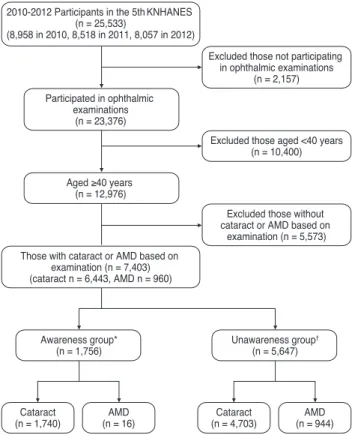
Multivariate logistic regression analysis was used to exam- ine factors associated with cataract awareness in patients diagnosed with cataract. For patients with AMD, it was not feasible to conduct a multivariate analysis due to the small sample size of the AMD awareness group (n = 16) (Fig. 1). Statistical significance was accepted at p < 0.05.
Results
Patient awareness of their eye disease
Among the subjects with cataract, 23.69% were aware of their eye disease (Fig. 2A). The average awareness rate of AMD was 1.45% over the 3-year study period, approxi- mately 16.3-fold lower than the cataract awareness rate.
2010-2012 Participants in the 5thKNHANES (n = 25,533)
(8,958 in 2010, 8,518 in 2011, 8,057 in 2012)
Those with cataract or AMD based on examination (n = 7,403) (cataract n = 6,443, AMD n = 960)
Participated in ophthalmic examinations
(n = 23,376)
Awareness group*
(n = 1,756)
Cataract
(n = 1,740) AMD
(n = 16)
Unawareness group† (n = 5,647)
Cataract
(n = 4,703) AMD
(n = 944) Aged ≥40 years
(n = 12,976)
Excluded those not participating in ophthalmic examinations
(n = 2,157)
Excluded those without cataract or AMD based on
examination (n = 5,573) Excluded those aged <40 years
(n = 10,400)
Fig. 1. Process for identifying and including study subjects. KN- HANES = Korea National Health and Nutrition Examination Survey; AMD = age-related macular degeneration. *Individuals who answered that they had been diagnosed with cataract or AMD by a physician; †Individuals who answered that they had not been diagnosed with cataract or AMD by a physician.
The proportion of patients with AMD who were aware of their eye disease increased 3.4-fold over the 3 years, from 0.69% (2010) to 2.38% (2012) (Fig. 2B). In contrast, cataract awareness increased only slightly from 22.71% to 25.48%.
Factors associated with patient awareness of their eye disease
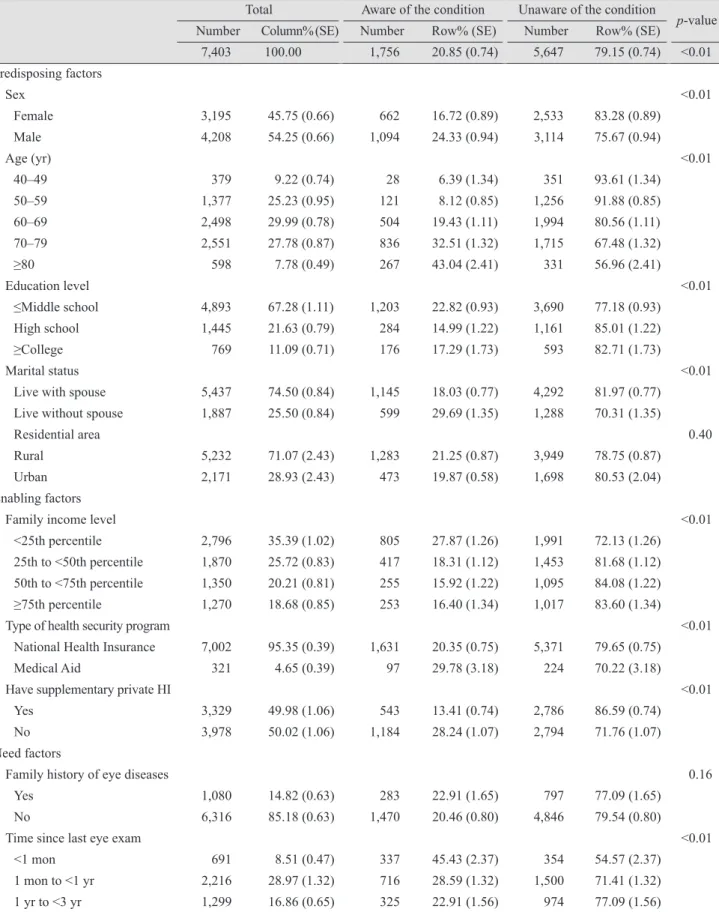
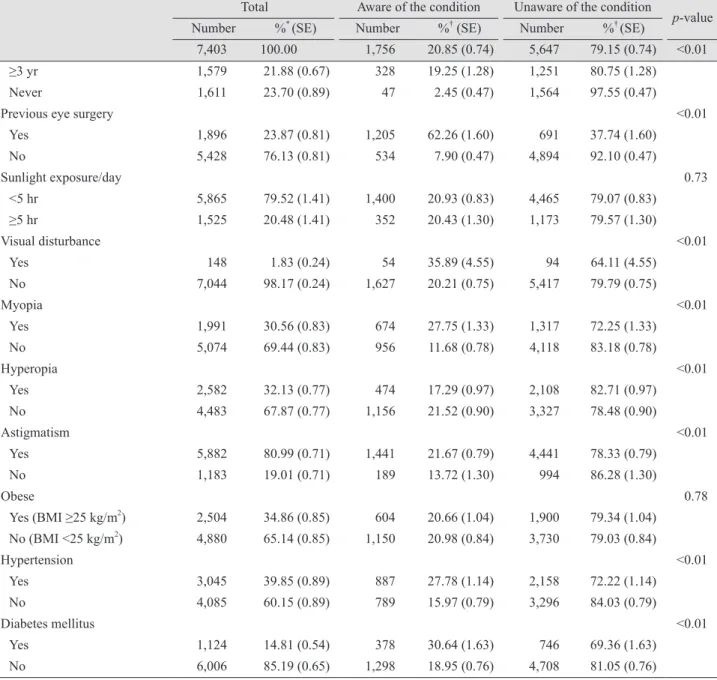
We compared the characteristics of the study subjects with either cataract or AMD according to awareness of their eye condition (Table 1). Almost all characteristics were significantly different (p < 0.05) between the aware and unaware groups. Women were 1.45-fold more aware of their eye disease (24.33%) than men (16.72%). While the prevalence of the two eye diseases was consistent across age groups (50 to 59 years, 25.23%; 60 to 69 years, 29.99%;
and 70 to 79 years, 27.78%), the proportion of awareness was only 8.12% in the 50- to 59-year-old age group and in- creased to 32.51% for subjects aged 70 to 79 years. The lowest income group, with family income level below the
25th percentile of the national population, had a greater awareness rate (27.86%) than higher income groups (15.92% to 18.32%). Patients with chronic diseases such as hypertension (27.78%) and diabetes mellitus (30.64%) had greater awareness rates than those without these chronic diseases (15.97% and 18.95%, respectively). Patients who had undergone recent eye examinations also had greater awareness of their eye disease than those who had not. Pa- tients with visual disturbance (35.89%), myopia (27.75%), or astigmatism (21.67%) showed greater awareness than those without these conditions (20.21%, 16.82%, and 13.72%, respectively).
The cataract or AMD subtype was considered as an im- portant predictor of patient awareness. For cataract, aware- ness was approximately two-fold greater among patients with mixed types than among patients with single type (24.3% vs. 12.85%, p < 0.001) (Table 2). Awareness was ap- proximately 24-fold greater among patients with late AMD than in those with early AMD (14.24% vs. 0.59%, p <
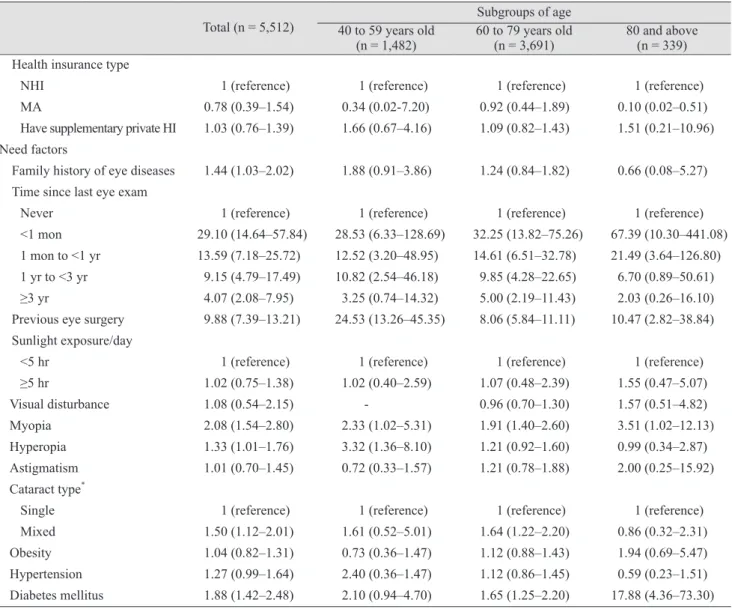
0.001) (Table 2). Multivariate logistic regression analysis was performed to examine the independent associations between the predisposing, enabling, and need factors and cataract awareness status (Table 3).
Age was the only statistically significant predictor among the predisposing factors; the probability that a per- son would be aware of a cataract significantly increased with age, with an odds ratio (OR) of 4.02 (95% CI, 1.97 to 8.20) in people aged 60 to 69 years and 9.77 (95% CI, 4.05 to 23.61) in those aged ≥80 years. None of the enabling fac- tors were significant independent predictors of patient awareness of cataract. Among the need factors, most of the variables for eye-specific health status were significant predictors of awareness. Those with prior eye conditions such as myopia (OR, 2.08; 95% CI, 1.54 to 2.80), hyperopia (OR, 1.33; 95% CI, 1.01 to 1.76), or family history of eye disease (OR, 1.44; 95% CI, 1.03 to 2.02) were more likely to be aware of having a cataract. As expected, those who had undergone an eye examination in the past also had a greater chance of being aware of their cataract condition.
Among the three chronic diseases, the presence of diabetes mellitus was the only significant predictor of cataract awareness (OR, 1.88; 95% CI, 1.42 to 2.48).
To examine whether predictors of patient awareness vary by patient age, we performed separate logistic regres- sion analyses for each of the three age groups: 40 to 59, 60 to 79, and ≥80 years (Table 3). For the youngest patient Fig. 2. Patient awareness of cataract or age-related macular de-
generation. (A) Awareness of cataract. (B) Awareness of age- related macular degeneration.
2010 2011 2012 Total
(2010-2012) 100
2030 4050 6070 8090 100 (%)
22.71
Unaware Aware
22.55 25.48 23.70
2010 2011 2012 Total
(2010-2012) 100
2030 4050 6070 8090 100
(%) 0.69
Unaware Aware
1.65 2.38 1.45
A
B
Table 1. Comparison of subject characteristics according to awareness of their eye condition
Total Aware of the condition Unaware of the condition
p-value
Number Column%(SE) Number Row% (SE) Number Row% (SE)
7,403 100.00 1,756 20.85 (0.74) 5,647 79.15 (0.74) <0.01 Predisposing factors
Sex <0.01
Female 3,195 45.75 (0.66) 662 16.72 (0.89) 2,533 83.28 (0.89)
Male 4,208 54.25 (0.66) 1,094 24.33 (0.94) 3,114 75.67 (0.94)
Age (yr) <0.01
40–49 379 9.22 (0.74) 28 6.39 (1.34) 351 93.61 (1.34)
50–59 1,377 25.23 (0.95) 121 8.12 (0.85) 1,256 91.88 (0.85)
60–69 2,498 29.99 (0.78) 504 19.43 (1.11) 1,994 80.56 (1.11)
70–79 2,551 27.78 (0.87) 836 32.51 (1.32) 1,715 67.48 (1.32)
≥80 598 7.78 (0.49) 267 43.04 (2.41) 331 56.96 (2.41)
Education level <0.01
≤Middle school 4,893 67.28 (1.11) 1,203 22.82 (0.93) 3,690 77.18 (0.93)
High school 1,445 21.63 (0.79) 284 14.99 (1.22) 1,161 85.01 (1.22)
≥College 769 11.09 (0.71) 176 17.29 (1.73) 593 82.71 (1.73)
Marital status <0.01
Live with spouse 5,437 74.50 (0.84) 1,145 18.03 (0.77) 4,292 81.97 (0.77)
Live without spouse 1,887 25.50 (0.84) 599 29.69 (1.35) 1,288 70.31 (1.35)
Residential area 0.40
Rural 5,232 71.07 (2.43) 1,283 21.25 (0.87) 3,949 78.75 (0.87)
Urban 2,171 28.93 (2.43) 473 19.87 (0.58) 1,698 80.53 (2.04)
Enabling factors
Family income level <0.01
<25th percentile 2,796 35.39 (1.02) 805 27.87 (1.26) 1,991 72.13 (1.26)
25th to <50th percentile 1,870 25.72 (0.83) 417 18.31 (1.12) 1,453 81.68 (1.12) 50th to <75th percentile 1,350 20.21 (0.81) 255 15.92 (1.22) 1,095 84.08 (1.22)
≥75th percentile 1,270 18.68 (0.85) 253 16.40 (1.34) 1,017 83.60 (1.34)
Type of health security program <0.01
National Health Insurance 7,002 95.35 (0.39) 1,631 20.35 (0.75) 5,371 79.65 (0.75)
Medical Aid 321 4.65 (0.39) 97 29.78 (3.18) 224 70.22 (3.18)
Have supplementary private HI <0.01
Yes 3,329 49.98 (1.06) 543 13.41 (0.74) 2,786 86.59 (0.74)
No 3,978 50.02 (1.06) 1,184 28.24 (1.07) 2,794 71.76 (1.07)
Need factors
Family history of eye diseases 0.16
Yes 1,080 14.82 (0.63) 283 22.91 (1.65) 797 77.09 (1.65)
No 6,316 85.18 (0.63) 1,470 20.46 (0.80) 4,846 79.54 (0.80)
Time since last eye exam <0.01
<1 mon 691 8.51 (0.47) 337 45.43 (2.37) 354 54.57 (2.37)
1 mon to <1 yr 2,216 28.97 (1.32) 716 28.59 (1.32) 1,500 71.41 (1.32)
1 yr to <3 yr 1,299 16.86 (0.65) 325 22.91 (1.56) 974 77.09 (1.56)
(Continuing)
group (40 to 59 years), an eye examination within the past 3 years, previous eye surgery, and history of myopia or hy- peropia were significantly, positively associated with cata- ract awareness. For the young elderly patients (60 to 79 years), higher education level, past eye examination, previ- ous eye surgery, mixed type of cataract, myopia, and dia- betes mellitus were significant predictors of cataract awareness. Finally, for the oldest patient group (≥80 years),
middle income status, an eye examination within the past year, previous eye surgery, myopia, and diabetes mellitus were significant predictors of cataract awareness.
Discussion
This study investigated the patient awareness rate of cat-
≥3 yr 1,579 21.88 (0.67) 328 19.25 (1.28) 1,251 80.75 (1.28)
Never 1,611 23.70 (0.89) 47 2.45 (0.47) 1,564 97.55 (0.47)
Previous eye surgery <0.01
Yes 1,896 23.87 (0.81) 1,205 62.26 (1.60) 691 37.74 (1.60)
No 5,428 76.13 (0.81) 534 7.90 (0.47) 4,894 92.10 (0.47)
Sunlight exposure/day 0.73
<5 hr 5,865 79.52 (1.41) 1,400 20.93 (0.83) 4,465 79.07 (0.83)
≥5 hr 1,525 20.48 (1.41) 352 20.43 (1.30) 1,173 79.57 (1.30)
Visual disturbance <0.01
Yes 148 1.83 (0.24) 54 35.89 (4.55) 94 64.11 (4.55)
No 7,044 98.17 (0.24) 1,627 20.21 (0.75) 5,417 79.79 (0.75)
Myopia <0.01
Yes 1,991 30.56 (0.83) 674 27.75 (1.33) 1,317 72.25 (1.33)
No 5,074 69.44 (0.83) 956 11.68 (0.78) 4,118 83.18 (0.78)
Hyperopia <0.01
Yes 2,582 32.13 (0.77) 474 17.29 (0.97) 2,108 82.71 (0.97)
No 4,483 67.87 (0.77) 1,156 21.52 (0.90) 3,327 78.48 (0.90)
Astigmatism <0.01
Yes 5,882 80.99 (0.71) 1,441 21.67 (0.79) 4,441 78.33 (0.79)
No 1,183 19.01 (0.71) 189 13.72 (1.30) 994 86.28 (1.30)
Obese 0.78
Yes (BMI ≥25 kg/m2) 2,504 34.86 (0.85) 604 20.66 (1.04) 1,900 79.34 (1.04) No (BMI <25 kg/m2) 4,880 65.14 (0.85) 1,150 20.98 (0.84) 3,730 79.03 (0.84)
Hypertension <0.01
Yes 3,045 39.85 (0.89) 887 27.78 (1.14) 2,158 72.22 (1.14)
No 4,085 60.15 (0.89) 789 15.97 (0.79) 3,296 84.03 (0.79)
Diabetes mellitus <0.01
Yes 1,124 14.81 (0.54) 378 30.64 (1.63) 746 69.36 (1.63)
No 6,006 85.19 (0.65) 1,298 18.95 (0.76) 4,708 81.05 (0.76)
SE = standard error; HI = health insurance; BMI = body mass index.
Table 1. Continued
Total Aware of the condition Unaware of the condition
p-value
Number %* (SE) Number %† (SE) Number %† (SE)
7,403 100.00 1,756 20.85 (0.74) 5,647 79.15 (0.74) <0.01
Table 2. Patient awareness of their eye condition by cataract or AMD subtype
Subtype Aware of the condition Unaware of the condition p-value
Cataract* <0.01
Single 687 12.85 (0.58) 3,802 87.15 (0.99)
Mixed 272 24.30 (0.34) 751 75.70 (0.79)
AMD† <0.01
Early 9 0.59 (0.19) 890 99.41 (1.14)
Late 7 14.24 (0.50) 54 85.76 (0.96)
Values are presented as number or % (standard error).
AMD = age-related macular degeneration.
*Patients with a single type of cataract (cortical, nuclear, or posterior subcapsular) in either eye were classified as ‘single.’ Patients with mixed types of cataracts (i.e., more than one type per eye) were classified as ‘mixed’; †For patients with AMD, the early stage was defined as early AMD with the presence of soft indistinct drusen or reticular drusen or hard or soft distinct drusen with pigmentary abnormal- ities in the absence of late AMD signs in the fundus photograph. Late AMD was defined as progressed AMD with the presence of wet AMD or geographic atrophy.
Table 3. Logistic regression analysis for the factors associated with patient awareness of cataract 40 to 59 years old
(n = 1,482) 60 to 79 years old
(n = 3,691) 80 and above (n = 339) Predisposing factors
Sex
Female 1 (reference) 1 (reference) 1 (reference) 1 (reference)
Male 0.84 (0.66–1.07) 0.86 (0.43–1.72) 0.79 (0.61–1.04) 0.54 (0.16–1.90)
Age (yr)
40–49 1 (reference) - - -
50–59 1.33 (0.65–2.72) - - -
60–69 4.02 (1.97–8.20) - - -
70–79 6.02 (2.81–12.92) - - -
≥80 9.77 (4.05–23.61) - - -
Education level
≤Middle school 1 (reference) 1 (reference) 1 (reference) 1 (reference)
High school 1.19 (0.86–1.64) 1.09 (0.48–2.49) 1.43 (1.03–1.99) 0.41 (0.07–2.51)
≥College 1.45 (0.99–2.12) 1.32 (0.54–3.24) 1.71 (1.07–2.72) 0.88 (0.13–6.09)
Marital status
Live with spouse 1 (reference) 1 (reference) 1 (reference) 1 (reference)
Live without spouse 1.16 (0.86–1.56) 0.84 (0.23–3.08) 1.32 (0.97–1.79) 0.63 (0.19–2.16) Residential area
Rural 1 (reference) 1 (reference) 1 (reference) 1 (reference)
Urban 0.77 (0.56–1.05) 0.97 (0.48–1.97) 0.84 (0.61–1.17) 0.37 (0.12–1.11)
Enabling factors Family income level
<25% 1 (reference) 1 (reference) 1 (reference) 1 (reference)
25% to <50% 1.01 (0.74–1.36) 0.38 (0.11–1.25) 1.06 (0.77–1.45) 0.63 (0.18–2.23) 50% to <75% 1.10 (0.78–1.56) 0.88 (0.28–2.76) 0.88 (0.59–1.30) 5.30 (1.33–21.16)
≥75% 0.97 (0.66–1.42) 0.67 (0.23–1.95) 0.90 (0.59–1.36) 1.70 (0.18–15.71)
(Continuing)
aract or AMD and examined factors associated with these awareness rates among elderly Koreans. Although the pro- portion of patients with cataract or AMD who were aware of their eye disease increased during the study period (2010 to 2012), the awareness rates for both diseases were very low. Only one-fifth of the elderly population with a cata- ract was aware of their eye disease, based on data from the KNHANES eye examinations. Furthermore, <2% of the patients with AMD knew they had the disease. This sig- nificant lack of awareness in patients with ARED has been observed in other countries. Based on a population-based
survey assessing five common eye conditions among 3,280 Malays aged 40 to 80 years in Singapore, the proportion of awareness was the lowest for AMD (0.6%), followed by glaucoma (8.0%), diabetic retinopathy (15.3%), cataract (21.6%), and myopia (48%) [10]. The Los Angeles Latino Eye Study in the US reported a proportion of detected eye disease of 2.1% for AMD and 43.0% for cataract [22].
Based on the 2005 to 2008 National Health and Nutrition Examination Survey, 17.7% of Americans aged ≥40 years were aware of their AMD [26].
The substantial difference in the awareness rates be- Health insurance type
NHI 1 (reference) 1 (reference) 1 (reference) 1 (reference)
MA 0.78 (0.39–1.54) 0.34 (0.02-7.20) 0.92 (0.44–1.89) 0.10 (0.02–0.51)
Have supplementary private HI 1.03 (0.76–1.39) 1.66 (0.67–4.16) 1.09 (0.82–1.43) 1.51 (0.21–10.96) Need factors
Family history of eye diseases 1.44 (1.03–2.02) 1.88 (0.91–3.86) 1.24 (0.84–1.82) 0.66 (0.08–5.27) Time since last eye exam
Never 1 (reference) 1 (reference) 1 (reference) 1 (reference)
<1 mon 29.10 (14.64–57.84) 28.53 (6.33–128.69) 32.25 (13.82–75.26) 67.39 (10.30–441.08) 1 mon to <1 yr 13.59 (7.18–25.72) 12.52 (3.20–48.95) 14.61 (6.51–32.78) 21.49 (3.64–126.80) 1 yr to <3 yr 9.15 (4.79–17.49) 10.82 (2.54–46.18) 9.85 (4.28–22.65) 6.70 (0.89–50.61)
≥3 yr 4.07 (2.08–7.95) 3.25 (0.74–14.32) 5.00 (2.19–11.43) 2.03 (0.26–16.10)
Previous eye surgery 9.88 (7.39–13.21) 24.53 (13.26–45.35) 8.06 (5.84–11.11) 10.47 (2.82–38.84) Sunlight exposure/day
<5 hr 1 (reference) 1 (reference) 1 (reference) 1 (reference)
≥5 hr 1.02 (0.75–1.38) 1.02 (0.40–2.59) 1.07 (0.48–2.39) 1.55 (0.47–5.07)
Visual disturbance 1.08 (0.54–2.15) - 0.96 (0.70–1.30) 1.57 (0.51–4.82)
Myopia 2.08 (1.54–2.80) 2.33 (1.02–5.31) 1.91 (1.40–2.60) 3.51 (1.02–12.13)
Hyperopia 1.33 (1.01–1.76) 3.32 (1.36–8.10) 1.21 (0.92–1.60) 0.99 (0.34–2.87)
Astigmatism 1.01 (0.70–1.45) 0.72 (0.33–1.57) 1.21 (0.78–1.88) 2.00 (0.25–15.92)
Cataract type*
Single 1 (reference) 1 (reference) 1 (reference) 1 (reference)
Mixed 1.50 (1.12–2.01) 1.61 (0.52–5.01) 1.64 (1.22–2.20) 0.86 (0.32–2.31)
Obesity 1.04 (0.82–1.31) 0.73 (0.36–1.47) 1.12 (0.88–1.43) 1.94 (0.69–5.47)
Hypertension 1.27 (0.99–1.64) 2.40 (0.36–1.47) 1.12 (0.86–1.45) 0.59 (0.23–1.51) Diabetes mellitus 1.88 (1.42–2.48) 2.10 (0.94–4.70) 1.65 (1.25–2.20) 17.88 (4.36–73.30) Values are presented as odds ratio (95% confidence interval).
NHI = National Health Insurance; MA = Medical Aid; HI, health insurance.
*Patients with a single type of cataract (cortical, nuclear, or posterior subcapsular) in either eye were classified as ‘single.’ Patients with mixed types of cataracts (i.e., more than one type per eye) were classified as ‘mixed.’
Table 3. Continued
Total (n = 5,512) Subgroups of age
40 to 59 years old
(n = 1,482) 60 to 79 years old
(n = 3,691) 80 and above (n = 339)
tween cataract and AMD in the present and earlier studies might be due to differences in the nature of symptoms and public disease recognition of each disease. Compared with AMD, cataract is more frequently detectable because blur- riness is an easily recognized symptom [27,28]. In contrast, symptoms of AMD are often considered to be age-related by those experiencing them, and they do not actively seek treatment [29]. This might have contributed to the low rate of AMD detection.
AMD awareness substantially increased 3.4-fold during the 3-year study period (0.69% to 2.38%) in contrast with cataract awareness, which only increased slightly (22.7%
to 23.7%). Since the study did not specifically investigate reasons for this change in awareness, we can only specu- late on potential influences. One important factor might be the increase in ocular examinations, possibly due to the significant increase in media-based publicity of AMD dur- ing the study period, encouraging the public to receive regular ophthalmologic evaluations. The increase in awareness might reflect an increase in AMD prevalence resulting from longer life expectancy and adherence to a more Westernized diet. Finally, the altered pattern in ocu- lar examinations by ophthalmologists might be another in- fluential factor. The development of newer instruments has facilitated fundus examinations without the need for pupil dilation. Increased knowledge of AMD among the newer generations of ophthalmologists might also have led to in- creased diagnosis.
Cataract awareness was greater in patients with chronic diseases such as diabetes or a family or prior history of ophthalmic diseases. Since these patients are in more fre- quent contact with their doctors, they have a greater chance of being diagnosed with eye disease. In the past, when routine medical examinations were rare, many pa- tients with hypertension or diabetes were unaware of their conditions. Presently, blood pressure, blood glucose level, and blood lipid level measurements are commonly con- ducted in routine medical examinations in Korea, and the detection of hypertension and diabetes has substantially improved [30]. Similarly, if ophthalmic diseases such as AMD and cataract become fundamental components in routine medical examinations, patient awareness for these conditions would improve. However, promoting ophthal- mic tests for detecting ARED in routine medical examina- tions would require preceding economic justification. For example, a cost-benefit analysis of additional ophthalmic
tests in routine medical examinations should be conducted to compare the direct costs of the tests with the expected benefits from early diagnosis and prevention of associated complications. Furthermore, increasing patient awareness of the relevance of ophthalmic health is just as important as the inclusion of ophthalmic tests in routine medical ex- aminations.
Subgroup analysis by age showed that some of the pre- dictors of cataract awareness differ across age groups. Un- like other age groups, younger elderly patients (60 to 79 years) tended to be aware of their eye condition, because they had received higher education. Higher family income was a significant predictor only for the oldest patient group (≥80 years old). The presence of diabetes mellitus was not a significant predictor of awareness for those <60 years old.
This study has several limitations. First, due to limita- tions in the information provided by the 5th KNHANES, we could only focus on cataract and AMD and were un- able to include other common AREDs that were not in- cluded in the survey such as glaucoma and diabetic reti- nopathy. Second, the multivariate analysis was conducted only in patients with cataract because only 16 of the 960 patients with AMD were aware of their condition. Future studies using KNHANES data collected over a longer pe- riod should have a larger sample size and allow examina- tion of factors associated with AMD awareness through multivariate analysis.
In conclusion, the observed poor awareness of AREDs among the middle-aged and elderly Korean population highlights the seriousness of this potential public health problem in an aging society. Eye-related conditions and di- abetes are significant predictors of patient awareness, im- plying that patients in frequent contact with their doctor have a greater chance of detecting eye disease. Therefore, ophthalmic tests should be more commonly available to patients, and public health education should emphasize the importance of regular check-ups for eye diseases.
Conflict of Interest
No potential conflict of interest relevant to this article was reported.
References
1. Moody's Investors Service. Population aging will dampen economic growth over the next two decades [Internet].
Boston: Moody's Investors Service; 2014 [cited 2017 Aug 6].
Available from: https://www.moodys.com.
2. Li Y, Crews JE, Elam-Evans LD, et al. Visual impairment and health-related quality of life among elderly adults with age-related eye diseases. Qual Life Res 2011;20:845-52.
3. Bourne RR, Stevens GA, White RA, et al. Causes of vision loss worldwide, 1990-2010: a systematic analysis. Lancet Glob Health 2013;1:e339-49.
4. Casten RJ, Rovner BW. Update on depression and age-re- lated macular degeneration. Curr Opin Ophthalmol 2013;
24:239-43.
5. Brody BL, Gamst AC, Williams RA, et al. Depression, vi- sual acuity, comorbidity, and disability associated with age- related macular degeneration. Ophthalmology 2001;108:
1893-900.
6. Bramley T, Peeples P, Walt JG, et al. Impact of vision loss on costs and outcomes in medicare beneficiaries with glau- coma. Arch Ophthalmol 2008;126:849-56.
7. Javitt JC, Zhou Z, Willke RJ. Association between vision loss and higher medical care costs in Medicare beneficia- ries costs are greater for those with progressive vision loss.
Ophthalmology 2007;114:238-45.
8. Marra KV, Wagley S, Kuperwaser MC, et al. Care of older adults: role of primary care physicians in the treatment of cataracts and macular degeneration. J Am Geriatr Soc 2016;64:369-77.
9. Bressler NM. Early detection and treatment of neovascular age-related macular degeneration. J Am Board Fam Pract 2002;15:142-52.
10. Huang OS, Zheng Y, Tay WT, et al. Lack of awareness of common eye conditions in the community. Ophthalmic Epidemiol 2013;20:52-60.
11. Korea Centers for Disease Control and Prevention. 2012 Statistics of health behaviors and chronic diseases [Inter- net]. Cheongju: Korea Centers for Disease Control and Pre- vention; 2013 [cited 2017 Aug 6]. Available from: http://cdc.
go.kr/CDC/info/CdcKrInfo0201.jsp?menuIds=HOME001- MNU1154-MNU0004-MNU1889&fid=28&q_type=&q_
value=&cid=22135&pageNum=1.
12. Yoo CU, Lee HJ, Yang YA. Common diseases in the elder- ly: data from Korea National Statistical Office. J Korean Assoc Occup Ther Policy Age Ind 2013;5:39-45.
13. Park HA. The Korea National Health and Nutrition Exami- nation Survey as a primary data source. Korean J Fam Med 2013;34:79.
14. Kim Y, Park S, Kim NS, Lee BK. Inappropriate survey de- sign analysis of the Korean National Health and Nutrition Examination Survey may produce biased results. J Prev Med Public Health 2013;46:96-104.
15. Kim EC, Cho E, Jee D. Association between blood cadmi- um level and age-related macular degeneration in a repre- sentative Korean population. Invest Ophthalmol Vis Sci 2014;55:5702-10.
16. Bae JH, Shin DS, Lee SC, Hwang IC. Sodium intake and socioeconomic status as risk factors for development of age-related cataracts: the Korea National Health and Nutri- tion Examination Survey. PLoS One 2015;10:e0136218.
17. Kim TN, Lee JE, Lee EJ, et al. Prevalence of and factors associated with lens opacities in a Korean adult population with and without diabetes: the 2008-2009 Korea National Health and Nutrition Examination Survey. PLoS One 2014;9:e94189.
18. Lee DS, Han K, Kim HA, et al. The gender-dependent as- sociation between obesity and age-related cataracts in mid- dle-aged Korean adults. PLoS One 2015;10:e0124262.
19. Yoon KC, Mun GH, Kim SD, et al. Prevalence of eye dis- eases in South Korea: data from the Korea National Health and Nutrition Examination Survey 2008-2009. Korean J Ophthalmol 2011;25:421-33.
20. Andersen RM, McCutcheon A, Aday LA, et al. Exploring dimensions of access to medical care. Health Serv Res 1983;18:49-74.
21. Zhang X, Andersen R, Saaddine JB, et al. Measuring ac- cess to eye care: a public health perspective. Ophthalmic Epidemiol 2008;15:418-25.
22. Varma R, Mohanty SA, Deneen J, et al. Burden and predic- tors of undetected eye disease in Mexican-Americans: the Los Angeles Latino Eye Study. Med Care 2008;46:497-506.
23. Suh HS, Kang HY, Kim J, Shin E. Effect of health insur- ance type on health care utilization in patients with hyper- tension: a national health insurance database study in Ko- rea. BMC Health Serv Res 2014;14:570.
24. Neale RE, Purdie JL, Hirst LW, Green AC. Sun exposure as a risk factor for nuclear cataract. Epidemiology 2003;
14:707-12.
25. Kim EC, Morgan IG, Kakizaki H, et al. Prevalence and risk factors for refractive errors: Korean National Health and Nutrition Examination Survey 2008-2011. PLoS One
2013;8:e80361.
26. Gibson DM. Diabetic retinopathy and age-related macular degeneration in the U.S. Am J Prev Med 2012;43:48-54.
27. Park SJ, Lee JH, Woo SJ, et al. Age-related macular degen- eration: prevalence and risk factors from Korean National Health and Nutrition Examination Survey, 2008 through 2011. Ophthalmology 2014;121:1756-65.
28. Dandona R, Dandona L, John RK, et al. Awareness of eye diseases in an urban population in southern India. Bull
World Health Organ 2001;79:96-102.
29. de Jong PT. Age-related macular degeneration. N Engl J Med 2006;355:1474-85.
30. Lee HS, Lee SS, Hwang IY, et al. Prevalence, awareness, treatment and control of hypertension in adults with diag- nosed diabetes: the Fourth Korea National Health and Nu- trition Examination Survey (KNHANES IV). J Hum Hy- pertens 2013;27:381-7.