Author contributions: R.M.L. and E.F.C. research design. R.M.L., J.S.L., J.L., H.F., R.A.C., A.F., and E.F.C. conducted experiments and performed data analysis. R.M.L. and E.F.C. wrote the manuscript.
This is an Open Access article distributed under the terms of the Creative Commons Attribution Non-Commercial License, which permits unrestricted non-commercial use, distribution, and reproduction in any medium, provided the original work is properly cited.
Copyright © Korean J Physiol Pharmacol, pISSN 1226-4512, eISSN 2093-3827
INTRODUCTION
Thyroid hormones (THs), 3,5,3',5' tetraiodo-L-thyronine (T4) and 3,5,3' triiodo-L-thyronine (T3), have important physiologi- cal and pathological effects on the cardiovascular system [1-4].
Excessive functional activity of the thyroid gland—hyperthyroid-
ism—is characterized by an overstimulated cardiovascular state with increased heart rate, stroke volume, systolic blood pressure, pulse pressure, and decreased systemic vascular resistance (SVR) [1-4]. Conversely, a significant reduction in THs synthesis and re- lease—hypothyroidism—results in decreased HR and stroke vol- ume, increased SVR, diastolic hypertension, and lessened pulse
Original Article
Comparative study of acute in vitro and short-term in vivo
triiodothyronine treatments on the contractile activity of isolated rat thoracic aortas
Ruth Mery López
1, Jorge Skiold López
2, Jair Lozano
2, Héctor Flores
3, Rosa Angelica Carranza
4, Antonio Franco
1, and Enrique Fernando Castillo
1,*
1Section of Postgraduate Studies and Research, Higher School of Medicine, National Polytechnic Institute, Mexico City 11340, Departments of 2Cellular
Biology and 3Inmuno-Biochemistry, National Institute of Perinatology, Mexico City 11000, 4Research Division, La Raza Medical Center, Mexican Instiitute of
Social Security, Mexico City 02990, Mexico
ARTICLE INFO
Received March 4, 2020
Revised April 14, 2020
Accepted April 20, 2020
*Correspondence
Enrique Fernando Castillo E-mail: [email protected] Key Words
Genomic effect
Rapid non-genomic effect Rat aorta
Triiodothyronine
ABSTRACT We aimed to characterize the participation of rapid non-genomic and delayed non-genomic/genomic or genomic mechanisms in vasoactive effects to triiodothyronine (T3), emphasizing functional analysis of the involvement of these mechanisms in the genesis of nitric oxide (NO) of endothelial or muscular origin.
Influences of in vitro and in vivo T3 treatments on contractile and relaxant respon-
siveness of isolated rat aortas were studied. In vivo T3-treatment was 500 μg·kg
–1·d
–1,
subcutaneous injection, for 1 (T3
1d) and 3 (T3
3d) days. In experiments with endothe-
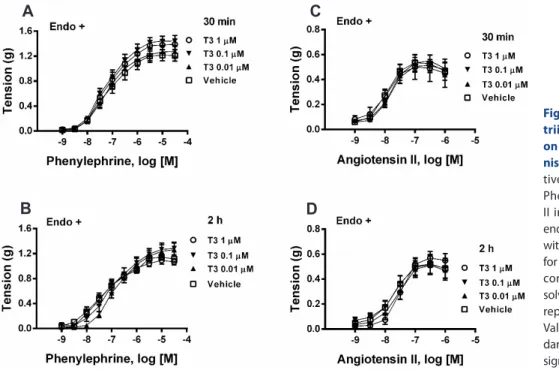
lium-intact aortic rings contracted with phenylephrine, increasing concentrations of
T3 did not alter contractility. Likewise, in vitro T3 did not modify relaxant responses
induced by acetylcholine or sodium nitroprusside (SNP) nor contractile responses
elicited by phenylephrine or angiotensin II in endothelium-intact aortas. Concentra-
tion-response curves (CRCs) to acetylcholine and SNP in endothelium-intact aortic
rings from T3
1d and T3
3d rats were unmodified. T3
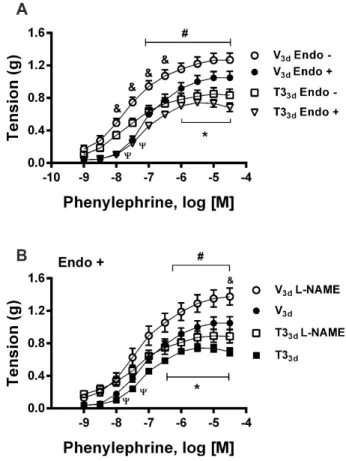
3d, but not T3
1d, treatment dimin-
ished CRCs to phenylephrine in endothelium-intact aortic rings. CRCs to phenyleph-
rine remained significantly depressed in both endothelium-denuded and endotheli-
um-intact, nitric oxide synthase inhibitor-treated, aortas of T3
3d rats. In endothelium-
denuded aortas of T3
3d rats, CRCs to angiotensin II, and high K
+ contractures, were
decreased. Thus, in vitro T3 neither modified phenylephrine-induced active tonus
nor CRCs to relaxant and contractile agonists in endothelium-intact aortas, discard-
ing rapid non-genomic actions of this hormone in smooth muscle and endothelial
cells. Otherwise, T3
3d-treatment inhibited aortic smooth muscle capacity to contract,
but not to relax, in an endothelium- and NO-independent manner. This effect may be
mediated by delayed non-genomic/genomic or genomic mechanisms.