L
ongitudinal studies have reported a high percentage of success in maintaining the attach- ment of root form implants to bone. Althoughproblems do occur at the implant-bone inter- face, the most common failures involve pros- thetic components and restorative materials.
Previous studies have shown that the most
Screw joint stability according to abutment screw materials
Yong-Tae Jeong, DDS, MSD, Chae-Heon Chung, DDS, MSD, PhD, Heung-Tae Lee, DDS, MSD
Department of Prosthodontics, College of Dentistry, Chosun University
Statement of problem. There have been previous studies about instability according to screw material by means of calculating preload in tightening screw or recording of the torque necessary to loosen screw after tightening screw.
Purpose.The purpose of this study was to evaluate screw joint stability through the analysis of fitness at the mating thread surfaces between implant and screw after tightening screws made of different materials.
Material and methods. In this study, screws were respectively used to secure a cmented abut- ment to a hexlock implant fixture; teflon coated titanium alloy screw and titanium alloy screw(Steri- Oss), gold-plated gold-palladium alloy screw and titanium alloy screw(Implant Innovation), gold screw and titanium screw(AVANA Dental Implant System). Each abutment screw was secured to the implant with recommended torque value using a digital torque controller. Each screw was again tightened after 10minutes. All samples were cross sectioned with sandpaper and polished. Then samples were evaluated with an scanning electron microscope analysis.
Results.In titanium alloy screw, irregular contact and relatively large gap was present at mat- ing thread surface. Also in teflon-coated titanium screw, incomplete seating and only partially contact was present at the mating thread surface. In gold-plated gold-palladium alloy screw, relatively close and tight contact without the presence of large gap was present by existing of gold coating at the mating thread surfaces. In gold alloy screw, relatively small gap between the mating components was seen.
Conclusions. This result suggested that gold plated gold-palladium alloy screw and gold alloy screw achieved a greater degree of contact at the mating thread surfaces compared to titani- um alloy screw and teflon-coated titanium alloy screw.
Key Words
Screw joint stability, mating thread surface, alloy screw, tight contact, gap
J Korean Acad Prosthodont : Volume 39, Number 3, 2001
common problem associsted with dental implant systems is loosening of the screw that holds the prosthesis and implant together.1Jemt2reported that in a population of 373 edentulous patients receiving 391 prostheses, 42% of the maxillary and 27% of the mandibular prostheses exhibited unstable gold screws at the 2 week postplacement appointment.2)The number of loose screws report- ed in studies vary. This may be the result in part of differences in prosthesis designs and the large variability in biting force between people and between different teeth in the same mouth.3
Researchers have concluded that the following factors contribute to screw instability; poor tight- ening, an inadequate prosthesis, poor compo- nent fit, excessive loading, settling of the screws, inadequate screw design, and the elasticity of bone.4Screw loosening seems to occur most often with single tooth implant restoration but also been reported to occur in multiple unit situa- tion. It is also possible to cause worse problems, such as bone loss or implant fracture.5
The microcosm of the screw joint demonstrates dynamic characteristics influenced by both inter- nal and external live loads. Factors such as preload, settling, and elongation play a critical role in screw-joint stability. For example, the tightening torque applied to a screw is taken up by the under surface of the head and its threads. As this occurs, the component parts are compressed together and the screw elongates. The stretched screw pulls the segments together and this tensile force is designated as the “preload”. For optimum joint stability, this should be as high a value as pos- sible. However, exceeding the elastic limit of the screw results in fracture and ultimate failure. The optimum tightening torque was reported at 75%
of the torque required to break the screw.4 Factors involved with screw joint remaining retentive are fit of the mating surfaces, length and width of the screws holding the component together, size of the components, and materials
used.6The single most significant factor that determines the bolting characteristics of the screw is the construction material, and manu- facturers have made numerous changes in that regard.
In Haack et al.1study, mean preload was 464N for gold screws and 380N for titanium. And Laney et al.7study, screw loosening effects in gold screws was lesser than in titanium screw.
There have been previous many studies about instability according to screw material by means of calculating preload in tightening screw or recording of the torque necessary to loosen screw after tightening screw.1,3,8-10
Therefore, the purpose of this study was to evaluate screw joint stability through the analy- sis of fitness between implant and screw after tight- ening screws made of different materials in SEM(scanning electron microscope).
MATERIAL AND METHODS
Material(Table ⅠⅠ) 1) Implant fixture
The implants selected in this study were exter- nal hexagonal extention threaded implants from Steri-Oss(Hexlock 3.8D×10mm; Steri-Oss, Yorba Linda,CA), 3i(Hexlock 3.75D×10mm; 3i/implant Innovations Inc,USA), AVANA Standard Fixture(Hexlock 3.75D×10mm ;AVANA Dental Implant System, Korea). Total 6 implants were selected.
2) Abutment
Cemented abutments for use with each implant system were also acquired. They were Steri-Oss staight abutment (∅4×10mmH), 3i Prep-Tite Post abument(∅4×10mmH), AVANA cement- ed abutment(∅4×8mmH).
Table Ⅰ. Kinds of implant system, abutments, screws and torque value used in this study
Steri-Oss Staight abutment Teflon-coated titanium alloy screw (Torq-Tite) 30
(∅4×10mmH) Titanium alloy screw 20
Prep-Tite Post Gold-plated Gold-palladium 32
3i Innovation
abument(∅4×10mmH) alloy screw(Gold-Tite)
Gold-pallalium alloy screw 20
AVANA Cemented abutment Gold alloy screw 30
(∅4×8mmH) Titanium alloy screw 20
3) Screw
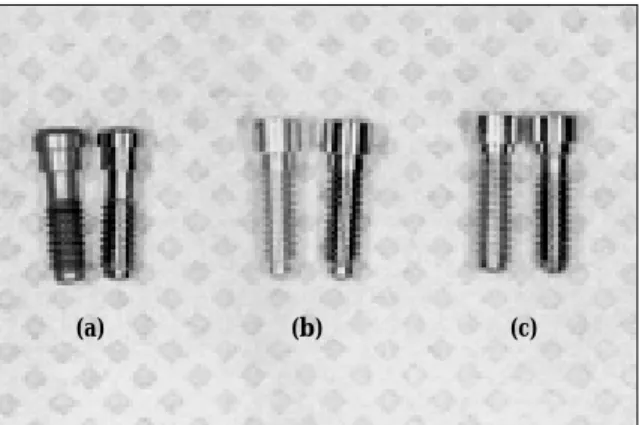
In this study, screws were respectively used to hold a abutment to a implant fixure(Fig. 1);
Teflon-coated titanium screw and titanium alloy screw(Steri-Oss system), gold-plated gold-pal- ladium alloy screw and titanium alloy screw(3i sys- tem), gold screw and titanium screw (AVANA Dental Implant System).
Method
1) Implant mounting in resin block
The implants were perpendiculary mounted in polymethyl methacrylate autopolymreizing acrylic resin block (Orthodontic resin, Densply
international Inc. USA) by use of dental surveyor.
2) Connection of each abutment to implant Each abutment was secured to the implant by screw with recommended torque value using a dig- ital torque controller(Branemark system DEA 020 Torque Controller). This torque controller was used to insure that an accurate and repro- ducible force was applied to each abutment screw(Fig. 2). The abutment screws were again retightened after 10 minutes following original tughtening.
3) Cross section and polishing of all samples All samples were cross sectioned with grinder- Fig. 1.Kind of abutment screws(a: Steri-Oss implant system,
b:3i implant system, c:AVANA implant system).
Implant system Abutment Screw type Recommended
torque(Ncm)
(a) (b) (c)
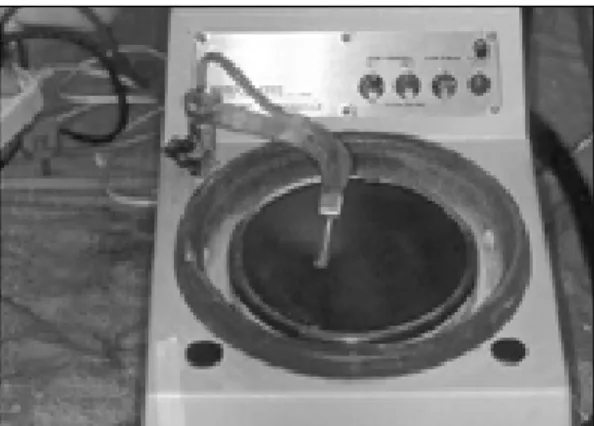
polisher unit(Omnilap 2000 SBT Inc)(Fig. 3) after embeded in liquid unsaturated polyesther(Epovia, Cray Valley Inc). The initial grinding was per- formed with 200 grid silicon carbide paper.
Polishing was continued with 1000, 1200 grid silicone carbide paper. Final polishing was carried out with a plano cloth and 1
μ
m Al2O3. All speci- mens were cleaned in liquid soap and water in an ultrasonic cleaner.4) Analysis of fitness between abutment screw/
implant interface in SEM
Then samples were evaluated in scanning elec- tron microscope (JSM 5400, Jeolco, Inc, Japan) analysis.
RESULTS
The fitness between abutment screw/implant interface in Steri-Oss system.
In the case of titanium alloy screw, irregular con- tact and relatively large gap was present at the mat- ing thread surfaces(Fig. 5). Also in the case of teflon- coated titanium screw, incomplete seating and only partially contact was present at the mating threads between implant and screw(Fig. 6).
The fitness between abutment screw/implant interface in 3i system.
In the case of gold-plated gold-palladium alloy screw, gold coating material was present at the mat- ing thread surfaces between implant and screw.
Therefore relatively close and tight contact with- out the presence of large gap was presented by existing of gold coating(Fig. 7). In titanium alloy screw, incomplete seating and partially contact was presented at the mating thread surfaces between implant and screw(Fig. 8).
The fitness between abutment screw/implant interface in AVANA system.
In the case of gold alloy screws, relatively small gap was presented at the thread surfaces between Fig. 2.Torque controller (Branemark system DEA 020
Torque Controller).
Fig. 4.Samples which were cross sectioned and polished.
Fig. 3.Grinder-polisher unit (Omnilap 2000 SBT Inc).
Fig. 5.Pictures of implant-titanium alloy screw assembly of Steri-Oss implant system in SEM(Magnification ×35,
×100,×250).
Fig. 6.Pictures of implant-teflon coated titanium alloy screw assembly in Steri-Oss implant system in SEM(Magnification
×35,×100,×250).
Fig. 7. Pictures of implant-gold plated gold alloy screw assembly in 3i implant system in SEM (Magnification ×35,
×100,×250).
Fig. 8.Pictures of implant-titanium alloy screw assembly in 3i implant system in SEM (Magnification ×35,×100,×
250).
implant and screw(Fig. 9). But in titanium alloy screw, irregular contact and relatively large gap was present at the mating thread surfaces(Fig. 10).
DISCUSSION
Previous studies have shown that the most common problem associated with dental implant systems is loosening of the screw that holds the prosthesis and implant together. In a further effort to overcome problems with joint instabil- ity the abutment-retaining screw has been mod- ified with respect to material, shank length, num- ber of threads, diameter, length, thread design, and torque application.11
There have been various screw materials by manufacturers. So we selected titanium alloy screw and teflon-coated titanium screw(Steri- Oss implant system), titanium alloy screw and gold-plated gold-palladium alloy screw(3i Implant system), titanium screw and gold screw (AVANA Dental Implant System, Korea).
To achieve a stable joint, the recommended torque values for tightining the various compo- nents must be followed. Some hand torque drivers are limited to providing consistent torque.
Electronically controlled torque drivers are more consistent and provide a variety of torque levels.4 So in this study, each abutment screw was secured to the implant with recommended torque val- ue(table 1) using a digital torque controller (Branemark system DEA 020 Torque controller).
Because neither the internal threads of the implant nor the screw threads that contat these internal threads can be machined perfectly smooth, high spots will inevitably be present on both surfaces.
Thus these high spots will be the only contacting surfaces when the initial tightening torque is applied to the screw and the preload develope. As the screw-joint components press together, the microsurface irregularities under the screw head, in the threads, and on the contact surface of the implant and the abutment start to flatten out.
This surface deformation of the contacting surfaces Fig. 9. Pictures of implant- gold alloy screw assembly in AVANA implant system in SEM (Magnification ×30,×100,
×250).
Fig. 10.Pictures of implant-titanium alloy screw assembly in AVANA implant system in SEM (Magnification ×30,
×100,×250).
is called “settling.”And 2%�10% of the initial pre- load is lost.2The amount of settling that occurs depends on the amount of rough spots on the con- tacting surfaces, the surface material hardness of the implant and the screw, and the amount of load applied to the system.4If the amount of settling is greater than the elastic elongation of the screw, the screw loses its ability to hold the parts together.
Externally applied live loads tend to further amplify the dynamic changes within the screw joint. To mitigate the consequences of this dynam- ic phenomenon, it is essential that components be retightened after their initial insertion and peri- odically thereafter.4So in this study the abut- ment screws were again retightened after 10min- utes following original tightening.10
Screws essentially hold the components togeth- er by compression, and the component parts must fit together intimately with very close tol- erances to avoid rotation and wiggling motions that lead to screw instability. When machined sur- faces do not fit passively and the screw is seated, threads bind; the results will be uneven thread con- tact, internal thread damage, increased settling, screw loosening, possible fracture and potential implant loss.8
The contacting surfaces of these interfaces play a major part in the torque-preload relationship and ultimately in the fatigue life of the screws.16,17,18 Applied torqe and preload are only indirectly pro- portional because of the frictional forces that act on the interfaces. Frictional forces depend on the geometry and material properties of the components that make up the screw interfaces. Size and surface area of the contacting theads, the pitch, the screw radius and the diameter of the head of a screw play a major role in the relationship between applied torque and preload.19-21
The importance of tightening is the applica- tion of the optimum preload. but the operation of tightening involves the application of torque.
Relationship between the torque reacted in the
threads and the preload is concerned coefficient of friction, geometry, and material properties.
The coefficient of friction is dependent on the hard- ness of the threads, the surface finishes as mate- rial properties. During loading the threads will deform and change the geometric factors. These changes will be functions of the modulus of elas- ticity, the Poissons ratio(=lateral strain/longi- tudinal strain), and the yield stress, because both gross elastic deformation and in the roots of the thread will occur.22 Low tensile strength and yield strength limit the amount of preload that can be obtained.
In a further effort to overcome problems with joint instability, the abutment screw has evolved to maximize preload and minimize loss of input torque to friction. The friction resistance between the titanium of the implant threads and the tita- nium of the screw threads, resulting in part from
“galling,”a form of adhesive wear that occurs dur- ing the intimate sliding contact of 2 like materi- als, limits the preload characteristics of titani- um screw. Hence transition has been made to the gold-alloy screw. Gold-alloy screws have a low- er coefficient of friction, can be tightened more effectively to higher preloads, and will not stick to titanium. A gold-alloy screw can attain preloads of more than 890N at approximately 75% of its yields strength, which is more than twice that attainable with a titanium-alloy screw. Current gold screw metallurgy varies between manufactur- ers, ranging in gold content from 64.1% to 2%, with yield strengths of 1,270N to 1,380N.12,23-25In Haack et al.1study, mean preload was 464N for gold screws and 380N for titanium.
In this study, the cases of gold-plated gold- palladium alloy screw(3i implant system) and Gold screw of AVANA system were seen relatively small gap between mating components than the case of titanium screw. Gaps between the com- ponents can act as a trap for bacteria, which might cause malodor and inflammatory reac-
tions in the peri-implant soft tissues.13,14 and might cause crevice corrosion.15 Then in this study, it is suggested that discrepancy or large gap between the mating threads in the case of titanium screw may result in above problem. And screw loosening effects in gold screw will be lesser than in titanium screw as Laney et al.7reported.
When two metal surfaces slide over one anther, adhesion and friction inhibits the movement of one across the other. In an effort to reduce frictional resistance even more, dry lubricant coatings have been applied to abutment screws. Most notable are Gold-Tite(3i Implant system) and TorqTite (Steri-Oss implant system). Gold-Tite screw is a gold palladium alloy screw which is coat- ed with pure gold. The pure gold coating acts as a lubricant to allow the screw to rotate further dur- ing tightening. According to manufacturer report, the Gold-Tite screw’s rotation capability dur- ing torque placement, elongates the retaining screw for an additional 25% preload clamping force. In the case of gold-plated gold-palladium alloy screw(Gold-Tite, 3i) of this study, gold coating material was squeezed and filled the gap between the mating threads. TorqTite is a pro- prietary teflon coating applied to titanium alloy screws, with a reported reduction of the fric- tional coefficient by 60%. But in the case of teflon coated titanium screw of this study, irregular contact and relatively large gap was present between the mating threads and there was no wide difference between the cases of TorqTite screw and titanium screw. Further study is needed to know irregular contact and relatively large gap in the case of teflon coated titanium screw.
This results suggested that gold plated gold-pal- ladium alloy screw and gold alloy screw achieved a greater degree of contact at the mating thread surfaces compared to titanium alloy screw and teflon-coated titanium alloy screw.
CONCLUSIONS
1. In the case of titanium alloy screw in Steri-Oss system, irregular contact and relatively large gap was present at the mating thread sur- faces. Also in the case of teflon-coated titanium screw, incomplete seating and only partially con- tact was present at the mating thread sur- faces between implant and screw.
2. In the case of gold-plated gold-palladium alloy screw in 3i system, gold coating materi- al was present at the mating thread surfaces between implant and screw. Therefore relatively close and tight contact without the presence of large gap was present by existing of gold coating material. In titanium alloy screw, incomplete seating and partially contact was present at the mating thread surfaces between implant and screw.
3. In the case of gold alloy screw in AVANA system, relatively small gap was present at the mating thread surfaces between implant and screw. But in titanium alloy screw in AVANA system, irregular contact and relatively large gap was present at the mating thread sur- faces.
Conclusively, gold plated gold-palladium alloy screw and gold alloy screw achieved a greater degree of contact at the mating thread surfaces compared to titanium alloy screw and teflon- coated titanium alloy screw.
This study was supported(in part) by research funds from Chosun University , 2000.
REFERENCES
1. Haack JE, Sakaguchi RL, Sun T, Coffey JP.
Determination of preload stress in dental implant screws. J Dent Res 73(Iadr Abstrcts) 1994;No. 808.
2. Jemt T, Laney WR, Harris D, Henry, PJ, Krogh P, Polizzi G. Osseointegrated implants for single tooth replacement. A 1-year report from a mul- ticenter prospective study. Int J Oral Maxillofac
Implants 1991;6: 29-36.
3. Haack JE, Sakaguchi RL, Sun T, Coffey JP.
Elongation and preload stress in dental implant abutment screws. Int J Oral Maxillofac Implants 1995;10:529-536.
4. Binon PP, Sutter F, Brunski J, Gulbransen H, Weiner R. The role of screws in implant systems.
Int J Oral Maxillofac Implants 1994; 9: 48-62.
5. McGlumphy EA, Mendel DA. Implant screw me- chanics. Dental Clin North Am 1998; 42: 71-89.
6. Schulte JK, Coffey J. Comparison of screw reten- tion of nine abutment systems:A pilot study.
Implnat Dent 1997; 6:28-31.
7. Laney WR, Jemt T, Harris D. Osseointegrated im- plants for single tooth replacement:Progress report from a multicenter prospective study after 3 years.
Int J Oral Maxillofac Implants 1994:49-54.
8. Binon PP, McHugh MJ. The effect of eliminating im- plant/abutment rotational misfit on screw joint sta- bility. Int J Prosthodont 1996; 9:511-519.
9. J rneus L, Jemt T, Carlsson L. Loads and designs of screw joints for single crowns supported by os- seointegrated implants. Int J Oral Maxillofac Implants 1992; 7:353-359.
10. Breeding LC, Dixon DL, Nelson EW, Tietge JD.
Torque required to loosen single-tooth implant abut- ment screw before and after simulated function. Int J Proshodont 1993;6(5): 435-439.
11. Eckert SE, Wollan PC. Restrospective review of 1170 endosseous implants placed in partially edentulous jaws. J Prosthet Dent 1998;79:415-421.
12. Binon PP. Implants and components :Entering the new millennium. Int J Oral Maxillofac Implants 2000; 5:76-94.
13. Gross M, Abramovich I, Weiss EI. Microleakage at the abutment-implant interface of osseointegrat- ed implants. Int J Oral Maxillofac Implants 1999;14:94-100.
14. Jansen VK, Conrads G, Richter EJ. Microbial leak- age and marginal fit of the implant-abutment Interface. Int J Oral Maxillofac Implants 1997;12:527- 540.
15. Kee SJ, Kweon HS, Choe HC. Corrosion charac- teristics between implant fixture and abutment
screw. J Kor Ac Prstho 2000;38:85-97.
16. Byren D, Houston F, Cleary R. Claffey N. The fit of cast and premachined implant abutments. J Prosthet Dent 1998;80:184-192.
17. Carr AB, Brunski JB, Hurley E. Effect of fabrication, finishing, and polishing procedures on preload in prostheses using conventional gold and plastic cylinders. Int J Oral Maxillofac Implants 1996;11:589- 598.
18. Dixon DL, Breeding LC, Sadler JP, Mckay ML.
Comparison of screw loosening, rotation, and de- flection among three implant designs. J Prosthet Dent 1995;74:270-8.
19. Jaarda MJ, Razzoog ME, Gratton DG. Effect of preload torque on the ultimate tensile strength of implant prosthetic retaining screws. Implant Dent 1994; 3:17-21.
20. Porter, T. T. Robb. Increasing implant-abutment pre- load by thin-gold coating abutment screws.
Implantology Research. 1999.
21. Jaarda MJ, Razzoog ME, Gratton DG. Geometric comparison of five interchangeable implant pros- thetic retaining screws. J Prosthet Dent 1995;74:373- 379.
22. Burguette RL, Johns MR, King TB, Patterson EA.
Tightening characteristic for screwed joint in os- seointegrated dental implant. J Prosthet Dent 1994;71:592-599. 23.Binon PP. Evaluation of mach- ing accuracy and consistency of selected implant, standard abutments and laboratory analog. Int J Prosthodont 1995;8:162-178.
24. Binon PP. Evaluation of three slip fit hexagonal im- plants. Implant Dent 1996;5:253-248.
25. Binon PP. The effect of implant/abutment hexag- onal misfit on screw joint stability. Int J Prosthodont 1996; 9:149-152.
Reprint request to:
CHAE-HEONCHUNG, D.D.S., Ph.D.
DEPT. OFPROSTHODONTICS,
COLLEGE OFDENTISTRY,CHOSUN UNIVERSITY
588, SEOSUK-DONG, DONG-KU, KWANGJU, 501-140, KOREA Tel:82-62-220-3820,
E-mail:[email protected]