Evaluation on Surface Scaling and Frost Resistance for Concrete Deteriorated due to Cyclic Freezing and
Thawing with Inherent Chloride
Gyu Yong Kim1,†, Bong Suk Cho2, Seung Hoon Lee3, and Moo Han Kim4
1Professor, Dept. of Architectural Engineering, Chungnam National University, Korea
2Doctoral course, Dept. of Architectural Engineering, Chungnam National University, Korea
3The Chief Engineer of Samsung Corporation, Korea
4Professor, Dept. of Architectural Engineering, Chungnam National University, Korea
The purpose of this study is to evaluate freezing-thawing and surface scaling resistance in order to examine the frost durability of concrete in a chloride-inherent environment. The mixing design for this study is as follows: 3 water binder ratios of 0.37, 0.42, and 0.47; 2-ingredient type concrete (50% OPC concrete and 50% ground granulated blast-furnace slag), and 3-ingredient type concrete (50% OPC concrete, 15%
fly ash, and 35% ground granulated blast-furnace slag). As found in this study, the decrease of durability was much more noticeable in combined deterioration through both salt damage and frost damage than in a single deterioration through either ofthese; when using blast-furnace slag in freezing-thawing seawater, the frost durability and surface deterioration resistance was evaluated as higher than when using OPC concrete.
BF 50% concrete, especially, rather than BFS35%+FA15%, had a notable effect on resistance to chloride penetration and freezing/expansion. It has been confirmed that surface deterioration can be evaluated through a quantitative analysis of scaling, calculated from concrete's underwater weight and surface-dry weight as affected by the freezing-thawing of seawater.
Keywords : salt damage, freezing-thawing, surface scaling, ground granulated blast-furnace slag, ternary concrete
†Corresponding author: [email protected]
1. Introduction
In terms of environmental conditions, seawater-affected concrete is different from ordinary concrete in that it is subject to combined deterioration caused by salt pene- tration and diffusion, abrasion by water droplets, dry-wet repetition, and the freezing-thawing of seawater. These multiple deterioration factors combine to result in much shorter durability of marine concrete structures than through the ordinary speed of chloride diffusion. This is thought to be because the deterioration stress, e.g. seawater penetration and freezing-thawing, is increased to destroy the surface structure of concrete and bring about a synergy effect. There is, however, little research on durability eval- uation that considers the combined deterioration by salt damage and freezing-thawing.1),2)
Alternatively, the surface deterioration of concrete is generally due to the expansion pressure occurring when
the moisture inside and outside concrete is frozen. Since the expansion pressure caused by the freezing of seawater is higher than that caused by the freezing of ordinary wa- ter, the seawater freezing outside the concrete leads to a further sharp surface deterioration.3) That is, surface deteri- oration can be more rapid than the destruction of the in- ternal structure of concrete by seawater, and a great de- crease of soundness of coated concrete can speed up the progress of salt damage.
This study, therefore, aims to evaluate the decrease of durability and the scaling deterioration of concrete under the combined deterioration conditions created in a marine environment (e.g. chloride penetration and freezing-thaw- ing), to assess the frost durability and surface scaling dete- rioration of concrete caused by the freezing of inherent chloride and seawater, and to examine the combined de- crease of durability of concrete under the condition of combined deterioration by salt damage and frost damage.
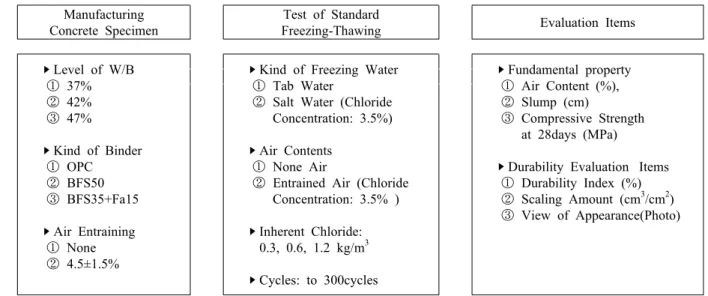
Manufacturing Concrete Specimen
Test of Standard
Freezing-Thawing Evaluation Items
▸Level of W/B ① 37%
② 42%
③ 47%
▸Kind of Binder ① OPC ② BFS50 ③ BFS35+Fa15
▸Air Entraining ① None ② 4.5±1.5%
▸Kind of Freezing Water ① Tab Water
② Salt Water (Chloride Concentration: 3.5%)
▸Air Contents ① None Air
② Entrained Air (Chloride Concentration: 3.5% )
▸Inherent Chloride:
0.3, 0.6, 1.2 kg/m3
▸Cycles: to 300cycles
▸Fundamental property ① Air Content (%), ② Slump (cm)
③ Compressive Strength at 28days (MPa)
▸Durability Evaluation Items ① Durability Index (%) ② Scaling Amount (cm3/cm2) ③ View of Appearance(Photo)
Fig. 1. Process and guide line of this study
2. Outline of experiment
2.1 Experimental plan
Fig. 1 shows a summary and the progress of this study;
in order to evaluate the frost durability and scaling deterio- ration of concrete caused by freezing-thawing under a chloride-inherent environment, artificial seawater4) with chloride of 3.5% concentration was prepared as frozen wa- ter and tap water. In the assumption that chloride exists inside concrete, chloride contents of 0.3, 0.6, and 1.2 kg/m3 were injected into the concrete.
The water binder ratio for concrete was set at 37, 42, and 47%. To evaluate the basic physical properties of con- crete, two kinds of binders were composed of OPC (Ordinary Portland Cement), BFS (2-ingredient type), BFS + Fly Ash (3-ingredient type). Also, in order to evaluate relative dynamic modulus and surface scaling amount, freezing-thawing tests were performed according to the en- trainment of air contents, the W/B ratio (water binder ra- tio), and the binder ingredient type.
2.2 Used materials and mix design
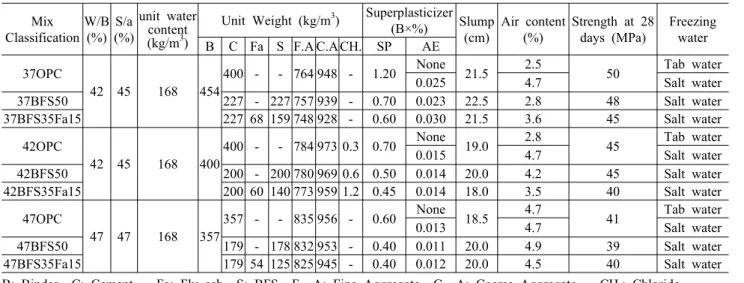
As shown in Table 1, the mixing design of concrete is as follows: water binder ratio of 37, 42, and 47%; 2-in- gredient type (50% OPC and 50% slag); 3-ingredient type (50% OPC, 35% slag, and 15% fly ash). Table 2 shows the materials used in this study. The admixture of OPC, ground granulated blast-furnace slag and fly ash was used as a concrete binder. Superplasticizer and AE agent were used to secure a certain consistency and air contents for concrete. River sand and crushed aggregate were used as aggregate.
2.3 Fundamental properties of concrete
Table 1 shows the basic physical properties of concrete.
The ranges of slump and air contents of OPC, BFS50%, and BFS35%+FA15% at the water binder ratios of 37, 42 and 47% were 18.0~21.5 cm, 3.5~5.0%. The air con- tents of none AE OPC concrete were 2.5, 2.8 and 3.8%
at the water binder ratios of 37, 42 and 47%. The com- pressive strength on the 28th day of standard curing dif- fered with each mixing design (OPC > BFS50% >
BFS35%+FA15%). It was measured at 45~50 Mpa, 43~45 Mpa, 39~41 MPa at the water binder ratios of 37%, 42%
and 47%, respectively.
2.4 Test items and testing method
Photo 1 illustrates the method used to evaluate the frost durability of concrete caused by freezing-thawing. The test was performed in accordance with KS F 2456 (testing method for resistance of concrete to rapid freezing and thawing) and ASTM C666 (resistance of concrete to rapid freezing-thawing). During the freezing-thawing test, the first resonant frequency was measured every 30 cycles and the relative dynamic modulus for the dynamic modulus before the freezing-thawing test was calculated.5) At the end of 30 cycles, the underwater weight and surface-dry weight of the specimen were measured in order to quantita- tively analyze the surface deterioration of concrete. Then the scaling amount (cm3/cm2) of concrete was measured using Equation (1).
Equation (1)
Table. 1. Mixing design and Fundamental Property of Concrete Mix
Classification W/B
(%) S/a (%)
unit water content (kg/m3)
Unit Weight (kg/m3) Superplasticizer (B×%) Slump
(cm)
Air content (%)
Strength at 28 days (MPa)
Freezing water B C Fa S F.A C.A CH. SP AE
37OPC
42 45 168 454
400 - - 764 948 - 1.20 None
21.5 2.5
50 Tab water
0.025 4.7 Salt water
37BFS50 227 - 227 757 939 - 0.70 0.023 22.5 2.8 48 Salt water
37BFS35Fa15 227 68 159 748 928 - 0.60 0.030 21.5 3.6 45 Salt water
42OPC
42 45 168 400
400 - - 784 973 0.3 0.70 None
19.0 2.8
45 Tab water
0.015 4.7 Salt water
42BFS50 200 - 200 780 969 0.6 0.50 0.014 20.0 4.2 45 Salt water
42BFS35Fa15 200 60 140 773 959 1.2 0.45 0.014 18.0 3.5 40 Salt water
47OPC
47 47 168 357
357 - - 835 956 - 0.60 None
18.5 4.7
41 Tab water
0.013 4.7 Salt water
47BFS50 179 - 178 832 953 - 0.40 0.011 20.0 4.9 39 Salt water
47BFS35Fa15 179 54 125 825 945 - 0.40 0.012 20.0 4.5 40 Salt water
B: Binder, C: Cement, Fa: Fly ash, S: BFS, F․A: Fine Aggregate, C․A: Coarse Aggregate, CH.: Chloride, SP: High Water Reducing Agent, AE: Air Entraining Agent
Table 2. Physical Properties of Used Materials Materials Physical Properties
Cement
∙Ordinary Portland Cement(OPC)
∙Specific Gravity:3.16, ∙Fineness:3,214cm2/g
∙Ig. loss:0.78, ∙Stability:0.06%
∙Initial setting time-2:36,
∙Final setting time-5:17 Blast Furnace
Slag ∙Specific Gravity:2.89, ∙Fineness:4,340cm2/g
∙Ig. loss:0.59%, ∙Chloride ion:0.001%,
Fly Ash
∙Specific Gravity:2.19, ∙Fineness:3,621cm2/g
∙Ig. loss:3.29%, ∙Moisture volume:0.13%
∙SiO2 Volume:63%
Super-
plasticizer ∙High Water Reducing Agent
∙Naphthalene Type ∙Air entraining agent Fine
Aggregate ∙Washing sand, ∙Specific Gravity:2.58,
∙Absorption ratio:1.01, ∙F.M.:2.89 Coarse
Aggregate
∙Crushed Gravel(25mm)
∙Specific Gravity:2.62,
∙Absorption ratio:0.82 ∙F.M.:6.87
where, Vsn: Scaling volume after n cycles (cm3/cm2) Vo : Volume of specimens before freezing-thaw-
ing test (cm3)
Vn : Volume of specimens after n cycles (cm3) A : Surface area of specimens before freez-
ing-thawing test (cm2)
The volume (cm3) of the specimen was calculated using Formula (2).
Equation (2)
(a) Freezing-thawing testing machine
(b) Evaluation of dynamic elasticity modulus Photo 1. Resistance evaluation of concrete to freezing and thawing where, Vn : Volume of specimens after n cycles (cm3) Wn : Surface drying weight after n cycles (g) Wwn: Underwater weight after n cycles (g) pw : Specific gravity of water
3. Experimental results
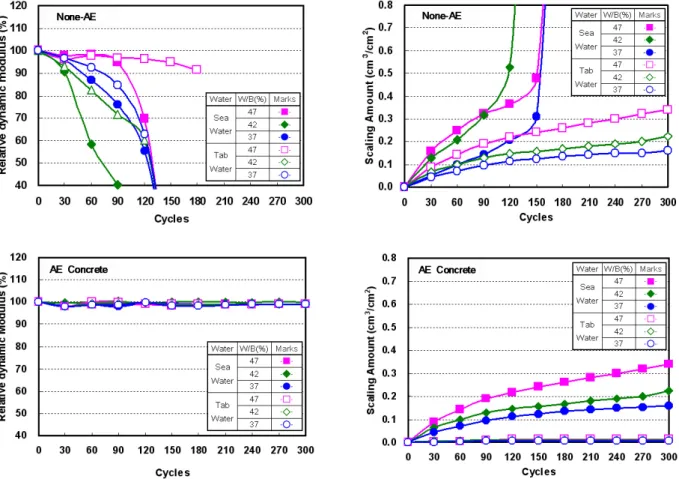
3.1 Frost resistance of concrete with air contents Fig. 2, respectively, show the results of evaluating the frost durability of none AE concrete and AE concrete at each water binder ratio of OPC-using concrete. In the case of none AE concrete, the rupture and relative dynamic modulus of the specimen were noticeably decreased, whether through tap water or seawater. The specimen frost-damaged by tap water showed a rupture without any sign of surface deterioration, while the specimen frost- damaged by seawater showed signs of rapid surface deteri- oration and of breaking and rupture. Especially in the case of the specimen under the freezing-thawing test at W/B
Fig. 2. Relative dynamic modulus and surface scaling amount of None AE Concrete and AE Concrete with freezing-thawing
of 47% using tap water, no rapid decrease of relative dy- namic modulus was shown before 180 cycles, but at 180 cycles an abrupt rupture occurred, making further measure- ments impossible.
Therefore, it has been confirmed that in the case of none AE concrete frost-damaged by seawater, deterioration oc- curs simultaneously inside and outside the concrete and the durability rapidly decreases.
Meanwhile, in the case of AE concrete, whether with tap water or seawater, the relative dynamic modulus, prov- ing to have excellent durability, showed little change be- fore and after frost-damage,. But, surface deterioration was more noticeable in the specimen frost-damaged by sea- water than that frost-damaged by tap water. The surface deterioration of concrete frost-damaged by seawater was reduced by increasing the strength of concrete and securing appropriate air contents using AE agent.
3.2 Frost resistance of concrete with W/B and binder types
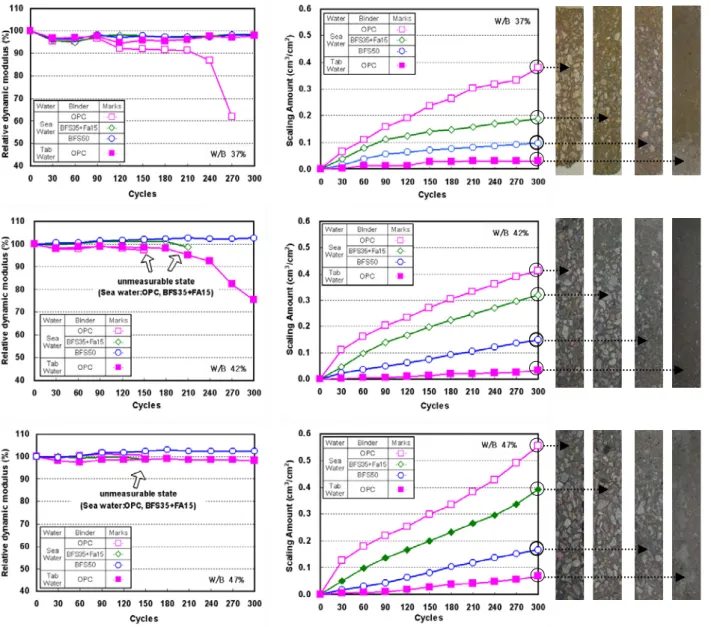
Figs. 3 and Fig. 4, respectively, show the results of eval- uating the relative dynamic modulus and surface deterio-
ration of concrete frost-damaged by seawater at each water binder ratio and binder mixing method. At W/B of 37%, the change of relative dynamic modulus was more notice- able when using seawater than tap water. This is thought to be because, when concrete is frozen, the surface deterio- ration of concrete is more accelerated, along with erosion by seawater. In the cases of the specimens under the freez- ing‐thawing test at W/B of 37% OPC-seawater and W/B of 42% OPC-tap water, the relative dynamic modulus’
were measured at 60% and 75%, respectively. All speci- mens except for these showed a relative dynamic modulus of over 95%.
Fig. 5 shows the results of evaluating the surface deteri- oration of concrete at each water binder ratio and accord- ing to freezing water. The surface scaling amount was larg- er when freezing-thawing was caused by seawater than by tap water. This is thought to be because the freezing expansion pressure on the concrete surface exercises great- er influence in the case of seawater than that of tap water.
As a result of evaluating the scaling amount at each binder ratio, OPC concrete showed a great difference in the amount of scaling through tap water as opposed to
Fig. 3. Relative dynamic modulus Fig. 4. Surface scaling amount
seawater.
In evaluating the frost durability of concrete, except for the fact that the freezing-thawing specimen at W/B of 42%
OPC-tap water showed a slight decrease in relative dynam- ic modulus, the relative dynamic modulus by tap water and seawater didn’t show any distinct trend. As well, it has been confirmed that the surface deterioration of con- crete is greatly affected by seawater.
The scaling amount of concrete according to binder ratio showed the following order: OPC>BFS35%+FA15%>
BFS 50%. Two-ingredient type and 3-ingredient type con- crete showed a relatively higher surface deterioration re- sistance compared to OPC concrete. Binder ingredient type has a more distinct effect than the reduction of water bind-
er ratio. BFS 50% concrete is the most effective for deteri- oration by seawater. This is thought to be because slag, through fixing of chloride, reduces the deterioration of concrete by chloride.
In the future, therefore, the utilization of slag is recom- mended for marine concrete structures that are subject to decreased durability due to salt damage by seawater, e.g.
sea-salt aerosols and droplets.
Photo 2 shows the surface scaling of W/B 42% OPC concrete in the case of freezing water. Surface deterio- ration was more noticeable through freezing-thawing by seawater than through tap water.
The fact that the scaling amount by seawater freez- ing-thawing becomes greater in spite of a similar relative
(a) OPC Concrete (b) BFS 35%+FA 15% Concrete (c) BFS 50% Concrete Fig. 5. Surface scaling amount of concrete with binder types
Cycles
Freezing Water 0 30 60 90 120 150 180 210 240 270 300
Tab water
Sea water
Photo 2. Surface scaling with freezing water (W/B 42% OPC Concrete) dynamic modulus is largely due to the noticeable scaling
caused by destruction of the fine structure on the concrete surface. This is thought be, as shown in Photo 3, because the freezing of the moisture inside concrete with inherent chloride decreases the stability of the fine porous structure and thus increases the osmotic pressure.
In the case of freezing-thawing of concrete with inherent chloride, a fine crack occurs inside the concrete, accelerat- ing the decrease of dynamic modulus and the diffusion of chloride, and eventually causing a combined deterio- ration through frost damage and salt damage.
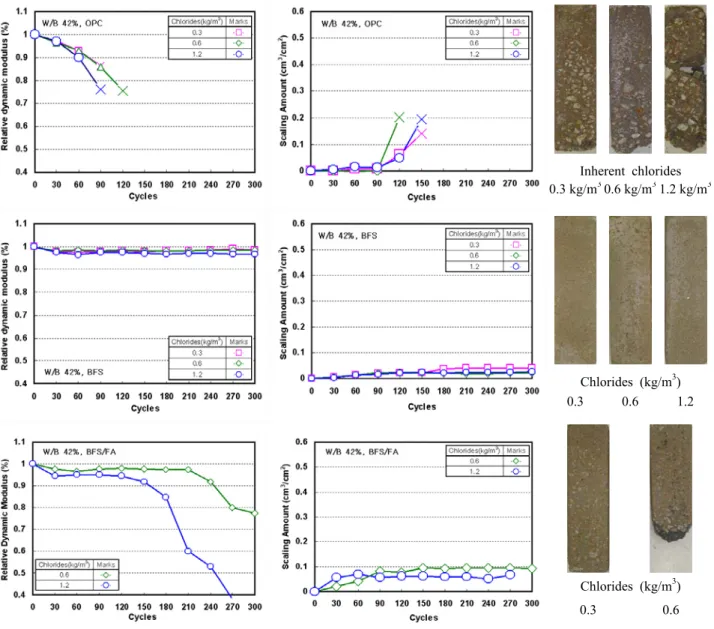
3.3 Deterioration of concrete with inherent chloride Figs. 6 and 7 show the results of evaluating the frost durability and surface deterioration of concrete with in- herent chloride. Contrary to the surface deterioration of concrete frost-damaged by outside seawater, surface dete- rioration rarely occurs in cases of concrete containing chloride inside, but its internal structure is rapidly de- stroyed, thus decreasing its frost durability. Therefore, it has been confirmed that chloride inside concrete is the
fundamental cause of a decrease in structural safety by erosion of the reinforcement, and that it triggers an abrupt decrease of resistance to frost damage.
As a result of evaluating its relative dynamic modulus and surface deterioration, BFS 50% concrete was found to be rarely subject to frost damage. BFS mixed into con- crete has the effect of decreasing the action of chloride so that, even though chloride is inherent inside concrete, this does not bring about a rapid decrease of durability, as in OPC concrete. BFS is judged to have the effect of reducing the expansion by chloride inherent inside con- crete.
Mixing chloride of 0.6 and 1.2 kg/m3 into 3-ingredient concrete (BFS35+Fa15) showed that the decrease of dura- bility was more noticeable than when it was mixed into slag 50% concrete. But it is judged to have a greater effect of hampering the decrease of durability. Therefore, BFS, a component of 3-ingredient concrete, is recognized as having the effect of reducing the expansion by chloride, but FA is not.
Inherent chlorides 0.3 kg/m30.6 kg/m31.2 kg/m3
Chlorides (kg/m3)
0.3 0.6 1.2
Chlorides (kg/m3)
0.3 0.6
Fig. 6. Relative dynamic modulus Fig. 7. Surface scaling amount
magnification Base-OPC (Before
freezing-thawing) Tab water-OPC Sea water-OPC Sea water
-BFS35%+FA15% Sea water-BFS 50%
× 50
× 250
Photo 3. The fine structure on the concrete surface (300 cycles)
Fig. 8. relationship between relative dynamic modulus and scaling amount
Table 3. surface deterioration resistances (Freezing-thawing 300cycles, Scaling amount (cm3/cm2))
Binder types W/B (%)
BFS 50%
BFS35%+
FA15% OPC
37 26 50 100
42 36 79 100
47 33 73 100
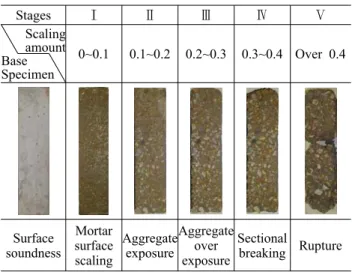
Table 4. the stages of scaling of concrete based on the scaling amount (cm3/cm2)
Stages Ⅰ Ⅱ Ⅲ Ⅳ Ⅴ
Scaling amount BaseSpecimen
0~0.1 0.1~0.2 0.2~0.3 0.3~0.4 Over 0.4
Surface soundness
Mortar surface scaling
Aggregate exposure
Aggregate over exposure
Sectional
breaking Rupture
3.4 Evaluation method of surface deterioration due to cyclic freezing and thawing
Fig. 8 shows the relationship between relative dynamic modulus and scaling amount. As a result of frost durability evaluation based on relative dynamic modulus, the con-
crete used within the scope of this study was evaluated as a high-durability concrete since it has a low water bind- er ratio and an appropriate amount of entrained air. But the surface deterioration of concrete by seawater had a wide range of change regardless of relative dynamic mod- ulus, and didn’t show any special correlation.
There are two distinct areas: Area I, where dynamic modulus decreases by freezing-thawing of tap water, and Area II, where scaling deterioration decreases by freez- ing-thawing of seawater. In the case of concrete in an envi- ronment subject to decrease of durability by seawater, this is through a combined deterioration of dry-wet repetition and freezing-thawing by seawater, so it requires not only a standard evaluation of frost durability based on relative dynamic modulus but also an evaluation of the deterio- ration of the concrete surface.
Table 3 shows the surface deterioration resistances of BFS50% and BFS35%+ FA15% concretes, based on the degree of surface deterioration of OPC concrete at 300 cycles of seawater freezing-thawing being 100.
Table 4 suggests the stages of scaling of concrete based on the scaling amount measurement result. The surface deterioration of concrete goes through the following stages: mortar surface scaling < aggregate exposure < ag- gregate overexposure < sectional breaking < rupture. It is thought that the scaling amount (cm3/cm2) of concrete can be utilized as an index to the degree of surface deterioration.
4. Conclusion
It has been confirmed that the decrease of concrete dura- bility was much more noticeable in a chloride-supplying environment than in a general environment. And, when concrete is subjected to freezing and thawing in a chlor- ide-supplying environment, we confirmed that deterio- ration of concrete increases.
(1) In the case of concrete with an appropriate amount of entrained air, the frost durability was shown to improve compared to concrete with a smaller amount of entrained air. The durability was shown to decrease more rapidly in combined deterioration through salt damage and frost damage than in a single deterioration.
(2) The frost durability and surface deterioration resist- ance of blast-furnace slag-mixed concrete were evaluated as higher than OPC concrete. BFS50% concrete showed a better effect of reducing chloride penetration, compared to BFS35%+FA15% concrete. This can be effective for improving the durability of concrete structures subject to salt damage.
(3) It has been confirmed that the quantitative analysis
of the amount of scaling, calculated from concrete’s under- water weight and surface-dry weight affected by the freez- ing-thawing of seawater, is valid as a method of evaluating concrete surface deterioration.
Acknowledgments
Parts of this study are supported by Construction &
Transportation R&D Project No. 「06 Foundation A-01」
and 2nd BK(Brain Korea) 21 Program. Thanks for sup- porting our research.
References
1. H.J. Gibbs, J.P. Bara, ASTM STP 322, 277 (1962).
2. J.E. Jennings, K. Knight, Proc. 4th Int. Conf. on soil Mech. and Found. Eng. 1, 316 (1957).
3. S. Leroueil, J.P. Magnan, Tavenas F. Remblais sur argiles molles., Technique et Documentation–Lavoisier, p.342, Paris, 1985.
4. E.L. Matyas, H.S. Radhakrishna, Géotechnique 18, 432 (1968).
5. K. Terzaghi, R.B. Peck Soil Mechanics in engineering practice, J. Wiley, New York, 1967.
6. K. Kropp, Performance Criteria for Concrete Durability, RILEM Report 12, 1995.
7. W. F. Cole and B. Kroone, ACI Journal, 31, 1275 (19??).
8. M.H. Kim, et al, Cement technology contest, 126 (19??).
9. H. Mihashi, S. Iwagami, Y. Kaneko, Concrete Research and Technology, Japan Concrete Institute. 10, 143 (1999).