73 https://doi.org/10.9713/kcer.2019.57.1.73
PISSN 0304-128X, EISSN 2233-9558
Phase Equilibrium of Binary Mixture for the (propylene oxide + 1-pentanol) System at Several Temperatures
Jeong-lae Kim, Hakmin Kim*, Su In Park*, Gyu Min An*, Min Gi Kim* and Moon Sam Shin*,†
Department of Biomedical Engineering, Eulji University, 553, Sanseong-daero, Sujeong-gu, Seongnam-si, Gyeonggi-do, 13135, Korea
*Department of Senior Health Care, Eulji University, 553, Sanseong-daero, Sujeong-gu, Seongnam-si, Gyeonggi-do, 13135, Korea (Received 15 October 2018; Received in revised form 25 November 2018; accepted 27 November 2018)
Abstract − Isothermal (vapor + liquid) equilibrium data measurements were undertaken for the binary mixtures of (propylene oxide + 1-pentanol) system at three different temperatures (303.15, 318.15, and 333.15) K. The Peng-Rob- inson-Stryjek-Vera equation of state (PRSV EOS) was used to correlate the experimental data. The van der Waals one- fluid mixing rule was used for the vapor phase and the Wong-Sandler mixing rule, which incorporates the non-random two liquid (NRTL) model, the universal quasi-chemical (UNIQUAC) model and the Wilson model, was used for the liq- uid phase. The experimental data were in good agreement with the correlation results.
Key words: Phase equilibrium, Propylene oxide, 1-Pentanol, Vapor, Liquid
1. Introduction
Glycol ethers are a group of solvents based on alkyl ethers of eth- ylene glycol or propylene glycol commonly used in pharmaceuti- cals, cosmetics and paints. These solvents typically have a higher boiling point, together with the favorable solvent properties of lower- molecular weight ethers and alcohols. Glycol ethers are classified into ethylene glycol ethers and propylene glycol ethers, depending on whether the raw material used in the synthesis is ethylene oxide or propylene oxide [1].The negligible toxicity of propylene glycol ether supports its use as a safe alternative to toxic ethylene glycol ether [2]. Propylene glycol ethers are based on reacting propylene oxide with varying chain alcohols [1]. The (vapor + liquid) equilibrium information about the mixtures of propylene oxide with alcohols is significant in the design and operation of separation processes.
Previously, we measured (vapor + liquid) equilibrium data for (propylene oxide + ethanol) and (propylene oxide + 1-propanol) [3].
In this work, isothermal (vapor + liquid) equilibrium data for the binary mixtures of (propylene oxide + 1-pentanol) system were measured at temperatures between 303.15 and 333.15 K. The experimental data were correlated using the Peng-Robinson-Stryjek-Vera equation of state (PRSV EOS) [4]. The van der Waals one-fluid mixing rule was used for the vapor phase and the Wong-Sandler mixing rule [5], which incorporates the non-random two liquid (NRTL) model [6], the universal quasi-chemical (UNIQUAC) model [7] and the Wil- son model [8], was used for the liquid phase.
2. Experimental section
2-1. Materials
Propylene oxide and 1-pentanol were supplied by Sigma Aldrich (St. Louis, MO, USA). All chemicals were used without further puri- fication. The supplier and purity of the chemicals are reported in Table 1.
2-2. Apparatus and procedures
A static (vapor + liquid) equilibrium apparatus was used to mea- sure the isothermal (vapor + liquid) equilibrium of binary mixtures.
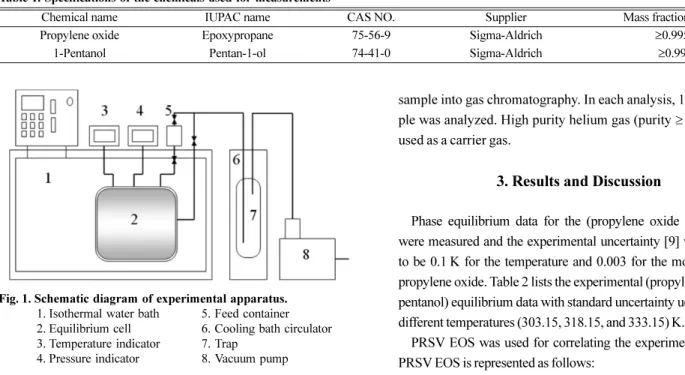
A schematic diagram of the apparatus is shown in Fig. 1. The details of the experimental apparatus and procedures can be found in previous work [3], so only the most salient information is offered here. The experimental pressure was determined using a pressure transducer (Honeywell, Model STJE) with an accuracy of ± 0.01 kPa, and the experimental temperature was determined using a digital thermome- ter (Hart Scientific, Model 5618B) with an accuracy of ± 0.008 K.
For each experiment, a small amount of liquid-phase sample was extracted and analyzed by gas chromatography.
2-3. Sample analysis
The composition of the extracted liquid was determined by a DS 6200 gas chromatograph equipped with a thermal conductivity detector. A 10% Carbowax 20M Chrom W-AW packed column (length, 2.438 m; o.d., 3.175 mm; i.d., 2.159 mm) and a 10% OV- 101 CHROM W-HP packed column (length, 3.048 m; o.d., 3.175 mm; i.d., 2.159 mm) were used for the (propylene oxide + 1-pentanol) system. For the (propylene oxide + 1-pentanol) system, the oven and detector temperatures were both kept at 373 K, the injector temperature was kept at 423 K and the current of thermal conductivity detector was 60 mA. A cooled syringe was used to inject a liquid
†To whom correspondence should be addressed.
E-mail: [email protected]
This is an Open-Access article distributed under the terms of the Creative Com- mons Attribution Non-Commercial License (http://creativecommons.org/licenses/by- nc/3.0) which permits unrestricted non-commercial use, distribution, and reproduc- tion in any medium, provided the original work is properly cited.
sample into gas chromatography. In each analysis, 1.5 µL of sam- ple was analyzed. High purity helium gas (purity ≥ 99.99%) was used as a carrier gas.
3. Results and Discussion
Phase equilibrium data for the (propylene oxide + 1-pentanol) were measured and the experimental uncertainty [9] was estimated to be 0.1 K for the temperature and 0.003 for the mole fraction of propylene oxide. Table 2 lists the experimental (propylene oxide + 1- pentanol) equilibrium data with standard uncertainty u(p) [9] at three different temperatures (303.15, 318.15, and 333.15) K.
PRSV EOS was used for correlating the experimental data. The PRSV EOS is represented as follows:
Fig. 1. Schematic diagram of experimental apparatus.
1. Isothermal water bath 5. Feed container 2. Equilibrium cell 6. Cooling bath circulator 3. Temperature indicator 7. Trap
4. Pressure indicator 8. Vacuum pump Table 1. Specifications of the chemicals used for measurements
Chemical name IUPAC name CAS NO. Supplier Mass fraction purity
Propylene oxide Epoxypropane 75-56-9 Sigma-Aldrich ≥0.995
1-Pentanol Pentan-1-ol 74-41-0 Sigma-Aldrich ≥0.99
Table 2. Experimental (vapor + liquid) equilibrium data for temperature T, pressure p with standard uncertainty u(p), and mole fraction x1 for the system propylene oxide(1) + 1-pentanol(2)a
T/K x1 p/kPa u(p)/kPa T/K x1 p/kPa u(p)/kPa
303.15 0.0324 5.76 0.12 318.15 0.0324 9.38 0.16
303.15 0.0775 12.78 0.13 318.15 0.0775 20.18 0.17
303.15 0.1265 19.29 0.16 318.15 0.1265 30.44 0.18
303.15 0.1800 25.89 0.17 318.15 0.1800 40.83 0.23
303.15 0.2382 32.19 0.19 318.15 0.2382 51.21 0.26
303.15 0.2946 38.04 0.21 318.15 0.2946 60.38 0.30
303.15 0.3678 44.38 0.22 318.15 0.3678 71.25 0.36
303.15 0.4325 49.05 0.25 318.15 0.4325 79.72 0.40
303.15 0.4900 53.28 0.27 318.15 0.4900 87.00 0.44
303.15 0.5681 58.23 0.29 318.15 0.5681 95.92 0.48
303.15 0.6395 62.71 0.31 318.15 0.6395 104.04 0.52
303.15 0.7463 69.40 0.35 318.15 0.7463 115.65 0.58
303.15 0.8344 74.58 0.37 318.15 0.8344 126.00 0.63
303.15 0.9164 80.12 0.40 318.15 0.9164 136.11 0.68
303.15 1.0000 86.90 0.43 318.15 1.0000 147.85 0.74
333.15 0.0000 3.09 0.12
333.15 0.0324 14.92 0.16
333.15 0.0775 30.55 0.18
333.15 0.1265 46.01 0.23
333.15 0.1800 61.51 0.31
333.15 0.2382 77.61 0.39
333.15 0.2946 92.02 0.46
333.15 0.3678 109.23 0.55
333.15 0.4325 123.32 0.62
333.15 0.4900 134.61 0.67
333.15 0.5681 149.83 0.75
333.15 0.6395 163.86 0.82
333.15 0.7463 184.46 0.92
333.15 0.8344 202.34 1.01
333.15 0.9164 219.39 1.10
333.15 1.0000 237.88 1.19
aStandard uncertainties u are u(T) = 0.10K and u(x1) = 0.0030
(1)
(2)
(3)
(4) (5) where Pc is the critical pressure, Tc the critical temperature, Tr the reduced temperature, κ1 the adjustable parameter characteristic of each pure compound, and ω the acentric factor.
The van der Waals one-fluid mixing rule was used for the vapor phase as follows:
(6) (7)
(8) where kij is the binary interaction parameter.
The Wong-Sandler mixing rule was used for the liquid phase as follows:
(9)
(10)
where Q and D are defined as:
(11)
(12)
and where and C are defined as:
(13)
(14)
Because excess Gibbs free energy (GE) is approximately equal to excess Helmholtz free energy at infinite pressure ( ), at low pressure GE can be substituted for . To obtain GE, we used the NRTL model, the UNIQUAC model and the Wilson model. The non-randomness parameter (αij) was fixed at 0.47, and the coordina- tion number (z) was fixed at 10. The correlating procedure is the same as in the previous work [3].
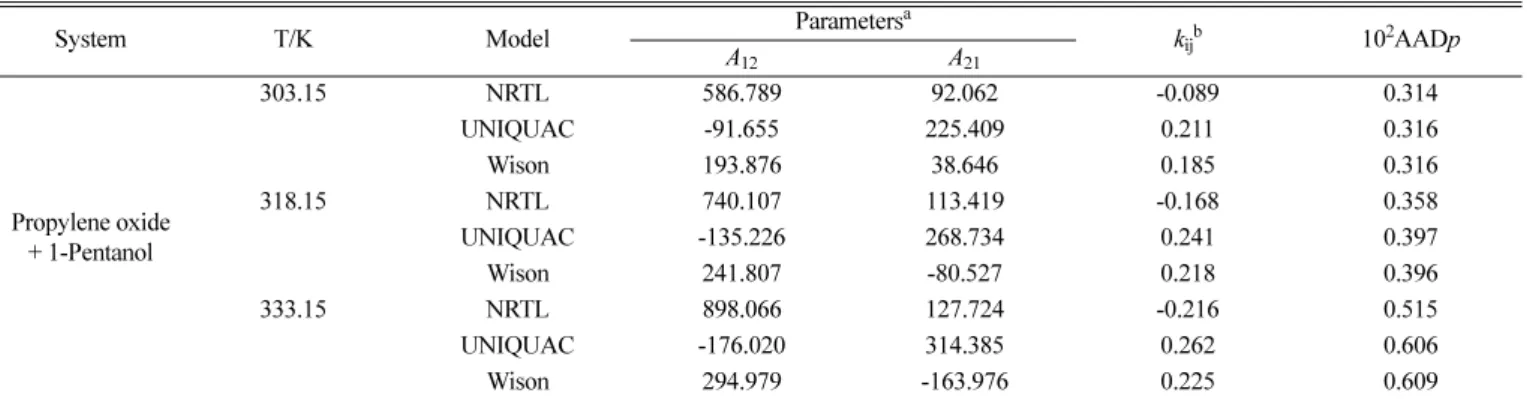
The vapor pressures of the pure propylene oxide at three different temperatures (303.15, 318.15, and 333.15) K and of pure 1-pentanol at 333.15 K were measured. The measured vapor pressures and literature values [10,11] are listed in Table 3 they deviated slightly from each other. Pure parameters for PRSV EOS are presented in Table 4, and the correlation results and average absolute deviations
( ) ( ( ) )
= −
− + + −
RT a T
p V b V V b b V b
( )
2 2c( )
c
0.45724 R T
a T T
p α
=
c c
0.07780 RT
b= p
( )
T 1(
1 Tr0.5)
1(
1 Tr)(
0.7 Tr)
2α = +⎡⎣ κ − +κ − − ⎤⎦
2 3
0.378893 1.4897153 0.17131848 0.0196554
= + − +
κ ω ω ω
m i j ij
i j
a =
∑∑
x x am i i
b =
∑
i x b( )
ij i j 1 ij
a = a a −k
( )
m
1
a Q D
RT = D
−
( )
m 1
b Q
= D
−
i j i j ij
Q x x b a
RT
⎛ ⎞
=
∑∑
⎜⎝ − ⎟⎠i E
i i i
a A
D x
b RT CRT∞
=
∑
+(
b a RT− /)
ij( )
i j
i j
ij ij
2 1 a a
b b
RT RT
b a k
RT
⎛ ⎞
⎛ − ⎞+⎜ − ⎟
⎜ ⎟
⎝ ⎠
⎛ − ⎞ = ⎝ ⎠ −
⎜ ⎟
⎝ ⎠
1 ln( 2 1)
= 2 −
C
A∞E A∞E
Table 3. Comparison of pure component vapor pressures Compound T/K pvapexp/kPa u(p)/kPa pvaplit /kPa Propylene oxide 303.15 86.90 0.43 86.75a
318.15 147.85 0.74 147.43a
333.15 237.88 1.19 237.12a
1-Pentanol 333.15 3.09 0.12 3.11b
u(T) = 0.1K
aReference [10]
bReference [11]
Table 4. Parameters used in the correlation
Compound ra qb vc/(cm3/mol)
Propylene oxide 2.266d 1.856d 70.549d 1-Pentanol 4.1287d 3.592d 108.534d
aVan der Waals volume of the molecule relative to those of a standard segment, UNIQUAC volume parameter
bVan der Waals area of the molecule relative to those of a standard segment, UNIQUAC area parameter
cPure-component liquid molar volume
dReference [12]
Table 5. The interaction parameters and average absolute deviations of pressure for propylene oxide + 1-pentanol system
System T/K Model Parametersa
kijb 102AADp
A12 A21
Propylene oxide + 1-Pentanol
303.15 NRTL 586.789 92.062 -0.089 0.314
UNIQUAC -91.655 225.409 0.211 0.316
Wison 193.876 38.646 0.185 0.316
318.15 NRTL 740.107 113.419 -0.168 0.358
UNIQUAC -135.226 268.734 0.241 0.397
Wison 241.807 -80.527 0.218 0.396
333.15 NRTL 898.066 127.724 -0.216 0.515
UNIQUAC -176.020 314.385 0.262 0.606
Wison 294.979 -163.976 0.225 0.609
aNRTL, A12=Δg12/R, A21=Δg21/R; UNIQUAC, A12=Δu12/R, A21=Δu21/R, Wilson, A12=Δγ12/R, A21=Δγ21/R
bBinary interaction parameter
of pressure (AADp) are presented in Table 5.
The interaction parameters were regressed by minimizing the objective function, AADp, using a simplex algorithm. The AADp is defined as follows:
(15)
where N is the number of experimental data points, piexp the experimental pressure, and pical the calculated pressure.
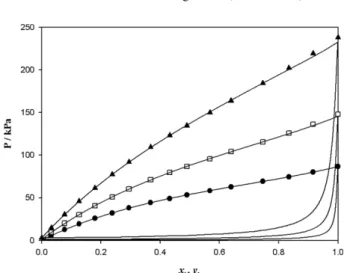
As shown in Table 5, the experimental (propylene oxide + 1-pen- tanol) equilibrium data were correlated within 0.515%, 0.606%, and 0.609% AADp for the NRTL, UNIQUAC, and Wilson models, respectively. In all cases, the NRTL model showed the best correlated results among the three models. Therefore, the NRTL model is appropri- ate for the systems studied in this work, and the UNIQUAC and Wil- son models showed similar correlation results. Figs. 2, 3, 4 show the experimental data and correlated values for the (propylene oxide + 1- pentanol) system, by NRTL, UNIQUAC, Wilson, respectively.
4. Conclusions
Isothermal (vapor + liquid) equilibrium data measurements were undertaken for the binary mixtures of (propylene oxide + 1-pentanol) system at three different temperatures (303.15, 318.15, and 333.15) K.
The correlation results were obtained from PRSV EOS with the van der Waals one-fluid mixing rule for the vapor phase and with the Wong-Sandler mixing rule for the liquid phase. The NRTL, UNI- QUAC, and Wilson models were used to calculate the excess Gibbs free energy. The experimental data were in good agreement with the correlation results obtained by all three models within less than 1%
AADp. The NRTL model is more suitable than the UNIQUAC and Wilson models for the systems studied in this work.
Acknowledgments
This research was supported by the Bio & Medical Technology Development Program of the National Research Foundation (NRF) funded of the Ministry of Science & ICT(2017M3A9D8048416).
References
1. Russo, V., Tesser R., Santacesaria E. and Serio M., “Chemical and Technical Aspects of Propene Oxide Production via Hydro- gen Peroxide (HPPO Process),” Ind. Eng. Chem. Res., 52, 1168- 1178(2013).
2. Zhang, W., Wang, H., Wei, W. and Sun, Y., “Solid Base and Their Performance in Synthesis of Propylene Glycol Methyl Ether,” J. Mol. Catal. A. Chem., 231, 83-88(2005).
3. Kim, H., Hyeong, S., Hong, J. H., Kim, A. R., Shin, M. S. and Kim, H., “Isothermal (Vapor + liquid) Equilibria for the Binary Mixtures of (Propylene oxide + ethanol) and (Propylene oxide + 1-propanol) at Several Temperatures,” J. Chem. Thermodyn., 86,
exp cal
N i i
i iexp
AAD 1 N
p p
p p
=
∑
−Fig. 2. Experimental (vapor + liquid) equilibrium data and correlated data by the NRTL for propylene oxide (1) + 1-pentanol (2) at temperatures from (303.15 to 333.15) K: ●, 303.15 K; □, 318.15 K; ▲, 333.15 K; solid lines, NRTL.
Fig. 3. Experimental (vapor + liquid) equilibrium data and correlated data by the UNIQUAC for propylene oxide (1) + 1-pentanol (2) at temperatures from (303.15 to 333.15) K: ●, 303.15 K;
□, 318.15 K; ▲, 333.15 K; solid lines, UNIQUAC.
Fig. 4. Experimental (vapor + liquid) equilibrium data and cor- related data by the Wilson for propylene oxide (1) + 1-pen- tanol (2) at temperatures from (303.15 to 333.15) K: ●, 303.15 K; □, 318.15 K; ▲, 333.15 K; solid lines, Wilson.
1-5(2015).
4. Stryjek, R. and Vera, J. H., “PRSV: An Improved Peng-Robin- son Equation of State for Pure Compounds and Mixtures,” Can.
J. Chem. Eng., 64, 323-333(1986).
5. Wong, D. S. H. and Sandler, S. I., “A Theoretically Correct Mixing Rule for Cubic Equations of State,” AIChE J. 38, 671-680(1992).
6. Renon, H. and Prausnitz, J. M., “Local Compositions in Ther- modynamic Excess Function for Liquid Mixtures,” AIChE J., 14, 135-144(1968).
7. Abrams, D. S. and Prausnitz, J. M., “Statistical Thermodynam- ics of Liquid Mixtures: A New Expression for the Excess Gibbs Energy of Partly or Completely Miscible Systems,” AIChE J., 21, 116-128(1975).
8. Wilson, G. M., “Vapor-Liquid Equilibrium. XI. A New Expres-
sion for the Excess Free Energy of Mixing,” J. Am. Chem. Soc., 86, 127-130(1964).
9. “Guidelines for Evaluating and Expressing the Uncertainty of NIST Measurement Results,” NIST Technical Note 1297, 1994 Edition.
10. Horstmann, S., Gardeler, H., Fischer, K., Köster, F. and Gmeh- ling, J., “Vapor Pressure, Vapor-liquid Equilibrium, and Excess Enthalpy Data for Compounds and Binary Subsystems of the Chloro- hydrin Process for Propylene Oxide Production,” J. Chem. Eng.
Data, 46, 337-345(2001).
11. NIST Chemistry Webbook Home Page. http://webbook.nist.gov/
chemistry/(accessed Oct 15, 2018).
12. DIPPR 801 Database, Design Institute for Physical Property Data, American Institute of Chemical Engineers (2002).