483 https://doi.org/10.9713/kcer.2017.55.4.483
PISSN 0304-128X, EISSN 2233-9558
Deposition of Functional Organic and Inorganic Layer on the Cathode for the Improved Electrochemical Performance of Li-S Battery
Hiesang Sohn†
Department of Chemical Engineering, Kwangwoon University, 20, Kwangwoon-ro, Nowon-gu, Seoul, 01897, Korea (Received 29 March 2017; Received in revised form 10 April 2017; accepted 25 April 2017)
Abstract − The loss of the sulfur cathode material through dissolution of the polysulfide into electrolyte causes a sig- nificant capacity reduction of the lithium-sulfur cell during the charge-discharge reaction, thereby debilitating the electrochemical performance of the cell. We addressed this problem by using a chemical and physical approach called reduction of polysulfide dissolution through direct coating functional inorganic (graphene oxide) or organic layer (polyethylene oxide) on electrode, since the deposition of external functional layer can chemically interact with polysulfide and physically prevent the leakage of lithium polysulfide out of the electrode. Through this approach, we obtained a composite electrode for a lithium-sul- fur battery (sulfur: 60%) coated with uniform and thin external functional layers where the thin external layer was coated on the electrode by solution coating and drying by a subsequent heat treatment at low temperature (~80oC). The external functional layer, such as inorganic or organic layer, not only alleviates the dissolution of the polysulfide electrolyte during the charging/discharging through physical layer formation, but also makes a chemical interaction between the polysulfide and the functional layer. As-formed lithium-sulfur battery exhibits stable cycling electrochemical performance during charging and discharging at a reversible capacity of 700~1187 mAh/g at 0.1 C (1 C = 1675 mA/g) for 30 cycles or more.
Key words: Li-S battery, Polysulfide dissolution, Electrode coating, Graphene oxide, Polyethylene oxide
1. Introduction
There has been an intensive exploration of high-capacity elec- trode materials for rechargeable lithium-ion batteries because of the increasing demand for renewable energy storage systems with high energy and power density [1-7]. 5 In contrast, elemental sulfur (S8) has gained significant attention as a cathode material of lithium-sul- fur (Li-S) batteries owing to its high theoretical specific capacity (1672 mAh/g) and energy density (2600 Wh/kg) [5-10]. In addition, the low cost, natural abundance, and non-toxicity of sulfur make it a more promising cathode material for Li/S batteries [5-12]. Despite these advantages, there are several key challenges which undermine the application of Li-S batteries towards commercial electrochemi- cal energy storage. These challenges include the low electrical con- ductivity of sulfur (5×10-30 S/cm at 25oC), and high solubility (in organic solvent electrolytes) of the polysulfide and lithium polysul- fide shuttle phenomenon [5-19]. Among them, it is an utmost issue to address polysulfide shuttling phenomenon-the diffusion back and forth of Li polysulfides through the electrolyte to the electrode during charge/discharge-since it forms at the initial lithiation stage of each cycle and leads to a loss of active material by irreversible depo- sition of lithium sulfide (Li2S, Li2S2) on both electrodes, low active
materials utilization, low coulombic efficiency, short cycle life of the S electrode and poor efficiency [5-19]. To address these problems, considerable efforts have been devoted to enhancing conductivity of sulfur-based cathode materials and reducing polysulfide dissolution through various approaches. For instance, there are intensive studies on encapsulation of sulfur into porous conductive media or utiliza- tion of chemical bonding or chemisorption to keep sulfur and poly- sulfides electrochemically active [5-19]. In addition, various carbon and conductive polymer materials have been applied as sulfur accommodating medium to compensate its insulating property and reduce the dissolution of Li polysulfides, as reported by Nazar, Wang and others [5,8]. They demonstrated mesoporous carbon/S nano- composites as cathode materials which can be cycled for 50 cycles at 1460 mAh/g at a rate of 0.5 C (1C = 1675 mA/g) with the corre- sponding coulombic efficiency of >94 %, at the first and 100th cycles [8]. Despite this progress, the polysulfide dissolution and shuttling problem have not been clearly addressed by the previous approaches.
Although there are few reports on fabricating novel C/S cathodes via the chemical reaction approach, it is not sufficient to address the above problems [9-19].
We used a low-cost and environmentally benign chemical/physi- cal strategy to immobilize sulfur and polysulfide by deposition of external layer on the surface of C/S composite cathodes with organic (polyethylene oxide: PEO) or inorganic (graphene oxides: GO) for Li/S cells in ether-based electrolytes (1,3-dioxolane (DOL)/dime- thoxy ethane (DME)). We used C/S composite as an active material and made a cathode coated with external layer (PEO and GO) through the solution deposition process. As-formed external layer can physi-
†To whom correspondence should be addressed.
E-mail: [email protected]
‡This article is dedicated to Prof. Choon Han on the occasion of his retirement from Kwangwoon University.
This is an Open-Access article distributed under the terms of the Creative Com- mons Attribution Non-Commercial License (http://creativecommons.org/licenses/by- nc/3.0) which permits unrestricted non-commercial use, distribution, and reproduc- tion in any medium, provided the original work is properly cited.
484 Hiesang Sohn
cally prevent the direct contact of polysulfide from electrolyte as well as can chemically interact with sulfur and polysulfide, thereby promoting the capacity retention during the charge/discharge cycles.
We also investigated the additional effect of functional group treat- ment towards the external layer on the electrochemical performance of Li-S battery cathode. We found that electrode with external layer shows improved electrochemical performance owing to the strong polysulfide adsorption with the functional groups of the organic/inor- ganic functional layers. In the end, we evaluated the self-discharge per- formance of our electrode through external functional layer coating since the approach can effectively retain the sulfur or polysulfide on the electrode, thereby reducing the self-discharge by loss of active material at rest.
2. Experimental
2-1. Preparation of the graphene oxide coated electrode of carbon- sulfur composite
Preparation of C/S composite: For the preparation of active mate- rial, the composite of carbon (Ketjenblack) and sulfur (40/60 wt%) was prepared by melt-infiltration of sulfur (at 155oC) into the car- bon. We further heat-treated the composite in an argon environment at low temperature (155oC) for 12 h to remove extra sulfur not directly infiltrated to the carbon. The sulfur amount contained in carbon was measured with TGA for the estimation of exact loading amount of sulfur in the C/S composite. Prior to the coating process of the exter- nal organic/inorganic layer, the composite was mixed with 10 wt%
carbon black (Super-P). The final composite contained 48% S, and the sulfur content in the coin cell.
Preparation of external layer deposited electrode: C/S composite was mixed with carbon black and binder (8:1:1 ratio) and was dried in vacuum for the preparation of electrode. As-formed electrode was further treated with organic/inorganic external functional layer by solution deposition of PEO and GO. The PEO solution was dissolved in ethanol and deposited on the electrode followed by drying under convection oven at 80oC. The deposited amount was varied from 20 to 500 μL. GO solution was synthesized by oxidizing graphite pow- der in a strong acidic medium according to the modified Hummer’s method [20]. The GO solution (1 mg/L) was deposited on the elec- trode of carbon sulfur composite. The deposited GO amount on the electrode was varied from 0.05 mg to 0.25 mg. For the endowment of additional function with external organic layer (polydopamine (pDA), tris (hydroxymethyl) aminomethane (TRIS)) and ammonia was further treated on GO layers.
2-2. Material characterizations
The size and morphology of the synthesized products were obtained by electron microscopy. Scanning electron microscopy (SEM) images were obtained with a NOVA NanoSEM 630 scanning electron micro- scope at an accelerating voltage of 1.5 kV. The nanocrystalline struc- ture of material was analyzed by X-ray diffraction (XRD) using a
Rigaku Dmax-2000 X-ray powder diffractometer with CuKα radia- tion (λ = 1.5418 Å) under operation voltage and current of 40 kV and 30 mA, respectively. The data were collected over a 2θ range between 20 and 50°. Thermogravimetric analysis (TGA) was used to analyze the sulfur content in the composite with a TA instruments SDT 2960, at a heating rate of 10oC/min in Ar for thermogravimetric-mass spectro- metric analysis.
2-3. Electrochemical test
The cathodes for Li-S batteries were prepared by mixing 80 wt%
of carbon-sulfur composite, 10 wt% carbon black (Super-P), and 10 wt% polyvinylidene difluoride (PVdF, Sigma-Aldrich) dissolved in 1-methyl-2-pyrrolidinone (NMP, Aldrich) to form a homogeneous slurry. Although carbon is present in the composite, we added carbon black to enhance interparticle electronic connectivity of the composite in the slurry. The slurry was then coated onto aluminum foil (Sigma- Aldrich) and dried at 60 oC under vacuum for 12 h. As-prepared foils were cut into discs (12 mm) from the dried slurry for use as cathodes;
each cathode had a sulfur loading of approximately 1.0 mg/cm2. Electro- chemical tests of these electrodes were performed using CR2016- type coin cells with the carbon/sulfur composite cathode coated with and without external functional layer and pure lithium foil (99.9%, Aldrich) as the anode. The electrolyte was 1 M bis (trifluorometh- ane)sulfonimide lithium salt (LiTFSI, Sigma-Aldrich) and 0.1 M lithium nitrate (LiNO3, Sigma-Aldrich) was dissolved in a mixture of 1,3-dioxolane (DOL, Sigma-Aldrich) and dimethoxymethane (DME, Sigma-Aldrich) (DOL: DME, 1:1 v/v). A microporous membrane (Cel- gard 2400) was used as a separator film. The cells were assembled in an argon-filled glove box. Cells were cycled in the voltage range of 3.0 V to 1.7 V using a BT-2043 arbin battery testing system. All capac- ity values were calculated based on sulfur mass. All cells were tested at room temperature.
3. Results and Discussion
3-1. Design of protective external layer on the surface of electrode Scheme 1 describes the mechanism of prevention of sulfur disso- lution and shuttling by organic/inorganic functional layer coated on electrode by chemical interaction (scheme 1A) and physical barrier (scheme 1B). As shown in scheme 1A, the presence of many func- tional groups of GO and PEO enables chemical adsorption of lith- ium polysulfide with them [21]. For instance, abundant amount of OH group of the PEO can effectively adsorb of the polysulfides because of strong molecular interaction between Li-S and OH [5,12,21]. In addition, carbonyl and carboxyl groups (edges site) and epoxy and hydroxyl groups (basal plane) of graphene oxide can actively inter- act with polysulfides [5,12,14,21]. Scheme 1B illustrates sectional images of external layer coated electrode under charge/discharge process. As-formed external functional nanolayer between electrode and electrolyte can work as a physical barrier by preventing direct contact of electrolyte on the sulfur. An external layer as a physical
barrier not only separates the electrode and electrolyte but also alle- viates the leaking of polysulfide out of the electrode during charge/
discharges. By combination of the advantages of both physical bar- rier and chemical interaction of external functional layers (PEO and GO), a carbon-sulfur composite electrode coated with external layer allows only small dissolution of lithium sulfide into electrolyte.
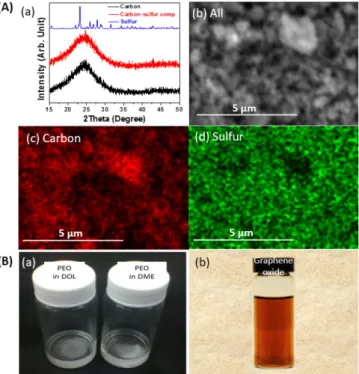
Figure 1A shows structural, morphological and elemental analy- ses of electrode material (carbon/sulfur (C/S) composite). Figure 1A-a compares X-ray diffraction (XRD) patterns for the carbon, sul- fur and carbon/sulfur composite (sulfur: 60%). The broad signals around 24 and 44 degree observed in the XRD pattern of carbon indicate its amorphous structure [9,10]. In addition, the pattern for C/
S composite does not exhibit any characteristic sulfur crystal peak, indicating good incorporation and dispersion of sulfur into the car- bon as absorbed by capillary force during sulfur infiltration process [9,10]. SEM image (Figure 1A-b) shows an irregular shape of C/S composite. As shown in Figure 1A-c and d, the elemental mapping by energy dispersive X-ray spectroscopy (EDS) was performed on the carbon-sulfur composite electrode to confirm the sulfur distribu- tion within carbon matrix. The mapping images indicate that sulfur and carbon are the only elements present in the carbon-sulfur com- posite electrode. In addition, sulfur is homogeneously distributed throughout the carbon, further indicating successful infiltration of sulfur on carbon in consistent with XRD result. Figure 1B-a is the digital photo image of PEO dispersed in the ether electrolyte (DOL/
DME) of Li-S battery to investigate the dissolution degree of PEO in the electrolyte. Figure 1B-b shows the digital photo-image of graphene oxide (GO) dispersed in the water. Good dispersion of GO in the water indicates hydrophilic nature of GO as well as existence of
abundant hydrophilic group (OH, COOH etc.) on the basal plane of graphene oxide [9,10,14].
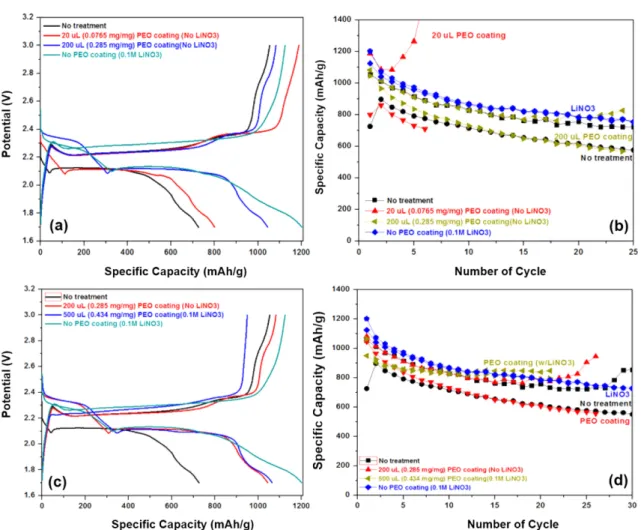
Figure 2 compares the electrochemical performance of C/S com- posite (ca. 60% sulfur) electrode coated with PEO in various concen- trations (20~500 μL per electrode). We prepared the electrochemical cells without lithium nitrate (LiNO3) in the electrolyte to more clearly compare the external layer effect on polysulfide shutting phenom- ena since LiNO3 is known as good additive to prevent the shuttling of lithium sulfide [7,8,12]. The reference cell containing lithium nitrate also was compared as a control. Figure 2a displays the initial voltage profiles (charge-discharge curves) for the PEO coated C/S composite electrodes where the PEO coating amount per electrode varied from 0~200 μL. The initial charge-discharge curves were recorded at a current density of a 0.1 C discharge rate (1C = 1680 mA/g) between 1.7~3.0 V (vs. Li/Li+). The discharge voltage plateaus for all samples around 2.1 V and 1.9 V correspond to the reduction of ele- mental sulfur to lithium polysulfide (Li2Sn, 4 ≤ n <8) and to lithium sulfide (Li2S2 or Li2S), respectively. In addition, we could find the change from sulfur to lithium polysulfides and the further reduction of higher-order lithium polysulfides to lithium sulfides by the voltage profile curves [3,4,6-8,10]. PEO coated C/S composite electrode exhibit significantly reduced polarization compared with that of pristine one due to increased resistance. Figure 2b shows that the good cycle sta- bility of PEO coated C/S composite electrode. PEO coated C/S com- posite electrode shows high initial discharge capacity of 1187 mAh/g and shows 700 mAh/g after 25 cycles. Such a well retained capacity Scheme 1. Schematic of organic/inorganic functional layer coated
on electrode to prevent sulfur dissolution and shuttling. (A) Chemical interaction of lithium polysulfide with external lay- ers of graphene oxide and PEO, and (B) physical preven-
tion of lithium sulfide dissolution. Fig. 1. (A) (a) Crystal structure of carbon, carbon-sulfur composite (60% sulfur loading) and sulfur, (b) SEM image of carbon-sul- fur composite; elemental mapping of composite, (c) carbon, (d) sulfu. (B) (a) Photo-images of dissolution of polyethylene oxide (PEO) in electrolyte, and (b) graphene oxide dispersion.
486 Hiesang Sohn
after 25 cycles indicates that PEO coated C/S composite electrode can maintain the initial voltage profile shape without severe polariza- tion since PEO could effectively prevent the dissolution of lithium polysulfide, alleviating the shuttling phenomena [5,21]. In addition, consistent with the initial voltage profile, the cycling performance of C/S composite electrode also depends on the coating amount of PEO.
The electrode coated with PEO shows superior EC performance (low polarization in voltage profile and cycle stability) to that of elec- trode with smaller PEO (~50 μL) [5,21]. As shown in Figure 2c and d, the effect of PEO coating on the electrochemical performance under more PEO (>200 μL) coating was investigated at similar sul- fur filling (ca. 60%). In general, the voltage profile and cycle perfor- mance of Li-S cell coated with excessive amount of PEO (>200 μL) show similar trend to that of sample prepared with small amount PEO coating (<50 μL). Also, while the addition of more PEO (over 50 μL) was effective to enhance the electrochemical performance of Li-S cell (Figure 2a and b), excessive coating of PEO (< 200 μL) is not benefi- cial for the improvement of performance. Note that, some decay of capacity after cycling even under PEO coating indicates shuttling of very small sized lithium sulfide between electrode and lithium. In both voltage profile and cycle stability test, although PEO coating
does not show as good as performance to cell with LiNO3, it is obvi- ous that PEO coating is an effective approach to reduce the polariza- tion and shuttling phenomena due to reduced polysulfide dissolution by the chemical and physical protection of PEO external layer.
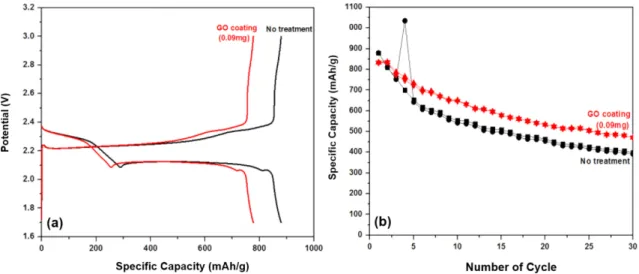
We also investigated the effect of inorganic external layer (GO) deposition on the C/S composite electrode by comparing the electro- chemical performance of C/S composite cathode coated with the GO (0.09 mg per electrode) and non-coated one (Figure 3). As with the PEO coating test, we prepared the electrochemical cells without lith- ium nitrate (LiNO3) in the electrolyte. Figure 3a displays the voltage profiles of initial cycle for the GO coated C/S composite electrode during initial charge-discharge process measured at 1.7~3.0 V (vs. Li/
Li+), as recorded at a current density of a 0.1 C. Similar to the result of PEO coated electrode (Figure 2a and c), the discharge voltage pla- teaus are observed around 2.1 V from both GO coated and non-coated electrode, indicating the sulfur reduction to lithium polysulfide (Li2Sn, 4≤ n < 8) and to lithium sulfide (Li2S2 or Li2S), respectively [5-10].
Figure 3b shows superior cycle stability of GO coated C/S compos- ite electrode to that of pristine one. Although GO coated C/S composite electrode shows the lower initial discharge capacity of 850 mAh/g than that of pristine one (900 mAh/g), GO coated electrode shows supe- Fig. 2. Electrochemical performance (a) voltage profile of PEO coated and non-coated lithium sulfur electrode, (b) Cycle stability of PEO coated
and non-coated lithium sulfur electrode, (c) voltage profile of PEO coated and non-coated lithium sulfur electrode, and (d) Cycle sta- bility of PEO coated and non-coated lithium sulfur electrode.
rior capacity retention (500 mAh/g) after 30 cycles to that of pristine one (400 mAh/g). Similar to PEO result, there is still capacity fading due to dissolution and leakage of small sized lithium sulfide shut- tling between electrodes [8,22].
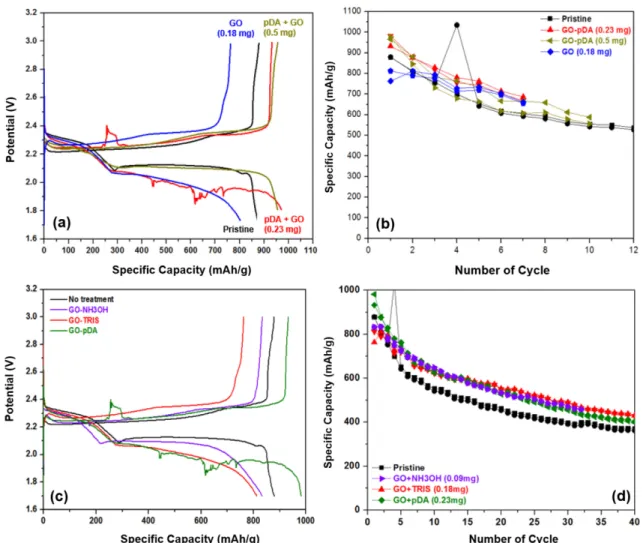
After successful application of GO layer on electrode, we further implemented the functionality of organic group (e.g., polydopamine (pDA), ammonia and tris (hydroxymethyl)aminomethane (TRIS)) into GO layer by combining the advantages of organic and inorganic layers. As shown in Figure 4, we investigated the effect of GO-func- tional organic layer coating on the electrochemical performance of Li-S cell. Further implanted organic functional groups (ammonia, TRIS and polydopamine) were employed since they have many nuc- leophilic groups (NH2, OH) which can interact with lithium polysulfide.
Figure 4a compares the voltage profile of GO-functional organic layer (polydopamine: pDA) coated electrode with controls (bare GO coated and pristine composite electrode) under 0.1 C between 1.7~3.0 V (vs. Li/Li+) where the GO-pDA was regulated at 0~0.5 mg/electrode.
At similar sulfur loading (ca. 60%), GO-functional organic layer coated electrode shows superior cycle stability to controls since GO-func- tional organic layer plays an important role in preventing polysul- fide shuttling and to stabilize Li-S redox reaction during the charge- discharge [22,23]. Compared with the sample coated with bare GO layer sample, the sample coated by GO-pDA layer exhibits markedly improved polarization behavior in the voltage profile. Figure 4b com- pares the cycling performance of C/S composite electrode coated with various GO-pDA layers [22,23]. GO-pDA layer coated C/S compos- ite electrode shows a high initial discharge capacity of 1000 mAh/g and shows 700 mAh/g after seven cycles. Compared with pristine and bare GO coated electrode, the sample of GO-pDA layer shows improved EC performance. Moreover, of all the GO-pDA samples, thin GO-pDA coated one (0.23 mg/electrode) shows superior performance to thicker samples (0.5 mg/electrode of GO-pDA). Such a deteriorated perfor- mance of thicker sample can be attributed to the alleviated wetting between electrode and electrolyte [22-24], indicating the importance
of optimal GO thickness. Figure 4c compares the voltage profiles of GO-organic layer with various functional groups (ammonia, TRIS and pDA) to further investigate the effect of functional group com- bined GO layer. Although all samples exhibit similar voltage profiles, the sample with GO-organic layer shows the largest polarization in the initial cycle, indicating increased interfacial resistance by organic group. Despite the increased resistance, improved chemical func- tionality of organic groups endows the electrode with better reten- tion of polysulfide in the electrode. Figure 4d compares the cycling performance of samples coated with GO-different organic layers.
The sample with GO-functional group (TRIS) exhibits the most supe- rior capacity retention (initial capacity of 800 mAh/g and 500 mAh/g after 40 cycles) to other samples. The good performance of GO-TRIS layer coated electrode can be attributed to the effective chemical interaction and physical barrier by GO-TRIS layer. Reportedly, as the external layer (e.g., carbon interlayer) is favorable to enhance the kinetics and reduce the resistance formed by the solid Li2S precipi- tate, so such external layer can improve the capacity and cycling sta- bility of the C/S composite cathodes in a similar manner [5,21].
Overall, these functional external layers combined with organic func- tional group are found to be effective to improve electrochemical performance of Li-S cell by cooperative function of GO layer and organic functional groups.
It is well-known that the self-discharge of Li-S cell is caused mainly by the dissolution of lithium sulfide at the non-charge/discharge sta- tus [24,25]. To reduce such self-discharge of Li-S battery, it is needed to prevent polysulfide dissolution from the electrode at static state.
In a similar manner (external layer coating on electrode) used for the improvement of capacity retention in previous results, we tried to reduce the self-discharge of Li-S battery. As shown in Figure 5, we investigated the effect of external layer coating on the self-discharge behavior of Li-S cell. For this experiment, we used 10 μL electrolyte of 1 M LiTFSI + 0.2 M LiNO3 in the electrolyte (DOL/DME) where all the sulfur should be in a soluble polysulfide state for conven- Fig. 3. Electrochemical performance (a) voltage profile of graphene oxide (GO) coated and non-coated lithium sulfur electrode, and (b) Cycle
stability of GO coated and non-coated lithium sulfur electrode.
488 Hiesang Sohn
tional sulfur electrodes. The self-discharge test reveals that capacity loss of PEO and GO coated electrode shows less than 5% for a day in a semi-discharged cell, whereas non-treated cell shows significant amount of loss at the same condition. As shown in the cycling test
(Fig. 5), the external layer could effectively prevent the dissolution and extracting out of sulfur and polysulfide in the electrode, indicating external layer coating on the electrode as a valid approach to reduce self-discharge [24,25].
4. Conclusion
We prepared inorganic (GO) and organic (PEO) coated C/S com- posite electrodes for the enhancement of electrochemical perfor- mance of Li-S battery by alleviating the dissolution and shuttling of polysulfide during charge/discharge process. Based on systematic study of external functional layer deposited electrode based Li-S cell, we found that the organic (PEO) or inorganic layer (GO) coating on electrode can effectively enhance the electrochemical performance of the Li-S cell. PEO- and GO-coated cathode shows initial capacity of 800~1187 mAh/g (based on sulfur) and improved cycle stability (capacity of 500~700 mAh/g over 30 cycles at 0.1C) compared with controls (Non-coated C/S composite electrode). Such an enhanced performance of Li-S battery can be attributed to the alleviated poly- sulfide dissolution through the chemical interaction and physical Fig. 4. Electrochemical performance (a) voltage profile of GO-organic layer (pDA) coated and non-coated lithium sulfur electrode, (b) Cycle
stability of GO-organic layer (pDA) coated and non-coated lithium sulfur electrode, (c) voltage profile of GO-functional group (pDA, ammonia, TRIS) coated and non-coated lithium sulfur electrode, and (d) Cycle stability of GO-functional group (pDA, ammonia, TRIS) coated and non-coated lithium sulfur electrode.
Fig. 5. Self-discharge performance of external layer (GO and PEO) coated electrode by comparing with non-coated electrode.
prevention of polysulfide with external functional layers. We further improved its EC performance through the additional functional layer (pDA, TRIS) treatment on the GO surface. In addition, such an exter- nal functional layer coated electrode could effectively reduce the self- discharge of Li-S battery by 20 times (external layer coating: 1%, no- treatment: 20%).
Based on the current result, we believe that external layer coating on the electrode is a very facile and efficient way to improve the EC performance of the Li-S battery. We are confident that our unique approach could be a versatile way to effectively enhance the EC per- formance of any cathode materials of Li-S batteries.
Acknowledgment
The present research was conducted by a research grant of Kwang- woon University in 2017.
References
1. Xiao, Q., Sohn, H., Chen, Z., Toso, D., Mechlenburg, M., Zhou, Z. H., Poirier, E., Dailly, A., Wang, H., Wu, Z., Cai, M. and Lu, Y., “Mesoporous Metal and Metal Alloy Particles Synthesized by Aerosol-Assisted Confined Growth of Nanocrystals,” Angew.
Chem. Int. Ed., 51, 10546-10550(2012).
2. Sohn, H., Chen, Z., Jung, Y. S., Xiao, Q., Cai, M., Wang, H. and Lu, Y., “Robust Lithium-ion Anodes Based on Nanocomposites of Iron Oxide-carbon-silicate,” J. Mater. Chem. A, 1, 4539-4545(2013).
3. Jin, E. M., Lee, G.-E., Na, B.-K. and Jeong, S. M., “Electrochemical Properties of Commercial NCA Cathode Materials for High Capacity of Lithium Ion Battery,” Korean Chem. Eng. Res., 55(2), 163-169(2017).
4. Kang, K.-Y., Choi, M. G., Lee, Y.-G. and Kim, K. M., “Phase Change of Nanorod-Clustered MnO2 by Hydrothermal Reaction Conditions and the Lithium-ion Battery Cathode Properties of LiMn2O4 Prepared from the MnO2,” Korean Chem. Eng. Res., 49(5), 541-547(2011).
5. Ji, X. and Nazar, L. F., J. Mater. Chem., 20, 9821-9826(2010).
6. Manthiram, A., Fu, Y. and Su, Y.-S., “Challenges and Prospects of Lithium-Sulfur Batteries,” Acc. Chem. Res., 46, 1125-1134(2013).
7. Marmorstein, D., Yu, T. H., Striebel, K. A., McLarnon, F. R., Hou, J. and Cairns, E. J., “Electrochemical Performance of Lith- ium/sulfur Cells with Three Different Polymer Electrolytes,” J.
Power Sources, 89, 219-226(2000).
8. Chen, S., Dai, F., Gordin, M. L. and Wang, D., “Exceptional Electrochemical Performance of Rechargeable Li-S Batteries with a Polysulfide-containing Electrolyte,” RSC Adv., 3, 3540-3543(2013).
9. Sohn, H., Gordin, M. L., Regula, M., Kim, D. H., Jung, Y.-S., Song, J. and Wang, D., “Porous Spherical Polyacrylonitrile-carbon Nanocomposite with High Loading of Sulfur for Lithium-sulfur Batteries,” J. Power Sources, 302, 70-78(2016).
10. Sohn, H., Gordin, M. L., Xu, T., Chen, S., Lv, D., Song, J., Manivan- nan, A. and Wang, D., “Porous Spherical Carbon/Sulfur Nanocompos- ites by Aerosol-Assisted Synthesis: The Effect of Pore Structure and Morphology on Their Electrochemical Performance As Lithium/
Sulfur Battery Cathodes,” ACS Appl. Mater. Interfaces, 6, 7596- 7606(2014).
11. Yamin, H., Gorenshtein, A., Penciner, J., Sternberg, Y. and Peled, E.
J., “Lithium Sulfur Battery Oxidation/Reduction Mechanisms of Polysulfides in THF Solutions,” J. Electrochem. Soc., 135, 1045- 1048(1988).
12. Mikhaylik, Y. V. and Akridge, J. R., “Polysulfide Shuttle Study in the Li/S Battery System,” J. Electrochem. Soc., 151, A1969- A1976(2004).
13. Liang, C., Dudney, N. J. and Howe, J. Y., “Hierarchically Struc- tured Sulfur/Carbon Nanocomposite Material for High-Energy Lithium Battery,” Chem. Mater., 21, 4724-4730(2009).
14. Lai, C., Gao, X. P., Zhang, B., Yan, T. Y. and Zhou, Z., “Synthesis and Electrochemical Performance of Sulfur/Highly Porous Car- bon Composites,” J. Phys. Chem. C, 113, 4712-4716(2009).
15. Zhang, B., Qin, X., Li, G. R. and Gao, X. P., “Enhancement of Long Stability of Sulfur Cathode by Encapsulating Sulfur into Micropores of Carbon Spheres,” Energy Environ. Sci., 3, 1531- 1537(2010).
16. Liang, X., Wen, Z., Liu, Y., Zhang, H., Huang, L. and Jin, J., “Highly Dispersed Sulfur in Ordered Mesoporous Carbon Sphere as a Composite Cathode for Rechargeable Polymer Li/S Battery,” J.
Power Sources, 196, 3655-3658(2011).
17. Schuster, J., He, G., Mandlmeier, B., Yim, T., Lee, K. T., Bein, T.
and Nazar, L. F., “Spherical Ordered Mesoporous Carbon Nanopar- ticles with High Porosity for Lithium-Sulfur Batteries,” Angew.
Chem. Int. Ed., 51, 3591-3595(2012).
18. Xu, T., Song, J., Gordin, M. L., Sohn, H., Yu, Z., Chen, S. and Wang, D., “Mesoporous Carbon-Carbon Nanotube-Sulfur Composite Microspheres for High-Areal-Capacity Lithium-Sulfur Battery Cathodes,” ACS Appl. Mater. Interfaces, 5, 11355-11362(2013).
19. Cheon, S. E., Ko, K. S., Cho, J. H., Kim, S. W., Chin, E. Y. and Kim, H. T., “Rechargeable Lithium Sulfur Battery II. Rate Capabil- ity and Cycle Characteristics,” J. Electrochem. Soc., 150, A800- A805(2003).
20. Dikin, D. A., Stankovich, S., Zimney, E. J., Piner, R. D., Dommett, G. H. B., Evmenenko, G., Nguyen, S. T. and Ruoff, R. S., “Prepa- ration and Characterization of Graphene Oxide Paper,” Nature, 448, 457-460(2007).
21. Agostini, M. and Hassoun, J., “A Lithium-ion Sulfur Battery Using a Polymer, Polysulfide-added Membrane,” Sci. Rep., 5, 7591-7595(2015).
22. Wang, J., Chew, S. Y., Zhao, Z. W., Ashraf, S., Wexler, D., Chen, J., Ng, S. H., Chou, S. L. and Liu, H. K., “Sulfur-meso- porous Carbon Composites in Conjunction with a Novel Ionic Liquid Electrolyte for Lithium Rechargeable Batteries,” Carbon, 46, 229-235(2008).
23. Li, X., Cao, Y., Qi, W., Saraf, L. V., Xiao, J., Nie, Z., Mietek, J., Zhang, J.-G., Schwenzer, B. and Liu, J., “Optimization of Mes- oporous Carbon Structures for Lithium-sulfur Battery Applica- tions,” J. Mater. Chem., 21, 16603-16610(2011).
24. Sun, X.-G., Wang, X., Mayes, R. T. and Dai, S., “Lithium-Sulfur Batteries Based on Nitrogen-Doped Carbon and an Ionic-Liquid Electrolyte,” ChemSusChem, 5, 2079-2085(2012).
25. Gordin, M. L., Dai, F., Chen, S., Xu, T., Song, J., Tang, D., Azimi, N., Zhang, Z. and Wang, D., “Bis(2,2,2-trifluoroethyl) Ether As an Electrolyte Co-solvent for Mitigating Self-Discharge in Lith- ium-Sulfur Batteries,” ACS Appl. Mater. Interfaces, 6, 8006-8010 (2014).