
Vol. 66, No. 10, October 2016, pp. 1210∼1214 http://dx.doi.org/10.3938/NPSM.66.1210
Generalized Conserved Lattice Gas on Random Networks
Wooseop Kwak · Sojeong Park
Department of Physics, Chosun University, Gwangju 61452, Korea
Meesoon Ha
∗Department of Physics Education, Chosun University, Gwangju 61452, Korea (Received 2 July 2016 : revised 11 August 2016 : accepted 26 August 2016)
We numerically investigate the mean-field (MF) behavior of the conserved lattice gas (CLG) model with effective temperature, where two types of random network topologies are considered, regular and random ones, and the effective temperature is controlled by using the thermal noise parameter. In particular, we focus on dynamic scaling for the spatiotemporal properties near the criticality of the CLG. Based on the MF theory and the finite-size scaling (FSS) analysis of continuous phase transitions, we present the MF values of the FSS exponent and the thermodynamic exponents. Finally, we conjecture a MF schematic phase diagram and discuss universality issues in the generalization of the CLG, which are compared with those in earlier results.
PACS numbers: 64.60.-i, 02.50.-r, 02.70.-c
Keywords: Conserved lattice gas, Random networks, Mean-field theory, Finite-size scaling
I. INTRODUCTION
Among dynamic phase transitions in nonequilibrium statistical physics, the universality class of absorbing phase transitions (APTs) has been intensively studied and well established through last decades [1–4]. It is because of wide applicability of rich phenomena to the self-organized criticality and the broad impact to real systems as well as sandpile model studies APTs can be described by the active particle density that represents a order parameter from nonzero in an active state to zero in one, two, or many absorbing states.
In the absorbing state, dynamics of the system is dead since the control parameter sets below the critical thresh- old. To find the location of the critical threshold in APTs and discuss universal scaling properties at and near the criticality, Monte-Carlo simulations and related analytic techniques are often employed with the extended finite- size scaling (FSS) theory, which plays a crucial role in the analysis of critical phenomena in not only equilib- rium processes but also nonequilibrium ones.
∗E-mail: [email protected]
Among stochastic lattice models that exhibit APTs, the conserved lattice-gas (CLG) model is the simplest model that belongs to a new universality class, distinct from the directed percolation (DP) universality class, where the total density of particles becomes a control parameter. The ordinary CLG [5–13] is expected for a second-order (continuous) APT from an active state to one or many absorbing states, whose scaling properties in low-dimensional cases belong to a non-DP universality class due to a conserved field.
In the one-dimensional (1D) CLG [5–9], the dynamics allows only two symmetric absorbing states at exactly the critical density ρc = 1/2, but it turns out that the dynamic scaling properties depend on initial conditions (ICs). It was reported that such scaling behaviors are exactly the same as those of A + B→ 0, in terms of the exact mapping relation [7]. Moreover, it is observed that no diverging fluctuations of the order parameter in the 1D CLG, and the origin of scaling properties in the 1D CLG is not a APT but a crossover between two different scaling behaviors caused by ICs of A + B → 0, random IC versus ordered IC [9].
This is an Open Access article distributed under the terms of the Creative Commons Attribution Non-Commercial License (http://creativecommons.org/licenses/by-nc/3.0) which permits unrestricted non-commercial use, distribution, and reproduction in any medium, provided the original work is properly cited.
Table 1. Effect of thermal noise on CLG dynamics.
p≡ e−1/T p = 0 0 < p < 1 p = 1 T ∈ [0, ∞] (T = 0) (any finite T ) (T =∞)
pa≡ pa= 0 pa= 1 pa= 1
min{1, p∆Nb} for ∆Nb> 0 for ∆Nb≤ 0 for any ∆Nb
For the two-dimensional (2D) CLG [10–12], a non- DP APT occurs with infinitely many absorbing states at ρc = 0.34494 [11], updated to ρc = 0.347103 [12], (ρc = 0.28875 for parallel updating scheme [10]). The mean-field (MF) scaling behavior of the CLG was also first studied with random nearest-neighboring hopping of active particles [13], where the MF critical exponent βMF of the density of active particles ρa is derived with simple approximations, ρa ∼ (ρ − ρc)β. In particular, the MF critical density ρc is estimated as a function of the number of random neighbors, z = 2d, varies in d- dimensional lattices: (1− ρc)z = zρc [13], ρc decreases as z increases, and the analytic result of ρc is slightly larger than its numerical result.
In this paper, we revisit the MF behavior of the CLG on network topologies with effective temperature for ran- dom neighbor hopping of active particles, and focus on the role of degree fluctuations and thermal noise in MF scaling properties of the CLG. The paper is organized as follows: In Sec. II, we briefly describe the dynamics of the generalized CLG (GCLG), the definitions of the noise parameter and physical quantities to be measured for the analysis of APTs. Numerical simulation results are presented in Sec.IIIwith both regular random (RR) and Erdös-Rényi random (ER) networks, and the ex- tended FSS theory is applied. Finally, we conclude the paper in Sec. IVwith some remarks.
II. MODEL
Tbe CLG is generalized with effective temperature.
We consider it on two different types of random networks with quenched linking disorder, RR and ER ones, where the total number of nodes is N , the average degree is
⟨k⟩ = z, and degree fluctuations are σ2k. For the RR case, degree fluctuations are free, i.e., the degree distribution P (k) = zδ(k− z) with σk2= 0, whereas for the ER case, degree fluctuations exist: P (k) = zke−z/k! with σ2k̸= 0.
Fig. 1. (Color online) Dynamics of the GCLG with p = e−1/T on a random network: A active node is high- lighted by the red/dashed-line circle, whose particle can move onto its nearest-neighboring empty node with the acceptance probability pa = min{1, p∆Nb}, where each target node has the different value of ∆Nb (-1 for 1, 0 for 2, +2 for 3) (see Table 1).
In the setup of the GCLG on a random network, each node can be occupied by at most one particle, so that the occupation number of a node i, ni= 0, 1. The total density of particles (ρ) is defined as
ρ≡
∑N i=1
ni(t)/N, (1)
which is fixed at any time t due to the conservation of particles, and plays a role of the control parameter. In the CLG dynamics, the occupied node becomes active once its any nearest-neighboring node is occupied as well, where the particle at the active node, namely the active particle, can move onto the nearest-neighboring empty node (see Fig.1).
Depending on the thermal noise parameter, p = e−1/T, the random hopping of the active particle is controlled, which mimics the role of temperature. Thus, the case of p = 1 (T = ∞) corresponds to the ordinary CLG, where the active particle moves onto a randomly cho- sen empty node, irrespective of the change of the num- ber of active bonds before and after the move, ∆Nb ≡ Nb(tf)− Nb(ti). As illustrated in Fig. 1 for the GCLG with 0 < p < 1 with three different target nodes, the random choice of neighboring empty nodes is exactly the same as the p = 1 case. However, the acceptance of the move in Metropolis-Hastings algorithms is determined by pa= min{1, p∆Nb}. With the acceptance (transition) probability pamentioned above, active particles have the tendency to reduce the number of active bonds as the
Table 2. MF results of ρc versus MC ones for p = 1.
ρc z = 2 4 9
MFa 0.267949 0.138017 0.062286
MCb 0.2224 0.1244 0.13020(RR), 0.12705(ER)
a [13] for analytic results of Euclidean dimensions.
b[13] for z = 2 (d = 1), and 4 (d = 2); ours for z = 9 (network)
thermal noise parameter p decreases (T gets lowered).
At T = 0 (p = 0), it was reported that the 2D GCLG forms at ρ = 0.5 the checker-board like pattern without active bonds (active particles) [14]. For finite T , the 2D GLCG exhibits some glassy behaviors.
To analyze the APT threshold and scaling properties in the GCLG, we focus on two major physical quantities:
the active particle density ρaand the survival probability Ps, where ρais the number of the occupied node with at least one occupied nearest neighbor divided by N , and Psis the fraction of the samples with nonzero ρa.
III. NUMERICAL RESULTS
We perform numerical simulations for the GCLG with various p values, where we set the average degree z = 9 for both RR and ER networks. In the earlier study of MF conjecture by Lübeck and Hucht [13], the analytic result of the critical density can be calculated as a function of z (see Table 2). However, it represents not for infinite dimensional case, namely network topologies but for d- dimensional lattices with long-range links.
Scaling properties of the GCLG with p are obtained from ρa and Psas a function of t and N . Employing the static simulation technique [1] near and at the criticality of the APT, the extended FSS forms are:
[ρa(t, N )]s= ρa(t, N )/Ps(t, N ) = t−δf (t/N¯z), (2)
Ps(t, N ) = g(t/Nz¯), (3)
where f (x) = xδ for x≫ 1; constant for x ≪ 1 with δ = β/ν∥ and ¯z = ν∥/¯ν. As a result, [ρa]∗s≡ [ρ(t → ∞, N)]s
and τ1/2= t∗ at Ps(t∗) = 1/2 satisfy
[ρa]∗s∼ N−α and τ1/2∼ Nz¯, (4) where α = δ¯z = β/¯ν.
Our results show that degree fluctuations do affect the critical density and dynamic scaling. As expected,
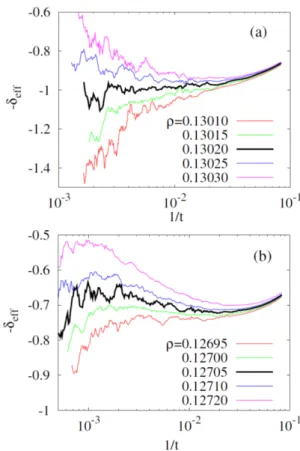
Fig. 2. (Color online) For p = 1 (T = ∞), effective exponent data are plotted to locate ρcand δ, where ρa∼ t−δeff in finite systems for various ρ: (a) ρc|RR= 0.13020 and δ|RR = 1.0, and (b) ρc|ER = 0.12705 and δ|ER <
1. Here we obtain data for N = 107 with at least 102 samplings.
ρc|ER< ρc|RR, the scaling behaviors for the ER case are less clearer than those for the RR case.
Fig.2represents the effective decay exponent plots of ρafor p = 1 as ρ varies, where the RR case clearly shows the MF result, but the ER case seems to have huge finite- size effects with logarithmic corrections to scaling. In Fig. 3, we plot both the dynamic exponent ¯z and the static exponent α at ρ = ρc against N , where the RR case shows the clean MF results, but the ER case seems to have logarithmic corrections to scaling. Logarithmic corrections have been observed in many cases [15,16].
In Figs.4and5, numerical data for p = 1 are well col- lapsed based on Eqs. (2)-(4) and the MF results of crit- ical exponents with and without logarithmic corrections to scalings. For the other values of p, we also perform MC simulations and obtain the similar results to those of p = 1. As the thermal noise parameter p decreases, the quenched disorder effect gets stronger to lead more
Fig. 3. (Color online) For p = 1, (a) the static expo- nent (α) from [ρa]∗s and (b) the dynamic exponent (¯z) from τ1/2 are plotted at the criticality as a function of N on both RR (open symbols) and ER (solid symbols), compared to the MF exponent values (lines).
Table 3. The critical density and critical exponents are summarized in the GCLG with p for various topologies.
For network cases, ⟨k⟩ = 9.
p ρc z = ν¯ ∥/¯ν δ = β/ν∥ α = β/¯ν
RR 1 0.13020 0.5 1.0 0.5
0.5a 0.1705 0.5 1.0 0.5
ERa 1 0.12075 0.5a 1.0a 0.5
0.5 0.1837 0.5a 1.0a 0.5
1Db 1 0.5 2.0 0.25 1.0
2Dc 1 0.347 103 1.53 0.41 0.792
0.5d 0.475 1.1 0.41 0.37
0 0.5 1.55 1.282 2.00
MFe 1 0.062286 1/2 1 1/2
a Logarithmic corrections to scalings exist.
b[6–9] for initial condition dependencies and crossover scaling.
c[10–12] for p = 1; [14] for p = 0.
d The detailed analysis will be discussed elsewhere.
e[13], where the random neighboring hopping of active particles is considered in d-dimensional lattices with long-range links, z = 9.
logarithmic corrections to scaling. Our results are sum- marized with the results on other topologies in Table 3.
Fig. 4. (Color online) For p = 1, the scaling func- tion of the survival probability is presented at ρ = ρc, g(t/Nz¯) = Ps(t, N ), based on Fig. 3: (a) RR and (b) ER, where the inset is plotted without logarithmic cor- rections to scaling for ¯z = 0.6.
IV. SUMMARY WITH REMARKS
We have investigated the role of effective temperature in the conserved lattice gas (CLG) model on two types of random network topologies, namely regular random networks (RR) and Erdös-Rényi random ones (ER). For T = ∞ (p = 1), we found that the critical behavior of the CLG on both RR and ER networks belongs to the mean-field (MF) directed percolation (DP) universality class as expected. However, ER degree fluctuations lead to logarithmic corrections to scaling in dynamic scaling.
When T is finite (0 < p < 1), the universality class of critical behaviors is still under investigation. Our pre- liminary results seem to be deviated from that for the MF DP universality class, where the ER case is much more sensitive than the RR case. However, the extended finite-size scaling (FSS) analysis shows that logarithmic corrections to scaling might resolve the discrepancy at least at p = 0.5.
Fig. 5. (Color online) For p = 1, the extended FSS forms of [ρa]s are tested with data collapse based on the corresponding scaling functions: (a)-(c) for the RR case and (d)-(f) for the ER case, where [ρa(t, N )]s, f (t/N¯z) = [ρa(t, N )]stδ, and F (t/N¯z) = [ρa]s(t, N )Nαfrom left to right.
Moreover, we have found in scaling properties at low temperature (small p), finite-size effects and quenched disorder effects from network topologies play a crucial role in determining the critical density ρc(p) as p de- creases in the thermodynamic limit . Our further study on this topic will be published elsewhere with the origin of the glassy behavior in the two-dimensional CLG with p and its phase diagram.
ACKNOWLEDGEMENTS
This research was supported by Basic Science Re- search Program through the National Research Foun- dation of Korea (NRF) funded by the Korean gov- ernment [NRF-2013R1A1A2065043 (W.K.) and NRF- 2014R1A1A4A01003864 (M.H.)].
REFERENCES
[1] J. Marro and R. Dickman, Nonequilibrium Phase Transitions in Lattice Models (Cambridge University Press, Cambridge, 1999), Chap. 6.
[2] D. Ben-Avraham and S. Havlin, Diffusion and Reac- tion in Fractals and Disordered Systems (Cambridge University Press, Cambridge, 2000).
[3] H. Hinrichsen, Adv. Phys. 49, 815 (2000).
[4] G. Ódor, Rev. Mod. Phys. 76, 663 (2004).
[5] M. J. de Oliveira, Phys. Rev. E 71, 016112 (2005).
[6] S.-G. Lee and S. B. Lee, Phys. Rev. E 77, 021113 (2008).
[7] S. Kwon and J. M. Kim, Phys. Rev. E 90, 046101 (2014).
[8] S. B. Lee, Phys. Rev. E 92, 062102 (2015).
[9] S. Kwon and J. M. Kim, Phys. Rev. E 93, 012106 (2016).
[10] M. Rossi, R. Pastor-Satorras, and A. Vespignani, Phys. Rev. Lett. 85, 1803 (2000).
[11] S. Lübeck, Phys. Rev. E 64, 016123 (2001).
[12] S. B. Lee and S.-G. Lee, Phys. Rev. E 78, 040103(R) (2008).
[13] S. Lübeck and A. Hucht, J. Phys. A: Math. Gen.
34, L577 (2001).
[14] J.-S. Yang, I.-M. Kim and W. Kwak, Phys. Rev. E 78, 051118 (2008).
[15] S. H. Lee, M. Ha, C. Jeon and H. Jeong, Phys. Rev.
E 82, 061109 (2010).
[16] M. Ha, New Phys.: Sae Mulli 63, 995 (2013).


![Fig. 5. (Color online) For p = 1, the extended FSS forms of [ρ a ] s are tested with data collapse based on the corresponding scaling functions: (a)-(c) for the RR case and (d)-(f) for the ER case, where [ρ a (t, N )] s , f (t/N ¯z ) = [ρ a (t, N )] s t δ](https://thumb-ap.123doks.com/thumbv2/123dokinfo/5422621.228461/5.892.100.797.165.501/color-online-extended-tested-collapse-corresponding-scaling-functions.webp)
