Agric. Chem. Biotechnol.48(4), 198-201 (2005) Article
Cytotoxic Isoquinoline Alkaloids from Chelidonium majus var. asiaticum
Jun Lee, Mi Yae Shon
1, Dae Sik Jang
2, Tae Joung Ha
3, Seon Woo Hwang, Sang Hae Nam
1, Eun-Kyoung Seo
4, Ki Hun Park and Min Suk Yang*
Department of Enviro-Biotechnology, Gyeongsang National University, Jinju 660-701, Korea
1Department of Food Science, Jinju National University, Jinju 660-758, Korea
2Department of Herbal Pharmaceutical Development, Korea Institute of Oriental Medicine, Daejeon 350-811, Korea
3Yeongnam Agricultural Research Institute, NICS, RDA, 1085, Milyang, 627-803, Korea
4College of Pharmacy, Ewha Womans University, Seoul 120-750, Korea Received October 19, 2005; Accepted December 2, 2005
Two known isoquinoline alkaloids, (+)-chelidonine (1) and (-)-stylopine (2), were isolated from CHCl3- soluble fraction of whole plants of Chelidonium majus L. var. asiaticum, and their structures were identified by spectroscopic methods and X-ray crystallographic analysis. Two isolates (1 and 2) were examined for their in vitro cytotoxic activities against five human cancer cell lines including DU-145 (prostate), MCF (breast), A549 (lung), HePG2 (liver), and HT-29 (colon) by sulphorhodamine B (SRB) assay.
Key words: Chelidonium majus var. asiaticum, Chelidonine, Stylopine, X-ray analysis, Cytotoxicity
Asian celandine, Chelidonium majus L. var. asiaticum (Papaveraceae) is widely distributed in the temperate region of Eastern Asia. This plant has been used as a traditional Oriental medicine and a folk remedy for medicinal purposes in Asian countries including Korea for a long period of time.1-3) C. majus has been reported to contain various isoquinoline alkaloids,4-7) which show a variety of biological activities such as antitumor, antiviral, antibacterial, anti-inflammatory, and spasmolytic effects.8-19)
In our continuous research to discover new anticancer agents from medicinal plants, two known isoquinoline alkaloids, (+)- chelidonine (
1
) and (-)-stylopine (2
), were isolated from a CHCl3-soluble fraction of the whole plants of C. majus var.asiaticum by repeated silica gel column chromatography and recrystallization. Their structures were identified by spectroscopic methods such as NMR, IR, Mass, and [α]D. In particular, the structure of compound
2
was clarified by X-ray crystallographic analysis. These two alkaloids were evaluated for their in vitro inhibitory activities on the growth of human cancer cell lines including DU-145 (prostate), MCF (breast), A549 (lung), HePG2 (liver), and HT-29 (colon) by sulphorhodamine B (SRB) assay. The isolation and structural identification of the compounds1
and2
from C. majus var. asiaticum and their in vitro cytotoxicity against five human cancer cell lines are reported herein.Materials and Methods
Plant materials.
The whole plants of Chelidonium majusL. var. asiaticum were collected from Uiryeong (Korea) in May 2000. A voucher specimen (Lee, J. & M. S. Yang 011) was deposited at the Herbarium of Gyeongsang National University (GNUC).
General experimental procedures.
Optical rotations were obtained using a Perkin-Elmer polarimeter. UV spectra were measured on a Beckman DU650 spectrophotometer. NMR experiments were conducted on a Bruker AM 500 (1H-NMR at 500 MHz, 13C-NMR at 125 MHz) spectrometer with tetramethylsilane (TMS) as the internal standard. EIMS were recorded on a Jeol JMS-700 instrument operated at 70 eV.TLC analysis were performed on Kieselgel 60 F254 (Merck) plates. Silica gel (Merck 60A, 70-230 or 230-400 mesh ASTM) were used for column chromatography.
Extraction and isolation.
The dried material (1 kg) was extracted with MeOH (5l× 3) at room temperature. The combined extract was concentrated in vacuo to afford a brown gum (76 g), which was partitioned with CHCl3, EtOAc, BuOH and water, among which the CHCl3-soluble fraction exhibited a significant activity (IC50 value: <10.0µg/ml) against the tumor cells tested. Thus, the CHCl3-soluble fraction (37 g) was chromatographed on a silica gel (650 g) column eluting with a CHCl3-MeOH gradient (from 1 : 0 to 0 : 1 v/v) to afford 78 fractions (F1-F78, each 120 ml). The fractions F33-37(A) were subjected to silica gel chromatography with gradient mixture of CHCl3 and acetone (49 : 1→1 : 1, each 50 ml) to give 48 subfractions A1-A48. (+)-Chelidonine (1
,12 mg, Rf = 0.62, CHCl3/acetone = 9/1) was purified from the subfractions A29-31 by recrystallization in n-hexane/CHCl3. The fractions F45-F49(B) were subjected to silica gel chromatography with a gradient mixture of CHCl3 and acetone (19 : 1→1 : 1, each 50 ml) to give 44 subfractions B1-B44. From the subfractions*Corresponding author
Phone: 82-55-751-5467; Fax: 82-55-757-0178 E-mail: [email protected]
Cytotoxic alkaloids from Chelidonium majus var. asiaticum 199 B21-B25, (-)-stylopine (
2
, 27 mg, Rf = 0.52, CHCl3/acetone =9/1) was purified by recrystallization in n-hexane/CHCl3.
(+)-Chelidonine (1)
; Colorless crystal; [α]20D+ 102o (CHCl3; c 0.50); IR νmax (KBr) cm−1: 3639, 3371, 3259, 2897, 2787, 1651; EIMS m/z (70 eV, rel. int.): 353 [M]+ (7.2), 335 (23.3), 304 (24.1), 275 (6.8), 188 (8.2), 176 (14.4). 1H-NMR (500 MHz, CDCl3) δ 2.28 (3H, s, N-Me), 2.98 (1H, t, J= 2.5 Hz, H-13), 3.08 (1H, dd, J= 17.5, 4.4 Hz, H-5a), 3.21 (1H, d, J= 17.5 Hz, H-5b), 3.43 (1H, d, J= 15.6 Hz, H-8a), 3.57 (1H, br s, H-14), 4.09 (1H, d, J= 15.6 Hz, H-8b), 4.24 (1H, br s, H- 6), 5.93 (2H, s, -OCH2O-), 5.95 (1H, s, -OCH2O-), 5.99 (1H, d, J= 1.16 Hz, -OCH2O-), 6.64 (1H, s, H-4), 6.66 (1H, s, H- 1), 6.74 (1H, d, J= 8.1 Hz, H-11), 6.76 (1H, d, J= 8.0 Hz, H- 12) ; 13C-NMR (125MHz, CDCl3) δ 39.6 (C-5), 42.0 (C-13), 42.4 (N-Me), 54.0 (C-8), 62.9 (C-14), 72.4 (C-6), 101.0 (2,3- dioxymethylene), 101.3 (9,10-dioxymethylene), 107.5 (C-12), 109.5 (C-1), 111.9 (C-4), 117.0 (C-8'), 120.4 (C-11), 125.6 (C- 4'), 128.7 (C-14'), 131.2 (C-12'), 143.0 (C-9), 145.2 (C-3), 145.5 (C-2), 148.1 (C-10).(-)-Stylopine (2)
; Colorless crystal; [α]20D - 335o (CHCl3; c 1.0); IR νmax (KBr) cm−1: 2891, 2802, 2359; EIMS m/z (70 eV, rel. int.): 323 [M]+ (46.1), 174 (37.4), 148 (100). 1H-NMR (500 MHz, CDCl3) δ 2.63 (2H, m, H-6a/H-5a), 2.80, 3.21 (2H, qd, J= 15.9, 11.4, 3.7 Hz, H-13), 3.12 (2H, m, H-5b/H- 6b), 3.53 (1H, d, J= 15.0 Hz, H-8a), 3.55 (1H, dd, J= 11.5, 3.4 Hz, H-14), 4.08 (1H, d, J= 15.3 Hz, H-8b), 5.90 (2H, s, -OCH2O-), 5.91 (1H, d, J= 1.5 Hz, -OCH2O-), 5.95 (1H, d, J= 1.5 Hz, -OCH2O-), 6.58 (1H, s, H-4), 6.62 (1H, d, J= 8.0 Hz, H-12), 6.67 (1H, d, J= 8.0 Hz, H-11), 6.72 (1H, s, H-1);
13C-NMR (125MHz, CDCl3) δ 29.6 (C-5), 36.5 (C-13), 51.2 (C-6), 52.9 (C-8), 59.8 (C-14), 100.8 (2,3-dioxymethylene), 101.0 (9,10-dioxymethylene), 105.5 (C-1), 106.8 (C-11), 108.4 (C-4), 116.9 (C-8'), 121.1 (C-12), 127.8 (C-4'), 128.6 (C-12'), 130.8 (C-14'), 143.3 (C-10), 145.0 (C-2), 146.0, 146.2 (C-3/C-9).
Structure determination of 2 by X-ray structural analysis.
Molecular formula, C19H17NO4, MW, 323.34; orthorhombic;
P212121; a = 7.1074(7) Å, b = 10.3381(10) Å, c = 20.0991 (18) Å, V = 1476.8(2) Å3, Z = 4; Dcalc= 1.454 Mg/cm3; T = 446(2) K. A colorless crystal with dimensions of 0.45 × 0.30
× 0.25 mm3 was used for data collection by a Siemens Smart diffractometer equipped with graphite monochromated MoKá radiation (λ= 0.71073 Å) and a CCD detector.
Sulphorhodamine B (SRB) assay.
Antiproliferative SRB assay was performed to assess the growth inhibition by a colorimetric assay, which estimates cell number indirectly by staining total cellular protein with the dye SRB.20) In brief, cells were fixed by layering 100µl ice-cold 15% trichloroacetic acid (TCA, Aldrich Chemical) on top of the growth medium.They were then incubated at 4oC for 1 h, after which plates were washed five times with cold water, the excess water drained off and the plates left to dry in air. SRB stain (100µl; 0.4 in 1% acetic acid) (Sigma) was added to each well and left in contact with the cells for 1 h, after which they were washed with 1% acetic acid and rinsed four times until only dye
adhering to the cells was left. The plates were dried and 1 ml of 10 mM Tris base (pH 10.5; Sigma) were added to each well to dissolve the dye. The plates were shaken gently for 20 min on a gyratory shaker, and the absorbance (OD) of each well was read on spectrophotometer at 520 nm. Cell survival was measured as the percentage absorbance compared to the control. Cancer cell lines used were DU-145 (prostate), MCF (breast), A549 (lung), HePG2 (liver), and HT-29 (colon).
Results and Discussion
Two known isoquinoline alkaloids (
1
and2
) (Fig. 1) were isolated from CHCl3-soluble fraction of whole plants of C.majus var. asiaticum by chromatographic methods as described in the Experimental section. Their structures were identified by interpretation of their spectral data as well as by comparison of physical and spectral data with those of literature values as the followings.
Compound
1
was obtained as colorless crystals. It showed the molecular formula of C20H19NO5 with twelve degrees of unsaturation as deduced from the HREIMS. The presence of one N-methyl group (δ 2.28) and two methylenedioxy groups (δ 5.93, 5.95, and 5.99) were confirmed from the 1H-NMR spectrum. The 1H-NMR of1
also showed two methylene signals, three methine signals including a hydroxyl methine, and four aromatic signals. The HMQC spectrum and DEPT experiments in the 13C-NMR revealed carbon signals for one N-methyl, two dioxymethylene, two methylene, seven methine, and eight quaternary carbons. From the above spectral data and comparison with published values,21) compound1
([α]20D+ 102o, CHCl3) was identified as the known hexahydrobenzo- phenanthridine alkaloid, (+)-chelidonine.
Compound
2
was also obtained as colorless crystals. Its HREIMS data indicated the molecular formula of C19H17NO4with twelve degrees of unsaturation. The 1H-NMR spectrum showed four aromatic proton signals at δ 6.58 (1H, s), 6.62 (1H, d, J= 8.0 Hz), 6.67 (1H, d, J= 8.0 Hz), and 6.72 (1H, s).
Two methylenedioxy groups also appeared at δ 5.90 (2H, s), 5.91 (1H, d, J= 1.5 Hz), and 5.95 (1H, d, J= 1.5 Hz) in the
1H-NMR spectrum. The 13C-NMR and DEPT spectra revealed carbon signals for two dioxymethylene, four methylene, five methine, and eight quaternary carbons. Good correlations between H-5/H-6 and H-13/H-14 were observed in the 1H-1H Fig. 1. Structures of compounds 1 and 2.
200 Jun Lee et al.
COSY spectrum. Accordingly, structure of compound 2
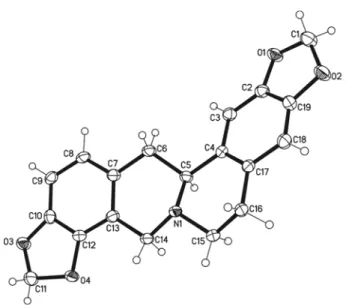
([α]20D - 335, CHCl3) was identified as the known tetrahydro- protoberberine alkaloid, (-)-stylopine.22) In particular, the structure of compound 2 was confirmed unambiguously by X- ray crystallographic analysis (Fig. 2).
These two alkaloids (1 and 2) were examined for their in vitro cytotoxic activities against a panel of human cancer cell lines including DU-145 (prostate), MCF (breast), A549 (lung), HePG2 (liver), and HT-29 (colon) by the sulphorhodamine B (SRB) assay. The IC50 values for compounds 1 and 2 are presented in Table 1. Compound 1 showed significant cytotoxic activity against the MCF and HT-29 human cancer cell lines with the IC50 values of 8.3 and 5.9µg/ml, respectively, while compound 2 exhibited a moderate cytotoxic activity against the DU-145 and MCF cell lines with the IC50 values of 13.9 and 16.6µg/ml, respectively.
Therefore, further studies will be performed on compounds 1
and 2 for their potential as anticancer agents through biological evaluations.
References
1. Kim, C. M., Sin, M. K., Ahn, D. K. and Lee, K. S. (1997) Joogyakdaesajun (in Korean). pp. 1563-1565, Jungdam pub-
lishing., Korea.
2. Koh, K. S. and Jeon. E. S. (2003) Ferns, fern-allies and seed-bearing plants of Korea. pp. 238, Iijinsa., Korea.
3. Ahn, D. K. (1998) Illustrated book of Korean medicinal herbs. pp 456, Kyo Hak Publishing Co. Ltd., Korea.
4. Chang, Q. N. and Li, Y. H. (1991) Determination of iso- quinoline alkaloids in Chelidonium majus L. by ion-pair high-performance liquid chromatography. J. Chromatogr. A
542, 193-199.
5. Liang, F. H., Wassyl, N. and Viktor, G. (1991) Reversed- phase high-performance liquid chromatographic separation of tertiary and quaternary alkaloids from Chelidonium majus L. J. Chromatogr. A543, 123-128.
6. Eva, T., Hana, B., Hana, P. and Jiri, D. (1994) Separation of alkaloids in Chelidonium majus by reversed phase HPLC.
Planta Med.60, 380-381.
7. Salvatore, D. R. and Giuseppe, D. V. (1992) Isochelido- nine, a benzophenanthridine alkaloid from Chelidonium majus. Phytochemistry31, 1085-1086.
8. Maria, L. C. and Enrica, B. (1996) Pharmacological activi- ties of Chelidonium majus L. (Papaveraceae). Pharmacol.
Res.33, 127-134.
9. Karl, O. H., Majid, G. and Heinz, S. (1998) Antispasmodic and relaxant activity of chelidonine, protopine, coptisine, and Chelidonium majus extracts on isolated guinea-pigs lleum. Planta Med.64, 758-760.
10. Lenfeld, J., Kroutil, M., Marsalek, E., Slavik, J., Preininger, V. and Simanek, V. (1981) Antiinflammatory activity of quaternary benzophenanthridine alkaloids from Chelido- nium majus. Planta Med.43, 161-165.
11. Lee, S. S., Kai, M. and Lee, M. K. (2001) Inhibitory effects of sanguinarine on monoamine oxidase activity in mouse brain. Phytother. Res.15, 167-169.
12. Annie, P., Anna, M. J., Pepita, C. B., Ernest, H. and Johanna, C. S. (2001) The effects of chelidonine on tubu- lin polymerization, cell cycle progression and selected sig- nal transmission pathways. Euro. J. Cell. Biol.80, 111-118.
13. Hladon, B., Kowalewski, Z., Bobkiewicz, T. and Gronostaj, K. (1978) Cytotoxic acitivity of some Chelidonium majus alkaloids on human and animal tumor cell cultures in vitro. Annales Pharmaceutici13, 61-68.
14. Vavreckova, C., Gawlik, I. and Muller, K. (1996) Ben- zophenanthridine alkaloids of Chelidonium majus; É. Inhibi- tion of 5- and 12-lipoxygenase by a non-redox mechanism.
Planta Med.62, 397-401.
15. Vavreckova, C., Gawlik, I. and Muller, K. (1996) Ben- zophenanthridine alkaloids of Chelidonium majus; II. Potent inhibitory action against the growth of human kerati- nocytes. Planta Med.62, 491-494.
16. Bhakuni, D. S. and Chaturnedi, R. (1983) The alkaloids of Corydalis meifolia. J. Nat. Prod.46, 320-324.
17. Joubert, A., Lottering, M. L. and Panzer, A. (2004) Influ- ence of chelidonine, an inhibitor of tubulin polymerization on tyrosine kinase activity in normal, transformed and malignant cell lines. Biomed. Res.25, 27-33.
18. Martinez, L. A., Rios, J. L., Paya, M. and Alcaraz, M. J.
Fig. 2. ORTEP view of compound 2.
Table 1. Inhibition of tumor cell proliferation by com- pounds 1 and 2 from C. majus var. asiaticum
Compound Cell linea [IC50 (µg/ml)]
DU-145 MCF A549 HePG2 HT-29
1 18.4±0.28 8.30±0.29 > 50 43.0±0.32 5.90±0.28 2 13.9±0.34 16.6±0.26 > 50 42.5±0.41 > 50
aIC50 values of compound against each human cancer cell lines (DU-145: prostate; MCF: breast; A549; lung: HePG2: liver; HT- 29: colon) were defined as concentrations (µg/ml) that caused 50% inhibition of cell proliferation in vitro.
Cytotoxic alkaloids from Chelidonium majus var. asiaticum 201 (1992) Inhibition of nonenzymic lipid peroxidation by ben-
zylisoquinoline alkaloids. Free Radic. Biol. Med. 12, 287- 19. Jang, S. I., Kim, B. H., Lee, W. Y., An, S. J., Choi, H. G.,292.
Jeon, B. H., Chung, H. T., Rho, J. R., Kim, Y. J. and Chai, K. Y. (2004) Stylopine from Chelidonium majus inhibits LPS-induced inflammatory mediators in RAW 264.7 cells.
Arch. Pharm. Res.27, 923-929.
20. Skehan, P., Storeng, R., Scudiero, D., Monks, A., McMa- hon, J., Vistica, D., Warren, J. T., Bokesch, H., Kenney, S.
and Boyd, M. R. (1990) New colorimetric cytotoxicity
assay for anticancer drug screening. J. Nat. Cancer Insti.
82, 1107-1112.
21. Cushman, M., Choong, T. C., Valko, J. T. and Koleck, M.
P. (1980) Total synthesis of (±)-chelidonine. J. Org. Chem.
45, 5067-5073.
22. Dai-Ho, G. and Mariano, P. S. (1988) Exploratory, mecha- nistic, and synthetic aspects of silylarene-iminium salt SET photochemistry. Studies of diradical cyclization processes and applications to protoberberine alkaloid synthesis. J.
Org. Chem.53, 5113-5127.