Pyrosequencing 을 이용한 메주, 천일염, 된장의 곰팡이 군집 분석
이림기, 허소정, 정도원*
동덕여자대학교식품영양학과
Received: May 14, 2019 / Revised: June 19, 2019 / Accepted: July 5, 2019
된장은단백질원인콩을주원료로하여발효시킨고염발 효식품으로독특한향미와맛으로인한기호성, 영양및기 능성을보유한조미식품이다. 된장은메주에소금과물을첨 가하여약 1달에서 6개월정도발효숙성하여제조한다[1].
된장의원료가되는메주는콩을증자하여성형한후볏짚 으로묶거나볏짚위에서약 2달간자연발효한다. 메주는 발효과정에서형성된미생물들이단백질분해효소와같은 효소를제공하고원료인콩이보유하고있는단백질의분해 와같은이화작용을통해독특한향미와맛을보유한다. 발 효된메주는된장의원료가되어보유하고있는미생물, 효 소, 영양소, 향, 맛성분등을제공한다[2, 3]. 따라서메주발 효에관여하는미생물의종류와분포는메주뿐만아니라된 장의품질에도영향을미친다고알려져있다.
지금까지 메주의 미생물 군집 연구결과 진균류로 Aspergillus, Cladosporium, Eurotium, Mucor, Penicillium, Rhizopus속이주로검출되었고, 세균에있어서는 Bacillus, Enterococcus, Lactobacillus, Clostridium, Staphylococcus
와 Tetragenococcus속이주로검출되었다[4, 5]. 특히, 진균 은메주의단백질과같은거대분자를분해하기위한여러가 지효소를생산하는이유로메주발효에중요한역할을한 다고알려져있고이들의기원을확인하기위해콩, 볏짚과 같은원료나환경의미생물군집을비교하였다[4]. 그러나, 메주의곰팡이가된장으로천이가되는지에대한연구는부 족한실정이다. 특히된장의미생물군집의기원에대한연구 는세균의군집에치중되어있고진균에대한연구는미흡 하다[6−8]. 따라서 본 연구에서는 진균의 ITS (internal
transcribed spacer) 유전자 서열 분석에 기반을 둔
pyrosequencing을이용하여메주의진균군집분석과더불
어된장의주요한원료인천일염, 그리고된장의진균군집 을분석하여진균천이에대한연구를확인하고자하였다.
본연구에사용된메주는 충청도서산지역에서 2017년 11월에전통적으로제조하여 2달간발효시킨재래식메주이 며, 해당메주를이용하여천일염을첨가후된장을제조하 였고 3달간발효후실험에사용하였다. 메주, 천일염, 된장 은 4℃에 저장하였다가사용하였다. 각시료는 PowerSoil DNA extraction kit (MOBIO, USA)을사용하여 DNA를추
출하였다. 곰팡이 ITS 서열의 PCR 증폭을 위해프라이머
ITS3 (5′-X-AC-TCGTCGGCAGCGTCAGATGTGTATAAGAG Fungal Microbial Community Profiles of Meju, Solar Salt, and Doenjang Using Pyrosequencing
Limgi Lee, Sojeong Heo, and Do-Won Jeong*
Department of Food and Nutrition, Dongduk Women’s University, Seoul 02748, Republic of Korea
In order to evaluate the migration of fungi into doenjang from its materials, meju and solar salt, microbial communities were analyzed using pyrosequencing. Dominant fungi of meju were Botrytis spp. (57.94%) and Dothiorella samentorum (24.08%). Unidentified fungal species (37.53%), unassigned species (32.60%) and several fungal species of small portion were identified in solar salt. In doenjang, Candida versatilis were predominantly detected (92.62%). Non-halophilic mold were dominantly identified from meju (low-salt fermented soybean), while halophilic bacteria and archaea for solar salt and salt-tolerance fungi such as C.
versatilis for doenjang (high-salt fermented soybean) were frequently detected. These results implied that most predominant fungal species might not be migrated from meju and/or solar salt into doenjang.
Keywords: Meju, solar salt, doenjang, fungal microbial community, pyrosequencing
*Corresponding author
Tel: +82-2-940-4463, Fax: +82-2-940-4610 E-mail: [email protected]
© 2019, The Korean Society for Microbiology and Biotechnology
ACAGG-CATCGATGAAGAACGCAGC-3′)과 ITS4 (5′-X- AC-GTCTCGTGGGCTCGGAG-ATGTGTATAAGAGAC
AGTCCTCCGCTTATTGATATGC′)를이용하였다. X는각
DNA 샘플의 8-nucleotide barcode와 AC는 barcode와프라 이머를연결한 a linker 부위이다. PCR은 95℃에서 initial denaturation을 3분실시하였고, 95℃ 30초 denaturation, 55℃에서 30초 annealing, 72℃ 30초 elongation을 25회반 복수행후종결반응을위해 72℃ 5분수행하였다. 증폭된 PCR 산물은 Qiagen purification kit (USA)을가지고정제 하였고, 각시료 PCR 산물 1 mg을 pyrosequencing 진행하 였다. Pyrosequencing은 Macrogen Inc. (Korea)이 MiSeqTM platform (Illumina, USA)을사용하여제조사의매뉴얼대로 수행하였다.
Pyrosequencing 결과는 SeqPurge 프로그램[9]을사용하 여오류교정을실행하였고, FLASH [10]를이용하여하나 의 서열로 조립하였다. Operational taxonomic units (OTUs)은 CD-HIT-OUT [11]를이용하여 97% 이상의서열 유사성을갖는서열끼리군집화하여종수준의 OUT를형성 하였다.
시료의진균군집분석을바탕으로계산된통계분석결과, 세개의시료에서 Goods Coverage가 0.99 이상으로보임으
로서진균군집분석을위한충분한 read 수를얻었다(Table
1). 각시료별종추정치(OUTs) 개수는 30−69개, 종풍부도 (species richness) Chao1는 31−69개로계산되었다. 종다양 성(species diversity) Shannon은 0.61−4.03으로계산되었다.
천일염의 Chao1과 Shannon 결과는메주와된장보다높은
종의다양성과풍부도를보였다. 메주는종풍부도측면에서
가장낮게나왔고, 된장의경우종의다양성이가장낮게나 왔다.
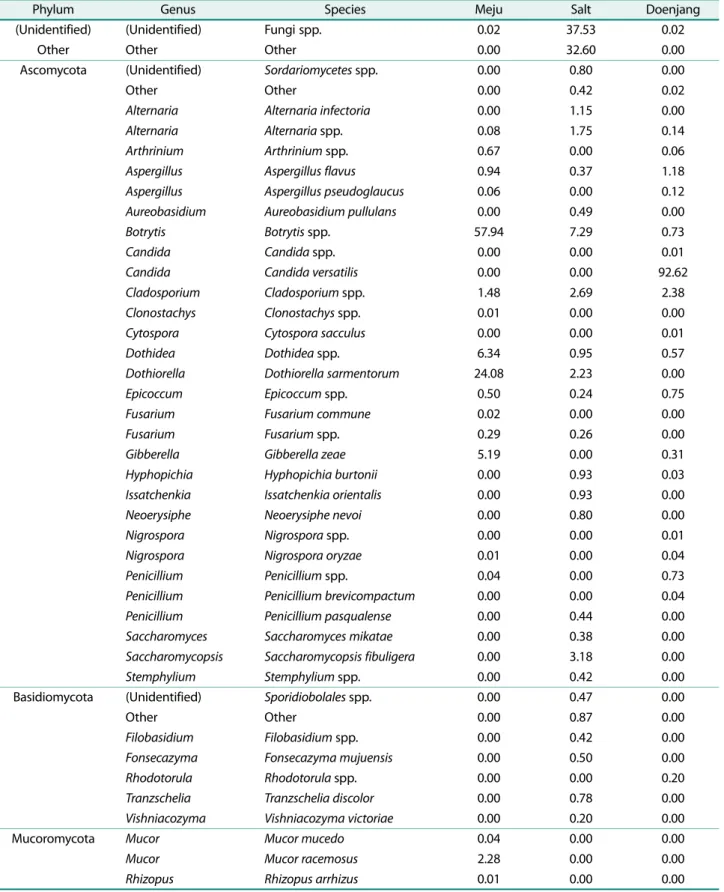
진균의분포도를종(species) 수준에서차지하는비율로볼
때 메주는 Botrytis spp. (57.94%), Dothiorella samentorum (24.08%), Dothidea spp. (6.34%), Gibberella zeae (5.19%)
의순으로보였다(Fig. 1). 일반적으로메주의우점진균으로
알려져있는 Mucor속은 Mucor racemosus (2.28%)와 Mucor mucedo (0.04%)가확인되었고, Aspergillus속은 Aspergillus flavus (0.94%)와 Aspergillus pseudoglaucus (0.06%)가확
인되었다(Table 2). 천일염의경우에는 확인되지 않은 종
(37.53%)과기타(32.60%)로분류된종이가장크게차지하 였고 Botrytis spp. (7.29%), Saccharomycopsis fibuligera (3.18%), Cladosporium spp. (2.69%), Alternaria spp.
(1.75%)의순으로확인되었다. 그리고 21개의종이적은비 율로검출되었다. 된장의경우 20개의종이확인되었고, 그 중 Candida versatilis (92.62%)가 가장 크게 차지하였고 Cladosporium spp. (2.38%), A. flavus (1.18%) 순으로확인 되었다.
Botrytis spp.는메주에서우점으로확인되었고천일염에
서 발견되었으나, 된장에서는 발견되지 않았다. Botrytis cinerea는메주에서분리확인되는진균중하나이며[12], 여 러종류의 protease를생산하는종이다[13]. 이러한결과는 단백질이많은메주에서단백질로부터아미노산으로분해하 는데 기여할것으로 추정할 수있다. 메주에서검출된 D.
samentorum는포도줄기를감염시키는원인균으로알려져
있으며[14], amylase, lipase 그리고 protease와같은외래분 비효소를많이생산한다고알려져있다[15]. 해당진균이메 Table 1. Fungal diversity indices of meju, solar salt and doenjang.
Sample name Total reads High-quality reads OTUs Chao1 Shannon ACE Goods coverage
Meju 46,226,062 136,769 30 31.0 1.84 0.59 0.99
Salt 75,754,235 196,947 69 69.0 4.03 0.84 1.00
Doenjang 60,568,584 214,061 43 46.3 0.61 0.14 0.99
Fig. 1. Fungal taxonomic compositions in meju, solar salt and doenjang. Data portray (A) phylum-, (B) genus-, and (C) species levels of ITS regions pyrotagged gene sequences found in three samples. The ITS regions with more than 200 bp were classified using the
Table 2. Taxonomic classification at the species levels showing fungal microbial community of meju, solar salt, and doenjang.
Phylum Genus Species Meju Salt Doenjang
(Unidentified) (Unidentified) Fungi spp. 0.02 37.53 0.02
Other Other Other 0.00 32.60 0.00
Ascomycota (Unidentified) Sordariomycetes spp. 0.00 0.80 0.00
Other Other 0.00 0.42 0.02
Alternaria Alternaria infectoria 0.00 1.15 0.00
Alternaria Alternaria spp. 0.08 1.75 0.14
Arthrinium Arthrinium spp. 0.67 0.00 0.06
Aspergillus Aspergillus flavus 0.94 0.37 1.18
Aspergillus Aspergillus pseudoglaucus 0.06 0.00 0.12
Aureobasidium Aureobasidium pullulans 0.00 0.49 0.00
Botrytis Botrytis spp. 57.94 7.29 0.73
Candida Candida spp. 0.00 0.00 0.01
Candida Candida versatilis 0.00 0.00 92.62
Cladosporium Cladosporium spp. 1.48 2.69 2.38
Clonostachys Clonostachys spp. 0.01 0.00 0.00
Cytospora Cytospora sacculus 0.00 0.00 0.01
Dothidea Dothidea spp. 6.34 0.95 0.57
Dothiorella Dothiorella sarmentorum 24.08 2.23 0.00
Epicoccum Epicoccum spp. 0.50 0.24 0.75
Fusarium Fusarium commune 0.02 0.00 0.00
Fusarium Fusarium spp. 0.29 0.26 0.00
Gibberella Gibberella zeae 5.19 0.00 0.31
Hyphopichia Hyphopichia burtonii 0.00 0.93 0.03
Issatchenkia Issatchenkia orientalis 0.00 0.93 0.00
Neoerysiphe Neoerysiphe nevoi 0.00 0.80 0.00
Nigrospora Nigrospora spp. 0.00 0.00 0.01
Nigrospora Nigrospora oryzae 0.01 0.00 0.04
Penicillium Penicillium spp. 0.04 0.00 0.73
Penicillium Penicillium brevicompactum 0.00 0.00 0.04
Penicillium Penicillium pasqualense 0.00 0.44 0.00
Saccharomyces Saccharomyces mikatae 0.00 0.38 0.00
Saccharomycopsis Saccharomycopsis fibuligera 0.00 3.18 0.00
Stemphylium Stemphylium spp. 0.00 0.42 0.00
Basidiomycota (Unidentified) Sporidiobolales spp. 0.00 0.47 0.00
Other Other 0.00 0.87 0.00
Filobasidium Filobasidium spp. 0.00 0.42 0.00
Fonsecazyma Fonsecazyma mujuensis 0.00 0.50 0.00
Rhodotorula Rhodotorula spp. 0.00 0.00 0.20
Tranzschelia Tranzschelia discolor 0.00 0.78 0.00
Vishniacozyma Vishniacozyma victoriae 0.00 0.20 0.00
Mucoromycota Mucor Mucor mucedo 0.04 0.00 0.00
Mucor Mucor racemosus 2.28 0.00 0.00
Rhizopus Rhizopus arrhizus 0.01 0.00 0.00
주발효에관여한다는결과는찾을수없었지만흙에서검 출된다는결과와효소생산을기반으로판단해볼때메주의 발효연관성에대한가능성을유추할수있다. 그러나, 두종 의진균이식물병원균으로먼저알려져있기때문에해당종 들이발효된메주에존재했을때발효식품의안전성측면에 서연구가필요하다. 그리고, 두종이메주에서 82.02%를차 지하고있었음에도불구하고된장에서는 0.73%를차지하는 것으로보아메주의우점진균이된장으로천이되지않은것 으로판단된다. 이런결과는내염성이없는두종이고염인 된장에서의생육이용이치않았을것으로판단한다.
천일염의경우는확인되지않은종이 70.13%를차지하고
있으며, 그외 Ascomycota문에포함되는공기나토양중에 존재하는곰팡이들이검출되었다. 특이하게도진균에속하 는효모중 S. fibuligera가 3.18% 검출되었으나, 이는메주 나된장에서모두검출되지않는것으로보아천일염으로부 터천이가일어나지않은것으로판단된다.
된장에서가장많이검출된것은 C. versatilis로 92.62%
검출되었다. 해당종은여러된장및발효콩에서우점진균으 로도보고되었다[8, 16]. 무엇보다 C. versatilis는고염에서 생육할수있는내염성을보였고, C. versatilis 유전체분석 은세포내글리세롤합성과환경으로부터글리세롤흡수를
통해 내염성을 보인다는 결과를 보였다[17]. 그리고 C.
versatilis가고염인간장발효에서향기성분생산에영향을
미친다고알려져있다[18, 19]. 이런결과는 C. versatilis가 고염인된장에서생육과동시에된장의향기성분에영향을 미칠수있는 중요한우점진균중하나임을유추할 수있 다. 그러나해당종은메주와천일염에서는검출되지않은 것으로보아두개의원재료에아주미미한정도로존재하다 가고염인환경에서생육을했거나, 다른부재료에서유래했 을것으로추정된다. 결과적으로우리는된장의발효에있어 서주원료가되는메주가지닌우점진균이된장으로천이가 되어영향을미칠것으로예상하였으나, 된장의진균은메주 의우점유무와상관없이염에내성을가지는진균이우점을 차지하여발효에영향을미치는것으로생각된다.
다만특이하게도, 메주및된장의우점진균으로알려져있
고 상업적 된장 제조에 종균으로 사용되는 Aspergillus
oryzae는본연구에서사용한서산에서제조된된장에서검
출되지않았다. 그리고조등의연구결과에서도제주나호남 권전통된장에서 A. oryzae는비우점진균으로확인되었다
[8]. 비록진균의군집구조가된장시료간에다양하게나타
난다는사실은이미알려져있으나, 해당결과는기존의알
려져 있는 A. oryzae 외에도 된장의 종균후보군으로 C.
versatilis를포함하여신규종균후보의존재를예상할수
있다. 그러나, 아직까지 C. versatilis는발효용종균으로사 용된예가없어종균후보로분리된다하더라도식품원료목
록에등재된종이아니므로위해성평가및식품의약품안전
처의사용허가가필요한실정이다. 2010년채택된나고야
의정서가 2014년발효됨에따라국내미생물자원의보호
및활용이활성화되어야한다. 이러한차원으로볼때우리 의전통메주나된장에서분리되어산업적으로유용한잠재 성을지닌균에대해서는식품원료목록에신규등재를위한 편리한절차와규정이필요하며, 신규종균에대한사용이 용이할수있도록국가적차원의전략이필요하다고제언 한다.
요 약
메주를염수에침지하여된장을만드는과정동안진균의 군집변화와재료가된메주와천일염의균총천이를확인 하고자진균의 ITS (internal transcribed spacer) 유전자서
열을기반으로하는 pyrosequencing을통해미생물군집을
확인하였다. 된장의 주요 원료인 메주는 Botrytis spp.
(57.94%)와 Dothiorella samentorum (24.08%)가우점종으 로확인되었다. 천일염은확인되지않은종들이(70.13%) 검 출되었고, 그외종들은적은비율로다양하게검출되었다. 된장은진균 중곰팡이가아닌효모인 Candida versatilis
(92.62%)가가장높은우점진균으로확인되었다. 메주의저
염은곰팡이생육이용이했고, 천일염은고세균또는호염 진균, 된장은고염효모의생존에용이했던것으로판단된다. 메주와천일염의우점진균이된장의균총에직접적인영향 을미치지못하는것으로판단된다.
Acknowledgments
This research was supported by the Dongduk Women’s University grant of 2018.
Conflict of Interest
The authors have no financial conflicts of interest to declare.
References
1. Park K-Y, Hwang K-M, Jung K-O, Lee K-B. 2002. Studies on the standardization of doenjang (Korean soybean pastes): 1. Stan- dardization of manufacturing method of doenjang by litera- tures. J. Korean Soc. Food Sci. Nutr. 31: 343-350.
2. Lee SS. 1995. Meju fermentation for a raw material of Korean traditional soy products. Korean J. Mycol. 23: 161-175.
3. Yoo JY, Kim HG. 1998. Characteristics of traditional mejus of nation-wide collection. J. Korean Soc. Food Sci. Nutr. 27: 259- 267.
4. Kim DH, Kim SH, Kwon SW, Lee JK, Hong SB. 2015. The mycobi- ota of air inside and outside the meju fermentation room and the origin of meju fungi. Mycobiology 43: 258-265.
5. Jung JY, Lee SH, Jeon CO. 2014. Microbial community dynam- ics during fermentation of doenjang-meju, traditional Korean fermented soybean. Int. J. Food Microbiol. 185: 112-120.
6. Jeong DW, Kim HR, Jung G, Han S, Kim CT, Lee JH. 2014. Bacte- rial community migration in the ripening of doenjang, a tradi- tional Korean fermented soybean food. J. Microbiol. Biotechnol.
24: 648-660.
7. Kim YS, Jeong DY, Hwang YT, Uhm T-B. 2011. Bacterial commu- nity profiling during the manufacturing process of traditional soybean paste by pyrosequencing method. Korean J. Microbiol.
47: 275-280.
8. Cho S, Park HS, Jo SW, Yim EJ, Yang HY, Ha GS, et al. 2017. Com- parison of microbial community profiling on traditional fer- mented soybean products (deonjang, gochujang) produced in Jeonbuk, Jeonnam, and Jeju province area. Korean J. Microbiol.
53: 39-48.
9. Sturm M, Schroeder C, Bauer P. 2016. SeqPurge: highly-sensi- tive adapter trimming for paired-end NGS data. BMC Bioinfor- matics 17: 208.
10. Magoc T, Salzberg SL. 2011. FLASH: fast length adjustment of short reads to improve genome assemblies. Bioinformatics 27:
2957-2963.
11. Li W, Fu L, Niu B, Wu S, Wooley J. 2012. Ultrafast clustering algo- rithms for metagenomic sequence analysis. Brief Bioinform. 13:
656-668.
12. Shin D, Jeong D. 2015. Korean traditional fermented soybean products: Jang. J. Ethnic Foods 2: 2-7.
13. Abidi F, Limam F, Marzouki MN. 2007. Purification and charac- terization of an alkaline protease Prot 1 from Botrytis cinerea:
biodetergent catalyst assay. Appl. Biochem. Biotechnol. 141:
361-376.
14. Baskarathevan J, Jaspers MV, Jones EE, Ridgway HJ. 2012. Inci- dence and distribution of botryosphaeriaceous species caus- ing dieback and decline in New Zealand vineyards. Eur. J. Plant Pathol. 132: 549-560.
15. Esteves AC, Saraiva M, Correia A, Alves A. 2014. Botryosphaeria- les fungi produce extracellular enzymes with biotechnological potential. Can. J. Microbiol. 60: 332-342.
16. Qi W, Hou LH, Guo HL, Wang CL, Fan ZC, Liu JF, Cao XH. 2014.
Effect of salt-tolerant yeast of Candida versatilis and Zygosac- charomyces rouxii on the production of biogenic amines during soy sauce fermentation. J. Sci. Food Agric. 94: 1537- 1542.
17. Ruan L, Meng M, Wang C, Hou L. 2019. Draft genome sequence of Candida versatilis and osmotolerance analysis in soy sauce fermentation. J. Sci. Food Agric. 99: 3168-3175.
18. Cao X, Hou L, Lu M, Wang C, Zeng B. 2010. Genome shuffling of Zygosaccharomyces rouxii to accelerate and enhance the fla- vour formation of soy sauce. J. Sci. Food Agric. 90: 281-285.
19. Song YR, Jeong DY, Baik SH. 2015. Monitoring of yeast commu- nities and volatile flavor changes during traditional Korean soy sauce fermentation. J. Food Sci. 80: M2005-2014.