한국과 중국 미생물 발효차의 미생물 군집분석 및 비교
김병혁1, 장종옥1, 좌재호1, 김진아1, 송승엽1, 임찬규1, 김천환1, 정영빈1, 성기철1, 김희식2, 문두경1*
1농촌진흥청국립원예특작과학원온난화대응농업연구소
2한국생명공학연구원세포공장연구센터
Received: February 28, 2017 / Revised: March 22, 2017 / Accepted: March 23, 2017
서 론
차는세계적으로넓게음용되는음료로서거의모든나라 에서소비되고있으며
,
중국,
일본,
한국등의동아시아지역 에서오랜시간동안음용되어왔다.
차나무(Camellia sinesis L.)
는다년생상록관목으로한국,
중국,
일본을비롯한아시 아,
아프리카,
러시아등의아열대지역과온대지역에걸쳐 넓게재배되고있으며,
차추출물에는카페인,
아미노산,
폴 리페놀(
카테킨)
등의다양한성분을함유하고있다[1].
최근 세계적으로건강에대한관심이증가되고,
차추출물의다양 한건강증진효과(
암예방,
심혈관계,
신경계등)
가보고되면 서차에대한관심과소비가증가되고있다[2
−5].
차는제조방법에따라녹차
,
반발효차(semi-oxidation tea),
발효차(oxidation tea),
후발효차(post-fermented tea)
로구 분되며,
제조시발효방법과발효강도에의해추출물내의 성분,
색,
향기,
맛등이차이를보이고있다[6].
후발효차는 찻잎의미생물발효를통해제조된다.
일반적으로후발효차 는불발효차인녹차에비해맛이부드럽고발효를통하여gallic acid, methoxy phenolic compound, poly-flavonoids
가증가되어후발효차의항균작용,
혈중콜레스테롤감소효 과,
항산화활성등이보고되었으며,
후발효차에대한관심이 증가되고 있다
[7
−10].
대표적인 후발효차는 중국의Yunnan pu-erh tea, Hunan Fu-zhuan tea, Hubei Qing- zhuan tea, Sichuan Bian-xiao tea, Guangxi Liu-bio tea
등 이있으며,
이중Yunnan pu-erh tea
가가장널리알려졌다.
한 국전통의후발효차는알가차(
경남하동)
와단차(
전남남원)
등이생산되고있는실정으로,
미생물발효에의한후발효차 는동아시아에서제한적으로생산되고있다[7].
후발효차는미생물의발효정도에따라서차의맛과향이
A Comparison of the Microbial Diversity in Korean and Chinese Post-fermented Teas
Byung-Hyuk Kim
1, Jong-Ok Jang
1, Jae-Ho Joa
1, Jin-Ah Kim
1, Seung-Yeob Song
1, Chan Kyu Lim
1, Chun Hwan Kim
1, Young Bin Jung
1, Ki-Cheol Seong
1, Hee-Sik Kim
2, and Doo-Gyung Moon
1*
1
Agricultural Research Institute for Climate Change, National Institute of Horticultural and Herbal Science, RDA, Jeju 63240, Republic of Korea
2
Cell Factory Research Center, KRIBB, Daejeon 34141, Republic of Korea
Tea is the most popular beverage in the world. The three main types are green, black, and post-fermented.
Post-fermented teas are produced by the microbial fermentation of sun-dried green tea leaves (Camellia sinensis). In this study, the composition of the bacterial communities involved in the production of traditional oriental post-fermented teas (Korean algacha, dancha, and Chinese pu-erh) were investigated using 16S rRNA gene analysis. The dominant microorganisms present in the post-fermented teas included the α-proteobacteria Rhodobacteraceae and Sphingomonas, and the γ-proteobacteria Pantoea. Cluster analysis confirmed that the microbial populations present in both Korean and Chinese post-fermented teas grouped into the same class. Interestingly, the dominant microorganism present in the Korean post- fermented teas was a bacterium, while for the Chinese post-fermented tea, it was a fungus.
Keywords: Camellia sinensis, double gradient-DGGE, microbial community, post-fermented tea, tea
*Corresponding author
Tel: +82-64-741-2564, Fax: +82-64-749-2066 E-mail: [email protected]
© 2017, The Korean Society for Microbiology and Biotechnology
결정되기때문에
,
미생물의역할이매우크다.
그러나,
현재 우리나라차에관한연구는불발효차인녹차가주를이루고 있으며,
후발효차에대한연구는매우부족하며중국의후발 효차인보이차의숙성에관한연구들이주를이루고있다[11
−14].
이에비해,
한국후발효차인알가차와단차의발효관여미생물에관한연구는전무한상태이며
,
후발효차의발효 관여미생물에대한연구역시매우부족하다.
실제환경에 서미생물들은주변환경에따라다른미생물들과상호작용 을통해군집을형성하며,
미생물군집의특성은개별적으로 존재하는미생물과는다른특성을가지며,
미생물간의상호 작용을통해발현적특성을가진다.
따라서미생물각개체 로이해하는것보다미생물군집을이해하는것이매우중요하게여겨지고있다
[15
−17].
미생물작용으로숙성되는미생물발효차에있어숙성미생물군집구조를규명하는연구는 후발효차의특성과품질을파악하는데매우중요한사항이 라판단된다
.
이러한미생물군집구조를조사하는방법중 전통적인배양방법을통해배지상에서배양가능한미생물은 전체미생물중에1%
미만으로미생물다양성과군집구조를 조사하는데한계가있다.
이에16S rRNA
유전자를이용한 분자생태학적방법들은생태학적인관계를규명하기위해활 용되고있다[16, 18].
한국전통후발효차
(
알가차,
단차)
와중국전통후발효차 인보이차의발효과정에관여하는미생물을규명하는것은 후발효차특성을파악하고품질을향상시키기위해꼭필요 한연구로,
후발효차숙성에관여하는미생물군집분석을분 자생태학적기법을통해분석하였다.
본연구를통한미생물 생태학적기초지식은후발효과정에서미생물간의상호작 용을이해하는데기여할것으로판단된다.
재료 및 방법
시료
한국전통후발효차인알가차와단차는
2015
년제조되었 고,
중국보이차는2015
년제조된O
사의후발효차(
보이차1)
와T
사의후발효차(
보이차2)
를각각분석하였다.
DNA 추출
Total DNA
는 후발효차0.5 g
을 사용했고, Fast DNA Spin kit for Soil (MP bio, Korea)
를이용하여추출하였다.
추출된DNA
의농도및순도는NanoDrop ND-2000 (Thermo Scientific, USA)
을이용하여확인하였다.
미생물 군집분석을 위한 PCR
미생물다양성을확인하기위해시료로부터얻은
DNA
를 주형으로1
차PCR
과nested-PCR
반응을 수행하였다[19,
20]. 1
차PCR
은27F (5'-AGA GTT TGA TCM TGG CTC AG-3')
와1541R (5'-AAG GAG GTG ATC CAN CCR CA- 3')
을이용하여50
μl
안에1× PCR buffer, 20 mM MgCl
2, 40 mM dNTP mixture,
각primer (1
μM), template DNA
와0.5 U Taq polymerase
를첨가하였다. PCR
반응조건은 우선94
℃에서5 min
동안DNA
를pre-denaturation
시킨 후, 94
℃에서45 sec denaturation, 56
℃에서45 sec annealing, 72
℃에서45 sec extension
을25 cycles
을수행 한후72
℃에서7 min
동안final extension
을수행하였다. PCR
산물은ethidium bromide
염색 후1% agarose gel
에 서 확인하였다. Double Gradient-Denaturing Gradient Gel Electrophoresis (DG-DGGE)
분석을위하여, 1
차PCR
의증폭산물을주형으로2
차PCR
을수행하였으며,
이때16S rDNA
를 증폭하기 위하여 사용된primer
는40
개의GC- clamp
가 붙은341F-GC (5'-CGC CCG CCG CGC GCG GCG GGC GGG GCG GGG GCA CGG GGG GCC TAC GGG AGG CAG CAG-3')
와786R (5'-CTA CCA GGG TAT CTA ATC-3')
을이용하였다[21
−23]. 2
차PCR
을위한PCR
혼합물은1
차PCR
에사용된 것과동일하며,
사용된PCR
반응조건은94
℃에서5 min
동안DNA
를pre- denaturation
시켜, 94
℃에서45 sec denaturation, 60
℃에 서45 sec annealing, 72
℃에서45 sec extension
하고72
℃ 에서7 min
동안final extension
을수행하였다. Annealing
온도는초기에는60
℃에서시작해서1 cycle
당0.5
℃감소 하게20 cycles
수행하였고,
그후50
℃에서15 cycles
을수 행하여touch-down PCR
을완료하였다.
얻어진2
차PCR
의 산물을이용하여DG-DGGE
를수행하였다[20].
DG-DGGE 운전조건
PCR
산물은Dcode
TMSystem (Bio-Rad)
을이용하여DG- DGGE
를수행하였다[20, 24]. DG-denaturing gradient gel
은8
−12% polyacrylamide (37.5:1=acrylamide:bisacrylamide)
에urea
와formamide
변성제를40
−70%
까지농도구배가형 성되도록제작하였으며,
제작된DG-DGGE gel
에PCR
증폭 산물을30
μl
씩loading
하여1× TAE buffer (40 mM Tris, 20 mM acetic acid, 1 mM EDTA, pH 8.0)
에서60
℃, 110 V
로21
시간동안전기영동하였다.
전기영동이끝난DG- DGGE gel
은ethidium bromide (1:10,000)
에서염색한후, UV
로확인하였다[16].
16S rRNA gene clone library
를 통한 미생물 군집분석16S rRNA gene clone library
분석을 위한PCR
은27F
(5'-AGA GTT TGA TCM TGG CTC AG-3')
와1541R (5'-
AAG GAG GTG ATC CAN CCR CA-3')
을 사용하였으며[23].
각각의primer
를 이용하여50
μl
안에10× PCR
buffer, 20 mM MgCl
2, 40 mM dNTP mixture,
각primer (1
μM), template DNA
와0.5 U Taq polymerase
를첨가하 여PCR
을수행하였다.
반응조건은94
oC
에서5 min
동안DNA
를pre-denaturation
시켜, 94
oC
에서1 min denaturation, 60
℃에서1 min annealing, 72
℃에서1 min 30 sec extension
하고72
℃에서5 min
동안final extension
을수행하였다. 16S rRNA gene clone library
구축을위해PCR
증폭산물을1% agarose gel
에loading
한후약1,500 bp
크기의band
를 잘라, LaboPass Gel Extraction kit (CosmoGen)
를 이용하여 정제한 후, All-in-one vector (Biofact)
에ligation
하고,
이plasmid
를E. coli DH5
α(RBC Korea)
에 넣은 후LB + kanamycin (50
μg/ml)
배지에서키워 생성된 군집락들을16S rRNA
유전자분석에이용하였으며,
모두241
개의군집 락을분석하였다.
염기서열분석
DG-DGGE gel
상에서다른위치에존재하는DNA
단편들을회수하기위하여각각의
band
를선택한후,
잘라내어3
차DW 50
μl
를첨가하고4
℃에서하룻밤동안방치하여상 등액을취하였다. Band
에서회수한DNA
를주형으로nested PCR
에사용한primer
를이용하여재증폭하였으며, PCR
산 물은agarose gel
에서 전기영동하여DNA recovery kit (Biofact)
로정제한후cloning
하였다. Cloning
은All-in-one vector (Biofact)
을이용하였고,
제조사가제시한방법을따 라수행하였으며,
삽입된16S rRNA
유전자의염기서열은3730xl DNA Analyzer (ABI)
를이용하여결정하였다.
결정 된 염기서열은NCBI (www.ncbi.nlm.nih.gov)
의GenBank database
를이용하여BLAST search
를통해분석하였다.
또한
, Phylogenetic tree
는ClusterX
를이용하여미생물간 의 상동성을 분석하고, MEGA 5.0
의neighbor-joining
method
를이용하여유전적계통분류를수행하였다[25].
미생물 군집 비교를 위한 정량 Real time PCR
각시료별미생물의군집의크기를정량적으로평가하기
위해
qPCR
을수행하였다.
미생물군집을정량하기위해서27F
와518R (5'-ATT ACC GCG GCT GCT GG-3') primer
를이용하였고[26], E. coil DH5
α의total DNA
를주형으로PCR
을수행하여491 bp
의PCR
산물을얻었다.
또한,
곰팡 이군집의정량을위해SR-4F (5'-AG CCG CGG TAA TTC CAG CT-3')
와SR-7R (5'-TCC TTG GGC AAA TGC TTT CGC-3')
을이용하였고, Aspergillus total DNA
를주형으로 하여388 bp
의PCR
산물을얻었다[27].
각각의PCR
산물은All-in-one vector (Biofact, Korea)
에cloning
하였으며, plasmid DNA
는LaboPass Mini Kit (CosmoGen, Korea)
를이용하 여 추출하였다.
염기서열분석은M13-20F and M13-20R
(All-in-one Vector Systems manual)
을이용하여분석하였 고, BLAST search
를통해확인하였다.
염기서열이확인된plasmid DNA
는real-time PCR
기기를이용하여melting curve (Bio-Rad, USA)
분석후정량분석을위한표준유전 자(artificial standard clone)
로사용하였다.
정량
PCR
을 위해CFX96 Touch
TMReal-Time PCR Detection System (Bio-Rad)
과iTaq
TMSYBR
®Green Supermix with ROX (Bio-Rad)
을이용하였다.
미생물16S rRNA
유전자정량PCR
은각각의primer
를이용하였으며 반응조건은95
℃에서15 min
동안pre-denaturation
시켜, 95
℃에서30 sec denaturation, 67
℃에서30 sec annealing, 72
℃에서30 sec extension
후fluorescence
를측정하고45 cycles
을 수행하였다.
그리고final extension
은72
℃에서5 min
동안수행하였다. Melting curve
분석은65
℃부터95
℃ 까지0.2
℃씩증가시키면서fluorescence
를측정하였다.
곰팡이군집의정량을위해서앞서사용된
PCR program
을이용하였으며
, annealing
온도는69
℃에서수행하였다.
정량을위해서표준유전자를serial dilutions
하여Real time-PCR
을 수행하였으며, DNA
농도는NanoDrop ND- 2000 (Thermo Scientific, USA)
을이용하여1 ng/
μl
를분석 에이용하였다[16, 28].
결과 및 고찰
미생물후발효차는동아시아에서제한적으로생산되며
,
미 생물의발효과정으로제조되기때문에녹차,
홍차등과구별 되는특유의맛,
색,
향을지니게된다.
본연구에서는한국 의전통후발효차와중국의후발효차의품질을결정짓는미 생물군집구조를분석·
비교하여한국후발효차(2
개시료)
와중국후발효차(2
개시료)
의공통점과차이점을규명하고 자하였다.
DG-DGGE를 통한 미생물 군집분석
한국의알가차와단차그리고중국의보이차는전통미생 물발효차로서연구에사용한시료는
2015
년제조하여1
년 숙성된후발효차를이용하였다.
본연구에서는개선된DG- DGGE
기법을사용하였다.
기존DGGE
기법은homo-duplexs
를분리하지못하는데비해
DG-DGGE
에서는분리가가능하기때문에보다정확한염기서열간의차이를구분할수있 다는장점을가지고있다
[29
−31].
각시료로부터total DNA
를 획득하였으며,
미생물universal primer
인341F-GC
와786R primer
를이용하여PCR
증폭산물을얻었고,
군집구 조를확인하는데유용한기법인DG-DGGE
를이용하여미 생물군집구조분석을수행하여미생물군집패턴을확인하 였다(Fig. 1).
또한,
미생물군집분석을위한밴드동정을위해
DG-DGGE gel
로부터알가차와단차에서7
개의밴드와 보이차에서3
개의밴드를회수하여염기서열을결정하였으 며, NCBI (www.ncbi.nlm.nih.gov)
의GenBank database
를이용하여BLAST search (blastn)
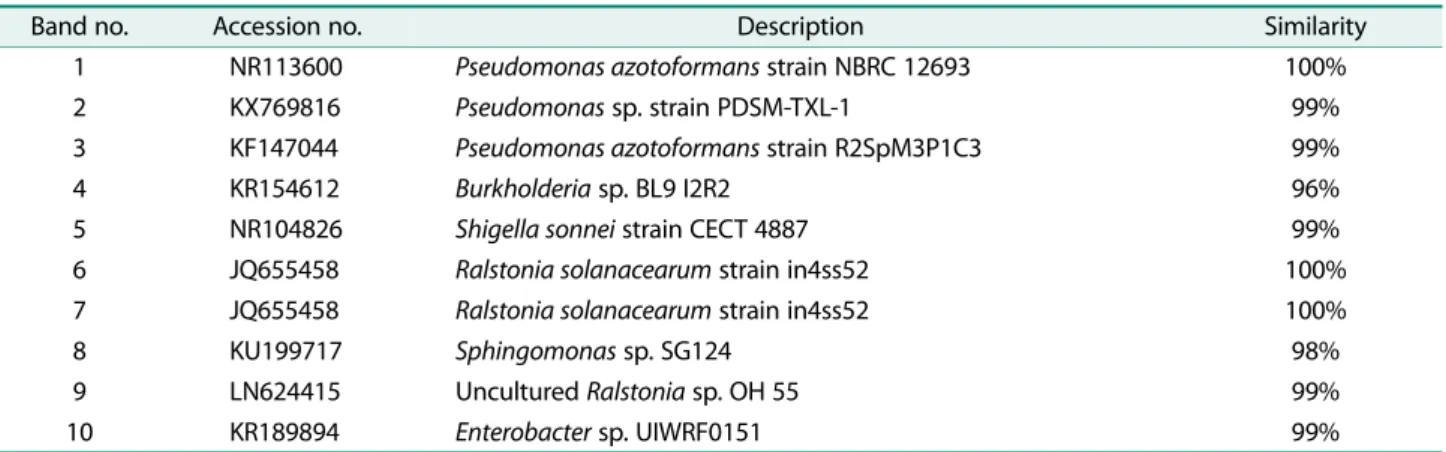
를통해상동성을비교 검색하였다(Table 1). DG-DGGE
를통한후발효차우점미 생물분석은genus
수준에서총6
종의미생물을동정했고, Pseudomonas (band 1, 2, 3) Burkholderia (band 4), Shigella sonnei (band 5), Ralstonia solanacearum (band
6, 7, 9), Sphingomonas (band 8)
와Enterobacter (band 10)
로확인되었다(Table 1).
미생물군집구조분석을수행한결과
DG-DGGE
밴드패 턴이전체적으로유사하였지만,
한국의후발효차와중국의 후발효차간의매우적은밴드패턴의차이를확인할수있 었다. 9
번밴드는중국의보이차에서만관찰되었고,
염기서 열분석결과Uncultured Ralstonia (LN624415)
로보이차에 서만확인되었다(Fig. 1, Table 1). DG-DGGE
분석을통해,
후발효차에존재하는미생물는매우유사하나,
한국후발효 차간,
중국후발효차간의각각미생물군집의유사성을확인 하였다.
이러한밴드차이를활용하여한국전통후발효차와 중국의후발효차를구별할수있는가능성을확인하였다.
또 한,
미생물군집분석을통한원산지구별방법이정립되기 위해서는더많은연구가수행되어야할것으로판단된다.
16S rRNA
유전자를 통한 미생물 군집분석16S rRNA gene clone library
를통해미생물군집의다양 성과각군집의크기를확인하였다.
미생물universal primer
인27F
와1542R
을 이용하여PCR
증폭산물을 얻었으며, cloning
을통하여16S rRNA
유전자염기서열을분석하였고, NCBI
의BLAST search
를통해검색하고동정하였다.
한국 후발효차인알가차의16S rRNA
유전자의미생물군집분석 결과Rhodobacteraceae (27.6%), Pantoea ananatis (13.8%), Roseomonas (13.8%)
와Uncultured bacterium (13.8%)
가 각각우점하였으며,
단차의미생물군집은Rhodobacteraceae (27.1%), Acidovorax (23.7%), Pantoea ananatis (10.2%)
와Pseudomonas (10.2%)
가우점하였다.
그리고중국의전통후 발효차인보이차1
의미생물군집분석결과Pantoea allii (19.4%), Gemmobacter caeni (16.1%), Sphingomonas (16.1%)
와Reyranella (12.9%)
가우점하고있으며,
보이차2
의미생 물 군집 분석결과Sphingomonas (17.7%), Exiguobacterium (16.1%), Pantoea allii (16.1%)
와Klebsiella (12.9%)
의 순Table 1. Identity of the bands obtained from 16S rRNA gene DG-DGGE profile of the oriental traditional post-fermented tea.
Band no. Accession no. Description Similarity
1 NR113600 Pseudomonas azotoformans strain NBRC 12693 100%
2 KX769816 Pseudomonas sp. strain PDSM-TXL-1 99%
3 KF147044 Pseudomonas azotoformans strain R2SpM3P1C3 99%
4 KR154612 Burkholderia sp. BL9 I2R2 96%
5 NR104826 Shigella sonnei strain CECT 4887 99%
6 JQ655458 Ralstonia solanacearum strain in4ss52 100%
7 JQ655458 Ralstonia solanacearum strain in4ss52 100%
8 KU199717 Sphingomonas sp. SG124 98%
9 LN624415 Uncultured Ralstonia sp. OH 55 99%
10 KR189894 Enterobacter sp. UIWRF0151 99%
Fig. 1. DG-DGGE patterns of 16S rDNA fragments of oriental
post-fermented tea bacteria. (A) Algacha, (B) Dancha, (C) Pu-
erh tea 1, and (D) Pu-erh tea 2.
으로우점하는것을확인하였다
(Fig. 2, Table 2).
한국후발효차인알가차와단차에가장우점하는미생물 은
Rhodobacteraceae (
α-proteobacteria,
알가차; 27.6%,
단 차; 27.1%)
로규명되었으나,
중국의후발효차인보이차2
종 에서는Pantoea allii (
γ-proteobacteria,
보이차1; 19.4%,
보이차2; 16.1%)
와Sphingomonas (
α-proteobacteria,
보이 차1; 16.1%,
보이차2; 17.7%)
가우점하는것으로분석되었 다.
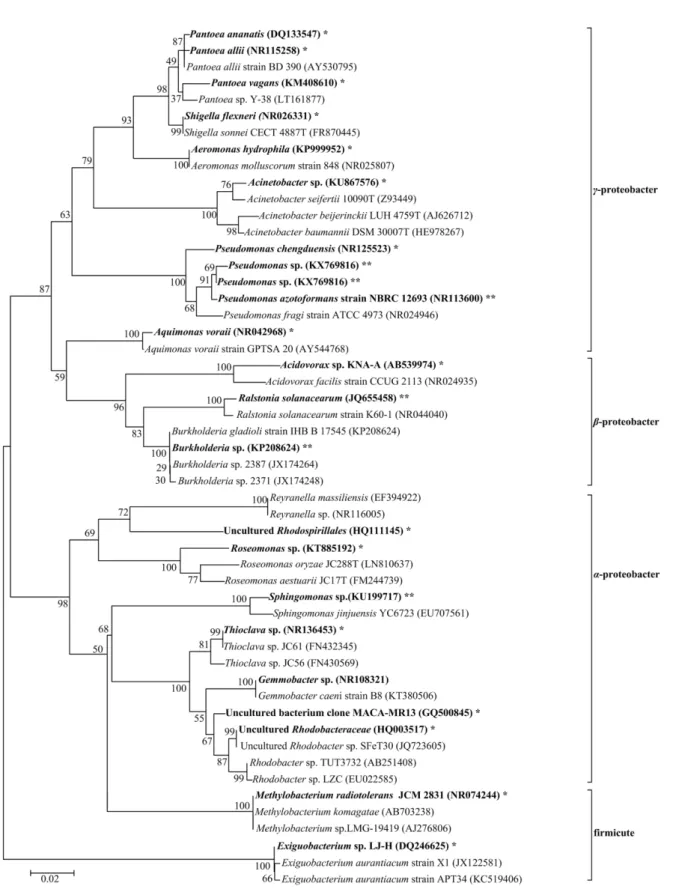
미생물후발효차에우점하는미생물은α-proteobacteria (Rhodobacteraceae, Roseomonas, Gemmobacter, Reyranella, Sphingomonas, Thioclava)
와 γ-proteobacteria (Acidovorax, Aeromonas, Klebsiella, Pantoea, Pseudomonas
등)
가전체 적으로우점하는것으로분석되었고,
α-proteobacteria
와 γ- proteobacteria
의우점률은모든후발효차에서79%
이상으 로확인되었다(Fig. 3, Table 2). Pantoea
는주로식물의잎등에서분리가되었으며
, meta-genome
분석을통해떡차에서우점하며
,
발효과정에서도Sphingomonas
와Bacillus
가 함께우점하고있다고보고되었다[32, 33].
또한, Polyphenol tannic acid
와gallic acid
의분해과정에관여하는gallic acid decarboxylase
는Pantoea agglomerans T71
에서 발견되었 으며, gallic acid
와tannic acid
의생물학적전환이보고되었 다[34].
또한, Pantoea dispersa Y08
은carotenoids
를아로 마화합물로전환시키는것이보고되었다[35]. Sphingomonas
와
Rhodobacteraceae
는현재까지다양한방향족화합물을 분해한다는많은보고가있으며,
한국과해외의전통발효식 품을제조하는데관여하는중요한발효미생물로잘알려져 있다[36
−41].
이와같이gallic acid, carotenoides
와방향족 화합물의생물전환능력이보고된Pantoea
와Sphingomonas
가후발효차에서우점하고있는것을고려하면후발효차의 발효과정에서중요한역할을하는것으로판단된다.
16S rRNA gene clone library
분석결과주목할점은한국 의후발효차에우점하고있는Rhodobacteraceae
는2
종의한 국차에서만검출되었으며, Pantoea vegans (
γ-proteobacteria)
역 시한국의후발효차에서만검출되었다.
또한,
보이차에우점 하는Pantoea allii
와Sphingomonas
는한국의후발효차에 서는검출되지않았으며, Gemmobacter, Klebsiella, Reyranella, Shigella, Thioclava
는중국의보이차에서만검출되었다.
또 한,
미생물군집분석결과를기반으로시료간차이와유사성 을규명하기위해SPSS program (SPSS V18, USA)
를이용 하여분석하였다[42].
각시료에서우점하는군집과크기를기반하여분석한결과는
Fig. 4
와같으며한국의후발효차와중국의후발효차가뚜렷하게구분되었다
.
향후미생물군집 분석을통해산지에따른후발효차를구분할수있는가능 성이있을것으로기대된다.
이를위해서는후발효차에관한 활발한연구를통해많은지식이축적되기를기대한다. Fig. 2. Dominant bacterial operational taxonomic units detected in the post-fermented tea 16S rRNA gene clone libraries.
(A) Algacha, (B) Dancha, (C) Pu-erh tea 1, and (D) Pu-erh tea 2.
후발효차 우점 미생물의 군집 크기 비교
본연구는후발효차의군집분석을수행하여우점미생물 를분석하고
,
한국후발효차와중국후발효차박테이라와곰 팡이군집크기를분석하였다.
총균수는Real-time PCR
을 이용하여측정하고군집의크기를비교하였다(Fig. 5).
미생 물의총균수는알가차1.46 × 10
6±1.32 × 10
5copy number,
단차1.69 × 10
6±6.34 × 10
5copy number,
보이차1
은6.00 × 10
5±4.11 × 10
4copy number,
보이차2
는2.63 × 10
5±5.95 × 10
4copy number
로분석되었다.
이결과로부터한국 후발효차인알가차와단차의미생물는1.46 × 10
6copy number
이상이고,
중국후발효차인보이차미생물는6.00 × 10
5copy
number
이하로한국후발효차미생물군집이중국후발효차미생물군집에비해약
2.5
배이상큰것으로분석되었다.
곰팡이의총균수분석결과는알가차
5.61 × 10
3±2.63 × 10
2copy number,
단차2.49 × 10
2±3.09 × 10
1copy number,
보이차1
은1.47 × 10
4 ±1.75 × 10
3copy number,
보이차2
는1.86 × 10
4±1.68 × 10
3copy number
로분석되었다.
중 국후발효차곰팡이군집크기는1.47 × 10
4copy number
이 상이며,
한국후발효차곰팡이군집은5.61 × 10
3copy number
이하로중국후발효차곰팡이군집이한국후발효차군집에 비해약2.6
배이상큰것으로분석되었다.
이분석결과를 통해한국후발효차는미생물군집이곰팡이군집보다더크 고,
중국후발효차는곰팡이군집이미생물군집보다더큰 것을확인하였다.
중국후발효차인보이차의발효과정에서 분자생물학적 기법을 통해 발효미생물을 분석한 결과Aspergillus
와Penicillium
같은곰팡이가우점한다고보고Table 2. Analysis of microbial community structure of the oriental traditional post-fermented tea based on 16S rRNA gene clone library analysis.
Operational taxonomic unit (OTU)
Algacha Dancha Pu-erh tea 1 Pu-erh tea 2
Clone number
Composi- tions
Clone number
Composi- tions
Clone number
Composi- tions
Clone number
Composi- tions
Acidovorax delafieldii 14 23.7%
Acinetobacter 4 6.9%
Aeromonas hydrophila 2 3.4%
Aquimonas voraii 1 1.6%
Burkholderia gladioli 2 3.4%
Exiguobacterium aurantiacum 4 6.9% 4 6.8% 6 9.7% 10 16.1%
Gemmobacter caeni 10 16.1% 3 4.8%
Klebsiella oxytoca 4 6.5% 8 12.9%
Methylobacterium radiotolerans 4 6.5%
Pantoea allii 12 19.4% 10 16.1%
Pantoea ananatis 8 13.8% 6 10.2% 4 6.5%
Pantoea vagans 6 10.3% 4 6.8%
Pseudomonas chengduensis 4 6.9% 6 10.2% 2 3.2%
Reyranella massiliensis 8 12.9% 4 6.5%
Roseomonas 8 13.8% 0.0%
Shigella flexneri strain 2 3.2% 1 1.6%
Sphingomonas oryziterrae 10 16.1% 11 17.7%
Thioclava atlantica 5 8.1% 6 9.7%
Uncultured bacterium clone
HH_aai33d01 8 13.8% 3 4.8%
Uncultured bacterium clone MACA-MR13 3 5.1%
Uncultured Rhodobacteraceae bacterium clone 3D6
16 27.6% 16 27.1%
Uncultured Rhodospirillales bacterium clone blastula 6
2 3.4%
58 100.0% 59 100.0% 62 100.0% 62 100.0%
Fig. 3. Phylogenetic tree based on 16S rRNA gene sequence using the neighbor-joining methods showing the oriental tradi-
tional post-fermented tea. *16S rRNA gene clone library, **DG-DGGE.
되었으며
,
미생물보다곰팡이류에의한발효연구가주를이 루고있는실정이다[13, 43, 44].
이에한국후발효차는미생 물에의한발효과정이이루어질가능성이더크며,
중국후 발효차는곰팡이에의한발효과정이이루어질수있다고판 단할수있다.
본연구는한국후발효차와중국후발효차의미생물군집 을분자생물학적기법으로분석하였다
.
그결과,
한국후발효 차에는Rhodobacteraceae
가우점하고있으며,
중국후발효차에는
Pantoea
와Sphingomonas
가우점하는것으로규명 하였다.
또한,
후발효차미생물(
미생물및곰팡이)
의군집의 크기를비교한결과,
미생물군집은한국의후발효차가중국 의후발효차보다크며,
곰팡이군집의크기는중국의후발효 차가한국의후발효차보다큰것으로확인되었다.
이는한국 과중국의녹차발효과정에관여하는미생물이서로다르다 는것을추론할수있다.
향후,
본연구결과를활용하여후 발효차원산지구별에기여할수있을것으로기대한다.
요 약
차는세계적으로인기있는음료로서
,
그종류는불발효차(
녹차),
반발효차(
우롱차),
완전발효차(
홍차),
후발효차등으 로구분된다.
후발효차는차나무(Camellia sinensis)
의잎을 미생물발효과정을거쳐생산된다.
본연구에서한국후발 효차(
알가차,
단차)
와중국후발효차(
보이차2
종)
에우점하 는미생물분석을위해16S rRNA
유전자를이용하였다.
후발효차에 우점하는 미생물은 α