Effects of Advance Care Planning on End-of-Life Decision Making: A Systematic Review and Meta-Analysis
Minju Kim, R.N., Ph.D. and Jieun Lee, R.N., Doctoral Student
College of Nursing, Dong-A University, Busan, Korea
Purpose: The purpose of this systematic review and meta-analysis was to investigate the effects of advance care planning on end-of-life decision-making. Methods: Databases including RISS, KISS, KMbase, KoreaMed, PubMed (MEDLINE), Embase, and CINAHL were searched for studies that examined the effects of advance care planning interven- tions. The inclusion criteria were original studies in English or Korean; adults ≥18 years of age (population); advance care planning (intervention); completion of advance directives (AD) or advance care planning (ACP) (outcomes); and randomized or non-randomized controlled trials (RCTs and non-RCTs, respectively) (design). Study quality was measured using the checklists of the Joanna Briggs Institute. Meta-analyses were conducted with the Comprehensive Meta-Analysis program. Results: Nine RCTs and nine non-RCTs were selected for the final analysis. The effect sizes (ES) of the outcome variables in nine RCTs were meta-analyzed, and found to range from 0.142 to 0.496 for the completion of AD and ACP (ES=0.496, 95% CI: 0.157~0.836), discussion of end-of-life care (ES=0.429, 95% CI: -0.027~0.885), quality of communication (ES=0.413, 95% CI: 0.008~0.818), decisional conflict (ES=0.349, 95% CI: -0.059~0.758), and congruence between prefer- ences for care and delivered care (ES=0.142, 95% CI: -0.267~0.552). Conclusion: ACP interventions had a positive effect on the completion of AD and ACP. To apply AD or ACP in Korea, it is necessary to develop ACP interventions that reflect aspects of Korean culture.
Key Words: Palliative care, Decision making, Advance care planning, Systematic review, Meta-analysis
Received January 13, 2020 Revised April 4, 2020 Accepted April 28, 2020
Correspondence to Jieun Lee
ORCID: https://orcid.org/0000-0001- 9068-1433
E-mail: [email protected] This research was supported by funding from the National Research Foundation of Korea (NRF) (NRF-2018R1D1A3B07040377).
This is an Open Access article distributed under the terms of the Creative Commons Attribution Non-Commercial License (http://creativecommons.org/licenses/by-nc/4.0/) which permits unrestricted non-commercial use, distribution, and reproduction in any medium, provided the original work is properly cited.
Copyright © 2020 by Korean Society for Hospice and Palliative Care
INTRODUCTION
1. Background
The end-of-life decision making process provides an oppor- tunity to understand the types of care that patients and their families wish to receive or not receive in the face of a life- threatening illness. However, discussing death and planning for end-of-life care with terminally ill patients—let alone with healthy family members—is challenging in Korean culture,
where people are reluctant to discuss the grave and serious topic of death [1]. Nonetheless, sharing thoughts and plans regarding death and end-of-life care allows patients to avoid unnecessary life-sustaining care [2] and to receive the types of care that they would prefer.
In Korea, most end-of-life care decisions are made by fam- ily members after a patient’s condition has already become critical [3-5], and these decisions are accepted without con- sidering the wishes of the patient [6]. These decision-making patterns are rooted in a culture where family-based decision-
www.kjhpc.org
making is considered normal [4,7]. A study at a general hos- pital showed that 46.2% of cases in which cardiopulmonary resuscitation (CPR) was discontinued involved patients whose consciousness was compromised [8]. This means that roughly half of the patients were unable to make critical decisions for themselves, such as discontinuing CPR, at the time when those decisions were made. In other words, when the time comes to make end-of-life care decisions, the responsibility is often in the hands of others, such as family members and medical staff, regardless of the patient’s wishes. Therefore, it is important for patients to set up advance care planning when they are still able to make their own decisions.
In 2018, the Act on Hospice and Palliative Care and Deci- sions on Life-Sustaining Treatment for Patients at the End of Life (hereinafter referred to as the Act on Decisions on Life-Sustaining Treatment) came into force, with the goal of protecting human dignity and values by respecting the self- determination of terminal patients [9]. This act authorized patients to create advance directives and life-sustaining treat- ment plans. The National Agency for Management of Life- Sustaining Treatment released information on the status of the life-sustaining treatment system on September 2, 2019, according to which there had been 62,546 reported decisions to withdraw life-sustaining treatment [10]. Only 32% of these patients had prepared advance directives (20,139) or life- sustaining treatment plans (725 cases) and most cases were decided based on statements made by the family of the patient (20,129 cases) or through agreement with the patient’s family (21,553 cases) [10]. Even with the increased social recogni- tion of the importance of end-of-life care and life-sustaining treatment planning since the enactment of the Act on Deci- sions on Life-Sustaining Treatment, decisions were still being made by the family more often than by the patients themselves [6]. Concerns have been raised that even as various kinds of end-of-life care decisions, such as withdrawing life-sustaining treatment, are being made, these decisions may reflect the will of family members, not that of the patient [11,12], and that self-determination rights of patients are not being protected with regard to end-of-life care decisions in clinical settings [8,13,14]. Intervention efforts to help patients plan for end- of-life treatment options will be necessary to address these is- sues.
Other countries have implemented many different programs to help patient prepare advance care planning, such as the “Let me decide,” “Let me talk,” and “Respect choice” programs and the physician order for life-sustaining treatment (POLST) ap- proach. The ‘Let me decide’ program provides patients and their families with education on writing advance directives and proved to be effective in reducing the number of hospitaliza- tions and medical costs [15].
The “Let me talk” program involves exchanging opinions on life, illness, and preferred end-of-life treatments and has dem- onstrated positive results in promoting advance directives and improving quality of life [16]. The “Respecting choices” pro- gram, which was designed to promote creating advance care planning [17,18], helps patients better understand advance care planning through interviews and takes into account their goals of end-of-life care. The program also encourages patients to communicate with their loved ones about their desires and to put the discussions in writing. A meta-analysis of the effects of the “Respecting choices” program reported that the program contributed to better alignment of the opinions of patients and their representatives [17]. The POLST approach is a com- munication program emphasizing shared decision-making [19] that was developed to help physicians communicate more effectively with patients regarding their treatment preferences for end-of-life care. The POLST form was designed to func- tion as a guideline for treatment if the patient’s status changes, such as in circumstances when CPR, treatment interventions, antibiotics, or nutritional interventions are needed. Hickman et al. [19] showed that the POLST program was effective in reducing the use of life-sustaining treatment and increasing the use of hospice care. As outlined above, there are many ways to help patients write advance directives, and the effects of in- terventions varied across studies. All of the programs used in these studies focused on communication with the aim of en- hancing patients’ ability to make decisions.
We found very limited Korean research investigating the ap- plication of interventions in advance care planning. Systematic literature reviews will be crucial for the development of ef- fective intervention methods to promote the preparation of advance care planning that are applicable in Korea. It will also be necessary to study ways to respect patients’ decisions and to communicate effectively with them regarding the completion
of advance directives.
2. Purpose
The purpose of this study was to analyze the effects of inter- vention programs developed to help decision-making related to end-of-life care in Korea and abroad through the prepara- tion of advance care planning. In this study, we analyze exist- ing intervention programs that aim to promote the completion of advance directives, and thereby will provide a foundation for establishing effective intervention programs for Korean pa- tients at the end of life.
METHODS
1. Study design
This study is a systemic literature review and meta-analysis of the effects of programs aiming to assist decision-making regarding end-of-life care on advance care planning.
2. Literature selection criteria 1) Inclusion criteria
A literature search was conducted based on the population, intervention, comparison, outcomes, study design (PICOS) ap- proach. All patients receiving end-of-life care, except for chil- dren, were selected as participants. All advance care planning intervention programs developed to assist in decision-making were included as subjects in the search. Non-intervention groups of patients who did not participate in these programs or received usual care were selected as comparison groups.
The primary outcome variables of the interventions were completion of advance directives and advance care planning, discussion of end-of-life care, and quality of communication.
Secondary outcome variables were decisional conflict, confi- dence of the patient’s legal representative in decision-making, congruence between the patient and the patient’s legal repre- sentative regarding the preferred treatment, and congruence between preferences for care and delivered care. The study design was limited to experimental studies only. The languages were limited to English and Korean, and only studies published before December 27, 2018 were included.
2) Exclusion criteria
Studies not published in Korean or English, studies only published as an abstract or a poster, academic conference ma- terials, books, and studies where the full text was unavailable were excluded. Additionally, studies in which the outcome variables were preferences and knowledge regarding end-of- life care were excluded, as well as those in which the effect size could not be estimated.
3. Literature search
The databases used to search the international literature were PubMed (MEDLINE), Embase, and CINAHL, while RISS, KISS, KMbase, and KoreaMed were used to search the Korean literature. Studies were searched using the PICOS approach.
The two researchers discussed and agreed on the search strat- egy and confirmed their congruence through a preliminary search before performing the actual search. The researchers independently searched all of the databases. Manual searching of reference lists was performed to find any additional litera- ture.
The Korean literature was searched using the following terms (translated): (‘end-stage’ OR ‘end-of-life’) AND (‘advance treatment plan*’ OR ‘advance care*’ OR ‘advance medicine*’
OR ‘advance life-sustaining medicine*’ OR ‘advance will*’
OR ‘advance consensus*’ OR ‘advance application*’ OR
‘advance directives*’ OR ‘advance rejection of treatment’ OR
‘advance notice’ OR ‘advance request*’ OR ‘advance deci- sion*’ OR ‘advance choice testament’ OR ‘death choice testa- ment’ OR ‘life testament*’ OR ‘living testament*’ OR ‘living will’ OR ‘decision making’ OR ‘life-sustaining’ OR ‘life pro- longing’ OR ‘lifespan extension’ OR ‘survival*’ OR ‘do-not- resuscitate order’ OR ‘non-execution of CPR’ OR ‘palliative*’
OR ‘hospice’ OR ‘shared decision making’ OR ‘common decision making’ OR ‘communication’ OR ‘conversation’).
The international literature was searched using the follow- ing terms: (‘advance care direct*’ OR ‘advance care plan*’
OR ‘advance directive*’ OR ‘advance health care plan*’ OR
‘advance healthcare plan*’ OR ‘advance medical direct*’ OR
‘advance medical plan*’ OR ‘DNH’ OR ‘DNR’ OR ‘living will*’ OR ‘wish’) AND (‘end of life’ OR ‘hospice’ OR ‘life prolonging’ OR ‘life support’ OR ‘life sustaining’ OR ‘pallia- tive’ OR ‘terminal care’) AND (‘decision making’ OR ‘shared
www.kjhpc.org
decision making’ OR ‘communication’ OR ‘conversation’ OR
‘end of life discussion’). The search criteria were limited to human studies that were in English (as well as Korean in some databases).
4. Quality evaluation of the literature
We performed a critical appraisal of the quality of the litera- ture using the quality evaluation tools developed by the Joanna Briggs Institute (JBI) [20]. The researchers independently re- viewed the quality of articles and discussed and analyzed the results to come to a final conclusion. Different quality assess- ment tools were used based on the study design. Randomized controlled trials (RCTs) were evaluated using the Checklist for Randomized Controlled Trials. This tool contains 13 items, including randomization used for assignment of participants, concealment of allocation to treatment groups, similarity of participants, participant blinding, treatment provider blinding, assessor blinding, identical treatment other than the interven- tion of interest, adequate treatment of completion of follow- up and difference between groups, analysis of participants in the randomized groups, identical measurement of outcomes, reliability of measurements, appropriateness of statistical analysis, and appropriateness of trial design. The Checklist for Quasi-Experimental Studies (non-randomized experimental studies) was used to appraise non-randomized studies. This tool comprises nine items, including a clear distinction of cause and effect, similarity of participants, control of participants, existence of a control group, measurement of outcomes before and after the intervention/exposure, adequate treatment of completion of follow-up and difference between groups, iden- tical measurement of outcomes, reliability of measurements, and appropriateness of statistical analysis. Each item was rated as “yes”, “no”, “unclear”, or “not applicable”.
5. Data coding
All the searched literature was entered into the reference management software Endnote X8. The studies included in the final analysis were arranged into a table by their charac- teristics, with reference to the characteristics analyzed in the existing literature. Author, year, country, setting, study design, participants, number of participants, intervention, outcome measurement timeframe, and outcome variables were recorded
in the coding sheet. One of the researchers filled out the coding sheet, while the other checked for potential errors.
6. Data analysis
Based on the statistics (mean±SD, P) reported in the studies selected for the systematic review, effect sizes (d) were calcu- lated using Microsoft Excel Effect Size Computation Program.
The meta-analysis of the literature was conducted using the Comprehensive Meta-Analysis software version 3 (Biostat, Englewood, NJ, USA).
1) Calculation of effect size
Effect sizes were calculated using the standardized mean dif- ference (SMD) to standardize the inconsistent results reported by the studies. An effect size of 0.2 or less represents a small effect, 0.5 indicates a medium-sized effect, and 0.8 and higher corresponds to a large effect [21].
2) Analysis of heterogeneity
The chi-square test (Q statistics) and Higgin’s I2 were used to confirm the heterogeneity of the data. In Q statistics, the null hypothesis of a homogenous effect size is tested, where a fixed-effects model is applied for P>0.10 and a random- effects model is applied for P<0.10 [22]. An I2 between 0%
and 40% implies that heterogeneity might not be important, an I2 between 30% and 60% implies medium-level heterogeneity, and an I2 of 75% to 100% means significant heterogeneity [23].
A forest plot was constructed for the visual evaluation of het- erogeneity.
3) Selection of analysis model
A fixed-effects model is appropriate when there is minimal heterogeneity in the effect size, while a random-effects model is suitable for high heterogeneity. A fixed-effects model was applied in this study, as low heterogeneity was found for all variables, with a P>0.10.
4) Publication bias
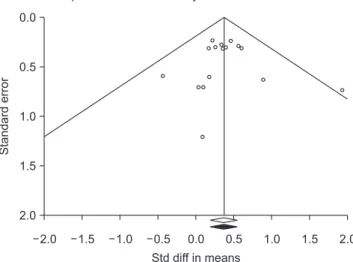
Publication bias occurs when the outcome of a study influ- ences the decision of whether to publish it [23]. The funnel plot and trim-and-fill methods were used to check for publication bias. The funnel plot method has long been used to evaluate
the possibility of missing outcomes in meta-analyses [23], us- ing a dispersion chart with the x-axis displaying the effect size and the y-axis displaying the sample size [22]. Smaller studies are distributed widely at the bottom of the graph, while larger studies are distributed narrowly at the top [23]. If the graph forms a funnel-shaped distribution, the possibility of publica- tion bias is relatively low. The trim-and-fill method is a way of estimating how many studies are in the non-symmetric area of a funnel plot, by trimming the studies causing funnel plot asymmetry, using the symmetric area to estimate the true cen- ter of the funnel, and then replacing the omitted studies and their missing counterparts at the center [24].
RESULTS
1. Selection of literature
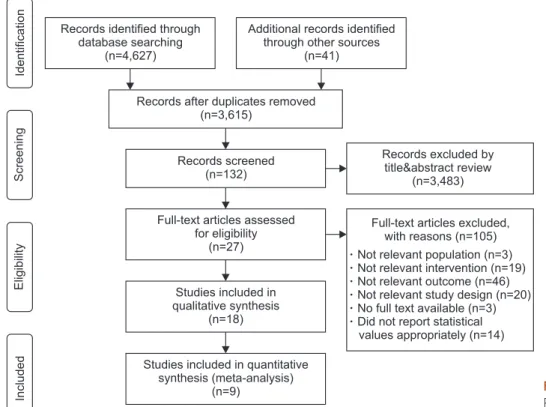
The literature for the systematic review was selected in ac- cordance with the Preferred Reporting Items for Systematic Reviews and Meta-Analysis (PRISMA) guidelines. During the literature search, the researchers evaluated the appropriateness of each other’s search strategy through a preliminary search.
The researchers independently reviewed the literature at each stage of the literature selection process and selected the final list through discussion. The search results found a total of 1,293 Korean studies (362 from RISS, 102 from KISS, 124 from KMbase, and 705 from KoreaMed) and 3,334 international studies (2,574 from PubMed [MEDLINE], 243 from Embase, and 517 from CINAHL). The total number of domestic and overseas studies was 4,668 after adding 42 manually searched studies. Among them, 1,053 studies overlapped according to the reference management software, reducing the net number of studies to 3,615. Next, 132 studies were selected after re- viewing titles and abstracts, ruling out 3,483 studies that did not meet the selection criteria. Upon reviewing the full text, 105 studies were additionally eliminated, including three stud- ies that did not meet the participant criteria, 19 studies that did not discuss interventions for advance care planning, 46 studies with irrelevant outcome variables, 20 studies that were quali- tative, protocols, or systematic literature reviews, three studies for which the full text could not be accessed (poster or non- published dissertations), and 14 studies that did not clearly report statistical values. The quality appraisal of the 27 studies that met the initial selection criteria resulted in the removal
IncludedEligibilityScreeningIdentification
Records after duplicates removed (n=3,615)
Records screened (n=132)
Full-text articles assessed for eligibility
(n=27)
Studies included in qualitative synthesis
(n=18)
Studies included in quantitative synthesis (meta-analysis)
(n=9)
Records excluded by title&abstract review
(n=3,483) Records identified through
database searching (n=4,627)
Additional records identified through other sources
(n=41)
Full-text articles excluded, with reasons (n=105) Not relevant population (n=3) Not relevant intervention (n=19) Not relevant outcome (n=46) Not relevant study design (n=20) No full text available (n=3) Did not report statistical
values appropriately (n=14)
Figure 1. PRISMA flowchart.
PRISMA: preferred reporting items for sys- tematic reviews and meta-analysis.
www.kjhpc.org
Table 2. Results of the Quality Assessment of Selected Non-RCTs Studies. Authors (ref)Clear cause and effectParticipant similarity Comparisons between participants receiving similar treatment/care
Control groupMultiple measurements of outcomeFollow up completeOutcome measured in the same way Outcome measured in a reliable way
Appropriate statistical analysis Ko et al.(34)YesNoYesNoYesNoYesYesYes Morrison et al.(35)YesYesUnclearYesYesYesYesYesYes Payne et al.(36)YesNoNoYesYesNoYesYesYes Reinke et al.(37)YesYesYesYesNoUnclearYesNoYes Schamp et al.(38)YesUnclearYesNoYesYesYesNoYes Schellinger et al.(39)YesUnclearYesYesYesNoYesNoYes Sinclair et al.(40)YesYesNoYesYesYesYesYesYes Song et al.(41)YesYesNoYesYesNoYesYesNo Van Scoy et al.(42)YesUnclearYesNoYesNoYesYesYes Non-RCT: non-randomized controlled trials.
Table 1. Results of the Quality Assessment of Selected RCTs Studies. Authors (ref)Participant randomizationAllocation concealmentParticipant similarityParticipant blinding Delivering treatment blinding Outcome assessors blinding Identical treatmentFollow up complete Analyzed in randomized groups Outcome measured in the same way Outcome measured in a reliable way Appropriate statistical analysis
Trial design appropriate Au et al.(25)YesYesYesUnclearYesYesYesYesYesYesYesYesYes Chan et al.(26)YesYesYesYesYesYesYesYesYesYesYesYesYes Engelhardt et al.(27)YesYesYesNoNoNoYesNoYesYesYesYesYes Jones et al.(28)YesYesYesYesNoNoYesYesYesYesYesYesYes Sampson et al.(29)YesUnclearYesUnclearYesUnclearYesYesYesYesYesYesYes Schwartz et al.(30)YesUnclearYesUnclearYesUnclearYesYesYesYesYesYesYes Song et al.(31)YesUnclearYesUnclearYesUnclearYesYesYesYesYesYesYes Song et al.(32)YesUnclearYesUnclearYesUnclearYesYesYesYesYesYesYes Song et al.(33)YesUnclearYesUnclearYesUnclearYesYesYesYesYesYesYes RCTs: randomized controlled trials.
of nine other studies, leaving nine RCTs and nine non-RCT studies as the final subjects of the systematic review. Meta- analyses were only performed for the nine RCTs. All of the finally selected studies were conducted in countries other than Korea, because no domestic studies met the final inclusion cri- teria, even though some Korean studies appeared in the initial search (Figure 1).
2. Quality appraisal outcomes
The JBI quality appraisal tool does not suggest criteria for evaluating the overall quality of studies; instead, it only al- lows an item-by-item evaluation. Through discussions, the researchers established criteria for selecting the final studies;
specifically, studies with a randomized control group were only included if at least nine out of 13 items (70%) were assured of quality, and non-randomized experimental studies were only included when at least six out of nine items (roughly 70%) were assured of quality. The quality of the 27 studies initially included in the systematic review was assessed. Two RCTs did not meet the criteria, leaving nine studies for the final analysis (Table 1). Of the 16 non-RCT studies, five were excluded, leaving nine non-RCTs for the final analysis (Table 2).
3. RCTs
An analysis of the characteristics of the included RCTs (Table 3) showed that the studies were published between 2002 and 2018, including three that were published before 2010. The patients’ conditions included chronic obstructive pulmonary disease, congestive heart failure, cancer, dialysis, and severe dementia, and the participants included community-dwelling patients, elderly patients, and homeless persons. The number of participants in each study was between 32 and 376.
The intervention programs and the number of studies they appeared in were as follows: a patient-specific feedback form in one study [25]; an advance care planning program (a re- vised version of the “Let me talk” program) in one study [26];
an advanced illness coordinated care program in one study [27]; an advance care planning intervention in two studies [28,29]; the respecting choices intervention in one study [30];
the end-of-life planning intervention in one study [31]; and the Sharing Patients’ Illness Representations to Increase Trust (SPIRIT) intervention in two studies [32,33]. Most of the in-
tervention programs included discussions, conversations, and consultations as basic elements [26-29,32,33]. Conversations with the patient or the patient’s legal representative were held to confirm the patient’s health status and their preferences re- garding end-of-life care. Some comprehensive interventions added education to the basic discussions and conversations [30,31]. The education provided information and resources for advance care planning. In the patient-specific feedback form intervention, physicians provided a feedback form [25] to pa- tients and patient’s legal representatives to let them know how well the physician understood the patient’s desires for end-of- life care after having conversations with the patient. In most of the interventions, the outcomes were recorded in the form of advance directives or documentation demonstrating the wishes of the patient [27-31], or the patients were connected with physicians so that their wishes could be documented [26]. The interventions consisted of one to four sessions that lasted from 45 minutes to 1 hour.
The outcome variables of the studies were required to meet the selection criteria of this study, including the completion of advance directives and advance care plans, discussion of end- of-life care, quality of communication, decisional conflict, the patient’s legal representative’s confidence in decision-making, and congruence regarding preferred care between the patient and the patient’s legal representative. No RCT studies analyzed congruence between preferences for care and delivered care as an outcome variable.
4. Non-RCT studies
The nine non-RCT studies (Table 4) were published between 2005 and 2017, with two studies published before 2010 and seven studies published after 2010. The participants’ illnesses included chronic obstructive pulmonary disease, heart failure, and chronic kidney disease, and the participants were low- income older adults, long-term care residents, and community dwellers. The number of participants in each study was be- tween 19 and 1,894.
The intervention programs and the number of studies they appeared in were: a stage-matched motivational interviewing intervention in one study [34], a social work intervention in one study [35], a protection motivation theory intervention in one study [36], a patient-specific feedback form in one study
www.kjhpc.org
Table 3. Characteristics of Included RCT Studies. Authors (ref)CountryParticipantsnInterventionOutcome Au et al.(25)USAChronic obstructive pulmonary disease376Patient-specific feedback form□ Quality of communication □ Occurrence of discussions about end-of-life preferences Chan et al.(26)Hong KongCommunity-dwelling patients230Advance care planning program (modified Let me talk program)□ Congruence in end-of-life care preferences □ Decisional conflict □ Documentation of end-of-life care preferences Engelhardt et al.(27)USAChronic obstructive pulmonary disease, congestive heart failure, cancer, other
275Advanced illness coordinated care program□ Completion of an advance directive Jones et al.(28)UKProgressive cancer42Advance care planning intervention□ Discussion with professionals and family and friends □ Happiness with communication Sampson et al.(29)UKSevere dementia32Advance care planning intervention□ Number of caregivers making an advance care plan □ Decisional conflict Schwartz et al.(30)USAAmbulatory geriatric patients61Respecting choices intervention□ Patient- representative congruence Song et al.(31)USAHomeless persons262End-of-life planning intervention□ Rate of advance directive completion Song et al.(32)USADialysis patients58Sharing patients’ illness representations to increase trust (SPIRIT) intervention□ Quality of communication □ Congruence in goals of care □ Decisional conflict □ Decision-making confidence Song et al.(33)USADialysis patients210Sharing patients’ illness representations to increase trust (SPIRIT) intervention□ Dyad congruence on goals of care □ Decisional conflict □ Decision-making confidence RCT: randomized controlled trial.
Table 4. Characteristics of the Included Non-RCT Studies. Authors (ref)CountryParticipantsnInterventionOutcome Ko et al.(34)USALow-income older adults30Stage-matched motivational interviewing intervention□ End-of-life communication □ Advance directives completion Morrison et al.(35)USANewly admitted long-term care residents139Social work intervention□ Documentation of advance directives and do-not-resuscitate orders □ Congruence of treatments received with documented preferences Payne et al.(36)USACommunity sample involving church groups and senior centers42Protection motivation theory intervention□ Completion of advance directives Reinke et al.(37)USAChronic obstructive pulmonary disease157Patient-specific feedback form□ End-of-life discussions □ Completion of advance directives Schamp et al.(38)USAUrban community outpatient160Pathways tool□ Completion Rates Schellinger et al.(39)USAHeart failure1,894Disease specific advance care planning program□ Types of documentation Sinclair et al.(40)AustraliaSevere lung disease149Advance care planning intervention□ Completion of advance directives □ Discussion about life sustaining treatments Song et al.(41)USAChronic kidney disease19Patient-centered advance care planning intervention□ Dyad congruence □ Decisional conflict □ Decision-making confidence □ Quality of communication Van Scoy et al.(42)USAAdult volunteers from communities68End-of-life conversation game□ Completion of a living will □ Completion of a health-care proxy □ Discussion of end-of-life wishes □ Discussion of quality Non-RCT: non-randomized controlled trial.
www.kjhpc.org
[37], a pathway tool in one study [38], a disease-specific advance care planning program in one study [39], an ad- vance care planning intervention in one study [40], a patient- centered advance care planning intervention in one study [41], and an end-of-life conversation game in one study [42]. Most
programs were based on discussions, consultations, and inter- views, just like in the RCTs [35,39-41], and some programs additionally provided education [34,36]. One of the programs used the same feedback form as that in the corresponding RCT [37], while another used the pathway tool [38] to catego-
Figure 2. Forest plots of the included studies.
AD: advance directives, EOL: end-of-life.
Chan 2018 Engelhardt 2006 Song 2010 Subtotal
Heterogeneity: Chi =0.469, df=2 (P=0.791); I =0%2 2 Study name Outcome
Completion of AD Completion of AD Completion of AD
0.609 0.344 0.567 0.496 Std diff in means
0.320 0.284 0.299 0.173 Standard
error
0.103 0.081 0.089 0.030 Variance
0.019 0.214 0.018 0.157 Lower limit
1.237 0.901 1.152 0.836 Upper limit
1.900 1.207 1.900 2.865 Z-value
0.057 0.227 0.057 0.004 P-value Statistics for each study
Au 2012 Jones 2011 Subtotal
Heterogeneity: Chi =0.234, df=1 (P=0.629); I =0%2 2 Study name Outcome
EOL discussion EOL discussion
0.468 0.103 0.429 Std diff in means
0.246 0.712 0.233 Standard
error
0.061 0.507 0.054 Variance
0.015 1.292 0.027 Lower limit
0.951 1.499 0.885 Upper limit
1.899 0.145 1.842 Z-value
0.058 0.885 0.065 P-value Statistics for each study
Au 2012 Jones 2011 Song 2009 Song 2009 (1) Subtotal
Heterogeneity: Chi =5.644, df=3 (P=0.130); I =46.846%2 2 Study name Outcome
Quality of communication Quality of communication Quality of communication Quality of communication
0.225 0.040 0.893 1.932 0.413 Std diff in means
0.241 0.711 0.637 0.741 0.207 Standard
error
0.058 0.506 0.405 0.550 0.043 Variance
0.248 1.354 0.355 0.479 0.007 Lower limit
0.698 1.434 2.140 3.385 0.818 Upper limit
0.933 0.057 1.403 2.605 1.996 Z-value
0.351 0.955 0.161 0.009 0.046 P-value Statistics for each study
Chan 2018 Sampson 2011 Song 2009 Song 2015 Subtotal
Heterogeneity: Chi =0.145, df=3 (P=0.986); I =0%2 2 Study name Outcome
Decision conflict Decision conflict Decision conflict Decision conflict
0.399 0.094 0.184 0.361 0.349 Std diff in means
0.098 1.467 0.370 0.106 0.043 Standard
error
0.313 1.211 0.608 0.326 0.208 Variance
0.214 2.280 1.008 0.277 0.059 Lower limit
1.012 2.468 1.376 1.000 0.758 Upper limit
1.277 0.078 0.302 1.109 1.677 Z-value
0.202 0.938 0.762 0.268 0.094 P-value Statistics for each study
Chan 2018 Schwartz 2002 Song 2015 Subtotal
Heterogeneity: Chi =1.073, df=2 (P=0.585); I =0%2 2 Study name Outcome
Congruence Congruence Congruence
0.262 0.430 0.178 0.142 Std diff in means
0.309 0.599 0.322 0.209 Standard
error
0.096 0.359 0.104 0.044 Variance
0.344 1.604 0.453 0.267 Lower limit
0.868 0.744 0.809 0.552 Upper limit
0.847 0.717 0.552 0.680 Z-value
0.397 0.473 0.581 0.496 P-value Statistics for each study
1.0 0.5 0.0 0.5 1.0
Std diff in means and 95% CI
Control Experimental
1.0 0.5 0.0 0.5 1.0
Std diff in means and 95% CI
Control Experimental
1.0 0.5 0.0 0.5 1.0
Std diff in means and 95% CI
Control Experimental
1.0 0.5 0.0 0.5 1.0
Std diff in means and 95% CI
Control Experimental
1.0 0.5 0.0 0.5 1.0
Std diff in means and 95% CI
Control Experimental
rize patients and help them designate a legal representative or document discussions on their wishes and to provide advice on the role of a patient’s legal representative. Another intervention program utilized games [42], so that patients and their legal representatives could access the content easily. All the inter- ventions included creating advance directives and documenting patients’ wishes in the last step. Most interventions comprised a single session lasting from 20 minutes to 1.5 hours.
The outcome variables of the studies meeting the selection criteria of this study were the completion of advance directives and advance care plans, discussion of end-of-life care, qual- ity of communication, decisional conflict, the patient’s legal representative’s confidence in decision-making, congruence regarding preferred care between the patient and the patient’
s legal representative, and congruence between preferences for care and delivered care.
5. Meta-analysis outcomes of RCT studies
The effect size of variables related to advance care planning interventions can be found in Figure 2. The three studies that analyzed documentation of advance directives and advance care plans as the primary outcome variables had no hetero- geneity (I2=0; P=0.791), with an effect size of 0.496 (95%
CI: 0.157~0.836; Z=2.865; P=0.004). The two studies that analyzed end-of-life care discussions showed no heteroge- neity (I2=0; P=0.629), with an effect size of 0.429 (95% CI:
-0.027~0.885; Z=1.842; P=0.065). The four studies analyzing the quality of communication demonstrated a medium level of heterogeneity (I2=46.859; P=0.130), with an effect size of 0.413 (95% CI: 0.008~0.818; Z=1.996; P=0.046).
In an analysis of the effect size of the secondary outcome variables by intervention, the four studies that analyzed con- flicts in decision-making had no heterogeneity (I2=0, P=0.986), with an effect size of 0.349 (95% CI: -0.059~0.758; Z=1.677;
P=0.094). The three studies analyzing congruence regard- ing preferred treatment between the patient and patient’s legal representative showed no heterogeneity (I2=0; P=0.585), with an effect size of 0.142 (95% CI: -0.267~0.552; Z=0.680;
P=0.496). One of the studies that analyzed the patient’s legal representative’s confidence in decision-making as a second- ary variable was excluded from the meta-analysis because its data could not be entered into the CMA statistical analysis
software. Since all measured variables had low heterogeneity, with P>0.10, a fixed-effects model was applied for effect sizes between 0.142 and 0.496.
6. Publication bias outcomes
Funnel plot and trim-and-fill analyses were performed to evaluate publication bias. The funnel plot analysis dem- onstrated a symmetrical funnel shape (Figure 3). The trim- and-fill analysis results confirmed that no studies were added to correct the asymmetry and the effect size did not change compared to the correction. It was concluded that the studies analyzed herein were not affected by publication bias.
DISCUSSION
This study analyzed effect sizes through a systematic review and meta-analysis of previous experimental research to un- derstand how intervention programs developed to assist in decision-making for end-of-life care affected advance care planning. Eighteen studies were finally selected for the analy- sis after reviewing a total of 4,668 studies found in the initial search.
The meta-analysis showed that advance care planning inter- ventions had significant effects on the completion of advance directives and advance care planning, as well as communica- tion quality, but no significant effect on discussions on end- of-life care, decisional conflict, or congruence in preferred care between patients and their legal representatives. The outcome
2.0 0.0
0.5
1.0
1.5
2.0
2.0
Standarderror
Std diff in means
1.5 1.0 0.5 0.0 0.5 1.0 1.5
Funnel plot of standard error by standard difference in means
Figure 3. Funnel plot of the included studies.
www.kjhpc.org
variable with the largest effect size was completion of advance directives and advance care plans. Many of the interventions for advance care planning involved conversations and discus- sions with patients or patient’s legal representatives to under- stand the status of the patient’s condition or their concerns and preferences in end-of-life care, with the creation of doc- uments such as advance directives as the last step [26,28,32].
Including documentation of advance directives as part of the intervention seems to have yielded effective outcomes in the documentation of advance directives. A systematic review of the effects of advance care planning [43] also suggested that advance care planning can be effective in encouraging patients to prepare advance directives. Korea has seen a gradual in- crease in the proportion of patients who write advance direc- tives since the Act on Decisions on Life-Sustaining Treatment came into force [10]. Applying interventions for advance care planning could encourage more people to prepare advance di- rectives and facilitate shared decision-making among patients, family members, and medical staff.
Although the interventions had no significant effects on discussions on end-of-life care, decisional conflict, and con- gruence in preferred care between patients and their legal representatives, the overall heterogeneity was low. As a vari- able, measurements of discussions on end-of-life care reflect the extent to which discussions on end-of-life care took place from the patient’s point of view. The study by Au et al. [25]
used a patient-specific feedback form to confirm the requests of the patient and family for care and to receive feedback from the medical staff without face-to-face discussions. This kind of intervention may have demonstrated a non-significant im- pact due to a lack of face-to-face interventions with the pa- tient, which would have prompted sufficient discussion. In the study by Song et al. [32] that probed the effects of the SPIRIT intervention on decisional conflict showed no difference in conflicts by time or group, while another study by Song et al.
[33] proved that decisional conflict decreased over time. The SPIRIT intervention targeted both patients and their legal rep- resentatives, but focused on improving the decision-making ability of the patient’s legal representative rather than that of the patient, which may explain why it did not have a signifi- cant effect on decisional conflict.
Advance care planning interventions had a small impact on
the level of congruence between patients and patient’s legal representatives on preferred treatment, with an effect size of 0.142, which means that it was not statistically meaning- ful. When looking at the effects of this intervention in indi- vidual studies that measured this variable, Chan et al. [26] and Schwartz et al. [30] showed that the intervention was effective by demonstrating that patients and their legal representatives had higher congruence after the intervention, while Song et al.
[33] showed partial improvement in congruence; however, the level was inconsistent across different times of measurement.
Although the impact of advance care planning interventions was small in terms of aligning the opinions between patients and their legal representatives, the interventions were of clini- cal significance because they had positive effects on fostering agreement between patients and their legal representatives.
The interventions used in the studies that had a normal or high SMD (between 0.609 and 1.932) were the “Let me talk”
program [26], the end-of-life planning intervention [31], and the SPIRIT intervention program [32]. These interven- tion programs commonly included the process of discussions and conversations about experiences of illness, life experiences, interests, and wishes regarding end-of-life care. The “Let me talk” program had meaningful effects on congruence between patients and their legal representatives on preferred care, de- cisional conflict, and documentation of advance directives and advance care plans. The end-of-life planning intervention was effective in promoting the documentation of advance di- rectives. The SPIRIT intervention program demonstrated ef- fectiveness for boosting satisfaction with communication and confidence in decision-making. These results imply that when writing advance directives, it is important for patients and their families to share opinions through conversations and to plan optimal end-of-life care together, taking the wishes and pri- orities of both parties into account.
The intervention programs used in the selected studies varied from single interventions involving discussions to comprehen- sive interventions including discussions and education. These interventions suggest ways to systematically approach deliver- ing bad news and exchanging opinions on end-of-life care.
These advance care planning interventions could be applicable in the Korean setting, where talking about death is a cultural taboo and decision-making is led by family members. In the