Chemotherapy
Infect Chemother 2013;45(2):202-210 pISSN 2093-2340 · eISSN 2092-6448
Received: September 3, 2012 Revised: December 8, 2012 Accepted: December 10, 2012 Corresponding Author : Kyong Ran Peck, MD, PhD
Division of Infectious Diseases, Samsung Medical Center, Sungkyunkwan University School of Medicine, 81 Irwon-ro, Gangnam-gu, Seoul 135-710, Korea
Tel: +82-2-3410-0329 Fax: +82-2-3410-0064 Email: [email protected]
Co-Corresponding Author: Sang Moo Lee, MD, PhD
Office of Health Technology Evaluation, National Evidence-based Healthcare Collaborating Agency, 174 Yulgok-ro, Jongno-gu, Seoul 110-450, Korea Tel: +82-2-2174-2850 Fax: +82-2-747-4918
Email: [email protected]
This is an Open Access article distributed under the terms of the Creative Commons Attribution Non-Commercial License (http://creativecommons.org/licenses/by-nc/3.0) which permits unrestricted non-commercial use, distribution, and repro- duction in any medium, provided the original work is properly cited.
Copyrights © 2013 by The Korean Society of Infectious Diseases | Korean Society for Chemotherapy
www.icjournal.org
Impact of Methicillin-Resistance on Mortality in Children and Neonates with Staphylococcus aureus Bacteremia: A Meta-analysis
Dong Ah Park
1,2, Sang Moo Lee
1, Kyong Ran Peck
3, Eun-Jeong Joo
3, and Eui Geum Oh
41Office of Health Technology Evaluation, National Evidence-based Healthcare Collaborating Agency; 2Doctoral student, College of Nurs- ing Yonsei University; 3Division of Infectious Diseases, Samsung Medical Center, Sungkyunkwan University School of Medicine; 4Institute of Nursing Policy and Research, College of Nursing Yonsei University, Seoul, Korea
Background: Staphylococcus aureus bacteremia (SAB) is the Staphylococcal infections in blood, one of the most common and fatal bacterial infectious diseases worldwide in adults as well as children or neonates. Recently, some studies have yielded inconsistent findings about the association between methicillin-resistance and mortality in patients with SAB. We performed a meta-analysis to assess the impact of methicillin-resistance on mortality in children or neonates with S. aureus bacteremia.
Materials and Methods: We searched using electronic databases such as Ovid-Medline, EMBASE-Medline, and Cochrane Library, as well as five local databases for published studies during the period of 1 January 2000 to 15 September 2011. Two reviewers indepen- dently selected articles in accordance with predetermined criteria and extracted prespecified data based on standardized forms. All cohort studies, which compared in-hospital mortality or SAB-related mortality in children and neonates with methicillin-resistant S.
aureus (MRSA) infection to those with methicillin-susceptible S. aureus (MSSA), were included. We conducted meta-analysis using the fixed-effect model to obtain pooled estimates of effect.
Results: Of 2,841 screened studies, seven cohort studies were finally selected for analysis. In children or neonates, MRSA bacteremia was associated with a higher mortality compared with MSSA bacteremia (pooled odds ratio [OR] 2.33, P = 0.0008, 95% confidence interval [CI] 1.42 to 3.82, I2 = 0%). Four studies reported SAB-related mortality, the pooled OR of these studies was 2.03 ( P = 0.29, 95% CI 0.55 to 7.53, I2 = 0%). A significant increase in mortality associated with methicillin resistance was found in the subgroup analyses of the studies with only neonates (OR: 2.66, 95% CI: 1.46 to 4.85, P = 0.001), prospectively design ones (OR: 3.20, 95% CI:
1.66 to 6.15, P = 0.0005,), the larger studies (OR: 2.89, 95% CI: 1.62 to 5.16, P = 0.0003) and the higher quality studies (OR: 2.76, 95% CI: 1.50 to 5.06, P = 0.001).
Introduction
Staphylococcus aureus is one of the major causative organ- isms for community- and hospital-acquired infections as causing invasive diseases, not only in adults but also in neo- nates and children [1]. Methicillin-resistant S. aureus (MRSA) bacteremia is resistant to beta-lactam antibiotics, limiting the use of antibiotics for treatment, and it is known to cause fetal infections throughout the world.
As well as multidrug-resistant enteric bacteria, MRSA is known to spread healthcare settings rapidly under the in ap- propriate infection control and cause hospital-acquired infec- tions [2]. Since the late 1990s, MRSA has been increasing in not only hospital-acquired S. aureus infections but also com- munity-acquired infections [3]. For that reason, there has re- cently been a high level of interest in the development of in- fection control plans to address this threat.
Compared with methicillin-susceptible S. aureus (MSSA), MRSA is known to cause higher morbidity and mortality and longer hospital stays [4, 5]. These findings, however, were mostly investigated in studies with adult subjects; two meta- analyses with adult subjects reported that MRSA bacteremia significantly increases mortality relative to MSSA bacteremia [6, 7]. Despite increase of bacteremia due to MRSA in neo- nates and children [8-11], results in those were not consistent across studies [12-15]. In addition, advancements in the treat- ment for S. aureus bacteremia (SAB) have been made over the past decade, including the development of effective antibiot- ics and various changes in medical environments, such as the strengthening of hospital infection control systems. Therefore, to better reflect actual circumstances in the current medical environment, we performed a systematic review and meta- analysis to assess the impact of methicillin-resistance on mor- tality in children and neonates with SAB based on published studies since 2000 that report mortality rates associated with both MRSA and MSSA bacteremia.
Materials and Methods
1. Search strategy
We searched for all studies comparing MSSA bacteremia and MRSA bacteremia in terms of their impact on mortality published between January 2000 and September 2011 through Ovid-MEDLINE, EMBASE, and Cochrane library da- tabases in addition to the following 5 local databases: Kore- aMed, National Assembly Library (NANET), Korean Studies Information Service System (KISS), Korean Medical Database (KMBASE), and Korea Institute of Science and Technology In- formation (KISTI) providing information on Korean medical published research. We used the search filter recommended by the Scottish Intercollegiate Guidelines Network (SIGN) to efficiently identify the cohort study design suited the objectives of this study. We applied no language restriction in electronic database search and limited to studies involving humans. We used the common keywords related to Staphylococcus aureus bacteremia and MRSA. The search terms were as follows:
“Bacteremia” OR “sepsis” OR “Staphylococcus aureus infec- tion” OR “endocarditis” AND “methicillin-resistant Staphylo- coccus aureus” OR “MRSA”. We also reviewed the bibliogra- phies of relevant articles to identify additional publications.
The search terms “neonates” and “children” were not included in the search process. In the last step of the study selection, studies were identified and classified to estimate the number of studies with adult subjects and neonates or children rele- vant to the aim of this study.
2. Study selection
In the first stage of the study selection, irrelevant studies were excluded by reviewing titles and abstracts. The full-text articles were reviewed in the second and third stages of the study selection process. Two authors (DA Park and SM Lee) independently reviewed the articles for eligibility with pre-de- termined selection criteria, and subsequently resolved any disagreements by discussion together with clinical expert consultation.
The study inclusion criteria were as follows: (1) studies com- paring patients with S. aureus bacteremia and S. aureus endo- Conclusions: MRSA bacteremia is associated with increased mortality compared with MSSA bacteremia in children or neo- nates. Due to limited studies for mortality in children or neonates with SAB, further research is needed to evaluate the impact of methicillin resistance on mortality in those populations.
Key Words: Staphylococcus aureus, Bacteremia, Methicillin Resistance, Mortality, Meta-analysis
carditis; (2) studies comparing patients with MRSA bactere- mia and MSSA bacteremia; (3) studies comparing mortality rates (all-cause mortality; SAB-related mortality); and (4) studies investigating children (18 years or younger) and neo- nates. The study exclusion criteria were as follows: (1) not original research; (2) animal studies or pre-clinical studies; (3) not cohort studies; (4) studies published with only an abstract;
(5) studies not published in Korean or English; and (6) dupli- cate reports.
3. Data extraction and quality assessment
Using a standardized data extraction form two independent reviewers authors (DA Park and SM Lee) extracted pre-speci- fied data: first author, publication year, country, research de- sign, study period, study setting, disease and number of study populations, age and sex of populations between MRSA/
MSSA groups, results of outcomes(in-hospital mortality, in- fection-related mortality). Quality assessment of each includ- ed studies was performed independently by two authors using the Newcastle-Ottawa Scale (NOS) [17]. This NOS scale for co- hort studies uses a star rating system (range: 0-9 stars) scoring three aspects of the study: selection (0-4), comparability (0-2) and outcomes (0-3). During the data extraction and quality assessment, any disagreements were resolved by discussion.
4. Data synthesis and analysis
Meta-analyses were conducted using Review Manager, ver- sion 5.0 (RevMan, The Cochrane Collaboration, Oxford, UK.
For the dichotomous outcomes such as all-cause mortality, in-hospital mortality, infection-related mortality, we calculat- ed the odds ratio (OR) and 95% confidence interval (CI) using the fixed-effect model. To test for heterogeneity, the forest plot was checked visually, and then statistical heterogeneity was assessed using a Q test (a P < 0.10 was considered significant) and the I2 statistic as a quantitative measure. Statistical het- erogeneity was defined as an I2 statistic equal to or greater than 50% [18].
Factors that may have had an effect on outcomes were pre- determined to investigate the cause of heterogeneity between studies, and sub-group analyses were conducted by type of study populations (neonates or children vs. neonates), study design (prospective cohort study vs. retrospective cohort study), the number of study subjects (60 people or fewer vs.
above 60 people (as a rule of thumb)) [19], and the number of NOS stars (under 8 stars vs. more than 8 stars).
Publication bias was visually assessed using a funnel plot by plotting the inverse of the standard error against the log odds
ratio. To examine for publication bias, the Egger regression asymmetry test [20] and the Begg and Mazumdar adjusted rank correlation test [21] were also conducted using software Stata 10.0 (Stata Corp., College Station, TX, USA).
A P value threshold for statistical significance was set at less than 0.05 for pooled effect estimates.
Results
1. Study characteristics
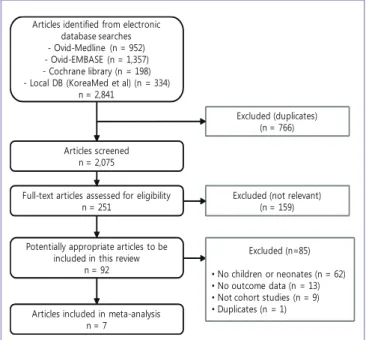
A total of 2,841 studies were identified through the search strategy (Fig. 1). Duplicate studies from each database were eliminated, and then 1,824 studies deemed irrelevant to this study through a review of titles and/or abstracts were exclud- ed. A total of 159 studies were found not to include a compari- son of clinical outcomes for MRSA and MSSA in SAB and, therefore, were excluded in the second stage of the study se- lection process. In the third stage, the authors reviewed the full-text of 92 studies with the inclusion and exclusion criteria.
A total of 7 studies [12-15, 22-24] were finally selected after the exclusion of 85 studies for the following reasons: (1) not in- cluding children or neonates; (2) unable to extract mortality data; (3) not cohort studies; and (4) duplicate studies.
A total of seven cohort studies that enrolled 667 patients (191 for MRSA, 476 for MSSA) were selected and included for the meta-analysis. The population size in each study ranged from 18 to 288. Most of the studies were published since 2005
Articles identified from electronic database searches - Ovid-Medline (n = 952) - Ovid-EMBASE (n = 1,357) - Cochrane library (n = 198) - Local DB (KoreaMed et al) (n = 334)
n = 2,841
Articles screened n = 2,075
Full-text articles assessed for eligibility n = 251
Potentially appropriate articles to be included in this review
n = 92
Excluded (not relevant) (n = 159) Excluded (duplicates)
(n = 766)
Excluded (n=85)
• No children or neonates (n = 62)
• No outcome data (n = 13)
• Not cohort studies (n = 9)
• Duplicates (n = 1) Articles included in meta-analysis
n = 7
Figure 1. Study flow diagram.
[12, 13, 15, 22-24]. In terms of study design, there were 5 retro- spective cohort studies [12, 13, 15, 22, 24] and 2 prospective cohort studies [14, 23].
Of the 7 studies, 3 had been conducted in the United States [12, 13, 22], 1 in Korea [24], 1 in Tanzania [23], 1 in Israel [15], and 1 in Australia [14]. Except one Korean study [24], the re- maining studies were published in English [12-15, 22, 23].
Most of the studies reported in-hospital mortality as the over-
all mortality rate [12, 14, 15, 22-24]. Kuint et al. [15] reported both all-cause mortality and sepsis-related mortality, and Burke et al. [13] reported only infection-related mortality. The main characteristics of the studies included in this review and meta-analysis are summarized in Table 1.
2. Results of quality assessment
Quality assessment of each study is reported in Table 1.
Table 1. Selected seven studies analysed in this study No Author Year Country Study
period Study design Popu- lations N
Age/
Gestational agea
Male (%)
MRSA (n)
MSSA
(n) Outcomes NOS (stars) 1 Hultén [22] 2010 USA 2001.8-
2007.7 Retrospective SAB 100 1 week-16.7
years NS 29 71 Hospital
mortality 7
2 Burke [13] 2009 USA 2001.7-
2006.6 Retrospective SAB 150 1 day-17
years 52 29 121
Infection- related mortality
7
3 Hakim [12] 2007 USA 2000.1-
2004.12 Retrospective SAB 36 0-14.9
years 58.3 14 22 Hospital
mortality 7 4 Kayange
[23]a 2010 Tanzania 2009.3-
2009.11 Prospective SAB 32 28-41
weeks NS 9 23 Hospital
mortality 9 5 Kang [24]a 2007 Korea 2001.2-
2007.5 Retrospective SAB 18 23-40
weeks NS 14 4 Hospital
mortality 7
6 Kuint [15]a 2007 Israel 1993.1-
2003.12 Retrospective SAB 43 23-42
weeks 60.5 31 12
Hospital mortality, Sepsis-related
mortality 8
7 Isaacs [14]a 2004 Australia 1992.1-
1998.12 Prospective SA-
sepsis 288 28.9 weeks NS 65 223 Hospital mortality 8 NS, not stated; SA, Staphylococcus aureus; SAB, Staphylococcus aureus bacteremia; NOS, the Newcastle-Ottawa Scale.
aStudies with only neonates.
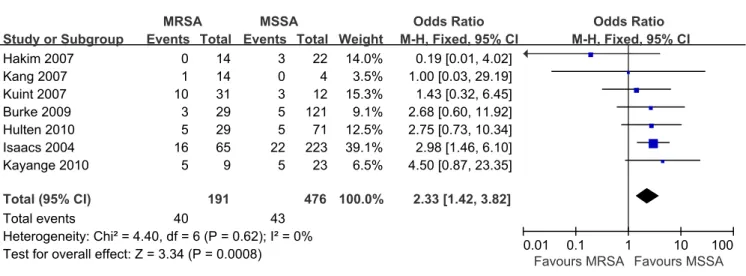
Figure 2. Mortality: MRSA bacteremia versus MSSA bacteremia.
When the quality of the included studies was assessed, 1 study with 9 stars [19], 2 studies with 8 stars [14, 15] and 4 studies with 7 stars [12, 13, 18, 20], were found.
3. Results of data analysis
A total of seven studies were combined in the all-cause mor- tality analysis with six reporting in-hospital mortality out- comes [12, 14, 15, 22-24] and one reporting infection-related mortality outcome [13]. In the pooled analysis with the fixed- effect model for all-cause mortality, there was no evidence of heterogeneity between-studies (χ2 = 4.40, P = 0.62, I2 = 0%). The pooled OR for the effect of methicillin resistance on mortality was 2.33 (95% CI: 1.42 to 3.82, P = 0.0008), indicating a signifi- cant increase for mortality in patients with MRSA bacteremia (Fig. 2).
Among four studies which have reported infection-related
mortality [12, 13, 15, 24], except two [12, 24] not reporting SAB-related mortality, remaining two studies [13, 15] were combined in the pooled analysis and showed no heterogene- ity between the studies (χ2 = 0.33, P = 0.56, I2 = 0%). The pooled OR for infection-related mortality in patients with MRSA was 2.03 (95% CI: 0.55 to 7.53), indicating the increasing tendency of infection-related mortality for MRSA without a statistically significant difference (P = 0.29) (Fig. 3).
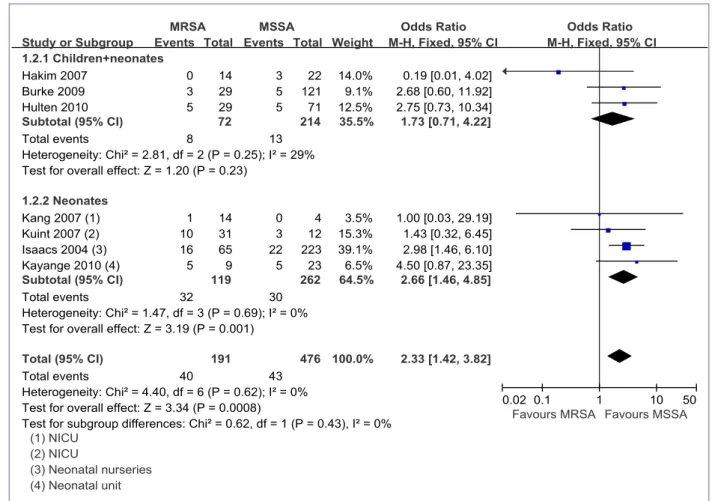
The results of methicillin resistance on mortality are sub-an- alyzed according to study population, study design, and sam- ple size and the results of quality assessment and presented in Table 2. The pooled OR from the 3 studies [12, 13, 22] that in- volved both neonates and children was 1.73 (95% CI: 0.71 to 4.22, P = 0.23). From four neonates studies [14, 15, 23, 24], the pooled OR was 2.66 (95% CI: 1.46 to 4.851, P = 0.001) (Fig. 4).
In terms of study design, the pooled OR from the 2 prospec- Table 2. Mortality of S. aureus bacteremia: Subgroup analysis according to study design and participants
Subgroup No.
of studies
No.
of participants
M-H, fixed, OR [95% CI]
P-value of
Q-test I2 statistics Participants
Children+Neonates 3 286 1.73 [0.71-4.22] 0.25 29%
Neonates 4 381 2.66 [1.46-4.85] 0.69 0%
Study design
Prospective 2 320 3.20 [1.66-6.15] 0.65 0%
Retrospective 5 347 1.60 [0.75-3.40] 0.55 0%
No. of participants
> 60 3 538 2.89 [1.62-5.16] 0.99 0%
≤ 60 4 129 1.46 [0.58-3.67] 0.31 16%
No. of NOS stars
≥ 8 stars 3 363 2.76 [1.50-5.06] 0.57 0%
< 8 stars 4 304 1.66 [0.70-3.96] 0.40 0%
M-H, Mantel-Haenszel; OR, odds ratio; No., number; CI, confidence interval; NOS, the Newcastle-Ottawa Scale.
Figure 3. Infection-related mortality: MRSA bacteremia versus MSSA bacteremia.
tive cohort studies [14, 23] was 3.20 (95% CI: 1.66 to 6.15, P = 0.0005), whereas the pooled OR from the 5 retrospective ones [12, 13, 15, 22, 24] was 1.60 (95% CI: 0.75 to 3.40, P = 0.22).
With regard to sample size, 3 studies [13, 14, 22] involved sam- ple size > 60 people, and 4 studies [12, 15, 23, 24] involved ≤ 60 people; the OR from studies with more than 60 people was 2.89 (95% CI: 1.62 to 5.16, P = 0.0003), and the OR from studies 60 people or fewer was 1.46 (95% CI: 0.58 to 3.67, P = 0.42).
There were three studies with NOS of more than 8 stars which showed OR 2.76 (95% CI: 1.50 to 5.06, P = 0.001), whereas four studies with NOS of under 8 stars showed OR 1.66 (95% CI:
0.70 to 3.96, P = 0.25).
No evidence of potential publication bias was noted in the funnel plot, the regression asymmetry test (P = 0.119), or the adjusted rank correlation test (P = 0.23).
Discussion
This study conducted a systematic review and meta-analysis of cohort studies published since 2000 to quantify the effect of
methicillin-resistance on mortality in neonates or children with SAB. The mortality rate was found to be significantly higher in patients with MRSA bacteremia, compared to rate in those with MSSA.
A total of 7 cohort studies were included in the final analysis.
The results of the analysis showed a significantly higher mor- tality risk (OR = 2.33) in neonates or children with MRSA bac- teremia than in those with MSSA bacteremia. We considered the possibility that estimating the mean mortality rate of 9.0%
(43/476) in the control group with MSSA bacteremia based on the pooled OR could result in an overestimation of the effect size. This difference of the pooled estimate might have been influenced by the result from Isaacs et al.’s study [14], which had the largest sample size among combined studies and of which subjects been enrolled in the 1990’s; in consideration of these factors, a sensitivity analysis, excluding the Isaacs et al.’s study, showed that methicillin resistance have not significant- ly increased the mortality rate (OR: 1.91, 95% CI: 0.97 to 3.77, P = 0.06). Although this sensitivity analysis did not obtain a statistical significance, the direction of effect was consistent with the pooled result of the overall mortality.
Figure 4. Mortality of S. aureus bacteremia analysed by study population.
In comparison of mortality rate between MRSA bacteremia and MSSA bacteremia in neonates or children, methicillin-re- sistance is considered to be associated with an increase in mortality risk. This study is the first meta-analysis to investi- gate the effect of methicillin-resistance on mortality in neo- nates and children with SAB. The result was comparable to the OR, 1.93 (95% CI: 1.54 to 2.42) in a meta-analysis [7] which have been investigated among adult subjects. Although the pooled analysis for infection-related mortality in four com- bined studies did not provide a statistically significant result, the direction of effect was in accordance with the hypothesis that methicillin-resistance increases the overall mortality in study population.
The significant association between resistance and mortality risk was found in the subgroup analysis only for neonate sub- jects, not for mixed population of children and neonates. It might be because the number of studies in mixed population of children and neonate are too small to show the significant result, compared to that in neonate studies. More published studies targeting children are required to show the significant association between methicillin-resistance and increase of mortality in SAB. In subgroups stratified according to study design and sample size, a significant risk of methicillin-resis- tance for mortality was found in prospectively designed groups, large population groups above 60 and higher quality groups more than 8 stars of NOS.
The lack of a significant difference in some subgroups is due to the small number of included studies, which have resulted in insufficient power to identify the association between methicillin-resistance and risk for mortality in children and neonates with SAB. Out of seven primary studies, only Isaacs et al. [14] demonstrated a significant difference of mortality rates between patients with MRSA and MSSA bacteremia. Re- maining six [12, 13, 15, 22-24] did not show any significant dif- ference of those. In a meta-analysis by Cosgrove et al. [7], which investigated adult subjects, although 77.4% of the 31 cohort studies failed to identify the impact of methicillin-re- sistance on mortality, but the integrated results showed a evi- dent association between MRSA bacteremia and mortality (OR: 1.93, 95% CI: 1.54 to 2.42). Similar to the result of Cos- grove’s study, an increase in mortality rate of methicillin resis- tance was demonstrated in the integrated results of our meta- analysis, even though 85.7% of studies did not demonstrate an increase of mortality.
Although the studies included in this meta-analysis had dif- ferent subject characteristics, such as neonates vs. children or neonates, no statistical heterogeneity was identified, and be-
tween-study statistical heterogeneity was not found in any of the all pooled analyses. (I2 statistic: 0% to 29%). In the meta- analysis by Cosgrove et al. [7], heterogeneity among the stud- ies was quite high (Q test : P = 0.03). In this study, however, the heterogeneity test results were considerably lower than those in the general meta-analysis by Cosgrove et al. This indicates that between-study heterogeneity did not have a major impact on the results. Therefore, a wide distribution of subject charac- teristics between studies in this meta-analysis is not consid- ered to have had a huge impact on the study results.
Publication bias has been considered to be a particular threat to the validity of meta-analysis of observational studies [25]. However, there was no evidence of publication bias in the current study. According to the Cochrane handbook, tests for funnel plot asymmetry should be used only when there are at least 10 studies included in the meta-analysis, because when there are fewer studies the power of the tests such as the Egger test, and Begg and Mazumdar rank correlation test is too low to distinguish chance from real asymmetry [26].
Therefore, the results of publication bias in this study should be cautiously interpreted, further research is needed to assess evidence to investigate the publication bias clearly .
This study is clinically meaningful in that it was the first study to conduct integrated analysis regarding mortality out- comes of resistance in neonates and children with SAB. Based on studies published since 2000, our meta-analysis results in- dicated that mortality rate in MRSA group is still higher than that in MSSA group despite advances in medical technology and environmental system. Prior to the year 2000, glycopep- tides were the primary treatment option for MRSA infection.
Around 2000, however, the FDA approved quinupristin-dalfo- pristin, linezolid, daptomycin, and tigecycline, broadening treatment choices for MRSA. Hence, MRSA treatment out- comes were expected to improve. As existing studies on the impact of MRSA are based on data collected prior to 2000, this study focused on studies published since 2000 to reevaluate the impact of MRSA in light of the introduction of new antibi- otics into clinical practice. However, one limitation of this analysis is that it does not fully reflect the current medical en- vironment, given that some of the primary studies included in this analysis had study periods earlier than 2000.
The more severe condition of MRSA bacteremia patients compared with MSSA bacteremia patients may have account- ed for the higher mortality rate, but none of the 7 studies in this analysis conducted multivariable analysis to identify methicillin-resistance as an independent predictive factor for mortality. Hultén et al. [22], however, reported that hospital-
acquired S. aureucs infections accounted for mortality in 23 out of 242 patients (9.5%), and at the time of death, all of these subjects had either bacteremia or catheter-associated infec- tion. Among them, 10 (43.5%) had SAB, 6 (26.1%) were pre- mature infants, and 7 (30.4%) were male. Kayange et al. [23]
reported that having a positive blood culture test and MRSA are significant related factors that increase mortality in neo- nates with sepsis. In the study published in Korea, Kang et al.
[24] reported that the absence of SAB-related mortality in pa- tients in the neonatal intensive care unit (NICU) was due to empirical antibiotic administration and vancomycin adminis- tration in the high-risk group (those with very low birth weight, ventilation therapy, retention of the central venous catheter, and high baseline levels of C-reactive protein).
In conclusion, a significant association was found between methicillin-resistance and higher mortality rate in neonates and children, compared to susceptible one. Based on the inte- grated results in comparison of mortality rate, MRSA bactere- mia is associated with higher mortality risk compared with MSSA bacteremia, and this was consistent in results of sub- groups with neonate subjects, prospective cohort studies, studies with large sample sizes and the higher quality studies.
Due to limited number of studies for mortality in children and neonates with SAB, it is insufficient to draw the conclusion about mortality risk of methicillin-resistance on outcomes in study population. Hence, further studies are warranted in these areas.
Acknowledgement
This study was supported by a grant of the Korea Healthcare technology R&D Project, Ministry of Health & Welfare, Repub- lic of Korea (A102065).
References
1. Laupland KB, Church DL, Mucenski M, Sutherland LR, Davies HD. Population-based study of the epidemiology of and the risk factors for invasive Staphylococcus aureus infections. J Infect Dis 2003;187:1452-9.
2. Brumfitt W, Hamilton-Miller JM. The worldwide problem of methicillin-resistant Staphylococcus aureus. Drugs Exp Clin Res 1990;16:205-14.
3. Naimi TS, LeDell KH, Como-Sabetti K, Borchardt SM, Boxrud DJ, Etienne J, Johnson SK, Vandenesch F, Fridkin S,
O’Boyle C, Danila RN, Lynfield R. Comparison of commu- nity- and health care-associated methicillin-resistant Staphylococcus aureus infection. JAMA 2003;290:2976-84.
4. Kaech C, Elzi L, Sendi P, Frei R, Laifer G, Bassetti S, Fluck- iger U. Course and outcome of Staphylococcus aureus bacteremia: a retrospective analysis of 308 episodes in a Swiss tertiar y-care centre. Clin Microbiol Infect 2006;12:345-52.
5. Kern WV. Management of Staphylococcus aureus bactere- mia and endocarditis: progress and challenges. Curr Opin Infect Dis 2010;23:346-58.
6. Whitby M, McLaws ML, Berry G. Risk of death from meth- icillin-resistant Staphylococcus aureus bacteraemia: a meta-analysis. Med J Aust 2001;175:264-7.
7. Cosgrove SE, Sakoulas G, Perencevich EN, Schwaber MJ, Karchmer AW, Carmeli Y. Comparison of mortality associ- ated with methicillin-resistant and methicillin-susceptible Staphylococcus aureus bacteremia: a meta-analysis. Clin Infect Dis 2003;36:53-9.
8. Herold BC, Immergluck LC, Maranan MC, Lauderdale DS, Gaskin RE, Boyle-Vavra S, Leitch CD, Daum RS. Commu- nity-acquired methicillin-resistant Staphylococcus aureus in children with no identified predisposing risk. JAMA 1998;279:593-8.
9. Khairulddin N, Bishop L, Lamagni TL, Sharland M, Duck- worth G. Emergence of methicillin resistant Staphylococ- cus aureus (MRSA) bacteraemia among children in Eng- land and Wales, 1990-2001. Arch Dis Child 2004;89:378-9.
10. Chuang YY, Huang YC, Lee CY, Lin TY, Lien R, Chou YH.
Methicillin-resistant Staphylococcus aureus bacteraemia in neonatal intensive care units: an analysis of 90 epi- sodes. Acta Paediatr 2004;93:786-90.
11. Purcell K, Fergie J. Epidemic of community-acquired methicillin-resistant Staphylococcus aureus infections: a 14-year study at Driscoll Children’s Hospital. Arch Pediatr Adolesc Med 2005;159:980-5.
12. Hakim H, Mylotte JM, Faden H. Morbidity and mortality of Staphylococcal bacteremia in children. Am J Infect Control 2007;35:102-5.
13. Burke RE, Halpern MS, Baron EJ, Gutierrez K. Pediatric and neonatal Staphylococcus aureus bacteremia: epide- miology, risk factors, and outcome. Infect Control Hosp Epidemiol 2009;30:636-44.
14. Isaacs D, Fraser S, Hogg G, Li HY. Staphylococcus aureus infections in Australasian neonatal nurseries. Arch Dis Child Fetal Neonatal Ed 2004;89:F331-5.
15. Kuint J, Barzilai A, Regev-Yochay G, Rubinstein E, Keller N,
Maayan-Metzger A. Comparison of community-acquired methicillin-resistant Staphylococcus aureus bacteremia to other staphylococcal species in a neonatal intensive care unit. Eur J Pediatr 2007;166:319-25.
16. DerSimonian R, Laird N. Meta-analysis in clinical trials.
Control Clin Trials 1986;7:177-88.
17. Wells GA, Shea B, O’Connell D, Peterson J, Welch V, Losos M, Tugwell P. The Newcastle-Ottawa Scale (NOS) for as- sessing the quality if nonrandomized studies in meta- analyses. Available at: http://www.ohri.ca/programs/clini- cal_epidemiology/oxford.asp. Accessed 20 August 2012.
18. Higgins JP, Thompson SG, Deeks JJ, Altman DG. Measur- ing inconsistency in meta-analyses. BMJ 2003;327:557-60.
19. Hogg RV, Tanis EA. Probability and Statistical Inference.
3rd ed. New York: Macmillan; 1988.
20. Egger M, Davey Smith G, Schneider M, Minder C. Bias in meta-analysis detected by a simple, graphical test. BMJ 1997;315:629-34.
21. Begg CB, Manzumdar M. Operating characteristics of a rank correlation test for publication bias. Biometrics 1994;50:1088-101.
22. Hultén KG, Kaplan SL, Lamberth LB, Slimp K, Hammer- man WA, Carrillo-Marquez M, Starke JR, Versalovic J, Ma- son EO Jr. Hospital-acquired Staphylococcus aureus infec- tions at Texas Children’s Hospital, 2001-2007. Infect Control Hosp Epidemiol 2010;31:183-90.
23. Kayange N, Kamugisha E, Mwizamholya DL, Jeremiah S, Mshana SE. Predictors of positive blood culture and deaths among neonates with suspected neonatal sepsis in a tertiary hospital, Mwanza-Tanzania. BMC Pediatr 2010;10:39.
24. Kang HC, Lee KC, Kim SS, Park JO, Kim CH. Staphylococ- cal infection in the neonatal intensive care unit. J Korean Soc Neonatol 2007;14:215-20.
25. Easterbrook PJ, Berlin JA, Gopalan R, Matthews DR. Publi- cation bias in clinical research. Lancet 1991;337:867-72.
26. Higgins JPT, Green S. Cochrane handbook for systematic reviews of interventions Version 5.0.2 [Updated Septem- ber 2009]. The Cochrane Collaboration, 2009. Available at:
www.mrc-bsu.cam.ac.uk/cochrane/handbook502/. Ac- cessed 20 August 2012.