서 론
전세계적으로 소아기 비만의 유병률이 증가하고 있다.1) 이런 추세는 제2형 당뇨병의 증가와 병행되고 있다.2,3) 캐나 다와 미국에서 청소년의 제2형 당뇨병이 특정 종족에서 높 게 나타나는데4-7), 특히 피마 인디언에서는 청소년기 당뇨병 이 1,000명당 22.3명(10~14세)으로 가장 높다.8)
내당능장애 환자는 제2형 당뇨병으로 발전할 위험성이 높고 수명 단축으로 이어지기 때문에 이를 예방하기 위한 적절한 대응책은 공복혈당장애의 조기 발견일 것이다.9) 최
근 연구들에서 건강한 식이, 규칙적인 신체 활동, 적절한 체 중 감량과 같은 건강한 생활 습관의 적용이 내당능장애가 당뇨병으로 진행하는 것을 늦추거나 막을 수 있다고 입증되 고 있다.10,11) 비록 유사한 연구가 공복혈당조절 이상을 가진 소아와 청소년에서 없다고 하더라도, 공복혈당조절 이상을 조기에 발견하는 것이 매우 중요하다는 사실을 부인할 수 없 다.12)
최근 미국당뇨병학회에서는 정상 공복혈당의 상한치를 기존의 110 mg/dL에서 100 mg/dL로 낮출 것을 제안하였 다.13) 따라서, 공복혈당장애의 관리 범위가 확대되면서, 성
청소년기 공복혈당장애와 관련된 요인
인제대학교 의과대학 서울백병원 가정의학과, 상계백병원 가정의학과(1)
강재헌․김규남(1)*․이선영(1)․유선미(1)
The Factors Associated with Impaired Fasting Glucose in Adolescents
Jae Heon Kang, Kyunam Kim(1)*, Seonyeong Lee(1), Sunmi Yoo(1)
Department of Family Medicine, Seoul Paik and Sanggye Paik Hospital
(1), College of Medicine, Inje University
요 약
연구배경: 공복혈당의 정상 상한치가 100 mg/dL로 낮아지면서 공복혈당장애의 범위가 확대되었다. 청소년기 공 복혈당장애를 조기 발견하여 관리한다면, 성인기 당뇨병의 발생을 줄이고 발현을 늦출 수 있다. 이에 청소년의 공 복혈당장애 유병률과 관련 요인을 조사하였다.
방법: 2003년 4월 전국 14개 중학교 학생 2,850명(남학생 1,584명, 여학생 1,266명)을 대상으로 신장, 체중, 공 복혈당 등을 측정하였다. 위험요인으로 부모의 연령 및 체질량지수, 자녀수, 출생 시 체중, 신체활동량, 월 가구 수 입 등을 자기기입식으로 설문조사하였다.
결과: 공복혈당장애 유병률은 4.3% (남학생 5.3%, 여학생 3.0%)였다. 단변량 분석에서 공복혈당장애와 관련된 요인은 남학생에서 농촌 지역(교차곱비 = 1.67), 월 가구 수입(P = 0.021), 아침 결식(교차곱비 = 3.33) 등이었으며, 여학생에서 농촌 지역(교차곱비 = 2.18), 비만(교차곱비 = 4.84)이었다. 다변량 로짓 회귀분석에서 남학생은 아침을 거를수록(교차곱비 = 3.50 [2.01~6.09]), 월 가구 수입이 높을수록(P = 0.011), 여학생은 비만일수록(교차곱비 = 5.95 [2.58~13.75]) 공복혈당장애의 위험성이 높았다.
결론: 청소년기 공복혈당장애는 남학생에서 아침 결식, 여학생에서 비만과 강한 관련성을 보인다.
ꠏꠏꠏꠏꠏꠏꠏꠏꠏꠏꠏꠏꠏꠏꠏꠏꠏꠏꠏꠏꠏꠏꠏꠏꠏꠏꠏꠏꠏꠏꠏꠏꠏꠏꠏꠏꠏꠏꠏꠏꠏꠏꠏꠏꠏꠏꠏꠏꠏꠏꠏꠏꠏꠏꠏꠏꠏꠏꠏꠏꠏꠏꠏꠏꠏꠏꠏꠏꠏꠏꠏꠏꠏꠏꠏꠏꠏꠏꠏꠏꠏꠏꠏꠏꠏꠏꠏꠏꠏꠏꠏꠏꠏꠏꠏꠏꠏꠏꠏꠏꠏ 중심단어: 청소년, 공복혈당장애, 비만
ꠏꠏꠏꠏꠏꠏꠏꠏꠏꠏꠏꠏꠏꠏꠏꠏꠏꠏꠏꠏꠏꠏꠏꠏꠏꠏꠏꠏꠏꠏꠏꠏꠏꠏꠏꠏ
접수일자: 2008년 11월 19일, 통과일자: 2009년 3월 27일
교신저자: 김규남, (139-707) 서울시 노원구 상계7동 761-1 인제대학교 의과대학 상계백병원 가정의학과 Tel: 02-950-1150, Fax: 02-952-4093, E-mail: [email protected], Mobile: 011-9606-3973
인과 함께 비만한 아동과 청소년을 대상으로 한 당뇨병 선 별검사의 필요성이 더욱 강화되었다.
그러나, 아직까지 국내 청소년기 공복혈당장애의 유병 률에 대한 자료가 없으며, 청소년기 비만과 공복혈당장애 의 상관성, 청소년기 공복혈당장애와 관련된 위험요인에 대한 검토가 이루어지지 않았다. 이에 전국 14개 중학교 2 학년생 2,850명을 대상으로 청소년기 공복혈당장애 유병 률을 조사하고, 아울러 비만의 상관성 및 관련 위험요인을 평가하였다.
연구 방법 1. 연구대상
2003년 4월, 전국 14개 중학교(서울특별시 2개교, 부산 광역시 1개교, 대구광역시 1개교, 대전광역시 1개교, 광주광 역시 1개교, 인천광역시 2개교, 경상북도 2개교, 충청남도 2 개교, 충청북도 1개교, 강원도 1개교) 2학년 학생 총 2,850 명(남자 1,584명, 여자 1,266명)을 대상으로 하였다.
2. 연구방법 1) 신체 계측
신장(cm)과 체중(kg)은 자동 신장체중계(Jenix, DS-102, Korea)로 소수점 첫째 자리까지 1회 측정하였으며, 가벼운 옷을 입고 신발은 벗은 상태로 측정하였다. 측정된 신장과 체중을 이용하여 1998년 대한소아과학회에서 조사한 한국 소아의 성별 신장별 체중의 50% 백분위수를 표준 체중으로 하고 다음과 같이 비만도를 산출하였다.
비만도(%) = 100 + [{(실측체중 ꠏ 표준체중) / 표준체중}
× 100] (%)
산출된 비만도가 120% 이상인 경우를 비만으로 정의하 였다.
2) 건강 위험 요인 측정 설문지
건강 위험요인을 파악하기 위해 자기기입식 설문조사를 부모의 동의를 받고 시행하였으며, 부모의 연령 및 체질량 지수(Body Mass Index, BMI; kg/m2), 비만 가족력, 자녀수, 출생 시 체중, 신체활동량, 월 가구 수입을 평가하였다. 부 모에서는 체질량지수 25 kg/m2 이상을 비만군으로 분류하 였다.
3) 실험실 검사
검사에 동의한 학생을 전날 저녁 9시 이후 금식한 후, 다 음날 아침에 채혈하였다. 공복혈당, 요산, AST, ALT, 총 콜 레스테롤, 중성지방, HDL-C을 HITACHI 747 자동 생화학
분석기로 측정하였다. 공복혈당장애는 공복혈당 100 mg/dL 이상으로 정의하였다.
4) 자료의 통계처리
조사된 자료는 SPSS 10.0 통계프로그램을 이용하여 통 계 처리하였으며, 조사 항목에 따라 빈도와 백분율, 평균과 표준편차를 구하였다. 설문지의 각 문항별로 조사되지 않은 문항들은 결측치로 처리하였다.
공복혈당장애의 유무에 따라 연속 변수는 t-test로 비교하 였으며, 인구사회학적 변수 등 범주화된 요인은 Pearson's chi square test, Fisher's exact test, Linear-by-linear association으로 검증하였다. 단변량 분석에서 P값이 0.1 미 만인 요인들을 독립 변수로, 공복혈당장애 유무를 종속 변 수로 한 다변량 로짓 회귀분석을 통해 보정된 위험도를 산 출하였다.
결 과
1. 성별 인구사회학적 특성 및 공복혈당장애 유무 비교
연구 대상자는 모두 중학교 2학년 학생으로 남녀간 출 생 시 체중, 부모의 연령 및 체질량지수는 차이가 없었다.
남학생이 여학생보다 신체활동량이 더 많은 양상을 띠었 으며, 비만한 학생이 더 많았고, 공복혈당장애도 더 많았 다. 반면 여학생은 남학생보다 자녀수가 더 많았다. 공복 혈당장애의 유병률은 4.3% (남학생 5.3%, 여학생 3.0%)였 다(Table 1).
지역, 월 가구 수입뿐만 아니라 공복혈당장애와 관련될 것으로 예상되는 비만 유무, 비만 가족력, 신체활동량 등이 남녀간에 두드러진 차이를 보여 성별로 분리하여 관련 요인 을 분석하였다. 공복혈당 정상군과 공복혈당 장애군을 비교 한 결과, 여학생에서 평균 중성지방치가 공복혈당 장애군에 서 유의하게 높았다(Table 2).
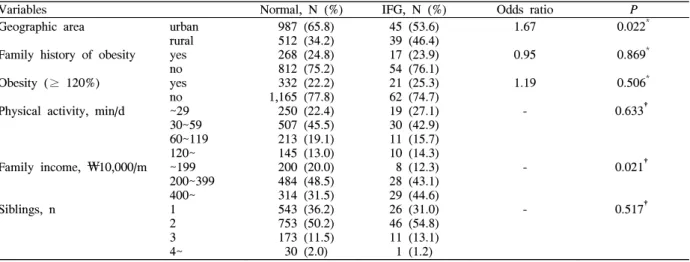
2. 공복혈당장애와 관련된 인구사회학적 요인 인구사회학적 요인 중 남학생에서 지역, 월 가구 수입, 여학생에서 지역과 비만이 공복혈당장애와 유의한 관련성 을 보였다(Table 3, 4)
3. 공복혈당장애와 관련된 식이 행태 및 습관 요인 남학생에서 ‘빨리 먹는' 식이 행태와 ‘아침 식사를 거 르는' 식이 습관 등이 공복혈당장애와 유의한 관련성을 보였다(Table 5). 여학생에서는 ‘온종일 먹으려 하는' 식 이 행태와 ‘아침식사를 거르는’ 식이습관이 공복혈당장 애와 중등도의 관련성을 보였다(Table 6).
Table 1. Demographic characteristics of study subjects
Characteristics Boys, (N = 1,584) Girls, (N = 1,266)
P
Birth weight (kg), M ± SD Father's age (y), M ± SD Mother's age (y), M ± SD Father's BMI (kg/m2), M ± SD Mother's BMI (kg/m2), M ± SD Geographic area
(N = 2,850), n (%) Family history of obesity (N = 2,076), n (%) Obesity (≥ 120%) (N = 2,846), n (%) Physical activity (min/d) (N = 2,136), n (%)
Family income (₩10,000/m) (N = 1,918), n (%) Siblings
(N = 2,850), n (%)
IFG (≥ 100 mg/dL) (N = 2,849), n (%)
urban rural no yes no yes
~29 30~ 59 60~119 120~
~199 200~399 400~
1 2 3 4~
no yes
3.3 ± 0.5 45.2 ± 6.6 41.9 ± 3.7 23.7 ± 2.4 21.7 ± 2.6 1,033 (65.2) 551 (34.8) 866 (75.2) 285 (24.8) 1,228 (77.7) 353 (22.3) 269 (22.7) 537 (45.3) 224 (18.9) 155 (13.1) 208 (19.6) 512 (48.2) 343 (32.3) 570 (36.0) 799 (50.4) 184 (11.6) 31 (2.0) 1,499 (94.7)
84 (5.3)
3.3 ± 0.5 44.9 ± 3.4 42.0 ± 3.8 23.5 ± 2.5 21.9 ± 2.5 769 (60.7) 497 (39.3) 635 (68.6) 290 (31.4) 1,133 (89.6) 132 (10.4) 385 (40.5) 376 (39.5) 132 (13.9) 58 (6.1) 126 (14.7) 401 (46.9) 328 (38.4) 391 (30.9) 579 (45.7) 236 (18.6) 60 (4.7) 1,228 (97.0)
38 (3.0)
0.739* 0.177* 0.563* 0.219* 0.178* 0.014† 0.001†
< 0.001†
< 0.001‡
0.001‡
0.001‡
0.003†
* t-test.
†Pearson's chi square test.
‡Linear-by-linear association.
Table 2. The comparisons of continuous variables between normal fasting glucose and IFG group according to sex
VariablesBoys Girls
Normal (N = 1,499),
M ± SD
IFG (N = 84),
M ± SD
P
*Normal (N = 1,228)
M ± SD
IFG (N = 38) M ± SD
P
* Birth weight, kgFather's BMI, kg/m2 Mother's BMI, kg/m2 Uric acid, mg/dL AST, mg/dL ALT, mg/dL T-C†, mg/dL Triglycerides, mg/dL HDL-C, mg/dL
3.3 ± 0.5 23.7 ± 2.4 21.7 ± 2.6 6.0 ± 3.6 23.5 ± 9.2 15.7 ± 14.8 163.5 ± 27.1 78.6 ± 40.4 43.8 ± 8.9
3.3 ± 0.5 23.3 ± 2.4 21.4 ± 2.8 5.7 ± 1.1 22.7 ± 5.7 16.9 ± 11.4 167.6 ± 32.1 84.7 ± 46.7 43.4 ± 9.8
0.736 0.304 0.346 0.316 0.418 0.462 0.258 0.184 0.720
3.3 ± 0.5 23.5 ± 2.5 21.9 ± 2.5 4.5 ± 0.9 19.5 ± 4.9 11.7 ± 4.8 175.5 ± 27.5 86.1 ± 36.0 46.9 ± 9.1
3.3 ± 0.5 23.5 ± 1.9 22.5 ± 2.7 4.7 ± 0.9 22.7 ± 17.8 18.5 ± 25.5 186.6 ± 37.1 104.5 ± 54.6 44.8 ± 9.4
0.802 0.982 0.153 0.132 0.286 0.110 0.074 0.046 0.178
* t-test.
†T-C; total cholesterol.
Table 3. The comparisons of categorical variables between normal fasting glucose and IFG group among boys
Variables Normal, N (%) IFG, N (%) Odds ratio
P
Geographic area
Family history of obesity Obesity (≥ 120%) Physical activity, min/d
Family income, ₩10,000/m
Siblings, n
urban rural yes no yes no
~29 30~59 60~119 120~
~199 200~399 400~
1 2 3 4~
987 (65.8) 512 (34.2) 268 (24.8) 812 (75.2) 332 (22.2) 1,165 (77.8) 250 (22.4) 507 (45.5) 213 (19.1) 145 (13.0) 200 (20.0) 484 (48.5) 314 (31.5) 543 (36.2) 753 (50.2) 173 (11.5) 30 (2.0)
45 (53.6) 39 (46.4) 17 (23.9) 54 (76.1) 21 (25.3) 62 (74.7) 19 (27.1) 30 (42.9) 11 (15.7) 10 (14.3) 8 (12.3) 28 (43.1) 29 (44.6) 26 (31.0) 46 (54.8) 11 (13.1) 1 (1.2)
1.67 0.95 1.19 -
-
-
0.022* 0.869* 0.506* 0.633†
0.021†
0.517†
* Pearson's chi square test.
†Linear-by-linear association.
4. 다변량 로짓 회귀분석을 통한 공복혈당장애 관련 요인의 위험도 산출
공복혈당장애 유무를 종속변수로 하고, 단변량 분석에서
P값이 0.1 미만인 요인들을 독립변수로 한 다변량 로짓 회 귀분석을 시행하였다. 남학생은 아침을 거를수록, 월 가구 수입이 높을수록, 여학생은 비만일수록 공복혈당장애의 위 험성이 유의하게 높았다(Table 7).
Table 4. The comparisons of categorical variables between normal fasting glucose and IFG group among girls
Variables Normal,
N (%)
IFG,
N (%) Odds ratio
P
Geographic area
Family history of obesity Obesity (≥ 120%) Physical activity, min/d
Family income, ₩10,000/m
Siblings, n
urban rural yes no yes no
~29 30~59 60~119 120~
~199 200~399 400~
1 2 3 4~
753 (61.3) 475 (38.7) 284 (31.7) 611 (68.3) 119 (9.7) 1,103 (90.3) 373 (40.5) 365 (39.7) 126 (13.7) 56 (6.1) 120 (14.5) 386 (46.6) 322 (38.9) 380 (30.9) 565 (46.0) 226 (18.4) 57 (4.6)
16 (42.1) 22 (57.9) 6 (20.0) 24 (80.0) 13 (34.2) 25 (65.8) 12 (38.7) 11 (35.5) 6 (19.4) 2 (6.5) 6 (22.2) 15 (55.6) 6 (22.2) 11 (28.9) 14 (36.8) 10 (26.3) 3 (7.9)
2.18 0.54 4.84 -
-
-
0.017* 0.173*
< 0.001* 0.607†
0.071† 0.228†
* Pearson's chi square test.
†Linear-by-linear association.
Table 5. The comparisons of dietary behavior and habits between normal fasting glucose and IFG group among boys
Variables Normal,
N (%)
IFG,
N (%) Odds ratio
P
"I can't control the amount of food I eat"
"I overeat even when I'm not hungry"
"If I am angry or anxious, I overeat"
"I like to eat throughout the whole day"
"I eat alone to avoid scolding"
"I eat until I feel discomfort due to gastric fullness"
"I eat faster than others"
"I feel unpleasant or depressed after overeating"
"I get stressed because of uncontrolled overeating"
"I don't eat breakfast"
"I consume half of the daily dietary intake at night"
"I can't fall asleep due to hunger"
no yes no yes no yes no yes no yes no yes no yes no yes no yes no yes no yes no yes
942 (82.8) 195 (17.2) 869 (76.6) 266 (23.4) 1,061 (93.5) 74 (6.5) 875 (77.2) 258 (22.8) 1,013 (89.1) 124 (10.9) 1,066 (94.0) 68 (6.0) 625 (54.9) 514 (45.1) 1,105 (97.4) 30 (2.6) 1,059 (93.3)
76 (6.7) 865 (75.9) 274 (24.1) 885 (78.4) 244 (21.6) 1,001 (88.8) 126 (11.2)
64 (86.5) 10 (13.5) 61 (82.4) 13 (17.6) 71 (98.6) 1 (1.4) 59 (81.9) 13 (18.1) 68 (94.4) 4 (5.6) 67 (94.4)
4 (5.6) 49 (68.1) 23 (31.9) 72 (100.0)
0 (0.0) 66 (90.4)
7 (9.6) 36 (48.6) 38 (41.4) 49 (68.1) 23 (31.9) 66 (91.7) 6 (8.3)
0.76 0.70 0.20 0.75 0.48 0.94 0.57 - 1.48 3.33 1.70 0.72
0.419* 0.318* 0.124† 0.219* 0.232† 1.000† 0.029* 0.253†
0.344*
< 0.001* 0.041* 0.454*
* Pearson's chi square test.
†Fisher's exact test.
고 찰
본 연구에서 공복혈당장애의 유병률은 4.3% (남 5.3%, 여 3.0%)였다. 코카시안 비만 아동 코호트 491명에서 12명 (2.4%)이 공복혈당장애로, 경구 당부하 검사를 시행한 102 명 중 37명이 내당능장애, 6명이 제 2형 당뇨병으로 진단되 었다.14) 독일에서도 비만한 아동과 청소년(9~20세)의 혈당
조절 이상이 6.7%였으며, 이 중 공복혈당장애가 3.7%를 차 지하였다.12) 일부 지역 청소년을 대상으로 한 공복혈당장애 유병률은 캐나다 퀘백의 15~19세 여학생의 ~3%15), 미국 온 타리오주의 10~19세 중 남학생의 3%, 여학생의 6%였다.16) 2001년 미국의 3차 National Health and Nutritional Examination Survey에 따르면, 청소년기 당뇨병과 공복혈 당장애의 유병률은 각각 0.41%, 1.76%였다.8) 최근 미국 내
Table 7. Adjusted odds ratio of IFG by multivariate logistic regression analysis
Variables Adjusted odds ratio
(95% CI*)
P
Boys Geographic area
"I eat faster than others"
"I don't eat breakfast"
"I consume half of the daily intake at night"
Family income, ₩10,000/m
rural yes yes yes
~199 200~399 400~
1.47 (0.86, 2.53) 0.64 (0.37, 1.11) 3.50 (2.01, 6.09) 0.84 (0.45, 1.57)
1.00 1.87 (0.78, 4.45) 3.46 (1.42, 8.41)
0.161 0.111
< .001 0.839 0.011
- 0.160 0.006 Girls Geographic area
"I like to eat throughout the whole day"
"I don't eat breakfast"
Obesity (≥ 120%) Family income, ₩10,000/m
rural yes yes yes
~199 200~399 400~
1.27 (0.56, 2.90) 0.40 (0.15, 1.07) 1.65 (0.73, 3.71) 5.95 (2.58, 13.75)
1.00 0.80 (0.28, 2.28) 0.40 (0.12, 1.38)
0.567 0.069 0.230
< .001 0.275
- 0.682 0.146
* CI, Confidence interval.
Table 6. The comparisons of dietary behavior and habits between normal fasting glucose and IFG group among girls
Variables Normal,
N (%)
IFG,
N (%) Odds ratio
P
"I can't control the amount of food I eat"
"I overeat even when I'm not hungry"
"If I am angry or anxious, I overeat"
"I like to eat throughout the whole day"
"I eat alone to avoid scolding"
"I eat until I feel discomfort due to gastric fullness"
"I eat faster than others"
"I feel unpleasant or depressed after overeating"
"I get stressed because of uncontrolled overeating"
"I don't eat breakfast"
"I consume half of the daily dietary intake at night"
"I can't fall asleep due to hunger"
no yes no yes no yes no yes no yes no yes no yes no yes no yes no yes no yes no yes
784 (83.4) 156 (16.6) 613 (65.2) 327 (34.8) 838 (89.2) 101 (10.8) 608 (65.0) 328 (35.0) 868 (92.5) 70 (7.5) 858 (91.7)
78 (8.3) 633 (67.6) 303 (32.4) 867 (92.4) 71 (7.6) 814 (86.6) 126 (13.4) 659 (70.1) 281 (29.9) 732 (78.3) 203 (21.7) 808 (86.2) 129 (13.8)
26 (83.9) 5 (16.1) 23 (74.2) 8 (25.8) 28 (90.3) 3 (9.7) 25 (80.6) 6 (19.4) 28 (90.3) 3 (9.7) 29 (93.5)
2 (6.5) 22 (71.0) 9 (29.0) 27 (90.0) 3 (10.0) 25 (83.3) 5 (6.7) 17 (54.8) 14 (45.2) 24 (80.0) 6 (20.0) 26 (89.7) 3 (10.3)
0.97 0.65 0.89 0.45 1.33 0.76 0.86 1.36 1.29 1.93 0.90 0.72
0.945* 0.301* 1.000† 0.071* 0.503† 1.000† 0.696* 0.495† 0.607* 0.069* 0.823* 0.786†
* Pearson's chi square test.
†Fisher's exact test.
다종족 비만 아동 및 청소년 코호트 167명 중 20% 이상에 서 내당능장애와 4명에서 무증상 제2형 당뇨병이 발생함을 보고하였다.17)
기존의 유병률 보고는 대부분 비만 아동과 청소년 대상 인 경우가 많았고, 혈당 기준치가 110 mg/dL였다는 점이 본 연구와 다르다. 본 연구의 유병률은 1회 측정으로 인한 진단의 부정확성과 공복혈당장애 기준치의 100 mg/dL 하 향으로 인해 과대평가되었다. 세계보건기구에서 권장하는 혈당의 정확한 평가 방법인 경구 당부하 검사나 2회 이상 의 공복혈당 측정에 의한 평가라면18), 유병률은 더 낮을 것 이다.
Mauritius 연구에 따르면, 남성이 여성보다 췌장 베타 세 포의 기능이 낮고 공복혈당장애의 유병률이 높은 반면, 여 성은 남성보다 인슐린 민감도가 낮고 내당능장애의 유병률 이 높다.19) 이 결과를 청소년에게 그대로 적용할 수 없지만, 여학생보다 많은 남학생의 공복혈당장애 유병률을 설명할 수 있는 한 가지 가능 모델이 될 수 있겠다. 또한, 청소년을 대상으로 아침 결식이 췌장 베타 세포 기능의 부전을 유발 할 수 있는지 실험적인 연구가 필요하겠다. 그래야만 본 연 구에서 남학생에서 보이는 아침 결식과 공복혈당장애의 관 련성을 확증할 수 있을 것이다.
공복혈당장애와 관련된 요인으로 남학생에서 아침 결식, 여학생에서 비만이 강한 유의성을 보였다. 남학생에서 비만 이 관련성을 입증하지 못한 이유는 남학생과 여학생의 신체 성장 발달 연령의 차이 때문일 것이다. 즉, 여학생은 신체적 성장이 완숙의 단계에 들어가 성인과 거의 같은 특성을 갖 는 반면, 남학생은 성장 진행 중인 단계로 성인과 다른 특성 을 보이기 때문일 것이다. 따라서 신체적 성장의 마무리 단 계인 남자 고등학생을 대상으로 한 연구를 통해 비만과 공 복혈당장애의 관련성을 재검토해야 할 것이다.
본 연구는 몇 가지 장점을 갖고 있다. 첫째, 단면 조사이 기는 하지만, 일개 학교나 일개 지역이 아닌 전국 규모의 대 단위 조사였다. 둘째, 남녀간 집단의 차별성을 반영하여 분 석하였다. 그 결과, 공복혈당장애의 유병률이 남학생에서 높 은데도, 비만과 공복혈당장애의 관련성은 여학생에서 두드 러짐을 밝힐 수 있었다. 셋째, 부모의 체질량지수, 비만 가 족력, 자녀수, 출생 시 체중, 신체활동량, 월 가구 수입 등에 대한 자료 조사가 함께 이루어졌다. 이를 통해 인구사회학 적 요인과 공복혈당장애의 관련성에 대한 평가를 할 수 있 었다.
그러나, 본 연구는 몇 가지 제한점을 갖고 있다. 첫째, 공 복혈당장애 진단의 부정확성이다. 코카시안 비만 아동 코호 트 연구에서 보듯이 공복혈당의 측정만으로는 비만 아동에 서 혈당 조절 이상을 발견하는 선별 기능이 부족하다.14) 따 라서, 향후 연구에서는 반드시 2회 이상의 반복 검사 또는 경구 당부하검사를 시행을 통해 정확한 유병률을 평가해야
할 것이다. 그렇지만, 경구 당부하검사가 시행의 불편감 때 문에 대단위 연구에서 적용하기 곤란한 점을 고려한다면, 처음 검사에서 공복혈당장애가 의심되는 대상을 다른 날 재 검사하는 2회 측정 방법이 더 타당할 것으로 생각한다. 둘 째, 당뇨병의 가족력을 조사하지 못했다. 즉, 청소년의 혈당 조절 이상은 선천적인 요소와 후천적인 요소가 모두 작용하 는 바, 유전적인 요소를 평가하지 못한 한계가 있다. MODY (maturity-onset diabetes of the young)는 소아와 청소년에 서 매우 드문 형태이며, 부모의 당뇨병 가족력이 특징적이 다.12) 또한 MODY 환자들은 대개 비만하지 않고 공복 인슐 린 농도가 낮은 특성을 보인다.20) 비록 이런 가능성이 낮기 는 하지만, 본 연구에서는 MODY를 완전히 배제하지 못했 다. 셋째, 식이 행태와 습관에 대한 정확한 평가가 이루어지 지 않았다. 본 연구에서는 기존 연구들에서 사용한 ‘비만과 관련된 식이 행태와 습관' 중에서 추출한 설문으로 평가하 였으나[설문의 신뢰도 계수(Cronbach's alpha) = 0.62], 설 문의 타당도가 검증되지 않아 공복혈당장애와 관련된 후천 적인 요소를 정확히 평가하지 못한 한계가 있다. 넷째, 연구 대상이 전체 청소년을 대표할 수 없었다. 본 연구에서처럼 남녀 중학생이 서로 다른 인구사회학적 특성을 갖는다면, 고등학생 또는 중학생과 고등학생 모두 포함한 연구 대상으 로 공복혈당장애의 유병률 조사와 관련 요인의 평가가 필요 하다.
결론적으로, 청소년의 공복혈당장애는 남학생에서 아침 결식, 여학생에서 비만과 강한 관련성을 보인다. 그러나, 전 체 청소년기 전체를 포괄하는 연구 대상 선정과 식이 행태 및 습관의 정확한 평가를 통해 청소년기 공복혈당장애의 정 확한 유병률과 관련 요인을 재검증할 필요가 있다.
감사의 글
한국방송공사의 지원과 ㈜ SCL의 협조에 감사드립니다.
ABSTRACT
The Factors Associated with Impaired Fasting Glucose in Adolescents
Background: Since the normal fasting plasma glucose
level has decreased to below 100 mg/dL, the range for impaired fasting glucose (IFG) has expanded. Early detection and management of IFG in adolescents can reduce and delay the development of diabetes. Therefore, the prevalence of IFG in adolescents and its related factors were investigated in this study.Methods: The study population comprised of 2,850
(1,584 boys and 1,266 girls) students from 14 different middle schools in Korea. The participants’ height, weight and fasting plasma glucose were measured. The participants’ age, body mass index (BMI), number of siblings, their parents’ monthly income, weight at birth, and physical activity were assessed using self-recording questionnaires.
Results: The prevalence of IFG is 4.3% (boys; 5.3%,
girls; 3.0%). Univariate analysis showed that rural community (OR = 1.67) and monthly income of parents (P = 0.021) were factors associated with IFG for boys, while rural community (OR = 2.18) and obesity (OR = 4.84) were associated with IFG for girls. Multiple logistic regression analysis showed that the risk of IFG is associated with skipping breakfasts (OR = 3.50 [2.01~6.09]) and high monthly income of parents (P = 0.011) for boys, while obesity (OR = 5.95 [2.58~13.75]) is the associated factor for girls.Conclusion: The factors strongly associated with IFG
for adolescents were skipping breakfast and obesity for boys and girls, respectively.Key words: Adolescent, Impaired fasting glucose, Obesity
참 고 문 헌
1. Rocchini AP. Childhood obesity and a diabetes epidemic. N Engl J Med 2002;346(11):802-10.
2. Rosenbloom AL, Joe JR, Young RS, Winter NE.
Emerging epidemic of type 2 diabetes in youth.
Diabetes care 1999;22(2):345-54.
3. American Diabetes Association. Type 2 diabetes in children and adolescents. Diabetes care 2000;23:
381-9.
4. Dabelea D, Hanson RL, Bennett PH, Roumain J, Knowler WC, Pettitt DJ. Increasing prevalence of type II diabetes in American Indian children.
Diabetologia 1998;41:904-10.
5. Dabelea D, Pettitt DJ, Jones KL, Arslanian SA. Type 2 diabetes mellitus in minority children and adolescents. An emerging problem. Endocrinol Metab Clin N Am 1999;28:709-29.
6. Glaser NS, Jones KL. Non-insulin dependent diabetes mellitus in Mexican-American children. West J Med 1998;168:11-6.
7. Harris SB, Gittelson J, Hanley A, Barnie A, Wolever
T, Gao J. The prevalence of NIDDM in native Canadians. Diabetes Care 1997;20:185-7.
8. Fagot-Campagna A, Saaddine JB, Flegal KM, Beckles GLA. Diabetes, impaired fasting glucose, and elevated HbA1c in US adolescents: the third National Health and Nutrition Examination Survey. Diabetes Care 2001;24:834-7.
9. The DECODE Study Group. Glucose tolerance and mortality: comparison of WHO and American Diabetes Association diagnostic criteria. Lancet 1999;
354:617-21.
10. Tuomilehto J, Lindström J, Eriksson JG, Valle TT, Hamalainen H, Hanne-Parikka P, et al. Prevention of type 2 diabetes mellitus by changes in lifestyle among subjects with impaired glucose tolerance. N Engl J Med 2001;344:1343-50.
11. Diabetes Prevention Program Research Group.
Reduction in the incidence of type 2 diabetes with lifestyle intervention or metformin. N Engl J Med 2002;346:393-403.
12. Wabitsch M, Hauner H, Hertrampf M, Muche R, Hay B, Mayer H, et al. Type II diabetes mellitus and impaired glucose regulation in Caucasian children and adolescents with obesity living in Germany. Int J Obesity 2004;28:307-13.
13. American Diabetes Association. Diagnosis and classification of diabetes mellitus. Diabetes Care 2004;27(Suppl 1):S5-S10.
14. Wiegand S, Maikowski U, Blankenstein O, Biebermann H, Tarnow P, Gruters A. Type 2 diabetes and impaired glucose tolerance in European children and adolescents with obesity – a problem that is no longer restricted to minority groups. Eur J Endocrinol 2004;151:199-206.
15. Delisle HF, Ekoe JM. Prevalence of non-insulin dependent diabetes mellitus and impaired glucose tolerance in two Algonquin communities in Quebec.
CMAJ 1993;148:41-7.
16. Harris MI, Flegal KM, Cowie CC, Eberhardt MS, Goldstein DE, Little RR, et al. Prevalence of diabetes, impaired fasting glucose, and impaired glucose tolerance in US adults: the third National Health and Nutritional Examination Survey, 1988-1994. Diabetes Care 1998;21:518-24.
17. Shina R, Fisch G, Teague B, Tamborlane WV, Banyas B, Allen K, et al. Prevalence of impaired
glucose tolerance among children and adolescents with marked obesity. N Engl J Med 2002;346:
802-10.
18. Alberti K. Definition, diagnosis and classification of diabetes mellitus and its complications. Report of a WHO consultation. Diabetes Med 1999;15:S39-53.
19. Williams JW, Zimmer PZ, Shaw JE, de Courten MP,
Cameron AJ, Chitson P, et al. Gender differences in the prevalence of impaired fasting glycaemia and impaired glucose tolerance in Mauritius: does sex matter? Diabet Med 2003;20:915-20.
20. Velho G, Froguel P. Genetic metabolic and clinical characteristics of maturity onset diabetes of the young. Eur J Endocrinol 1998;138:233-9.