• 검색 결과가 없습니다.

Journal of Korean Biological Nursing Science

N/A
N/A
Protected

Academic year: 2021

Share "Journal of Korean Biological Nursing Science"

Copied!
8
0
0

로드 중.... (전체 텍스트 보기)

전체 글

(1)

INTRODUCTION

Laparoscopic surgery requires carbon dioxide (CO

2

) gas of 20-21˚C for insufflation, which can affect body temperature of surgical patients [1]. In addition, most anesthetics dilate peripheral vessels and increase the flow of heat from the core to peripheral re-distribution [2]. For these reasons, laparoscopic surgery under general anesthesia is likely to be ac- companied by intra-operative hypothermia. The incidence of peri-oper- ative hypothermia (<36°C) is as much as 90% in laparoscopic surgery compared to 40-57% in open abdominal surgery [3-5]. In recent years,

laparoscopic surgery has been increasingly used in major abdominal and thoracic surgeries.

Hypothermia (<36˚C) reduces coagulation enzyme activity, impairs neutrophils, and suppresses activation of lymphocytes and production of cytokines [6-9]. Intra-operative hypothermia might drive surgical wound infection and extend the duration of hospitalization [10,11]. Risk factors of peri-operative hypothermia include older age (> 60 years), ma- jor surgeries, American Society of Anesthesiologists (ASA) physical sta- tus class (≥ 2), infusion of unwarmed solution or blood transfusion, du- ration of surgery (>2-3 hours), ambient operating room temperature

Factors Influencing Intra-Operative Body Temperature in Laparoscopic Colectomy Surgery under General Anesthesia:

An Observational Cohort

Kong, Mi Jin

1

·Yoon, Haesang

2

1

Gachon University Gil Medical Center, Incheon;

2

College of Nursing, Gachon University, Incheon, Korea

Purpose: This study aimed to identify factors influencing intra-operative core body temperature (CBT), and to develop a predictive model for intra-operative CBT in laparoscopic abdominal surgery. Methods: The prospective observational study involved 161 sub- jects, whose age, weight, and height were collected. The basal pre-operative CBT, pre-operative blood pressure, and heartbeat were measured. CBT was measured 1 hour and 2 hours after pneumoperitoneum. Results: Explanatory factors of intra-operative hypo- thermia (< 36˚C) were weight (β= .361, p< .001) and pre-operative CBT (β= .280, p= .001) 1 hour after pneumoperitoneum (Adjust- ed R

2

= .198, F= 7.56, p< .001). Weight was (β= .423, p< .001) and pre-operative CBT was (β= .206, p= .011) 2 hours after pneumo- peritoneum (Adjusted R

2

= .177, F= 5.93, p< .001). The researchers developed a predictive model for intra-operative CBT (˚C) by ob- serving intra-operative CBT, body weight, and pre-operative CBT. The predictive model revealed that intra-operative CBT was posi- tively correlated with body weight and pre-operative CBT. Conclusion: Influence of weight on intra-operative hypothermia increased over time from 1 hour to 2 hours after pneumoperitoneum, whereas influence of pre-operative CBT on intraoperative hypothermia decreased over time from 1 hour to 2 hours after pneumoperitoneum. The research recommends pre-warming for laparoscopic surgi- cal patients to guard against intra-operative hypothermia.

Key Words: Laparoscopic surgery; Hypothermia; Body temperature; Peri-operative care 국문주요어: 복강경수술, 저체온, 체온, 수술간호

Corresponding author:

Yoon, Haesang

College of Nursing, Gachon University, 191 Hambakmoe-ro, Yeonsu-gu, Incheon 21936, Korea Tel: +82-32-820-4212 Fax: +82-32-820-4201 E-mail: [email protected]

* This manuscript is a revision of the first author’s master’s thesis from Gachon University.

Received: June 19, 2017 Revised: July 11, 2017 Accepted: July 12, 2017

This is an Open Access article distributed under the terms of the Creative Commons Attribution Non-Commercial License (http://creativecommons.org/licenses/by-nc/4.0) which permits

unrestricted non-commercial use, distribution, and reproduction in any medium, provided the original work is properly cited.

(2)

(< 21˚C), laparoscopic surgery, and general anesthesia [3,12-14]. Intra- operative warming during laparoscopic surgery helps prevent intra-op- erative hypothermia [15].

Risk factors of peri-operative hypothermia in laparotomic surgery in- clude pre-operative body temperature, systolic blood pressure, catechol- amine level, body weight and body fat [16,17,19]. Even though contribut- ing factors for intra-operative hypothermia in laparotomic surgery have been investigated [3,16,17], factors that influence intra-operative hypo- thermia for laparoscopic surgery have not been investigated. Therefore, risk factors for intra-operative hypothermia in laparoscopic surgery need to be identified.

The present study was undertaken to investigate the incidence of in- tra-operative hypothermia and identify the explanatory factors for intra- operative hypothermia in laparoscopic surgery. Pre-operative assess- ment of risk factors for intra-operative hypothermia in laparoscopic sur- gery helps to provide individual nursing care to laparoscopic surgical patients and to prevent the patients from peri-operative hypothermia.

METHODS

1. Research design

This study had a prospective descriptive research design. Core body temperature (CBT), heart rate and systolic blood pressure (SBP) were measured before the induction of general anesthesia, and then at 1 hour and 2 hours after pneumoperitoneum in surgical patients who received a laparoscopic colectomy.

2. Subjects and sampling

In this study, inclusion criteria of subjects were age (>20 years), con- scious state, and ASA physical status class I or II. We excluded patients with peri-operative use of clonidine (phenothiazine), which can influ- ence thermoregulation, intra-operative blood transfusion, or conditions that can influence metabolic heat production or peripheral vasocon- striction including diabetes mellitus, thyroid disease, and Raynaud’s disease [18,19].

3. Samples and setting

Subjects who received an elective laparoscopic colectomy under gen- eral anesthesia were recruited by a convenient sampling at a 1,300-bed G university hospital, Incheon, Korea, from January to June 2012. The

subjects in this study included the control group in Park & Yoon’s study [20].

The day before surgery and after the pre-operative interview the prin- cipal investigator provided the eligible patients with a printed handout and explained an overview of this study during a face-to-face meeting. A printed handout included the purpose, outcome measurements, dura- tion, and voluntary relinquishment of this study.

The patients were fully informed about the purpose, design, and du- ration of this study and could drop-out freely at any time. Written in- formed consent was waived because it was a non-interventional analysis of our standard practice. Participation was accepted by verbal consent in the light of fulfillment of the inclusion criteria. One-hundred seventy patients provided verbal consent, and nine patients withdrew during the study period, representing a completion rate of 94.7% (Figure. 1).

4. Anesthetic technique

General anesthesia was performed with a standardized technique. All patients were pre-medicated by an intra-muscular injection of glycopyr- rolate and/or midazolam. General anesthesia was induced by an intra-ve- nous administration of 1.5 mg/kg propofol, 1 mg/kg rocuronium, and 10 µg alfentanil, and an endotracheal tube was inserted in the trachea. Ven- tilation was mechanically controlled and fresh gas flow was maintained at 2 L/min by a semi-closed circle system. A heated circuit kit airway heating exchanger (Ace Medical, Seoul, Korea) was set to 40˚C. While in- halation anesthesia was maintained with desflurane (6-7%), air (1.5-2 L/

min) and O

2

(1.5-2 L/min), a blanketrol full-length circulating water mat- Convenience sample of 181 eligible patients

with laparoscopic surgery

170 patients in ASA I or II physical status

Patient exclusion (n= 9) due to intra-operative transfusion (n= 3) due to duration of surgery time < 2 hours (n= 6)

161 patients analyzed

Figure 1. Flow diagram of study participants for factors affecting intra-

operative hypothermia.

(3)

tress set to 38˚C (Cincinnati Sub-Zero Products, Cincinnati, OH, USA) was placed under the participant’s back just after induction of general an- esthesia, and passive insulation was restricted to surgical draping.

Pneumoperitoneum was established with insufflation of 3 to 4 L of 21˚C CO

2

into the peritoneal cavity and maintained with an intra-ab- dominal pressure of 12-15 mmHg. Lactated Ringer’s solution at the am- bient temperature of the operating room (22-23˚C) was infused at ap- proximately 5-8 mL/kg/h. At the commencement of skin suture, the neuromuscular blockade was reversed with neostigmine (1.0 mg) and atropine (1.0 mg), and the endotracheal tube was removed. Normal sa- line for irrigation was warmed to 37˚C.

5. Power calculation

Effect size based on data of Kim & Yoon [3] and Lee & Yoon [4] was estimated as 0.15. Through G-power 3.1 for multiple regression analysis, a total of 153 subjects were needed with an effect size of 0.15, an alpha of .05, a power of .95 and seven predictors. Seven predictors included age, pre-operative CBT, pre-operative SBP, pre-operative heart rate, weight, total body fat (TBF) and ambient temperature in operating room. Con- sidering a 5% dropout rate, we recruited 170 participants.

6. Data collection

After obtaining approval from the Ethics and Research Committee of G University Hospital (Institutional Review Board No: GIRBA2648), this prospective study was performed on 170 surgical patients. Patients were recruited throughout the general surgery wards after admission and prior to surgery. After surgical patients verbally consented to partic- ipate in the study as a research subject, the surgical patients were exam- ined on fulfillment of inclusion criteria for the research subject.

During the pre-operative assessment, demographic data including

gender, age, ASA physical status class, disease history, weight, and height (DS-103, Dongsahn Jenix, Seoul, Korea) were collected on the pre-oper- ative visit. Body mass index (BMI, kg/m

2

) was calculated using the Kauffman index, body surface area (BSA) was calculated by the Dubois index, lean body mass was calculated by the James formula, and total body fat was calculated from lean body mass according to the following formula: [(weight in kg - lean body mass in kg) ÷ weight in kg] × 100.

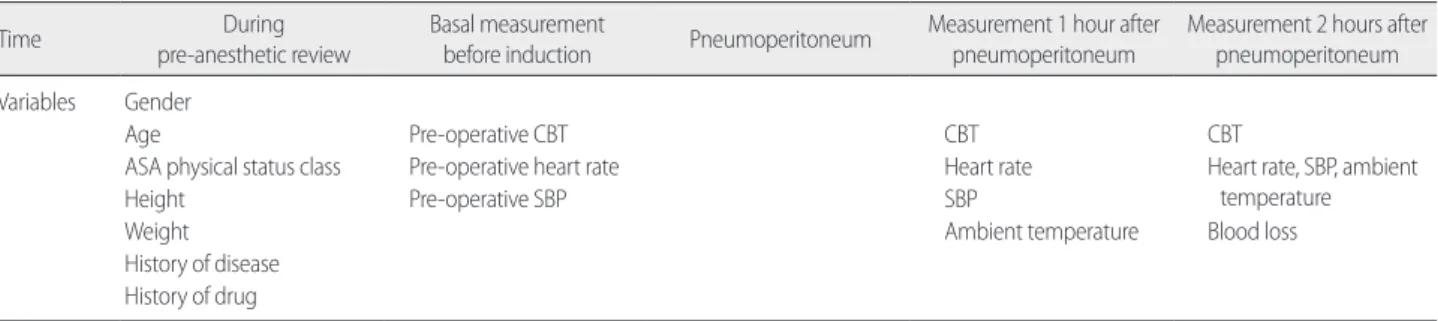
Research assistants were three nurses who had worked more than three years in the anesthetic nursing unit. They measured clinical vari- ables including tympanic membrane CBT, heart rate, and SBP (Table 1).

The three assistants were trained to measure tympanic membrane CBT.

As soon as the patients were transported to the operating room, basal pre-operative CBT was measured in the right ear using a tympanic membrane thermometer (ThermoScan IRT-4520, Braun, Frankfurter, Germany). The thermometer was calibrated in accordance with manu- facturer’s guidelines. As well, the basal pre-operative SBP and heart rate were measured using an electrocardiograph monitor (Dash 4000, GE, New York, NY, USA) in the supine position. CBT was measured again at induction of general anesthesia.

Subsequently, CBT and the ambient temperature in the operating room were measured 1 hour and 2 hours following pneumoperitoneum.

In addition, volume of irrigation fluid for the abdominal cavity, and the amount of estimated blood loss were recorded 2 hours after pneumo- peritoneum. Finally, the duration of pneumoperitoneum and operation were recorded at the end of the operation.

7. Data analyses

All analyses were performed using IBM SPSS 19.0 (IBM SPSS, Ar- monk, NY, USA). The chi-square test and Student’s t-test were used to determine differences of the demographic and clinical characteristics

Table 1. Measurement of Variables by Time Sequence

Time During

pre-anesthetic review

Basal measurement

before induction Pneumoperitoneum Measurement 1 hour after pneumoperitoneum

Measurement 2 hours after pneumoperitoneum Variables Gender

Age Pre-operative CBT CBT CBT

ASA physical status class Pre-operative heart rate Heart rate Heart rate, SBP, ambient

temperature

Height Pre-operative SBP SBP

Weight Ambient temperature Blood loss

History of disease History of drug

ASA= America Society of Anesthesiologists; CBT= core body temperature; SBP= systolic blood pressure.

(4)

between the normothermia (≥36˚C) and hypothermia (<36˚C) groups.

The multiple regression through an enter method (p<.05 to enter) was used to determine explanatory factors intra-operative hypothermia in laparoscopic surgery. Variation inflation factors of BMI, BSA, and weight/BSA ratio were more than 10.0, which caused multicollinearity in multiple regression. Therefore, the authors selected weight and TBF as the morphometric variables, and determined a total of seven variables at 2 hours following pneumoperitoneum for an independent variable in the multiple regression.

RESULTS

1. Comparison of general characteristics between normothermia and hypothermia groups

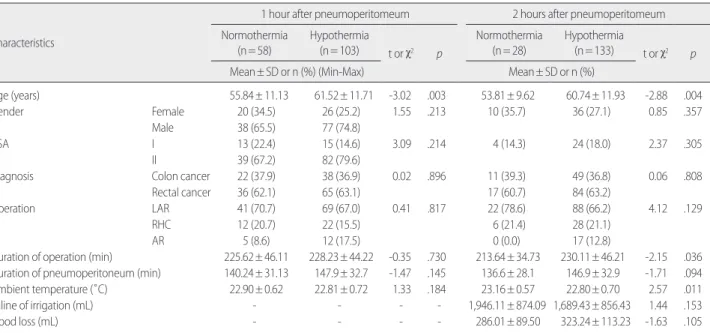
The 161 patients were divided into the normothermia group (≥36˚C, n=58) and hypothermia group (<36˚C, n=103) at 1 hour after pneu- moperitoneum, and the normothermia group (n=28) and hypothermia group (n=133) at 2 hours after pneumoperitoneum.

Results of the Student’s t-test and chi-square test for the demographic and clinical physiologic characteristics between the normothermia and Table 2. General Characteristics in Normothermia and Hypothermia Groups after Pneumoperitoneum (N=161)

Characteristics

1 hour after pneumoperitomeum 2 hours after pneumoperitomeum Normothermia

(n= 58)

Hypothermia

(n= 103) t or χ

2

p

Normothermia (n= 28)

Hypothermia

(n= 133) t or χ

2

p

Mean± SD or n (%) (Min-Max) Mean± SD or n (%)

Age (years) 55.84± 11.13 61.52± 11.71 -3.02 .003 53.81± 9.62 60.74± 11.93 -2.88 .004

Gender Female 20 (34.5) 26 (25.2) 1.55 .213 10 (35.7) 36 (27.1) 0.85 .357

Male 38 (65.5) 77 (74.8)

ASA I 13 (22.4) 15 (14.6) 3.09 .214 4 (14.3) 24 (18.0) 2.37 .305

II 39 (67.2) 82 (79.6)

Diagnosis Colon cancer 22 (37.9) 38 (36.9) 0.02 .896 11 (39.3) 49 (36.8) 0.06 .808

Rectal cancer 36 (62.1) 65 (63.1) 17 (60.7) 84 (63.2)

Operation LAR 41 (70.7) 69 (67.0) 0.41 .817 22 (78.6) 88 (66.2) 4.12 .129

RHC 12 (20.7) 22 (15.5) 6 (21.4) 28 (21.1)

AR 5 (8.6) 12 (17.5) 0 (0.0) 17 (12.8)

Duration of operation (min) 225.62± 46.11 228.23± 44.22 -0.35 .730 213.64± 34.73 230.11± 46.21 -2.15 .036 Duration of pneumoperitoneum (min) 140.24± 31.13 147.9± 32.7 -1.47 .145 136.6± 28.1 146.9± 32.9 -1.71 .094

Ambient temperature (˚C) 22.90± 0.62 22.81± 0.72 1.33 .184 23.16± 0.57 22.80± 0.70 2.57 .011

Saline of irrigation (mL) - - - - 1,946.11± 874.09 1,689.43± 856.43 1.44 .153

Blood loss (mL) - - - - 286.01± 89.50 323.24± 113.23 -1.63 .105

ASA=American Society of Anesthesiologists; LAR=low anterior resection; RHC=right hemicolectomy; AR=anterior resection; Normothermia ≥36˚C; Hypother- mia <36˚C.

Table 3. Physiological Characteristics in Normothermia and Hypothermia Groups after Pneumoperitoneum (N=161)

Characteristics

1 hour after pneumoperitomeum 2 hours after neumoperitomeum

Normothermia (n= 58)

Hypothermia

(n= 103) t or χ

2

p

Normothermia (n= 28)

Hypothermia

(n= 133) t or χ

2

p

Mean± SD Mean± SD

Preoperative CBT before induction (˚C) 36.87± 0.36 36.56± 0.32 5.62 < .001 36.99± 0.27 36.60± 0.35 5.50 < .001 CBT at 1 hour after pneumoperitoneum 36.18± 0.17 35.39± 0.41 13.60 < .001 36.07± 0.13 35.24± 0.48 9.01 < .001 Preoperative SBP (mmHg) 135.50± 23.1 135.01± 18.90 0.166 .868 148.53± 20.34 132.47± 19.44 3.95 < .001

Preoperative HR (bpm) 73.19± 12.91 68.00± 12.74 2.50 .013 79.91± 9.64 67.71± 12.63 4.79 < .001

Weight (kg) 65.54± 9.97 62.29± 9.97 1.94 .054 68.54± 10.18 62.39± 9.58 3.06 .003

BMI (kg/m

2

) 24.43± 3.38 23.13± 2.77 2.98 .003 25.79± 3.31 23.18± 2.83 4.32 < .001

Body surface area 1.70± 0.14 1.67± 0.15 1.19 .235 1.73± 0.14 1.67± 0.14 1.98 .049

Total body fat (%) 23.79± 5.65 22.43± 4.81 1.66 < .001 24.89± 5.77 22.49± 4.94 2.28 .024

Weight/BSA 38.18± 2.98 36.80± 2.82 2.90 .004 39.24± 2.88 36.9± 2.80 1.07 < .001

CBT= core body temperature; Weight/BSA= body surface area ratio; BMI= body mass index; SBP= systolic blood pressure.

(5)

hypothermia groups at 1 hour and 2 hours after pneumoperitoneum are presented in Table 2. The Chi-square test for gender, ASA physical status class, and operation type showed no statistically significant differences between the two groups. Student’s t-test for age (p=.003) showed statisti- cally significant differences between either group at 1 hour after pneu- moperitoneum. In addition, Student’s t-test for age (p=.004), and ambi- ent temperature (p=.011) showed statistically significant differences be- tween the two groups at 2 hours after pneumoperitoneum.

2. Comparison of physiological characteristics in the normothermia and hypothermia groups

Comparisons of pre-operative CBT, SBP and heart rate between the normothermia and hypothermia groups are presented in Table 3. Stu- dent’s t-test revealed statistically significant differences in pre-operative CBT (p<.001), heart rate (p =.013), BMI (p =.003), TBF (p<.001), and weight/BSA ratio (p=.004) at 1 hour after pneumoperitoneum between the two groups. In addition, there were statistically significant differenc- es in pre-operative CBT (p<.001), SBP (p<.001), heart rate (p<.001), weight (p =.003), BMI (p <.001), BSA (p =.049), TBF (p =.024), and weight/BSA ratio (p<.001) at 2 hours after pneumoperitoneum between the two groups.

Mean CBT at 1 hour after pneumoperitoneum was 36.18˚C and 35.39˚C in the normothermia and hypothermia group, respectively (p<.001). The respective CBT value at 2 hours after pneumoperitoneum

was 36.07˚C and 35.24˚C (p<.001). Of the 161 laparoscopic surgical pa- tients, incidences of core hypothermia (<36°C) at 1 hour and 2 hours after pneumoperitoneum were 64.0% (103 of 161 patients) and 82.6%

(133 of 161 patients), respectively.

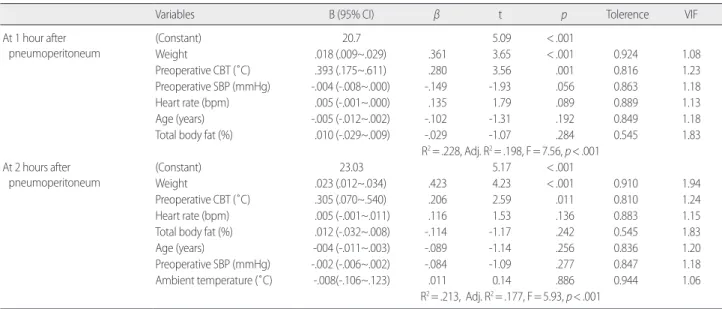
3. Explanatory factors of intra-operative hypothermia Table 4 displays the results of the multiple regression analysis to iden- tify the explanatory factors of intra-operative hypothermia (<36°C) at 1 hour and 2 hours after pneumoperitoneum.

There was no autocorrelation problem because the Durbin-Watson statistic (1.59≤d≤1.76) was 1.71 and 1.64 at 1 hour and 2 hours after pneumoperitoneum, respectively. In addition, there was no problem with multicollinearity because tolerance ranged from 0.816 to 0.924 (>.10) and the variance inflation factor ranged from 1.08 to 1.83 (<10) at 1 hour after pneumoperitoneum, tolerance ranged from 0.810 to .944 (>.10), and the variance inflation factor ranged from 1.06 to 1.94 (<10) at 2 hours after pneumoperitoneum. The results of multiple linear re- gression analysis were considered reliable because all hypotheses of the regression equation, linearity, residual normality, and homoscedasticity were satisfied.

For intra-operative body temperature at 1 hour after pneumoperito- neum, the statistically significant factors were weight (β=.361, p<.001) and pre-operative CBT (β =.280, p =.001). The explanatory power of these two factors was 19.8% (F=7.56, p<.001) (Table 4). For intra-opera-

Table 4. Influencing Factors of Intra-operative Core Body Temperature after Pneumoperitoneum (N=161)

  Variables B (95% CI) β t p Tolerence VIF

At 1 hour after pneumoperitoneum

(Constant) 20.7   5.09 < .001    

Weight .018 (.009~.029) .361 3.65 < .001 0.924 1.08

Preoperative CBT (˚C) .393 (.175~.611) .280 3.56 .001 0.816 1.23

Preoperative SBP (mmHg) -.004 (-.008~.000) -.149 -1.93 .056 0.863 1.18

Heart rate (bpm) .005 (-.001~.000) .135 1.79 .089 0.889 1.13

Age (years) -.005 (-.012~.002) -.102 -1.31 .192 0.849 1.18

Total body fat (%) .010 (-.029~.009) -.029 -1.07 .284 0.545 1.83

R

2

= .228, Adj. R

2

= .198, F= 7.56, p< .001

At 2 hours after pneumoperitoneum

(Constant) 23.03   5.17 < .001    

Weight .023 (.012~.034) .423 4.23 < .001 0.910 1.94

Preoperative CBT (˚C) .305 (.070~.540) .206 2.59 .011 0.810 1.24

Heart rate (bpm) .005 (-.001~.011) .116 1.53 .136 0.883 1.15

Total body fat (%) .012 (-.032~.008) -.114 -1.17 .242 0.545 1.83

Age (years) -004 (-.011~.003) -.089 -1.14 .256 0.836 1.20

Preoperative SBP (mmHg) -.002 (-.006~.002) -.084 -1.09 .277 0.847 1.18

Ambient temperature (˚C) -.008(-.106~.123) .011 0.14 .886 0.944 1.06

  R

2

= .213, Adj. R

2

= .177, F= 5.93, p< .001

CBT= core body temperature; SBP= systolic blood pressure.

(6)

tive body temperature at 2 hours after pneumoperitoneum, the statisti- cally significant factors were weight (β=.423, p<.001) and pre-operative CBT (β=.206, p=.010). The explanatory power of these two factors was 17.7% (F=5.93, p<.001) (Table 4).

We developed a model to predict intra-operative CBT, Y (˚C) based on weight (kg) and CBT (°C), X

1

; body weight (kg), X

2

: pre-operative CBT (˚C)

Y

1

(˚C)=20.71+0.018 × X

1

(kg)+0.393 × X

2

(˚C) Y

2

(˚C)=23.03 +0.023 × X

1

(kg)+0.305 × X

2

(˚C)

( Y

1

= CBT 1 hour after pneumoperitoneum; Y

2

= CBT 2 hours after pneumoperitoneum)

Therefore, we can estimate intra-operative CBT of 36.13˚C 1 hour af- ter pneumoperitoneum of a laparoscopic surgical patient with weight 60 kg and pre-operative CBT of 36.5˚C. In addition, we can estimate intra- operative CBT of 35.08˚C 2 hours after pneumoperitoneum of a laparo- scopic surgical patient with weight 40 kg and pre-operative CBT 36.5˚C.

DISCUSSION

The incidences of hypothermia (<36°C) were 64% and 82.6% at 1 hour and 2 hours after pneumoperitoneum in laparoscopic surgery, re- spectively. Previous studies reported that the incidence of intra-operative hypothermia in laparoscopic surgery had a wider range of 41% up to 94% [21,22]. This wide range seems attributable to a warming method during laparoscopic operation. For example, the incidence of intra-oper- ative hypothermia was 94% in laparoscopic surgical patients who were just covered with blanket mattress [21]. However, the incidence of intra- operative hypothermia was 37% in laparoscopic surgical patients who were actively warmed with forced air warming and airway humidifica- tion [22]. According to previous and present findings, peri-operative warming intervention seems effective in reduction of advent intraopera- tive hypothermia.

The incidences of hypothermia (<36°C) were 64% and 82.6% at 1 hour and 2 hours after pneumoperitoneum in laparoscopic surgery.

That is far higher than the rate of 34.7% and 46.3% in laparotomic sur- gery at 1 hour and 2 hours after induction, respectively [3]. As the pres- ent and previous studies were conducted at the same hospital, the re- search environments were almost similar in several aspects including the use of circulating water mattress set to 38˚C, surgical draping type,

inhalation anesthesia protocol, and the ambient temperature of the op- erating room. However, the intra-operative CBT in the present study was 35.39˚C and 35.24˚C at 1 hour and 2 hours after pneumoperitone- um, respectively, which was lower by 0.21˚C and 0.29˚C compared with 35.6˚C and 35.49˚C in the prior study [3]. The National Institute for Health and Care Excellence stipulates a difference of more than 0.2˚C is clinically important in CBT less than 36˚C [18]. This supports that idea that 21˚C carbon dioxide gas during pneumoperitoneum decreases the intra-operative CBT [1]. Throughout abdominal laparoscopic surgery, providing continuously 180-200 L carbon dioxide gas of 21˚C [23,24], which is lower than 36.6˚C body temperature, seems to have the poten- tial for heat loss and possibly to aggravate intra-operative hypothermia.

Our findings show that the weight and the pre-operative CBT mainly affected the intra-operative CBT during the 2 hours period following pneumoperitoneum. Through this predictive model for intra-operative CBT, CBT of a laparoscopic surgical patient with pre-operative CBT of 36.0˚C and 50 kg weight is estimated as 35.75˚C and 35.16˚C at 1 hour and 2 hours after pneumoperitoneum, respectively. However, when pre- operative body temperature of surgical patient is raised to 37˚C through pre-warming, the CBT of surgical patient with 50 kg weight can be esti- mated as 36.15˚C and 35.47˚C 1 hour and 2 hours after pneumoperito- neum, respectively. Pre-operative body temperature of 37˚C helps raise intra-operative CBT of 0.4˚C and 0.31˚C at 1 hour and 2 hours after in- duction compared to pre-operative CBT of 36˚C, respectively. Therefore, intra-operative CBT of laparoscopic surgical patient with 40 kg weight and pre-operative CBT of 36˚C can fall into severe hypothermia as much as 34.7˚C at 2 hours after pneumoperitoneum. Authors are able to assume that pre-warming helps to prevent intra-operative hypothermia in laparoscopic patients through this predictive model for intra-opera- tive CBT.

Some previous studies support our findings that higher pre-operative CBT helps to prevent intra-operative hypothermia and lower body weight brings out intra-operative hypothermia in laparoscopic and lapa- rotomic patients [3,4,13]. Therefore, we suggest warming during trans- portation or active pre-warming awaiting the operation to increase pre- operative body temperature and prevent intra-operative hypothermia in laparoscopic as well as laparotomic patients [25-27].

Our findings indicate that age, pre-operative SBP, and heart rate did

not influence intra-operative hypothermia during the 2 hours after

pneumoperitoneum. It has been reported that age, pre-operative SBP,

(7)

and heart rate influence intraoperative hypothermia in laparotomic sur- gery [3,4]. Advancing age decreases the responsiveness of the sympathet- ic nerves to hypothermia [28] and leads to incomplete thermoregulatory vasoconstriction and decreased metabolic heat production [29]. Howev- er, presently age did not influence intra-operative hypothermia during the 2 hours after pneumoperitoneum. The influence of age on intra-op- erative hypothermia in laparoscopic patients seemed negligible com- pared to laparotomic patients. Those findings imply that continuous provision of carbon dioxide (21˚C) during laparoscopic surgery is more influential on intra-operative hypothermia to marginalize the influence of age, pre-operative SBP or heart rate.

The limitation of this study was the administration of glycopyrrolate and/or midazolam as the sedative which can alter threshold tempera- ture. However, this may not be controversial because effects of glycopyr- rolate and midazolam on CBT are small compared to the profound im- pairment induced by general anesthesia [8,30]. Secondly, even though esophageal temperature can be accurate and precise in almost all condi- tions [6], we measured tympanic membrane CBT because esophageal temperature could not be measured before induction of anesthesia. Even though tympanic membrane temperature can vary according to the measurer, the research assistants were instructed on how to measure the tympanic membrane temperature precisely. Finally, we did not measure the amount of saline used during surgery which could affect intra-oper- ative CBT [26,27]. However, this may not be controversial because the amount of saline used during surgery is small compared to irrigation sa- line used by the end of operation. Further studies concerning the effect of warm irrigation fluid on post-operative hypothermia are needed.

CONCLUSION

Influential factors on intra-operative hypothermia during 2 hours af- ter pneumoperitoneum seem to include weight and pre-operative CBT.

The influence of weight over the intraoperative CBT increased from 1 hour to 2 hours. Therefore, we recommend active pre-warming and in- tra-operative warming for laparoscopic patients<50 kg weight and du- ration of surgery>2 hours. Nursing interventions for intra-operative hy- pothermia can play an important role to decrease adverse outcomes against peri-operative hypothermia.

REFERENCES

1. Peng Y, Zheng M, Ye Q, Chen X, Yu B, Liu B. Heated and humidified CO

2

pre- vents hypothermia, peritoneal injury, and intra-abdominal adhesions during prolonged laparoscopic insufflations. Journal of Surgical Research.

2009;151(1):40-47. http://dx.doi.org/10.1016/j.jss.2008.03.039

2. Matsukawa T, Sessler DI, Sessler AM, Schroeder M, Ozaki M, Kurz A, et al.

Heat flow and distribution during induction of general anesthesia. Anesthesiol- ogy. 1995;82(3):662-673.

3. Kim EJ, Yoon H. Preoperative factors affecting the intraoperative core body temperature in abdominal surgery under general anesthesia: an observational cohort. Clinical Nurse. 2014;28(5):268-276. http://dx.doi.org/10.1097/

NUR.0000000000000069

4. Lee S, Yoon H. Factors affecting intraoperative body temperature in surgical patients with laparotomy under general anesthesia. Journal of Korean Biological Nursing Science. 2015;17(3):236-244. http://dx.doi.org/10.7586/jkbns.2015.17.3.236 5. Kwak HJ, Min SK, Yi IK, Chang YJ, Kim JY. Comparison of the effects of sevo-

flurane and propofol on core body temperature during laparoscopic abdominal surgery. Korean Journal of Anesthesiology. 2011;61(2):133-137. http://dx.doi.

org/10.4097/kjae.2011.61.2.133

6. Cereda M, Maccioli GA. Intraoperative temperature monitoring. International Anesthesiology Clinics. 2004;42(2):41-54.

7. Qadan M, Gardner SA, Vitale DS, Lominadze D, Joshua IG, Polk HC. Hypother- mia and surgery: immunologic mechanisms for current practice. Annals of Sur- gery. 2009;250(1):134-140. http://dx.doi.org/10.1097/SLA.0b013e3181ad85f7 8. Sessler DI. Temperature monitoring and perioperative thermoregulation. Anesthe-

siology. 2008;109(2):318-338. http://dx.doi.org/10.1097/ALN.0b013e31817f6d76 9. Wenisch C, Narzt E, Sessler DI, Parschalk B, Lenhardt R, Kurz A, et al. Mild in-

traoperative hypothermia reduces production of reactive oxygen intermediates by polymorphonuclear leukocytes. Anesthesia and Analgesia. 1996; 82(4):810- 816.

10. Flores-Maldonado A, Medina-Escobedo CE, Ríos-Rodríguez HM, Fernández- Domínguez R. Mild perioperative hypothermia and the risk of wound infection.

Archives of Medical Research. 2001;32(3):227-231. http://dx.doi.org/10.1016/

S0188-4409(01)00272-7

11. Kurz A, Sessler DI, Lenhard R. Perioperative normothermia to reduce the inci- dence of surgical-wound infection and shorten hospitalization. The New Eng- land Journal of Medicine. 1996;334(19),1209-1215. http://dx.doi.org/10.1056/

NEJM199605093341901

12. Kongsayreepong S, Chaibundit C, Chadpaibool J, Komoltri C, Surasera- nivongse S, Suwannanonda P, et al. Predictor of core hypothermia and the sur- gical intensive care unit. Anesthesia and Analgesia. 2003;96(3):826-833. http://

dx.doi.org/10.1213/01.ANE.0000048822.27698.28

13. Torossian A, Bräuer A, Höcker J, Bein B, Wulf H, Horn EP. Preventing inadver- tent perioperative hypothermia. Deutsches Ärzteblatt International. 2015;

112(10):166-172. http://dx.doi.org/10.3238/arztebl.2015.0166

14. Yang L, Huang CY, Zhou ZB, Wen ZS, Zhang GR, Liu KX, et al. Risk factors for hypothermia in patients under general anesthesia: Is there a drawback of lami- nar airflow operating rooms? A prospective cohort study. International Journal of Surgery. 2015;21:14-17. http://dx.doi.org/10.1016/j.ijsu.2015.06.079 15. Pu Y, Cen G, Sun J, Gong J, Zhang Y, Zhang M, et al. Warming with an under-

body warming system reduces intraoperative hypothermia in patients under-

(8)

going laparoscopic gastrointestinal surgery: a randomized controlled study. In- ternational Journal of Nursing Studies. 2014;51(2):181-189. http://dx.doi.org/

10.1016/j.ijnurstu.2013.05.013

16. Kasai T, Hirose M, Matsukawa T, et al. Preoperative blood pressure and cate- cholamines related to hypothermia during general anesthesia. Acta Anaesthesi- ologica Scandinavica. 2003;47(2):208-212. http://dx.doi.org/10.1034/j.1399- 6576.2003.00048.x

17. Yamakage M, Kamada Y, Honma Y, Tsujiguchi N, Namiki A. Predictive vari- ables of hypothermia in the early phase of general anesthesia. Anesthesia and Analgesia. 2000;90(2):456-459.

18. National Institute for Health and Clinical Excellence. The management of inad- vertent perioperative hypothermia in adults. Clinical Practice Guidelines. Na- tional Collaborating Centre for Nursing and Supportive Care. London: Nation- al Collaborating Centre for Nursing and Supportive Care. 2008. p. 1-567 19. Eberhart LH, Döderlein F, Eisenhardt G, Kranke P, Sessler DI, Torossian A, et al.

Independent risk factors for postoperative shivering. Anesthesia and Analgesia.

2005;101(6):1849-1857. http://dx.doi.org/10.1213/01.ANE.0000184128.41795.

FE

20. Park JI, Yoon H. Effects of 37˚C carbon dioxide pneumoperitoneum on core body temperature, systolic blood pressure, heart rate and acid-base balance: a randomized double-blind controlled trial. Journal of Korean Biological Nurs- ing Science. 2017;19(2):76-85.

21. Moore SS, Green CR, Wang FL, Pandit SK, Hurd WW. The role of irrigation in the development of hypothermia during laparoscopic surgery. American Jour- nal of Obstetrics and Gynecology. 1997;176(3):598-602.

22. Nguyen NT, Fleming NW, Singh A, Lee SJ, Goldman CD, Wolfe BM. Evalua- tion of core temperature during laparoscopic and open gastric bypass. Obesity Surgery. 2001;11(5):570-575.

23. Nguyen NT, Furdui G, Fleming NW, Lee SJ, Goldman CD, Singh A, et al. Effect

of heated and humidified carbon dioxide gas on core temperature and postop- erative pain: a randomized trial. Surgical Endoscopy. 2002;16(7):1050-1054.

http://dx.doi.org/10.1007/s00464-001-8237-0

24. Sammour T, Kahokehr A, Hayes J, Hulme-Moir M, Hill AG. Warming and hu- midification of insufflation carbon dioxide in laparoscopic colonic surgery: a double-blinded randomized controlled trial. Annals of Surgery. 2010;251(6):

1024-1033. http://dx.doi.org/10.1097/SLA.0b013e3181d77a25

25. Andrzejowski J, Hoyle J, Eapen G, Turnbull D. Effect of prewarming on post- induction core temperature and the incidence of inadvertent perioperative hy- pothermia in patients undergoing general anaesthesia. British Journal of Anaes- thesia. 2008; 101(5):627-631. http://dx.doi.org/10.1093/bja/aen272

26. Campbell G, Alderson P, Smith AF, Warttig S. Warming of intravenous and ir- rigation fluids for preventing inadvertent perioperative hypothermia. Cochrane Database Systemic Review. 2015;13(4):CD009891. http://dx.doi.org/10.1002/

14651858.CD009891.pub2

27. Cobb B, Cho Y, Hilton G, Ting V, Carvalho B. Active warming utilizing com- bined IV fluid and forced-air warming decreases hypothermia and improves maternal comfort during cesarean delivery:A randomized control trial. Anes- thesia and Analgesia. 2016;122(5):1490-1497. http://dx.doi.org/10.1213/

ANE.0000000000001181

28. Holowatz LA, Thompson-Torgerson C, Kenney WL. Aging and the control of human skin blood flow. Frontiers in Bioscience. 2010;1(15):718-739.

29. Ozaki M, Sessler DI, Matsukawa T, Ozaki K, Atarash K, Negishi C, et al. The threshold for thermoregulatory vasoconstriction during nitrous oxide/sevoflu- rane anesthesia is reduced in the elderly. Anesthesia and Analgesia.1997;84(5):

1029-1033.

30. Kim EJ, Yoon H. Influence of midazolam and glycopyrrolate on intra-operative

body temperature in abdominal surgical patients. Journal of Korean Biological

Nursing Science. 2012;14(1):25-32.

수치

Figure 1. Flow diagram of study participants for factors affecting intra- intra-operative hypothermia.
Table 1.  Measurement  of  Variables  by  Time  Sequence
Table 3. Physiological Characteristics in Normothermia and Hypothermia Groups after Pneumoperitoneum                                      (N=161)
Table 4. Influencing Factors of Intra-operative Core Body Temperature after Pneumoperitoneum                                                    (N=161)

참조

관련 문서

Abbreviations: yr, year; DM, Diabetes Mellitus type 2; HTN, Hypertension; M, mean; SD, standard deviation; SBP, systolic blood pressure; DBP, diastolic blood pressure;

Results: In this research, there were positive changes in sub-factors of body composition, cardiopulmonary endurance, and heart rate variability in obese

Factors affecting post-traumatic stress of general hospital nurses after the epidemic of Middle East respiratory syndrome infection: Journal of Korean Clinical

2) In between-group comparison before and after elastic band exercise, a significant difference was found in the percentage of body fat, fat-free

1) Zone of viscous action (boundary layer): frictional effects cannot be neglected. 2) Flow in the reservoir and central core of the tube: primary forces are pressure

The core stability, body composition, and physical fitness were verified through the exercise program, and the core stability, body composition, and

Bone mineral content (BMC) and bone mineral density (BMD) of the lumbar spine, total hip, and proximal femur were measured before and after exercise... Results : 1) Body

Micro- and nano-sized pores were formed on the surface of the alloy using PEO and anodization methods, and the pore shape change according to the Zr