• 검색 결과가 없습니다.

Change in Estradiol Levels among Premenopausal Patients with Breast Cancer Treated Using Leuprolide Acetate 11.25 Milligrams 3-Month Depot and Tamoxifen

N/A
N/A
Protected

Academic year: 2021

Share "Change in Estradiol Levels among Premenopausal Patients with Breast Cancer Treated Using Leuprolide Acetate 11.25 Milligrams 3-Month Depot and Tamoxifen"

Copied!
7
0
0

로드 중.... (전체 텍스트 보기)

전체 글

(1)

ABSTRACT

The combination of luteinizing hormone-releasing hormone analogs (LHRHa) with tamoxifen is used as a standard postoperative adjuvant therapy in patients with hormone receptor-positive/premenopausal breast cancer. Long-acting LHRHa formulations offer advantages in terms of patient convenience. However, data on the effectiveness of the 3-month (3M) acting formulation are still insufficient. This study was performed on patients who received the 3M LHRHa after surgery. The serum estradiol (E2) and follicle-stimulating hormone levels were measured before surgery, and periodically after surgery. In total, 318 patients were included in the study and analyzed. The mean E2 level before surgery was 63.7 pg/mL, while the mean E2 level during the administration of 3M LHRHa was 4.9 pg/mL.

None of the patients were menstruating and had E2 values above 30.0 pg/mL. It is thought that the 3M LHRHa formulation can suppress the ovarian function effectively and be safely used to improve compliance.

Keywords: Breast neoplasms; Premenopaus; Antineoplastic agents; Gonadotropin-releasing hormone

Approximately 70% of patients with breast cancer have hormone receptors (HRs), which promote the growth of the cancer cells by receiving signals from female hormones [1].

Endocrine treatment is a standard therapy used in patients with HR-positive breast cancer;

several treatment regimens have been developed and are used as an adjuvant therapy [2-6]. Particularly, inhibition of estradiol (E2) production is the basis of treatment in premenopausal women, and various methods of suppressing the ovarian function, such as ovarian ablation, have been implemented [5]. In several clinical studies, luteinizing hormone-releasing hormone analogs (LHRHa) are used as an adjuvant therapy after surgery

Brief Communication

Received: May 28, 2020 Accepted: Sep 9, 2020 Correspondence to BeomSeok Ko

Department of Surgery, Asan Medical Center, University of Ulsan College of Medicine, 88 Olympic-ro 43-gil, Songpa-gu, Seoul 05505, Korea.

E-mail: [email protected]

© 2020 Korean Breast Cancer Society This is an Open Access article distributed under the terms of the Creative Commons Attribution Non-Commercial License (https://

creativecommons.org/licenses/by-nc/4.0/) which permits unrestricted non-commercial use, distribution, and reproduction in any medium, provided the original work is properly cited.

ORCID iDs Young-jin Lee

https://orcid.org/0000-0001-5658-5077 Zhen-Yu Wu

https://orcid.org/0000-0003-1731-6370 Hee jeong Kim

https://orcid.org/0000-0002-4509-953X Jong Won Lee

https://orcid.org/0000-0001-7875-1603 Il Yong Chung

https://orcid.org/0000-0001-5271-8530 Jisun Kim

https://orcid.org/0000-0002-4884-6107 Sae Byul Lee

https://orcid.org/0000-0002-3370-6937 Byung Ho Son

https://orcid.org/0000-0002-6757-0388 Sung-Bae Kim

https://orcid.org/0000-0001-5588-8332 Jae Ho Jung

https://orcid.org/0000-0002-8749-2612

Young-jin Lee 1 , Zhen-Yu Wu 1,2 , Hee jeong Kim 1 , Jong Won Lee 1 , Il Yong Chung 1 , Jisun Kim 1 , Sae Byul Lee 1 , Byung Ho Son 1 , Sung-Bae Kim 3 , Jae Ho Jung 3 , Gyungyub Gong 4 , Sei-Hyun Ahn 1 , BeomSeok Ko 1

1

Division of Breast Surgery, Department of Surgery, Asan Medical Center, University of Ulsan College of Medicine, Seoul, Korea

2

Department of Breast Surgery, Shanghai East Hospital, Tongji University School of Medicine, Shanghai, China

3

Department of Oncology, Asan Medical Center, University of Ulsan College of Medicine, Seoul, Korea

4
Department of Pathology, Asan Medical Center, University of Ulsan College of Medicine, Seoul, Korea

Change in Estradiol Levels among Premenopausal Patients with Breast Cancer Treated Using Leuprolide

Acetate 11.25 Milligrams 3-Month

Depot and Tamoxifen

(2)

Gyungyub Gong

https://orcid.org/0000-0001-5743-0712 Sei-Hyun Ahn

https://orcid.org/0000-0002-6705-7867 BeomSeok Ko

https://orcid.org/0000-0001-7831-7874 Conflict of Interest

The authors declare that they have no competing interests.

Author Contributions

Conceptualization: Wu ZY, Son BH, Ko B;

Data curation: Lee YJ; Formal analysis: Lee YJ; Investigation: Wu ZY, Kim HJ, Lee SB;

Methodology: Lee YJ, Jung JH, Kim SB, Gong G, Ahn SH; Project administration: Ko B;

Supervision: Kim HJ, Lee JW, Chung IY, Kim J, Ko B; Validation: Son BH, Ahn SH; Writing - original draft: Lee YJ; Writing - review &

editing: Ko B.

in patients with HR(+), human epidermal growth factor receptor 2 negative (−), and lymph node (+/−) breast cancer, and they are considered a replacement for chemotherapy (CTx) by exerting the same effect as CTx, but with fewer side effects [7-11]. In clinical studies involving patients with breast cancer, LHRHa is mainly administered as a 1-month regimen (3.75 mg leuprolide, 3.6 mg goserelin, and 3.75 mg triptorelin); therefore, a 1-month formulation is recommended in the guidelines [2-4]. Visiting a breast cancer clinic once per month for LHRHa injections can cause discomfort and economic loss to patients and reduce their treatment compliance. In addition, more frequent injections may potentially increase the incidence of injection-related complications such as pain, hematoma, or infection. Despite studies on the safety and effectiveness of long-acting LHRHa in patients with breast cancer, only a few reports are available [12-14]. This study aimed to perform a retrospective analysis of E2 levels in premenopausal patients receiving a 3-month (3M) LHRHa formulation (11.25 mg leuprolide) + tamoxifen (T) to confirm the effectiveness and safety of long-acting ovarian function suppression (OFS).

This study was a retrospective chart review and was conducted with the exemption of consent under Institutional Review Board (IRB) of the Asan Medical Center (IRB No. 2017-1341) deliberation using a platform for extracting unidentified clinical information for research purposes. We enrolled LHRHa-treated premenopausal women who were HR(+) from among patients who had undergone surgery for breast cancer at the Asan Medical Center between June 2017 and December 2019. Patients with previous bilateral oophorectomy, those who received neoadjuvant or adjuvant CTx, and those with metastatic disease were excluded from the study. Basic characteristics such as the patient's age and body mass index (BMI) were investigated, and the type of cancer, lymph node metastasis, and stage were determined based on the pathological results (Table 1). Patients underwent mastectomy or conserving surgery according to the size of the tumor, and adjuvant therapy was performed in accordance with the breast cancer guidelines and the treating physician's judgment (Table 1).

Antihormonal therapy in premenopausal women was administered with T alone or T in combination with LHRHa. LHRHa administration was planned for 2–5 years, depending on the stage and the patient's age, and was defined as premenopausal if menstruation had occurred within 1 year or the patient had E2 levels > 30 pg/mL and follicle-stimulating hormone (FSH) levels < 30 mIU/mL at the preoperative examination [15]. Regarding the various LHRHa regimens, only patients who received 11.25 mg leuprolide as a 3M formulation, were included in the analysis. The effectiveness of treatment was measured based on menstruation and E2 level. FSH level was used to determine if menopause had occurred before surgery; however, as FSH level is altered by the administration of T [15,16], it cannot be used as an index to determine the effect of LHRHa. Menstrual status and E2 levels were checked at 3, 6, 12, 18, and 24 months after surgery during the patient's visit cycle. Clinical information and pathologic results of the patients were analyzed, and preoperative and intermediate E2 levels were examined to verify the effect of LHRHa. Drug discontinuation owing to side effects during administration of the 3M formulation was retrospectively investigated. Side effects such as hot flush, insomnia, arthralgia, myalgia etc. were charted; however, it was hard to statistically analyze the data because of the retrospective nature of the study.

A total of 5,881 patients underwent surgery for breast cancer from June 2017 to December

2019; of these, 514 patients received 3M LHRHa as adjuvant therapy. Totally, data of 318

patients, except for 191 patients who received CTx including neoadjuvant treatment and

other OFS treatments, were finally analyzed (Figure 1). The mean age of the patients was

(3)

45 years, with a range of 25–52 years, and 307 (96.5%) patients were under 50 years of age.

The BMI was below 24 in 254 (79.9%) patients. The cancer type was invasive ductal cancer in 259 (81.5%) patients, invasive lobular cancer in 31 (9.7%) patients, and other classified cancers in 28 (8.8%) patients. There were 165 (51.9%) patients with a stage I cancer, 150 (47.2%) patients with a stage II cancer, and 3 patients with a stage III cancer (Table 1). Breast- conserving surgery was performed in 248 (78.0%) patients and mastectomy was performed in 70 (22.0%) patients. There were 218 (68.6%) patients with sentinel lymph node biopsy and 100 (31.5%) patients with axillary lymph node dissection (Table 1). In the preoperative examination, the mean (range) serum E2 level was 63.7 pg/mL (0–752 pg/mL) and the mean Table 1. Patient and tumor characteristics, type of surgery and adjuvant treatment

Total patients (n = 318) Values

Age (yr)

≤ 50 307 (96.5)

> 50 11 (3.5)

Body mass index (kg/m

2

)

≤ 24 254 (79.9)

> 24 64 (20.1)

Pathology

Invasive ductal carcinoma 259 (81.5) Invasive lobular carcinoma 31 (9.7)

Other 28 (8.8)

Stage

I 165 (51.9)

II 150 (47.2)

III 3 (0.9)

T stage

T1 207 (65.1)

T2 104 (32.7)

T3 7 (2.2)

N stage

N0 239 (75.2)

N1 79 (24.8)

N2 0 (0)

N3 0 (0)

Tumor grade

I 24 (7.5)

II 275 (86.5)

III 19 (6.0)

Multifocality

Yes 96 (30.2)

No 222 (69.8)

Subtype

HR(+), HER2(−) 312 (98.1)

HR(+), HER2(+) 5 (1.6)

HR(−), HER2(+) 1 (0.3)

HR(−), HER2(−) 0 (0)

Surgery

Mastectomy 70 (22.0)

BCS 248 (78.0)

Axillary surgery

SNB 218 (68.5)

ALND 100 (31.5)

Radiation therapy

Yes 249 (78.3)

No 69 (21.7)

Values are presented as number (%).

HR = hormone receptor; HER2 = human epidermal growth factor receptor 2; BCS = breast-conserving surgery;

SNB = sentinel lymph node biopsy; ALND = axillary lymph node dissection.

(4)

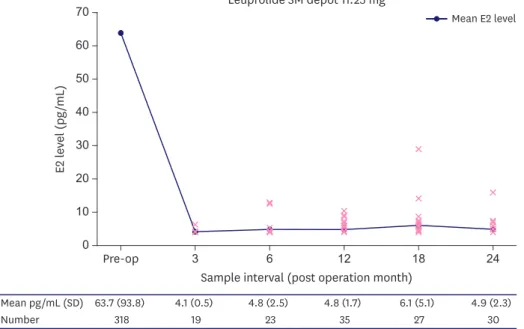
serum FSH level was 6.33 mIU/mL (0.13–55.8). The mean E2 level at the follow-up visit 3 months after surgery was 4.14 pg/mL (4–6.3), at 6 months was 4.84 pg/mL (4–12.9), and at 12 months was 4.79 pg/mL (4–10.4); the mean E2 level over the entire dosing period was 4.9 pg/

mL (4.0–28.9) (Figure 2). Kim at al. [9] who conducted their study in our center reported that the pretreatment E2 level of 317 patients who received monthly LHRHa was 88.7 ± 0.1 pg/mL and was maintained at < 30 pg/mL until the end of the LHRHa therapy. In the retrospective chart record, although some vaginal bleeding was recorded in 4 patients, it was judged to be not of menstrual origin based on the laboratory data and the trace amount of bleeding compared to that during the existing menstruation. Since no patients had E2 values above 30.0 pg/mL during the OFS, the serial analysis of E2 and FSH levels was not performed in this

No systemic treatment:

569 patients Systemic treatment:

5,312 patients Breast surgery: 5,881 patients

Only HT 2,861 patients

CTx +/− HT 2,451 patients

AI

877 patients 3M LHRHa + T

318 patients T +/− 1M LHRHa 1,666 patients 2017.6–2019.12

Figure 1. Summary of enrolled patients.

HT = hormonal therapy; CTx = chemotherapy; AI = aromatase inhibitors; 3M = 3-month; LHRHa = luteinizing hormone-releasing hormone analogs; T = tamoxifen; 1M = 1-month.

Sample interval (post operation month) Leuprolide 3M depot 11.25 mg

0

E2 le vel ( pg /mL )

20 50 70

18 12

6 3

30

10

Pre-op 24

Mean pg/mL (SD) Number

63.7 (93.8) 318

4.1 (0.5) 19

4.8 (2.5) 23

4.8 (1.7) 35

6.1 (5.1) 27

4.9 (2.3) 30 60

40

Mean E2 level

Figure 2. E2 level change before and after administration of LHRHa agonist (total).

E2 = estradiol; 3M = 3-month; SD = standard deviation; LHRHa = luteinizing hormone-releasing hormone analogs.

(5)

study. No serious side effects, such as discontinuation of OFS or change in treatment, were recorded during the observation period.

In premenopausal patients, the 8-year DFS and OS rates were better in the group with OFS added to T after CTx than in the T-only group [17]. Noh et al. [18] reported that ovarian function was monitored for 2 years after CTx termination, and that DFS was improved when OFS was added to T in patients determined to be premenopausal. According to the recently updated breast cancer guidelines, high-risk patients with premenopausal HR-positive breast cancers are recommended to receive OFS after adjuvant CTx [2-4]. LHRHa have lower side effects than surgical oophorectomy or ovarian irradiation and they enable the temporary suppression of the ovarian function [5,17]. de Haes et al. [8] concluded that in estrogen receptor-positive and node-positive early breast cancer, LHRHa showed an efficacy equivalent to CTx and resulted in a better quality of life, suggesting that it could replace CTx. In 2 retrospective studies that compared LHRHa and adriamycin/cyclophosphamide (AC) therapy, there was no difference in DFS between the 2 groups. Kim et al. [9] reported that LHRHa + T treatment could be an option for premenopausal women with endocrine- responsive, node-negative breast cancer. Sohn et al. [10] showed no difference in recurrence- free, cancer-specific, and overall survival rate after a median follow-up of 5 years. As a result, hormone therapy + LHRHa can replace CTx in certain patients with low tumor burden, such as node-negative tumors, despite the insufficiency of evidence. Schmid et al. [12] compared the 3-monthly depot LHRHa and CMF in pre- or perimenopausal patients with ER-positive and node-positive breast cancer. During the median follow-up period of 5.8 years, recurrence- free survival was similar in both groups, and overall survival was favorable in the OFS group.

Noguchi at al. [13] reported in their phase 3, open-label, multicenter trial that serum E2 level at 24 weeks from administration was not different in the 2 groups, which were treated with monthly (3.6 mg) and 3-monthly (10.8 mg) goserelin, and the DFS was similar. Masuda et al. [14] compared a 3.6-mg monthly goserelin dose with a 10.8-mg 3-monthly goserelin depot and showed that the safety and efficacy of the 3M formulation was not inferior to that of the 1-month formulation. According to their study, the frequency of showing an E2 level above 30 pg/mL was higher in the 1-month formulation group [14]. Sa-Nguanraksa et al. [11]

reported that there was no difference in disease-free survival and mortality when comparing 40 patients who received T and 10.8 mg goserelin at 3M intervals and 130 patients who were administered an AC regimen.

As OFS itself does not have a direct cytotoxic effect, the effectiveness of OFS should be evaluated by how well it suppresses the ovaries. To evaluate the effect of 3M LHRHa in this study, menstruation and E2 levels were measured during the treatment. Because of the retrospective nature of the study, the FSH level was not measured in most of the patients in this study. We are planning to conduct further studies on the change in FSH level in the following study. In this study, a small number of patients had E2 levels slightly higher than the average levels. In the SOFT study, ovarian function of 116 patients who received exemestane plus triptorelin was periodically checked, and E2 levels exceeded the threshold in 17% of patients [19]. In the present study, OFS and T were used in all the patients, and it is believed that T administration may affect E2 levels by increasing the plasma estrogen concentrations through interference with the normal pituitary negative feedback mechanism [20].

This study has several limitations. First, it was a single-institution, retrospective study.

Second, E2 level was measured during treatment in a small number of patients, because the

prescriptions vary depending on the physician, and the E2 level was not checked monthly

(6)

because of the outpatient visit schedule. Since the E2-level of all the tested patients was maintained at less than 30 pg/mL, further analysis on the change process of the E2-level was not performed in this study. The correlation between serial change of E2 level and patient characteristics (i.e., age, BMI) are expected to be analyzed in the follow-up study. Third, no systematic evaluation of patient side effects or satisfaction during treatment was performed.

In summary, analysis of ovarian function in premenopausal women with HR(+) breast cancer who were administered a 3M formulation of LHRHa with T showed that the ovarian function was successfully suppressed in all the patients and that no serious side effects occurred.

Given the improved patient convenience and long-term treatment compliance, long-acting LHRHa are considered a good treatment option.

REFERENCES

1. Kang SY, Kim YS, Kim Z, Kim HY, Lee SK, Jung KW, et al. Basic finding regarding breast cancer in Korea in 2015: data from a breast cancer registry. J Breast Cancer 2018;21:1-10.

PUBMED | CROSSREF

2. Burstein HJ, Lacchetti C, Anderson H, Buchholz TA, Davidson NE, Gelmon KA, et al. Adjuvant endocrine therapy for women with hormone receptor-positive breast cancer: ASCO clinical practice guideline focused update. J Clin Oncol 2019;37:423-38.

PUBMED | CROSSREF

3. Balic M, Thomssen C, Würstlein R, Gnant M, Harbeck N. Gallen/Vienna 2019: a brief summary of the consensus discussion on the optimal primary breast cancer treatment. Breast Care (Basel) 2019;14:103-10.

PUBMED | CROSSREF

4. Swarm RA, Anghelescu D, Benedetti C. NCCN Clinical Practice Guidelines in Oncology (NCCN Guidelines®). Adult Cancer Pain Version. Plymouth Meeting (PA): National Comprehensive Cancer Network; 2019.

5. Park WC. Role of ovarian function suppression in premenopausal women with early breast cancer. J Breast Cancer 2016;19:341-8.

PUBMED | CROSSREF

6. Prowell TM, Davidson NE. What is the role of ovarian ablation in the management of primary and metastatic breast cancer today? Oncologist 2004;9:507-17.

PUBMED | CROSSREF

7. Nystedt M, Berglund G, Bolund C, Fornander T, Rutqvist LE. Side effects of adjuvant endocrine treatment in premenopausal breast cancer patients: a prospective randomized study. J Clin Oncol 2003;21:1836-44.

PUBMED | CROSSREF

8. de Haes H, Olschewski M, Kaufmann M, Schumacher M, Jonat W, Sauerbrei W, et al. Quality of life in goserelin-treated versus cyclophosphamide + methotrexate + fluorouracil-treated premenopausal and perimenopausal patients with node-positive, early breast cancer: the Zoladex Early Breast Cancer Research Association Trialists Group. J Clin Oncol 2003;21:4510-6.

PUBMED | CROSSREF

9. Kim HJ, Lee JS, Park EH, Lim WS, Sei JY, Koh BS, et al. Short term results from GHRH analogue use in pre-menopausal breast cancer in Korea. Eur J Surg Oncol 2009;35:936-41.

PUBMED | CROSSREF

10. Sohn G, Ahn SH, Kim HJ, Son BH, Lee JW, Ko BS, et al. Survival outcome of combined GnRH agonist and tamoxifen is comparable to that of sequential adriamycin and cyclophosphamide chemotherapy plus tamoxifen in premenopausal patients with lymph-node-negative, hormone-responsive, HER2-negative, T1–T2 breast cancer. Cancer Res Treat 2016;48:1351-62.

PUBMED | CROSSREF

11. Sa-Nguanraksa D, Krisorakun T, Pongthong W, O-Charoenrat P. Survival outcome of combined GnRH agonist and tamoxifen is comparable to that of sequential adriamycin and cyclophosphamide chemotherapy plus tamoxifen in premenopausal patients with early breast cancer. Mol Clin Oncol 2019;11:517-22.

PUBMED | CROSSREF

(7)

12. Schmid P, Untch M, Kossé V, Bondar G, Vassiljev L, Tarutinov V, et al. Leuprorelin acetate every-3-months depot versus cyclophosphamide, methotrexate, and fluorouracil as adjuvant treatment in premenopausal patients with node-positive breast cancer: the TABLE study. J Clin Oncol 2007;25:2509-15.

PUBMED | CROSSREF

13. Noguchi S, Kim HJ, Jesena A, Parmar V, Sato N, Wang HC, et al. Phase 3, open-label, randomized study comparing 3-monthly with monthly goserelin in pre-menopausal women with estrogen receptor-positive advanced breast cancer. Breast Cancer 2016;23:771-9.

PUBMED | CROSSREF

14. Masuda N, Iwata H, Rai Y, Anan K, Takeuchi T, Kohno N, et al. Monthly versus 3-monthly goserelin acetate treatment in pre-menopausal patients with estrogen receptor-positive early breast cancer. Breast Cancer Res Treat 2011;126:443-51.

PUBMED | CROSSREF

15. Gracia CR, Sammel MD, Freeman EW, Lin H, Langan E, Kapoor S, et al. Defining menopause status:

creation of a new definition to identify the early changes of the menopausal transition. Menopause 2005;12:128-35.

PUBMED | CROSSREF

16. Gill S, Lavoie HB, Bo-Abbas Y, Hall JE. Negative feedback effects of gonadal steroids are preserved with aging in postmenopausal women. J Clin Endocrinol Metab 2002;87:2297-302.

PUBMED | CROSSREF

17. Francis PA, Pagani O, Fleming GF, Walley BA, Colleoni M, Láng I, et al. Tailoring adjuvant endocrine therapy for premenopausal breast cancer. N Engl J Med 2018;379:122-37.

PUBMED | CROSSREF

18. Noh WC, Lee JW, Nam SJ, Park S, Im SA, Lee ES, et al. Role of adding ovarian function suppression to tamoxifen in young women with hormone-sensitive breast cancer who remain premenopausal or resume menstruation after chemotherapy: the ASTRRA study. J Clin Oncol 2018;36:502.

19. Bellet M, Gray KP, Francis PA, Láng I, Ciruelos E, Lluch A, et al. Twelve-month estrogen levels in premenopausal women with hormone receptor-positive breast cancer receiving adjuvant triptorelin plus exemestane or tamoxifen in the Suppression of Ovarian Function Trial (SOFT): the SOFT-EST substudy. J Clin Oncol 2016;34:1584-93.

PUBMED | CROSSREF

20. Shapiro CL, Recht A. Side effects of adjuvant treatment of breast cancer. N Engl J Med 2001;344:1997-2008.

PUBMED | CROSSREF

수치

Figure 2. E2 level change before and after administration of LHRHa agonist (total).

참조

관련 문서