Dietary Intake and Accumulation of Phlorotannins in Abalone after Feeding the Phaeophyte Ecklonia stolonifera
Issa Bangoura
1,2and Yong-Ki Hong
1*
1Department of Biotechnology, Pukyong National University, Namku, Busan 608-737, Korea
2Aquaculture
Division, Ministry of Fisheries and Aquaculture, P. O. Box 307, Conakry, Guinea Republic Received April 6, 2015 /Revised June 10, 2015 /Accepted July 23, 2015
Dietary intake and bioavailability of phorotannins in abalone was investigated after feeding with the phlorotannin-rich brown seaweed Ecklonia stolonifera after 4 days starvation. Reverse-phase high-per- formance liquid chromatography (RP-HPLC) affords isolation and quantification of the major phlor- otannins of 7-phloroeckol and eckol, which were identified by mass spectrometry and nuclear mag- netic resonance. Abalone growth and feed consumption rates were similar when fed either with the E. stolonifera or the common feed seaweed Saccharina japonica for 20 days. Throughout the feeding peri- od, 7-phloroeckolol was accumulated in the abalone flesh tissue up to an average of 0.58±0.13 mg/g dry weight after 6 days. Eckol was reached to 0.25±0.05 mg/g dry tissue after 6 days, and maintained the level until end of feeding period. By feeding S. japonica as a control, no phlorotannins were de- tected in the abalone tissues. Both of the abalone, fed with E. stolonifera or S. japonica, had enzymes that decomposed 7-phloroeckol and eckol in muscle tissues, with similar degradation rates of –0.05 or less and –0.05 mg/ml/hr, respectively. Phlorotannins were reduced by constitutive enzymes in ab- alone tissues. Therefore, value-added abalone containing bioactive phlorotannins can be produced by simply changing the feed to the phlorotannin-rich brown seaweed E. stolonifera 6 days before harvest.
Key words :
Abalone, accumulation, Ecklonia stolonifera, phlorotannin
*Corresponding author
*Tel : +82-51-629-5862, Fax : +82-51-629-5863
*E-mail : [email protected]
This is an Open-Access article distributed under the terms of the Creative Commons Attribution Non-Commercial License (http://creativecommons.org/licenses/by-nc/3.0) which permits unrestricted non-commercial use, distribution, and reproduction in any medium, provided the original work is properly cited.
Journal of Life Science 2015 Vol. 25. No. 7. 780~785 DOI : http://dx.doi.org/10.5352/JLS.2015.25.7.780
Introduction
Abalone is an herbivorous gastropod feeding mostly on seaweed. It has long been consumed and is a highly valued seafood worldwide. In many countries, abalone is produced by aquaculture. The most important species with regard to aquaculture in Asia is Haliotis discus hannai [5]. Annual pro- duction levels in Korea in 2013 were estimated to be 7,479 t and 119 t by aquaculture and natural catch, respectively [11]. On-farm production of seaweeds constitutes a viable alternative source for continuous supply of high quality feed [18]. Currently, farmers use to feed their stock of abalone on the locally cultured brown seaweeds Saccharina japonica and Undaria pinnatifida. To render abalone a value-added product, one simple technique would be feeding valuable seaweed containing biologically active compounds. Thus, these substances are transferred to the abalone. In the pre-
vious research, bio-active phlorotannins were accumulated
in the flesh tissue of abalone by feeding of the Ecklonia cava
[1]. Phlorotannins, polymers of phloroglucinol found only
in brown seaweeds [14], are known as potent antioxidant
[8], anti-inflammatory [9], antidiabetic [13], and anti-
hypertensive [7] compounds. The Ecklonia stolonifera is also
known as a rich source of phlorotannins [6]. This seaweed
is common along coastal regions of the South Sea and south-
ern part of East Sea, Korea. It belongs to the family
Alariaceae and grows on rocks near and below low-tide
mark on rough open coasts. The lamina unifoliate is 0.3-1
m long and 5-30 cm broad [17]. Stipe, 15-25 cm long and
3-5 mm diameter cylindrical, is connected to stolon. The lam-
ina is annual, but the stolon is perennial. The seaweed has
bitter and tannin tastes and leathery in texture, thus people
prefer not to eat it directly. It is known that polyphenolic
substances also deter grazing by abalone [20]. Thus, we as-
sessed the dietary intake and bioavailability of phlorotannins
by feeding with the bitter-tasting seaweed after 4 days of
starvation. After feeding with the E. stolonifera, amounts of
7-phloroeckol and eckol in abalone tissues, relative growth
rates, phlorotannin distribution, and degradation patterns
were measured.
Materials and Methods
Seaweed materials
Feeding material of the brown seaweed Ecklonia stolonifera was collected from the coast of Youngdo (35
o08
’08
’’N, 129
o04
’16
’’E), Busan, Korea in 2013 and 2014. A voucher specimen was deposited in the author’s laboratory (Y.K.
Hong). Seaweed thalli were dried completely for 1 week at room temperature and then stored at 4℃ until feeding.
Commercial dry thalli of Saccharina japonica, commonly fed in abalone farms, were used as a reference feed.
Abalone
The aquacultured abalone Haliotis discus hannai with an initial wet weight of 52±6 g and shell length of 7±1 cm were purchased from the local fish market. They were kept in an aquarium tank (200 l), and acclimatized for 7 days with feed- ing on S. japonica. Flow-through seawater (3 l/min) was sup- plied to the tank, and adjusted to 20±1℃. Fecal matter was removed from the tank bottom by siphoning daily, and sea- water was renewed at the rate of 30% 1 hr before feeding.
Feeding trials
Abalone was starved for 4 days before feeding trials. The 6 abalone were kept in each plastic container (10 cm long, 8 cm wide, 5 cm high) with slits on all sides to allow water flow and protect egress of feed. Abalone was fed at a rate of 0.8 g seaweed per one abalone at 17:00 o’clock everyday during feeding trial. To measure the seaweed amount con- sumed, the thalli remaining after daily feeding were har- vested, dried and weighed. Thalli under identical conditions but in the absence of abalone were compared as a control for reasons other than abalone grazing. Feed consumption is expressed as: amount of provided thalli – amount of re- mained thalli after grazing. Relative growth rate (%) of ab- alone was calculated as: [(final weight – initial weight) / initial weight)] ×100.
Quantification of phlorotannins from E. stolonifera Phlorotannins were quantified from the seaweed powder according to Chowdhury et al. [3]. Briefly, one gram of pow- der was suspended in 100 ml of boiling distilled water, and stirred for 5 min to extract water-soluble compounds. For solvent extraction, 10 g of the E. stolonifera powder were shaken in a mixture of methanol (40 ml) and chloroform (80 ml), and then partitioned by adding 30 ml deionized
water. The upper layer was collected and extracted again with 30 ml ethyl ether. This crude phlorotannin residue was dissolved in methanol (1 mg/ml) and quantified by re- verse-phase high-performance liquid chromatography (RP- HPLC).
Quantification of phlorotannins from abalone To measure amounts of 7-phloroeckol and eckol from ab- alone, tissues detached from the shell were cleaned thor- oughly with distilled water to remove contaminants and oth- er mucilage, chopped into small pieces, and ground in paste for 5 min using a hand-held blender. The procedure was conducted on ice to reduce enzymatic degradation of phlorotannins. Phlorotannins were extracted from the tissue paste according to the method of Bangoura et al. [1]. Briefly, abalone paste (2.5 g) was shaken in methanol (10 ml) and chloroforms (40 ml), and then partitioned by adding de- ionized water (7.5 ml). The upper layer was collected, ex- tracted twice with ethyl ether (7.5 ml), and then dried under nitrogen stream. This crude phlorotannin was dissolved in methanol (300 μl) and quantified by RP-HPLC. The HPLC system included a Waters 486 Tunable Absorbance Detector (Waters Associate Inc., Milford, MA, USA) with a C18 col- umn (250×10 mm; Altech Associates Inc., Deerfield, IL, USA). Elution was performed at a flow rate of 1 ml/min using a linear gradient of 30 to 100% methanol for 40 min.
All compounds were isolated on the basis of retention time.
Identification of phlorotannins
Each substance was analyzed by
1H nuclear magnetic res- onance (NMR) spectroscopy using a JNM-ECP 400 NMR spectrometer (JEOL, Tokyo, Japan) with methanol-d (CD
3OD).
The GC-MS spectrum was analyzed using a GC-MS- QP5050A (Shimadzu, Kyoto, Japan). The chemical structure was verified by comparison with previously reported spec- tral data [9].
Enzymatic degradation of phlorotannins
For the preparation of crude enzyme from abalone tissues, abalone was fed with E. stolonifera or S. japonica for 20 days.
The muscle tissue (2.5 g) was ground in 3 ml distilled water,
and collected the supernatant enzyme after centrifugation
at 3,000 g for 15 min. Crude enzyme (400 μl) was reacted
with each pure phlorotannin at 30
oC for 4 hr, and measured
periodically the remained amount of each phlorotannin us-
ing RP-HPLC. Degradation rates (mg/ml/hr) were calcu-
Table 1. Phlorotannin distributions in abalone tissues after feeding E. stolonifera for 6 days
Foot muscle (mg/g tissue) Gut tissue (mg/g tissue) Gonad (mg/g tissue) Heart tissue (mg/g tissue) 7-Phloroeckol
Eckol
0.58±0.13 0.25±0.08
0 0
0.08±0.02 0
0 0
lated by measuring the slope of phlorotannin level according
to reaction time.
Statistical analysis
All data are presented as the mean ± SE of at least three independent replicates. Statistical comparisons of the mean values were performed by analysis of variance (ANOVA), followed by Duncan’s multiple test using the SPSS software (ver. 12.0). Mean values indicated by different letters are stat- istically significantly different (p<0.05).
Results
The feeding seaweed of E. stolonifera contains several phlorotannin substances. MS and
1H-NMR data of major substances revealed that some matched with known phlor- otannins and identified their chemical structures. Separation of the water extract (obtained by boiling for 5 min) from E. stolonifera detected major peaks of 7-phloroeckol and eckol by RP-HPLC at retention times of 20 min and 28 min, respectively. Separation of the solvent extract from E. stoloni- fera detected major peaks of dieckol and phlorofucofuroeck- ol-A at retention times of 32 min and 39 min, respectively.
For comparison of relative growth of abalone fed with phlor- otannin-rich E. stolonifera and common fodder S. japonica, each seaweed was fed for 20 days. During the 20-d feeding trial, the relative growth rates of abalone fed with E. stoloni- fera and S. japonica revealed almost similar (Fig. 1). After abalone adapted to the fodders after 4 days of starvation, their growth rates are reached to approximately 0.7% within 14 days. Thus, the E. stolonifera had no effect on feed prefer- ence or growth compared with the common feed seaweed of S. japonica. Total amounts of seaweed consumed by in- dividual abalone during the 20-day feeding period were 1.6±0.2 g for E. stolonifera and 2.4±0.2 g of S. japonica. Daily seaweed consumption of feed was similar, 11% and 15% for E. stolonifera and S. japonica provided, respectively.
During feeding E. stolonifera to abalone for 20 days, each abalone was removed periodically. The flesh tissue was ground, and the tissue paste (92% moisture) was used to extract phlorotannins. By RP-HPLC, the abalone extract
showed two major peaks of 7-phloroeckol and eckol at re- tention times of 20 min and 28 min, respectively. These sub- stances are water-soluble and were likely partitioned into the aqueous layer because the tissue paste per se had high moisture content. Thus, above phlorotannins were extracted from abalone using a solvent-water partition procedure.
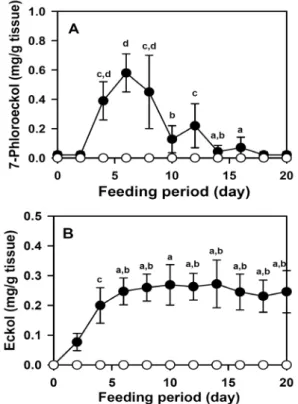
Quantification of the compound was calculated based on comparisons of RP-HPLC peak dimensions with those of standard curves. 7-Phloroeckol accumulated to a maximum of 0.58±0.13 mg/g dry weight of abalone tissue after 6 days.
The control S. japonica-fed abalone showed no accumulation of this substance (Fig. 2A). Eckol reached 0.25±0.05 mg/g dry tissue after 6 days, and accumulated maximum of 0.27±0.08 mg/g dry tissue after 10 days. This eckol level maintained until end of feeding period. Control S. japon- ica-fed abalone showed no accumulation of eckol (Fig. 2B).
To understand the distribution of phlorotannins in differ- ent tissues of abalone, all animals were sacrificed after feed- ing E. stolonifera (0.8 g/abalone/day) for 6 days, and each of the foot muscle, heart, gonad, and gut tissues was chop- ped and ground to paste on ice. Table 1 shows the amounts of phlorotannins accumulated in each tissue part. The edible foot muscle tissue contained the highest levels of 7-phlor- oeckol (0.58±0.13 mg/g dry tissue) and eckol (0.25±0.08 mg/g dry tissue), respectively.
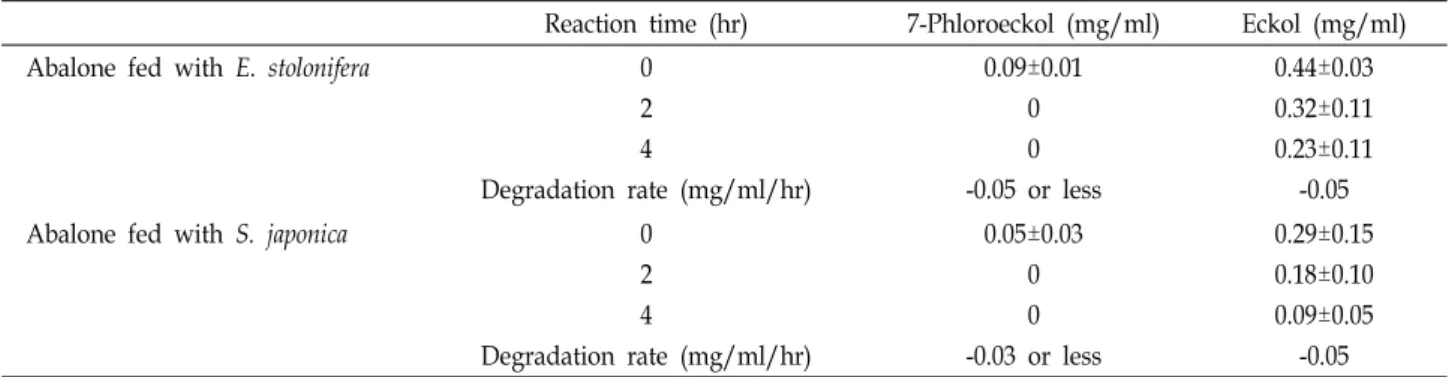
Levels of both phlorotannins in abalone muscle decreased to zero 5 days later after replacing their food with S. japonica or stopping E. stolonifera feeding. To confirm enzymatic deg- radation of phlorotannins in abalone tissues, aliquots of muscle paste from abalone fed for 20 days with E. stolonifera or S. japonica (control) were analyzed as enzyme source. Both of the abalone, fed with E. stolonifera or S. japonica, had en- zymes that decomposed 7-phloroeckol and eckol in tissues (Table 2). Abalone fed with E. stolonifera showed degradation rates of –0.05 or less and –0.05 mg/ml/hr in the 7-phlor- oeckol and eckol, respectively. Abalone fed with S. japonica showed degradation rates of –0.03 or less and –0.05 mg/
ml/hr in the 7-phloroeckol and eckol, respectively. S. japon-
ica contained no phlorotannins, but tissue of abalone fed
with this fodder could also degrade the phlorotannins. Thus,
it seems that the phlorotannin-decomposing enzymes in ab-
Table 2. Enzymatic degradation of phlorotannins by muscle tissues of abalone fed with E. stolonifera or S. japonica
Reaction time (hr) 7-Phloroeckol (mg/ml) Eckol (mg/ml)
Abalone fed with E. stolonifera 0
2 4
Degradation rate (mg/ml/hr)
0.09±0.01 0 0 -0.05 or less
0.44±0.03 0.32±0.11 0.23±0.11
-0.05
Abalone fed with S. japonica 0
2 4
Degradation rate (mg/ml/hr)
0.05±0.03 0 0 -0.03 or less
0.29±0.15 0.18±0.10 0.09±0.05
-0.05
Fig. 1. Relative growth rates of abalone after feeding with E.
stolonifera and S. japonica. Black circles, E. stolonifera feed- ing; white circles, S. japonica feeding as a reference.
Abalone was fed with 0.8 g seaweed daily. Relative growth rate (%) was calculated as [(final weight – initial weight) / initial weight] ×100. Values are means±SE.
Mean values with different letters are significantly dif- ferent based on Duncan’s multiple range test (p<0.05).
alone tissues are a kind of constitutive enzyme.
Discussion
Abalone is a valuable seafood source in many areas of the world where the species is abundant. The foot muscle of abalone is consumed raw or cooked in a variety of dishes, and the shell is used as a decorative item. To produce a value-added abalone with flesh containing biologically ac- tive substances, we changed the feed to the brown seaweed E. stolonifera for a short period before harvest. The E. stoloni- fera contains high levels of diverse phlorotannins [6], which have diverse biological activities, including anti-oxidative and anti-inflammatory properties [8, 9].
Usually, polyphenolic compounds from brown algae are considered to deter grazing by and growth of abalones [20].
Abalones prefer to eat phenolic-poor rather than -rich seaweeds. Humans consume E. stolonifera as a foodstuff after removal of bitter-tasting substances by blanching [10]. Thus, we starved the abalone for 4 days before providing them phenolic-rich E. stolonifera as the sole feed source. After adaptation, abalone consumed this seaweed readily.
Significant and similar body weight gain occurred after feed- ing with phlorotannin-rich E. stolonifera and phlorotannin- poor S. japonica (Fig. 1), indicating that phlorotannins may not affect weight gain, at least during the short 20-day feed- ing period. Kubanek et al. [12] also reported significant in- creases in the survival and growth of amphipods upon addi- tion of purified phlorotannins to their feeds. Accumulation of diet-derived substances by many herbivores has been reported. Abalone previously fed with the green seaweed Ulva lactuca accumulated more dimethylsulfoniopropionate than did wild-caught abalone or those that received artificial fodders [16]. The sea hare Aplysia dactylomela grazing on the red seaweed Centroceras clavulatum accumulated mycospor-
ine-like amino acids in the body tissues and spawn [2]. The sea hare grazing on the red seaweed Delisea pulchra accumu- lated halogenated furanone [4]. The accumulated furanones were lost at a mean rate of –0.92 mg/g dry weight per day from sea hare when fed with Ulva green seaweed [15].
Common dietary polyphenols undergo extensive degra- dation in the intestine and liver, facilitating their elimination from the body [19]. Abalone also lost phlorotannins at the same degradation rate of –0.05 mg/ml/hr whether fed with E. stolonifera or S. japonica. It suggests that these phlor- otannin-degradable enzymes are expressed constitutively.
In conclusion, the results indicate that E. stolonifera can be used as a fodder source, and that maximum phlorotannin accumulation in abalone flesh occurs after 6 days of feeding.
Moreover, our findings suggest the possibility of producing
value-added abalone containing high levels of phlorotannins
Fig. 2. Accumulation of 7-phloroeckol (A) and eckol (B) in ab- alone flesh after feeding with E. stolonifera. Black circles, E. stolonifera feeding; white circles, S. japonica feeding as a reference. Abalone was fed with 0.8 g of seaweed daily.
Phlorotannins accumulated in abalone were quantified by RP-HPLC and expressed as amounts per 1 g of dry flesh tissue. Values are means±SE. Mean values with dif- ferent letters are significantly different based on Duncan’s multiple range test (p<0.05).
by simply changing the fodder used.
References
1. Bangoura, I., Chowdhury, M. T. H., Kang, J. Y., Cho, J. Y., Jun, J. C. and Hong, Y. K. 2014. Accumulation of phlor- otannins in the abalone Haliotis discus hannai after feeding the brown seaweed Ecklonia cava. J. Appl. Phycol. 26, 967-972.
2. Carefoot, T. H., Karentz, D., Pennings, S. C. and Young, C. L. 2000. Distribution of mycosporine-like amino acids in the sea hare Aplysia dactylomela: effect of diet on amounts and types sequestered over time in tissues and spawn.
Comp. Biochem. Phys. C. 126, 91-104.
3. Chowdhury, M. T. H., Bangoura, I., Kang, J. Y., Park, N.
G., Ahn, D. H. and Hong, Y. K. 2011. Distribution of phlor- otannins in the brown alga Ecklonia cava and comparison of pretreatments for extraction. Fish. Aquat. Sci. 14, 198-204.
4. de Nys, R., Steinberg, P. D., Rogers, C. N., Charlton, T. S.
and Duncan, M. W. 1996. Quantitative variation of secon- dary metabolites in the sea hare Aplysia parvula and its host plant Delisea pulchra. Mar. Ecol. Prog. Ser. 130, 135-146.
5. FAO. 2009. The State of World Fisheries and Aquaculture 2008, pp. 1-176, Food and Agriculture Organization of the United Nations: Rome, Italy.
6. Hyun, R. G., Choi, J. S. and Na, D. H. 2010. Quantitative determination of major phlorotannins in Ecklonia stolonifera.
Arch. Pharm. Res. 33, 539-544.
7. Jung, H. A., Hyun, S. K., Kim, H. R. and Choi, J. S. 2006.
Angiostensins-converting enzyme I inhibitory activity of phlorotannins from Ecklonia stolonifera. Fish. Sci. 72, 1292- 1299.
8. Kang, H. S., Chung, H. Y., Kim, J. Y., Son, B. W., Jung, H.
A. and Choi, J. S. 2004. Inhibitory phlorotannins from the edible brown alga Ecklonia stolonifera on total reactive oxy- gen species (ROS) generation. Arch. Pharm. Res. 27, 194-198.
9. Kim, A. R., Shin, T. S., Lee, M. S., Park, J. Y., Park, K. E., Yoon, N. Y., Kim, J. S., Choi, J. S., Jang, B. C., Byun, D.
S., Park, N. K. and Kim, H. R. 2009. Isolation and identi- fication of phlorotannins from Ecklonia stolonifera with anti- oxidant and anti-inflammatory properties. J. Agric. Food.
Chem. 57, 3484-3489.
10. Kim, J. A. and Lee, J. M. 2004. The changes of biologically functional compounds and antioxidant activities in Ecklonia cava with blanching times. Kor. J. Food Cult. 19, 369-377.
11. Korean Fisheries Association. 2014. Korean Fisheries Yearbook, pp. 343-345, Uno Design Publishing Co.: Seoul, Korea.
12. Kubanek, J., Lester, S. E., Fenical, W. and Hay, M. E. 2004.
Ambiguous role of phlorotannins as chemical defenses in the brown alga Fucus vesiculosus. Mar. Ecol. Prog. Ser. 277, 79-93.
13. Okada, Y., Ishimaru, A., Suzuki, R. and Okuyama, T. A.
2004. New phloroglucinol derivative from the brown alga Eisenia bicyclis: potential for the effective treatment of dia- betic complications. J. Nat. Prod. 67, 103-105.
14. Ragan, M. A. and Glombitza, K. W. 1986. Phlorotannins, brown algal polyphenols. Prog. Phycol. Res. 4, 129-241.
15. Rogers, C. N., de Nys, R., Charlton, T. S. and Steinberg, P. D. 2000. Dynamics of algal secondary metabolites in two species of sea hare. J. Chem. Ecol. 26, 721-744.
16. Smith, A. J., Robertson-Andersson, D. V., Peall, S. and Bolton, J. J. 2007. Dimethylsulfoniopropionate (DMSP) accu- mulation in abalone Haliotis midae (Mollusca: Prosobranchia) after consumption of various diets, and consequences for aquaculture. Aquaculture 269, 377-389.
17. Tokuda, H., Kawashima, S., Ohno, M. and Ogawa, H. 1994.
Seaweeds of Japan, pp. 106-137, Midori Shobo Co., Ltd.:
Tokyo, Japan.
18. Troell, M., Robertson-Andersson, D., Anderson, R. J., Bolton, J. J., Maneveldt, G., Halling, C. and Probyn, T. 2006. Abalone farming in South Africa: an overview with perspectives on kelp resources, abalone feed, potential for on-farm seaweed production and socio-economic importance. Aquaculture 257, 266-281.
19. van Dorsten, F. A., Grün, C. H., van Velzen, E. J. J., Jacobs, D. M., Draijer, R. and van Duynhoven, J. P. M. 2010. The metabolic fate of red wine and grape juice polyphenols in humans assessed by metabolomics. Mol. Nutr. Food Res. 54,
초록:전복에서의 갈조류 곰피의 섭취 및 phlorotannin 축적
이싸 방구라
1,2․홍용기
1*
(1부경대학교 생물공학과, 2기니아 수산양식부 양식과)
전복을 4일간 굶긴 후 phlorotannin-고함유 곰피를 제공하여 이의 섭취 및 phlorotannin 축적정도를 조사하였 다. 전복의 성장속도는 곰피 혹은 일반 사료로 쓰이는 다시마를 20일간 투여한 경우 서로 비슷하였다. 주된 phlor- otannin 성분인 7-phloroeckol 및 eckol은 역상 HPLC로서 측정하였다. 7-phloroeckolol은 섭취 6일만에 전복 건조 육 1g당 0.58±0.13 mg 정도 축적되었다. Eckol은 6일만에 전복 건조 육 1g당 0.25±0.05 mg 정도 축적되었으며 실험기간 내 그 정도를 유지하였다. 대조군로서의 다시마 투여 전복은 phlorotannin을 전혀 함유하지 않았다.
Phlorotannin은 전복 조직내에서의 구성효소들에 의하여 분해되어 지는것으로 보인다. 그러므로 다양한 생리활성 을 지닌 phlorotannin 물질들을 가진 고부가 가치의 전복 생산은 전복수확 6일전부터 간단히 사료만 phlor- otannin-고함유 곰피로 바꾸어 공급함으로서 생산가능하다.
1-12.
20. Winter, F. C. and Estes, J. A. 1992. Experimental evidence for the effects of polyphenolic compounds from Dictyoneu-
rum californicum Ruprecht (Phaeophyta: Laminariales) on feeding rate and growth in the red abalone Haliotus rufescens Swainson. J. Exp. Mar. Biol. Ecol. 155, 263-277.