Anti-metastatic Effect of Garlic Hexane Extract on Lung Metastasis Induced by Melanoma B16F10 Cells in Mice
Min Jung Ko1, Seetharaman Rajasekar1, Ziyu Wang1, Mei Li1, Jung Ho Kwak2, Young Hoon Park1, Beung Gu Son1, Jum Soon Kang1 and Young Whan Choi1,3*
1College of Natural Resources and Life Science, Pusan National University, Miryang 627-706, Korea
2Vegetable Research Division, National Institute of Horticultural & Herbal Science, Rural Development Administration, Suwon 440-706, Korea
3Life and Industry Convergence Research Institute, Pusan National University, Miryang 627-706, Korea Received February 1, 2016 /Revised February 14, 2016 /Accepted February 19, 2016
Metastatic cancer is one of the main causes of cancer-related death since they rarely respond to avail- able treatments. There is epidemiologic evidence that high garlic consumption decreases the incidence of cancer. Recent studies of our laboratory have revealed that a garlic-extracts is effective in suppress- ing metastasis. For experimental metastasis, C57BL/6 mice were injected intravenously with melano- ma B16F10 cells in the tail vein, and were orally administered various concentrations (0, 50, 100 or 200 mg/kg body weight) of garlic hexane extract (GHE) for 21 days. The incidence and the area of the melanoma cell colony occupied by the poorly differentiated carcinoma were significantly lower in dose-dependent in 50, 100 and 200 mg/kg BW GHE–treated mice compared with control mice.
In conclusion, the results of the present study show that GHE administration prevents lung metastasis in C57BL/6 mice.
Key words : C57BL/6 mice, garlic hexane extract, melanoma B16F10, metastasis
*Corresponding author
*Tel : +82-55-350-5522, Fax : +82-55-350-5529
*E-mail : [email protected]
This is an Open-Access article distributed under the terms of the Creative Commons Attribution Non-Commercial License (http://creativecommons.org/licenses/by-nc/3.0) which permits unrestricted non-commercial use, distribution, and reproduction in any medium, provided the original work is properly cited.
Journal of Life Science 2016 Vol. 26. No. 2. 259~264 DOI : http://dx.doi.org/10.5352/JLS.2016.26.2.259
Introduction
Cancer metastasis consists of a complex cascade of events, which ultimately allow for tumor cell escape and seeding of ectopic environments [28]. Metastasis is a sequen- tial process in which tumor cells detach from the primary growth, invade through the surrounding host tissue into the circulation and subsequently disseminate to distant or- gans, where they arrest, extravasate and proliferate to form metastatic foci [1]. Melanoma is the most aggressive form of skin cancer with high metastatic potential and extra- ordinary resistance to cytotoxic agents [24, 26]. Despite re- cent advances, the results of chemotherapy for patients with metastatic melanoma remain inadequate because of the rela- tive drug resistance of metastatic cells.
Garlic (Allium sativum) has been used as a spice and an ingredient in folk medicine since ancient times [22, 25].
There have been many literature reports of epidemiological
studies indicating that a garlic-rich diet decreases risk of some cancers such as gastric, stomach, and colon in vitro [6, 29] and the growth of transitional cell carcinoma xeno- grafts [14, 19]. Recent studies in our team have revealed that a garlic-extracts or derived compounds are effective in suppressing metastasis [9, 16, 20], proliferation of cancer cells [8, 10, 21], sepsis [13] and inflammation [11, 12, 17].
Several individual compounds have been isolated from gar- lic and two major groups of compounds that show active anticancer effects have been identified [5, 8, 24]. One group is the lipid-soluble allyl sulfur compounds, and the other one is the water-soluble compounds [5, 24]. It is still unclear which compounds in garlic has positive role in the pre- vention of cancers.
Despite the abundant in vitro evidence for anti-cancer and anti-metastatic effect of garlic extract or its compounds is not well studied. In this study, we provide novel anti-meta- static activity from hexane fractions of dried garlic.
Materials and Methods
Animals
C57BL/6 female mice, 6-7 weeks old were purchased from Samtako (Osan-shi, Kyunggi-do, South Korea) and housed in polycarbonate cages under laboratory conditions - Note -
260 생명과학회지 2016, Vol. 26. No. 2
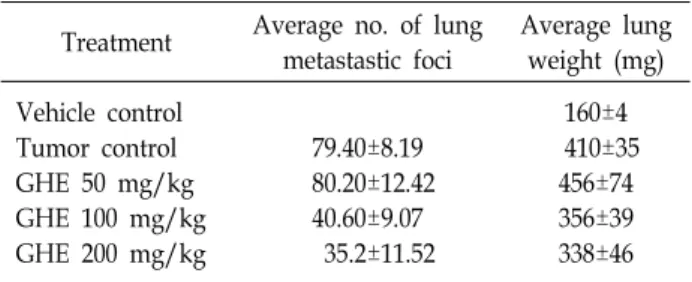
Table 1. Effect of GHE on lung metastasis induced in mice by B16F10 cells
Treatment Average no. of lung metastastic foci
Average lung weight (mg) Vehicle control
Tumor control GHE 50 mg/kg GHE 100 mg/kg GHE 200 mg/kg
79.40±8.19 80.20±12.42
40.60±9.07 35.2±11.52
160±4 410±35
456±74 356±39 338±46 B16F10 melanoma cells (1×10⁶ cells/mice) were injected to the lateral tail vein of mice. After GHE treatment for 10 alternative days animals were sacrifice and lung nodule were counted.
Values are mean ± standard error, n=10.
with a 12 hr day-night cycle, room temperature of 22±2℃
and humidity of 50-60%. They were fed standard pelleted rats chow and had free access to water during the experiment. The animal experiments were approved by the Pusan National University, Institutional Animal Care and Use Committee (PNU-2010-000102).
Tumor cell line
B16F10 cells were obtained from Korean Cell Line Bank in Seoul, South Korea, maintained in RPMI-1640 medium supplemented with 10% FBS, antibiotics (100 U/ml pen- icillin G, 100 μg/ml streptomycin), in an incubator at 37℃
with a humidified atmosphere at 5% CO2 concentration.
When needed for experiments the cells were harvested with trypsin:EDTA (0.05:0.03[w/v]) solution, and then washed in phosphate-buffered saline (PBS, pH 7.4). For the animal ex- periments, the recovered cells were adjusted to 1×10⁶ cells/ml in PBS and then 100 μl of the suspension was in- jected into the tail-vein.
Anti-metastasis study of GHE in B16F10 cell implanted C57BL/6 mice
GHE was suspended in olive oil to the desired concen- tration (50, 100, 200 mg/kg body weight/2 interval day).
For the studies, the GHE was administered orally (OA) starting on the day the B16F10 tumor cells were injected (1×10⁶cells in 0.1 ml) by tail vein and there after the GHE was given for 21 days by OA.
Experimental groups for metastasis
C57BL/6 mice were divided into 6 groups of 10 mice each to carry out the level of GHE present in lung tumor bearing mice model. B16F10 cell line was injected (1×10⁶ cells in 0.1 ml) by tail vein to groups III, IV, V and VI.
GHE was given for respective group at a dose of 50, 100 and 200 mg/kg/body weight/day for 21 days after cell line implantation.
Group I : Controls animal (Olive oil alone administrated orally for 10 alternative days).
Group II: Drug control (GHE-200 mg/Kg in olive oil ad- ministrated orally for 10 alternative days).
Group III: Tumor alone (Olive oil alone administrated orally for 10 alternative days).
Group IV: Tumor induced+GHE-50 mg/Kg in olive oil administrated orally for 10 alternative days.
Group V: Tumor induced+GHE-100 mg/Kg in olive oil
administrated orally for 10 alternative days.
Group VI: Tumor induced+GHE-200 mg/Kg in olive oil administrated orally for 10 alternative days.
Pulmonary colonization assay
For in vivo experimental pulmonary metastasis assays, mice were injected with 1×10⁶ B16F10 melanoma cells through the lateral tail vein. One day after tumor induction, GHE in olive oil at different concentrations were orally ad- ministrated for 10 alternative days. Whereas the tumor con- trol mice were treated with the vehicle olive oil. The animals were sacrificed after 21 days of tumor induction, lungs were excised and metastatic colonies in lung were counted.
Percentage of inhibition was calculated by the formula [(Control -Treated)/Control] ×100.
Statistical analysis
Results were provided as mean ± SE for each condition and statistically analyzed by the Student–Newman–Keuls test. p<0.05 was considered statistically significant.
Results
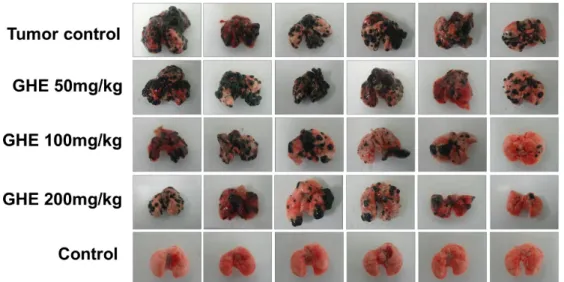
The effect of GHE on inhibition of lung cancer was as- sessed by counting the number of lung tumor colony formed in the respective groups as given in Table 1. The lungs of GHE-treated mice showed less number of tumor colonies (35.2±11.52) compared to those mice. Metastastic tumor bearing mouse treated with GHE showed significant reduction on tumor colony formation in a dose dependent manner (Fig. 1, Fig. 2). Untreated control animals developed a massive number of tumor colonies (97.4±30.2) in the lung.
Lung metastasis frequency was significantly reduced by
Fig. 1. Effect of GHE on B16F10 lung metastasis. Mice injected with B16F10 cells were orally administrated either with GHE at different concentration and olive oil. After treatment of 10 alternative days lung were excised and tumor colonies were counted.
Fig. 2. Effect of GHE on formation of metastatic foci in lung of mice injected with B16F10 cells. B16F10 melanoma cells (1×10⁶ cells/mice) were injected through the lateral tail vein of mice. After GHE treatment for 10 alternative days animals were sacrifice and lung nodule were counted. Values are mean ± standard deviation, n=10.
Comparisons between control and treatment groups were performed by Student-Newman-Keuls test. p val- ues **<0.01, *<0.05.
Fig. 3. Inhibitory effect of GHE on lung metastasis induced by B16F10 cells. Values are mean ± standard deviation, n=10. Comparisons between control and treatment groups were performed by Student-Newman-Keuls test. p values **<0.01, *<0.05.
6.93, 46.80 and 50.53% in mice treated with 50, 100 and 200 mg/kg of GHE, respectively (Fig. 3). In comparison with control, reduction of lung weight also noticed in mice treat- ed with GHE at dose-dependent manner (Table 1).
Metastasis remains to be the major cause of death in can- cer patients and it has critical importance in cancer therapy.
Some drugs used for metastasis therapy have low efficiency, low response rate and it also produce a number of side effects. In the present study we investigate the anti-meta- static effect of garlic hexane extract on lung metastasis in-
duced by B16F10 melanoma cell in experimental mice. GHE extracted from garlic showed that it could significantly abro- gate the metastatic formation of nodules in lung by dose-de- pendent manner (Fig. 1, Fig. 2). More than 100 mg/kg garlic extract exert maximum anti-metastatic effect with 56% (Fig.
3). Though GHE showed inhibition of metastasis, this study opens ups further investigation on mode of action behind this effect.
Discussion
Melanoma is the most aggressive form of skin cancer with high metastatic potential and extraordinary resistance to cytotoxic agents. Despite recent advances, the results of
262 생명과학회지 2016, Vol. 26. No. 2
chemotherapy for patients with metastatic melanoma re- main inadequate because of the relative drug resistance of metastatic cells. Metastasis is a sequential process in which tumor cells detach from the primary growth, invade through the surrounding host tissue into the circulation and subsequently disseminate to distant organs, where they ar- rest, extravasate and proliferate to form metastatic foci [1].
Metastasis covers 90% of causality of cancer patients’ death [4] indicating that anti-metastatic agents are required for efficient cancer therapy. Consequently, identification of nov- el agents that are nontoxic but can delay onset and/or pro- gression of cancer is highly desirable. Natural products have received increasing attention in recent years for the discov- ery of novel cancer preventive and therapeutic agents [15].
Many in vitro and animal studies have reported a relation between garlic intake supplementation and risk cancer pre- vention [18, 24]. Recent studies have provided evidence that sarcoma cell migration was inhibited by aged garlic extract [7] and different garlic extracts [9]. However, it is still am- biguous by which agents suppress metastasis of cancer cells from garlic extracts. In the present study, to screen the novel anti-metastasis compound from garlic, we prepared differ- ent extracts of garlic such as raw garlic and black garlic.
During this process, hexane extract provide novel activity which suppresses the migration of cancer cells [9] and the proliferation of cancer cells [9], and garlic constituent sulfur [16], various solvent extracts were highly effective in sup- pressing growth of cancer cells in intro [10].
Several other research studies stated the establishment of the experimental lung metastasis model or pulmonary metastatic model by intravenously injected mouse melano- ma B16F10 in C57BL/6 mice [3, 27]. The B16F10 mouse mel- anoma cell line was chosen on the basis of its high meta- static potential in this study. Specifically, the B16F10 line has been shown to metastasize to the lungs when injected into the lateral tail vein and the majority of cells find them- selves in the pulmonary tissue, but some are also localized in other organs [2] and is accepted as useful model for the study of lung metastasis [23]. We showed that the mice received B16F10 cells only implanted, the melanoma cells quite well and the lungs of these hosts were visibly riddled with metastatic tumor nodules within 21 days (Fig. 1). Using C57BL/6 model mouse, we demonstrated that GHE could inhibit the colony forming rate of melanoma cells in dose- dependent manners (Fig. 3). Moreover, GHE significantly inhibited the colony-forming ability of melanoma cells. In
conclusion, the results of the present study indicate that oral administration of GHE prevents development of mela- noma carcinoma and multiplicity of pulmonary metastatic lesions in C57BL/6 mice without causing weight loss.
Acknowledgement
This work was supported for two years by a Pusan National University Research Grant.
References
1. Bedrosian, I., Faries, M. B., Guerry, D. t., Elenitsas, R., Schuchter, L., Mick, R., Spitz, F. R., Bucky, L. P., Alavi, A., Elder, D. E., Fraker, D. L. and Czerniecki, B. J. 2000.
Incidence of sentinel node metastasis in patients with thin primary melanoma (< or = 1 mm) with vertical growth phase. Ann. Surg. Oncol. 7, 262-267.
2. Fidler, I. J. 1973. Selection of successive tumor lines for metastasis. Nature (London) 242, 148-149.
3. Gautam, A., Waldrep, J. C. and Densmore, C. L. 2000.
Inhibition of experimental lung metastasis by aerosol deliv- ery of PEI–p53 complexes. Mol. Ther. 2, 318-323.
4. Hanahan, D. and Weinberg, R. A. 2000. The hallmarks of cancer. Cell 100, 57-70.
5. Herman-Antosiewicz, A. and Singh, S. V. 2004. Signal trans- duction pathways leading to cell cycle arrest and apoptosis induction in cancer cells by Allium vegetable-derived orga- nosulfur compounds: a review. Mutat. Res. 555, 121-131.
6. Hsing, A. W., Chokkalingam, A. P., Gao, Y. T., Madigan, M. P., Deng, J., Gridley, G. and Fraumeni, J. F. Jr. 2002.
Allium vegetables and risk of prostate cancer: a population based study. J. Natl. Cancer Inst. 94, 1648-1651.
7. Hu, X., Cao, B. N., Hu, G., He, J., Yang, D. Q. and Wan, Y. S. 2002. Attenuation of cell migration and induction of cell death by aged garlic extract in rat sarcoma cells. Int.
J. Mol. Med. 9, 641-643.
8. Jeong, J. W., Park, S., Park, C., Chang, Y. C., Moon, D.
O., Kim, S. O., Kim, G. Y., Cha, H. J., Kim, H. S., Choi, Y. W., Kim, W. J., Yoo, Y. H. and Choi, Y. H. 2014. N-ben- zyl-N-methyldecan-1-amine, a phenylamine derivative iso- lated from garlic cloves, induces G2/M phase arrest and apoptosis in U937 human leukemia cells. Oncol. Rep. 32, 373-381.
9. Kim, E. K., Yun, S. J., Ha, J. M., Jin, I. H., Kim, Y. W., Kim, S. G., Park, D. J., Choi, Y. W., Yoon, S., Kim, C. D.
and Bae, S. S. 2011. Inhibition of cancer cell migration by compounds from garlic extracts. J. Life Sci. 21, 767-774.
10. Kim, H. J., Han, M. H., Kim, G. Y., Choi, Y. W. and Choi, Y. H. 2012. Hexane extracts of garlic cloves induce apopto- sis through the generation of reactive oxygen species in Hep3B human hepatocarcinoma cells. Oncol. Rep. 28, 1757-1763.
11. Kim, H. K., Choi, Y. W., Lee, E. N., Park, J. K., Kim, S.
G., Park, D. J., Kim, B. S., Lim, Y. T. and Yoon, S. 2011.
5-Hydroxymethyl furfural from black garlic extract pre- vents TNF-α-induced monocytic cell adhesion to HUVECs by suppression of vascular cell adhesion molecule-1 ex- pression, reactive oxygen species generation and NF-κB activation. Phytother. Res. 25, 965-974.
12. Kim, K. H., Park, J. K., Choi, Y. W., Kim, Y. H., Lee, E.
N., Lee, J. R., Kim, H. S., Baek, S. Y., Kim, B. S., Lee, K.
S. and Yoon, S. 2013. Hexane extract of aged black garlic reduces cell proliferation and attenuates the expression of ICAM-1 and VCAM-1 in TNF-α-activated human endo- metrial stromal cells. Int. J. Mol. Med. 32, 67-78.
13. Lee, S. K., Park, Y. J., Ko, M. J., Wang, Z., Lee, H. Y., Choi, Y. W. and Bae, Y. S. 2015. A novel natural compound from garlic (Alliums ativum L.) with therapeutic effects against experimental polymicrobial epsis. Biochem. Biophys.
Res. Commun. 464, 774-779.
14. Marsh, C. L., Torrey, R. R., Woolley, J. L., Barker, G. R.
and Lau, B. H. 1987. Superiority of intravesical im- munotherapy with Corynebacterium parvum and Allium sat- ivum in control of murine bladder cancer. J. Urol. 137, 359- 362.
15. Newman, D. J., Cragg, G. M. and Snader, K. M. 2003.
Natural products as sources of new drugs over the period 1981-2002. J. Nat. Prod. 66, 1022-1037.
16. Park, H. S., Kim, G. Y., Choi, I. W., Kim, N. D., Hwang, H. J., Choi, Y. W. and Choi, Y. H. 2011. Inhibition of matrix metalloproteinase activities and tightening of tight junctions by diallyldisulfide in AGS human gastric carcinoma cells.
J. Food Sci. 76, T105-T111.
17. Park, S. Y., Seetharaman, R., Ko, M. J., Kim, D. Y., Kim, T. H., Yoon, M. K., Kwak, J. H., Lee, S. J., Bae, Y. S. and Choi, Y. W. 2014. Ethyl linoleate from garlic attenuates lip- opolysaccharide-induced pro-inflammatory cytokine pro- duction by inducing heme oxygenase-1 in RAW264.7 cells.
Int. Immunopharmacol. 9, 253-261.
18. Qingjun, C., Ling, M. T., Feng, H., Cheung, H. W., Tsao, S. W., Wang, X. and Wong, Y. C. 2006. A novel anticancer effect of garlic derivatives: inhibition of cancer cell invasion through restoration of E-cadherin expression. Carcinogenesis 27, 2180-2189.
19. Riggs, D. R., DeHaven, J. I. and Lamm, D. L. 1997. Allium sativum (garlic) treatment for murine transitional cell carcinoma. Cancer 79, 1987-1994.
20. Shin, D. Y., Kim, G. Y., Kim, J. I., Yoon, M. K., Kwon, T. K., Lee, S. J., Choi, Y. W., Kang, H. S., Yoo, Y. H. and Choi, Y. H. 2010. Anti-invasive activity of diallyldisulfide through tightening of tight junctions and inhibition of ma- trix metalloproteinase activities in LNCaP prostate cancer cells. Toxicol. In Vitro 24, 1569-1576.
21. Shin, D. Y., Yoon, M. K., Choi, Y. W., Gweon, O. C., Kim, J. I., Choi T. H. and Choi, Y. H. 2010. Effects of aged black garlic extracts on the tight junction permeability and cell invasion in human gastric cancer cells. J. Life Sci. 20, 528- 534.
22. Tannock, I. F., de Wit, R., Berry, W. R., Horti, J., Pluzanska, A., Chi, K. N., Oudard, S., Théodore, C., James, N. D., Turesson, I., Rosenthal, M. A. and Eisenberger, M. A. 2004.
Docetaxel plus prednisone or mitoxantrone plus prednisone for advanced prostate cancer. N. Engl. J. Med. 351, 1502- 1512.
23. Teng, M. W., von Scheidt, B., Duret, H., Towne, J. E. and Smyth, M. J. 2011. Anti-IL-23 monoclonal antibody syner- gizes in combination with targeted therapies or IL-2 to sup- press tumor growth and metastases. Cancer Res. 71, 2077- 2086.
24. Thomson, M. and Ali, M. 2003. Garlic (Allium sativum): a review of its potential use as an anti-cancer agent. Curr.
Cancer Drug Targets 3, 67-81.
25. Virginia, L. 2006. The analysis of onion and garlic. J.
Chroma. A 1112, 3-22.
26. William, E. D. Jr., Rosenbaum, L. E. and Bosenberg, M.
2011. Decoding melanoma metastasis. Cancers 3, 126-163.
27. Yao, Z., Che, X. C., Lu, R., Zheng, M. N., Zhu, Z. F., Li, J. P., Jian, X., Shi, L. X., Liu, J. Y. and Gao, W. Y. 2007.
Inhibition by tyroserleutide (YSL) on the invasion and ad- hesion of the mouse melanoma cell. Mol. Med. 13, 14-21.
28. Yoon, S. O., Kim, M. M. and Chung, A. S. 2001. Inhibitory effect of selenite on invasion of HT1080 tumor cells. J. Biol.
Chem. 276, 20085-20092.
29. Yun, H. M., Ban, J. O., Park, K. R., Lee, C. K., Jeong, H.
S., Han, S. B. and Hong, J. T. 2014. Potential therapeutic effects of functionally active compounds isolated from garlic. Pharmacol. Ther. 142, 183-195.
264 생명과학회지 2016, Vol. 26. No. 2
초록:Melanoma B16F10 cell에 의해서 유도된 mouse모델에서 마늘 헥산 추출물의 암전이에 억제 효과
고민정1․라자세커 시타르만1․왕자옥1․이 매1․곽정호2․박영훈1․손병구1․강점순1․최영환1,3*
(1부산대학교 원예생명과학과, 2국립원예특작과학원 채소과, 3부산대학교 생명산업융합연구원)
암전이는 현재까지 적당한 치료제가 거의 없었기 때문에 암에 의한 사망의 주요한 원인 중의 하나로 인식되고 있다. 최근 본 연구팀은 마늘 추출물과 순수분리한 성분에 대한 암전이 억제 시험 결과 마늘의 추출물 또는 성분 이 암전이를 억제시켰으며, 역학조사에서도 마늘을 많이 섭취한 사람은 암의 발생을 억제시키는 것으로 보고되어 있다, 본 연구의 암전이 실험에서는 C57BL/6 mouse의 꼬리 정맥에 melanoma B16F10세포를 주사하여 폐에 전이 를 유도하였다. 암세포 주사 1일 후에 마늘의 헥산 추출물 50, 100 및 200 mg/kg body weight를 2일 간격으로 21일 동안 구강투여 한 다음 암전이 억제효과를 조사하였다. GHE를 처리하지 않은 대조구에서는 폐에서 암 col- ony가 97.4±30.2으로 대량 생성되었다. GHE를 50, 100 및 200 mg/kg의 농도로 경구투여시에 암전이 빈도는 각각 6.93, 46.80 및 50.53% 억제하였다. 또한 100 mg/kg body weight 경구투여 시에는 폐로 암전이 억제율이 약 53%
이상으로 매우 높았다. 폐에서 melanoma cell colony의 발생율과 면적은 마늘 헥산 추출물의 농도가 높을수록 감소하였다. 결론적으로 C57BL/6 mice의 암전이 모델에서 마늘 헥산추출물의 구강투여는 폐에 암전이를 억제시 켰으나, 향후 그 기작에 대한 연구가 수행되어야 할 것으로 생각된다.