Solvent Tolerant Bacteria and Their Potential Use
Woo Hong Joo*
Department of Biology and Chemistry, Changwon National University, Changwon 51140, Korea Received December 8, 2015 /Revised December 24, 2015 /Accepted December 24, 2015
Many organic solvent-tolerant bacteria have been isolated from all environments such as soil, waste- water, even deep sea after first isolation report of organic solvent-tolerant bacterium. Most organic sol- vent-tolerant isolates have been determined to be Gram-negative bacteria, because Gram-negative bac- teria have inherent tolerance property toward hostile organic solvents more than Gram-positive bacteria. The mechanisms of organic solvent tolerance have been elucidated extensively using mainly organic solvent-tolerant Gram-negative bacteria. The solvent-tolerance mechanisms in Gram-positive bacteria can be found in comparatively recent research. Organic solvents exhibited different toxicity depending on the solvent, and the tolerance levels of organic solvent-tolerant bacteria toward organic solvents were also highly changeable among species and strains. Therefore, organic solvent-tolerant bacteria could coped with solvent toxicity and adapted to solvent stress through the multifactorial and multigenic adaptative strategies. They could be survived even in the hyper concentrations of organic solvents by mechanisms which include: changes in cell morphology and cell behaviour, cell surface modifications, cell membrane adaptations, solvent excretion pumps, chaperones and anti-oxidative response. The aim of this work is to review the representative solvent tolerant bacteria and the adap- tative and tolerance strategies toward organic solvents in organic solvent-tolerant bacteria, and their potential industrial and environmental impact.
Key words : Biocatalysis, biodegradation, solvent-tolerance, solvent-tolerant bacteria
*Corresponding author
*Tel : +82-55-213-3453, Fax : +82-55-213-3459
*E-mail : [email protected]
This is an Open-Access article distributed under the terms of the Creative Commons Attribution Non-Commercial License (http://creativecommons.org/licenses/by-nc/3.0) which permits unrestricted non-commercial use, distribution, and reproduction in any medium, provided the original work is properly cited.
Journal of Life Science 2015 Vol. 25. No. 12. 1458~1469 DOI : http://dx.doi.org/10.5352/JLS.2015.25.12.1458
서 론
극한생물들(extremophiles)은 현재 다소 이용도가 낮은 생 물자원으로 주로 미생물에 국한되어 있으며, 많은 연구자가 다양한 분야에 적용하여 활용하고자 활발히 탐색하고 있다.
많은 미생물이 극한적인 환경에서 내성을 가질 수는 있으나 (그 예로 Staphylococcus aureus가 10% NaCl의 극한 조건에서 도 견딜 수 있는 것을 볼 수 있다), 극한적인 환경이 최적생장 조건인 미생물은 소수에 지나지 않으며 이들을 극한미생물이 라 정의하고 있다. 비교적 최근에는 진핵생물의 단세포 조류 가 호염성과 호산성 환경에서 생육가능함이 확인되었고, 흑색 효모들이 극호염성과 호산성 환경에서 발견[29]됨에 따라 극 한생물의 범위가 확대되고 있는 추세이다. 극한생물로 호산성 생물(acidophile, 최적 pH가 3-4 이하인 생물), 빈영양생물 (oligotroph, 영양이 부족한 환경에서 생육가능한 생물), 저온 성 생물(10℃ 이하에서 최적 생육하나 20℃가 최고 온도인 생 물), 건생생물(xerophile, 극도의 건조에 강한 내성을 보이는
생물), 호알칼리성 생물(alkaliphile, pH 10 이상에서 최적 생 육을 하는 생물), 호염성 생물(halophile, 생육에 최소한 1M 염을 필요로 하는 생물) 및 고온성 생물(thermophile, 60℃에 서 85 ℃의 온도에서 생육가능한 생물)들이 잘 알려져 있으며 [29], 1965년 Thomas Brock이 미국 yellowstone 국립공원에서 Thermus aquaticus를 분리 보고한 이후 보다 다양한 극한생물 들이 관심속에서 탐색 보고되고 있다. 이들은 생명이 존재할 수 없다고 추정되어 왔던 바위 속, 80℃ 이상의 온도, 추운 사막의 바위 속, 고농도의 중금속 존재 하, 40 MPa 이상의 고압, 고준위의 이온화 방사선, 그리고 고농도의 유기용매 등 가혹한 조건에서도 생존 및 증식이 가능함이 확인되어 각각 암석생물(endolith), 초고온생물(hyperthermophile), hypo- lith, 중금속 내성생물(metaloterant organism), 호압생물 (piezophile 또는 barophile), 방사능 내성생물(radioresistant organism), 내독성생물(toxitolerant organism) 등으로 정리되 어 불리워지고 있다[29].
이들 극한생물은 비교적 새로운 생물로서 새로운 자원의 보고로 많은 연구진이 이들을 대상으로 연구를 진행하여 왔 다. 본 총설에서는 극한생물 중에서 유기용매 내성 세균에 초 점을 맞추어 고찰하고자 한다.
본 론
유기용매 내성 세균
유기용매 내성 세균은 1989년 Inoue 등에 의하여 처음 분리 - Review -
Table 1. Representative organic solvent-tolerant bacteria
Strain Organic solvent tolerance Tolerance limit
(log P value) References P. putida IH-2000
P. putida S12 P. putida Idaho P. putida DOT-T1 P. aeruginosa PST-01 Bacillus sphaericus 205y P. aeruginosa K Rhodococcus opacus B-4 Staphylococcus sp. ZZ1 P. putida BCNU171 Burkholderia multivorans V2
Bacillus sp. BCNU 5005 Bacillus sp. BCNU 5006 P. putida BCNU106 P. putida BCNU154
Cyclohexane, xylene, toluene, heptanol Xylene, toluene, heptanol, dimethyl phthalate Xylene, toluene
90% toluene
Cyclohexane, xylene, 1-octanol Xylene, ethylbenzene, toluene, benzene Toluene, benzene
Cyclohexane, xylene, toluene, benzene Xylene, toluene, phenol
Xylene, ethylbenzene, toluene
Toluene, benzene, ethyl acetate, dimethyl fluoride, dimethyl sulfoxide
Xylene, ethylbenzene, toluene Cyclohexane, xylene, toluene, benzene
Xylene, ethylbenzene, toluene, benzene, chloroform Xylene, ethylbenzene, toluene, benzene, chloroform
2.4 2.3 2.5 2.5 2.9 2.0 2.0 2.0 1.5 2.5 -1.3
2.5 2.0 2.0 2.0
[31]
[25, 86]
[14]
[63]
[55]
[30]
[24]
[49]
[94]
[7]
[15]
[8]
[9]
[11]
[10]
보고되어 새로운 극한생물로 주목을 받고 있다[31]. 분리 균주 인 Pseudomonas putida IH-2000는 고농도의 유기용매 즉 cyclo- hexane, xylene, toluene 나아가 heptanol의 존재 하에서도 생 존가능함이 알려졌다. 이후 다수의 연구자들에 의하여 유기용 매 내성세균을 분리하는 시도가 지속적으로 이루어져 다수의 유기용매 내성세균이 분리되고 있다. 이들 연구에 의하여 주 로 그람음성 세균에서 유기용매 내성 세균이 다수 분리되고 있으며, 대표적인 유기용매 내성세균인 P. putida Idaho 균주 가 다양한 유기용매에 내성을 보임이 보고되었으며[14], P. pu- tida S12도 xylene, toluene, heptanol 및 dimethyl phthalate에 대하여 내성이 있는 것으로 보고되었다[25, 86]. 그리고 연구에 가장 많이 이용되고 있는 P. putida DOT-T10가 Ramos등에 의하여 보고되었다[63].
그람양성 세균에서의 유기용매 내성세균의 분리 탐색에 시 간이 다소 소요된 것은 그람양성 세균이 그람음성 세균에 비 하여 항생제에 대한 감수성이 높은 것 처럼 유기용매의 독성 에 대하여도 내성한계가 약한 특성에서 기인한다. 그람양성 유기용매 내성세균은 Hun 등에 의하여 보고된 Bacillus sphaer- icus 205y [30]와, Na 등에 의하여 Rhodococcus opacus B-4가 분리되었다[49]. 이들 그람양성 유기용매 내성세균들은 그람 음성 유기용매 내성세균 등에 비하여 생리적 및 형태적인 특 성상 유기용매에 대한 내성한계와 농도가 낮으며 수적으로도 분리되어 보고되는 확률이 낮다.
이들 유기용매 내성세균(그람음성 유기용매 내성세균 뿐만 아니라 그람양성 유기용매 내성세균도)은 대부분의 유기용매 에서 생존 및 증식이 가능하므로 생명의 한계를 뛰어넘는 생 물로서 다양한 생물공학적인 활용이 가능할 것으로 기대되고 있다. Table 1에 대표적인 유기용매 내성세균 및 그들의 유기 용매 내성 범위와 한계가 정리되어 있다. 우리나라에서는 유
기용매 내성세균이 2008년 처음 분리되어 P. putida BCNU171 로 동정 명명되었고[7], 2013년에 P. putida BCNU154 그리고 P. putida BCNU106도 연이어 보고되었다[10, 11]. 한편 그람양 성 세균으로 Bacillus sp. BCNU 5005와 Bacillus sp. BCNU 5006도 보고되었다[8, 9]. 이들 국내 토착 유기용매 내성세균 중 P. putida BCNU171는 거의 포화상태의 유기용매 즉 cyclo- hexane 9 M, xylene 8 M, toluene 9 M, benzene 0.02 M, chloroform 0.04 M 그리고 phenol 0.008 M 에서도 생존 가능 하다고 보고되고 있으며[7], P. putida BCNU106 는 cyclo- hexane 8.41 M, xylene 7.06 M, toluene 8.07 M, benzene 0.02 M, chloroform 0.04 M 그리고 phenol 0.01 M에서도 생존가능 한 것으로 보고되고 있다[11]. 이들 균주들은 보고된 유기용매 내성세균 중에서 유기용매에 대하여 내성한계가 가장 높은 균주임이 밝혀져 있다.
한편 유기용매 내성 세균은 유기용매 내성 효소를 연구하는 연구진들에 의하여도 보고되고 있다. 예를 들면 Ogino 등에 의하여 분리 보고된 P. aeruginosa PST-01 균주는 유기용매 내 성 단백질 분해효소를 찾는 과정에서 분리된 균주로 cyclo- hexane, xylene 및 1-octanol에 대하여 내성을 보이는 것으로 확인되었다[55]. 유기용매 내성 효소를 생산하는 일반 세균들 과 진균류들에 대한 보고가 다수 있으나 이들의 유기용매 내 성 유무는 모두 조사되어 있지 않으므로 이들 균주들 중에는 유기용매 내성을 나타내는 균주도 다수 포함되어 있을 것으로 생각되며, 또한 각종 환경인자에 대하여 강한 내성을 보이는 archaea, 고온성 세균 그리고 호염성 세균 등도 일부 유기용매 에 대하여 교차 내성을 보일 것으로 추정된다. 그러므로 고농 도와 고독성 유기용매에서 생존가능한 균주에 국한하여 유기 용매 내성 미생물이라 정리함이 타당하다.
유기용매 내성 세균의 유기용매 내성 기전
대표적인 유기용매로 사용되는 hexane은 alkane화합물로 서 지방족 화합물이며, benzene, toluene, ethylbenzene 및 xy- lene 등은 방향족 화합물로서 이들은 모두 탄화수소(hydro- carbons)에 속한다. 이들 탄화수소들은 저농도에서도 생물독 성이 심한 화학물질로 난분해성 물질들이며, 또한 자연에 존 재하는 terpene화합물들도 탄화수소로서 세균의 증식을 저해 하고 있다[75]. 이들 물질들은 자연에 다양하게 존재하며 공업 화 도시화에 따라 가정 및 공업적으로 다양하게 사용됨으로써 그 독성이 문제시되고 있다. 이들 화합물들의 독성에 대하여 는 Sikkema 등의 총설에 잘 고찰되고 있는 것과 같이 주로 세포막에 작용하여 독성을 나타냄으로써 세포막의 구조와 기 능을 마비시키며 세포막에 함몰되어 있는 단백질에도 영향을 미치는 것으로 알려져 있다[75]. 그러나 유기용매는 적은 농도 로도 세포의 모든 부분의 구조와 기능에 영향을 미치는 독성 물질이며 세포 수준에서 전반적인 영향을 미치므로 세포들은 전세포적으로 변화와 적응을 통하여 생존을 기하고 있다.
일반 세균과 세포들도 적은 농도의 유기용매에 대하여는 적응을 통하여 생존 가능할 수 있으며 이들 미생물의 유기용 매에의 적응기구는 Weber 등의 논문에서 잘 언급되고 있다 [87]. 1989년 이후 유기용매 내성 세균이 분리 보고됨으로써 유기용매에 대한 적응과 내성기전이 보다 명확하게 연구되고 있다. 유기용매 내성세균은 고농도의 유기용매에서도 생존가 능하므로 이들을 이용하여 보다 자세한 유기용매에 대한 적응 과 내성기전을 밝히는 연구가 진행되고 있다[65, 66, 70, 72, 74, 79]. 유기용매 내성 세균의 유기용매에 대한 전반적인 적응 및 내성 기전은 Table 2에 정리되어 있는 것 같이 모든 동원 가능한 다양한 메커니즘이 이용되고 있다.
첫째로 유기용매 내성 세균들 중 다수의 세균은 세포밖에서 유기용매를 분해하거나 독성이 약한 물질로 변환시킨다. 대표 적인 유기용매 내성 그람음성 세균인 P. putida DOT-T1E와 P. putida S12는 이런 방법을 통하여 세포밖 환경을 생존할 수 있는 환경으로 변화시킨다[25, 63, 86]. 국내 토착 유기용매 내성 그람음성 세균인 P. putida BCNU106 균주 및 P. putida BCNU171 균주는 benzene, toluene, ethylbenzene 및 xylene 을 분해할 뿐만 아니라 m- 와 p-xylene 보다 분해 중간물질의 독성이 강한 o-xylene도 분해하며, 특히 P. putida BCNU106균 주는 염소화 화합물들을 비롯한 다양한 난분해성 물질도 적극 적으로 분해하여 외부 환경의 독성 물질을 최소화함으로써 세포를 생존하게 한다[7, 11]. 유기용매 내성 그람양성 세균들 중에서도 Rhodococcus sp. 33, Exiguobacterium sp., Bacillus sp.
및 Rhodococcus sp. 들이 benzene, toluene 및 xylene을 비롯한 유기용매들을 분해함이 밝혀져 있으며[56, 83], 또한 유기용매 내성 고온성 세균인 B. pallidus ST3는 고농도 2-propanol을 세포외에서 분해함으로써 이들 환경에서 생존한다[6]. 한편 P.
aeruginosa PST-01 등 그람음성 유기용매 내성 세균과 B. li-
cheniformis S-86 등 그람양성 유기용매 내성 세균들은 효소를 세포외로 분비하여 독성물질을 독성이 약한 각종 아세테이트 에스테르로 전환하여 이용함으로써 이들 물질의 독성을 회피 한다[55, 77]. 많은 유기용매 내성 세균들이 리파아제, 에스테 라아제 등을 분비하여 독성물질의 변환과정을 통하여 유기용 매 등의 독성을 약독화하는 것으로 추정된다.
두번째 내성 메커니즘으로 유기용매가 세포에 대한 독성을 나타냄에 따라 유기용매 내성 세균들은 세포의 형태나 행동양 식을 수정하여 이에 대응하며 내성을 나타내고 있다. 먼저 유 기용매를 분해하는 유기용매 내성 세균 P. putida DOT-T1E은 보다 적극적으로 이를 인지하여 화학주성을 나타낸다. 이 균 주는 toluene에 노출되면 과도한 화학주성을 나타내어 이를 적극적으로 분해함으로써 고농도의 toluene에서도 생존한다 [44]. 또한 유기용매 내성 그람음성 세균만이 아니라 그람양성 세균도 세포 표면적을 줄임으로써 독성물질에 대한 노출을 최소화하여 독성물질에서 생존한다고 알려져 있다. 유기용매 내성 세균인 P. putida P8은 phenol 및 4-chlorophenol 존재시 세포형태와 크기를 변화시키며 물질의 독성효과에 준하여 세 포직경이 커진다고 보고되어 있으며[51], 알칸 분해균주인 Enterobacter sp. VKGH12 균주도 n-butanol 농도가 높아지면 세포의 크기도 증가함이 관찰되었다[52]. 그리고 그람양성 유 기용매 내성세균인 B. licheniformis S-86에서도 3-methyl- butan-1-ol의 존재하에서 세포가 긴 다세포 사상형으로 변화 됨이 관찰되어 세포체 용량에 대한 세포 표면적을 감소시켜서 전체 표면적을 줄이는 기전에 의하여 용매 등 독성물질의 위 해로부터 자신을 보호[77]한다는 내성기작을 뒷받침하고 있 다. 그러나 유기용매 등 독성물질에 완전히 적응된 세균은 오 히려 세포 크기가 작아지며, 세포체 용량에 대한 세포 표면적 을 증가시켜서 이들 물질을 흡수하고 변환을 보다 원활히 함 이 Enterobacter sp. VKGH12에서 관찰되었다[81].
한편 유기용매 등 독성물질에 미생물이 노출되면 세포외 다당체인 캡슐을 보다 더 생성하여 자신을 보호한다. 이런 현 상은 대장균과 같은 그람음성 세균에서 관찰되는 현상이나 이에 대한 확실한 보고는 없다. 그러나 대장균 BW25113의 lon 유전자 결손변이주가 캡슐 다당체를 보다 더 생성하여 유기용 매에 대하여도 내성을 나타낸다는 보고가 이러한 현상을 시사 해주고 있다[85]. 그람양성 유기용매 내성 세균인Rhodococcus sp. 33에서 세포외 다당체가 유기용매 즉 benzene에서의 생존 에 기여함이 밝혀져 있고[2], 유기용매 내성세균인 Staphylococcus sp. ZZ1에서도 이러한 현상이 관찰되었다[94].
또한 유기용매 존재시 표현형질에서의 적응, 특히 콜로니 색 깔의 변화를 보임으로써 유기용매에 대한 적응 또는 내성을 나타내고 있다. R. erythropolis DCL14는 10% 에탄올에서는 정 상적인 핑크색을 나타내나 30-50% 에탄올 존재시는 노란색의 점액질의 콜로니로 변한다[16].
셋째로 유기용매 내성 기전은 세포표층 변화를 통하여 이루
Table 2. Organic solvent tolerance mechanisms in organic solvent tolerant bacteria OS, Organic solvent
OS-tolerance mechanism Microorganism (OS) References
Extracellular fuctions Transformation of solvents
Esterefication
Pseudomonas putida DOT-T1E (toluene), P. putida S12 (xylene, toluene, heptanol, dimethyl phthalate)
P. putida BCNU106 (xylene, ethylbenzene, toluene) Rhodococcus sp 33.(benzene, toluene, xylene)
Exiguobacterium sp., Bacillus sp., Rhodococcus sp. (benzene, toluene, xylene)
B. pallidus ST3 (2-propanol)
P. aeruginosa PST-01 (cyclohexane, xylene, 1-octanol), B. licheniformis S-86 (3-methylbutan-1-ol)
[25, 63, 86]
[11]
[56]
[83]
[6]
[55]
[77]
Changes in cell morphology and cell behaviour Hyperchemotaxis
Decrease in cell surface-to-volume ratio
Increase or production in extracellular capsule
Phenotypic adaptation: change in colonies’ color
P. putida DOT-T1E (toluene)
P. putida P8 (phenol, 4-chlorophenol, 2,4-dichlorophenol) B. licheniformis S-86 (3-methylbutan-1-ol)
Rhodococcus sp. 33 (benzene) Staphylococcus sp. ZZ1 (toluene)
R. erythropolis DCL14 (water-inmiscible solvent)
[44]
[52]
[77]
[2]
[94]
[16]
Cell surface modifications Reduction of cell surface
hydrophobicity
Increased cell surface hydrophobicity
P. putida S12 (xylene, toluene, heptanol, dimethyl phthalate), P. putida Idaho (p-xylene, m-xylene, toluene)
P. putida DOT-T1E (toluene)
Mycobacterium sp. LB501T (anthracene)
[61, 87]
[4, 53, 88]
Cell membrance adaptations Decreased membrane fluidity
Increased membrane fluidity
Changes in membrane proteins
P. putida DOT-T1E (toluene), P. putida P8 (phenol, 4-chlorophenol, 2,4-dichlorophenol), P. putida S12 (xylene, toluene, heptanol, dimethylphthalate)
Bacillus sp. ORAs2 (toluene)
Rhodococcus erythropolis DCL14 (alkanes and long-chain alcohols) Staphylococcus haemolyticus (toluene, benzene, p-xylene)
Rhodococcus erythropolis DCL14 (short-chain alcohols) P. putida IH-2000 (toluene)
Clostridium thermicellum 27405 (ethanol)
[20, 28, 38]
[59]
[18]
[51]
[17]
[42]
[90]
Solvent excretion
Efflux pump P. putida S12 (xylene, toluene, heptanol, dimethyl phthalate) P. putida DOT-T1E (toluene)
B. cereus R1 (toluene)
[33, 41]
[64, 67]
[45]
Chaperones and anti-oxidative response Chaperones
Extracytoplasmic sigma factors
Hsp 33 stress protein Anti-oxidative stress response
P. putida KT2440 (toluene, o-xylene ) P. putida DOT-T1E (toluene)
P. putida S12 (toluene)
Clostridium acetobutylicum (butanol) P. putida KT2440 (toluene, o-xylene) P. putida DOT-T1E (toluene) B. subtilis (ethanol)
B. psychrosaccharolyticus (2-propanol) P. putida KT2440 (toluene)
P. putida BCNU106 (toluene)
[21]
[73]
[82]
[76]
[21]
[22]
[60]
[39]
[21]
[13]
어지고 있다. 먼저 세포표면 hydrophobicity를 감소시킴으로 써 유기용매에 내성을 나타낸다. P. putida S12와 P. putida Idaho 균주에서 유기용매 존재하에서 세포의 세포표면 hy- drophobicity가 감소함이 관찰되었고[61, 87], 이러한 현상은 지질다당체(lipopolysaccharide)의 변화와 관련성이 있는 것 이 확인되었으며[3], 실제로 유기용매 내성세균 P. putida Idaho 에서 지질다당체가 증가함이 밝혀졌다[61]. 그러나 P. putida DOT-T1E와 Mycobacterium sp. LB501T에서는 앞에서 서술한 바와 반대로 세포표면 hydrophobicity이 증가하는 것으로 보 고되어 있다[5, 53, 88]. 이런 현상은 매우 소수성인 물질과의 표면 부착성을 증가시켜 이들 물질을 신속히 이용할 수 있게 하고 세포표면에 축적하게 함으로써 보다 원활히 세포내로 운반할 수 있게 한다[4, 54, 88]. 특히 P. putida DOT-T1E에서 outer membrane vesicles가 증가하며 나아가 세포표면 hy- drophobicity을 증가하게 하여 생물막을 형성하게 함으로써 내성을 나타낸다[4].
넷째로 생각할 수 있는 유기용매에 대한 내성기전은 세포막 의 변형 및 변화이다. 세포막의 구성성분인 지방산의 조성과 구성을 변화함으로써 유기용매에서의 생존이 가능하다. 먼저 P. putida DOT-T1E, P. putida P8 및 P. putida S12 등 유기용매 내성 그람음성 세균에서는 단기적으로는 주로 세포막 인지질 의 지방산의 cis 타입을 trans 타입으로 전환함으로써 세포막의 유동성을 감소시키며, 장기적으로는 세포막의 포화지방산의 농도를 증가시킴으로써 세포막의 유동성 감소를 도모하여 유 기용매에서 생존한다[20, 28, 38]. 이런 내성 기전은 그람양성 유기용매 내성세균 Bacillus sp. ORAs2에서도 관찰되었다[59].
그리고 유기용매 내성 그람양성 세균인 Rhodococcus erythrop- olis DCL14에서도 alkanes 이나 long-chain 알코올에서는 유 동성이 감소함이 확인되었다[18]. 그러나 Staphylococcus hae- molyticus는 toluene, benzene 등 유기용매에서 anteiso 지방산 조성을 증가시킴으로써 세포막의 유동성을 증가 시킴이 조사 되었으며[51], R. erythropolis DCL14도 에탄올 같은 짧은 알코 올의 존재시에서는 세포막 유동성을 증가하는 것으로 확인되 었다[18]. 그러므로 세포막 유동성에 의한 유기용매 내성 기전 은 보다 심층적인 연구가 요구되며, 이러한 내성 기전은 유기 용매와 세균의 생리적 특성을 함께 고려하여 판단하여야 할 것 이다. P. putida IH-2000에서의 유기용매 감수성 돌연변이주 (cyoC, cytochrome o의 subunit이 Tn5에 의하여 파괴된 감수 성 돌연변이주)에서 outer membrane 단백질들이 감소함에 따 라 유기용매에 대한 저항성이 감소함이 밝혀져, outer mem- brane 단백질들이 유기용매 내성에 크게 기여하는 것으로 확 인되었다[42]. Outer membrane 단백질들의 변화가 에탄올에 적응된 Clostridium thermicellum 27405에서도 조사되어 이러한 기전이 입증되었다[90].
한편 유기용매 내성은 유기용매 등 독성물질을 외부로 방출 하는 시스템을 갖추고 있음으로 나타나는 현상이다. 유기용매
방출 펌프는 1996년 P. putida S12에서 처음 발견되었으며, 이 방출 펌프의 유전자 (srpABC)를 유기용매 감수성 균주에 도입 시 유기용매 내성을 부여하는 것으로 밝혀졌다[33, 41]. P. pu- tida DOT-T1E 에서 약제 방출유전자 mexB와 상동성이 높은 유전자가 또 다른 유기용매 방출 펌프를 코드하고 있음이 보 고되었다[64]. 나아가 P. putida DOT-T1E에는 3종류의 toluene 방출 펌프가 있는 것으로 보고되었으며, TtgABC와 TtgGHI 펌프는 toluene, styrene, m-xylene, ethylbenzene, 및 pro- pylbenzene 방출하며, TtgDEF 펌프는 toluene과 styrene만 방 출함이 확인되었다[67]. 그리고 유기용매 내성 그람양성 세균 인 Bacillus cereus strain R1에서 toluene에 적응시킨 세포들에 서 ABC transporter가 toluene을 방출하여 세포내 toluene 농 도를 30%까지 감소시킴이 밝혀졌다[45].
마지막으로 앞에서 언급되지 않은 유기용매 내성 기전에는 dnaK, htpG GroEL, GroS, GrpE, IbpA 등 chaperones 및 열충 격단백질(heat shock protein)이 관여하고 있음이 단백질체 및 전사체 연구를 통하여 확인되고 있다. 먼저 P. putida KT2440 에서 toluene 및 o-xylene 존재시 GroES 및 GroEL와 같은 chaperone들과 IbpA와 htpG 같은 열충격단백질이 과발현됨 이 확인되었으며[21], 이는 Roma-Rodrigues 등에 의해 2010년 재확인되었다[68]. P. putida DOT-T1E에서도 toluene에서 배 양하면 groES가 증가함이 관찰되었으며[73], P. putida S12에 서도 GroEL가 과발현됨이 조사되었다[82]. 또한 위에서 언급 한 그람음성 세균뿐만 아니라 그람양성균 Clostridium acetobu- tylicum에서도 groESL의 과발현으로 butanol에 대한 내성이 증가됨이 확인되어 chaperone 및 열충격단백질이 유기용매 내성에 중요한 인자임이 확인되었다[76]. 한편 세포막외 sig- ma factor들이 세포의 유기용매 내성의 한 주요 인자임이 그람 양성 세균인 B. subtilis [60], 그람음성균인 P. putida KT2440 [21] 그리고 P. putida DOT-T1E에서 연이어 확인되었다[22].
또한 Hsp 33 스트레스 단백질의 중요함도 밝혀져 있다[39].
한편 유기용매 등이 산화적인 스트레스를 유발하므로 이를 완화시키는 항산화 적응반응이 유기용매 내성 기전의 하나로 추정되어 확인한 결과 catalase, gluthatione S-transferase 그리 고 peroxidase가 증가되어 산화적 스트레스를 소거하는 것으 로 조사되었으며, 특히 두 종류의 항산화효소 alkylhydroper- oxidase가 충분히 발현되어 역할을 하고 있는 것으로 확인되 었다[21]. 이런 항산화 시스템의 유기용매 내성에의 기여는 토 착 유기용매 내성세균인 P. putida BCNU106에서도 조사 확인 되었다[13].
유기용매 내성 세균의 이용
유기용매 내성 세균의 이용에 관하여는 de Bont의 리뷰, Sardessai 등의 총설 그리고 Torres 등의 총설에서 잘 정리되 어 보고되고 있으므로[19, 72, 79], 본 총설에서는 이를 기초로 하여 최근 이용 현황 부분 그리고 일부 누락된 부분을 첨가하
여 보고하고자 한다. 물에 불용성인 지질친화적인 물질을 이 용한 생물변환반응에는 물질의 최대 용해가 수율을 결정하는 주요인이 되고 있기 때문에 two-liquid water-solvent 시스템 을 사용하는 경우가 많다. 즉 최대용해도를 기반으로 최대의 변환율과 추출효율이 two-liquid water-solvent 시스템의 이 점이기 때문에 많은 연구자의 주목을 받고 있다[19]. 그리고 이러한 시스템에서 변환산물을 추출하기 위하여는 다양한 유 기용매를 사용하여야 하나 다양한 유기용매에 일반 세균들은 생존이 불가능하므로 생체촉매로 사용가능한 미생물은 제한 적이다. 유기용매 내성 세균은 octane 보다 덜 지질친화적인 용매 심지어 heptanol 등에 대하여도 내성이 있기 때문에 이러 한 용매를 two-liquid water-solvent 시스템에 사용 가능하여 변환과 효율적인 추출이 가능하다[19], 그러므로 이들 유기용 매 내성 세균은 새로운 생체촉매로서 중요성이 부각되고 있다.
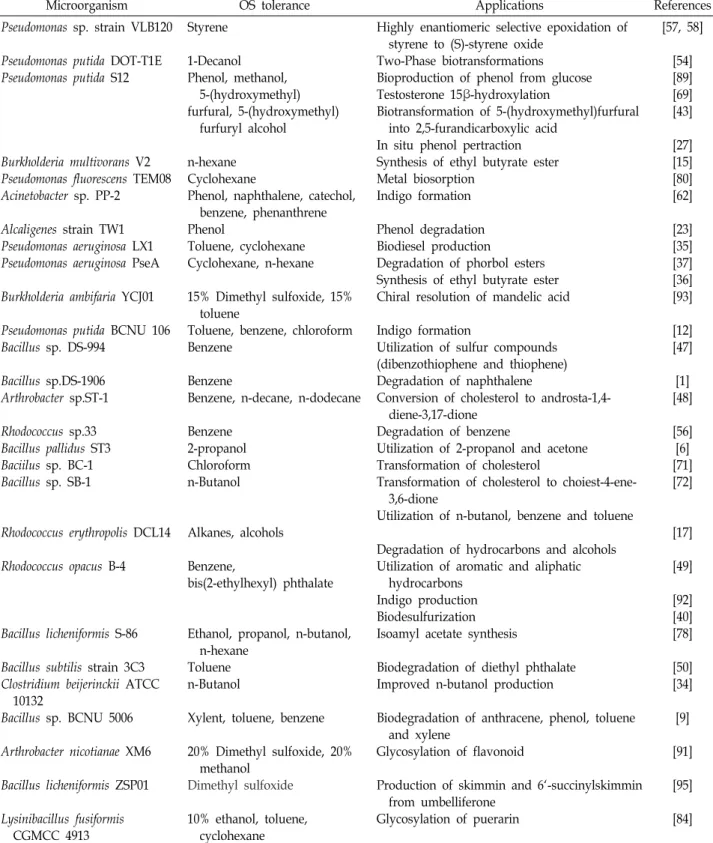
Table 3에 정리되어 있는 유기용매 내성 세균의 이용현황과 같이 많은 연구자들이 유기용매 내성 세균을 다양한 생물변환 및 분해 반응에 활용하고자 시도하고 있다. 먼저 유기용매 내 성 그람음성 세균의 이용현황을 살펴보면 Pseudomonas sp.
strain VLB120을 이용하여 styrene 분해유전자와 조절기능을 조절 및 발현하게 함으로써 제약공업에서의 부가가치 높은 빌딩블락인 거울상이성질체 (S)-styrene oxide의 고순도 생산 이 시도되었으며[57], Park 등에 의하여 다양한 배양법에 기초 하여 탄수화물 대사와 반응산물 독성이 면밀하게 검토되었다 [58]. Neumann 등은 P. putida DOT-T1E를 생체촉매로 사용하 기 위한 기초연구로서 이상계 (two-phase) 생물변환반응에 사 용할 수 있는 용매를 예측할 수 있는 시스템을 개발하고 나아 가 생물변환반응 기질로서 3-nitrotoluene을 사용하여 내성을 증가시킬 수 있는 용매를 예측할 수 있는 시스템도 연구하였 다[54]. 유기용매 내성세균인 P. putida S12를 사용하여 생물공 학적으로 phenol을 생산하고자 하는 시도도 강구되었으며 [89], 변환 후 phenol 회수 공정에 대한 연구도 진행되었다[27].
또한 P. putida S12균주에 유전공학과 돌연변이 유발 기술을 도입한 후 생체촉매로써 이용하여 testosterone 15β-hydrox- ylation 특이성과 변환활성을 증가시키고자 하는 연구가 시도 되었고[69], P. putida S12균주를 이용하여 폴리에스테르 합성 에서 사용되는 terephthalate의 청정 대체물질로서의 2,5-fur- andicarboxylic acid 생산이 시도되었다[43]. Burkholderia mul- tivorans V2 의 리파아제를 사용하여 n-hexane를 포함한 비수 계(non-aqueous system)에서의 ethyl butyrate에스테르 합성 이 연구되었고[15], Pseudomonas fluorescens TEM08를 중금속 흡착 및 제거에 적용하고자 중금속에 대한 흡착능력 등이 조 사되었다[80]. Acinetobacter sp. PP-2를 phenol, naphthalene, catechol, benzene, phenanthrene, xylol과 indole 등 다양한 기질이 포함된 조건에서 배양하여 indigo의 생산수율이 phe- nol을 기질로 사용했을 때 가장 높음을 밝혔다[62]. Phenol에 대해서는 고내성 균주인 Alcaligenes strain TW1을 이용한 phe-
nol 분해가 연구되었으며, 다양한 난분해성 물질의 분해 가능 성이 연구되었다[23]. 한편 P. aeruginosa LX1를 사용하여 바이 오디젤 생산이 시도되어 특히 tert-butanol을 용매로 사용시 반응산물인 메탄올과 글리세롤의 영향이 감소됨으로써 생산 성 향상이 확인되었다[35]. 발효공정에서 사용 후의 탈지 Jatropha 종자를 이용하여 바이오디젤을 생산하는데 있어 독 성문제를 일으키는 phorbol 에스테르 화합물들을 제거하는데 P. aeruginosa PseA를 사용하는 시도도 있었다[37] 그리고 이 균주는 ethyl butyrate 에스테르 합성에도 사용되었다[36].
15% Dimethyl sulfoxide 와 15% toluene에 대하여 내성을 보 이는 Burkholderia ambifaria YCJ01를 이용하여 제약산업에서의 중요 중간물질인 키랄활성 (S)-mandelic acid를 선별적으로 생 성하는 시도도 진행되었다[93]. 국내에서도 토착 유기용매 내 성 세균을 이용하여 인디고 색소 생성이 조사되었다[12].
다음으로 유기용매 내성 그람양성 세균의 이용 현황을 살펴 보면 벤젠 내성세균인 Bacillus sp. DS-994가 분리되어 유황화 합물(dibenzothiophene 과 thiophene)에 대한 탈황활성이 보 고되어 탈황공정에 적용가능함이 시사되었다[46, 47]. 그리고 다가방향족화합물에 대한 분해활성을 갖춘 Bacillus sp. DS- 1906가 분리되어 나프탈렌 등 다가방향족화합물 분해 공정개 발에의 적용가능성이 보고되었다[1]. 분리된 Arthrobacter sp.
ST-1은 n-decane과 n-dodecane에서 cholesterol을 androsta- 1,4-diene-3,17-dione로 변환함이 확인되었다[48]. Rhodococcus sp. 33는 Paje 등에 의해 분리되어 benzene 분해 활성이 보고 되었다[56]. 한편 유기용매 내성 세균 Bacillus pallidus ST3에 의한 고농도 isopropanol 생물분해가 연구되었다[6]. 그리고 Rhodococcus erythropolis DCL14에 의한 hydrocarbons과 alco- hol의 분해반응도 연구되었다[17]. Bacillus sp. BC-1에서 cho- lesterol의 전환반응이 조사되었고[71], Bacillus sp. SB-1에서도 cholesterol 변환반응과 n-butanol, benzene 그리고 toluene 분 해반응이 보고되고 있다[71]. 한편 Bacillus licheniformis S-86을 이용하여 n-hexane 에서 isoamyl acetate를 합성한 보고도 있 으며 isoamyl acetate는 향미성분으로 식품공업에는 중요하므 로 이의 생합성보고는 의의가 크다[78]. Rhodococcus opacus B-4 에서는 다양한 방향족 및 탄화수소 화합물의 분해와 인디고 생산 그리고 생물학적 탈황반응에의 이용이 보고되고 있으며 [40, 49, 92], 같은 균주를 대사공학적으로 개량하여 사용한 결 과, 주요 오염원인 dibenzothiophene 농도를 증가시킴에도 저 해되지 않고 분해속도는 증가함이 확인되어 탈황소재로서 중 요성이 부각되었다[40]. Bacillus subtilis strain 3C3에서는 di- ethyl phthalate 분해조건이 검토되어 분해공정에의 적용가능 성이 보고되었다[50]. 또한 부탄올 내성 세균 Clostridium bei- jerinckii ATCC 10132을 이용하여 단계적으로 적응 농도를 높 여서 적응시키는 과정을 통하여 부탄올 생산성의 향상이 시도 되었다[34]. 균주개량 없이도 생산성 향상이 가능하다는 점이 생물공학적으로는 의미있는 성과이다. Arthrobacter nicotianae
Table 3. Applications of organic solvent tolerant bacteria
Microorganism OS tolerance Applications References
Pseudomonas sp. strain VLB120
Pseudomonas putida DOT-T1E Pseudomonas putida S12
Burkholderia multivorans V2 Pseudomonas fluorescens TEM08 Acinetobacter sp. PP-2
Alcaligenes strain TW1 Pseudomonas aeruginosa LX1 Pseudomonas aeruginosa PseA Burkholderia ambifaria YCJ01
Pseudomonas putida BCNU 106 Bacillus sp. DS-994
Bacillus sp.DS-1906 Arthrobacter sp.ST-1
Rhodococcus sp.33 Bacillus pallidus ST3 Baciilus sp. BC-1 Bacillus sp. SB-1
Rhodococcus erythropolis DCL14 Rhodococcus opacus B-4
Bacillus licheniformis S-86
Bacillus subtilis strain 3C3 Clostridium beijerinckii ATCC
10132
Bacillus sp. BCNU 5006 Arthrobacter nicotianae XM6 Bacillus licheniformis ZSP01
Lysinibacillus fusiformis CGMCC 4913
Styrene
1-Decanol Phenol, methanol,
5-(hydroxymethyl) furfural, 5-(hydroxymethyl)
furfuryl alcohol
n-hexane Cyclohexane
Phenol, naphthalene, catechol, benzene, phenanthrene Phenol
Toluene, cyclohexane Cyclohexane, n-hexane
15% Dimethyl sulfoxide, 15%
toluene
Toluene, benzene, chloroform Benzene
Benzene
Benzene, n-decane, n-dodecane
Benzene 2-propanol Chloroform n-Butanol
Alkanes, alcohols
Benzene,
bis(2-ethylhexyl) phthalate
Ethanol, propanol, n-butanol, n-hexane
Toluene n-Butanol
Xylent, toluene, benzene
20% Dimethyl sulfoxide, 20%
methanol Dimethyl sulfoxide 10% ethanol, toluene,
cyclohexane
Highly enantiomeric selective epoxidation of styrene to (S)-styrene oxide
Two-Phase biotransformations Bioproduction of phenol from glucose Testosterone 15β-hydroxylation
Biotransformation of 5-(hydroxymethyl)furfural into 2,5-furandicarboxylic acid
In situ phenol pertraction Synthesis of ethyl butyrate ester Metal biosorption
Indigo formation
Phenol degradation Biodiesel production
Degradation of phorbol esters Synthesis of ethyl butyrate ester Chiral resolution of mandelic acid
Indigo formation
Utilization of sulfur compounds (dibenzothiophene and thiophene) Degradation of naphthalene
Conversion of cholesterol to androsta-1,4- diene-3,17-dione
Degradation of benzene
Utilization of 2-propanol and acetone Transformation of cholesterol
Transformation of cholesterol to choiest-4-ene- 3,6-dione
Utilization of n-butanol, benzene and toluene
Degradation of hydrocarbons and alcohols Utilization of aromatic and aliphatic
hydrocarbons Indigo production Biodesulfurization Isoamyl acetate synthesis
Biodegradation of diethyl phthalate Improved n-butanol production
Biodegradation of anthracene, phenol, toluene and xylene
Glycosylation of flavonoid
Production of skimmin and 6‘-succinylskimmin from umbelliferone
Glycosylation of puerarin
[57, 58]
[54]
[89]
[69]
[43]
[27]
[15]
[80]
[62]
[23]
[35]
[37]
[36]
[93]
[12]
[47]
[1]
[48]
[56]
[6]
[71]
[72]
[17]
[49]
[92]
[40]
[78]
[50]
[34]
[9]
[91]
[95]
[84]
XM6이 생산하는 친수성 유기용매에 대하여 내성을 나타내는 glycosidase를 사용하여 플라보노이드인 puerarin으로부터 puerarin glycosides (특히 monofructosyl puerarin와 di- fructosyl puerarin)로 높은 수율로 변환시킬 수 있음이 보고되
었다[91]. Bacillus licheniformis ZSP01를 이용하여 umbellifer- one에서 skimmin와 6'-succinylskimmin의 생산에도 적용한 보고가 있으며 이러한 변환은 위치이성체 선택성이 높고 용매 첨가에 따른 수율이 증가하는 특색이 있다[95]. 그리고
Lysinibacillus fusiformis CGMCC 4913에서도 위에서 언급한 puerarin의 glycosylation 반응에 대한 최적조건을 검토 보고 하고 있다[84]. 국내에서는 유기용매 내성 세균의 보고가 한정 되어 있으므로 유기용매 내성 그람양성 세균의 이용에 대한 연구도 2012년 처음 유기용매 내성 그람양성 세균이 적용되어 즉 그람양성 내성세균 Bacillus sp. BCNU 5006이 사용되어 an- thracene, phenol, toluene 및 xylene의 분해반응이 보고되고 있는 것이 전부이다[9].
결론 및 전망
유기용매 내성 세균의 유기용매에 대한 내성 범위는 매우 다양하며 농도면에서도 고농도에서 저농도까지 다양하다. 현 재 유기용매 내성을 판정하는 방법은 주로 Inoue 와 Hor- ikoshi [32]의 방법에 준하여 log P값을 기준으로 하고 있다.
즉 log P값이 적을수록 지질친화적으로 세포독성이 높은 것으 로 간주되어 log P값이 낮은 유기용매에서 생존가능한 세균을 유기용매 내성 세균으로 분리 이용하고 있다. 현재는 유기용 매 내성 세균 판정법이 개선되어 tetrazolium violet 비색방법 으로 유기용매 내성 정도의 판정이 가능하다[26]. 그러므로 유 기용매 내성 세균에 대한 tetrazolium violet 비색방법으로 정 확한 판정이 필요하며 유기용매 내성 세균은 엄밀하고 정확히 정의되어야 한다. 유기용매 내성 세균의 유기용매 내성 기작 은 그람음성 유기용매 내성 세균을 위주로 검토되었고 이어 분리된 그람양성 유기용매 내성 세균에 대해서도 일반적인 유기용매 내성 기전이 검증되었다. 유기용매 내성 세균의 유 기용매 내성 기전에는 균주 특이성이 크게 관여하고 있는 것 으로 밝혀지고 있으므로 많은 그람음성 세균 및 그람양성 세 균을 대상으로 유기용매 내성 기전에 대한 다양한 생리학 및 분자 생물학적 연구가 요구되고 있다. 그리고 유기용매 내성 세균의 산업 및 환경생명공학적인 활용에서도 많은 균주들이 특이성을 가짐이 밝혀져 보다 다양한 적용가능성 검토가 필요 하다. 특히 토착 유기용매 내성 세균에 대한 선도적인 분리 및 탐색이 필요하며 이를 기반으로 해서 유기용매 내성 기전 에서의 연구도 좋은 연구성과가 기대되는 분야이다. 또한 토 착 유기용매 내성 세균의 이용과 활용 분야도 의미있는 성과 가 기대되는 분야이다.
감사의 글
본 논문은 창원대학교 2015-2016학년도 교내연구비 지원을 받아 수행된 연구임.
References
1. Abe, A., Inoue, A., Usami, R., Moriya, K. and Horikoshi,
K. 1995. Properties of newly isolated marine bacterium that can degrade polyaromatic hydrocarbons in the presence of organic solvents. J. Marine Biotechnol. 2, 182-186.
2. Aizawa, T., Neilan, B. A., Couperwhite, I., Urai, M., Anzai, H., Iwabuchi, N., Nakajima, M. and Sunairi, M. 2005.
Relationship between extracellular polysaccharide and ben- zene tolerance of Rhodococcus sp. 33. Actinomycetologica 19, 1-6.
3. Aono, R. and Kobayashi, H. 1997. Cell surface properties of organic solvent-tolerant mutants of Escherichia coli K-12.
Appl. Environ. Microbiol. 63, 3637-3642.
4. Baumgarten, T., Vazquez, J., Bastisch, C., Veron, W., Feuillo- ley, M. G., Nietzsche, S., Wick, L. Y. and Heipieper, H. J.
2012. Alkanols and chlorophenols cause different physio- logical adaptive responses on the level of cell surface prop- erties and membrane vesicle formation in Pseudomonas puti- da DOT-T1E. Appl. Microbiol. Biotechnol. 93, 837-845.
5. Baumgarten, T., Sperling, S., Seifert, J., von Bergen, M., Steiniger, F., Wick, L. Y. and Heipieper, H. J. 2012. Mem- brane vesicle formation as a multiple-stress response mecha- nism enhances Pseudomonas putida DOT-T1E cell surface hy- drophobicity and biofilm formation. Appl. Environ. Microbiol.
78, 6217-6224.
6. Bustard, M. T., Whiting, S., Cowan, D. A. and Wright, P.
C. 2002. Biodegradation of high-concentration isopropanol by a solvent-tolerant thermophile, Bacillus pallidus. Extremo- philes 6, 319-323.
7. Choi, H. J., Kim, S. A., Kim, D. W., Moon, J. Y., Jeong, Y.
K. and Joo, W. H. 2008. Characterization of Pseudomonas sp.
BCNU 171 tolerant to organic solvents. J. Basic Microbiol.
48, 473-479.
8. Choi, H. J., Hwang, M. J., Jeong, Y. K. and Joo, W. H. 2011.
Evaluation of the Potential of Organic Solvent Tolerant Bacillus sp. BCNU 5005. J. Life Sci. 21, 700-705.
9. Choi, H. J., Hwang, M. J., Kim, B. S., Jeong, Y. K. and Joo, W. H. 2012. Potential of Organic Solvent Tolerant Bacillus sp. BCNU 5006. KSBB J. 27, 61-66.
10. Choi, H. J., Hwang, M. J., Seo, J. Y. and Joo, W. H. 2013.
Organic Solvent-tolerant Lipase from Pseudomonas sp.
BCNU 154. J. Life Sci. 23, 1246-1251.
11. Choi, H. J., Seo, J. Y., Hwang, S. M., Lee, Y. I., Jeong, Y.
K., Moon, J. Y. and Joo, W. H. 2013. Isolation and character- ization of BTEX tolerant and degrading Pseudomonas putida BCNU 106. Biotechnol. Bioprocess Eng. 18, 1000-1007.
12. Choi, H. J., Kwon, G. S. and Joo, W. H. 2014. Production of Indigoid Pigments by Persolvent Fermentation with Pseudomonas putida BCNU 106. J. Life Sci. 24, 81-85.
13. Choi, H. J., Yoo, J. S., Jeong, Y. K. and Joo, W. H. 2014.
Involvement of antioxidant defense system in solvent toler- ance of Pseudomonas putida BCNU 106. J. Basic Microbiol. 54, 945-950.
14. Cruden, D. L., Wolfram, J. H., Rogers, R. T. and Gibson, D. T. 1992. Physiological properties of a Pseudomonas strain which grows with p-xylene in a two-phase (organic-aque- ous) medium. Appl. Environ. Microbiol. 58, 2723–2729.
15. Dandavate, V., Jinjala, J., Keharia, H. and Madamwar, D.
2009. Production, partial purification and characterization of organic solvent tolerant lipase from Burkholderia multivorans V2 and its application for ester synthesis. Bioresour. Technol.
100, 3374-3381.
16. De Carvalho, C. C. C, R, Da Cruz, A. A., Pons, M. N., Pinheiro, H. M., Cabral, J., Da Fonseca, M. M. R., Ferreira, B. S. and Fernandes, P. 2004. Mycobacterium sp., Rhodococcus erythropolis, and Pseudomonas putida behavior in the presence of organic solvents. Microsc. Res. Tech. 64, 215-222.
17. De Carvalho, C. C. C. R. and Ds Fonseca, M. M. R. 2005.
Degradation of hydrocarbons and alcohols at different tem- peratures and salinities by Rhodococcus erythropolis DCL14.
FEMS Microbiol. Ecol. 51, 389-399.
18. De Carvalho, C. C. C. R., Parreño-Marchante, B., Neumann, G., Da Fonseca, M. M. R., and Heipieper, H. J. 2005.
Adaptation of Rhodococcus erythropolis DCL14 to growth on n-alkanes, alcohols and terpenes. Appl. Microbiol. Biotechnol.
67, 383-388.
19. De Bont, J. A. 1998. Solvent-tolerant bacteria in biocatalysis.
Trends Biotechnol. 16, 493-499.
20. Diefenbach, R., Heipieper, H. J. and Keweloh, H. 1992. The conversion of cis into trans unsaturated fatty acids in Pseudomonas putida P8: evidence for a role in the regulation of membrane fluidity. Appl. Microbiol. Biotechnol. 38, 382-387.
21. Domínguez-Cuevas, P., González-Pastor, J. E., Marqués, S., Ramos, J. L. and de Lorenzo, V. 2006. Transcriptional trade- off between metabolic and stress-response programs in Pseudomonas putida KT2440 cells exposed to toluene. J. Biol.
Chem. 281, 11981-11991.
22. Duque, E., Rodríguez-Herva, J. J., de la Torre, J., Domín- guez-Cuevas, P., Muñoz-Rojas, J. and Ramos, J. L. 2007. The RpoT regulon of Pseudomonas putida DOT-T1E and its role in stress endurance against solvents. J. Bacteriol. 189, 207-219.
23. Essam, T., Amin, M. A., El Tayeb, O., Mattiasson, B. and Guieysse, B. 2010. Kinetics and metabolic versatility of high- ly tolerant phenol degrading Alcaligenes strain TW1. J.
Hazard. Mater. 173, 783-788.
24. Geok, L. P., Razak, C. N. A., Rahman, R. N. Z. A., Basri, M. and Salleh, A. B. 2003. Isolation and screening of an ex- tracellular organic solvent-tolerant protease producer. Biochem.
Eng. J. 13, 73-77.
25. Hartmans S., van der Werf M. J. and de Bont J. A. M. 1990.
Bacterial degradation of styrene involving a novel flavin ad- enine dinucleotide-dependent styrene monooxygenase.
Appl. Environ. Microbiol. 56, 1347-1351.
26. Hayashi, S., Kobayashi, T. and Honda, H. 2003. Simple and rapid cell growth assay using tetrazolium violet coloring method for screening of organic solvent tolerant bacteria.
J. Biosci. Bioeng. 96, 360-363.
27. Heerema, L., Wierckx, N., Roelands, M., Hanemaaijer, J. H., Goetheer, E., Verdoes, D. and Keurentjes, J. 2011. In situ phenol removal from fed-batch fermentations of solvent tol- erant Pseudomonas putida S12 by pertraction. Biochem. Eng.
J. 53, 245-252.
28. Heipieper, H. J., Loffeld, B., Keweloh, H. and de Bont, J.
A. 1995. The cis/trans isomerisation of unsaturated fatty
acids in Pseudomonas putida S12: an indicator for environ- mental stress due to organic compounds. Chemosphere 30, 1041-1051.
29. Horikoshi, K. and Bull, A. T. 2011. Extremophiles handbook, pp. 3-15, Tokyo, Japan, Springer.
30. Hun, C. J., Rahman, R. N. Z. A., Salleh, A. B. and Basri, M. 2003. A newly isolated organic solvent tolerant Bacillus sphaericus 205y producing organic solvent-stable lipase.
Biochem. Eng. J. 15, 147-151.
31. Inoue, A. and Horikoshi, K. 1989. A Pseudomonas thrives in high concentrations of toluene. Nature 338, 264-266.
32. Inoue, A. and Horikoshi, K. 1991. Estimation of solvent-tol- erance of bacteria by the solvent parameter log P. J. Ferment.
Bioeng. 71, 194-196.
33. Isken, S. and De Bont, J. A. 1996. Active efflux of toluene in a solvent-resistant bacterium. J. Bacteriol. 178, 6056-6058.
34. Isar, J. and Rangaswamy, V. 2012. Improved n-butanol pro- duction by solvent tolerant Clostridium beijerinckii. Biomass Bioenergy 37, 9-15.
35. Ji, Q., Xiao, S., He, B. and Liu, X. 2010. Purification and characterization of an organic solvent-tolerant lipase from Pseudomonas aeruginosa LX1 and its application for biodiesel production. J. Mol. Catal., B Enzym. 66, 264-269.
36. Joshi, C. and Khare, S. K. 2013. Purification and character- ization of Pseudomonas aeruginosa lipase produced by SSF of deoiled Jatropha seed cake. Biocatal. Agric. Biotechnol. 2, 32-37.
37. Joshi, C., Mathur, P. and Khare, S. K. 2011. Degradation of phorbol esters by Pseudomonas aeruginosa PseA during sol- id-state fermentation of deoiled Jatropha curcas seed cake.
Bioresour. Technol. 102, 4815-4819.
38. Junker, F. and Ramos, J. L. 1999. Involvement of the cis/trans Isomerase Cti in Solvent Resistance of Pseudomonas putida DOT-T1E. J. Bacteriol. 181, 5693-5700.
39. Kang, H. J., Heo, D. H., Choi, S. W., Kim, K. N., Shim, J., Kim, C. W., Sung, H. C. and Yun, C. W. 2007. Functional characterization of Hsp33 protein from Bacillus psychro- saccharolyticus; additional function of HSP33 on resistance to solvent stress. Biochem. Biophys. Res. Commun. 358, 743- 750.
40. Kawaguchi, H., Kobayashi, H. and Sato, K. 2012. Metabolic engineering of hydrophobic Rhodococcus opacus for bio- desulfurization in oil–water biphasic reaction mixtures. J.
Biosci. Bioeng. 113, 360-366.
41. Kieboom, J., Dennis, J. J., de Bont, J. A. and Zylstra, G. J.
1998. Identification and molecular characterization of an ef- flux pump involved in Pseudomonas putida S12 solvent tolerance. J. Biol. Chem. 273, 85-91.
42. Kobayashi, H., Takami, H., Hirayama, H., Kobata, K., Usami, R. and Horikoshi, K. 1999. Outer Membrane Changes in a Toluene-Sensitive Mutant of Toluene-Tolerant Pseudomonas putida IH-2000. J. Bacteriol. 181, 4493-4498.
43. Koopman, F., Wierckx, N., de Winde, J. H. and Ruijssenaars, H. J. 2010. Efficient whole-cell biotransformation of 5- (hydroxymethyl) furfural into FDCA, 2, 5-furandicarboxylic acid. Bioresour. Technol. 101, 6291-6296.
44. Lacal, J., Muñoz‐Martínez, F., Reyes‐Darías, J. A., Duque, E., Matilla, M., Segura, A., Ortega Calvo, J. J., Jiménez- Sanchez, C., Krell, T. and Ramos, J. L. 2011. Bacterial chemo- taxis towards aromatic hydrocarbons in Pseudomonas.
Environ. Microbiol. 13, 1733-1744.
45. Matsumoto, M., de Bont, J. A. and Isken, S. 2002. Isolation and characterization of the solvent-tolerant Bacillus cereus strain R1. J. Biosci. Bioeng. 94, 45-51.
46. Moriya, K. and Horikoshi, K. 1993. Isolation of a benzene- tolerant bacterium and its hydrocarbon degradation. J.
Ferment. Bioeng. 76, 168-173.
47. Moriya, K. and Horikoshi, K. 1993. A benzene-tolerant bac- terium utilizing sulfur compounds isolated from deep sea.
J. Ferment. Bioeng. 76, 397-399.
48. Moriya, K., Yanagitani, S., Usami, R. and Horikoshi, K. 1995.
Isolation and some properties of an organic-solvent-tolerant marine bacterium degrading cholesterol. J. Mar. Biotechnol.
2, 131-133.
49. Na, K. S., Kuroda, A., Takiguchi, N., Ikeda, T., Ohtake, H.
and Kato, J. 2005. Isolation and characterization of ben- zene-tolerant Rhodococcus opacus strains. J. Biosci. Bioeng. 99, 378-382.
50. Navacharoen, A. and Vangnai, A. S. 2011. Biodegradation of diethyl phthalate by an organic-solvent-tolerant Bacillus subtilis strain 3C3 and effect of phthalate ester coexistence.
Int. Biodeterior. Biodegradation 65, 818-826.
51. Nielsen, L. E., Kadavy, D. R., Rajagopal, S., Drijber, R. and Nickerson, K. W. 2005. Survey of extreme solvent tolerance in gram-positive cocci: membrane fatty acid changes in Staphylococcus haemolyticus grown in toluene. Appl. Environ.
Microbiol. 71, 5171-5176.
52. Neumann, G., Veeranagouda, Y., Karegoudar, T. B., Sahin, Ö., Mäusezahl, I., Kabelitz, N., Kappelmeyer, U. and Hei- pieper, H. J. 2005. Cells of Pseudomonas putida and Enterobac- ter sp. adapt to toxic organic compounds by increasing their size. Extremophiles 9, 163-168.
53. Neumann, G., Cornelissen, S., van Breukelen, F., Hunger, S., Lippold, H., Loffhagen, N., Wick, L. Y. and Heipieper, H. J. 2006. Energetics and surface properties of Pseudomonas putida DOT-T1E in a two-phase fermentation system with 1-decanol as second phase. Appl. Environ. Microbiol. 72, 4232- 4238.
54. Neumann, G., Kabelitz, N., Zehnsdorf, A., Miltner, A., Lip- pold, H., Meyer, D., Schmid, A. and Heipieper, H. J. 2005.
Prediction of the adaptability of Pseudomonas putida DOT- T1E to a second phase of a solvent for economically sound two-phase biotransformations. Appl. Environ. Microbiol. 71, 6606-6612.
55. Ogino, H., Yasui, K., Shiotani, T., Ishihara, T. and Ishikawa, H. 1995. Organic solvent-tolerant bacterium which secretes an organic solvent-stable proteolytic enzyme. Appl. Environ.
Microbiol. 61, 4258-4262.
56. Paje, M. L. F. and Neilan, B. A. 1997. A Rhodococcus species that thrives on medium saturated with liquid benzene.
Microbiology 143, 2975-2981.
57. Panke, S., Witholt, B., Schmid, A. and Wubbolts, M.G. 1998.
Towards a biocatalyst for (S)-styrene oxide production:
characterization of the styrene degradation pathway of Pseudomonas sp. strain VLB120. Appl. Environ. Microbiol. 64, 2032-2043.
58. Park, J. B., Bühler, B., Panke, S., Witholt, B. and Schmid, A. 2007. Carbon metabolism and product inhibition de- termine the epoxidation efficiency of solvent‐tolerant Pseu- domonas sp. strain VLB120℃. Biotechnol. Bioeng. 98, 1219- 1229.
59. Pepi, M., Heipieper, H. J., Fischer, J., Ruta, M., Volterrani, M. and Focardi, S. E. 2008. Membrane fatty acids adaptive profile in the simultaneous presence of arsenic and toluene in Bacillus sp. ORAs2 and Pseudomonas sp. ORAs5 strains.
Extremophiles 12, 343-349.
60. Petersohn, A., Brigulla, M., Haas, S., Hoheisel, J. D., Völker, U. and Hecker, M. 2001. Global analysis of the general stress response of Bacillus subtilis. J. Bacteriol. 183, 5617-5631.
61. Pinkart, H. C., Wolfram, J. W., Rogers, R. and White, D.
C. 1996. Cell envelope changes in solvent-tolerant and sol- vent-sensitive Pseudomonas putida strains following exposure to o-xylene. Appl. Environ. Microbiol. 62, 1129-1132.
62. Qu, Y., Pi, W., Ma, F., Zhou, J. and Zhang, X. 2010. Influence and optimization of growth substrates on indigo formation by a novel isolate Acinetobacter sp. PP-2. Bioresour. Technol.
101, 4527-4532.
63. Ramos J. L., Duque E., Huertas M. J. and Haı̈dour A. 1995.
Isolation and expansion of the catabolic potential of a Pseudomonas putida strain able to grow in the presence of high concentrations of aromatic hydrocarbons. J. Bacteriol.
177, 3911-3916.
64. Ramos, J. L., Duque, E., Godoy, P. and Segura, A. 1998.
Efflux pumps involved in toluene tolerance in Pseudomonas putida DOT-T1E. J. Bacteriol. 180, 3323-3329.
65. Ramos J. L., Duque E., Rodrı́guez-Herva J. J., Godoy P., Haı̈
dour A., Reyes F. and Fernández-Barrero A. 1997. Mechan- isms for solvent tolerance in bacteria. J. Biol. Chem. 272, 3887- 3890.
66. Ramos, J. L., Duque, E., Gallegos, M. T., Godoy, P., Ramos-González, M. I., Rojas, A. Teran, W. and Segura, A.
2002. Mechanisms of solvent tolerance in gram-negative bacteria. Annu. Rev. Microbiol. 56, 743-768.
67. Rojas, A., Duque, E., Mosqueda, G., Golden, G., Hurtado, A., Ramos, J. L. and Segura, A. 2001. Three Efflux Pumps Are Required to Provide Efficient Tolerance to Toluene in Pseudomonas putida DOT-T1E. J. Bacteriol. 183, 3967-3973.
68. Roma-Rodrigues, C., Santos, P. M., Benndorf, D., Rapp, E.
and Sá-Correia, I. 2010. Response of Pseudomonas putida KT2440 to phenol at the level of membrane proteome. J.
Proteomics 73, 1461-1478.
69. Ruijssenaars, H. J., Sperling, E. M., Wiegerinck, P. H., Brands, F. T., Wery, J. and de Bont, J. A. 2007. Testosterone 15β-hydroxylation by solvent tolerant Pseudomonas putida S12. J. Biotechnol. 131, 205-208.
70. Sardessai, Y. and Bhosle, S. 2002. Tolerance of bacteria to organic solvents. Res. Microbiol. 153, 263-268.
71. Sardessai, Y. and Bhosle, S. 2003. Isolation of an organic-sol-
vent-tolerant cholesterol-transforming Bacillus species, BC1, from coastal sediment. Mar. Biotechnol. 5, 116-118.
72. Sardessai, Y. N. and Bhosle, S. 2004. Industrial potential of organic solvent tolerant bacteria. Biotechnol. Prog. 20, 655- 660.
73. Segura, A., Godoy, P., van Dillewijn, P., Hurtado, A., Arroyo, N., Santacruz, S. and Ramos, J. L. 2005. Proteomic analysis reveals the participation of energy-and stress-re- lated proteins in the response of Pseudomonas putida DOT-T1E to toluene. J. Bacteriol. 187, 5937-5945.
74. Segura, A., Molina, L., Fillet, S., Krell, T., Bernal, P., Muñoz- Rojas, J. and Ramos, J. L. 2012. Solvent tolerance in Gram- negative bacteria. Curr. Opin. Biotechnol. 23, 415-421.
75. Sikkema, J., De Bont, J. A. and Poolman, B. 1995. Mechanisms of membrane toxicity of hydrocarbons. Microbiol. Rev. 59, 201-222.
76. Tomas, C. A., Welker, N. E. and Papoutsakis, E. T. 2003.
Overexpression of groESL in Clostridium acetobutylicum re- sults in increased solvent production and tolerance, pro- longed metabolism, and changes in the cell's transcriptional program. Appl. Environ. Microbiol. 69, 4951-4965.
77. Torres, S., Baigorí, M. D. and Castro, G. R. 2005. Effect of hydroxylic solvents on cell growth, sporulation, and ester- ase production of Bacillus licheniformis S-86. Process Biochem.
40, 2333-2338.
78. Torres, S., Baigorí, M. D., Swathy, S. L., Pandey, A. and Castro, G. R. 2009. Enzymatic synthesis of banana flavour (isoamyl acetate) by Bacillus licheniformis S-86 esterase. Food Res. Int. 42, 454-460.
79. Torres, S., Pandey, A. and Castro, G. R. 2011. Organic sol- vent adaptation of Gram positive bacteria: applications and biotechnological potentials. Biotechnol. Adv. 29, 442-452.
80. Uzel, A. and Ozdemir, G. 2009. Metal biosorption capacity of the organic solvent tolerant Pseudomonas fluorescens TEM08. Bioresour. Technol. 100, 542-548.
81. Veeranagouda, Y., Karegoudar, T. B., Neumann, G. and Heipieper, H. J. 2006. Enterobacter sp. VKGH12 growing with n‐butanol as the sole carbon source and cells to which the alcohol is added as pure toxin show considerable differ- ences in their adaptive responses. FEMS Microbiol. Lett. 254, 48-54.
82. Volkers, R. J., De Jong, A. L., Hulst, A. G., Van Baar, B.
L., De Bont, J. A. and Wery, J. 2006. Chemostat‐based pro- teomic analysis of toluene‐affected Pseudomonas putida S12.
Environ. Microbiol. 8, 1674-1679.
83. Wang, L., Qiao, N., Sun, F. and Shao, Z. 2008. Isolation, gene detection and solvent tolerance of benzene, toluene and xylene degrading bacteria from nearshore surface water and Pacific Ocean sediment. Extremophiles 12, 335-342.
84. Wang, S., Liu, G., Zhang, W., Cai, N., Cheng, C., Ji, Y., Sun, L,m Zhan, J. and Yuan, S. 2014. Efficient glycosylation of puerarin by an organic solvent-tolerant strain of Lysinibacil- lus fusiformis. Enzyme Microb. Technol. 57, 42-47.
85. Watanabe, R. and Doukyu, N. 2014. Improvement of organic solvent tolerance by disruption of the lon gene in Escherichia coli. J. Biosci. Bioeng. 118, 139-144.
86. Weber, F. J., Ooijkaas, L. P., Schemen, R. M., Hartmans, S.
and de Bont, J. A. 1993. Adaptation of Pseudomonas putida S12 to high concentrations of styrene and other organic solvents. Appl. Environ. Microbiol. 59, 3502-3504.
87. Weber, F. J. and de Bont, J. A. 1996. Adaptation mechanisms of microorganisms to the toxic effects of organic solvents on membranes. Biochim. Biophys. Acta 1286, 225-245.
88. Wick, L., De Munain, A., Springael, D. and Harms, H. 2002.
Responses of Mycobacterium sp. LB501T to the low bioavail- ability of solid anthracene. Appl. Microbiol. Biotechnol. 58, 378-385.
89. Wierckx, N. J., Ballerstedt, H., de Bont, J. A. and Wery, J.
2005. Engineering of solvent-tolerant Pseudomonas putida S12 for bioproduction of phenol from glucose. Appl. Environ.
Microbiol. 71, 8221-8227.
90. Williams, T. I., Combs, J. C., Lynn, B. C. and Strobel, H.
J. 2007. Proteomic profile changes in membranes of etha- nol-tolerant Clostridium thermocellum. Appl. Microbiol. Bio- technol. 74, 422-432.
91. Wu, X., Chu, J., Wu, B., Zhang, S. and He, B. 2013. An effi- cient novel glycosylation of flavonoid by β-fructosidase re- sistant to hydrophilic organic solvents. Bioresour. Technol.
129, 659-662.
92. Yamashita, S., Satoi, M., Iwasa, Y., Honda, K., Sameshima, Y., Omasa, T., Kato, J. and Ohtake, H. 2007. Utilization of hydrophobic bacterium Rhodococcus opacus B-4 as whole-cell catalyst in anhydrous organic solvents. Appl. Microbiol.
Biotechnol. 74, 761-767.
93. Yao, C., Cao, Y., Wu, S., Li, S. and He, B. 2013. An organic solvent and thermally stable lipase from Burkholderia ambi- faria YCJ01: purification, characteristics and application for chiral resolution of mandelic acid. J. Mol. Catal., B Enzym.
85, 105-110.
94. Zahir, Z., Seed, K. D. and Dennis, J. J. 2006. Isolation and characterization of novel organic solvent-tolerant bacteria.
Extremophiles 10, 129-138.
95. Zhang, S., Zhou, Z., Yao, Z. and He, B. 2013. Efficient pro- duction of skimmin and 6′-succinylskimmin from umbelli- ferone by organic solvent-tolerant Bacillus licheniformis ZSP01 using nitrogen sources regulation strategy. Biochem. Eng. J.
71, 105-110.
초록:유기용매 내성 세균과 이용가능성
주우홍*
(창원대학교 생물학화학융합학부)
유기용매 내성 세균의 첫 분리 보고 이후 다수의 유기용매 내성 세균들이 토양 폐수 심지어 심해 등 모든 환경 에서 분리 보고되고 있다. 대부분의 유기용매 내성 세균은 그람음성세균으로 이는 그람음성 세균이 그람양성 세 균 보다 유전적으로 더 내성을 보이기 때문이다. 유기용매 내성 기전은 유기용매 내성 그람음성 세균을 주로 사용 하여 집중적으로 구명되어왔다. 유기용매 내성 그람양성 세균의 유기용매 내성 기전은 비교적 최근 연구에서 발 견되고 있다. 유기용매는 용매에 따라 다른 독성을 보이며 유기용매 내성세균의 유기용매 내성 수준은 종과 균주 에 의존적으로 매우 변화가 심하다. 그러므로 유기용매 내성세균은 다양한 변인과 다유전자에 의한 적응 전략에 의하여 용매독성과 싸우며 용매 스트레스에 적응할 수 있다. 그들은 세포형태 및 세포 행동에서의 변화, 세포표층 의 수식, 세포막 적응, 용매 배출 펌프, 샤페론 그리고 항산화 반응 등의 기전을 통하여 유기용매의 과량의 농도에 서도 생존할 수 있다. 본 총설에서는 대표적인 유기용매 내성 세균, 유기용매 내성 세균에서의 유기용매에의 적 응 및 내성 전략들 나아가 그들의 산업적 및 환경공학적인 잠재적인 영향에 대하여 개관하고자 한다.