Solvent-tolerant Lipases and Their Potential Uses
Woo Hong Joo*
Department of Biology and Chemistry, Changwon National University, Changwon 51140, Korea Received October 31, 2017 /Revised November 24, 2017 /Accepted November 28, 2017
This review described solvent-tolerant lipases and their potential industrial, biotechnological and envi- ronmental impacts. Although organic solvent-tolerant lipase was first reported in organic solvent-toler- ant bacterium, many organic solvent-tolerant lipases are in not only solvent-tolerant bacteria but also solvent-intolerant bacterial and fungal strains, such as the well-known Bacillus, Pseudomonas, Streptomyces and Aspergillus strains. As these lipases are not easily inactivated in organic solvents, there is no need to immobilize them in order to prevent an enzyme inactivation by solvents. Therefore, the solvent-tol- erant lipases have the potential to be used in many biotechnological and biotransformation processes.
With the solvent-tolerant lipases, a large number insoluble substrates become soluble, various chem- ical reactions that are initially impossible in water systems become practical, synthesis reactions (instead of hydrolysis) are possible, side reactions caused by water are suppressed, and the possibility of chemoselective, regioselective and enantioselective transformations in solvent and non-aqueous sys- tems is increased. Furthermore, the recovery and reuse of enzymes is possible without immobilization, and the stabilities of the lipases improve in solvent and non-aqueous systems. Therefore, lipases with organic-solvent tolerances have attracted much attention in regards to applying them as biocatalysts to biotransformation processes using solvent and non-aqueous systems.
Key words : Biocatalyst, biotransformation, solvent-tolerance, solvent-tolerant lipase, transformation
*Corresponding author
*Tel : +82-55-213-3453, Fax : +82-55-213-3459
*E-mail : [email protected]
This is an Open-Access article distributed under the terms of the Creative Commons Attribution Non-Commercial License (http://creativecommons.org/licenses/by-nc/3.0) which permits unrestricted non-commercial use, distribution, and reproduction in any medium, provided the original work is properly cited.
Journal of Life Science 2017 Vol. 27. No. 11. 1381~1392 DOI : https://doi.org/10.5352/JLS.2017.27.11.1381
서 론
유기용매 존재하의 극한적인 조건에서 생존할 수 있는 미생 물과 유기용매에서도 활성을 유지할 수 있는 효소의 존재는 한동안 과학적으로 그 존재가 연구되지 않고 있던 분야이다.
그러나 1989년 Inoue 등에 의하여 유기용매 내성 세균이 처음 분리되어 새로운 생물자원으로 보고되었다[11]. 이 분리 균주 는 고농도의 유기용매 cyclohexane, xylene, toluene 및 hepta- nol에서도 생존가능함이 밝혀져 이후 다수의 연구자들에 의한 유기용매 내성세균에 대한 분리 탐색연구의 기폭제가 되었다.
유기용매 내성세균은 초기에는 주로 그람음성 세균에서 분리 되었으며 주요 균주로는 Pseudomonas putida Idaho [4], P. puti- da S12 [9, 34]. 그리고 P. putida DOT-T1E [26] 등이 있다. 이어 서 유기용매 내성 그람양성 세균들(Bacillus sphaericus 205y [10]와 Rhodococcus opacus B-4 [21])이 속속 분리 탐색되어 유기 용매 내성 세균이 그람음성 뿐만 아니라 그람양성 세균에도 폭넓게 존재함이 확인되었다. 이에 비해 다소 늦게 유기용매 내성 효소에 대한 연구가 시작되어 유기용매 내성 효소의 존
재가 보고되었다. P. aeruginosa LST-03에서 유기용매 내성 리 파아제 그리고 P. aeruginosa PST-01균주에서 유기용매 내성 단백질 분해효소가 Ogino 등[23, 24]에 의하여 분리 보고된 이후 다수의 유기용매 내성 효소가 보고되고 있다[6, 27]. 이들 유기용매 내성효소들은 유기용매 내성 세균에서 처음 보고되 었으나[23, 24]. 유기용매 내성 효소는 이후 유기용매 내성 세 균만이 아니라 다양한 미생물에서 생산됨이 보고되었으며 유 기용매 내성 세균 기원의 유기용매 내성 효소 뿐만 아니라 다양한 유기용매 비내성 미생물들 유래의 유기용매 내성 효소 도 산업적으로 유용하다는 것이 입증되었다[6, 27].
다수의 화학물질은 물에 불용성인 지질친화적인 물질로써 이를 이용한 생물변환반응에서는 물질의 용해도가 변환효율 을 결정하는 주요인이 되고 있으며, 이에 two-liquid wa- ter-solvent시스템을 사용하여 용해도를 최대화함으로써 변 환율과 추출효율을 동시에 최대화할 수 있다[5]. 특히 세균을 whole cell biocatalyst로 사용하는 경우 변환산물을 추출하기 위한 다양한 유기용매에 의하여 세포가 손상을 받을 수 있어 whole cell biocatalyst로 사용할 수 있는 범위가 제한적이다.
그러므로 유기용매 내성 효소를 생산하는 유기용매 내성 세균 은 유용성이 높은 새로운 whole cell biocatalyst로 주목을 받 고 있다[5, 33]. 일반적인 유기용매 내성이 없는 효소는 유기용 매에 의하여 불활성화되는 반면 유기용매 내성 효소는 이상계 (two-phase system), 유기용매계 또는 비수계(non-aqueous system)에서 안정적으로 활성을 유지하기 때문에 이상계, 유 기용매계 또는 비수계에서의 생물변환반응에 적용할 수 있는
- Review -
최적의 생물촉매이다[5, 6, 27, 33]. 한편 리파아제는 ester- ification (에스터화반응), transesterification (에스테르교환반 응), 산가수분해(acidolysis), 가아민 반응(aminolysis), 알코올 분해(alcoholysis), 아실화 반응(acylation) 그리고 라시미체의 분해 등에 이용되는 가수분해 또는 합성반응을 촉매하는 tri- acylglycerol ester hydrolases (EC 3.1.1.3)이다[27]. 특히 유기 용매 내성 리파아제는 수용액 뿐만 아니라 유기용매에서도 그들의 이용성과 안정성을 가지므로 생물공정에서 널리 이용 될 가능성이 높다[28]. 이상계에서 효소가 용해되어 있는 수용 액과 불용성 기질층 또는 기질이 용해되어 있는 유기용매 사 이의 경계면에서 에스테르결합의 가수분해를 촉매하며, 비수 계에서는 글리세롤과 지방산으로부터 글리세리드를 형성하 는 에스터화 반응(esterification)과 에스테르 교환반응 (transesterification)같은 가역반응이 일어난다[28]. 현재까지 많은 연구진에 의해 연구되어 온 비교적 새로운 효소인 유기 용매 내성 효소는 유기용매 내성 미생물에서만 아니라 일반 미생물에서도 널리 생산 분비되고 있는 것으로 알려져 있으며 산업적으로나 환경적으로 매우 활용성이 높은 생물소재이다.
그러므로 본 총설에서 유기용매 내성 미생물 뿐만 아니라 일 반적인 미생물이 생산하는 산업적으로 활용도가 높은 유기용 매 내성 리파아제에 대하여 초점을 맞추어 고찰하고자 한다.
본 론
유기용매 내성 리파아제
리파아제(EC3.1.1.3)는 단백질분해효소와 아밀라제에 이어 세 번째로 가장 풍부하게 존재하는 효소로서 이들은 가수분해 를 촉매하며 지방분해 효소, glycerol ester 가수분해효소 또는 triacylglycerol acyl가수분해효소로 알려져 있으며, 이들은 또 한 수계 또는 비수계 매체에서 가수분해의 가역적인 반응을 촉매하는 것으로 알려져 산업적으로 유용성이 높은 효소이다 [13]. 일반적으로 효소는 물에 용해성이 있으나 효소의 기질이 대부분 물에 불용성이므로 먼저 기질을 유기용매에 녹인 후 물과 혼합하여 이상계(two-phase system)에서 반응이 가능하 다[13].
유기용매를 포함하고 있는 반응계에서의 반응은 수많은 불 용성 기질의 용해도를 높일 수 있으며, 수계에서는 불가능한 다양한 화학반응이 가능할 수 있으며, 가수분해보다 합성반응 이 가능하며, 물 때문에 생기는 부반응을 억제가능하고, 기질 -(chemo-), 위치-(regio-) 및 입체-특이적(stereo-specific)인 변 화가 가능하며, 별도의 고정화 작업없이도 효소의 회수와 재 이용이 가능하며, 반응물의 회수 분리 및 수율향상도 도모할 수 있으며, 거의 무수계 유기용매계에서 온도안정성도 종종 향상되며 나아가 미생물 오염을 최소화할 수 있는 많은 장점 을 가지고 있으나, 유기용매에서는 쉽게 효소가 불활성화되 고, 이를 방지하기 위한 효소의 고정화 등에는 노력과 비용이
많이 드며, 이질적인 반응계에서나 점성 용매계에서는 물질 기질 이동에 제한적이고, 나아가 응축반응을 포함한 공정에서 water activity 관리가 필요한 단점이 있다[6]. 그러므로 유기 용매에서도 자연적으로 안정한 효소의 탐색은 효소의 유기 용매계 또는 비수계에서 이용하는데 있어서의 단점을 극복하 며 유기용매계에서의 장점을 활용할 수 있는 기술의 기초로서 많은 연구자의 주목을 받고 있다.
유기용매 내성 효소 특히 유기용매 내성 리파아제에 대한 탐색은 Ogino 등에 의해 P. aeruginosa LST-03에서 처음으로 이루어 졌다[23]. 그러나 유기용매 내성 리파아제는 유기용매 내성 세균 뿐만 아니라 호염성 세균, 호열성 세균 나아가 저온 성 세균에서도 보고되고 있으므로 유기용매 내성 효소 탐색에 서 시작하여 성질 규명 나아가 이용에 이르는 연구는 유기용 매 내성 세균에만 국한되어 있지 않다. 특히 극한미생물인 유 기용매 내성 세균은 확률적인 의미에서도 소수이고 그 발견 확률도 상당히 낮다는 측면에서도 이러한 경향은 증대되고 있다. 유기용매 내성 효소에 대한 자세한 총설은 Doukyu 와 Ogino에 의하여 정리 보고되어 있으며[6], 유기용매 내성 리파 아제와 그 이용에 대한 총설은 Sharma와 Kanwar에 의해 최근 보고되고 있다[28]. 또한 최근 새롭게 Salihu 와 Alam에 의해 유기용매 내성 리파아제에 대한 총설이 보고되고 있다 [27].
그러므로 본 논문에서는 이들 논문 발표 이후에 출간된 자료 를 토대로 유기용매 내성 리파아제에 대하여 정리 보고한다.
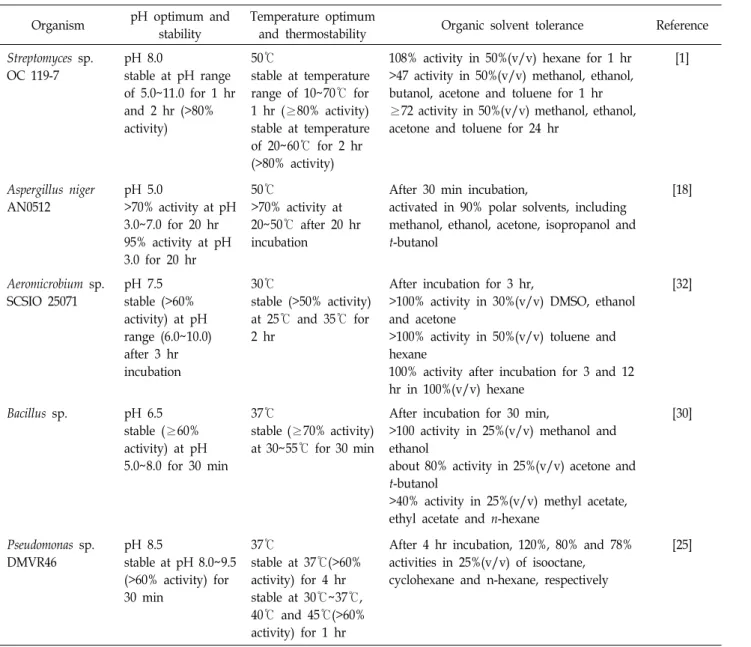
전술한 바와 같이 유기용매 내성 리파아제는 일반 미생물 또 는 유기용매 내성 여부가 조사되지 않은 미생물에서 주로 조 사 보고되고 있다. 2014년도 이후 발표되고 있는 유기용매 내 성 리파아제도 Table 1에 정리되어 있는 바와 같이 주로 유기 용매 내성 여부가 조사되지 않은 미생물과 일반 미생물 기원 이 대부분을 차지하고 있다.
세균 기원의 유기용매 내성 리파아제
먼저 세균 기원의 유기용매 내성 리파아제에 대하여 서술하 면, Pseudomonas sp. AMS8 리파아제는 pH 8에서 pH 12의 알카리영역에서 광범위하게 안정한 효소 활성을 보이며 내열 안정성에 관한 조사는 없으나 유기용매에 대한 내성은 조사 보고되어 있다[8]. 이 효소의 활성은 유기용매 dimethyl sulfoxide (DMSO), n-decane 그리고 n-tridecane에 의하여 각 각 122%, 126% 그리고 136%로 효소 안정성이 촉진되며, benzene과 toluene 에서는 각각 66% 그리고 78% 효소활성이 유지된다[8]. 한편 Pseudomonas sp. AKM-L5 리파아제는 최적 pH는 pH 7이나 pH 2에서 pH 11의 광범위한 pH영역에서 상당히 높은 pH안정성(80% 이상 활성유지)을 보이며 세균 자 체는 저온성 세균으로 최적온도가 10℃이나 온도 0℃에서 6 5℃의 범위에서도 80% 이상 활성을 유지함이 밝혀져 있다[19].
유기용매하에서 1시간 후에도 isopropanol에서는 140% 그리 고 hexane에서는 122%으로 효소활성이 증가되고 있다[19].
Table 1. Representative organic solvent-tolerant lipases Organism pH optimum and
stability
Temperature optimum
and thermostability Organic solvent tolerance Reference Schizophyllum
commune ISTL04
pH 11.0
stable at pH 3.0~12.0 (≥70% activity) for 24 hr
60℃
stable at 50℃ and 60℃
(≥90% activity) for 5 hr,
stable at 70℃ (≥60%
activity) for 1 hr
After 1 hr incubation,
99% and 45% activities in 50%(v/v) DMSO and 50%(v/v) methanol, respectively 61% activity in 50%(v/v) acetone 93% and 131% in 50%(v/v) toluene and 50%(v/v) hexane, respectively
[29]
Aspergillus japonicus LAB01
pH 8.5
stable from pH 5.0 to 9.0 (≥80% activity) for 90 min
45℃
stable at 45℃ (70%
activity) for 3 hr
After 90 min incubation,
137% and 100% activities in hexane and toluene, respectively
98% and 90% activities in methanol (25%, v/v) and ethanol (25%, v/v)
70% activity in iso-propanol (25%, v/v)
[31]
Pseudomonas sp.
AMS8
pH 10.0
stable from pH 8.0 to 12.0 (>60% activity) for 30 min
- After 30 min incubation,
122%, 126% and 136% activities in 25%(v/v) DMSO, 25%(v/v) n-decane and 25%(v/v) n-tridecane, respectively
102% and 109% activities in 25%(v/v) ethanol and 25%(v/v) octane, respectively.
66% and 78% activities in 25%(v/v) benzene and 25%(v/v) toluene, respectively
[8]
Pseudomonas sp.
AKM-L5
pH 7.0
stable from pH 2.0~11.0 (≥80%
activity) for 60 min 10℃
stable from 0~65℃
(>80% activity) for 30 min
After 1 hr pre-incubation,
140% activity in 20%(v/v) iso-propanol 122% activity in 10% and 20%(v/v) hexane
>80% activity in 10%, 20% and 30%(v/v) of butanol, methanol, ethanol, and xylene
[19]
Stenotrophomonas maltophilia GS11
pH 8.0
stable from pH 7.0 to 10.0 (>80% activity) for 30 min
35℃
stable even at 5℃ (55%
activity) for 30 min
After 7 day incubation,
89.7~100.9% activities in hydrophobic organic solvents at both 20% and 50%(v/v) concentration
After 24 hr incubation, more than 85% activity in hydrophilic solvents at a 20%(v/v) concentration
[17]
Bacillus sp. pH 7.0
stable from pH 5.0 to 11.0 (>60%
activity) for 30 min 30℃
stable from 10~60℃
(≥80% activity) for 30 min
After incubation for 7 days, >70% activity in acetone, butanol, benzene, acetonitrile and ethanol (75%, v/v)
>90% activity in hexane and isooctane (25%
and 50%, v/v)
110% and 140% activity in 25%(v/v) xylene and n-decane, respectively
[12]
Burkholderia ubonensis SL-4
pH 8.5
stable at pH 8.0 (79.6% activity) and pH 8.5 (94%
activity) for 6 hr stable at pH 7.5, 9.0 and 9.5 for 1 hr (68.39%, 89.09% and 88.03%,
respectively)
65℃
stable at >90% and 70% activities for 50℃ and 55℃, respectively, after 20 hr
After 2 hr incubation,
92~147% activities in 15%(v/v) isopropanol, acetonitrile, acetone, chloroform and xylene 85~225% activities in 15%(v/v) polar solvents, such as glycerol, ethylene glycol, methanol and ethanol,
as well a non-polar hydrophobic solvents, such as n-hexane, n-heptane and isooctane
[35]
Table 1. Continued
Organism pH optimum and stability
Temperature optimum
and thermostability Organic solvent tolerance Reference Streptomyces sp.
OC 119-7
pH 8.0
stable at pH range of 5.0~11.0 for 1 hr and 2 hr (>80%
activity)
50℃
stable at temperature range of 10~70℃ for 1 hr (≥80% activity) stable at temperature of 20~60℃ for 2 hr (>80% activity)
108% activity in 50%(v/v) hexane for 1 hr
>47 activity in 50%(v/v) methanol, ethanol, butanol, acetone and toluene for 1 hr
≥72 activity in 50%(v/v) methanol, ethanol, acetone and toluene for 24 hr
[1]
Aspergillus niger AN0512
pH 5.0
>70% activity at pH 3.0~7.0 for 20 hr 95% activity at pH 3.0 for 20 hr
50℃
>70% activity at 20~50℃ after 20 hr incubation
After 30 min incubation,
activated in 90% polar solvents, including methanol, ethanol, acetone, isopropanol and t-butanol
[18]
Aeromicrobium sp.
SCSIO 25071
pH 7.5 stable (>60%
activity) at pH range (6.0~10.0) after 3 hr incubation
30℃
stable (>50% activity) at 25℃ and 35℃ for 2 hr
After incubation for 3 hr,
>100% activity in 30%(v/v) DMSO, ethanol and acetone
>100% activity in 50%(v/v) toluene and hexane
100% activity after incubation for 3 and 12 hr in 100%(v/v) hexane
[32]
Bacillus sp. pH 6.5 stable (≥60%
activity) at pH 5.0~8.0 for 30 min
37℃
stable (≥70% activity) at 30~55℃ for 30 min
After incubation for 30 min,
>100 activity in 25%(v/v) methanol and ethanol
about 80% activity in 25%(v/v) acetone and t-butanol
>40% activity in 25%(v/v) methyl acetate, ethyl acetate and n-hexane
[30]
Pseudomonas sp.
DMVR46
pH 8.5
stable at pH 8.0~9.5 (>60% activity) for 30 min
37℃
stable at 37℃(>60%
activity) for 4 hr stable at 30℃~37℃, 40℃ and 45℃(>60%
activity) for 1 hr
After 4 hr incubation, 120%, 80% and 78%
activities in 25%(v/v) of isooctane, cyclohexane and n-hexane, respectively
[25]
Stenotrophomonas maltophila GS11리파아제의 최적 pH는 pH 8.0이며 pH 7에서 10의 중성 및 알카리영역에서 높은 효소안 정성(80%보다 높은 활성)을 보이며, 최적 생육온도가 35℃이 나 효소의 안정성은 5℃에서도 안정성을 보였다[17]. 그리고 20% 및 50% 농도의 소수성 용매 속에서 7일 후에도 89.7 내지 100.9%의 효소활성이 유지되었으며, 20% 농도의 친수성 유기 용매들에서 24시간 후에 85% 이상의 효소안정성을 보였다 [17]. Bacillus sp.리파아제는 생산균의 최적 생육 pH는 pH 7.0 이나 pH 5에서 pH 11의 넓은 범위에서 60% 이상의 효소활성 을 보였고 최적온도는 역시 30℃이나 온도 10℃에서 60℃의 넓은 온도역에서 80% 이상의 효소활성을 보였으며 나아가 75%(v/v)농도의 acetone, butanol, benzene, acetonitrile및 ethanol에서 7일 후에도 70% 이상의 효소을 보였으며 25%
및 50%(v/v)농도의 hexane및 isooctane에서 7일 후에도 90%
이상의 효소활성을 그리고 25%(v/v)농도의 xylene 및 n-hexane에서도 7일 후에도 각각 110% 그리고 140% 효소활성 을 보여 Bacillus sp.리파아제는 유기용매 내성이 있음이 보고 되고 있다[12]. Burkholderia ubonensis SL-4는 최적 생육 pH가 pH 8.5 최적 생육온도 65℃로 고온성 알카리 세균이다. 이 균 주가 생산하는 리파아제는 pH 8.0 과 pH 8.5에서 6시간 후에 도 각각 79.6%와 94% 활성을 보였으며 pH 9.0과 pH 9.5에서 1시간 후에도 89.09%와 88.03% 활성이 유지되었으며, 온도 50
℃와 55℃에서 24시간 후에 각각 90% 그리고 70% 이상 효소 안정성을 보여주고 있으며, 15%(v/v) isopropanol, acetonitrile, acetone, chloroform 그리고 xylene에서 92%에서 147% 효소 활성을 보였으며, n- hexane, n-heptane과 isooctane같은 비극 성 소수성 용매 뿐만 아니라 glycerol, ethylene glycol, methanol그리고 ethanol같은 극성 용매에서 85% 내지 225%
의 효소활성을 보였으므로 다양한 유기용매에 대하여 내성이 있음이 밝혀져 있다[35]. Streptomyces sp. OC119-7균주는 최적 생육 pH 8.0 그리고 최적 생육온도 50℃이었으나, pH에서의 효소 안정성은 광범위한 pH에서 확인되었으며(pH 5.0과 pH 11.0에서 1시간 그리고 2시간 후에 80% 이상의 효소활성을 보임), 1시간 후에 10℃에서 70℃의 범위에서 80% 이상의 효소 활성을 보여주었고 20℃에서 60℃의 온도범위에서 2시간 후 에 80% 이상의 효소활성을 보여 광범위한 온도에서 매우 높은 효소안정성을 보여 주고 있으며, 나아가 hexane에서 1시간 후 에 108% 효소활성을 methanol ethanol acetone 과 toluene에 서 24시간 후 72% 이상의 효소활성을 보여주어 유기용매 내성 도 있음이 밝혀져 있다[1]. Aeromicrobium sp. SCSIO 25071균 주의 최적 생육 pH와 온도는 pH 7.5와 30℃이었으나, pH 6에 서 10의 조건하에서 3시간 배양 후 60% 이상의 효소활성이 유지되었으며, 온도안정성은 크게 높지 않은 것으로 보고되었 으나, Aeromicrobium sp. SCSIO 25071리파아제는 30%(v/v) DMSO, ethanol과 acetone에서 3시간 후 100% 이상의 효소활 성을 보였으며 50%(v/ v)의 toluene과 hexane에서도 100%
이상의 활성을 보였으며 100%(v/v) hexane에서도 3시간과 12 시간 후 100% 효소활성을 보여줌으로써 유기용매 내성이 있 음이 확인되었다[32]. Bacillus sp. 균주는 최적 생육 pH와 온도 가 pH 6.5와 37℃이었으나, 생산된 리파아제는 pH 5에서 8에 서 30분 후 60% 이상의 효소활성을 유지하였으며 온도 30℃에 서 55℃의 범위에서 70% 이상의 효소활성을 보였으며 나아가 methanol과 ethanol에서 30분 후 100% 이상의 효소활성을, acetone과 3차 butanol에서는 80% 이상의 효소활성을, 그리고 methyl acetate, ethyl acetate와 n-hexane에서 40% 이상의 효 소활성을 보여주어 유기용매 내성이 상당히 있는 것으로 보고 되고 있다[30]. Pseudomonas sp. DMVR46은 최적 생육 pH와 온도는 pH 8.5와 37℃이었으나, pH 8에서 pH 9.5에서 30분 후 60% 이상의 효소활성을 보였으며, 온도 40℃와 45℃에서 1시간 후 60% 효소활성을 유지하여 DMVR46 리파아제는 다 소 내알카리성와 내열성을 가지고 있는 것으로 확인되었으며, 25%(v/v) isooctane, cyclohexane과 n-hexane존재하에서 4시 간 후 각각 120%, 80% 그리고 78%의 효소활성을 보여 상당한 유기용매 내성을 가지고 있음이 밝혀져 있다[25].
균류 기원의 유기용매 내성 리파아제
Schizophyllum commune ISTL04 리파아제는 pH 3에서 12에 이르는 광범위한 pH 영역에서 안정하며, 온도 70℃에서 1시간 후에 60% 이상의 활성을 유지하며 50℃와 60℃에서 5시간 후 에 각각 90% 그리고 60%이상의 활성을 유지하고 나아가 유기 용매 존재 하의 조건에서 DMSO, acetone 그리고 methanol에 서 1시간 후 각각 99%, 61% 그리고 45% 활성을 유지하며 심지 어 hexane에서는 리파아제 활성이 더 촉진되어 대조구보다 증가하는 것으로 보고되고 있다[29]. Aspergillus japonicus
LAB01 리파아제는 pH 5에서 9사이에서 90분간 안정성을 보 이며, 45℃에서 3시간 후에 70% 활성이 유지되며 나아가 유기 용매에 대한 내성을 즉 25%(v/v) isopropanol에서는 70% 활 성, 25%(v/v) methanol과 25%(v/v) ethanol에서는 각각 98%
그리고 90%의 활성, 나아가 25%(v/v) hexane과 toluene은 오 히려 활성을 촉진하여 각각 137% 그리고 150% 활성을 보이는 것으로 확인되고 있다[31]. Aspergillus niger AN0512 균주의 생육 최적 pH와 온도는 각각 pH 5.0과 50℃이었으나 pH 3에 서 7에서 20시간 후 70% 이상의 효소활성을 유지하였고 pH 3에서 20시간 후 95% 효소활성을 유지하였고, 온도 20에서 50℃에서 20시간 후 70% 이상의 효소활성을 유지하여 Aspergillus niger AN0512리파아제는 내산성과 내냉성이 강한 효소임이 확인되었다[18]. Aspergillus niger AN0512 리파아제 는 90%(v/v) 극성용매들(methanol, ethanol, acetone, iso- propanol과 3차 butanol)에서 30분 후 효소활성이 촉진되었다 [18].
유기용매 내성 리파아제의 구조적 특성
단백질분해효소에서 일부 아미노산을 소수성 아미노산으 로 교체하여 표면 전하(surface charge)를 제거하면 유기용매 안정성이 증가한다는 보고[20]와 유기 용매 내성 단백질분해 효소에서 이황화(disulfide) 결합이 유기용매 내성에 중요한 역할을 한다는 보고[22]는 있으나, 유기용매 내성 리파아제의 분자 구조와 유기용매에서의 내성(안정성)과의 상관성에 대한 연구는 전무하다. 유기용매 내성 리파아제의 구조는 Bacillus sp. 42가 생산하는 유기용매 내성 리파아제와 같이 두 개의 체인으로 구성되어 있으며 각 체인은 두 개의 도메인으로 구 성되어 있다(Fig. 1).
기발표된 유기용매 내성 리파아제의 구조에서 유기용매 내 성과의 연관성을 밝힐려고 시도한 Chakravorty 등의 논문[3]
에 의하면, 구조상 LogP 2 이상의 유기용매에 내성을 보이는 리파아제, LogP 2 이하의 유기용매에 대하여 내성을 보이는 리파아제 그리고 넓은 범위의 LogP를 보이는 유기용매에 대 하여 내성을 보이는 리파아제로 대별할 수 있다. LogP 2 이상 의 유기용매에 내성을 보이는 리파아제에는 LogP 2 이하의 유기용매에 대하여 내성을 보이는 리파아제에 비해 퍼지티브 전위가 보다 많으며 네커티브 전위는 보다 적으며 크기가 크 며 극성이며 방향족인 잔기들이 아주 높게 분포함이 확인되었 다[3]. LogP 2 이하의 유기용매에 대하여 내성을 보이는 리파 아제에는 소수성, 지방족 그리고 크기가 작은 잔기들이 보다 높게 존재하며, 넓은 범위의 LogP를 보이는 유기용매에 대하 여 내성을 보이는 리파아제에는 퍼지티브 전위를 가지는 잔기 들과 네커티브 전위를 나타내는 잔기들이 동일한 퍼센트로 존재하는 특징을 보이고 있다[3]. 29개 유기용매 내성 리파아 제는 10개의 subfamily로 나누어지며, 이들 sub-family로 나누 어 지는 리파아제들은 표면 노출 잔기가 퍼지티브 전하를 가
A
B
Fig. 1. Domain structure of an organic solvent-tolerant lipase from Bacillus sp. 42. (A) A chain of Bacillus sp. 42 lipase with two domains; (B) B chain of Bacillus sp. 42 lipase with two domains. Data from The National Center for Biotechnology Information (NCBI) at the US National Institutes of Health.
지는 지, 네거티브 전하를 가지는지, 또는 중성 전하를 가지는 지에 따라 구별되고 있다[3]. 한편 모든 유기용매 내성 리파아 제는 대개 소수성 활성 부위를 가지고 있으며, 비이온성 세제 와 비극성 용매에서 안정한 대부분의 리파아제는 그들의 활성 부위에 소수성 잔기들 보다 중성잔기들이 보다 많이 존재하고 있다[3]. 이러한 경향은 임위적으로 돌연변이를 유발하거나 부위 특이적으로 돌연변이를 유발함으로써 유기용매 내성을 증대시키는 각종 단백질공학 실험에서도 확인되고 있다[7, 14]. 유기용매 내성 리파아제는 효소 활성부위에서만 아니라 효소 도메인의 다양한 부위에서의 변화 나아가 이들 변화의 상승적 또는 상호적인 작용을 통하여 유기용매에 대한 내성을 나타낸다[3].
생물공정에서는 회수공정도 생물변환반응 못지 않게 중요 하지만 수계에서는 높은 끓는 점과 낮은 vapor pressure 때문 에 회수비용이 많이 들고 공정중에 가수분해, 라세미화, 중합 그리고 분해같은 부반응이 수계에서는 자주 일어나므로 효소 이용은 매우 제한적이다[15]. 그러므로 이상계, 유기용매계 그 리고 비수계를 이용한 생물변환 반응이 많이 연구되고 있다.
또한 이런 변환공정에 적용할려면 효소 자체가 유기용매 내성 을 가지고 있는 효소를 탐색하여 적용할 필요가 높다. 앞으로 유기용매 내성 효소가 가지고 있는 특성 기질(chemo-), 위치 (regio-) 및 입체 특이적(stereo-specific)인 활성이 매우 다양하 므로 다양한 생물변환반응에의 적용을 위하여 보다 다양한 유기용매 내성 리파아제에 대한 기초연구가 활발히 이루어질
것으로 예상되고 있다.
유기용매 내성 리파아제의 이용
2014년 이후의 유기용매 내성 리파아제의 이용 현황은 Table 2에 정리되어 있는 바와 같다.
환경 및 화학공정 분야에의 이용
Pseudomonas AKM-L5리파아제는 광범위한 pH 영역에서 효소 안정성이 높으며 효소의 온도 안정성도 겸비하고 있고 나아가 유기용매 내성도 있으며 특히 10%, 20% 그리고 30%
농도의 butanol, hexane, methanol, isopropanol과 ethanol 그 리고 20%와 30% 농도의 xylene에서 100% 이상의 효소활성을 10% 농도의 xylene에서는 90% 이상의 활성을 보였으며 AKM- L5리파아제는 유기용매와 금속이온 존재하의 저온에 서도 높은 안정성과 활성을 보이고 높은 유류 제거능력을 가 지고 있어 유류로 오염된 토양 및 해양 복원에 중요한 역할을 할 것으로 기대된다[19]. Pseudomonas stutzeri LC2-8 리파아제 는 25%(v/v)의 isopropanol, acetone, ethanol, methanol, di- methylformamide(DMF) 그리고 DMSO에서 효소활성이 완 전히 유지되거나 오히려 촉진되었으며, 25%(v/v) n-heptane 에서도 90% 이상의 효소활성이 유지되어 리파아제 자체가 상 당한 유기용매 내성을 가지고 있음이 밝혀졌으며 나아가 LC2-8 리파아제를 사용하여 만델산(mandelic acid)의 enan- tio-selctive acylation를 실현시켜 (s)-o-acetyl mandelic acid을
Table 2. Applications of some organic solvent-tolerant lipases
Organism
Stability in organic solvents
Incubation
period Applications Reference
Stimulatory effect (≥100% relative
activity)
Mild inhibitory effect (≥90%
relative activity)
Inhibitory effect (<90% relative
activity) Pseudomonas
sp. AKM-L5
10%, 20% and 30% of butanol, hexane, methanol, isopropanol, ethanol
20% and 30% of xylene
10% xylene - 60 min The lipase show high stability
and activity at cold temperature in presence of organic solvents and metal ions.
Pseudomonas sp. AKM-L5 lipase also had high oil removal capability.
[19]
Bacillus sp. 25%(v/v) of xylene and n-decane 50% and 75%
(v/v) of n-decane
Hexane and isooctane at concentration of 25% and 50%
(v/v) 25%(v/v) toluene 25%(v/v) heptane
Acetone, butanol, benzene, acetonitrile, ethyl acetate and ethanol at concentration as high as 75%(v/v)
7 days Synthesis of iso-butyl acetate and ethyl lactate was achieved based on the esterification of iso-butyl alcohol and ethyl alcohol using acetic acid and lactic acid as acyl donor, respectively
Isobutyl acetate and ethyl lactate is used in the food industry
The transesterification efficiency of lipase for waste, palm and cotton oil was recorded to be 75.7%, 99.5%
and 88.8%, respectively The lipase mediated >4-fold increase in oleic acid content of chlorella oil
[12]
Burkholderia ubonensis SL-4
15%(v/v) and 30%(v/v) of glycerol, ethylene glycol, dimethyl sulfoxide, methanol and n-heptane 15%(v/v) of dimethylformami de, isopropanol, acetone, chloroform and xylene
15% and 30%
(v/v) of ethanol, 15%
(v/v) of acetonitrile and isooctane
15% and 30%
(v/v) of tetra-hydrofuran, n-butanol, 1-hexanol, iso-octanol 30%(v/v) of dimethylforma- mide,
isopropanol, acetonitrile, acetone, xylene, n-hexane and isooctane
2 hr The SL-4 lipase was used for biodiesel production from soybean oil in a solvent-free system.
Conversion yield of 92.24%
was achieved after 42 hr for soybean oil
[35]
Streptomyces sp. OC 119-7
Hexane (50%, v/v)
- 50%(v/v) of
methanol, ethanol, isopropanol, butanol, hexane, ethyl acetate, acetone, acetonitrile and toluene
1~24 hr Streptomyces sp. OC 119-7 lipase was used in transesterification as a biocatalyst for biodiesel production
[1]
Table 2. continued
Organism
Stability in organic solvents
Incubation
period Applications Reference
Stimulatory effect (≥100% relative
activity)
Mild inhibitory effect (≥90%
relative activity)
Inhibitory effect (<90% relative
activity) Aspergillus
niger AN0512
90%(v/v) of methanol, ethanol, acetone, isopropanol, t-butanol and butanol
- 90%(v/v) of
diethyl ether, chloroform and hexane
30 min Aspergillus niger AN0512 lipase showed significant 3- regiospecificity
Trout oil was hydrolyzed by AN0512 lipase for enriching EPA and DHA
The EPA and DHA contents increased from 1.97±0.04%
and 3.08±0.06% to 2.17±0.02%
and 3.45±0.04% after 12 hr hydrolysis
[18]
Bacillus sp. 25%(v/v) of methanol, ethanol
- 25%(v/v) of
acetone, t-butanol, n-hexane
30 min Bacillus sp. lipase was used for methyl ester production The yield of fatty acid methyl esters from Botryococcus sp. oil reached 80% after 40 hr
[30]
Pseudomonas sp. DMVR46
25% isooctane - 25% of
isopropanol, acetone, cyclohexane and n-hexane
4 hr DMVR46 lipase was used for the synthesis of pentyl valerate, offering better production of odor and flavor
The immobilized DMVR46 lipase into AOT- organogels exhibited 88% ester production efficiency after 4 days
[25]
Pseudomonas stutzeri LC2-8
25%(v/v) of isopropanol, acetone, ethanol, methanol, DMF, DMSO
25%(v/v) of n-heptane
25%(v/v) of nonane, isooctane, n-octane, n-hexane
24 hr The enantioselective acylation of mandelic acid was achieved using by lipase LC2-8 The (s)-o-acetyl mandelic acid was obtained in 99.8% ee and the conversion reached 49.15%
within 15 hr
[2]
Idiomarina sp. W33
50%(v/v) n- hexane
50%(v/v) glycerol and cyclohexane
50%(v/v) DMSO, methanol, ethanol, acetone, t-butanol, benzene, toluene, 1-decanol and isooctane
3 d About 84 and 91% yields of biodiesel production was achieved using Jatropha oil by free and immobilized Idiomarina lipase, respectively
[16]
99.8% ee 로 획득되게 하였으며, 그 결과 15시간 이내 전환율이 49.15%에 도달하였다[2].
식품분야에의 이용
Bacillus sp.리파아제는 광범위한 pH 영역에서 활성이 있으 며, 저온과 고온에서도 효소안정성을 보이고 있으며 25%(v/v) xylene과 n-decane, 50%와 75%(v/v) 농도의 n-decane에서
100% 이상의 효소활성을 보이며 hexane 과 isooctane (25%
그리고 50%(v/v)), 25%(v/v) toluene 그리고 25%(v/v) hep- tane에서는 90% 이상의 효소활성을 보였다, 이 균주 리파아제 는 acetic acid와 lactic acid를 아실기 공여자로서 사용하여 각각 isobutyl alcohol과 ethyl alcohol의 에스테르화에 기초하 여 isobutyl acetate와 ethyl lactate를 합성하였다[12]. 이들 물 질은 식품산업에서 향미성분 또는 식품첨가제로서 활용도가
높은 물질이다. 또한 Bacillus sp.리파아제를 사용하여 클로렐 라 오일의 oleic acid함량을 4배 이상 증가시킬 수 있음이 확인 보고되었으며, oleic acid은 뉴트라슈티컬 오일로서 이용이 증 가될 수 있기에 중요한 연구결과이다[12]. Aspergillus niger AN0512 기원의 리파아제는 90%(v/v) 농도의 methanol, ethanol, acetone, isopropanol, 3차 butanol 그리고 butanol에 서 100% 이상의 효소활성이 유지 촉진됨이 보고되었으며 나 아가 Aspergillus niger AN0512 리파아제는 중요한 3-위치특이 성(3-regio-specificity)을 보여 송어오일을 AN0512 리파아제 로 12시간 가수분해하면 eicosapentaenoic acid (EPA)와 do- cosahexaenoic (DHA)가 증가하여 EPA와 DHA 함량이 각각 1.97±0.04%와 3.08±0.06%에서 2.17±0.02%와 3.45±0.04%로 증 가함이 확인되었다[18]. Pseudomonas sp. DMVR46 리파아제 는 25%(v/v) 농도의 isooctane 존재하에서 100% 이상의 효소 활성이 유지 또는 촉진되었으며 25%(v/v) propanol, acetone, cyclohexane 그리고 n-hexane 에서는 효소활성이 저해는 되었 으나 다소의 활성이 유지되었으며 DMVR46 리파아제는 풍미 성분과 냄새성분 합성을 하기 위한 pentyl valerate합성에 사용 되었다[20]. 또한 AOT-organogel에 고정화된 DMVR46 리파아 제는 4일 후 88% ester 생산 수율을 보였다[25]. 또한 각종 ester 류들 합성도 시도되었다[25, 30].
바이오에너지분야에의 이용
Bacillus sp. 리파아제의 폐유 팜유 그리고 면화유에 대한 트랜스에스테르반응 수율이 각각 75.7%, 99.5% 그리고 88.8%
임이 보고되고 있다[12]. 폐유 팜유 그리고 면화유의 트랜스에 스테르화는 바이오디젤 제조의 기반이 되는 기술로서 미래 사회를 위한 원천기술의 하나이다. Burkholderia ubonensis SL-4 리파아제는 15%(v/v)와 30%(v/v)의 glycerol, ethylene gly- col, DMSO, methanol 그리고 n-heptane, 또한 15%(v/v)의 di- methylformamide, isopropanol, acetone, chloroform 그리고 xylene에서 100% 이상의 효소활성을 보였으나 15%와 30%
(v/v) ethanol 그리고 15%(v/v) acetonitrile과 isooctane에서 는 90% 이상의 효소활성을 나타내어 유기용매 내성이 있음이 확인되었으며 나아가 SL-4 리파아제는 무용매계(solvent-free system)에서의 바이오디젤생산에 이용되어 무용매계(solvent- free system)에서 대두유를 42시간 전환시 대두유의 전환율이 92.24%에 도달함이 조사 보고되었다[35]. Streptomyces sp. OC 119-7리파아제는 50%(v/v) hexane 에서도 100% 이상의 활성 을 보였으며, 50%(v/v) 농도의 methanol, ethanol, isopropanol, butanol, ethyl acetate, acetone, acetonitrile 그리고 toluene에 서도 효소활성은 다소 저해를 받으나 상당한 안정성을 유지하 는 것으로 밝혀져 바이오디젤 생산을 위한 촉매로써 트랜스에 스테르 반응에 이용되었다[1]. Bacillus sp.가 생산하는 리파아 제는 25%(v/v)농도의 methanol과 ethanol에서 효소활성이 완전히 유지되거나 촉진되었으며 25%(v/v)농도의 acetone,
butanol 그리고 hexane 에서도 효소활성이 다소 저해되었으 나 상당한 효소활성이 유지되었으며 Bacillus sp. 리파아제는 methyl ester 생산에 적용되어 민물에서 사는 흔한 단세포 조 류인 보트리오코쿠스(Botryococcus sp.) 오일로부터 지방산 methyl ester 전환 수율이 40시간 후 80%에 이르런다고 보고 되고 있다[30]. 한편 Idiomarina sp. W33 리파아제는 50%(v/v) n-hexane에서 100% 이상의 효소활성을 보였으며 50%(v/v) glycerol, cyclohexane에서도 90% 이상의 효소활성을 유지하 여 상당한 유기용매 내성을 보였으며 자르토파 오일 (Jatropha oil)을 사용하여 바이오디젤을 생산함이 있어서 비고정화 또는 고정화 Idiomarina sp. W33 리파아제가 각각 약 84 그리고 91%
수율로 바이오디젤을 생산하는 것으로 밝혀졌다[16].
이상과 같이 유기용매 내성 리파아제를 식품분야에서 활용 하기 위하여 풍미성분과 식품첨가제로서 isobutyl acetate와 ethyl lactate 합성[10], 식품중의 EPA와 DHA 함량증가[18].
그리고 oleic acid 함량증가[12]. 나아가 pentyl valerate등 풍미 성분 합성[25]이 시도되었다. 화학공정(의약품 합성) 분야에서 는 변환반응으로 키랄성 합성 단위체의 주요 선구물질인 (S)-o-acetyl mandelic acid의 합성이 이루어졌다[2]. 그러나 가 장 많이 연구된 분야는 바이오에너지인 바이오디젤 생산 분야 이었으며, 각종 오일에 대한 에스테르 교환반응에 유기용매 내성 리파아제가 활용되었고[1, 12, 35]. esterification 반응에 기초하여 바이오디젤 생산을 위한 각종 ester 류들 합성도 시 도되었다[16, 25, 30].
리파아제는 식품, 낙농, 제약, 농화학, 세제에서 유화학, 차 산업, 화장품, 피혁 그리고 다양한 환경산업 등의 광범위한 산업분야에서 활용성이 높다[28]. 그러므로 최근 연구가 미진 한 분야인 화장품 산업에서의 유화제로서의 이용 그리고 항 산화제 개발을 위한 기능성 페놀류의 esterification 반응에의 적용 등에 유기용매내성 리파아제를 적극 활용하여야 할 것이 다. 또한 합성 및 의약품 산업에서는 각종 racemic 화합물들의 입체화학적인 분할을 통하여 광학적으로 순도높은 물질의 생 산에 유기용매 내성 리파아제의 stereo-선택성 그리고 enan- tio-특이적인 특성을 이용할 수 있게 이에 대한 기초 연구가 이루어져야 할 것이다. 한편 지방산 esters 합성을 위한 생물변 환 반응에 대한 연구는 바이오디젤 생산과 풍미성분의 생산을 위하여 많은 연구가 진행되었으나 지방산 에스테르들은 바이 오디젤과 풍미 및 아로마 화합물로서 이용될 뿐만 아니라 세 제 화장품 나아가 제약산업에서도 중요한 화합물로 이용되고 있으므로 유기용매 내성 리파아제를 적용하여 새롭고 효율적 인 공정 개선 등이 필요하다.
결론 및 전망
유기용매 내성 리파아제를 비롯한 유기용매 내성 효소는 처음 유기용매 내성 세균에서 보고되었으나 이후 다양한 미생
물이 생산하는 것으로 알려져 있으며, 유기용매 내성 미생물 의 탐색에 있어서의 어려움 때문에 최근에는 주로 유기용매 내성 미생물 보다는 유기용매 내성 유무를 떠나 다양한 미생 물에서 유기용매 내성 효소를 찾는 것이 보다 신속하며 확률 적으로도 많은 유기용매 내성 효소를 찾는 방법으로 확인되고 있다. 따라서 최근 유기용매 내성 미생물이 생산하는 유기용 매 내성 리파아제에 대한 보고는 많지 않으며 균류을 비롯한 다양한 미생물에서 유기용매 내성 리파아제가 보고되고 있다.
이들 유기용매 내성 리파아제는 유기용매 내성 뿐만 아니라 다양한 pH 및 온도에서도 활성을 유지함이 확인되고 있어 효 소에 대한 활용범위가 폭넓은 경향이 있다. 이들 효소 중 pH 2.0에서 pH 12.0에서도 상당한 효소활성을 유지하는 것도 있 으며 일부를 제외한 대다수의 효소가 알카리 영역의 pH에서 효소활성을 유지하는 것으로 일반적으로 알려져 있다. 한편 이들 리파아제들 중 저온에서도 효소활성을 보이는 효소도 보고되고 있으며, 다소 내열성이 있는 효소도 보고되고 있으 나 일부 리파아제들은 상당한 범위의 온도하에서도 효소활성 이 유지되며 일부 리파아제는 심지어 10℃-70℃의 넓은 범위 의 온도역에서도 상당시간 효소활성이 유지됨이 알려져 있다.
그러므로 다양한 분야에서의 응용가능성을 이들 리파아제는 구비하고 있다. 그러므로 이들 유기용매 내성 리파아제는 환 경분야에서 오염 오일의 제거 등에서 활용이 시도되고 있으 며, 식품분야에의 적용을 위하여 다양한 odor 와 flavor 에스테 르들의 생산에 적용되고 있다. 각종 오일에서 EPA 및 DHA 함량을 증가시킴으로써 오일의 부가가치 향상에도 적용되고 있다. 또한 합성 화학분야에서는 키랄성 합성단위체(synthon) 의 주요 전구물질인 만델산(mandelic acid) 등의 acetylation등 에 이들 효소가 적용되며 특히 기질 (S)-O-Acetyl mandelic acid등에 대한 높은 enantiopreference을 가진 유기용매 내성 리파아제의 적용은 효율적인 공정개발에 유효한 것으로 확인 되었다. 그러나 무엇보다 에너지 측면 특히 바이오에너지 개 발을 위한 바이오 디젤 생산에 많은 유기용매 내성 리파아제 가 적용되어 성과를 내고 있어 유기용매 내성 리파아제의 적 용 연구가 가장 활발히 이루어지고 있는 분야이다.
유기용매 내성, enantiopreference 그리고 에스터화 반응 및 에스테르 교환반응 효율 등은 균주 특이성이 매우 높은 것으 로 알려져 있으므로 보다 많은 유기용매 내성 리파아제에 대 한 탐색과 연구가 요구되고 있다. 그리고 유기용매 내성 리파 아제의 식품 화학공학 환경 그리고 바이오에너지 분야에서의 적용도 이들 효소에 대한 기초연구를 토대로 하여 이루어지는 만큼 다양한 시도와 적용가능성 검토가 필요하다. 특히 토착 미생물에서의 유기용매 내성 리파아제에 대한 선도적인 탐색 연구가 필요하며 이를 기초로 하여 유기용매 내성 리파아제의 물리화학적 성질에 대한 특성화 연구를 함으로써 차별화된 그리고 의의가 있는 연구성과 도출이 가능할 것이다. 또한 우 리나라에서 탐색한 유기용매 내성 리파아제의 다양한 분야에
의 이용과 적용도 학문적으로나 산업적으로 많은 성과가 기대 되는 분야이다.
감사의 글
본 논문은 창원대학교 2017-2018학년도 교내연구비 지원을 받아 수행된 연구임.
References
1. Ayaz, B., Ugur, A. and Boran, R. 2015. Purification and char- acterization of organic solvent-tolerant lipase from Strepto- myces sp. OC119-7 for biodiesel production. Biocatal. Agric.
Biotechnol. 4, 103-108.
2. Cao, Y., Wu, S., Li, J., Wu, B. and He, B. 2014. Highly effi- cient resolution of mandelic acid using lipase from Pseudo- monas stutzeri LC2-8 and a molecular modeling approach to rationalize its enantioselectivity. J. Mol. Catal. B-Enzym.
99, 108-113.
3. Chakravorty, D., Parameswaran, S., Dubey, V. K. and Patra, S. 2012. Unraveling the rationale behind organic solvent sta- bility of lipases. Appl. Biochem. Biotechnol. 167, 439-461.
4. Cruden, D. L., Wolfram, J. H., Rogers, R. T. and Gibson, D. T. 1992. Physiological properties of a Pseudomonas strain which grows with p-xylene in a two-phase (organic-aque- ous) medium. Appl. Environ. Microbiol. 58, 2723-2729.
5. De Bont, J. A. 1998. Solvent-tolerant bacteria in biocatalysis.
Trends Biotechnol. 16, 493-499.
6. Doukyu, N. and Ogino, H. 2010. Organic solvent-tolerant enzymes. Biochem. Eng. J. 48, 270-282.
7. Dror, A., Shemesh, E., Dayan, N. and Fishman, A. 2014.
Protein engineering by random mutagenesis and struc- ture-guided consensus of Geobacillus stearothermophilus li- pase T6 for enhanced stability in methanol. Appl. Environ.
Microbiol. 80, 1515-1527.
8. Ganasen, M., Yaacob, N., Rahman, R. N., Leow, A. T., Basri, M., Salleh, A. B. and Ali, M. S. 2016. Cold-adapted organic solvent tolerant alkalophilic family I. 3 lipase from an Antarctic Pseudomonas. Int. J. Biol. Macromol. 92, 1266-1276.
9. Hartmans, S., van der Werf, M. J. and de Bont, J. A. 1990.
Bacterial degradation of styrene involving a novel flavin ad- enine dinucleotide-dependent styrene monooxygenase.
Appl. Environ. Microbiol. 56, 1347-1351.
10. Hun, C. J., Rahman, R. N., Salleh, A. B. and Basri, M. 2003.
A newly isolated organic solvent tolerant Bacillus sphaericus 205y producing organic solvent-stable lipase. Biochem. Eng.
J. 15, 147-151.
11. Inoue, A. and Horikoshi, K. 1989. A Pseudomonas thrives in high concentrations of toluene. Nature 338, 264-266.
12. Jain, D. and Mishra, S. 2015. Multifunctional solvent stable Bacillus lipase mediated biotransformations in the context of food and fuel. J. Mol. Catal. B-Enzym. 117, 21-30.
13. Javed, S., Azeem, F., Hussain, S., Rasul, I., Siddique, M. H., Riaz, M., Afzal, M., Kouser, A. and Nadeem, H. 2017.
Bacterial lipases: A review on purification and character- ization. Prog. Biophys. Mol. Biol. http://dx.doi.org/10.1016/j.
pbiomolbio.2017.07.014
14. Kawata, T. and Ogino, H. 2010. Amino acid residues in- volved in organic solvent-stability of the LST-03 lipase.
Biochem. Biophys. Res. Commun. 400, 384-388.
15. Kumar, A., Dhar, K., Kanwar, S. S. and Arora, P. K. 2016.
Lipase catalysis in organic solvents: advantages and applications. Biol. Proced. Online 18, 2.
16. Li, X., Qian, P., Wu, S. G. and Yu, H. Y. 2014. Characterization of an organic solvent-tolerant lipase from Idiomarina sp. W33 and its application for biodiesel production using Jatropha oil. Extremophiles 18, 171-178.
17. Li, M., Yang, L. R., Xu, G. and Wu, J. P. 2016. Cloning and characterization of a novel lipase from Stenotrophomonas mal- tophilia GS11: the first member of a new bacterial lipase fam- ily XVI. J. Biotechnol. 228, 30-36.
18. Liu, G., Hu, S., Li, L. and Hou, Y. 2015. Purification and Characterization of a Lipase with High Thermostability and Polar Organic Solvent-Tolerance from Aspergillus niger AN0512. Lipids 50, 1155-1163.
19. Maharana, A. and Ray, P. 2015. A novel cold-active lipase from psychrotolerant Pseudomonas sp. AKM-L5 showed or- ganic solvent resistant and suitable for detergent for- mulation. J. Mol. Catal. B-Enzym. 120, 173-178.
20. Martinez, P. and Arnold, F. H. 1991. Surface charge sub- stitutions increase the stability of alphalytic protease in or- ganic solvents. J. Am. Chem. Soc. 113, 6336-6337.
21. Na, K. S., Kuroda, A., Takiguchi, N., Ikeda, T., Ohtake, H.
and Kato, J. 2005. Isolation and characterization of ben- zene-tolerant Rhodococcus opacus strains. J. Biosci. Bioeng. 99, 378-382.
22. Ogino, H. and Ishikawa, H. 2001. Enzymes which are stable in the presence of organic solvents. J. Biosci. Bioeng. 91, 109-116.
23. Ogino, H., Miyamoto, K. and Ishikawa, H. 1994. Organic- solvent-tolerant bacterium which secretes organic-solvent- stable lipolytic enzyme. Appl. Environ. Microbiol. 60, 3884- 3886.
24. Ogino, H., Yasui, K., Shiotani, T., Ishihara, T. and Ishikawa, H. 1995. Organic solvent-tolerant bacterium which secretes an organic solvent-stable proteolytic enzyme. Appl. Environ.
Microbiol. 61, 4258-4262.
25. Patel, V., Nambiar, S. and Madamwar, D. 2014. An ex- tracellular solvent stable alkaline lipase from Pseudomonas sp. DMVR46: Partial purification, characterization and application in non-aqueous environment. Process Biochem.
49, 1673-1681.
26. Ramos, J. L., Duque, E., Huertas, M. J. and Haı̈dour, A. 1995.
Isolation and expansion of the catabolic potential of a Pseudomonas putida strain able to grow in the presence of high concentrations of aromatic hydrocarbons. J. Bacteriol.
177, 3911-3916.
27. Salihu, A. and Alam, M. Z. 2015. Solvent tolerant lipases:
a review. Process Biochem. 50, 86-96.
28. Sharma, S. and Kanwar, S. S. 2014. Organic solvent tolerant lipases and applications. The Scientific World Jo.
29. Singh, M. K., Singh, J., Kumar, M. and Thakur, I. S. 2014.
Novel lipase from basidiomycetes Schizophyllum commune ISTL04, produced by solid state fermentation of Leucaena leucocephala seeds. J. Mol. Catal. B-Enzym. 110, 92-99.
30. Sivaramakrishnan, R. and Incharoensakdi, A. 2016. Purifica- tion and characterization of solvent tolerant lipase from Bacillus sp. for methyl ester production from algal oil. J.
Biosci. Bioeng. 121, 517-522.
31. Souza, L. T. A., Oliveira, J. S., dos Santos, V. L., Regis, W.
C., Santoro, M. M. and Resende, R. R. 2014. Lipolytic poten- tial of Aspergillus japonicus LAB01: production, partial purifi- cation, and characterisation of an extracellular lipase.
BioMed Res. Int. 2014, 108913.
32. Su, H., Mai, Z., Yang, J., Xiao, Y., Tian, X. and Zhang, S.
2016. Cloning, expression, and characterization of a cold- active and organic solvent-tolerant lipase from Aeromicrobi- um sp. SCSIO 25071. J. Microbiol. Biotechnol. 26, 1067-1076.
33. Torres, S., Pandey, A. and Castro, G. R. 2011. Organic sol- vent adaptation of Gram positive bacteria: applications and biotechnological potentials. Biotechnol. Adv. 29, 442-452.
34. Weber, F. J., Ooijkaas, L. P., Schemen, R. M., Hartmans, S.
and de Bont, J. A. 1993. Adaptation of Pseudomonas putida S12 to high concentrations of styrene and other organic solvents. Appl. Environ. Microbiol. 59, 3502-3504.
35. Yang, W., He, Y., Xu, L., Zhang, H. and Yan, Y. 2016. A new extracellular thermo-solvent-stable lipase from Burkhol- deria ubonensis SL-4: identification, characterization and ap- plication for biodiesel production. J. Mol. Catal. B-Enzym.
126, 76-89.
초록:유기용매 내성 리파아제와 그 이용가능성
주우홍*
(창원대학교 생물학화학융합학부)
본 총설에서는 유기용매 내성 리파아제와 그들의 산업, 생물공학 및 환경에서의 잠재적인 영향에 대하여 서술 하고자 한다. 유기용매 내성 리파아제는 유기용매 내성 세균에서 처음 보고되었으나, 많은 유기용매 내성 리파아 제들이 유기용매 내성 세균 뿐만 아니라 잘 알려진 Bacillus, Pseudomonas, Streptomyce 그리고 Aspergillus sp. 균주 같은 유기용매 비내성 세균 그리고 균류 균주들에서도 보고되고 있다. 이들 리파아제들은 유기용매에서 쉽게 불 활성화되지 않기 때문에 유기용매에 의한 효소 불활성화를 방지하기 위하여 별도로 그들을 고정화할 필요가 없 다. 그러므로 다수의 생물공정 및 생물변환 공정에서 이용될 수 있는 잠재적인 유용성을 가지고 있다. 이들 유기 용매 내성 리파아제들을 사용하면, 유기용매계 또는 비수계에서 다수의 불용성 기질들의 용해도가 증가하며, 수계 에서는 불가능한 다양한 화학반응들이 일어나고, 가수분해 대신에 합성반응이 일어나며, 물에 의한 부반응이 억제 되며, 화학, 위치 그리고 엔안티오(대칭) 선택성(chemo, regio and enantioselective) 변환반응의 가능성이 증가한 다. 나아가 고정화하지 않아도 효소의 회수와 재이용이 가능하며, 유기용매계와 비수계에서는 리파아제의 안정성 이 더 좋아지는 경향도 있다. 그러므로 유기용매 내성 리파아제는 유기용매계와 비수계를 이용한 생물변환공정에 생물촉매로써 그들을 이용가능하다는 점에서 많은 주목을 받고 있다.