508
Copyright © 2014 The Korean Society of Fisheries and Aquatic Science pISSN:0374-8111, eISSN:2287-8815
서 론
우리나라는세계상위권의패류생산국으로
2011
년패류생산 량은약461
천톤으로총수산물생산량의14.3%
를차지하고 있으며품종별로는굴이306
천톤으로66%,
바지락이38
천톤 으로8.1%
를차지하고있다(MOF, 2014).
패류는생식
,
가열조리등다양한형태로소비되는국민기호 식품이지만,
생물학적특성상원료수확해역이연안에위치하 고있고여과섭식의생리적특성상여러가지식품위생안전위 해에노출될 가능성이 타수산물에 비하여 상대적으로 높다(Hunter et al., 1999; Mallin et al., 2001).
특히인구의증가와 도시의발달로전염병이나세균성식중독등감염증을유발하 는병원균이함유되어있을확률이높은분변성하수의연안환 경을오염시키고있으며어장및양식장에도심각한피해를야 기시키고있어(Metcalf, 1978; Miossec et al., 1988; Lipp et al.,
2001)
생산단계에서부터의철저한위생관리가요구되고있다.
특히굴의경우는가열조리하지않고날것으로섭취하는경우 가많기때문에생산단계에서오염되는여러가지식품위생위
험요소로인해인체에직접적인위해를미칠수있다
(Sobsey
and Jaykus, 1991).
한국 연안산 패류 중 Vibrio parahaemolyticus의 분포 및 항생제내성 특성 비교
유홍식*·오은경
1·신순범
2·박용수·이희정
3·김지회·송기철
1국립수산과학원 식품안전과, 1국립수산과학원 서해수산연구소, 2국립수산과학원 남서해수산연구소, 3식품의약품안전평가원 미생물과
Distribution and Antimicrobial Resistance of Vibrio parahaemolyticus Isolated from Korean Shellfish
Hongsik Yu*, Eun-Gyoung Oh
1
, Soon Bum Shin2
, Yong Su Park, Hee-Jung Lee3
, Ji Hoe Kim and Ki Cheol Song1
Food Safety Division, National Fisheries Research and Development Institute, Busan 619-705, Korea 1West Sea Fisheries Institute, National Fisheries Research and Development Institute, Incheon 400-420, Korea 2Southwest Sea Fisheries Institute, National Fisheries Research and Development Institute, Yeosu 556-823, Korea
3Food Microbiology Division, National Institute of Food and Drug Safety Evaluation, Cheongju 363-700, Korea
The contamination status of Vibrio parahaemolyticus in commercially valuable shellfish from the south and west coasts of Korea and the antimicrobial resistance patterns of isolated V. parahaemolyticus were investigated from July through October, 2011. The range of V. parahaemolyticus concentrations in oysters Crassostrea gigas and short neck clams Venerupis philippinarum was <30~290 MPN/100 g and <30~46,000 MPN/100 g, respectively, and greater than 10,000 MPN/100 g of V. parahaemolyticus was detected from 7 of 40 short neck clams. During the survey period, 436 strains of V. parahaemolyticus were isolated (129 from oysters and 307 from short-neck clams) and the antimicrobial resistance patterns of all of the isolates were examined. Antimicrobial resistance against at least one antibiotic was seen in 79.8% of the oyster isolates (103 strains) and 63.8% of the short neck clam isolates (196 strains). The anti- microbial resistance patterns were relatively simple because the antimicrobial resistance of the isolates was simply due to resistance to ampicillin. Only one oyster isolate and three short neck clam isolates showed multiple antibiotic resistance, i.e. , resistance against more than four antibiotics.
Key words: Vibrio parahaemolyticus , Antimicrobial resistance, Multiple antibiotic resistance
This is an Open Access article distributed under the terms of the Creative Commons Attribution Non-Commercial Licens (http://creativecommons.org/licenses/by-nc/3.0/)which permits unrestricted non-commercial use, distribution, and reproduction in any medium, provided the original work is properly cited.
http://dx.doi.org/10.5657/KFAS.2014.0508 Kor J Fish Aquat Sci 47(5) 508-515, October 2014
Received 25 August 2014; Revised 3 September 2014; Accepted 12 September 2014
*Corresponding author: Tel: +82. 51. 720. 2632 Fax: +82. 51. 720. 2619
E-mail address: [email protected]
수산물섭취와관련된세균성식중독의가장중요한원인균 은장염비브리오균
(Vibrio parahaemolyticus)
으로이균은전 세계적으로기수지역이나연안의해수와수산물에서널리검 출되는해양상재세균이다( Ortigosa et al., 1994; Diggles et al., 2000; Urakawa et al., 2000).
이세균의식중독관련성은1950
년일본에서최초로밝혀졌고,
주로하절기에오염된수산물의 생식이나불충분한가열후섭취시에발생하는위장염의주요 원인이되고있으며매년하절기에는이균에의한식중독이빈 번히발생하여수산물소비에도큰영향을끼치고있다.
우리나 라의경우V. parahaemolyticus
에의한식중독발생건수는7
월 에서11
월까지가80%
이상을차지하고있다(KFDA, 2014).
따 라서이균에대한효율적인위생관리및식중독대책을위해서 는오염실태를정확히파악하고,
그에대한제어등적절한대책 의강구가절대적으로필요하다.
한편최근임상및축산분야에서는질병의치료에사용되는 각종항균제에내성을나타내는병원세균이종종분리되고있 으며
,
수산분야에서도어류양식장에서장기간에걸친항균제 의사용으로V. parahaemolyticus
등병원성세균군에서의내 성균의발생이우려되고있다.
세균의항균제내성을결정하는 인자들은플라스미드전이에의해쉽게전달되는데이러한인 자들이사람에게질병을유발하는세균에전이될수있으며,
양 식생물이이러한매개체역할을할수도있다고보고된바있다(Rhodes et al., 2000).
특히항균제를투여한축산동물이나사람의분변으로부터내 성균이자연환경으로방출되기도하는데
,
사람이나동물에게 투여한항균제가완전히소화흡수되지않고섭취된항균제의 경우약70%
정도가성분이변하지않은상태로배설된다는보 고도있다(Kümmerer, 2009).
따라서본연구에서는우리나라주요연안산패류
(
굴,
바지 락)
을대상으로식중독원인균인V. parahaemolyticus
에대한 오염실태파악을위하여2011
년7
월부터11
월까지남해안및 서해안패류양식장을대상으로V. parahaemolyticus
의분포를 조사를하였다.
또한비브리오균의항균제내성패턴연구의기 초자료로활용하고자분리된균에대한항균제내성특성에대 해서검토하였다.
재료 및 방법
패류 시료
V. parahaemolyticus
분리를위하여우리나라패류의주생산 지인남해안(
통영·
거제)
및서해안(
곰소만)
패류양식장에서각 각굴(Crassostrea gigas)
과바지락(Venerupis philippinarum)
을2011
년7
월부터11
월까지매월채취하여시료로하였다.
패류시료는멸균된용기에채취한후
10℃
이하로유지하면서실험실로운반하여실험에사용하였다
.
시험에사용된시료는굴 과바지락이각각40
개였다.
시료채취시해수의수온과염분은
YSI 556 multiprobe system (Yellow Springs, YSI Life Sci- ence, OH, USA)
을사용하여현장에서측정하였다.
V. parahaemolyticus 의 분리 및 동정
V. parahaemolyticus
는Bacteriological Analytical Manual (Elliot et al., 2005)
에준하여3 tube MPN
법으로정량분석을 실시하였다.
각각8
개채취지점에서채취한굴과바지락시료 는채취지점별로12
개체이상을1
회시험에사용하였으며,
패 각을제거한패육과패액200 g
에phosphate buffered saline (PBS: 140 mM NaCl, 5 mM anhydrous Na
2HPO
4, and 1.5 mM KH
2PO
4pH 7.4)
을2
배비율로첨가하여균질화하였다.
그리고80 mL
의PBS
에균질액20 g
을첨가하여10
배희석액 을만들어시료로하였다.
희석액을이용하여100
배, 1,000
배 등 단계별희석용액을만들어사용하였다.
각 희석단계별로alkaline peptone water (pH 8.5±0.2, 2% NaCl
함유)
가들어 있는3
개의시험관에접종하고35±0.5℃
에서18-24
시간배양 하였다.
배양한후Thiosulfate Citrate Bile Salt Agar (TCBS agar, Difco)
에획선도말하여, 35℃
에서18-24
시간배양하였 다.
전형적인청록색집락을도말하여Triple Sugar Iron Agar (Difco)
에접종하고35℃
에서24
시간배양한후,
전형적인반 응을나타내는균주를대상으로동정시험을실시하였다.
동정 시험에는내염성시험, 42℃
발육시험, ONPG (O-nitrophenyl- β-D-galacto-pyranoside)
시험 등 생화학시험이이용되었으며VITEK system (BioMerieux Vitek, France)
으로확정하였다.
정량분석의결과는최확수표를이용하여100 g
당MPN
으로 나타내었다.
독소 유전자 시험
동정된
V. parahaemolyticus
균주를대상으로식중독을유발 시키는독소유전자인tdh, trh
유전자의존재유무확인은PCR
기법을이용하였다.
독소유전자tdh, trh
검출을위한primer
는 각각VPD-1/VPD-2
와VPR-1/VPR-2 (Takara, Japan)
를사용 하였다.
시험균주를Tryptic Soy Broth (Difco, USA) 10 mL
에 접종하여37℃, 18-24
시간배양한다음10
분간heating block (EYELA, MG-1200, Japan)
에서가열한후균액5 μL, deoxy- nucleoside triphosphate mixture (1 mM dATP, 1 mM dCTP, 1 mM dTTP, 1 mM dGTP) 2μL, 10×PCR
용액5μL, primer (100 pmol/μL) 1 μL, Taq polymerase 1.25 U
를혼합한후,
총 부피를50 μL
로조정하고Thermal Cycle (Takara, Japan)
로94℃
에서60
초, 60℃
에서60
초, 72℃
에서60
초의반응을35
회 반복하여PCR
을실시하였다항균제 감수성 시험
분리동정된각
V. parahaemolyticus
균주의항균제감수성은Acar and Goldstein (1991)
의디스크확산법을이용하였으며 감수성판정은미국NCCLS (National Committee for Clinical
Laboratory Standards)
기준을근거로하였다.
분리된각균주를
Muller Hinton Broth (Merck, Germany)
에접종한후35℃
에서
18-24
시간전배양한다음균 배양액의농도를McFar- land No. 0.5
로희석조정하였다.
각희석된균배양액을미리1%
농도가되도록NaCl
을첨가한두께4 mm
의Muller Hin- ton Agar (Merck, Germany)
평판에도말한후실온에5
분간 방치하여균액을흡수시키고항균제디스크(φ 8 mm)
를균접 종후15
분이내에고착시켰다.
시험항균제는Amikacin (30 μg), Ampicillin (10 μg), Amoxicillin/clavulanic acid (30 μg), Cefepime (30 μg), Cefotaxime (30 μg), Chloramphenicol (5 μ g), Ciprofloxacin (5 μg), Erythromycin (5 μg), Gentamycin (10 μg), Nalidixic acid (30 μg), Rifampin (5 μg), Streptomy- cin (10 μg), Sulfamethoxazole/trimethoprim (25 μg), Tetracy- cline (5 μg), Ttrimethoprim (5 μg)
등15
종(BBL, USA)
을사 용하였다.
항균제디스크를고착시킨Muller Hinton Agar
평판 은35℃, 16-18
시간배양한다음균의증식저해대(inhibition zone)
의크기를caliper
로측정하여감수성유무를판별하였으 며,
감수성결과의정도관리를위하여Escherichia coli ATCC
25922
를대조균주로사용하여각항균제디스크에대한역가를확인하였다
.
결과 및 고찰
V. parahaemolyticus 검출현황
2011
년7
월부터11
월까지남해안및서해안패류양식장에서 채취한굴40
개및바지락40
개총80
개시료를대상으로V.
parahaemolyticus
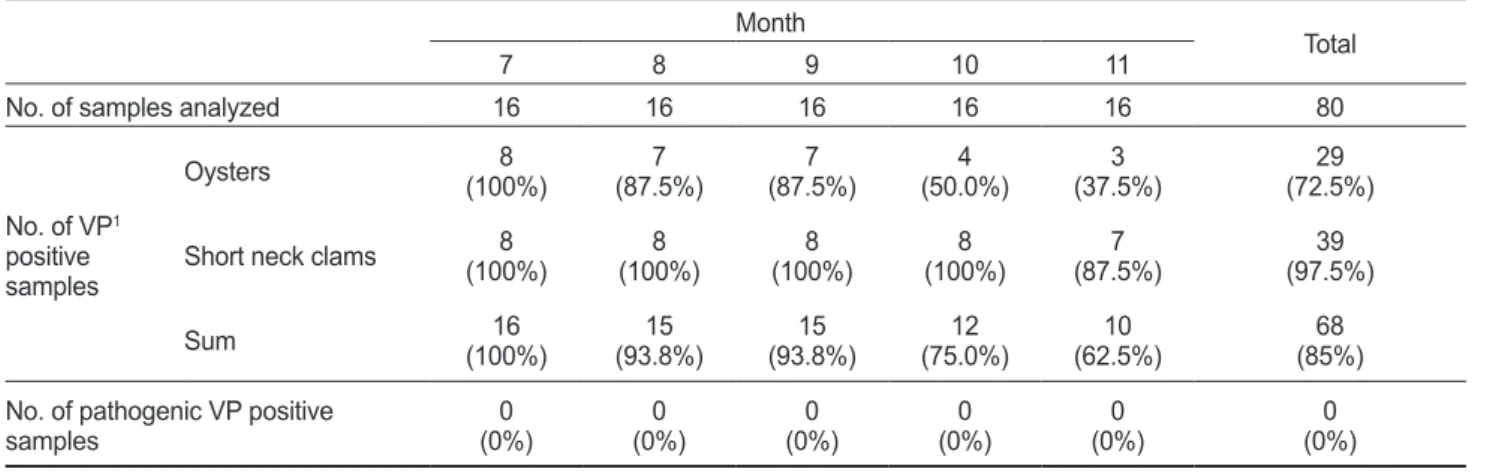
오염실태를조사한결과를Table 1
에나타내 었다.
조사당시수온의범위는16.4-26.9℃
였으며,
염분의범 위는23.6-33.1 psu
이었다(Fig. 1).
굴과바지락채취해역의수 온및염분차는남서해안의수리학적특성과해황에기인하는 것으로사료된다.
80
개의시료중68
개의시료에서V. parahaemolyticus
가검출 되어85%
의높은검출율을나타내었으며,
특히7
월에는모든시료에서검출되었다
.
비브리오균은보통염분농도가낮은기 수지역에서검출율이높다고알려져있으나(Annie and Marta, 2012),
굴양식장이위치한남해안에서7
월부터9
월까지나타 난염분농도 변화는동시기발생한대량강우로인한일시적 인환경변화로V. parahaemolyticus
검출율에는큰영향을미 치지않았다.
굴의경우총
40
개시료중29
개시료에서검출되어72.5%
의 검출율을나타내었다.
시기별로보면굴은7
월에는모든시료에 서검출되어검출율이가장높았으며,
수온이낮아짐에따라검 출율이낮아져11
월에는37.5% (3/8)
를나타내었다.
반면바지 락은40
개시료중39
개의시료에서검출되어97.5%
의높은검oyster short-neck calm
V.bparahaemolyticus ( MPN/100 g )
1 10 100 1000 10000 100000
Jul Aug Sep Oct Nov
oyster short-neck calm
Temp ( ℃ )
Jul 0 10 20 30 40
Aug Sep Oct Nov
oyster short-neck calm
Salinity (‰)
10 20 30 40
Jul Aug Sep Oct Nov
Fig. 1. Monthly variation of salinity and water temperature during survey period.
Table 1. Distribution of Vibrio parahaemolyticus from shellfish farm in the coast of Korea Month
Total
7 8 9 10 11
No. of samples analyzed 16 16 16 16 16 80
No. of VP1 positive samples
Oysters 8
(100%) 7
(87.5%) 7
(87.5%) 4
(50.0%) 3
(37.5%) 29
(72.5%) Short neck clams 8
(100%) 8
(100%) 8
(100%) 8
(100%) 7
(87.5%) 39
(97.5%)
Sum 16
(100%) 15
(93.8%) 15
(93.8%) 12
(75.0%) 10
(62.5%) 68
(85%) No. of pathogenic VP positive
samples 0
(0%) 0
(0%) 0
(0%) 0
(0%) 0
(0%) 0
(0%)
1Vibrio parahaemolyticus.
출율을나타내었다
. 7
월부터10
월까지모든시료에서검출되었 으며11
월에도87.5% (7/8)
의검출율을나타내어굴보다높은 검출율을나타내었다.
이러한경향은남해안산굴은연승수하식으로양식되어해수 중에존재하는
V. parahaemolyticus
만을체내에농축하는반면 서해안산바지락은각종세균이다량존재하는펄에서바닥식 으로양식되고있어환경에서유래하는V. parahaemolyticus
를 체내에고농도로농축할확률이높은데기인하는것으로보인 다. Ju (1983)
에의하면제주,
거제,
남해,
욕지,
부산및마산지 역해수및펄에대한V. parahaemolyticus
분포조사결과,
해수 시료에서V. parahaemolyticus
검출율이9.8% (36/367)
인반 면펄시료에서는18.8% (59/313)
에이른다고보고한바있다.
이연구결과는Chao et al. (2009)
와Das et al. (2009)
가중 국및인도의어패류에서V. parahaemolyticus
검출율을각각47.2%
와55%
라고보고한것보다높은검출율을 보이고있다
. Kirs et al. (2011)
의조사에의하면총58
개의굴시료중55
개의시료에서V. parahaemolyticus
가검출되어94.8%
의높 은검출율을나타내었다고보고한바있어본연구결과와유사 한결과를나타내었다.
또한미국의Chesapeake Bay
에서채취 한굴시료에서100%
의검출율을나타내었으며(Parveen et al.,
2008),
멕시코의걸프만의시료에서도100%
의검출율을나타내어
(Zimmerman et al., 2007)
본결과와유사한결과를나타 내었다.
이러한결과는수온이상승하는하절기에는전세계적 으로V. parahaemolyticus
검출율이높은것을시사하고있으 며V. parahaemolyticus
에의한식중독의발생시기와도일치 하고있다.
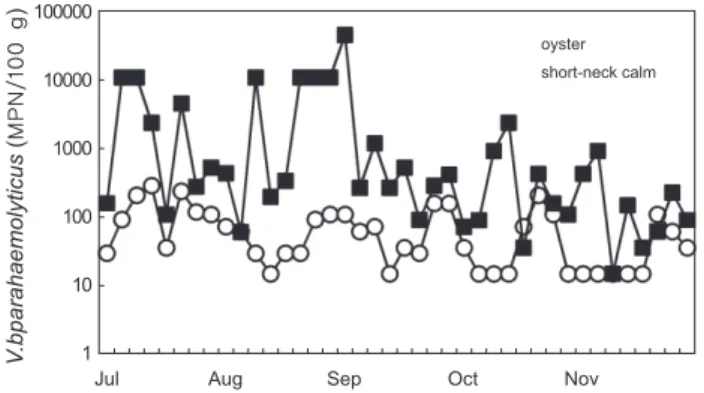
남해안에서채취한굴중의
V. parahaemolyticus
균수는<30- 290 MPN/100 g
였으며,
월별로는7
월과8
월에높은세균함량 을나타내었으며11
월에는대부분의시료에서<30 MPN/100 g
의값을나타내었다(Fig. 2).
굴의V. parahaemolyticus
균수는 총시료40
개중70% (28
개시료)
가<30-100 MPN/100 g
의범 위를나타내었으며, 101-1,000 MPN/100 g
의균수를나타내는 시료는30% (12
개시료)
였다. Annie and Marta (2012)
에의한Rhode Island
의굴과해수에대한V. parahaemolyticus
조사결 과, 7
월에서8
월이V. parahaemolyticus
에의한위험성이가장높은시기라고보고하고있으며
, Alabama
굴을대상으로시기별로
V. parahaemolyticus
를조사한결과, 4
월에서11
월에100- 1,000 CFU/100 g
을나타내었으며12
월에서3
월까지는<100
CFU/100 g
였다고보고하고있어이연구결과와동일한경향을나타내었다
(Angelo et al., 2003).
서해안산바지락중의경우
V. parahaemolyticus
균수는<30- 46,000 MPN/100 g
이었으며, 7
월부터11
월까지채취한총40
개의시료중11
월에채취한1
개의시료에서만<30 MPN/100 g
이었다. <30-100 MPN/100 g
을 나타내는 시료가총40
개 중9
개(22.5%), 101-1,000 MPN/100 g
의시료가20
개(50%), 1,001-10,000 MPN/100 g
이4
개(10%), 10,000 MPN/100 g
을 초과하는시료는7
개(17.5%)
이였다.
바지락중V. parahaemo- lyticus
균수는101-1,000 MPN/100 g
의범위가가장많았으 며, 10,000 MPN/100 g
을초과하여검출되는시료도40
개시 료중7
개에달하였다.
이중57% (4
개시료)
가8
월에채취한것 으로나타나8
월이가장많은V. parahaemolyticus
식중독환자 가발생한것과시기적으로일치하는경향을보였다.
그러나V.
parahaemolyticus
의식중독을일으키는주요병원인자인내열성용혈독소
(Thermostable direct hemolysin, TDH)
와내열성 용혈독소 유사독소(TDH-related hemolysin, TRH)
의유전자 를보유한V. parahaemolyticus
는검출되지않았다.
이상의결과패류중
V. parahaemolyticus
는수온이상승하 는하절기에주로검출되었나병원성인자를보유한V. para- haemolyticus
는검출되지않아수확후온도-
시간관리와적절 한가공처리를통하여위생학적안전성을확보할수있을것으 로사료되었다.
V. parahaemolyticus 분리주의 항균제 내성특성
남해안산굴과서해안산바지락에서분리된V. parahaemo- lyticus 436
균주(
굴129
균주,
바지락307
균주)
를대상으로15
종의항균제에대하여감수성시험결과를Table 2
및Table 3
에 각각나타내었다.
굴에서 분리된
V. parahaemolyticus 129
균주 중26
균주(20.2%)
가항균제15
종에감수성을나타내었고,
나머지103
균주
(79.8%)
가한가지이상의항균제에대하여내성을나타내었다
.
항균제별내성양상에있어제1
세대항균제인penicillin
계 열ampicillin
에대한내성균비율이79%
로높게나타내었으며trimethoprim, streptomysin
에대해서는각각3.1%
및1.6%
의 내성균비율을보였다.
그외의항균제에대해서는내성균비율 이1%
미만으로낮았다(Table 2).
바지락에서분리된
V. parahaemolyticus 307
균주중111
균 주(36.2%)
가모든항균제에감수성을나타내었고,
나머지196
균주
(63.8%)
가한가지이상의항균제에대하여내성을나타내었다
.
바지락에서분리된V. parahaemolyticus
역시ampicillin
oyster short-neck calm
V.bparahaemolyticus ( MPN/100 g )
1 10 100 1000 10000 100000
Jul Aug Sep Oct Nov
oyster short-neck calm
Temp ( ℃ )
Jul 0 10 20 30 40
Aug Sep Oct Nov
oyster short-neck calm
Salinity (‰)
10 20 30 40
Jul Aug Sep Oct Nov
Fig. 2. Monthly variation of Vibrio parahaemolyticus concentra- tion in shellfish.
에대하여
61.2%
의높은내성균비율을보였다.
그외에trim- ethoprim, streptomysin, rifampin
에대해서각각5.2%, 2.9%
및
2.3%
의내성균비율을확인되었다(Table 3).
즉
,
패류에서분리된V. parahaemolyticus
는ampicillin
에대 Table 2. Antimicrobial resistance of Vibrio parahaemolyticus isolated from oystersClass Antimicrobial agents Drug amount (μg)/disk Diffusion zone breakpoint (mm)1 No. of isolates (%)
Penicillins Ampicillin 10 ≤ 13 102(79.1)
Amoxicillin/
clavulanic acid 30 ≤ 13 0(0.0)
Cephalosporins Cefepime 30 ≤ 14 0(0.0)
Cefotaxime 30 ≤ 14 1(0.8)
Aminoglycosides Streptomycin 10 ≤ 11 2(1.6)
Gentamycin 10 ≤ 12 1(0.8)
Amikacin 30 ≤ 14 0(0.0)
Fluoroquinolones Ciprofloxacin 5 ≤ 15 0(0.0)
Quinolones Nalidixic acid 30 ≤ 13 1(0.8)
Sulfonamides Trimethopenem/
sulfamethoxazole 1.25/23.75 ≤ 10 1(0.8)
Trimethoprim 5 ≤ 10 4(3.1)
Phenicols Chloramphenicol 5 ≤ 12 0(0.0)
Tetracyclines Tetracycline 5 ≤ 14 0(0.0)
Ansamycins Rifampin 5 ≤ 17 1(0.8)
Macrorides Erythromycin 5 ≤ 13 0(0.0)
1US National Committee for Clinical Laboratory Standards.
Table 3. Antimicrobial resistance of Vibrio parahaemolyticus isolated from short neck clams
Class Antimicrobial agents Drug amount (μg)/disk Diffusion zone breakpoint (mm)1 No. of isolates (%)
Penicillins Ampicillin 10 ≤ 13 188(61)
Amoxicillin/
clavulanic acid 30 ≤ 13 0(0.0)
Cephalosporins Cefepime 30 ≤ 14 0(0.0)
Cefotaxime 30 ≤ 14 0(0.0)
Aminoglycosides Streptomycin 10 ≤ 11 9(2.9)
Gentamycin 10 ≤ 12 3(1)
Amikacin 30 ≤ 14 0(0.0)
Fluoroquinolones Ciprofloxacin 5 ≤ 15 0(0.0)
Quinolones Nalidixic acid 30 ≤ 13 3(1)
Sulfonamides Trimethopenem/
sulfamethoxazole 1.25/23.75 ≤ 10 0(0.0)
Trimethoprim 5 ≤ 10 16(5.2)
Phenicols Chloramphenicol 5 ≤ 12 1(0.3)
Tetracyclines Tetracycline 5 ≤ 14 0(0.0)
Ansamycins Rifampin 5 ≤ 17 7(2.3)
Macrorides Erythromycin 5 ≤ 13 0(0.0)
1US National Committee for Clinical Laboratory Standards.
해서높은내성을나타내며그외의항균제에대해서는대부분 감수성을나타내어내성패턴은비교적단순하였다
. Oh et al.
(2011)
은어류양식장에서분리한V. parahaemolyticus
의내성 양상조사결과, ampicillin
에57.8%, rifampin
에11.9%, trim- ethoprim
에6.4%, streptomysin
에8.7%
의내성균비율이확인 되었으며그외의항생제에대해서는4%
이하의낮은내성균비 율이나타났다고이연구와유사한결과를보고하였다.
많은연구자들이
V. parahaemolyticus
의높은ampicillin
내성 에관하여보고하고있다. Son et al. (2005)
은남해안어류양식 장의어류와해수에서분리한V. parahaemolyticus
균주중에 서97.9%
가ampicillin
에내성을나타내었다고보고한바있으 며,
서해연안해수(Lee et al., 2008)
와국내유통수산물(Lee et al., 2007)
로부터분리한V. parahaemolyticus
균주모두가ampicillin
에대한내성을나타내었다고보고된바있다.
또한Oh et al. (2009)
은바다로유입되는기수지역에서분리한비브 리오균에대한항생제내성패턴조사결과, V. parahaemolyticus 177
균주중152
균주(85.9%)
가ampicillin
에대하여내성을나 타낸다고보고하고있다.
외국의경우인도네시아
Jakarta Bay
에서분리된V. parahae- molyticus
균주의97%
가ampicillin
에내성을나타내었다고하 며(Moritori et al., 1985),
이탈리아의La Maddmlena, Tavolara Islands
그리고Aleghero gulf
연안에서분리된Vibrio
속세균 중80%
이상이ampicillin
에내성을나타내었다고한다(Zanetti et al., 2001).
이와같이수산물뿐만아니라자연환경에서분 리된V. parahaemolyticus
을비롯한Vibrio
속세균이ampicil- lin
에대하여높은내성을가지는것을볼때ampicillin
에대한Vibrio
속세균의내성은자연내성에가까운것으로추정된다.
분리된
V. parahaemolyticus
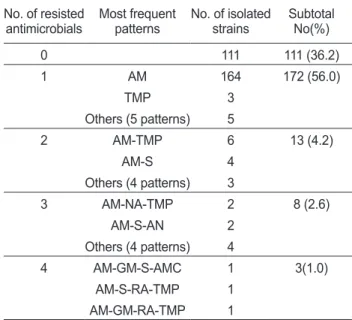
의내성패턴을Table 4
와Table 5
에나타내었다.
바지락에서분리된V. parahaemolyticus
의내성패턴이
22
개조합을나타내어굴에서분리한V. parahaemo- lyticus
의8
개조합보다다소복잡한경향을나타내었다.
그러 나대부분이1
개항생제에내성(
굴-95
균주; 73.6%,
바지락-172
균주; 56.0%)
을나타내고있고, 4
가지이상의항생제에대하여 내성을나타내는다제내성(Multiple antibiotic resistance)
균은 굴에서1
균주(0.8%),
바지락에서3
균주(1.0%)
로매우낮게검 출되었다.
뿐만아니라대부분이ampicillin
을포함한두세가 지항균제에만내성을보여단순한내성경향을가지고있었다(Table 4, Table 5).
그러나비브리오균중일부는내성인자들을수계침전물이나 주변환경으로부터획득할수있다는보고
(Neela et al., 2007)
도있으며,
주거지가밀집하여있는지역에서발생한오수가유 입되는지역에서분리된V. parahaemolyticus
는상대적으로높 은 내성균검출경향을나타내었다는보고도있다(Oh et al.,
2009).
따라서다양한내성인자를보유한세균들이하천이나마을하수를통하여연안에유입되어해양에존재하는이종또 는동종세균으로
plasmid, transposon, integron
등과같은이 동성인자(mobile element)
의수평적전이(horizontal transfer)
를통하여내성유전자풀이형성될가능성을배제할수없다.
서식지가연안에위치하고있으며여과섭식의생리적특성을 가진패류의경우는
V. parahaemolyticus
와같은식중독원인 균의전달매개체로서나아가해양세균과육상세균간내성인 자전달매개체로서도위험군에속하는수산물이기때문에생 산단계와수확후단계에서적절한위생학적관리가이루어져Table 4. Antimicrobial resistance profiles of Vibrio parahaemo- lyticus isolates from oysters
No. of resisted
antimicrobials Most frequent
patterns No. of isolated
strains Subtotal, no(%)
0 26 26 (20.2)
1 AM 94 95 (73.6)
TMP 1
2 AM-TMP 2 6 (4.7)
AM-S 2
Others(2 patterns) 2
3 AM-S-CTX 1 1 (0.8)
6 AM-S-AMC-RA-
NA-TMP 1 1 (0.8)
AM, ampicillin; AMC, Amoxillin/clavulanic acid; CTX, cefo- taxime; NA, nalidixic acid; RA, Rifampin; S, streptomycin; TMP, trimethoprim.
Table 5. Antimicrobial resistance profiles of Vibrio parahaemolyti- cus isolates from short neck clams
No. of resisted
antimicrobials Most frequent
patterns No. of isolated
strains Subtotal No(%)
0 111 111 (36.2)
1 AM 164 172 (56.0)
TMP 3
Others (5 patterns) 5
2 AM-TMP 6 13 (4.2)
AM-S 4
Others (4 patterns) 3
3 AM-NA-TMP 2 8 (2.6)
AM-S-AN 2
Others (4 patterns) 4
4 AM-GM-S-AMC 1 3(1.0)
AM-S-RA-TMP 1
AM-GM-RA-TMP 1
AM, ampicillin; AN, amikacin; C, chloramphenicol; CIP, cipro- floxacin; E, erythromycin; NA, nalidixic acid; RA, rifampin; S, streptomycin; SXT, trimethpenem/sulfamethoxazole; TE, tetracy- cline; TMP, trimethoprim.
야할것으로생각된다
.
사 사
이 연구는 국립수산과학원 수산시험연구사업
(RP-2014-
FS-013)
의지원에의해수행되었으며이에감사드립니다.
References
Acar JF and Goldstein FW. 1991. Disk susceptibility test. In:
Antibiotics in laboratory medicine. Lorian V, ed. Williams
& Wilkins, Baltimore, USA, 17-52.
Angelo D, Jessica LN, John CB, Joy GW, and David WC. 2003.
Seasonal Abundance of Total and Pathogenic Vibrio para-
haemolyticus in Alabama Oysters. Appl Environ Microbiol
69, 1521-1526. http://dx.doi.org/10.1128/AEM.69.3.1521- 1526.2003.Annie MC and Marta GC. 2012. Vibrio parahaemolyticus in Rhode Island Coastal Ponds and the Estuarine Environment of Narragansett Bay. Appl Environ Microbiol 78, 2996- 2999. http://dx.doi.org/10.1128/AEM.07519-11.
Chao G, Jiao X, Zhou X, Yang Z, Huan J, Pan Z, Zhou L and Qian X. 2009. Serodiversity,319 pandemic O3:K6 clone, molecular typing, and antibiotic susceptibility of foodborne and clinical 320 Vibrio parahaemolyticus isolates in Jiangsu, China. Foodborne Pathog Dis 6, 1021-1028.
Das B, Manna SK, Sarkar P and Batabyal K. 2009. Occur- rence of Vibrio parahaemolyticus in different finfish and shellfish species. J Food Safety 29, 118-125. http://dx.doi.
org/10.1111/j.1745-4565.2008.00146.x.
Diggles BK, Moss GA, Carson J and Anderson CD. 2000. Lu- minous vibriosis in rock lobster Jasus verreauxi (Decapoda:
Palinuridae) phyllosoma larvae associated with infection by
Vibrio harvey. Dis Aquat Org 43, 127-137.
Elliot EL, Kaysner CA, Jackson L and Tamplin ML. 1995. Vib-
rio cholerae, V. parahaemolyticus, V. vulnificus and other Vibrio spp. In: Bacteriological Analytical Manual, Asso-
ciation of Official Analytical Chemists, Arlington, U.S.A., 9.01-9.27.Hunter C, Perkins J, Tranter J and Gunn J. 1999. Agricultural land-use effects on the indicator bacterial quality of an up- land stream in the Derbyshire Peak District in the UK. Water Res 33, 3577-3586.
Ju JW. 1983. Studies on Vibrio parahaemolyticus on the south- ern seas of Korea -On the isolation of V. parahaemolyticus from sea water, sea mud and marine products in Juju, Koeje, Namhae, Yockji, Busan and Masan. J Korea Soc Microbiol 18, 1- 9.
KFDA. 2014. Food poisoning statistics by pathogen and month. Retrieved from http://www.mfds.go.kr/e-stat/index.
do?nMenuCode=32 on August 23 2014.
Kirs M, DePaola A, Fyfe R, Jones JL, Krantz J, Van Laanen
A, Cotton D and Castle M. 2011. A survey of oysters (Crassostrea gigas) in New Zealand for Vibrio parahae-
molyticus and Vibrio vulnicus. Int J Food Microbiol 147,
149–153.Kümmerer K. 2009. Antibiotics in the aquatic environment:
a review - partⅠ. Chemosphere, 417-434. http://dx.doi.
org/10.1016/j.ijfoodmicro.2011.03.012.
Lee H, Oh YH, Park SG and Choi SM 2007. Antibiotic suscep- tibility and distribution of Vibrio parahaemolyticus isolated from the seafood. Kor J Env Hlth 33, 16-20.
Lee HW, Lee SK and Kim MS. 2008. Characteristics of ampicil- lin-resistant Vibrio spp. isolated from a west coastal area of Korean Peninsula. J Kor Fish Soc 42, 20-25.
Lipp EK, Farrah SA and Rose JB. 2001. Assessment and impact of microbial fecal pollution and human enteric pathogens in a coastal community. Mar Pollut Bull 42, 286-293.
Mallin MA, Ensign SH, McIver MR, Shank GC and Fowler PK. 2001. Demographic, landscape, and meteorologi- cal factors controlling the microbial pollution of coast- al waters. Hydrobiologia 460, 185-193. http://dx.doi.
org/10.1023/A:1013169401211.
Metcalf TG. 1978. Indicators of viruses in shellfish. In: Indica- tors of viruses in water and food. Berg G, ed. Ann Harbor Science, Michigan, 383-415.
Miossec L, Guyader F, Haugarreau L, Comps MA and Pom- mepuy M. 1988. Possible relation between a winter epidem- ic of acute gastroenteritis in France and viral contamination of shellfish. J Shellfish Res 17, 1661-1664.
MOF. 2014. Fisheries production statistics. Retrieved from http://
www.fips.go.kr/jsp/sf/ ss/ss_info.jsp?menuDepth=070101 on August 23 2014.
Morris JG and Tenny J Jr. 1985. Antibiotic therapy for Vibrio
vulnificus infection. J Am Med Assoc 253, 1121–1122.
Neela FA, Nonaka L and Suzuki S. 2007. The diversity of multi- drug resistance profiles in tetracycline-resistant Vibrio spe- cies isolated from coastal sediments and seawater. J Micro- biol 45, 64-68.
Oh EG, Son KT, Ha KS, Yoo HD, Yu HS, Shin SB, Lee HJ and Kim JH. 2009. Antimicrobial Resistance of Vibrio strains from Brackish Water on the Coast of Gyeongsangnamdo. J Kor Fish Soc 42, 335-343.
Oh EG, Son KT, Yu HS, Lee TS, Lee HJ, Shin SB, Kwon JY, Park KBW and KIM JH. 2011. Antimicrobial resistance of
Vibrio parahaemolyticus and Vibrio alginolyticus strains
isolated from Farmed Fish in Korea during 2005-2007. J Food Protec 74, 380-386.Ortigosa M, Garay E and Pujalte MJ. 1994. Numerical taxono- my of vibrionaceae isolated from oysters and seawater along an annual cycle. Syst Appl Microbiol 17, 216-225.
Parveen S, Hettiarachchi KA, Bowers JC, Jones JL, Tamplin ML, McKay R, Beatty W, Brohawn K, Dasilva LV, Depaola A. 2008. Seasonal distribution of total and pathogenic Vibrio
parahaemolyticus in Chesapeake Bay oysters and waters. Int
J Food Microbiol 128, 354–361. http://dx.doi.org/10.1016/j.ijfoodmicro.2008.09.019.
Rhodes BJ, Smith HL Jr. and Ogg JE. 1986. Isolation of non- O1 Vibrio cholerae serovars from surface waters in Western Colorado. Appl Environ Microbiol, 51, 1216-1219.
Sobsey MD and Jaykus LA. 1991. Human enteric viruses and depuration of bivalve molluscs. In: Molluscan shellfish de- pravation. Otwell WS, Rodrick GE and Martin RE, eds.
CRC Press, Boca Raton, Florida, USA, 71-114.
Son KT, Oh EG, Lee TS, Lee HJ, Kim PH and Kim JH. 2005.
Antimicrobial susceptibility of Vibrio parahaemomlyticus and Vibrio alginolyticus from fish farms on the southern coast of Korea. J Kor Fish Soc 38, 365-371.
Urakawa H, Yoshida T, Nishimura M and Ohwada K. 2000.
Characterization of depth related population variation in mi- crobial communities of coastal marine sediment using 16S rDNA-based approaches and quinone profiling. Environ Microbiol 2, 542-554.
Zanetti S, Spanu T, Deriu A, Romano L, Sechi LA and Fadda G.
2001. In vitro susceptibility of Vibrio spp. isolated from the environment. Int J Antimicrob Agents 17, 407–409.
Zimmerman AM, DePaola A, Bowers JC, Krantz JA, Nord- strom JL, Johnson CN and Grimes DJ. 2007. Variability of total and pathogenic Vibrio parahaemolyticus densities in northern Gulf of Mexico water and oysters. Appl Environ Microbiol 73, 7589–7596.