• 검색 결과가 없습니다.

The Effect of Job Anxiety of Replacement by Artificial Intelligence on Organizational Members' Job Satisfaction in the 4th Industrial Revolution Era: The Moderating Effect of Job Uncertainty

N/A
N/A
Protected

Academic year: 2021

Share "The Effect of Job Anxiety of Replacement by Artificial Intelligence on Organizational Members' Job Satisfaction in the 4th Industrial Revolution Era: The Moderating Effect of Job Uncertainty"

Copied!
9
0
0

로드 중.... (전체 텍스트 보기)

전체 글

(1)

The Effect of Job Anxiety of Replacement by Artificial Intelligence on Organizational Members' Job Satisfaction in the 4th Industrial

Revolution Era: The Moderating Effect of Job Uncertainty

TaeSik Rhee 1 , Xiu Jin 2*

1

Processor, Dept. of Business Administration, Soongsil University

2

Assistant Processor, Dept. of Business Administration, Honam University

4차 산업 혁명 시대의 인공 지능의 직업 대체 불안감이 구성원들의 직무만족에 미치는 영향: 직무 불확실성의

조절효과

이태식 1 , 김수 2*

1

숭실대학교 경영학부 교수,

2

호남대학교 경영학부 조교수

Abstract The core competencies such as technology have been rapidly developing with advent of the fourth industrial revolution. One of the representative technologies in the era of the 4th Industrial Revolution is artificial intelligence(AI). In particular, AI makes human life richer and more comfortable and has many positive aspects. The negative aspect is that AI is likely to replace the organizational members' job and has the ability to replace skills associated with it. These threats may increase the level of perception that organizational members may loss their job. Moreover, it may lead to a sense of anxiety. In addition, organizational members who perceive job uncertainty highly, the job substitution anxiety may be become highly. According to this, their job satisfaction can be lower. Overall, this research emphasized the negative aspects of AI in contrast to the positive aspects of the fourth industrial era. It is also emphasized that the organization should need to recognize such problems and seek solutions to reduce workers' anxiety. Finally, practical implications and research directions of future study were presented through the research results.

Key Words : Fourth Industrial Revolution, Job Anxiety of Replacement, Job Satisfaction, Job Uncertainty

요 약 우리 사회는 4차 산업혁명 시대가 도래되면서 급변하고 있다. 4차 산업혁명시대에 있어서 대표적인 기술 중 하나가 인공지능이다. 특히 인공지능은 인간의 삶을 보다 풍요롭고 편하게 만들어 주어 대부분 긍정적인 측면들을 지니 고 있다. 그러나 인공지능의 기술 발전과 같은 변화는 항상 긍정적인 변화를 이끌어 낸다고 볼 수 없다. 인공지능의 발전은 인간의 노동력을 대체 할 가능성이 높고 이와 관련된 가치들을 대체 할 수 있는 기능을 지니고 있다. 따라서 인공지능으로 인해 자신의 직업이 대체 된다고 높게 인지하는 근로자일수록 인공지능이 주는 위협이나 4차 산업혁명시 대의 변화에 따라 초래되는 불안감을 인지하게 될 수 있다. 또한 4차 산업혁명시대에 따른 직무 불확실성을 더 높게 인지하는 구성원일수록 미래에 대한 불안감이 커지기 때문에 직무만족이 더 낮아 질 수 있다. 그래서 이 연구는 4차 산업시대의 변화에 따른 인공지능의 긍정적인 측면과 달리 부정적인 측면을 강조하였고 이를 기반으로 나타나는 부정 적인 성과를 통해 그 역할을 규명하는데 초점을 두었다. 더 나아가 이러한 문제점들을 인식할 필요가 있으며 근로자들 의 불안감을 낮추기 위해 해결해야 할 필요가 있다는 것을 강조하였다. 마지막으로 연구 결과를 통해 실무적인 시사점 들을 제시하였다.

주제어 : 4차 산업혁명, 직무 대체 불안감, 직무만족, 인공지능, 직무 불확실성

*Corresponding Author : Xiu Jin([email protected]) Received April 5, 2021

Accepted July 20, 2021

Revised April 27, 2021

Published July 28, 2021

(2)

1. Introduction

Our society is predicting positive hopes in the Fourth Industrial Revolution[1]. Most of organizations focus on developing appropriate organizational strategies in these situations.

Organizations focus on building appropriate organizational strategies in these situations. In general, the 4th Industrial Revolution era has the potential to improve the quality of life and bring new opportunities in our society[2, 3]. However, such positive aspects may not generalize and they have various limitations or negative roles. In relation to the era of the 4th Industrial Revolution, one of the typical technologies can be considered as artificial intelligence(AI). The development of AI has various positive influences as the fundamental aspects of society are rapidly increasing[4]. However, due to technological developments in the field of a AI, there is considerable concern that unemployment may increase over the next few decades[5]. Despite these concerns, there are currently significant job losses due to the advantages and convenience of technological development[6]. AI can be regarded as a double-sidedness that it replaces organizational members' job. If they become aware of negative role of AI and they realize that machines can replace humans’ job, they will recognize AI replace their job. This situation will cause members to experience a career discontinuation or psychological anxiety that their job may be replaced. If organizational members become more aware of their job uncertainty, they will reduce their intrinsic motivation for their job and lead to lower level of personal and organizational performance. This phenomenon is going to cause organizational and social problem. Based on this background, this research conducts an empirical study for organizational members who are engaged in Korean IT industry. This study focuses on identifying the level of job substitution anxiety. It

also verifies the influence of job substitution anxiety on their job satisfaction. Furthermore, it verifies the moderating effect of job uncertainty on the relationship between job anxiety of replacement and job satisfaction. Through the empirical results of this research, it emphasizes that IT industries should make efforts to recognize employees’ psychological anxiety and to find ways to reduce the anxiety. Finally, practical implications and research directions of future study were presented through the research results.

2. Literature Review

2.1 Job Anxiety of Replacement

Artificial intelligence(AI) is a set of technologies that utilizes and realizes perception, language skills, and reasoning through various computer programs including IT in relation to humans' ability to learn. The word of AI was first used at a conference in 1955 by mathematician John McCarthy of Dartmouth University[7]. AI has been described in 1967 by cognitive scientist Marvin Minsky as an object that could be created in a generation[8]. With the rapid development of AI, it is expected that AI will be a great substitute for organizational members' job. This will raise the awareness of the possibility that members will lose their jobs and create anxiety that their jobs can be replaced by AI. Job anxiety refers to the negative feelings employees have about their jobs[9].

Anxiety is a job related perception or an

awareness of individual dysfunction as a result of

an event[9, 10]. In addition, job anxiety refers to

organizational members' propensity to emotional

tension caused by anxiety related to one or

several factors in their work life, or by common

sense of fear and anxiety[11]. Such job anxiety

can arise from overall job experience and

specific aspects[9]. The psychological

(3)

components of job anxiety include fear, anxiety, self-depreciation, and risk, and are pessimistic thoughts related to various job components.

Examples include stability in employment and safety, management treatment, compensation and penalties, future prospects for career development, and pessimism about the ability to perform work and responsibilities[11].

2.2 Job Satisfaction

Job satisfaction can be seen as the most concept of study in organizational behavior research[12]. It refers to organizational members feel about different aspects of jobs or the degree to which they are satisfied with their job[13]. It can also be seen as the degree to which organizational members have a positive emotional orientation toward employment in their organization[14]. Therefore, job satisfaction can be viewed as a concept that employees think positively of their job and are generally satisfied with their job. Those who are more satisfied with their jobs are able to engage in more prosocial and civic behaviors[15]. Furthermore, it leads to personal life satisfaction[16]. When job satisfaction is high, turnover intention can be decreased. On the contrary, when job satisfaction is low, turnover intention is increased[17, 18]. In addition, job satisfaction provides a variety of positive benefits, such as reducing moral stress, forming good relationships with colleagues or managers, and creating new thinking and innovation[19].

2.3 The Relationship between Job Anxiety of Replacement and Job Satisfaction

High job anxiety negatively affects organizational members' mental state and their job satisfaction[11]. This is because job anxiety can threaten members' basic attachment to their own organization[20]. In this regard, employees may be psychologically stressed due to anxiety

about their job. Eventually, they will have a difficult experience in performing their job continuously. Therefore, the degree of job satisfaction will be decreased. In the previous study of [21], it was found that organizational members who already had low awareness of job security were less satisfied with their jobs.

Therefore, job anxiety is negatively related to job satisfaction[20]. In addition, demands for wage amendments and safety aspects lead to low level of job anxiety[22]. Based on these theories, it can be seen that job anxiety reduces job satisfaction.

Therefore, with the advent of the 4th industrial era, if the possibility of replacing members' jobs increases due to the rapid development of artificial intelligence technology. It will make employees aware of the possibility of replacing their jobs. Through this, the anxiety that can lead to loss of a branch job will eventually reduce job satisfaction. According to this, hypothesis 1 was established as follows.

Hypothesis 1: The perception of job anxiety of replacement caused by AI will have a negative influence on job satisfaction.

2.4 Job Uncertainty

Environmental uncertainty refers to frequent

and unpredictable changes related to technology

development and competitive behavior perceived

by managers[23]. In an environment with high

uncertainty, organizational decisions can lead to

various of mistakes. because it is difficult for

managers to determine or predict alternatives to

solve problems[24, 25, 26]. Therefore, in

situations of high environmental uncertainty,

organizations frequently attempt to collect and

process information to deal with environmental

changes[27]. Job uncertainty in the process of

organizational change refers to immediate work

situations such as job change, job performance,

and promotion opportunities[28, 29]. Uncertainty

(4)

can also refers to an evasive state caused by insufficient information and the inability to distinguish between relevant and inappropriate information[30, 31]. Therefore, the phenomena of rearranging or downsizing may cause uncertainty within the organization and cause difficulties for members. Therefore, it creates a stressful environment[29, 31, 32].

2.5 The Moderating Effect of Job Uncertainty Job anxiety is threatening to organizational members. The reason is that they anticipate involuntary job changes[33]. In this regard, previous studies have already shown that job anxiety is directly related to lower job satisfaction[20]. In addition, job anxiety is a major factor in organizational members' job attitude (for example, job satisfaction). Influence[33]. The perception of job anxiety may lead to low level of job satisfaction. Higher perceptions of environmental uncertainty can cause serious problems, put the organization at risk, lead to high levels of stress and anxiety, and reduce trust between organization managers and members[34].

In this regard, excessive job stress reduces job satisfaction[35]. Based on this theory, high level of job uncertainty leads to low level of job stability.

Such process arouses job stress and anxiety.

Therefore, it is predicted that employees perceive job uncertainty highly, their job satisfaction will be reduced. In addition, the formation of uncertainty and instability negatively affects organizational members[36]. In this regard, if organizational members become aware of higher levels of job anxiety of replacement and job uncertainty, it is predicted that their job satisfaction will be decreased lower. Therefore, hypothesis 2 and hypothesis 3 were established.

Hypothesis 2: Job uncertainty will have a negative influence on job satisfaction.

Hypothesis 3: Job uncertainty will negatively moderate the relationship between job anxiety of replacement and job satisfaction.

3. Method

3.1 Sample Collection and Characteristics This research conducted a questionnaire survey to examine the effect of job anxiety of replacement on organizational members' job satisfaction. In addition, we also verified the moderating effect of job uncertainty in the relationship between job anxiety of replacement and job uncertainty. The total of 97 questionnaires were collected from employees in medium and small sized enterprises in Korea.

However, 17 questionnaires were judged to be non-response or not faithfully completed. Finally, a total of 80 were used for empirical analysis.

The results of demographic analysis are as follows. There were 44 males (55.0%) and 36 females (45.0%) participated in the survey.

Among them, 48 (60.0%) respondents are in their 20s, 27 (33.8%) respondents are in their 30s, 3 (3.8%) respondents are in their 40s, and 2 (2.4%) respondents are in their 50s or over 50s. In relation to service year, 33(41.3%) employees have been worked for 1-2 years, 30(37.5%) employees have been worked for 3-4 years (37.5%), 8(10.0%) employees have been worked for 3-4 years, and 9(11.2%) employees have been worked for over 4 years.

3.2 Measurement

Job anxiety of replacement is defined as

anxiety in which members lose their job or their

job is replaced due to the development of

artificial intelligence. To measure it, the tool of

[37] measurement was used and the questions

consisted of a total of 4 items. The sample item

includes "AI will negatively affect my job.".

(5)

Job satisfaction is defined as organizational members feel about different aspects of jobs or the degree to which they are satisfied with their job[13]. Job satisfaction is measured using the measurement tools of [38]. The measurement is composed of a total of 4 items. The sample item includes "I am satisfied with my work.".

Job uncertainty is defined as the uncertainty about immediate work situations such as job change, job performance, and opportunities for promotion[28, 29]. To measure it, the instrument of [31] was used and the questions consisted of a total of 5 items. The sample item includes "I am uncertain about whether I need to learn new skills for my job.".

4. Results

4.1 Exploratory Factor Analysis

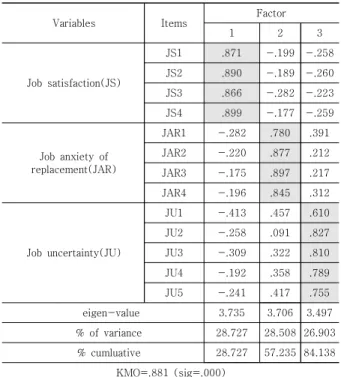
The following <Table 1> is the result of exploratory factor analysis(EFA) and it is summarized as follows. The item of measurement of job satisfaction were grouped as factor 1 from

.866 to .899. The item of measurement of job anxiety of replacement caused by AI were grouped as factor 2 from .780 to .897. The item of measurement of job uncertainty were grouped as factor 3 from .610 to .827. In addition, the eigen values of these three variables were showed from 3.497 to 3.735. Therefore, all of eigen values were showed over 1. The KMO value was .881 and it is significant( p <.001).

4.2 Reliability, Descriptive Statistics, and Correlation Analysis

The results of reliability analysis are as follows.

Job anxiety of replacement was .942, job uncertainty was .924, and job satisfaction was .955. Thus, it shows acceptable reliability. In addition, the result of correlation analysis are as follows. It was found that job anxiety of replacement( r =.688, p <.001) had a positive correlation with job uncertainty. Job anxiety of replacement( r =-.512, p <.001) was found to have a negative correlation with job satisfaction. Job uncertainty( r =-.616, p <.001) was found to have a negative correlation with job satisfaction. The following <Table 2> is the result of reliability, descriptive statistics, and correlation Analysis.

Mean S.D 1 2 3

1 3.000 1.472 (.942)    

2 3.170 1.335 .688

***

(.924)  

3 5.275 1.322 -.512

***

-.616

***

(.955) 1=Job anxiety of replacement, 2=Job uncertainty, 3=Job satisfaction, ( )=Reliability

***: p <.001, **: p <.01, *: p <.05

Table 2. The Results of Reliability, Descriptive Statistics, and Correlation Analysis

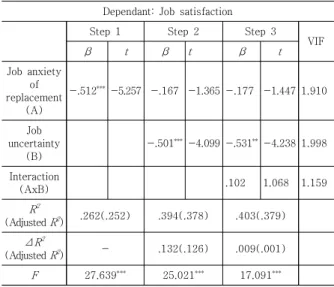
Regression analysis was conducted using the SPSS18 program to verify the effect of job anxiety of replacement caused by AI on job satisfaction. As a result, it was found thatjob anxiety of replacement had a negative influence on job satisfaction ( β =-.512, P< .001). Therefore, hypothesis 1 was supported. In addition, job

Variables Items Factor

1 2 3

Job satisfaction(JS)

JS1 .871 -.199 -.258

JS2 .890 -.189 -.260

JS3 .866 -.282 -.223

JS4 .899 -.177 -.259

Job anxiety of replacement(JAR)

JAR1 -.282 .780 .391

JAR2 -.220 .877 .212

JAR3 -.175 .897 .217

JAR4 -.196 .845 .312

Job uncertainty(JU)

JU1 -.413 .457 .610

JU2 -.258 .091 .827

JU3 -.309 .322 .810

JU4 -.192 .358 .789

JU5 -.241 .417 .755

eigen-value 3.735 3.706 3.497 % of variance 28.727 28.508 26.903

% cumluative 28.727 57.235 84.138 KMO=.881 (sig=.000)

Table 1. The Result of EFA

(6)

uncertainty had a negative influence on job satisfaction ( β =-.501, P <.001). Therefore, hypothesis 2 was supported. Finally, the moderating effect of job uncertainty showed that the interaction(job anxiety of replacement × job uncertainty) was β =.102, P >.05. Therefore, the moderating effect was insignificant and hypothesis 3 was rejected. The table 3 shows the result of regression analysis, which is the moderating effect of job uncertainty.

Dependant: Job satisfaction

Step 1 Step 2 Step 3

β t β t β t VIF

Job anxiety of replacement

(A)

-.512

***

-5.257 -.167 -1.365 -.177 -1.447 1.910

Job uncertainty

(B)

-.501

***

-4.099 -.531

**

-4.238 1.998

Interaction

(AxB) .102 1.068 1.159

R

2

(Adjusted R

2

) .262(.252) .394(.378) .403(.379)

⊿ R

2

(Adjusted R

2

) - .132(.126) .009(.001) F 27.639

***

25.021

***

17.091

***

***: p <.001, **: p <.01, *: p <.05

Table 3. The Result of Regression Analysis

5. Conclusion

5.1 Conclusion and research implications This research is to investigate the effect of employees' perception of job anxiety of replacement caused by AI on job satisfaction in the era of the 4th industrial revolution.

Furthermore, we also verified the moderating effect of job uncertainty in the relationship between job anxiety of replacement and job satisfaction. According to the results of empirical analysis, it was found that job anxiety of replacement had a negative effect on job satisfaction. It suggests that the level of job satisfaction is lowered as organizational members

recognize the possibility of their job being replaced by AI and the possibility of losing their job. It also emphasizes that the change to the 4th industrial revolution is not only positive, but it is likely to be accompanied negative outcomes. In addition, job uncertainty was also found to have a negative effect on job satisfaction. As the uncertainty about their job increases, employees consider their careers or job will be changed.

Such recognition can lead to low level of job satisfaction. Finally, it was found that the moderating effect of job uncertainty in the relationship between job anxiety of replacement and job satisfaction was not significant. Although the moderating effect of job uncertainty was showed to be insignificant, job anxiety of replacement and job uncertainty itself decreases job satisfaction. Overall, this research emphasizes that AI can improve the quality of human life, but the functions of AI can also replace humans.

Therefore, it suggests that AI is likely to be perceived as a negative factor that can lead to job anxiety of replacement caused by AI. In this regard, organizations should utilize AI technologies efficiently. Simultaneously, organizations should relieve employees' psychological anxiety and find the way to increase psychological stability. In addition, since the job replacement is expected to cause employees to lose their jobs, solutions to negative aspects should be needed for employee's job stability.

5.2 Limitations and future directions

The limitations and directions of future

research related to this research are summarized

as follows. First, this research focused only on

job satisfaction as dependant variable caused by

job anxiety of replacement in the 4th industrial

revolution. In future research, researchers should

focus on various variables such as psychological

stability, task performance, and contextual

performance. Second, the moderating effect of

(7)

job uncertainty was insignificant. It is considered to be related to the small size of samples used in this research. In future research, it will be necessary to reverify the moderating effect by increasing sample size. Third, it only focused on job anxiety of replacement as the negative aspects of AI. Future research should explore the negative aspects of AI in more depth. In addition, Research to find solutions that can alleviate these negative aspects should be conducted.

Finally, individual and organizational performance will contribute to continuous development of the organization. In 4th industrial revolution era, green consumption [39] actions related to environmental protection and resource conservation will be important. Furthermore, organizations should need to consider green management as well. In addition, organizations should focus on the efficient use of artificial intelligence [40].

REFERENCES

[1] H. Patrick, B. van Niekerk & Z. Fields. (2019).

Developing Cybersecurity Resilience in the Provincial Government. In Cyber Law, Privacy, and Security:

Concepts, Methodologies, Tools, and Applications, 870-897. IGI Global.

https://doi.org/10.4018/978-1-5225-8897-9.ch041 [2] P. S. Patil. (2016). Review on Use Artificial Intelligence

in Various Applications of Mechanical Engineering, Medical and healthcare Field.

[3] S. D. Gawai, R. R. Mahamuni & Rane, V. Y. (2020).

COMPREHENSIVE STUDY ON IMPACT OF ARTIFICIAL INTELLIGENCE IN HUMAN LIFE. Advance and Innovative Research, 338-340.

[4] C. Cath, S. Wachter, B. Mittelstadt, M. Taddeo & L.

(2018). Floridi, Artificial Intelligence and the ‘Good Society’: the US, EU, and UK approach. Science and Engineering Ethics, 24(2), 505-528.

https://doi.org/10.1007/s11948-017-9901-7

[5] T. Walsh. (2018). Expert and non-expert opinion about technological unemployment. International Journal of Automation and Computing, 15(5), 637-642.

https://doi.org/10.1007/s11633-018-1127-x

[6] N. Chala & O. Poplavska. (2018). Social responsibility

of business: the challenges of the 4th industrial revolution.

[7] J. McCarthy, M. L. Minsky, N. Rochester & C. E.

Shannon. (2006). A proposal for the dartmouth summer research project on artificial intelligence, august 31, 1955. AI magazine, 27(4), 12-14.

https://doi.org/10.1609/aimag.v27i4.1904

[8] M. L. Minsky. (1967). Computation: finite and infinite machines. Prentice-Hall, Inc.

[9] C. L. Law, L. R. Martinez, E. N. Ruggs, M. R. Hebl & E.

Akers. (2011). Trans-parency in the workplace: How the experiences of transsexual employees can be improved.

Journal of Vocational Behavior, 9(3), 710-723.

https://doi.org/10.1016/j.jvb.2011.03.018

[10] D. F. Parker & T. A. (1983). DeCotiis, Organizational determinants of job stress. Organizational Behavior and Human Performance, 32(2), 160-177.

https://doi.org/10.1016/0030-5073(83)90145-9 [11] S. Verma. (2015). Job Anxiety Among Bank Employees.

Journal of Psychosocial Research, 10(1), 65-71.

[12] P. E. Spector. (1997). Job satisfaction: Application, assessment, causes, and consequences, 3, Sage publications.

[13] C. J. Cranny, P. C. Smith & E. F. Stone. (1992). (Eds.).

Job satisfaction: How people feel about their jobs and how it affects their performance, Lexington Books.

[14] J. L. Price. (1997). Handbook of organizational measurement. International Journal of Manpower, 18(4/5/6), 305-558.

https://doi.org/10.1108/01437729710182260

[15] T. S. Bateman & D. W. Organ. (1983). Job satisfaction and the good soldier: The relationship between affect and employee “citizenship”. Academy of Management Journal, 26(4), 587-595.

https://doi.org/10.5465/255908

[16] T. A. Judge & S. (1994). Watanabe, Individual differences in the nature of the relationship between job and life satisfaction. Journal of Occupational and Organizational Psychology, 67(2), 101-107.

https://doi.org/10.1111/j.2044-8325.1994.tb00554.x [17] T. W. Lee & R. T. Mowday. (1987). Voluntarily leaving

an organization: An empirical investigation of Steers and Mowday's model of turnover. Academy of Management Journal, 30(4), 721-743.

https://doi.org/10.5465/256157

[18] R. P. Tett & J. P. Meyer. (1993). Job satisfaction, organizational commitment, turnover intention, and turnover: path analyses based on meta‐analytic findings. Personnel Psychology, 46(2), 259-293.

https://doi.org/10.1111/j.1744-6570.1993.tb00874.x [19] B. Nimalathasan & V. Brabete. Job satisfaction and

employees’ work performance: A case study of people’s bank in Jaffna Peninsula, Sri Lanka.

University of Craiova, Faculty of Economics and

(8)

Business Administra.

[20] S. J. Ashford, C. Lee & P. Bobko. (1989). Content, cause, and consequences of job insecurity: A theory-based measure and substantive test. Academy of Management Journal, 32(4), 803-829.

https://doi.org/10.5465/256569

[21] G. R. Oldham, C. T. Kulik, M. L. Ambrose, L. P. Stepina

& J. F. (1986). Brand, Relations between job facet comparisons and employee reactions. Organizational Behavior and Human Decision Processes, 38(1), 28-47.

https://doi.org/10.1016/0749-5978(86)90024-5 [22] A. K. Srivastava. (1974). An inquiry into the

Relationship between Job Anxiety and Job Satisfaction. Ph.D. thesis, BHU, Varanasi.

[23] C. Y. Lin & Y. H. Ho. (2010). The influences of environmental uncertainty on corporate green behavior: an empirical study with small and medium-size enterprises. Social Behavior and Personality: An International Journal, 38(5), 691-696.

https://doi.org/10.2224/sbp.2010.38.5.691

[24] R. L. Daft. (2001). Organization Theory & Design, 7th ed. South western College Publishing, Cincinnati, OH.

[25] J. Karimi, T. M. Somers & Y. P. (2004). Gupta, Impact of environmental uncertainty and task characteristics on user satisfaction with data. Information Systems Research, 15(2), 175-193.

[26] P. J. Schoemaker. (1993). Strategic decisions in organizations: rational and behavioural views. Journal of Management Studies, 30(1), 107-129.

https://doi.org/10.1111/j.1467-6486.1993.tb00297.x [27] A. K. Gupta & V. (1991). Govindarajan, Knowledge

flows and the structure of control within multinational corporations. Academy of Management Review, 16(4), 768-792.

https://doi.org/10.5465/amr.1991.4279628

[28] J. Buono & J. Bowditch. (1989). The human side of mergers and acquisitions. San Francisco: Jossey-Bass.

[29] S. Jackson, R. Schuler & D. Vredenburgh. (1987).

Managing stress in turbulent times. In A. Riley & S.

Zaccaro (Eds), Occupational stress and organizational effectiveness. New York: Praeger.

[30] W. E. Gifford, H. R. Bobbitt & J. W. Slocum Jr. (1979).

Message characteristics and perceptions of uncertainty by organizational decision makers.

Academy of Management Journal, 22(3), 458-481.

https://doi.org/10.5465/255738

[31] N. Paulsen, V. J. Callan, T. A. Grice, D. Rooney, C.

Gallois, E. Jones & P. Bordia. (2005). Job uncertainty and personal control during downsizing: A comparison of survivors and victims. Human Relations, 58(4), 463-496.

https://doi.org/10.1177/0018726705055033

[32] N. L. Jimmieson, D. J. Terry & V. J. Callan. (2004). A longitudinal study of employee adaptationto

organizational change: The role of change-related information and change-related self-efficacy. Journal of Occupational Health Psychology, 9(1), 11–27.

https://doi.org/10.1037/1076-8998.9.1.11

[33] W. D. Reisel, T. M. Probst, S. L. Chia, C. M. Maloles &

C. J. König. (2010). The effects of job insecurity on job satisfaction, organizational citizenship behavior, deviant behavior, and negative emotions of employees. International Studies of Management &

Organization, 40(1), 74-91.

https://doi.org/10.2753/IMO0020-8825400105

[34] D. A. Waldman, G. G. Ramirez, R. J. House & P.

Puranam. (2001). Does leadership matter? CEO leadership attributes and profitability under conditions of perceived environmental uncertainty.

Academy of Management Journal, 44(1), 134-143.

https://doi.org/10.5465/3069341

[35] P. J. Morrissette. (2000). School Counsellor Well-Being.

Guidance & Counseling, 16(1), 2-8.

[36] D. M. Schweiger & J. M. Ivancevich. (1985). Human resources: The forgotten factor in mergers and acquisitions. Personnel Administrator, 30(11), 47-61.

[37] S. W. Hahm. (2017). Transformational Organization System and Workers’ Capacity in the Fourth Industrial Revolution, KSII The 12th Asia Pacific International Conference on Information Science and Technology(APIC-IST).

[38] K. W. Mossholder, R. P. Settoon & S. C. Henagan.

(2005). A relational perspective on turnover: Examining structural, attitudinal, and behavioral predictors.

Academy of Management Journal, 48(4), 607-618.

https://doi.org/10.5465/amj.2005.17843941

[39] Dong-mei Quan, Ying-ying Li, Cheng-lin Qing. (2020).

The Effect of Consumers’ Anticipated Guilt on Green Consumption Intention : Focused on the Post-1980s Generation of China. Journal of Digital Convergence, 18(11), 81-86.

https://doi.org/10.14400/JDC.2020.18.11.081

[40] W. S. Choi. (2021). A Study on the Possibility of Utilizing Artificial Intelligence for National Crisis Management: Focusing on the Management of Artificial Intelligence and R&D Cases, Journal of Digital Convergence, 19(3), 81-88.

https://doi.org/10.14400/JDC.2021.19.3.081

이 태 식(TaeSik Rhee) [정회원]

․ 2004년 3월 ~ 현재 : 숭실대학교 경영 학부 교수

․ 관심분야 : 조직행동, 리더십, 인적자원 관리, 노사관계

․ E-Mail : [email protected]

(9)

김 수(Xiu Jin) [정회원]

․ 2020년 3월 ~ 현재 : 호남대학교 경영 학부 조교수

․ 관심분야 : 조직행동, 리더십, 인적자원 관리, 융합연구

․ E-Mail : [email protected]

수치

Table 2. The Results of Reliability, Descriptive Statistics,  and  Correlation  Analysis
Table  3.  The  Result  of  Regression  Analysis

참조

관련 문서

The purpose of this study is to investigate the effect of the “problem solving and programming” area of ​​information subject on perception and

In this regard, this study analyzes the effect of the job characteristics and work environment of workers with physical disabilities on job satisfaction

As for the criterion of age, those in their 40s showed high value in task significance (of job characteristic), duty, job security, boss leadership, salary satisfaction,

Objectives: The present study was conducted to determine the relationship between degree of work performance and job satisfaction in NICU nurses.. Methods: The subjects of

And the mediating effect of organizational ambidexterity between strong &amp; balanced organizational culture and organizational performance and the moderating

Therefore, A lot of native English-speaking teachers have come to Korea to teach English.. The purpose of this study is to assess the job satisfaction of

For job characteristics sub-factors, while the average of functional diversity was high in graduate school graduates, the average of task importance, job

Objectives: This study aimed to investigate the relationship between job stress and turnover intention of employed opticians and to investigate the mediating effect of burnout