JESK
http://jesk.or.kr eISSN:2093-8462Characteristics of Occupational Accidents by Type of Parking Lot
Myoung Hwan Park, Byung Yong Jeong, Cha-O-Rum Park
Department of Industrial and Management Engineering, Hansung University, Seoul, 02876
Corresponding Author Byung Yong Jeong Department of Industrial and Management Engineering, Hansung University, Seoul, 02876
Phone : +82-2-760-4122 Email : [email protected]
Received : July 10, 2015 Revised : July 26, 2015 Accepted : July 31, 2015
Objective:This study aims to analyze occupational accidents of parking lot attendants by parking lot type.
Background: Recently, efforts are made to analyze accident characteristics by occupation type targeting the workers engaged in the same work.
Method: This study analyzes 303 occupational accidents of parking lot attendants occurring from 2010 to 2012. Parking lots are grouped into two groups according to the work environment. One is public/ground type which comprises road side or open area parking lots and the other is building/mechanical type which comprises a multi-story parking building with connecting ramps and/or mechanical parking system. The characteristics of occupational accidents by parking lot type are analyzed.
Results: Accident characteristics showed the difference between public/ground type and building/mechanical type on the size of enterprise, age, gender and work experience of the injured. Also the accident type, source of accident and parts of body affected are different between the two parking lot types.
Conclusion and Application: The findings of accident characteristics according to parking lot types can be used as baseline data for establishing systemized preventative policies for occupational accidents of parking lot attendants.
Keywords: Parking manager and service workers, Parking lot attendant, Ground and building parking lot occupational accident
Copyright@2015 by Ergonomics Society of Korea. All right reserved.
○
ccThis is an open-access article distributed under the terms of the Creative Commons Attribution Non-Commercial License (http://creativecommons.org/licenses/by-nc/3.0/), which permits unrestricted non-commercial use, distribution, and reproduction in any medium, provided the original work is properly cited.
1. Introduction
As a result of the effort to establish accident preventive policies through occupational accidents and injuries analysis, there were many achievements in the establishment of accident preventative policies (Jeong, 1997). However, an analysis to analyze accident characteristics by occupational type targeting the workers engaged in the same type of occupation is required so as to establish suitable systematic accident preventative policies, in consideration of the occupation type characteristics in which workers are engaged, rather than general accident preventative policies, through accident analysis by industry, where workers carry out various works (Jeong, 1998;
Jeong, 1999; Lee and Jeong, 2009). Especially, efforts are made to analyze accident characteristics by occupation type targeting the workers engaged in the same work like cooks or hotel employees recently (Ahn et al., 2006; Buchanan et al., 2010;
Haruyama et al., 2014; Park et al., 2015).
A parking lot attendant means a person who operates, manages and guides parking facilities operated free of charge or paid parking facilities. Korean Standard Classification of Occupations (Statistics Korea, 2007) classifies the parking lot attendants as elementary workers (Major group), agriculture, forestry, fishing and other elementary occupations (Sub-major group), and meter reading, money collecting and parking controlling related workers (Minor group/Unit group) and parking manager and service workers (Occupation). Between the countries including the U.S., where unmanned payment system is generalized in the ground and parking buildings and the Asian region where parking attendants engaged, the duties of parking lot employees or parking lot attendants are much different, and the characteristics of the accidents and injuries caused in parking lots can be greatly different. Parking lot management in Korea includes control of entry/exit/parking of vehicles and management of parking lot facilities. Concerning vehicle entry/exit/parking management, protection of incoming and outgoing and parked vehicles, control of illegal access of external vehicles, and emergency action upon accident taking place are included. The facility management includes parking lot access/exit control facility, parking lot sanitary maintenance and signs and lights maintenance.
There exist potential occupational risks of parking lot attendants, such as injury of hitting by vehicle, slipping and falling risk in the facilities within a parking lot, and temperature stress risk by intense cold and heat. In Korea, relatively various parking lot types exist, due to small territory and many high rise buildings, and they are divided into building parking management, ground parking lot management and mechanical parking lot management. Parking lot attendants are exposed to vehicle's exhaust gas, harmful mote, dust and noise caused by parking lot environment. They experienced discomfort in a fixed posture in the small parking lot fee collecting booth for a long time. In a public/ground parking lot, a parking attendant can be exposed to high temperature in summer and cold weather in winter for a long time. In the accident analysis of mechanical parking lot by KTSA (2011), parking attendant's manipulation errors took up 50% of total accident, followed by errors and failures of parking facility during inspection and repair. Although mechanical parking lots were just 483,312 lanes in 2009 (MOLIT, 2010), and took up only 3.3% of 14,634,578 parking lanes in 2009 (excluding free of charge parking lots), it is reported that four cases out of the five accidents in the mechanical parking lots in 2009 were fatal accidents, and one case was a nasty accident in which three people were injured (KTSA, 2011).
Concerning working environment of a parking lot attendant in Korea, various duties or working types exist, according to ground or underground, free of charge service or paid service and mechanical parking or building parking types. A parking lot attendant can be a representative occupational type in which aged workers increase. According to various parking lot types, differences in accident risk factors and accident characteristics are expected to exist between the public/ground parking lots that can be exposed to outdoor traffic accidents, and building/mechanical parking lots, where risk of mechanical operation exist. Although the parking lot managing occupation emerges as an area requiring in-depth study for aged workers' accident prevention, it is difficult to find the literature systematically studying accident characteristics on parking lot attendants in Korea.
This study analyzes the characteristics of accidents of the public/ground parking lots and building/mechanical parking lots where accident characteristics are expected to be different according to parking lot type. Although, there are differences by parking lot type, the duties of parking lot managers and service workers can be classified into customer reception, fee collection, guide, valet parking, lift and mechanical device operation, maintenance, patrol and cleaning processes. The lift and mechanical device operation is the process mainly conducted in mechanical parking lots or building parking lots. When the parking lot is big, person in charge of each process can be divided in detail; however, one or two parking lot attendants carry out all parking lot managing activities, if the parking lot is small.
The purpose of this study is to offer guidelines of accident prevention for parking lot attendant of whom aged workers are
prevalent, by systematically analyzing the characteristics of the accidents occurring in parking lots. That is, this study aims to make
contributions to accident prevention by analyzing characteristics of the injured and characteristics of accident by parking lot
type targeting the accidents of parking lot attendants working in parking lot operation enterprises and annexed parking lots.
2. Methods
This study analyzed the parking lot attendants comprising the dead, the injured and occupational disease cases, who took a leave for at least four days, by an accident that occurred during the parking lot managing work. In this study, we classified the type of parking lot into public/ground and building/mechanical parking lots, and also classified accidents according to accident summary report. 303 injured persons in the parking lot management work for three years up to 2012, for which parking lot type classification was possible, were analyzed.
In this study, the independent variables include the size of company in which the injured were employed, the characteristics of the injured (age, gender, work experience) and the characteristics of accidents (accident type, agency, operation process). The dependent variables include parking lot types. This study analyzed whether there were differences of accidents between parking lot type, according to parking lot size, injured person characteristics (by age, gender and work experience) and accident characteristics (accident type, agency, work process). To investigate a dependency between dependent variables and independent variables, Chi-square test was used and the significance level was 0.05.
3. Results
3.1 Characteristics of injured persons by type of parking lot 3.1.1 Fatal and nonfatal injuries by type of parking lot
Table 1 shows the injured persons caused in the parking lot management work by the type of parking lot for three years (2010~2012). The building/mechanical parking lots accounted for 64.9% of the total, while the public/ground parking lots accounted for 35.1%. As for the fatal accident, 83.3% of it occurred in the building/mechanical parking lots.
3.1.2 Injured persons by size of employment
Table 2 shows the distribution of the injured by size of employment of parking lot. 55.8% of total accidents took place in the companies containing 15 or less employees. This can be interpreted that many accidents occurred in small-sized parking lot enterprises. Among the total parking lot enterprises in 2012, the number of the enterprises having 9 and less employees were 5,984, or took up 98.8% of the total (KOSIS, 2013). From Table 2, the distribution of the injured by parking lot type are different according to the size of employment ( χ
2=27.466, p <0.001). While many accidents in the building/mechanical parking lots took place in the enterprises employing 15 or less employees (63.3%), accidents occurred mainly in the enterprises with under 15 employees (41.3%) and in the large scale enterprises with 50 and more of employees (40.4%) in the public/ground parking lots.
Table 1. Fatal and nonfatal injuries by type of parking lot (unit: person, %)
Type Non-fatal Fatal Total
Number % Number % Number %
Public/Ground 102 35.1% 2 16.7% 104 34.3%
Building/Mechanical 189 64.9% 10 83.3% 199 65.7%
Total 291 100.0% 12 100.0% 303 100.0%
Therefore, accident prevention for small-sized enterprises needs to be performed intensively, and also risk management for the enterprises with 50 and more employees in the public/ground parking lots needs to be carried out simultaneously.
3.1.3 Injured persons by gender
Table 3 shows the distribution of injured persons by gender, and 86.1% of the total injured persons are male. There were differences in the distribution of injured persons by gender in view of parking lot type ( χ
2=5.316, p =0.021). 89.4% of the injured were male in the building/mechanical parking lots, however, 79.8% were male in the public/ground type, which implies that male injured people's ratio was higher in the building/mechanical type. Comparing to the fact that the ratio of the male engaged in parking lot operation business in 2012 (KOSIS, 2013) was 80.8%, the male ratio of the injured was similar in the case of public/
ground type. But, the male ratio of the injured was higher in the case of building/mechanical type.
3.1.4 Injured persons by age
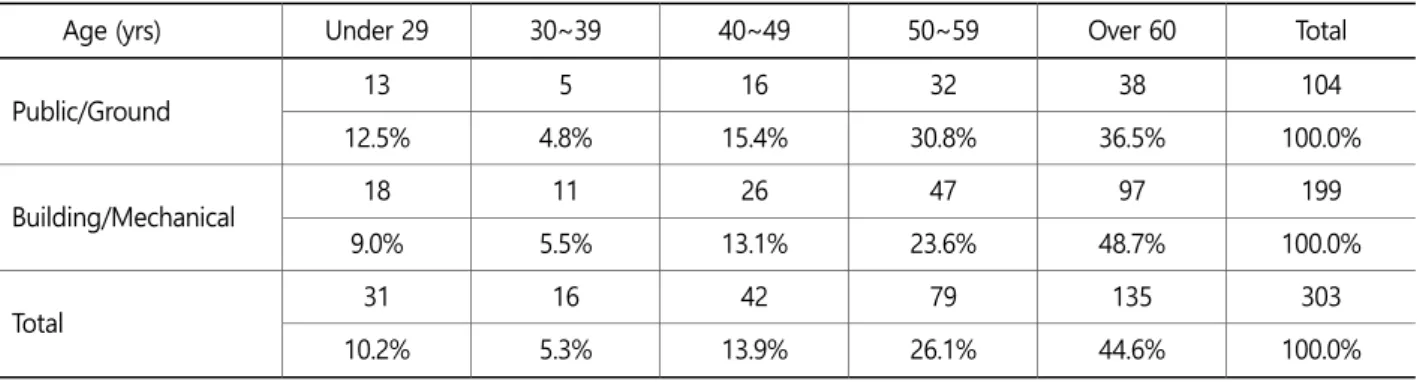
Table 4 shows the distribution of the injured by age. The proportion of the injured was 44.6% in their 60s and older 40s, 26.1% in their 50s and 13.9% in their 40s. Actually, the injured in 50s and older took up to 70.7%. The reason why there were more injured persons in 60s and older may be interpreted that more old generations, especially retirees, participated in simple service occupation like parking lot attendant that does not require much strength. In Korea, it is difficult to identify the data offering the distribution
Table 2. Distribution of the injured by size of employment (unit: person, %)Size of employment Under 15 16~29 30~49 Over 50 Total
Public/Ground 43 9 10 42 104
41.3% 8.7% 9.6% 40.4% 100.0%
Building/Mechanical 126 17 28 28 199
63.3% 8.5% 14.1% 14.1% 100.0%
Total 169 26 38 70 303
55.8% 8.6% 12.5% 23.1% 100.0%
Table 3. Distribution of the injured by type of parking lot (unit: person, %)
Gender Male Female Total
Public/Ground 83 21 104
79.8% 20.2% 100.0%
Building/Mechanical 178 21 199
89.4% 10.6% 100.0%
Total 261 42 303
86.1% 13.9% 100.0%
of parking lot attendants by age, because industrial statistics is prevalent. Therefore, it is difficult to calculate accident rate by age. There was no difference in the distribution of injured persons by age in view of parking lot type ( χ
2=4.752, p =0.314).
3.1.5 Injured persons by work experience
Table 5 shows the distribution of injured persons by work experience. The ratio of the injured with under six months of work experience was 42.6%, and it was 57.5% of those with under one year of work experience. The reason why beginners with work experience of less than one year have more accidents is that they begin their work without sufficient knowledge on work and safety. There was no difference in the distribution of the injured by work experience in view of parking lot type ( χ
2=2.344, p =0.673).
3.2 Characteristics of accidents by type of parking lot 3.2.1 Injured persons by accident type
Table 6 shows the distribution of the injured by accident type according to parking lot type, and the accidents occurred in the following order: falls, slips, trips (44.9%), contact with objects (28.4%) and fall to lower level (7.9%). There were differences in the distribution of injured persons by accident type in view of parking lot type ( χ
2=17.634, p =0.007). While accidents by falls, slips,
Table 4. Distribution of the injured by age (unit: person, %)Age (yrs) Under 29 30~39 40~49 50~59 Over 60 Total
Public/Ground 13 5 16 32 38 104
12.5% 4.8% 15.4% 30.8% 36.5% 100.0%
Building/Mechanical 18 11 26 47 97 199
9.0% 5.5% 13.1% 23.6% 48.7% 100.0%
Total 31 16 42 79 135 303
10.2% 5.3% 13.9% 26.1% 44.6% 100.0%
Table 5. Distribution of the injured by work experience (unit: person, %)
Work experience (yrs) Under 6 months 6 months ~ 1 1 ~ 2 2 ~ 5 Over 5 Total
Public/Ground 41 13 14 23 13 104
39.4% 12.5% 13.5% 22.1% 12.5% 100.0%
Building/Mechanical 88 32 23 33 23 199
44.2% 16.1% 11.6% 16.6% 11.6% 100.0%
Total 129 45 37 56 36 303
42.6% 14.9% 12.2% 18.5% 11.9% 100.0%
trips was 54.8%, contact with objects 27.9% in the public/ground parking lots, accidents by falls, slips, trips was 39.7%, contact with objects 28.6%, and fall to lower level 11.6% in the building/mechanical parking lots. This imply the need for accident preventative measures and for the use of equipment or facilities according to work environment and parking lot type.
3.2.2 Injured persons by agency of accident
Table 7 shows the distribution of injured persons by agency of accident. Floor/surface took up 33.7%, followed by vehicles (26.7%) and parts and materials, furniture & fixtures (13.2%). There were differences in the distribution of the injured by agency of accidents according to parking lot type. Most accidents occurred in floor and surface (44.2%) and vehicles (31.7%) in public/
ground type. However, the accidents occurred in the following order in the building/mechanical parking lots: floor/surface (28.1%), vehicle (24.1%), parts and materials, furniture & fixtures (15.6%) and machinery (11.6%) ( χ
2=24.769, p <0.001).
3.2.3 Injured persons by part of body affected
Table 8 shows the distribution of the injured by part of body injured due to accidents. The distribution was in the following order:
lower extremities (25.7%), hand/finger (10.2%), head (8.3%) and waist/trunk/neck (8.3%). There was no difference in the distribution
Table 6. Distribution of the injured by accident type (unit: person, %)Accident type Falls, slips, trips Contact with
objects Transportation
incidents Fall to
lower level Violence Over-exertion and bodily
reaction
others All Total
Public/
Ground
57 29 5 1 6 2 4 104
54.8% 27.9% 4.8% 1.0% 5.8% 1.9% 3.8% 100.0%
Building/
Mechanical
79 57 9 23 6 10 15 199
39.7% 28.6% 4.5% 11.6% 3.0% 5.0% 7.5% 100.0%
Total 136 86 14 24 12 12 19 303
44.9% 28.4% 4.6% 7.9% 4.0% 4.0% 6.3% 100.0%
Table 7. Distribution of the injured by source of injury or illness (unit: person, %)
Source of injury
or illness Floors, walkways
or ground surfaces Vehicles Pats and materials,
furniture & fixtures Machinery Person All
others Total Public/
Ground
46 33 9 1 7 8 104
44.2% 31.7% 8.7% 1.0% 6.7% 7.7% 100.0%
Building/
Mechanical
56 48 31 23 7 34 199
28.1% 24.1% 15.6% 11.6% 3.5% 17.1% 100.0%
Total 102 81 40 24 14 42 303
33.7% 26.7% 13.2% 7.9% 4.6% 13.9% 100.0%
of body part affected by parking lot type ( χ
2=4.121, p =0.660).
3.2.4 Injured persons by operation process
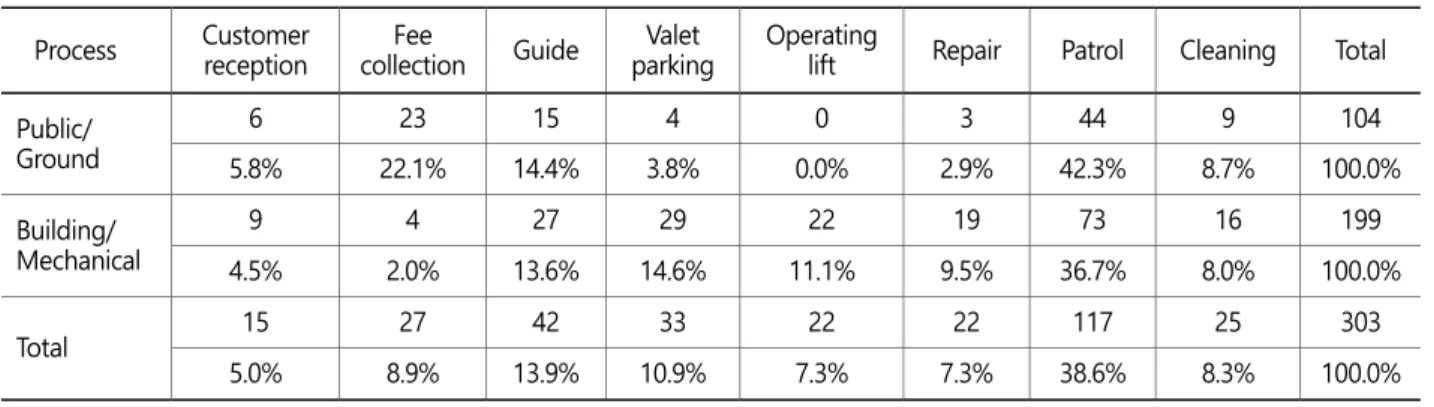
Table 9 shows the distribution of the injured by operation process according to parking lot type. It is distributed as follows: patrol (38.6%), guide (13.9%), valet parking (10.9%) and fee collection (8.9%). The injuries were caused in the order of patrol (42.3%), fee collection (22.1%), and guide (14.4%) in public/ground type, meanwhile, the injuries were caused in the order of patrol (36.7%), valet parking (14.6%) and guide (13.6%) in building/mechanical type.
4. Conclusion and Discussion
As the number of registered vehicles increased from 17.94 million in 2010 to 18.87 million in 2012, the fee parking lot and annexed parking spaces increased from 15.22 million to 17.00 million parking lanes (MOLIT, 2013). The parking lot attendant occupation is the job that retirees aged 60 and older can work without special entry barrier, and it can be a typical occupation that aged people can work. According to the increase of the number of parking lots, the parking lot attendant occupation is expected to increase. This study analyzed the characteristics of accident according to parking lot type, by using accident data
Table 8. Distribution of the injured by part of body affected (unit: person, %)Part of body
affected Head Trunk/
Neck Shoulder/
Arm Lower
extremities Hand/
Finger Multiple
parts All
others Total Public/
Ground
7 11 3 30 9 8 36 104
6.7% 10.6% 2.9% 28.8% 8.7% 7.7% 34.6% 100.0%
Building/
Mechanical
18 14 9 48 22 10 78 199
9.0% 7.0% 4.5% 24.1% 11.1% 5.0% 39.2% 100.0%
Total 25 25 12 78 31 18 114 303
8.3% 8.3% 4.0% 25.7% 10.2% 5.9% 37.6% 100.0%
Table 9. Distribution of the injured by operation process (unit: person, %)
Process Customer
reception Fee
collection Guide Valet
parking Operating
lift Repair Patrol Cleaning Total Public/
Ground
6 23 15 4 0 3 44 9 104
5.8% 22.1% 14.4% 3.8% 0.0% 2.9% 42.3% 8.7% 100.0%
Building/
Mechanical
9 4 27 29 22 19 73 16 199
4.5% 2.0% 13.6% 14.6% 11.1% 9.5% 36.7% 8.0% 100.0%
Total 15 27 42 33 22 22 117 25 303
5.0% 8.9% 13.9% 10.9% 7.3% 7.3% 38.6% 8.3% 100.0%
from 2010 to 2012. The results of this study revealed different characteristics in the distribution of the injured persons' age, gender, work experience, accident type, agency, and operation process according to parking lot type.
According to the study, 55.8% of accidents occurred in small-sized company employing less than 15 employees. Actually, 86.1%
of the total injured persons were male, and the injured persons aged 50s and older took up 70.7% of the total accidents. The accident ratio was 57.5% for workers with work experience of one year or less. Concerning accident characteristics, the accidents occurred in the following order: falls/slips/trips (44.9%), contact with objects (28.4%) and fall to lower level (7.9%). As for the agency of accident, floor/surface took up 33.7% of the total injured persons, followed by vehicles (26.7%) and parts and materials, furniture & fixtures (13.2%). The ratio of body part affected by accidents was in the order of lower extremities (25.7%), hand/
finger (10.2%), head (8.3%) and waist/trunk/neck (8.3%). The order was patrol (38.6%), guide (13.9%), valet parking (10.9%) and fee collection (8.9%) by operation process.
This study proposes the alternatives of accident prevention by reflecting the accident analysis results. The preventative measures in the building/mechanical parking lots taking up 64.9% of the injured and most of the fatal accidents must be established first.
In the mechanical parking lot, facility halts often due to malfunction of control board or lift. When a parking attendant climbs up or descend from the parking lift to take an emergency action, there can be such an accident as being caught in the lift or fall to lower level. Therefore, the parking lot attendant should not solve the problem by him/herself, but request emergency repair to the lift facility company. Anyone should not enter the inside of mechanical parking facilities, and an access needs to be allowed only if safety from fall is secured by wearing safety gear. A signboard should be used to let the others know about one's access to the inside of mechanical parking facilities for repair or emergency action.
Because, there are lots of slippery floor areas in a parking lot, due to oil and water leaked from vehicles, the accidents caused by slipping on the slippery floor took up most, irrelevant of parking lot type. In this regard, measures to prevent slip and fall accidents by slip should be put in place in priority. The floor of a building parking lot is paved with urethane in many cases, and the surface becomes slippery, because of water flow. Therefore, passing drivers or parking lot attendants slip in many cases. Actually, when water or oil flows on the parking lot floor, it needs to be removed by cleaning it. For water or oil that was not removed, a signboard needs to be posted for caution of slip, so that walking drivers or parking lot attendants can identify water or oil on the floor surface, and cope with the situation.
Although, driving speed is limited to less than 10km in a parking lot, many accidents clashing with an over-speeding vehicles occur. For this reason, a speed limit sign needs to be posted on the visible location and installing a speedbump can be a good alternative. Adequate indoor lights need to be maintained by checking periodically because an accident can occur by not detecting a parking lot attendant in the dark area of a parking lot.
In foreign countries, parking lots are warned as a place where caution is required, due to severe burglary and violence occur often.
There are some cases in which a dispute due to vehicle damage or parking fee leading to a violence in Korea. Consequently, a parking attendant needs to accurately check parking hours, and notice the drivers of clear parking fee regulations in advance, or post the regulations not to cause any dispute. It is good to prepare objective data including eyewitness or CCTV surveillance regarding the damaged vehicle. Manners need to be observed so that any dispute on parking fee or damaged vehicle cannot lead to a violence case, and an arbitration including the police intervention should be requested. Any action to grab a vehicle's door in order to prevent any vehicle not paying the parking fees from running away should be banned in a public/ground parking lot, where crossing gate is not installed at the entrance of the parking lot.
This study has analyzed the characteristics of the injured by parking lot type, and has presented accident preventative measures
by using the data of accidents occurred during the parking lot management work. The results imply that customized accident
preventative measures are required, according to parking lot type, since the characteristics of the injured and accidents are different in accordance with parking lot type. That is, effective accident preventative measures reflecting different circumstances and conditions of the public/ground and building/mechanical parking lots can be presented by using the results of this study.
Acknowledgements
This research was financially supported by Hansung University.
References
Ahn, T.H., Kim, J.S. and Jeong, B.Y., Ergonomic job hazard assessment of hotel chef, Journal of the Ergonomics Society of Korea, 25(3), 105-111, 2006.
Buchanan, S., Vossenas, P., Krause, N., Moriarty, J., Frumin, E., Shimek, J.A.M., Mirer, F., Orris, P. and Punnett, L., Occupational injury disparities in the US hotel industry. American Journal of Industrial Medicine, 53(2), 116-125, 2010.
Haruyama, Y., Matsuzuki, H., Tomita, S., Muto, T., Haratani, T., Muto, S. and Ito, A., Burn and cut injuries related to job stress among kitchen workers in Japan. Industrial health , 52(2), 113-120, 2014.
Jeong, B.Y., Characteristics of occupational accidents in the manufacturing industry of South Korea, International Journal of Industrial Ergonomics , 20(4), 301-306, 1997.
Jeong, B.Y., Occupational deaths and injuries in the construction industry. Applied Ergonomics , 29(5), 355-360, 1998.
Jeong, B.Y., Comparisons of variables between fatal and nonfatal accidents in manufacturing industry. International Journal of Industrial Ergonomics, 23(5), 565-572, 1999.
KOSIS, Report on the Transportation Survey (2012 yearly base), Statistics Korea, 2013.
http://kosis.kr/
KTSA (Korea Transportation Safety Authority), Report on the Occupational Accidents in the Mechanical Parking System, 2011.
http://www.ts2020.kr/main.do
Lee, K.S. and Jeong, B.Y., Characteristics and Prevention of Occupational Accidents in the Small-Sized Textile Industry, Journal of the Ergonomics Society of Korea , 28(4), 101-107, 2009. doi.10.5143/JESK.2009.28.4.101
MOLIT (Ministry of Land, Infrastructure and Transport), Parking Lot Statistics in Korea, Statistical Data, 2010. https://stat.molit.go.kr/
portal/main/portalMain.do
MOLIT, Total Registered Moter Vehicles, Statistical Data, 2013. https://stat.molit.go.kr/portal/main/portalMain.do
Park, M.H., Jeong, B.Y. and Kim, S.H., Occupational Accidents and Injuries for Moving Helpers, Journal of the Ergonomics Society of Korea , 34(4), 353-362, 2015. doi.10.5143/JESK.2015.34.4.353
Statistics Korea, Korean Standard Classification of Occupations. 2007.
Author listings
Myoung Hwan Park: [email protected]
Highest degree: PhD, Department of Industrial Engineering, KAIST
Position title: Professor, Department of Industrial and Management Engineering, Hansung University Areas of interest: Management Science, Innovation Engineering
Byung Yong Jeong: [email protected]
Highest degree: PhD, Department of Industrial Engineering, KAIST
Position title: Professor, Department of Industrial and Management Engineering, Hansung University Areas of interest: Ergonomics, Safety and Health Management, UX
Cha-O-Rum Park: [email protected]
Highest degree: BS, Department of Industrial & Management Engineering, Hansung University Position title: MS Student, Department of Industrial & Management Engineering, Hansung University Areas of interest: Ergonomics, Safety and Health Management