JESK
http://jesk.or.kr eISSN:2093-8462Occupational Accidents and Injuries for Moving Helpers
Myoung Hwan Park, Byung Yong Jeong, Sook-Hyun Kim
Department of Industrial and Management Engineering, Hansung University, Seoul, 02876
Corresponding Author Byung Yong Jeong
Department of Industrial and Management Engineering, Hansung University, Seoul, 02876
Phone : +82-2-760-4122 Email : [email protected]
Received : July 17, 2015 Accepted : July 26, 2015
Objective:This study aims to analyze occupational accidents of moving helpers by work place type which means the type of residence where moving operation is done.
Background: Most efforts have been focused on the industry base comprising various occupational spectrum and provided industry general preventative policies.
But occupation specific policies are required for the workers involved and will reduce the occurrences of occupational accidents for the workers subject to similar working environment and process.
Method: This study analyzes 208 non-motor vehicle collision related occupational accidents of moving helpers working for used household and office goods moving industry occurring from 2010 to 2012. Accident Type, agencies, event or exposure, parts of body affected are characterized by work places according to the work environment.
Results: Accidents characteristics showed the difference between high-rise type and low-rise type on the size of enterprise, age, gender and work experience of the injured. Also the accident type, source of accident and parts of body affected are different between the two work place types. Finally, Accidents occurred on the specific operational processes of moving service also showed different characteristic between the two types.
Conclusion and Application: The findings of accident characteristics according to workplace types and operational process of moving service can be used as baseline data for establishing systemized preventative policies for occupational accidents of moving helpers.
Keywords: Occupational injuries; Moving helpers; Accident prevention
Copyright@2015 by Ergonomics Society of Korea. All right reserved.
○
ccThis is an open-access article distributed under the terms of the Creative Commons Attribution Non-Commercial License (http://creativecommons.org/licenses/by-nc/3.0/), which permits unrestricted non-commercial use, distribution, and reproduction in any medium, provided the original work is properly cited.
1. Introduction
Korean Standard Classification of Occupations (Statistics Korea, 2007) classifies workers
in household and office goods moving into '92102-Moving helpers' and there are
four hierarchical categories including Elementary Workers (Major group), Transport
Related Elementary Occupations (Sub-major group), Loading and Lifting Elementary
Workers (Minor group/Unit group) and moving helpers (Occupations). The domestic
household goods moving industry corresponds to 'used household and office goods
forwarding business' defined as 'business to handle used household and office goods
(including extra services such as packaging and storing)' distinguished from 'general
freight forwarding business' according to Article 9 of the ordinance of Trucking
Transport Business Act (KMGL). As Article 48 of Trucking Transport Business Act has
been revised, a separate association from the Freight Forwarders Association is being established. Thus, it is currently hard to investigate companies or workers in this business. According to the data published by Korea Consumer Agency in 1999, there were 1,197 household goods forwarders in Seoul and about 5,000 in Korea (KCA, 1999). In June 2015, 1,066 household goods forwarders have been registered in Seoul, suggesting that the size may be nationally comparable to that in 1999 (SMFA, 2015).
As for comparison, there were 21,520 workers in 9,123 overland freight forwarders in 2012, and private corporations account for 52.8% of workers (KOSIS, 2013).
When household goods forwarding is required, an address changes and therefore statistics for move-ins or move-outs needs to be investigated to figure out the number of moving in and out. As shown in Table 1, the number of move-ins in 2012 has decreased, compared to 2010. However, there were 1.47 million move-ins of two or more member households among total 4.58 million move-ins (KOSIS, Internal Migration Statistics).
There is no previous study to specify household goods moving, but several studies on industrial accidents arising in trucking forwarders have been conducted. In particular, loading/unloading household goods in a stopped vehicle is different from the accidents caused by traffic accidents during driving. There are various accidents, such as injuries caused by freight weight and size in the freight moving process, accidents caused by errors and defects in operation of a carrying machine equipped in a truck, false steps in stairs or a flatland, slips and falls (Lin & Cohen, 1997; OSHA, 2002; Spielholz et al., 2008; Friswell & Williamson, 2010;
Smith & Williams, 2014). Lin & Cohen (1997) suggested improvement plans for equipment design, protective equipment, safety education and facilities and vehicle maintenance by analysis of type and cause of accidents arising in trucking forwarders. OSHA (2002) made the safety guide for the freight moving and storing process. In the study of Spielholz et al. (2008) for trucking forwarders and truck drivers in Washington, it was suggested that accidents, such as musculoskeletal disorders, false steps, slips and falls, arose commonly and therefore heavy weight lifting should be limited, proper equipment should be used and the slippery floor should be carefully controlled. Friswell & Williamson (2010) carried out a survey for short-range light delivery truck drivers in Australia to analyze a correlation between the accidents they have experienced and the work-related accidents. Carrying heavy or large freight without a power support, and repetitive lifting caused injuries most frequently and slips, false steps and falls from a vehicle also induced injuries. The back, shoulders and hands were most often injured, and a strain or a sprain of muscle, ligament, tendon and joints also frequently observed. Smith & Williams (2014) analyzed accidents, except traffic accidents, by detailed industry and occupational category in the trucking industry and found that a quarter of total accidents were slips, false steps and falls. Thus, they suggested that it is important to analyze accidents by detailed industry and occupational category in order to use limited accident prevention resources effectively because a level of accidents is different depending on detailed industries and occupational categories.
The risk of accidents in household goods moving is different between a high-rise workplace and a low-rise workplace. In case of a high-rise workplace, an elevator that can accommodate freight or a lift truck for moving household goods between the ground and high moving place can be used. Therefore, risk of accidents caused by mechanical defects related to a lift truck and dropped household goods arises in a high-rise workplace while workers are carrying household goods by using a lift truck whereas risk of accidents in a low-rise workplace increases while workers are carrying household goods by taking the stairs.
Table 1. Migrants per migration report for province (unit: case)
Migrants per report 1 2 3 4 Over 5 Total
2010 3,309,794 634,586 484,452 404,435 110,439 4,943,706
2012 3,108,404 581,332 434,545 353,773 98,870 4,576,924
In this study, we are to investigate the characteristics of both the injured and occupational patients by distinguishing between a high-rise workplace and a low-rise workplace. Despite a difference by workplace type, tasks of moving helpers basically consist of the activities as follows: assembly and disassembly of doors and windows, packaging/unpacking for household goods handling;
manual handling such as descending/ascending stairs, passing a flat surface, a corridor and the interior; loading/unloading processes. In case of a high-rise workplace, moving processes between floors such as ladder works for lift truck such as ladder installation/ladder disassembly/descending & ascending carriage/general works and loading/unloading onto an elevator, and accessorial works are added. In the household goods forwarding business, a responsible person may be designated for each process, but one or two moving helpers can carry all household goods moving process if the size of household goods is small.
The work safety is directly related to dangerous environments, such as risk type, risk possibility, possible connection to accidents and severity of accidents. For accident prevention, the characteristics of the occurrence of accidents by workplace type or operation process need to be analyzed. In this study, we are to contribute to accident prevention by analyzing the characteristics of the injured, arising in the household goods moving process, by workplace and operation process in a high-rise workplace and a low-rise workplace.
2. Methods
The injured away from work for at least four days due to accidents while moving household goods were included in this study.
The study includes the dead, the injured and occupational patients.
Among the injured arising from moving household goods between 2010 and 2012 for three years, 208 victims who could be classified by workplace type were included in this study. We are to analyze the characteristics of accidents by classifying workplace type into the following, depending on the type of buildings and residences where household goods are moved: a high-rise workplace, such as apartments, buildings and high-rise townhouses, where household goods should be carried by freight forwarding elevator or lift truck; a low-rise workplace where household goods should be moved by human resources without a power unit. The distribution of the injured, arising from moving household goods for three years (2010~2012), by workplace type is shown in Table 2. The proportion of accidents in high-rise workplaces and low-rise workplaces was 60.1% and 39.9%, respectively, in total accidents. The fatalities were all found in high-rise workplaces.
In addition, we are to analyze the characteristics of accidents by process on the basis of work at the time of an accident. Although there is a difference depending on workplace, processes can be classified into household goods moving, manual carriage, loading/unloading, ladder work and elevator work.
In this study, the independent variables include the size of household goods forwarders in which the injured were employed, the characteristics of the injured (age, gender, work experience) and the characteristics of accidents (accident type, agency). The
Table 2. Distribution of the injured by type of work place (unit: person, %)Type Non-fatal Fatal Total
High-rise 121 59.3% 4 100.0% 125 60.1%
Low-rise 83 40.7% 0 0.0% 83 39.9%
Total 204 100.0% 4 100.0% 208 100.0%
dependent variables include workplace type and operation process. A difference in accidents arising from moving household goods by workplace type was analyzed depending on the size of household goods forwarders, the characteristics of injured (age, gender, work experience) and the characteristics of accidents (accident type, agency, operation process). To investigate a dependency between dependent variables and independent variables, Chi-square test was used and the significance level was 0.05.
3. Results
3.1 Analysis of the characteristics of the injured in each workplace type 3.1.1 Distribution of the injured by size of employment
The distribution of the injured by workplace type and by size of the forwarders where the injured were employed is presented in Table 3. Most of accidents arose in the companies containing five or less workers, and they accounted for 89.9% of total accidents. Therefore, regardless of workplace type, accidents should be intensively prevented for small-size household goods forwarders. Small-size household goods forwarders have lacked the capability of safety management such as accident prevention and also education, which need to be intensified. In addition, small-size household goods forwarders commonly hire day laborers and therefore safety management should be enhanced. Analysis showed there was no difference in the distribution of the size of household goods forwarders where the injured were included, by workplace type ( χ
2=4.244, p =0.120).
3.1.2 Distribution of the injured by gender in each workplace type
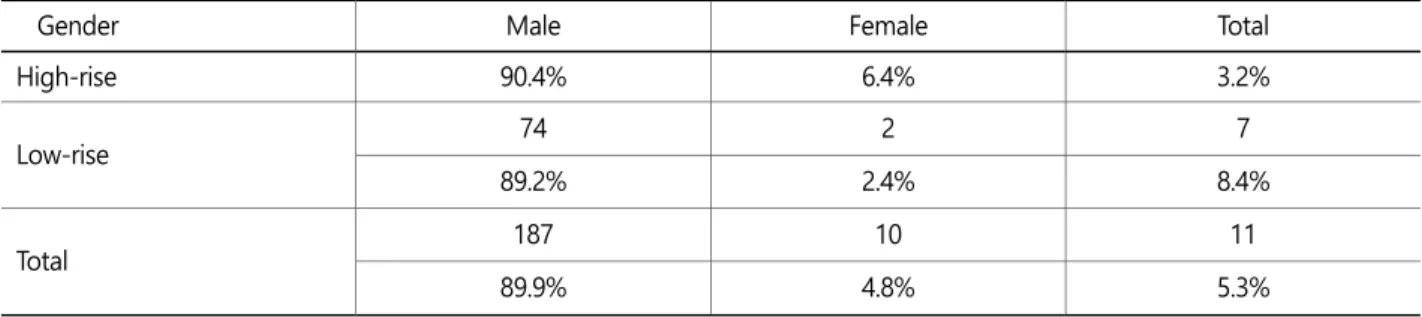
The gender distribution of the injured is presented in Table 4 and shows 95.7% of the total injured workers were male. It is because female workers are generally packaging, unpacking or tidying goods in the household goods moving business and therefore they are rarely exposed to accidents. In the result, there was no difference in gender distribution by workplace type at the .05 significance level ( χ
2=2.810, p =0.094).
Table 3. Distribution of the injured by size of employment (unit: person, %)
Size of employment Under 5 5~10 Over 10 Total
High-rise 113 8 4 125
90.4% 6.4% 3.2% 100.0%
Low-rise 74 2 7 83
89.2% 2.4% 8.4% 100.0%
Total 187 10 11 208
89.9% 4.8% 5.3% 100.0%
Table 4. Distribution of the injured by type of parking lot (unit: person, %)
Gender Male Female Total
High-rise 113 8 4
3.1.3 Distribution of the injured by age in each workplace type
The age distribution of the injured is presented in Table 5. The proportion of the injured was 42.8% in their 40s, 24.0% in their 30s and 24.5% in their 50s. The number of injured workers over 60 was small because there are a small number of workers over 60 due to a high muscular strength required for moving household goods. And the number of injured workers in their 20s or younger was also small and this may be because of the fact that the youth do not prefer a hard work. There was a significant difference in the distribution of the injured by workplace type as shown in Table 5 ( χ
2=17.662, p =0.001). In case of high-rise workplaces, the proportion of the injured was 53.6% in their 40s, 22.4% in their 50s and 19.2% in their 30s. However, in case of low-rise workplaces, the proportion was 31.3% in their 30s, 27.7% in their 50s and 26.5% in their 40s and therefore the number of the injured in their 30s was the largest.
3.1.4 Distribution of the injured by work experience in each workplace type
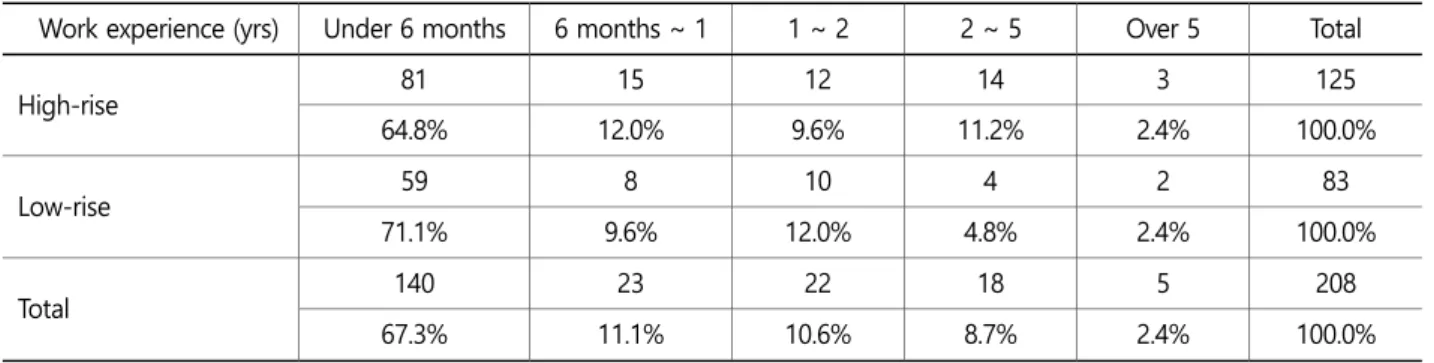
The distribution of the injured by work experience is presented in Table 6. The proportion of the injured with work experience less than six months was 67.3%. When workers had work experience more than six months, the rate of accidents decreased and evenly distributed and when workers had work experience more than five years, the rate was 2.4% which is very low. The fact that more accidents arose in new recruits who had work experience less than six months may suggest that they were put into a duty with lack of understanding of tasks and safety. There was no difference in work experience of the injured by workplace type ( χ
2=3.174, p =0.529).
Table 4. Distribution of the injured by type of parking lot (unit: person, %) (Continued)
Gender Male Female Total
High-rise 90.4% 6.4% 3.2%
Low-rise 74 2 7
89.2% 2.4% 8.4%
Total 187 10 11
89.9% 4.8% 5.3%
Table 5. Distribution of the injured by age (unit: person, %)
Age (yrs) Under 29 30~39 40~49 50~59 Over 60 Total
High-rise 3 24 67 28 3 125
2.4% 19.2% 53.6% 22.4% 2.4% 100.0%
Low-rise 7 26 22 23 5 83
8.4% 31.3% 26.5% 27.7% 6.0% 100.0%
Total 10 50 89 51 8 208
4.8% 24.0% 42.8% 24.5% 3.8% 100.0%
3.2 Distribution of the characteristics of accidents in each workplace type 3.2.1 Distribution of the injured by accident type in each workplace type
The distribution of the injured by accident type is shown in Table 7 and there were falls from a height (21.6%), slips and trips (18.3%), caught in (15.4%) and struck by object (12.0%) in order. In the accident type by workplace type, falls from a height (28.0%) and caught in (15.2%) frequently arose in high-rise workplaces and slips and trips (25.3%) and caught in (15.7%) were observed often in low-rise workplaces. And there was a significant difference ( χ
2=14.919, p =0.037). Falls arising in high-rise workplaces included falls from a cargo box of a truck and from cage of a ladder which comprises three out of four fatalities. In low-rise workplaces, false steps on the flat surface and stairs were commonly observed. The distribution characteristics of accident types depending on workplace type suggested that prevention of accidents by the working environment and use of instrument and equipment by workplace type is required. In particular, a safety guide for ladder works in lift truck should be established and followed in order to eliminate fatal accidents fundamentally.
3.2.2 The characteristics of the injured by agency of accidents in each workplace type
The distribution of the injured by agency which causes accidents is presented in Table 8. Furniture/office supply/musical instrument/transport basket caused 39.9% of the total injured, and furniture-related accidents ranked top among this. In addition,
Table 6. Distribution of the injured by work experience (unit: person, %)Work experience (yrs) Under 6 months 6 months ~ 1 1 ~ 2 2 ~ 5 Over 5 Total
High-rise 81 15 12 14 3 125
64.8% 12.0% 9.6% 11.2% 2.4% 100.0%
Low-rise 59 8 10 4 2 83
71.1% 9.6% 12.0% 4.8% 2.4% 100.0%
Total 140 23 22 18 5 208
67.3% 11.1% 10.6% 8.7% 2.4% 100.0%
Table 7. Distribution of the injured by accident type (unit: person, %) Accident
type Falls from
a height Slips and
trips Caught
in Struck by object
Struck against
object Overexertion Cuts, lacerations, punctures Others Total
High-rise 35 17 19 14 8 10 12 10 125
28.0% 13.6% 15.2% 11.2% 6.4% 8.0% 9.6% 8.0% 100.0%
Low-rise 10 21 13 11 12 5 4 7 83
12.0% 25.3% 15.7% 13.3% 14.5% 6.0% 4.8% 8.4% 100.0%
Total 45 38 32 25 20 15 16 17 208
21.6% 18.3% 15.4% 12.0% 9.6% 7.2% 7.7% 8.2% 100.0%
trucks caused 15.9% of the total injured and lift/elevator, which support moving, were related to 11.5%. Among these lift related accidents were majority. Stairs and passages caused 11.1% the total injured. In the distribution of agencies by workplace type, furniture/office supply/musical instrument/transport basket caused most of the accidents in both high-rise workplaces and low- rise workplaces. However, ladders in lift trucks were the most frequent cause of accidents in high-rise workplaces, and accidents caused by stairs and corridors arose a lot in low-rise workplaces while going up and down the stairs ( χ
2=23.111, p <0.001).
3.2.3 The characteristics of the part of body affected by accidents in each workplace type
The distribution of the part of body damaged by accidents is shown in Table 9. Leg/feet, hand/finger and trunk/neck accounted for 25.0%, 24.5% and 11.1% of the injured part, respectively. There was no difference in the part of body affected by accidents in each workplace type ( χ
2=9.675, p =0.139).
3.2.4 Distribution of the injured by operation processes at the time of accidents in each workplace type
Activities of moving operation process are as follows: assembly and disassembly of doors and windows, packaging/unpacking for household goods handling; manual moving load such as descending/ascending stairs, passing a flat surface, a corridor and the interior; loading/unloading (lift onto/lift off from truck) processes. Operations in a high-rise workplace are composed of ladder
Table 8. Distribution of the injured by agency of injury or illness (unit: person, %)Agency Containers, materials,
furniture and fixtures Machinery Vehicles Floors, steps
walkways Others Total
High-rise 46 24 21 8 26 125
36.8% 19.2% 16.8% 6.4% 20.8% 100.0%
Low-rise 37 0 12 15 19 83
44.6% 0.0% 14.5% 18.1% 22.9% 100.0%
Total 83 24 33 23 45 208
39.9% 11.5% 15.9% 11.1% 21.6% 100.0%
Table 9. Distribution of the injured by part of body affected (unit: person, %)
Part of body
affected Head Trunk/neck Shoulder/arm Leg/feet Hand/finger Multiple
parts Others Total
High-rise 5 16 6 24 30 6 38 125
4.0% 12.8% 4.8% 19.2% 24.0% 4.8% 30.4% 100.0%
Low-rise 2 7 7 28 21 3 15 83
2.4% 8.4% 8.4% 33.7% 25.3% 3.6% 18.1% 100.0%
Total 7 23 13 52 51 9 53 208
3.4% 11.1% 6.3% 25.0% 24.5% 4.3% 25.5% 100.0%
works, such as ladder installation/ladder disassembly/descending & ascending carriage/general works, and elevator works, such as loading/unloading onto an elevator. The distribution of the injured by operation process at the time of accidents in each workplace type is shown in Table 10. The operation processes included manual moving load (42.3%), ladder car works (29.8%), loading/unloading (15.4%) and preparation/packaging (11.5%) in order. In high-rise workplaces, the injured arouse frequently during ladder car works (49.6%), manual moving load (27.2%) and loading/unloading (12.8%) whereas in low-rise workplaces, the injured arouse frequently during manual moving load (65.1%), loading/unloading (19.3%) and preparation/ packaging (15.7%).
4. Conclusion and Discussion
In this study, we analyzed the characteristics of industrial accidents, arising during household goods handling operations, in each workplace type, which have been rarely studied.
In the result of the accident type, there were falls from a height (21.6%), slips and trips (18.3%), caught in (15.4%) and struck by/against (12.0%) in order, which is comparable to the result of Lin & Cohen (1997) reporting slip, falls and struck by/against in order. In the study of Spielholz et al. (2008) for truck drivers in freight forwarding industries in Washington, the USA, it was suggested that slips/ missteps/tumbling/falls, except musculoskeletal disorders, arose most frequently and struck and caught in were also common. In the study of Friswell & Williamson (2010), slips and falls, except musculoskeletal disorders arising from repetitive lifting, were the main accidents for truck drivers and bumped and struck workers were also common. In addition, it was comparable to the result of accidents for moving helpers, except traffic accidents, in the freight forwarding industry when musculoskeletal disorders arising from repetitive lifting of freight were not considered (Smith & Williams, 2014).
In our study, large household goods comprised a large majority (39.9%) of agencies at the time of accidents, and accidents arouse substantially during ladders (lift truck) works in high-rise workplaces whereas accidents caused by moving load through the stairs and corridors arose largely in low-rise workplaces. It is comparable to the result showing that accidents arose during manual moving load (42.3%), ladder works (29.8%), loading/unloading (15.4%) and preparation and packaging (11.5%). In the distribution of the part of body damaged, hand and finger were frequently injured in high-rise workplaces whereas leg/foot were frequently injured in low-rise workplaces. There was a difference in the part of body injured because the freight carrying distance is short in high-rise workplaces, but it is relatively long in low-rise workplaces even with stairs.
Considering the characteristics of accidents, safety shoes are required to prevent injuries caused by falling stuff and non-slip gloves should be worn to prevent household goods from being slipped. When using stairs and corridors, safety actions, such as retention
Table 10. Distribution of the injured by operation process (unit: person, %)Process Ladder car Lift on/off Elevator Preparation/packaging Moving load Total
High-rise 62 16 2 11 34 125
49.6% 12.8% 1.6% 8.8% 27.2% 100.0%
Low-rise 0 16 0 13 54 83
0.0% 19.3% 0.0% 15.7% 65.1% 100.0%
Total 62 32 2 24 88 208
29.8% 15.4% 1.0% 11.5% 42.3% 100.0%
of a carrying path and removal of obstructions, should be performed in advance. Workers should be prohibited from boarding a cage while lifting or carrying out freight by using a lift cage and the safety fence should be installed to ban people from entering the working radius of a lift truck. In addition, the working conditions should be accurately informed by radio in upper and lower locations.
In the study, the injured who have stayed away from work for at least four days due to accidents, while moving household goods, and the characteristics related to the accidents were analyzed by workplace type and operation process and then the measures to prevent accidents were suggested. There was a difference in the injured and the characteristics of the accidents by workplace type. Therefore, it is suggested that customized measures to prevent accidents are required for each workplace type. In other words, the results may be used to suggest practical and effective measures to prevent accidents by considering the characteristics of household goods handling works in low-rise and high-rise workplaces.
Acknowledgements
This research was financially supported by Hansung University.
References
Friswell, R. and Williamson, A., Work characteristics associated with injury among light/short-haul transport drivers. Accident Analysis & Prevention, 42(6), 2068-2074, 2010.
KCA Report, The Issues and Improvement plans for Used household and office goods Moving Industry, KCA (Korea Consumer Agency), 1999.
KMGL (Korea Ministry of Government Legistration), http://www.law.go.kr/main.html
KOSIS (Korean Statistical Information Service), Statistical Database - Population/Household - Migration - Internal Migration Statistics, http://kosis.kr/
KOSIS, Report on the Transportation Survey (2012 yearly base), Statistics Korea, 2013. http://kosis.kr/
Lin, L. and Cohen, H.H., Accidents in the trucking industry. International Journal of Industrial Ergonomics , 20, 287-300, 1997.
OSHA., Materials Handling and Storage (OSHA 2236). U.S. Department of Labor. 2002.
SMFA (Seoul Move Forwarders Association), 2015. http://www.smfa.or.kr/
Smith, C.K. and Williams, J., Work related injuries in Washington State's Trucking Industry, by industry sector and occupation.
Accident Analysis and Prevention, 65, 63-71, 2014.
Spielholz, P., Cullen, J., Smith, C., Howard, N., Silverstein, B. and Bonauto, D., Assessment of perceived injury risks and priorities among truck drivers and trucking companies in Washington State. Journal of Safety Research, 39(6), 569-576, 2008.
Statistics Korea, Korean Standard Classification of Occupations. 2007.
Author listings
Myoung Hwan Park: [email protected]
Highest degree: PhD, Department of Industrial Engineering, KAIST
Position title: Professor, Department of Industrial and Management Engineering, Hansung University Areas of interest: Management Science, Innovation Engineering
Byung Yong Jeong: [email protected]
Highest degree: PhD, Department of Industrial Engineering, KAIST
Position title: Professor, Department of Industrial and Management Engineering, Hansung University Areas of interest: Ergonomics, Safety and Health Management, UX
Sook-Hyun Kim: [email protected]
Highest degree: MS Student, Department of Industrial and Management Engineering, Hansung University Areas of interest: Ergonomics, Safety and Health Management