포도씨 추출물과 분획물의 Tyrosinase 저해활성
⁃연구노트⁃
한지영․성지혜․김대중․정헌상․이준수†
충북대학교 식품공학과
Inhibitory Effect of Methanol Extract and Its Fractions from Grape Seeds on Mushroom Tyrosinase
Jiyoung Han, Jeehye Sung, Dae-Jung Kim, Heon-Sang Jeong, and Junsoo Lee†
Dept. of Food Science and Technology, Chungbuk National University, Chungbuk 361-763, Korea
Abstract
The objectives of this study were to determine inhibitory effect on tyrosinase activity and antioxidant activity of the methanolic extract from grape seeds and to investigate relationships between tyrosinase inhibitory activity and antioxidant activity of the extract. The 80% methanol extracts of grape seeds were fractionated subsequently with hexane, chloroform, ethyl acetate and water. The methanolic extract and fractions from grape seeds inhibited tyrosinase activity in a concentration dependent manner. The methanolic extracts showed the highest inhibitory effects on tyrosinase activity. The inhibitory effects of the ethyl acetate fraction from the methanolic extract on tyrosinase activity was higher than other fractions. The ethyl acetate fraction from methanolic extracts showed higher antioxidant activity and contained higher polyphenolic and flavonoid contents compared to other fractions. The correlation coefficients among the polyphenoilc content of methanolic extracts, ABTS radical cation scavenging activity and inhibitory effect of tyrosinase were relatively high. These results suggest that grape seeds may have potential as a depigmentation agent for cosmetics and functional food products.
Key words: grape seeds, tyrosinase, antioxidant activity, antioxidant compound
†Corresponding author. E-mail: [email protected]
†Phone: 82-43-261-2566, Fax: 82-43-271-4412
서 론
급속한 산업화에 따른 환경오염으로 인해 오존층이 파괴 되어 자외선 조사량이 증가하고 있다(1). 이로 인해 기미, 주근깨, 검버섯 등 피부갈변 또는 피부 스트레스가 유발되 며, 이러한 색소침착은 멜라닌 색소의 증가에 기인한다. 멜 라닌은 동·식물과 미생물계에 널리 존재하는 페놀류의 고분 자 천연색소로 표피 기저층에 존재하는 melanocyte 내의 melanosome에서 합성된다(2). 멜라닌은 노란색과 빨간색을 나타내는 pheomelanin과 갈색과 검은색을 나타내는 eume- lanin의 두 가지 종류로 체내에서 합성되며 피부, 머리카락, 눈동자 등에 분포되어 있다(3,4). 멜라닌은 tyrosinase (monophenol, dihydroxy-L-phenylalanine: oxygen oxi- doreductase, EC 1.14.18.1) 효소의 연속적 산화반응으로 생 합성 되며, tyrosinase는 멜라닌 생합성 과정의 key enzyme 으로 넓은 범위의 페놀화합물을 기질로 이용하는 구리 함유 효소이다(5). L-Tyrosine은 tyrosinase에 의해 3,4-dihy- droxyphenylalanine(L-DOPA)로 합성되고, L-DOPA는 phenylanine-3,4-quinone으로 산화되며, 중간 대사산물을
거쳐 최종 멜라닌으로 합성된다(6). 지금까지 멜라닌 색소의 생합성을 저해하는 물질에 관한 연구는 tyrosinase 효소 활 성을 저해하는 수준에서 주로 이루어져 왔으며 현재까지 알 려진 tyrosinase 저해제로는 hydroquinone, ascorbic acid, 4-hydroxyanisole, kojic acid, azelaic acid, arbutin, cortico- steroids 등이 보고되고 있으나, 안전성과 경제성 등의 문제 점으로 사용이 제한되고 있다(7,8).
포도(Vitis vinifera L.)는 갈대나무목(Rhamnales) 포도과 (Vitaceae)에 속하는 덩굴성과수로, 포도과에는 11속 700여 종이 있으며 주로 열대, 아열대 지역에서 자생하며 일부는 온대지방까지 분포한다(9). 포도는 세계적으로 광범위하게 재배되고 있으며 세계과일 생산량의 약 30%를 차지하고, 우리나라에서는 연간 40만 톤의 포도가 생산된다(10). 포도 는 세계적으로 포도주 생산에 가장 많이 이용되고 있으나 국내에서는 식용으로 이용되며 음료 및 주류의 가공에 이용 되고 있다(11). 이런 포도의 가공 공정에서 약 천 톤 정도의 포도씨가 부산물로 배출되는 것으로 추정되지만 포도씨에 대한 활용도는 미비한 실정이다(12). 포도 중량의 3~5%를 차지하고 있는 포도씨는 지방(9~12%), 단백질(8~10%) 및
hemicellulose와 같은 식이섬유소(45%)를 함유하고 있을 뿐 만 아니라 oleic acid 및 linoleic acid와 같은 불포화지방산을 다량 함유하고 있다. 포도씨에는 (+)-catechins, (-)-epi- catechin, (-)-epicatechin-3-o-gallate 등의 monomer 페놀 화합물, polyhydroxy favan-3-ol 단위의 oligomer, 그리고 polymer인 proanthocyanidin이 다량 함유되어 있어 기능성 신소재로 각광받고 있다. 포도씨에 함유된 유용물질들은 심 혈관계 질환을 예방하고 항산화작용, 항암작용, 항균작용 등 여러 가지 생리활성을 지니는 것으로 알려져 있으나 멜라닌 생합성 저해 효과에 대한 연구는 미비한 실정이다. 따라서 본 연구에서는 포도 가공 부산물인 포도씨를 이용하여 피부 노화 및 색소침착에 관련된 tyrosinase 저해활성을 알아보고 자 하였으며 폴리페놀 화합물과 총항산화력과의 상관관계 를 비교·분석하고자 하였다.
재료 및 방법
재료 및 시약
본 실험에 사용한 포도씨는 삼랑진 농산물 가공 공장에서 제공받았으며, tyrosinase 저해활성 실험에 사용된 dime- thysulfoxide(DMSO), gallic acid, catechin, Folin-Ciocalteu (FC) reagent, mushroom tyrosinase, L-DOPA는 Sigma Chemical Co.(St. Louis, MO, USA)에서 구입하였다. 그 밖 에 사용된 추출용매 및 시약은 analytical 및 HPLC 등급을 사용하였다.
시료 추출 및 분획
포도씨를 분쇄기로 일정하게 마쇄하여 시료 50 g에 80%
methanol 500 mL을 가하여 실온에서 24시간 추출 후 얻어진 추출물은 여과지(Whatman No.2)를 사용하여 고형분과 분 리하였고 감압농축기(EYELA, Tokyo, Japan)로 농축한 후 동결건조 하여 분말 형태로 사용하였다. 분말 형태의 포도씨 추출물은 -74°C에 보관하여 사용하였다. 용매 분획은 농축 된 메탄올 추출물을 증류수로 현탁시킨 후 hexane, chloro- form, ethyl acetate, water를 이용하여 순차 분획하였으며 감압농축 하여 분말 형태로 제조하였다.
Tyrosinase 활성 측정
Tyrosinase 활성은 Kubo 등(13)의 방법을 변형하여 사용 하였다. 반응액의 총 부피는 300 μL이며, 1/15 M sodium phosphate buffer(180 μL), 각 추출액(30 μL), 0.1 mM L-DOPA(40 μL), tyrosinase(50 μL)를 넣고 25°C에서 10분 동안 반응시킨 후 475 nm에서 흡광도를 측정하였다.
총 polyphenol 함량 측정
총 polyphenol의 함량 측정은 Folin-Denis 방법을 변형하 여 사용하였다(14). 각 추출액(100 μL)에 2% Na2CO3용액(2 mL)를 가하고 3분 방치한 후 50% FC reagent(100 μL)를
가하였다. 30분 후 반응액의 흡광도 값을 750 nm에서 측정 하였고 표준물질로 0.1% gallic acid를 사용하여 mg gallic acid equivalent per g residue로 나타내었다.
총 flavonoid 함량 측정
총 flavonoid의 함량 측정은 발색방법을 이용하여 측정하 였다(15). 각 추출액(200 μL)에 1.25 mL의 증류수와 5%
NaNO2(75 μL)를 첨가하고 5분 방치 후 10% AlCl3·H2O(150 μL)을 넣고 5분간 상온에서 반응시킨 후 1 M NaOH(500 μL)을 첨가한 후 잘 혼합하여 반응액의 흡광도 값을 510 nm 에서 측정하였고 표준물질로 0.02% (+)-cathechin을 사용하 여 mg (+)-catechin equivalents per g residue로 나타내었다.
ABTS 라디칼을 이용한 총항산화력 측정
총항산화력의 측정은 ABTS radical cation을 이용한 방 법(16)에 의하여 시행하였다. ABTS(7.4 mM)와 potassium persulphate(2.6 mM)를 하루 동안 암소에 방치하여 ABTS 양이온을 형성시킨 후 이 용액을 414 nm에서 흡광도 값이 1.5가 되도록 몰 흡광계수(ε=3.6×10⁴ M-1cm-1)를 이용하여 증류수로 희석하였다. 희석된 ABTS 용액 1 mL에 추출액 30 μL를 가하여 흡광도의 변화를 정확히 90분 후에 측정하 였으며 표준물질로서 Trolox를 동량 첨가하여 표준곡선을 작성한 후 계산하였다.
결과 및 고찰
포도씨 추출물과 분획물의 tyrosinase 활성과 항산화성 분과의 상관성
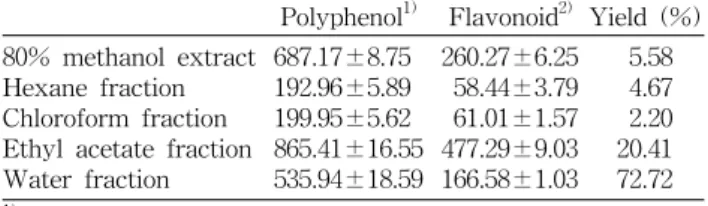
포도씨 methanol 추출물과 분획물의 수율은 Table 1에 나타내었다. Methanol 추출물과 각 분획물의 수율은 meth- anol 추출물의 경우 5.58%이며 hexane 분획층은 methanol 추출물의 4.67, chloroform 분획층은 2.20, ethyl acetate 분획 층은 20.41, water 분획층은 72.72%로 나타났다. 여러 연구 결과에 의하면 추출에 사용된 용매의 극성이 증가할수록 유 용성분의 추출률이 높아지며 물 추출물보다는 aqueous methanol과 ethanol을 사용하였을 경우 추출물의 활성이 증 가하는 것으로 보고되었다(17,18). 따라서 본 연구에서는
Table 1. Polyphenol and flavonoid contents of methanolic extracts and its' fraction obtained from grape seeds and extraction yields
Polyphenol1) Flavonoid2) Yield (%) 80% methanol extract
Hexane fraction Chloroform fraction Ethyl acetate fraction Water fraction
687.17±8.75 192.96±5.89 199.95±5.62 865.41±16.55 535.94±18.59
260.27±6.25 58.44±3.79 61.01±1.57 477.29±9.03 166.58±1.03
5.58 4.67 2.20 20.41 72.72
1)Mean of triplicate determinations expressed as mg gallic acid equivalents per g residue.
2)Mean of triplicate determinations expressed as mg catechin equivalents per g residue.
80% methanol을 추출용매로 선택하여 여러 가지 활성 성분 을 추출하고 포도씨에 존재하는 생리활성물질의 손실을 최 소화하고자 하였다.
포도씨 methanol 추출물과 그 분획물의 tyrosinase 저해 효과는 0.01, 0.1, 0.25, 0.5, 1.0 mg/mL의 농도로 측정하였다.
포도씨 methanol 추출물은 1 mg/mL의 농도에서 약 18%의 tyrosinase 활성을 나타냈으며 농도 의존적인 경향을 나타내 었다(Fig. 1). 포도씨 methanol 추출 분획물의 tyrosinase 활 성은 Fig. 2에 나타내었다. Tyrosinase 저해활성은 1 mg/
mL의 농도에서 hexane, chloroform, ethyl acetate 및 water 분획층은 각각 64.18, 103.52, 24.18, 47.25%의 tyrosinase 활 성을 나타내었고 0.01 mg/mL의 농도에서는 4가지 층 모두 tyrosinase 억제효과를 보이지 않았다. Chloroform 분획층 은 실험에 사용한 모든 농도에서 거의 효과가 나타나지 않았
Concentration (mg/mL)
0.01 0.10 0.25 0.50 1.00
T y ro s in a s e ac tiv ity ( % )
0 20 40 60 80 100 120
Fig. 1. Inhibitory effect of 80% methanol extracts from grape seeds against tyrosinase activity. Data values are ex- pressed as mean
±
SD of triplicate determination.Concentration (mg/mL)
0.00 0.01 0.10 0.25 0.50 1.00
Ty ro s in a s e a c ti v ity (% )
0 20 40 60 80 100 120 140
Hexane fraction Chloroform fraction Ethyl acetate fraction Water fraction
Fig. 2. Inhibitory effects of fraction from grape seeds 80%
methanol extracts against tyrosinase activity. Data values are expressed as mean
±
SD of triplicate determination.으나 ethyl acetate 분획층은 농도 의존적으로 매우 우수한 저해활성을 나타냈다. Woo와 Yang(19)의 연구 결과에 의하 면 송이에서 분리된 균사배양액의 분획물 또한 ethyl ace- tate 층에서 매우 놓은 활성을 나타내었고 본 연구 결과와 유사한 경향을 보였다. 포도씨의 methanol 추출물과 분획물 은 tyrosinase 저해활성에서 모두 농도 의존적인 경향을 나 타내었으며, 이 결과로 포도씨에서 tyrosinase 저해활성을 나타내는 물질은 hexane, chloroform 정도의 비극성 유기용 매보다 ethyl acetate, water 정도의 용매에 잘 추출되는 비 교적 극성이 강한 물질이라고 여겨진다. 포도씨 methanol 추출물은 그 분획물보다 같은 농도에서(1 mg/mL) 더 높은 tyrosinase 저해활성을 나타내었다. 그 이유는 유기용매를 사용하여 극성별로 유용성분을 추출하여 tyrosinase 활성을 측정하는 것보다 극성, 비극성물질의 유용성분들이 모두 추 출되어 나온 crude extract인 methanol 추출물에서 서로 상 호간의 상승효과가 나타난 것으로 사료된다. Jo 등(20)은 대 장암 세포주에 대한 만형자 추출물의 항암효과를 측정하였 고 만형자 acetone 추출물이 acetone 추출물의 분획물보다 효과적인 암세포 성장 억제 활성을 나타낸다는 것을 보고하 였다.
포도씨는 다량의 phenolic compound를 함유하며 이들이 체내에서 여러 생리활성을 나타내는 것은 널리 알려진 사실 이다. 따라서 포도씨의 methanol 추출물의 polyphenol 함량 과 flavonoid 함량을 분석하여 tyrosinase 저해활성과의 상 관성을 분석하고자 하였다. 포도씨 methanol 추출물의 총 polyphenol 함량은 687.17 mg/g residue의 함량을 나타내었 고 hexane, chloroform, ethyl acetate, water 분획층은 각각 192.96, 199.95, 865.41, 535.94 mg/g residue의 함량을 나타냈 다. 총 flavonoid 함량은 methanol 추출물이 260.27 mg/g residue, 분획층별로는 58.44, 61.01, 477.29, 166.58 mg/g residue의 함량을 나타내었고 polyphenol 함량과 flavonoid 함량 모두 ethyl acetate 층에서 가장 높게 나타났다. Makris 등(21)의 연구 결과에 의하면 포도씨의 total polyphenol 함 량이 6465 mg/100 g sample로 나타났고 본 연구 결과와 비 슷한 결과를 나타내었다. 포도씨의 polyphenol 및 flavonoid 함량과 tyrosinase 저해활성과의 경향을 비교해 보면 phe- nolic compound의 함량이 가장 높은 ethyl acetate 분획층이 가장 높은 tyrosinase 저해활성을 보였고 phenolic com- pound 함량이 높은 water 분획층도 비교적 높은 tyrosinase 저해활성을 보였다. Phenolic compound의 함량이 비교적 낮 은 hexane 및 chloroform 분획층은 tyrosinase 저해효과가 미비하였다. 따라서 tyrosinase 저해활성은 phenolic com- pound의 함량과 매우 높은 상관성이 있는 것으로 생각한다.
포도씨 추출물의 총항산화력과 tyrosinase 저해활성과 의 상관성
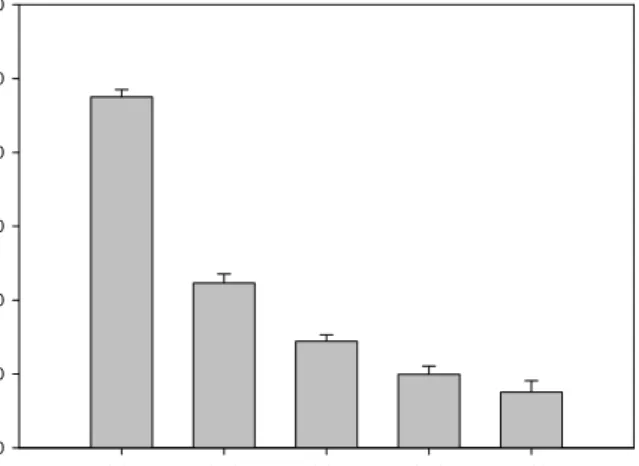
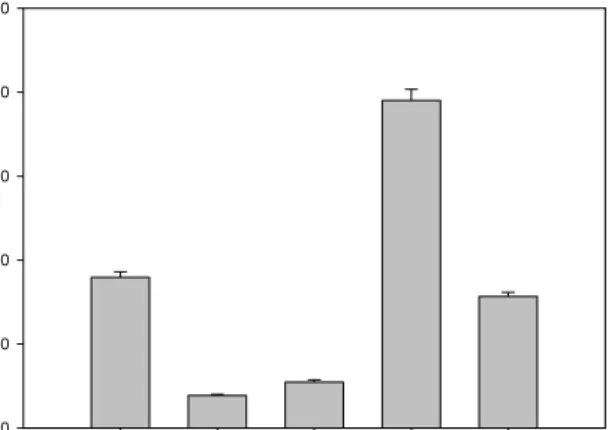
본 연구에서는 표준물질로 Trolox를 사용하여 총항산화
A B C D E ABTS radical scanvenging activity (%) (mg TEAC/1g residue)
0 1000 2000 3000 4000 5000
Fig. 3. Total antioxidant activity of the 80% methanolic ex- tracts from grape seed on ABTS radical. Each value repre- sents the mean of triplicate measurements of analyzed samples (TEAC: mg trolox equivalent antioxidant capacity). (A) 80%
methanol extract, (B) hexane fraction, (C) chloroform fraction, (D) ethyl acetate fraction, (E) water fraction.
력을 Trolox equivalent antioxidant capacity(TEAC mg/g residue)로 산출하여 Fig. 3에 나타내었다. 포도씨 methanol 추출물은 TEAC값이 1794.00 mg Trolox/g residue로 표현 되는데 이것은 포도씨 methanol 추출물 1 g의 잔사량당 Trolox 1794.00 mg에 해당하는 항산화력을 지니는 것으로 해석할 수 있다. 포도씨 methanol 추출물과 분획물의 TEAC 값은 ethyl acetate 분획층이 가장 높은 3901.67 mg Trolox/g residue를 나타내었고 water, chloroform, hexane 분획층 순 으로 1566.67, 546.00, 386.67 mg Trolox/g residue의 결과를 나타내었다. 포도씨 추출물은 catechin, epicatechin, quer- cetin, anthocyanin, resveratrol 등의 polyphenol류 성분들이 다량 함유되어 있어 항산화효과가 높은 것으로 알려져 있으 며 포도씨 분획물 중 ethyl acetate 층에서 가장 높은 항산화 력을 나타내었고 이는 tyrosinase 활성과도 매우 높은 상관 성을 보였다(22). 천연물에서 유래된 tyrosinase 활성 저해 제로 알려진 물질인 quercetin, resveratrol 등이 포도에 다량 함유되어있는 것으로 예상되어 기능성을 나타내는 물질에 대한 추가적인 연구가 진행되어야할 것으로 사료된다(23).
요 약
본 연구에서는 포도 가공 부산물인 포도씨를 이용하여 피 부노화 및 색소침착에 관련된 tyrosinase 저해활성을 알아보 고자 하였으며 폴리페놀 화합물과 총항산화력과의 상관관 계를 비교·분석하고자 하였다. 포도씨 80% 메탄올 추출물은 hexane, chloroform, ethyl acetate, water 층의 순서로 분획 되었다. Tyrosinase 저해활성은 각 분획물보다 crude한 형 태인 methanol 추출물의 효과가 더 높았으며 분획물 중 eth- yl acetate 층이 가장 높은 tyrosinase 저해활성을 나타내었 고 추출물과 분획물 모두 농도 의존적인 경향을 나타내었다.
포도씨 분획물 중 ethyl acetate층이 polyphenol과 flavonoid 함량이 가장 높았고 ABTS 라디칼 소거능 또한 가장 높은 결과를 나타내었으며 water 분획층도 비교적 높은 활성을 나타내었다. 본 연구 결과 tyrosinase 활성과 항산화 성분, 항산화 활성 경향이 일치하는 것을 볼 수 있었으며 포도씨는 미백, 항노화 효과로 화장품 산업에서 천연 물질로 잠재적인 기능성을 가지고 있을 것으로 사료된다.
감사의 글
이 논문은 농림부/농림기술관리센터 지정 포도연구사업 단의 연구비 지원에 의해 연구되었으며 이에 감사드립니다.
문 헌
1. Yoo YG, Joung MS, Choi JW, Kim JH. 2005. The study on the whitening effect of Ephedra sinica extract. J Soc
Cosmet Scientists Korea 31: 153-159.
2. Seo SY. 2001. Screening of tyrosinase inhibitors from ori- ental herbs. Korean J Plant Res 14: 32-37.
3. Wakamatsu K, Shosuke I. 2002. Advanced chemical meth- ods in melanin determination. Pigment Cell Res 15:
174-183.
4. Chin JE, Kim KC. 2005. Effects of chestnet bark extracts on tyrosinase gene expression. Korean J Sanitation 20:
10-16.
5. Slominski A, Tobin DJ, Shibahara S, Wortsman J. 2004.
Melanin pigmentation in mammalian skin and its hormonal regulation. Rhysiol Rev 84: 1155-1228.
6. Solano F, Briganti S, Picardo M, Ghanem G. 2006.
Hypopigmenting agents: an updated review on biological, chemical and clinical aspects. Pigment Cell Res 19: 550- 571.
7. Lee HB, Bai S, Chin JE. 2005. Inhibitory effect of
Lithospermum erythrorhizon extracts on melanin biosyn-
thesis. J Korean Soc Food Sci Nutr 34: 1325-1329.8. Kwak JH, Kim YH, Chang HR, Park CW, Han YH. 2004.
Inhibitory effect of gardenia fruit extracts on tyrosinase ac- tivity and melanogenesis. Korean J Biotechnol Bioeng 19:
437-440.
9. Choi SW, Chung US, Lee KT. 2005. Preparation of high quality grape seed oil by solvent extraction and chemical refining process. Korean J Food Preserv 12: 600-607.
10. Lee EJ, Kwon JH. 2006. Characteristics of microwave-as- sisted extraction for grape seed components with different solvents. Korean J Food Preserv 13: 216-222.
11. Jeong SM, Kim SY, Ha JU, Lee SC. 2005. Effect of far-in- frared irradiation on the antioxidant activity of extracts from grape seed. J Korean Soc Food Sci Nutr 34: 1619- 1624.
12. Woo MJ, Seo JW, Byun SY. 2005. Extraction of resveratrol containing grape seed oil with supercritical carbon dioxide.
Korean J Biotechnol Bioeng 20: 383-386.
13. Kubo I, Hori IK, Yokokawa Y. 1994. Tyrosinase inhibitors from Anacardium occidentale fruits. J Nat Prod 57: 545- 551.
14. Choi Y, Jeong HS, Lee J. 2007. Antioxidant activity of methanolic extracts from some grain consumed in Korea.
Food Chem 103: 130-138.
15. Choi Y, Lee SM, Chun J, Lee HB, Lee J. 2006. Influence of heat treatment on the antioxidant activities and poly- phenolic compounds of Shiitake (Lentinus edodes) mush- room. Food Chem 99: 381-387.
16. Robert R, Nicoletta P, Anna P, Ananth P, Min Y, Catherine RE. 1999. Antioxidant activity applying an improved ABTS radical cation decolorization assay. Free Radic Biol Med 26: 1231-1237.
17. Duh PD, Yeh DB, Yen GC. 1992. Extraction and identi- fication of an antioxidant component from peanut hull.
JAOCS 69: 818-819.
18. Balasinska B, Troszynska A. 1998. Total antioxidative ac- tivity of evening primrose (Oenothera paradoxa) cake ex- tract measured in vitro by liposome model and murine L1210 cells. J Agric Food Chem 46: 3558-3563.
19. Woo H, Yang D. 2003. Inhibitory effect of the extracts of
Tirchloma matsutake mycelia on tyrosinase activity.
Korean J Biotechnol Bioeng 18: 45-50.
20. Jo K, Yoon M, Lee M, Cha M, Park H. 2007. The anticancer effect of extracts form Vitex rotundifolia on human colon carcinoma cell lines. J Korean Soc Appl Biol Chem 50:
228-232.
21. Makris DP, Boskou G, Andrikopoulos NK. 2007. Polyphe- nolic content and in vitro antioxidant characteristics of wine industry and other agri-food solid waste extracts. J Food
Compos Anal 20: 125-132.
22. Kim J, Kim H, Park K, Cho Y. 2004. Understanding of func- tional foods for nutritional skin care. J Soc Cosmet
Scientists Korea 30: 313-320.
23. Song S, Lee H, Jin Y, Ha YM, Bae S, Chung HY, Suh H.
2007. Syntheses of hydroxy substituted 2-phenyl-naph- thalenes as inhibitors of tyrosinase. Bioorg Med Chem Lett 17: 461-464.
(2008년 9월 29일 접수; 2008년 11월 16일 채택)