a) Dept. of Electronics and Computer Engineering, Hanyang University
‡ 교신저자 : Gwanggil Jeon ([email protected])
※ This work was supported by the Korea Research Foundation Grant funded by the Korean Government (MOEHRD)
(KRF-2006-005-J04101).
․접수일(2009년3월16일),수정일(2009년7월28일),게재확정일(2009년7월 28일)
An Adaptive Tone Reproduction for High Dynamic Range Image
Joohyun Lee
a), Gwanggil Jeon
a)‡, and Jechang Jeon
a)Abstract
A high dynamic range (HDR) image can represent real world scenes that have a wide range of luminance intensity. However, compared with the range of real world luminance, conventional display devices have a low dynamic range (LDR). To display HDR images onto conventional displayable devices such as monitors and printers, we propose the logarithmic based global reproduction algorithm that considers the features of the image using reproduction parameters. Based on the characteristics of the image, we first modify the input luminance values for reproducing perceptually tuned images and then obtain the displayable output values directly. The experimental results show that the proposed algorithm achieves good subjective results while preserving details of the image; furthermore, the proposed algorithm has a fast, simple and practical structure for implementation.
Keyword : High dynamic range imaging, tone mapping, tone reproduction.
I. INTRODUCTION
High dynamic range (HDR) imaging is an attractive technique to mimic the capabilities of the human eye as it can capture real world luminance in a scene for each pixel. Moreover, we can record more than human eyes can see using HDR techniques. Example applications for HDR imaging are scientific and medical visualization, sat- ellite imagery, physically-based rendering, and digital cin-
ema
[1-6]. However, compared with the range of real
world luminance that ranges from 10
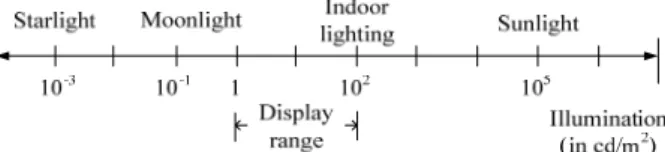
8:1,from bright sun- light to starlight, as shown in Fig. 1, display devices such as plasma/CRT/LCD displays and projectors only have a low dynamic range (LDR) from 10
2:1 candela per meter
squared (cd/m
2)
[7].
Fig. 1. Luminance ranges of some real world scenes
To display an HDR image to within a displayable range, we must adjust an image in dynamic range to below two orders of magnitude. The discrepancy between the wide ranges of luminance that can be captured and the small ranges that can be reproduced by existing displays makes the accurate display of the images of the captured scene.
Due to these limitations, we need proper tone mapping or tone reproduction techniques to transform HDR images into display devices that have LDR while still preserving details depending on the characteristics of the original HDR image.
In previous works, tone reproduction techniques have
been developed focused on compression and quality evalu-
ation of HDR image for visualizing high dynamic range
특집논문-09-14-4-05
images. Tone reproduction can be classified as global oper- ator (spatially uniform)
[8-15]where the same reproduction function is applied in all regions or local operator (spatially varying)
[16-18]where different tone reproduction functions are applied depending on neighboring pixels of current pix- el through the modeling of spatial adaptation.
The former tone reproduction technique, global operator, consists of monotonic tone reproduction function to match HDR values to LDR values. By using realistic image theo- ry, a tone global operator transferred HDR luminance to displayable luminance range
[19]. Drago et al. suggested adaptive operator with logarithmic reproduction for dis- playing high contrast scenes
[10]. Although it is simple for these global reproduction algorithms to transform pixels in- to LDR values, these algorithms cannot preserve local edge contrasts in images well. In most cases, we want to empha- size and preserve all local contrasts for displaying LDR clearly without producing perceivable artifacts. Ward et al.
described a more sophisticated approach to globally adjust contrast with respect to luminance histogram
[14]. However, image details were lost in the bright and dark regions while adjusting the contrast of an image.
The latter tone reproduction technique, local operator technique, uses the spatial modeling function using neigh- boring pixels based on the retinex theory
[20]. Operation functions are taken by the average luminance value of local neighboring pixels of the transformed pixel value in each pixel. In this type of algorithm, however, it is difficult to determine the size of the local neighborhood area correctly and also computationally expensive to transform the pixels.
It can also easily cause various artifacts such as halos de- pending on the methods used. Most authors are interested in computational efficiency, ignoring characteristics of hu- man visual system (HVS).
The proposed algorithm is a global tone reproduction method, but it applies characteristic-based luminance ad- justment integrating global and local features. A perceptual
decomposition of the luminance into a certain number of regions based on a histogram is performed to assess the characteristics of an image. Unlike common global oper- ator, which cannot preserve local edge contrasts in images, the proposed algorithm achieves a comparable performance compared with local operator and contrast and edges are preserved by using luminance adjustment.
This paper is organized as follows. Section II provides basic concept of HDR and tone reproduction. In Section III, we present the proposed tone reproduction method, which can reproduce HDR image into LDR image. Several experimental results prove the performance of proposed method in Section IV. Finally, we conclude our paper with an overall discussion in Section V.
II. BACKGORUND
For HDR file format, there is more than bit depth to de- fining the difference between HDR and LDR images. A 24-bit RGB image is usually defined as an output-referred coordinate because output colors are associated with a spe- cific target device. In contrast, most HDR images are a scene-referred coordinate because their pixels have a rela- tion to radiance in a scene. From a scene-referred HDR im- age, the run-length encoded input values are converted to floating point numbers of linear RGB value. Then, RGB values are converted to CIE XYZ color space, standard ma- trix such as that specified by ITU-R BT.709
[21]is given by
0.4124 0.3576 0.1805 0.2126 0.7152 0.0722 0.0193 0.1192 0.9505
X R
Y G
Z B
⎡ ⎤ ⎡ ⎤ ⎡ ⎤
⎢ ⎥ ⎢ = ⎥ ⎢ ⎥
⎢ ⎥ ⎢ ⎥ ⎢ ⎥
⎢ ⎥ ⎢ ⎥ ⎢ ⎥
⎣ ⎦ ⎣ ⎦ ⎣ ⎦
(1)
First, the minimum value and the maximum value of the
pixels in image must be found using Y components in the
XYZ format that represents luminance. A representation of
(a) (b) (c) (d)
Fig. 2. Result comparison between linear scaling and tone reproduction: (a) image using linear scaling; (b) image using tone reproduction; (c) detailed part of using linear scaling; (d) detailed part of using tone reproduction.
luminance is obtained by computing a linear combination of the red, green, and blue components according to the second row of (1) as follows:
0.2126 0.7152 0.0722
Y = × + R × + G × B
(2)Based on the luminance values that we get from (2), we can extract the characteristic of an image and reproduce the image to fit into a displayable range using the parameters from the characteristic of an image.
The displayable luminance range of an image for a con- ventional device is almost two orders (10
2) of magnitude as shown in Fig.1, where each pixel consists of thered, green, and blue components. Therefore, it is not possible to directly display images into conventional display devices with a much higher dynamic range. Moreover, for display to exhibit realism, the images should be faithful visual rep- resentations of the scenes when images are reproduced from HDR to LDR. For example, Fig. 2(a) and Fig. 2(b) show the LDR images using a linear scaling operator and using a tone reproduction operator, respectively. Such sim-
ple scaling without a tone reproduction operator generates images with complete loss of the detail and contrast in the resulting display, as shown in Fig. 2(c) compared with Fig.
2(d). Hence, simple scaling or compression of the lumi- nance range and the contrast range is not sufficient to re- produce the proper visual appearance of the scene.
III. PROPOSED METHOD
The tone reproduction aims to enhance the contrast ratio for fine image details/textures while maintaining the color constancy from HDR to LDR conversion. There are gen- eral approaches that aim for preserving brightness, con- trast, and appearance according to luminance information.
So, proposed algorithm also follows these approaches that use luminance information instead of processing chromi- nance information at parameter estimation process.
However, rather than adjusting the adaptation level based
on spatial location in the image, the proposed tone re-
production algorithm is processed on the population of the
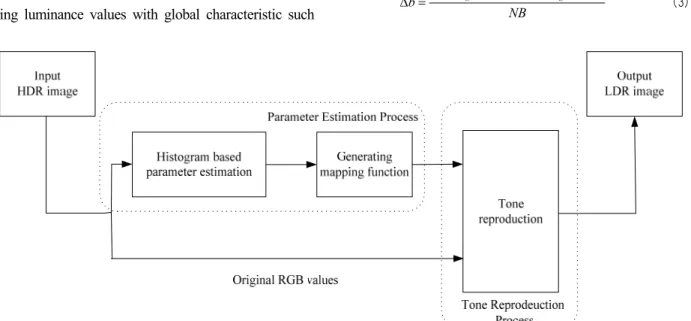
Fig. 3. Overall structure of proposed method
luminance adaptation levels at each bin in the image. The first step is to estimate reproduction parameter based on histogram information of input luminance data, which can represent the characteristics of an image properly. Then, re- production function is created using the estimated parame- ters at each bin adaptively. The final step is to acquire the displayable LDR image from HDR image based on the corresponding reproduction function and modified input image values. At the final step, the proposed algorithm is designed to compress luminance values while considering chromaticity by maintaining the color ratios among the col- or channels; In contrast, conventional methods derive a lu- minance component from input RGB values and then re- duce the luminance range, which excludes a comprehensive modeling of the color components. The overall structure of the proposed algorithm is provided in Fig. 3. The details of the proposed algorithm are described in the following sections.
1. Histogram based parameter estimation
Many tone reproduction methods only focus on com- pressing luminance values with global characteristic such
as average value of overall luminance, maximum lumi- nance value, and minimum luminance value. However, it is difficult to keep detailed features of image by using these tone reproduction methods, especially in dark and bright regions. Therefore, the proposed algorithm adopts histo- gram information of image and extracts features of each region. To identify the category of the luminance levels and initially estimate reproduction parameters to generate a final reproduction function, a pixel count of the lumi- nance histogram is used. The key idea of proposed algo- rithm is to expand the contrast of detailed and highly popu- lated regions by assigning larger color dynamic range.
The feature parameter values of a scene can be estimated from histogram techniques. More specifically, we start with a pixel count based on a logarithmic approximation of brightness from luminance values. The histogram is taken between the minimum and maximum values in equal-sized bins on a log scale of luminance. The bin size (Δb) is first calculated from the entire dynamic range of input lumi- nance values, and then divided by NB as
max min
(
g) (
g)
Log L Log L
b NB
δ δ
+ − +
Δ =
(3)where NB is the number of bins that divides over all dynamic range as NB bins, L
gmaxand L
gminare the global maximum luminance value and the minimum luminance value, respectively, and δ is small constant to avoid log function error when input value equals 0. Therefore, the whole luminance range is divided into NB bins that each bin size is Δb.
To find the features of image at each bin, the pixel dis- tribution (t) in NB bins is described as the percentage form of probability density of each bin at i as
( ) 1 ( ) 100, 1
t i f i i NB
= T × ≤ ≤
(4)where f(i) and T represent the pixel count for the histogram bin a i, and total pixel count in the image, respectively.
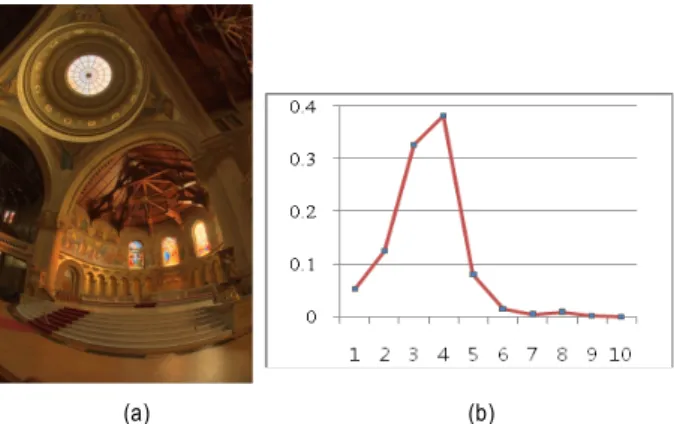
Figure 4 shows the pixel distribution of a memorial church image in each bin that follows (3) and (4). The hori- zontal axis represents NB bins that each bin size is Δb and the vertical axis represents a probability density of each bin. The number of histogram bin, NB, can be adjusted as a user parameter according to a computational efficiency.
By adding histogram bins, a sensitivity for detecting finer features is increased, but computational burden also increased. Note that NB is determined as 10 with heuristic
(a) (b)
Fig. 4. Pixel distribution of memorial church image in each bin. (a) input image, (b) pixel distribution in each bin.
approach in Fig. 4 and for experimental tests. Most of the pixels are concentrated in the medium luminance range, as shown in Fig. 4(b). It is reasonable to expand the contrast of image details by assigning a larger dynamic range for highly populated bins according to the histogram. In this concept, the weighting factor (w) is determined by the pixel distribution of the image, as shown in Fig. 5. Weighting factors vary from 0.8 to 1.6, and each bin has a different weighting factor at the ith bin, denoted as w
i.
Pixel distribution (t)
0 10 20 30 40 50 60
Weighting Factor (w)
0.8 1.0 1.2 1.4 1.6 1.8
Fig. 5. Weighting factor (w) based on pixel distribution.
Up to this point, weighting factor of each bin based on pixel distribution is calculated. The other informative fac- tors that we can apply to find characteristics of image are luminance log average value, maximum value, and mini- mum value at each bin. Because we empirically found that the log average luminance value correlates to the peak found in histogram, the combination of log average value, maximum value, and minimum value suggests good esti- mation for generating tone reproduction function. 1≤i≤
NB, is calculated as
( )
,
1 log + ( , )
avi i
i x y
L L x y
N δ
=
∑
(5)where N
iis the number of pixels in ith bin, L
i(x,y) is
the pixel value included in ith bin at the position of (x,y).
Moreover, the global log average of image (L
av) is just cal- culated with the sum of the average values of each bin that are already processed in (5) as
1
1
NB i.
av av
N
L L
=
NB
∑
= (6)2. Generating tone reproduction function
The real world luminance that HVS can recognize is im- pressively wide at a high dynamic range, from the scotopic threshold to the glare limit. Experimental model of perceiv- ing the luminance value shows that HVS cannot operate over impressive dynamic range simultaneously. Moreover, subjective brightness is a logarithmic function of light in- tensity on HVS.
The feature parameter values of a scene that are derived in previous section are used to generate tone reproduction function. The first parameter is weighting factor of each bin based on pixel distribution. The other parameters are luminance log average value, maximum value, and mini- mum value at each bin. Based on these feature parameters, we get key value a using the following procedures.
In (7a), fg is global feature value that represents the dis- tance difference between minimum luminance (L
gmin) and maximum luminance (L
gmax) relative to the log average lu- minance (L
av) of whole range in image. Then, in (7b), to make a
gvalue positive, a
gvalue is two to the power of f
g.
(
2 min) (
2 max)
2 max 2 min
log log
log log
av g av g
g
g g
L L L L
f L L
− + −
= −
(7a)2
fga
g= .
(7b)Similar method is applied to get local feature value (f
i)
at ith bin that estimates characteristics of each bin as
( 2 min ) (
2 max )
2 max 2 min
log log
log log
i i i i
i i
av av
i
L L L L
f L L
− + −
= −
. (8a)Then, in (8b), the following a
iis calculated as
2
fia
i=
(8b)Hence, the key value (k
i) not only considers global char- acteristics, but also uses local features as
i g i
k = a × a
(9)where a
gand a
iare feature values that reflect global and local tendency, respectively.
Up to this point, we extract key value determined by global/local characteristic in this section and derive weight- ing factor determined by the pixel distribution of the image in previous section. For the proposed method, input lumi- nance values are modified according to these two parame- ters as
( , ) ( , )
i i i i
L x y ′ = × × k w L x y
(10)where L′i (x,y) indicates reproduced luminance value at (x,y).
To get a final LDR tone reproduced image, we consider
the HVS characteristic for improving quality of an image
while reproducing HDR to LDR. The HVS has a complex
mechanism with some features that have to be considered
when preparing an image for display. However, many tone
reproduction methods only focus on compressing lumi-
nance values without considering chromaticity, which is an
objective specification of the quality of a color that can be
achieved by maintaining the color ratios among the color
channels. In this point of view, to consider color appear-
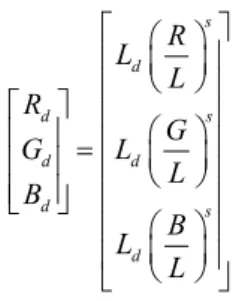
ance of a scene, compressing the luminance component is executed with color components together as follows.
s d
d s
d d
d s
d
L R R L G L G
B L L B
L
⎡ ⎛ ⎞ ⎤
⎢ ⎜ ⎟ ⎥
⎢ ⎝ ⎠ ⎥
⎡ ⎤ ⎢ ⎛ ⎞ ⎥
⎢ ⎥ ⎢ = ⎜ ⎟ ⎥
⎢ ⎥ ⎢ ⎝ ⎠ ⎥
⎢ ⎥ ⎢ ⎥
⎣ ⎦
⎢ ⎛ ⎞ ⎥
⎢ ⎜ ⎟ ⎝ ⎠ ⎥
⎣ ⎦
(11)
In (11), the factors is given as a user parameter like gam- ma correction value that takes valuesfrom 0 to 1. We can obtain display able output values (R
d, G
d, B
d) where L
dand R, G, B mean linearly normalized luminance value from 0 to 1 from L′
i(x,y) in (10) and original floating point R, G, B values, respectively. From (11), we finally obtain displayable tone reproduced LDR image through the pro- posed algorithm.
IV. EXPERIMENTAL RESULTS
All experiments were carried out with Microsoft Windows XP on a 2.4 GHz Intel Pentium IV processor with 1 GB RAM memory. In our tone reproduction meth- od, the HDR format, which is originally known as the radi- ance picture format (.hdr, .pic), was used and computation time increases according to the size of an image.
In experiments, we set the user parameter s as 0.45. The conventional algorithms have many user parameters that adjust tone reproduction function properly; however, the proposed algorithm only has one user parameter s while adjusting tone reproduction function adaptively. That means, without manual manipulations, the proposed meth- od finds the characteristics of the image and reproduces HDR to LDR adaptively.
To evaluate a subjective quality of experimental results, an image visualized at HDR display is used as a reference and compares the tone-mapped images against it. But cur- rent HDR displays are rare and costly, and it is difficult to calibrate. Since the original HDR images cannot used in the comparison, tone reproduced images are compared against conventional algorithms. Note that the human eye is very sensitive to differences rather than absolute values, contrast is an important attribute that needs to be preserved under tone reproduction. Although tone reproduced images are printed on black/white, subjective quality is dis- tinguished by contrast. We compare our results with linear tone reproduction algorithm in terms of visual quality.
Figure 6 shows subjective comparisons of proposed tone reproduction algorithm for the different sizes and scenes.
The proposed tone reproduction algorithm achieves good subjective quality compared with linear tone reproduction.
Figures 6(a), (c), and (e) show the result images mapped by linear reproduction algorithm with memorial church, couple, and design center images, respectively. Figures 6(b), (d), and (f) show the result images of proposed meth- od with memorial church, couple, and design center im- ages, respectively. In the design center images in Fig. 6(e) and (f), the foreground should be fairly dark, with visible detail, and the area near window should be pretty bright with detail. Compared with linear tone reproduction meth- od, the proposed algorithm shows good quality. In Figure 7, the proposed algorithm is compared to the conventional tone reproduction operators. With default parameter set- tings for each algorithm, the proposed algorithm is com- pared using two global operators, which are the segmenta- tion-based technique of Yee et al.
[8]and the logarithmic method of Drago et al.
[10], and a local operator, which is the photographic method of Reinhard et al.
[16].
The brief explanations of the methods we have used to
compare the performance of our new algorithm against are
described as follows. In global operators, the segmenta-
(a) (b) (c) (d) (e) (f)
Fig. 6. Tone mapped images: (a), (c), and (e) show the result images of linear reproduction. (b), (d), and (f) show the result images of proposed reproduction. The result images of linear reproduction (a, c, and e) cause complete loss of the detail and contrast in the resulting display. The result images of proposed method (b, d, and f) preserve the detail and contrast of the image in bright and dark region.
(a) (b) (c) (d)
Fig. 7. The quality comparison with Memorial church: (a) segmentation-based technique, (b) logarithmic method, (c) photographic method, and (d) proposed method.
tion-based technique computes local adaptation luminance for a global operator that makes use of image segmentation.
The logarithmic method is a simple global tone re- production algorithm that compresses the luminance range according to the base of the logarithm chosen for each pixel. With local operators, the photographic method ex- ecutes one of the global or local operators, which is de- termined based on a parameter estimation technique. In this experiment, the photographic method is chosen as a local operator by using a Gaussian filter with a parameter esti- mation technique.
Experimental results show that the visual quality of the
tested local operators is only marginally better than that of the tested global operators. The tested global operators still produce good subjective results, but they cannot success- fully preserve local edge contrasts in an image, especially in dim and bright regions, compared with global operators, as shown in Fig. 7. Compared to using local operators, the proposed algorithm achieves comparable subjective quality, especially in images with both dim and bright regions.
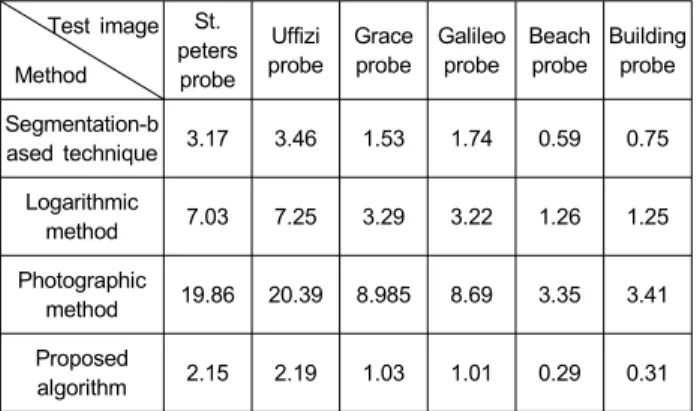
The proposed method has a low computational burden compared with the tested algorithms as shown in Table 1.
Local operators achieve better subjective results than global
operators, because they implement a spatial modeling func-
tion that uses neighboring pixels and results in a high com- putational burden. Photographic has a high computational burden because it uses a Gaussian filter. The proposed al- gorithm has fast simple and practical structure for implementation.
Test image Method
St.
peters probe
Uffizi probe
Grace probe
Galileo probe
Beach probe
Building probe Segmentation-b
ased technique 3.17 3.46 1.53 1.74 0.59 0.75 Logarithmic
method 7.03 7.25 3.29 3.22 1.26 1.25
Photographic
method 19.86 20.39 8.985 8.69 3.35 3.41
Proposed
algorithm 2.15 2.19 1.03 1.01 0.29 0.31
Table 1. Computation time for tone mapping (unit: Seconds)
V. CONCLUSION
High dynamic range image is an emerging technique that can describe the real world scenes that have a wide range of luminance intensity. To display high dynamic range im- age onto conventional displayable devices which have LDR such as monitors and printers, we have to reproduce HDR image into LDR image. Based on characteristics of image, the proposed tone reproduction algorithm re- produces reasonable images while considering features of image using reproduction parameters. The experimental re- sults show that the proposed algorithm achieves good sub- jective results and proposed algorithm has fast simple and practical structure for implementation.
REFERENCES
[1] G. Ward, H. Rushmeier, and C. Piatko, “A visibility matching tone reproduction operator for high dynamic range scenes,” IEEE Trans.
Visualization and computer Graphics, vol. 3, no. 4, pp. 291–306, Oct. 1997.
[2] B. R. Lim, R. H. Park, and S. Kim, “High dynamic range for con- trast enhancement,” IEEE Trans. Consumer Electronics, vol. 52, no.
4, pp. 1454–1462, Nov. 2006.
[3] L. Meylan and S. Süsstrunk, “High dynamic range image rendering with a retinex-base adaptive filter,” IEEE Trans. Image Processing, vol. 15, no. 9, pp. 2802–2830, Sept. 2006.
[4] A. Pardo and G. Sapiro, “Visualization of high dynamic range im- ages,” IEEE Trans. Image Processing, vol. 12, no. 6, pp. 639-647, June 2003.
[5] P.E. Debevec and J. Malik, “Recovering high dynamic range radi- ance maps from photographs,” in Proc. SIG GRAPH, pp. 369-378, Aug. 1997.
[6] S. Battiato, A. Castorina, and M. Mancuso, “High dynamic range imaging for digital still camera: an overview,” Journal of Electronic Imaging, vol. 12, no. 3, pp. 459–469, July 2003.
[7] E. Reinhard, G. Ward, S. Pattanaik, and P. Debevec, High dynamic range imaging: acquisition, display, and image-based lighting, Morgan Kaufmann, 2005.
[8] Y. H. Yee and S. Pattanaik, "Segmentation and adaptive assim- ilation for detail-preserving display of high-dynamic range images,"
The Visual Computer, vol. 19, no. 7–8, pp. 457–466, Dec. 2003.
[9] J. A. Ferwerda, S. Pattanaik, P. Shirley, and D. P. Greenberg, “A model of visual adaptation for realistic image synthesis,” in Proc.
SIGGRAPH, pp. 249–258, Aug. 1996.
[10] F. Drago, K. Myszkowski, T. Annen, and N. Chiba, “Adaptive log- arithmic mapping for displaying high contrast scenes,” Computer Graphics Forum, vol. 22, no. 3, 2003.
[11] J. Tumblin, J. K. Hodgins, and B. K. Guenter, “Two methods for display of high contrast images,” ACM Trans. on Graphics, vol. 18, no. 1, pp. 56–94, 1999.
[12] S. N. Pattanaik, J. Tumblin, H. Yee, and D. P. Greenberg, “Time dependent visual adaptation for fast realistic display,” in proc.
SIGGRAPH, pp. 47–54, July 2000.
[13] E. Reinhard, “Parameter estimation for photographic tone re- production,” Journal of Graphics Tools, vol. 7, no. 1, pp. 45–51, 2003.
[14] G. Ward, H. Rushmeier, and C. Piatko, “A visibility matching tone reproduction operator for high dynamic range scenes,” IEEE Trans.
on Visualization and Computer Graphics, vol. 3, no. 4, 1997.
[15] J. Tumblin and H. Rushmeier, “Tone reproduction for computer generated images,” IEEE Computer Graphics and Applications, vol.
13, no. 6, pp. 42–48, Nov. 1993.
[16] E. Reinhard, M. Stark, P. Shirley, and J. Ferwerda, “Photographic tone reproduction for digital images,” ACM Trans. on Graphics, vol. 21, no. 3, pp. 267–276, 2002.
[17] S. N. Pattanaik, J. A. Ferwerda, M. D. Fairchild, and D. P.
Greenberg, “A multiscale model of adaptation and spatial vision for realistic image display,” in proc. SIGGRAPH, pp. 287–298, July 1998.
[18] M. Ashikhmin, “A tone mapping algorithm for high contrast im- ages,” in Proc. Eurographics Workshop on Rendering, pp. 145– 155, 2002.
[19] J. Tumblin and H. Rushmeier, “Tone reproduction for realistic im- ages,” IEEE Computer Graphics and Applications, vol. 13, pp.
42-48, 1993.
[20] K. Chiu, M. Herf, P. Shirley, S. Swamy, C. Wang, and K.
Zimmerman, “Spatially nonuniform scaling functions for high con- trast images,” in Proc. graphics Interface, pp. 245–253, 1993.
[21] ITU-R Recommendation BT.709, Basic parameter values for the HDTV standard for the studio and for international program ex- change, Technical Report BT.709, ITU, 1990.
저 자 소 개
Joohyun Lee received the B.S. and M.S. degrees in electronics and computer engineering from Hanyang University, Korea, in 2004 and 2006, respectively. He is currently pursuing the Ph.D. degree in electronics and computer engineering at Hanyang University.
His research interests are in the fields of image processing and compression, including the areas of H.264 video coding, scalable video coding, and HDR
Gwanggil Jeon received B.S., M.S., and Ph.D. (Summa Cum Laude) degrees in electronic engineering from Hanyang University, Korea, in 2003, 2005, and 2008, respectively.
He is currently a researcher in the Department of Electronics and Computer Engineering, Hanyang University. His research interests fall under the umbrella of image processing, particularly image compression, motion estimation, demosaicing, and image enhancement as well as computational intelligence such as fuzzy and rough sets theories.
Dr. Jeon was with the recipient of the IEEE Chester Sall Award in 2007 and 2008 ETRI Journal Paper Award.
Jechang Jeong received a B.S. degree in electronic engineering from Seoul National University, Korea, in 1980, an M.S. degree in electrical engineering from the Korea Advanced Institute of Science and Technology in 1982, and a Ph.D. degree in electrical engineering from the University of Michigan, Ann Arbor, in 1990.
From 1982 to 1986, he was with the Korean Broadcasting System, where he helped develop teletext systems. From 1990 to 1991, he worked at the University of Michigan, Ann Arbor, as a Postdoctoral Research Associate, where he helped to develop various signal processing algorithms. From 1991 through 1995, he was with the Samsung Electronics Company, Korea, where he was involved in the development of HDTV, digital broadcasting receivers, and other multimedia systems. Since 1995, he has conducted research at Hanyang University, Seoul, Korea. His research interests include digital signal processing, digital communication, and image/audio compression for HDTV and multimedia applications. He has published numerous technical papers.
Dr. Jeong received the “Scientist of the Month” award in 1998, from the Ministry of Science and Technology of Korea, and was with the recipient of the IEEE Chester Sall Award in 2007 and 2008 ETRI Journal Paper Award. He was also honored with a government commendation in 1998, from the Ministry of Information and Communication of Korea.