HEVC 화면 내 예측을 위한 FAST 에지 검출 기반의 CU 분할 방법
전 승 수a), 김 남 욱a), 전 병 우a)‡
CU Depth Decision Based on FAST Corner Detection for HEVC Intra Prediction
Seungsu Jeona), Namuk kima), and Byeungwoo Jeona)‡
요 약
High efficiency video coding (HEVC)은 H.264/AVC와 같은 이전 비디오 압축 표준 보다 더 높은 압축 효율을 갖는 최신 비디오 압축 표준이다. 화면 내 예측에서 최대 압축 단위 (LCU)들은 quadtree 구조를 통해 64x64부터 8x8까지의 크기를 갖는 더 작은 압축 단위 (CU)들로 나누어지고, 이들은 다시 예측 단위 (PU)들로 나누어진다. 가능한 크기까지 CU를 분할하면서 RDO (Rate Distortion Optimization) 과정을 통해 최적의 CU 분할 형태가 선택된다. 이 과정에서 HEVC는 많은 계산량을 필요로 한다. 본 논문에서는 HEVC의 계산량을 줄이기 위해, FAST (Features from Accelerated Segment Test) 코너 검출을 이용하여 화면 내 예측을 위한 고속 CU depth 결정 방법 (FCDD)을 제안한다. 제안하는 방법은 기존의 HEVC와 비교하여 약 0.7%의 BDBR 만큼의 적은 압축 성능 감 소와 함께 부호화기에서 약 53.73%의 계산 시간을 감소시켰다.
Abstract
The High efficiency video coding (HEVC) is the newest video coding standard that achieves coding efficiency higher than previous video coding standards such as H.264/AVC. In intra prediction, the prediction units (PUs) are derived from a large coding unit (LCU) which is partitioned into smaller coding units (CUs) sizing from 8x8 to 64x64 in a quad-tree structure. As they are divided until having the minimum depth, Optimum CU splitting is selected in RDO (Rate Distortion Optimization) process. In this process, HEVC demands high computational complexity. In this paper, to reduce the complexity of HEVC, we propose a fast CU mode decision (FCDD) for intra prediction by using FAST (Features from Accelerated Segment Test) corner detection. The proposed method reduces computational complexity with 53.73% of the computational time for the intra prediction while coding performance degradation with 0.7% BDBR is small compared to conventional HEVC.
Keyword : video coding, HEVC, intra prediction, FAST corner detection
a)성균관대학교 정보통신대학(Sungkyunkwan University, College of Information and Communication Engineering)
‡Corresponding Author : 전병우(Byeungwoo Jeon) E-mail: [email protected] Tel: +82-31-290-7144
ORCID: http://orcid.org/0000-0002-5650-2881
※This work was supported by the National Research Foundation of Korea (NRF) grant (No. NRF- 2011-0017578) and the Institute for Information
& communications Technology Promotion (IITP) grant (No. 14-000-02-001) both funded by the Korea government (MSIP).
※이 논문의 연구결과 중 일부는 “IWAIT 2016”에서 발표한 바 있음.
・ Manuscript received March 14, 2016; Revised June 14, 2016; Accepted July 18, 2016.
특집논문 (Special Paper)
방송공학회논문지 제21권 제4호, 2016년 7월 (JBE Vol. 21, No. 4, July 2016) http://dx.doi.org/10.5909/JBE.2016.21.4.484
ISSN 2287-9137 (Online) ISSN 1226-7953 (Print)
Ⅰ. Introduction
The Joint Collaborative Team on Video Coding (JCT- VC) which is composed by ITU-T Video Coding Experts Group (VCEG) and ISO/IEC Moving Pictures Expert Group (MPEG) developed the newest video compression standard, called High Efficiency Video Coding (HEVC)/
H.265
[1]. The aim of HEVC is to achieve bit rate reduction of 50% compared to previous video coding standard, H.264/AVC to support high quality video services such as ultra-high-definition television (UHDTV).
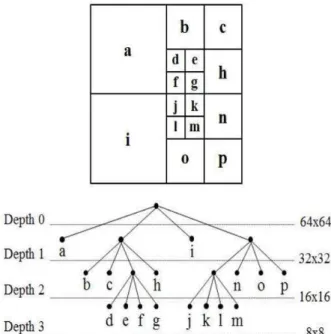
In HEVC, a picture is divided into square-shaped large coding units (LCUs) which correspond to CU at depth of 0. Using quad-tree structures, each LCU is recursively split into four CUs and its depth increases by one at a time as shown in Fig. 1. A CU can have sizes from 8x8 to 64x64, and its maximum depth (for luma) can be up to 3. The pre- diction units (PUs) are for prediction process such as intra
그림 1. Quad-tree 구조를 사용하여 64x64 크기의 LCU를 32x32부터 8x8 크기의 CU로 분할하는 방법
Fig. 1. Splitting 64x64 LCUs into CUs of 8x8 to 32x32 luma samples using quad-tree structure
and inter prediction. There are eight different ways in split- ting a CU into PUs. A PU can be a single CU or can be partitioned into two or four square or rectangular PUs. In case of intra prediction, if CU is of 8x8 size, it can have 2 cases in splitting: a 8x8 PU and four 4x4 PUs and other- wise, it can only have one case having the same size
[2]. The HEVC intra prediction has three different prediction modes: 33 distinct angular prediction modes, planar pre- diction mode, and DC prediction mode.
HEVC selects the best prediction mode among all possi-
ble CU sizes and 35 intra prediction modes to find the least
rate distortion cost (RD-cost). In this process, it requires
higher computational complexity. Many fast intra pre-
diction methods have been proposed recently to achieve
significant time saving with little loss in coding per-
formance. Some of them use fast algorithm for HEVC intra
prediction
[3]-[10]: the fast intra mode decision using in-
formation of previous PUs and transform units (TUs) based
on hierarchical structure
[3], the method in rate-distortion op-
timization (RDO) process searching for minimum intra pre-
diction mode using histogram based on gradient
[4], the
method only using adjacent modes of optimum direction
without modes of impossible directions in measuring total
gradient from four directions of Coding Tree Unit (CTU)
[5],
the intra prediction mode decision using edge in CU
[6], the
CU splitting and pruning method using Bayesian se-
lection
[7], the early skip mode decision without checking
the rest according to rate distortion cost of Merge mode
[8],
the fast quantization method in RDO process choosing only
optimum level of quantization
[9], the fast mode decision for
intra prediction with direction of the edges and neighboring
CUs modes
[10]. There are also fast algorithms for HEVC
intra prediction specially using fast CU size decision
[11]-[13]:
the fast CU size decision with the texture homogeneity and
bypass strategy
[11], the fast CU size decision using skipping
some specific depth based on RD cost and intra prediction
mode correlations among spatially nearby CUs
[12], the fast
CU depth decision with keypoint based on blob de- tection
[13].
It is important to select a right depth for a CU because it directly affects the number of bits – when depth in- creases by one, a CU is split into four smaller CUs having a half size each, and it needs more number of bits as the number of CUs increases. So, selecting a smaller CU depth is more advantageous to encode video from the point of view of bit amounts. But distortion between original and reconstructed sequences is also related to CU depth. If the smallest CU depth is only selected, it is hard to predict a block using reference samples. This paper proposes a fast CU mode decision algorithm using the FAST (Features from Accelerated Segment Test) corner detector which can estimate homogeneity of current CU and decide the mini- mum CU depth.
The rest of this paper is as follows: Section Ⅱ introduces the FAST corner detection and the proposed fast CU depth decision method with related thresholds. Section Ⅲ shows the simulation results and performance of the proposed method. Finally, brief conclusion is given in Section Ⅳ.
Ⅱ. Proposed Fast CU Depth Decision
1. FAST Corner Detection
The FAST (Features from Accelerated Segment Test) is a corner detection method which extracts features with high speed
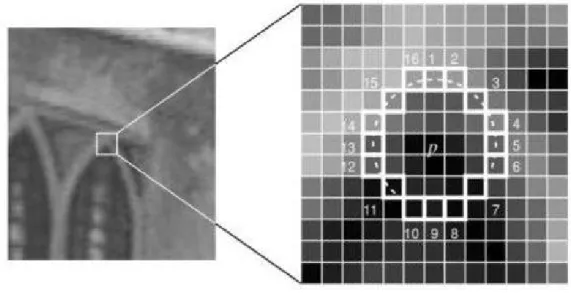
[14]. In the FAST, a pixel is determined whether it is corner or not considering a circle of its surrounding 16 pixels. Technically, in Fig. 2, a pixel, , is determined as a corner if all contiguous pixels in the circle of 16 pixels are brighter than
or darker than
where
is the intensity of selected pixel and is a threshold value. For high-speed test which is used to exclude a lot of non-corners, it examines only the four pixels at 1, 9, 5 and 13: pixels at 1 and 9 are tested first whether they are brighter or darker than the selected pixel; If so, then it further checks pixels at 5 and 13. is considered as a corner if at least three of these pixels are brighter than
or darker than
. Otherwise, cannot be a corner. The FAST corner detection is good for detecting feature points rapidly with high performance. As shown in Fig. 3, a CU tends
그림 2. FAST를 이용한 코너 검출 방법 (점선은 조건에 만족하는 픽셀들을 표시함)Fig. 2. FAST corner detection (white dash lines indicates contiguous pixels which meet specified conditions)
to have a larger depth if it has many feature points.
Otherwise, it tends to have a small depth. So if the degree of frequency is measured for a LCU using the FAST corner detection, its depth can be decided.
2. Fast CU Depth Decision
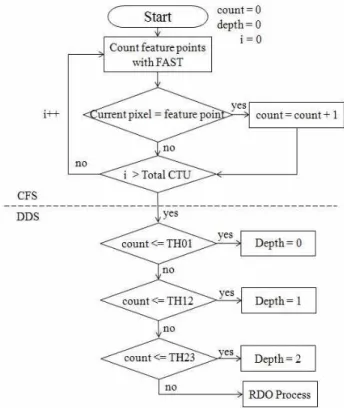
In HEVC, intra prediction uses all CU sizes from 8x8 to 64x64 and 35 intra prediction modes so that it has crit- ical impact on the encoding time. To reduce encoding time, the proposed fast CU Depth decision (FCDD) focuses on prediction. As shown in Fig. 4, the proposed algorithm has two stages: the counting feature points stage (CFS) and the depth decision stage (DDS). First of all, in the CFS, all feature points in a LCU is detected using the FAST cor- ner detection in which its threshold value plays an im- portant role in determining whether a pixel is feature point or not. But the FAST uses the original pixel values in deciding CU depths. So it is independent of QP value.
그림 4. 고속 CU 깊이 결정 알고리즘의 흐름도 Fig. 4. Flowchart of the proposed FCDD algorithm 그림 3. 특징점과 CU 분할의 관계 (색깔 원은 특징점을 나타냄)
Fig. 3. The relationship between the number of feature points and CU splitting. (Colored circles indicate feature points)
In HEVC, as the QP value influences the quality of re- constructed picture, the number of feature points in the same LCU is changed if QP value is changed. Therefore, we make the threshold value adaptive to have correlation with the qual- ity of reconstructed picture: we confirm the number of feature points with different QP value in reconstructed picture and with different threshold value. Compared to original picture, we confirm how many number of feature points disappear in reconstructed picture and find out the tendency to have the correlation between the threshold value and QP value experimentally. Finally, we find the relation between the threshold and QP value as below:
(1)It counts pixels which are considered as feature points to check the texture homogeneity. When the number of fea- ture points is large, it means that the current LCU has high frequency energy much. The homogeneity of LCU is re- lated to its depth: if the texture of the current LCU is com- plex, it needs higher depth to keep the intra prediction per- formance higher in smaller CU; and if homogeneous, it is possible to have a smaller depth in larger CU. Therefore, by counting feature points, the degree of partition, or depth, can be decided. We check not only the number of feature points but also how feature points are dispersed in the cur- rent CU. The distribution of feature points are checked with the variance of distances between feature points and centre point which is measured by the average of positions of feature points as below:
(2)
(3)
(4)where
and
are the x and y positions of centre point respectively,
and
are those of a feature point respectively, N is the number of feature points, and
is the variance of distances between feature points and its centre point. As shown in Table. 1, there are two data sets with 32x32 CU and QP=22 in HEVC: one case (see the first and second rows) is that two CUs having the same number of feature points and similar variance have differ- ent result on whether they split or not; another case (see the third to fifth rows) is that three CUs with the same number of feature points but different variance have differ- ent result on whether they split or not, specifically there is no relation between variance value and whether it split or not. So, we consider only the number of feature points in determining the depth of CU.
Split or Non Split Number of feature
points Variance value
Non Split 32 31.4575
Split 32 31.5013
Non Split 13 23.0998
Split 13 41.7179
Split 13 21.6080
표 1. 동일한 특징점과 유사한 분산값에서 분할 여부가 다른 경우의 예 Table 1. Example of whether it splits or not in case of same feature points and similar variance value
The depth decision stage (DDS) determines the depth of the current LCU through three depth thresholds: the first depth threshold (
) to decide whether a 64x64 CU, same as depth 0, splits or not; the second depth threshold (
) to decide whether a 32x32 CU, same as depth 1, splits or not; the last depth threshold (
) to decide whether a 16x16 CU, same as depth 2, splits or not. We count the number of feature points on the current CU and its possibility of being split.
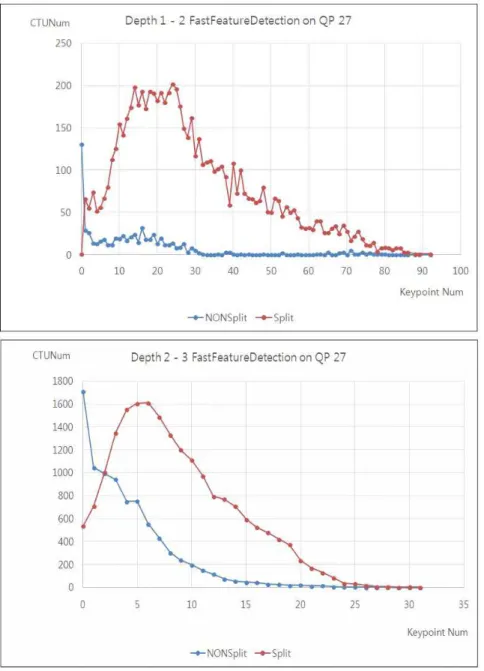
As shown in Fig. 5, in the depth 0 to 1 and depth 1
to 2 which have similar tendency on the graph, the current
CU is not split when the number of feature points is equal to zero or near zero in case of high QP value, but almost split when we select larger case if non split and split cases are overlapped by less than 30%. In the depth 2 to 3, it is really hard to decide the
value because both cases
are overlapped by more than 30% except when the number of feature points is equal to zero. So, when the number of feature points is more than
, we need to use the con- ventional method, the rate distortion optimization (RD) process, to decide the depth of current CU. To find the
그림 5. 현재 CU에 대한 특징점의 개수와 분할 여부의 관계Fig. 5. The relation between the number of feature points and whether split or not on the current CU
three depth thresholds, we used following two of sequences in Class C: 10 frames of “BQMall” and “BasketballDrill”, respectively. Finally we decided the depth threshold value as in Table 2.
QP
22 0 0 0
27 0 0 0
32 0 0 1
37 0 0 1
표 2. QP에 따른 깊이 문턱치 값
Table 2. Depth thresholds according to QP
Ⅲ. Experiment Result
The proposed FCDD algorithm is implemented on the HEVC reference software (HM 16.7) for performance eval- uation to compare it with the original reference HEVC en- coder as the anchor. The simulation platform is Intel(R) Core(TM) i5-4690 CPU @ 3.50GHz with quad cores and 8.00 GB RAM. All-Intra-Main profile is used for encoding.
Simulation conditions are defined as follow: 100 frames;
QPs are set to 22, 27, 32 and 37. Coding efficiency is measured using BDPSNR and BDBR
[15], and the reduction of computational complexity is measured using the time saving of encoding as follows:
× (5)
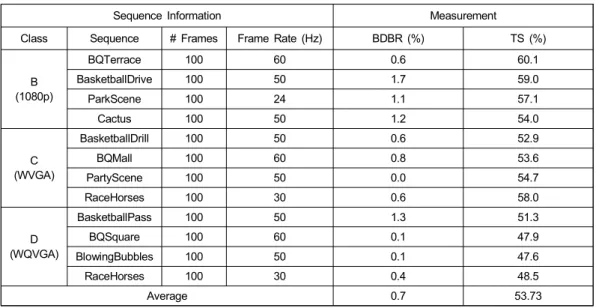
Table 3 shows performance results of the proposed FCDD algorithm which is shown to reduce the encoding time by about 53.73% with loss of coding efficiency of 0.7% in BDBR on average. This is because the proposed method uses the number of feature points based on corner detection for skipping the RDO process required for LCU splitting decision. It can be found that the loss of coding efficiency is not large considering fast intra prediction with a minimum of BDBR 0.0% on “ParkScene”, and maximum of BDBR 1.7% on “Basketball Drive”. However, although FCDD does not require the full RDO process, it still needs additional computation to carry out the FAST corner de- tection process. So, it achieved the minimum time saving of 47.6%.
Sequence Information Measurement
Class Sequence # Frames Frame Rate (Hz) BDBR (%) TS (%)
B (1080p)
BQTerrace 100 60 0.6 60.1
BasketballDrive 100 50 1.7 59.0
ParkScene 100 24 1.1 57.1
Cactus 100 50 1.2 54.0
C (WVGA)
BasketballDrill 100 50 0.6 52.9
BQMall 100 60 0.8 53.6
PartyScene 100 50 0.0 54.7
RaceHorses 100 30 0.6 58.0
D (WQVGA)
BasketballPass 100 50 1.3 51.3
BQSquare 100 60 0.1 47.9
BlowingBubbles 100 50 0.1 47.6
RaceHorses 100 30 0.4 48.5
Average 0.7 53.73
표 3. HM 16.0 부호화기와 비교한 제안된 FCDD 알고리즘의 성능
Table 3. Performance of the proposed FCDD algorithm compared to HM 16.0 encoder (anchor)
IV. Conclusion
In this paper, we proposed a fast CU mode decision al- gorithm for HEVC intra prediction by using the FAST cor- ner detection and determining range of depth on LCU size.
Experimental results showed that the proposed method can reduce about 53.73 % of the computational time at encoder and also maintain the coding performance with 0.7%
BDBR loss. We need the proposed fast algorithm to over- come high computational complexity with only small loss of coding efficiency. So, the proposed algorithm can be ef- fective for retaining the coding performance as the required computational time grows to support higher definition video. The proposed method can alleviate the increasing computation.
참 고 문 헌 (References)
[1] G. J. Sullivan and J. R. Ohm, “Recent developments in standardization of high efficiency video coding (HEVC),” Proc. SPIE, vol. 7798, p.77980V, Sep.2010.
[2] I.-K. Kim, J. Min, T. Lee, W.-J. Han, and J. Park, “Block partitioning structure in the HEVC standard,” IEEE Trans. Circuits Syst. Video Technol., vol. 22, no. 12, pp. 1697–1706, Dec. 2012.
[3] J. Kim, J. Y. Yang, H. Y. Lee, and B. Jeon, “Fast Intra Mode Decision of HEVC based on Hierarchical Structure,” 8th International Conference on Information, Communication and Signal Processing, pp. 1-4, Dec. 2011.
[4] W. Jiang, H. J. Ma, and Y. W. Chen, “Gradient Based Fast Mode Decision Algorithm for Intra Prediction in HEVC,” Proc. 2nd
International Conference on Consumer Electronics, Communications and Networks, pp. 1836-1840, Apr. 2012.
[5] Y. Zhang, Z. Li, and B. Li, “Gradient-based fast decision for intra pre- diction in HEVC,” Proc. IEEE Vis. Commun. Image Process. (VCIP), pp. 1–6, Nov. 2012.
[6] G. Chen, Z. Liu, T. Ikenaga, and D. Wang, “Fast HEVC intra mode de- cision using matching edge detector and kernel density estimation alike histogram generation,” Proc. IEEE ISCAS, pp. 53–56, May 2013.
[7] S. Chao and M. Kim, “Fast CU splitting and pruning for suboptimal CU partitioning in HEVC intra coding,” IEEE Trans. Circuits Syst.
Video Technol., vol. 23, no. 9, pp. 1555–1563, Sep. 2013.
[8] Hoyoung Lee, Huik Jae Shim, Younghyun Park, and Byeungwoo Jeon,
“Early Skip Mode Decision for Fast HEVC Encoder,” IEEE Trans.
Broadcasting, vol. 61, No.3, pp.388-397, Sept. 2015.
[9] Hoyoung Lee, Seungha Yang, Younghyun Park, and Byeungwoo Jeon,
“Fast Quantization Method with Simplified Rate-Distortion Optimized Quantization for HEVC Encoder,” IEEE.Trans. Circ. and Syst. for Video Technology (Sepcial issue on HEVC Implementation), VOL.
26, No.1, pp.107-116, Jan. 2016.
[10] F. Pan and et al., “Fast mode decision algorithm for intra prediciton in H.264/AVC video coding.” IEEE Trans. Circuits Syst. Video Technol., vol. 15, no. 7, pp. 813–822, Jul. 2005.
[11] L. Shen, Z. Zhang, and Z. Liu, “Effective CU size decision for HEVC intracoding,” IEEE Trans. Image Process, 23, 10, pp. 4232–4241, 2014.
[12] L. Shen, Z. Zhang, and P. An, “Fast CU size decision and mode deci- sion algorithm for HEVC intra coding,” IEEE Trans. Consum.
Electron., vol. 59, no. 1, pp. 207–213, Feb. 2013.
[13] N. Kim, S.-C. Kim, H. Ko, B. Jeon, "Keypoint-based Fast CU Depth Decision for HEVC Intra Coding.", Journal of The Institute of Electronics and Information Engineers, vol. 53, no. 2, Feb. 2016.
[14] E. Rostern, and T. Drummond, “Machine learning for high-speed cor- ner detection,“ Computer Vision-ECCV, vol. 3951, pp. 430-443, 2006.
[15] G. Bjontegaard, “Calculation of average PSNR differnece between RD-curves,” 13th VCEG Meeting, VCEG-M33, Austin, TX, USA, Apr. 2001.
저 자 소 개
전 승 수
- 2015년 : 성균관대학교 전자전기공학과 졸업 (학사)
- 2015년 9월 ~ 현재 : 성균관대학교 전자전기컴퓨터공학과 석사과정 - ORCID : http://orcid.org/0000-0001-8821-1125
- 주관심분야 : 멀티미디어, 영상압축, 영상처리
저 자 소 개
김 남 욱
- 2015년 : 성균관대학교 전자전기공학과 졸업 (학사) - 2015년 3월 ~ 현재 : 성균관대학교 IT융합학과 석사과정 - ORCID : http://orcid.org/0000-0003-0839-5580 - 주관심분야 : 멀티미디어, 영상압축, 신호처리
전 병 우
- 1985년 : 서울대학교 전자공학과 졸업 (학사) - 1987년 : 서울대학교 전자공학과 졸업 (석사)
- 1992년 : Purdue Univ. School of Elec. 졸업 (공학박사) - 1993년 ~ 1997년 : 삼성전자 신호처리연구소 선임/수석연구원 - 1997년 ~ 현재 : 성균관대학교 전자전기공학부 교수 - ORCID : http://orcid.org/0000-0002-5650-2881 - 주관심분야 : 멀티미디어, 영상압축, 영상인식, 신호처리