Evaluating the Performance of APEX-Paddy Model
using the Monitoring Data of Paddy Fields in Iksan, South Korea
국내 논필지 모니터링 자료를 이용한 APEX-Paddy 모델 적용성 평가
Mohammad Kamruzzamana⋅Jaepil Chob⋅Soon-Kun Choic Jung-Hun Songd⋅Inhong Songe⋅Syewoon Hwangf,†
모하마드 캄루자먼⋅조재필⋅최순군⋅송정헌⋅송인홍⋅황세운
ABSTRACT
The APEX model has been developed for assessing agricultural management efforts and their effects on soil and water at the field scale as well as more complex multi-subarea landscapes, whole farms, and watersheds. Recently, a key component of APEX application, named APEX-Paddy, has been modified for simulating water quality by considering paddy rice management practices. In this study, the performance of the APEX-Paddy model was evaluated using field data at Iksan experimental paddy sites in Korea. The discharge and pollutant load data during 2013 and 2014 were used to both manually and automatically calibrate the model. The APEX auto-calibration tool (APEX-CUTE 4.1) was used for model calibration and sensitivity analysis. Results indicate that APEX-Paddy reasonably performs in predicting runoff discharge rate and nitrogen yield. However, sediment and phosphorus yield is not correctly predicted due to the limitation of model schemes. With APEX-Paddy, the performance in reproducing the discharge and nitrogen yield is found to be a satisfactory level after manual calibration. The manually calibrated model performed better than the automatically calibrated model in nearly all comparisons. For runoff, manual calibration reduced PBIAS while R2 and NSE values of the automatically calibrated model were the same as the manual calibration. For T-N, NSE and PBIAS were reduced when using manual calibration, whereas R2 value was the same as manual calibration. The limitation of the APEX-Paddy model for predicting sediment, as well as the phosphorous yield, was discussed in this study.
Keywords: APEX-Paddy Model; rice paddy; calibration; discharge; sediment; pollutant loads
초 록
APEX 모형은 다양한 영농 활동의 토양과 물환경에 대한 영향을 필지 및 유역 규모로 평가하기 위해 개발된 모형이다. 최근 APEX의 주요 기작을 바탕으로 논에서의 수도작 운영에 따른 물수지, 양분 유출에 대한 모의가 가능하도록 한 APEX-Paddy가 고안된 바 있다. 본 연구에서는 익산 지역의 논 시험포 모니터링 자료를 이용하여 APEX-Paddy 모형의 적용성을 평가하고자 하였다. 2013년과 2014년의 논 유출량과 부하량 자료를 수집하고 자동보정 툴 APEX-CUTE 4.1과 추가적 수동보정을 통해 모형의 모의성능을 검토하고 한계점을 고찰하였다. 연구결과, 논의 물수지와 질소 배출부하량은 대체로 합리적인 수준의 모의성능을 보이는 한편 유사량과 인 배출부하량 모의에 있어 논의 담수상태 유사배출 기작에 대한 고려가 미흡하여 모의성능에 한계가 있는 것으로 분석되었으며 원인에 대해 고찰하였다. 더불어 자동보정 툴의 적용에 있어 매개변수 민감도를 바탕으로 한 수동보정 결과보다 정확도가 다소 떨어지는 경향을 보여 그 활용에 유의가 필요한 것으로 판단되었다.
Ⅰ. INTRODUCTION
Nutrients export from agricultural lands is a significant contributor to the accelerated eutrophication of water bodies globally (Kim et al., 2006). Among the agricultural non-point
† Corresponding author
Tel.: +82-55-772-1930, Fax: +82-55-772-1939 E-mail: [email protected]
Received: September 10, 2019 Revised: October 31, 2019 Accepted: November 04, 2019
a Ph.D. Student, Department of Agricultural Engineering, Gyeongsang National University
b Director, Convergence Center for Watershed Management, Integrated Watershed Management Institute (IWMI)
c Researcher, Climate Change and Agro-Ecology Division, Department of Agricultural Environment, National Academy of Agricultural Science, RDA
d Post-Doctoral Researcher, Department of Agricultural and Biological Engineering & Tropical Research and Education Center, University of Florida
e Assistant Professor, Department of Rural Systems Engineering, Research Institute of Agriculture and Life Sciences, Seoul National University
fAssociate Professor, Department of Agricultural Engineering, Institute of Agriculture and Life Science, Gyeongsang National University
sources (NPS), paddy fields account for a considerable portion of agricultural land in some East Asian countries (Takeda and Fukushima, 2006). Paddy fields accounted for 54.1% (0.91 million ha) of the agricultural area (1.64 million ha) in South Korea (MAFRA, 2015). The reduction of nutrient loads from paddy rice cultivation, particularly in the Asian monsoon region, has been an essential issue for surface and groundwater water quality management (Zhang et al., 2011). Kim et al. (2007) reported that NPS pollution from paddy fields is a significant problem in water quality management in South Korea. Thus, the government has emphasized to cut nutrient export from paddy fields under the total maximum daily load policy in Korea (Choi et al., 2015).
The downstream water quality may improve by reduction of surface drainage during paddy rice cultivation. It can be achieved by water-saving irrigation, reducing pond water depth, raising the outlet height of paddy fields, and minimizing forced surface drainage (Yoon et al., 2006; Jang et al., 2012; Choi et al., 2013). Matsuno et al. (2006) proposed that appropriate paddy management, including judiciously use of fertilizer, reuse of discharge water, and plot-to-plot irrigation, can considerably reduce water quality problems.
A good number of computer models have been developed to simulate the different aspects of rice cultivation, such as phonological stages, water management, and ecological impacts of rice production. Some models emphasis on predicting rice crop growth and yield, while taking into considering several aspects of water, nutrient, and associated biophysical routes (Tang et al., 2009; Ahmad et al., 2012). Other models are supposed to simulate hydrologic balance, pesticide fate and transport, or the transportation of other pollutants within rice paddies (La et al., 2014; Jeon et al., 2005). As a domestic experiment, CREAMS-PADDY (Seo et al., 2002) has been developed to consider water balance and quality schemes in the paddy field and applied to estimated pollutant loads from the fields (e.g., Song et al., 2011; Kim et al., 2015). These models are used to single rice paddies or clusters of rice paddies within relatively small areas, although few models have been extended to support watershed-scale applications (Tsuchiya et al., 2015;
Lee et al., 2018). However, the comprehensive assessment of paddy water quality dynamics based on cropping systems simulation has been limited because some models are capable of simulating the effects of paddy management on biophysical
processes in an integrated modeling framework at the field-to-watershed-scale (Tsuchiya et al., 2015).
The Agricultural Policy/Environmental eXtender (APEX) model was developed by integrating single-field functionalities of the Environmental Policy Integrated Climate (EPIC) model and extending them to allow simulations at the field scale, farm scale, and at the small watershed scale. These models have been used to estimate the effects of management changes in a landscape (Havlik et al., 2011), to predict sediment and nutrient loss (Kiniry et al., 1995; Ramirez-Avila et al., 2017), and to estimate the risks of climate change on runoff and nutrient flows (Rosenzweig et al., 2014). However, the APEX model could not simulate paddy-specific practices such as puddling, flood irrigation management, or transplanting, making it difficult to apply the model to rice paddy dominant agricultural watersheds that a recommend to Korea. The Rural Development Administration (RDA), along with Texas A & M University jointly revised the model to allow for the evaluation and management of nonpoint sources in response to the paddy growing environment.
Recently, Choi et al., 2017 constructed a physically-based modeling framework for simulating paddy processes by the link in agricultural management practices, including puddling, flood irrigation, transplanting, fertilizer application on flooded paddies, and irrigation management to rice growth and water quality dynamics within the APEX model. They also developed crop parameters that represent the growth characteristics of paddy rice. Up to date, Choi et al. (2017) have been only calibrated the model using the monitoring data from Korean paddy field.
They evaluated the APEX-Paddy model and found the APEX-Paddy showed higher accuracy in flow and water-soluble nitrogen prediction. Therefore, further study should be needed within APEX that enhances water quality simulation in rice paddy farms based on algorithms that connect paddy practices, rice growth, and water quality processes at the field-to-watershed scale.
The objectives of this study to evaluate the paddy module using field data from experimental paddy fields in Korea.
Experimental fields in the Iksan regions in Korea were selected to test the performance of the paddy module.
Ⅱ. MATERIALS
1. Paddy field experiment data
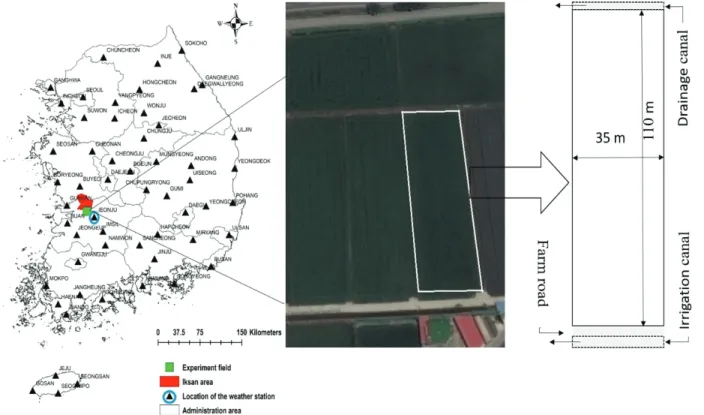
Seoul National University conducted this experiment during the paddy growing season in 2013, and 2014. The experimental field was located near Iksan city (35.9016 N, 127.0331 E) of the Jeonbuk province in South Korea. In terms of soil, Jeonbuk series fits the predominant soil characteristics near the Iksan site. The Jeonbuk series is a poorly drained silty clay loam soil series built on the fluvio-marine plain. The physical properties of the upper layer(∼20 cm) of soil contained 11.1 % sand, 71.1% silt, and 17.8% clay. The average annual rainfall is 1260 mm, and the average annual temperature is 12.7°C (https://en.
climate-data.org/asia/south-korea/jeollabuk-do/iksan-si-4130/).
The study site is highly influenced by the monsoon rainfall.
Most of the precipitation occurred in Korea during July and August. Approximately 52% of the annual rainfall occurs in the study area during this time. Most of the growing season for rice includes the monsoon period. Therefore, paddy fields are vulnerable to discharging sediment and nutrients to downstream water bodies.
A paddy field of 35 m wide and 110 m long in size was
established for paddy hydrology and water quality monitoring, as shown in Figure 1. A weir was also installed at the paddy field drainage outlet to measure the drainage water amount.
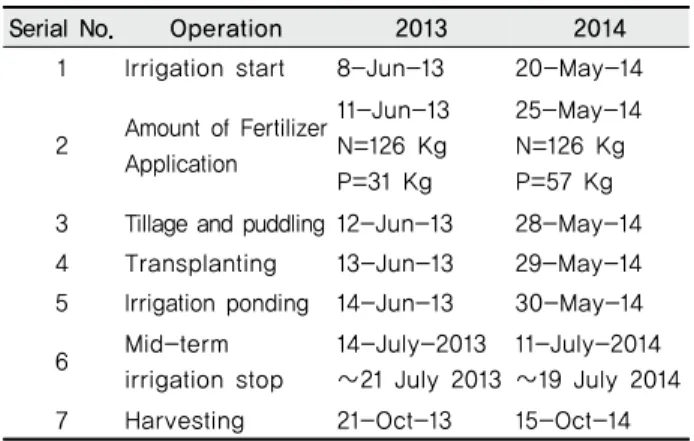
The outlet weir is also used to control the ponding depth inside the paddy field. Figure 2 illustrates the weir setup in different two years. An ultrasonic water level gauge was used to measure paddy ponding depth. The water samples of paddy fields were collected at regular intervals of 15 days. However, rainfall-runoff samples were collected when the major storm occurred. All water samples were analyzed using standard methods, as described in APHA (1998) for nutrient content determination. The field experiment was performed for two years (2013-2014) during the rice-growing season. Table 1 summarizes the paddy management scheduled during the study period. A Japonica rice variety of ‘Saenuri’ was transplanted as per schedule. Midseason forced surface drainage of 1 to 2 weeks is a common practice in Korea for improving air supply to the rice root zone and increasing the number of tillers for lodging tolerance with sturdy rice stalk (Hong et al. 2012). The forced drainage was practiced in the second week of July for about two weeks.
Fig. 1 Location of experimental field and weather station
Fig. 2 Weir height in different management practices
Serial No. Operation 2013 2014
1 Irrigation start 8-Jun-13 20-May-14
2 Amount of Fertilizer Application
11-Jun-13 N=126 Kg P=31 Kg
25-May-14 N=126 Kg P=57 Kg 3 Tillage and puddling 12-Jun-13 28-May-14 4 Transplanting 13-Jun-13 29-May-14 5 Irrigation ponding 14-Jun-13 30-May-14 6 Mid-term
irrigation stop
14-July-2013
∼21 July 2013
11-July-2014
∼19 July 2014
7 Harvesting 21-Oct-13 15-Oct-14
Table 1 Typical paddy management schedule of the Iksan field
2. APEX-Paddy model setup and inputs
Apex model (version 1501) was used in this study. The APEX-Paddy (modified APEX) model requires inputs site-specific inputs data for simulating discharge, sediment, and nutrients loss from paddy management practices. Soil characteristics are essential factors when modeling runoff from a basin. The U.S. Natural Resource Conservation Service (NRCS) classifies soils into four hydrologic groups based on the infiltration characteristics of the soils. NRCS Soil Survey Staff (1996) defines a hydrologic group as a group of soils having similar runoff potential under the same storm and cover conditions. Soil properties that influence runoff potential are those that impact the minimum rate of infiltration for a bare soil after prolonged wetting and when not frozen. These properties are depth to the seasonally high water table, saturated hydraulic conductivity, and depth to a very slowly permeable layer. Hydrologic soil groups are classified as either an “A”, “B”,
“C”, or “D” soil. For instance, “A” soils infiltrate rainwater the best, and therefore properties with an “A” soil generate the least amount of runoff.”D “soils have the lowest infiltration rates and
thus contribute the most runoff. In this study, the hydrologic soil group selected ‘B’ due to a terrace that had been installed.
In APEX, a user may either create a new weather station or use one of the default stations defined by the program (Steglich et al., 2016). As APEX works on a daily time-step, a daily weather file (.DLY) was created by using Jeonju weather station data from 1976 to 2015 in this study. Six parameters are used in the weather file, including precipitation, maximum and minimum temperature, solar radiation, relative humidity, and wind speed.
The schematic of the APEX processes with the paddy module is illustrated in Figure 3. With the paddy enhancement, a subarea is flexible for setting land as dry or wet (flooded) as prescribed in the operation schedule file that is attached to the subarea. APEX uses the Natural Resources Conservation Service Curve Number (CN) equation (Hawkins et al. 2009) or the Green and Ampt method for estimating the runoff. The CN technique was selected in this study. The CN method relates run-off to soil type, land use, and management practices (Williams et al. 2008). The APEX model has five options for estimating potential evapotranspiration (PET), such as Penman-Monteith, Penman, Priestley-Taylor, Hargreaves, and Baier-Robertson. In this study, Hargreaves and Samani (Hargreaves and Samani 1985) equation was used for the estimation of PET. Hargreaves is a temperature-based model and uses temperature and extraterrestrial radiation to estimate daily PET. The Hargreaves method gives the best estimate of PET when data on relative humidity, solar radiation, and wind speed data are not available (Williams and Izaurralde 2005).
There are seven equations to select from in APEX to simulate rainfall/runoff erosion. All of the options are modifications of the Universal Soil Loss Equation (USLE), primarily in the energy component (Steglich et al., 2016). For this research, soil erosion is estimated by the Modified Universal Soil Loss Equation (MUSLE) equation.
The amount of NO3-N lost when water flows through a layer is estimated by considering the change in concentration. Thus, the equation:
QNO3=QT×CNO3 (1) Where; QNO3 is the amount of NO3-N lost from a soil layer, and CN03 is the average concentration of NO3-N in the layer
during the percolation of volume QT through the layer.
A loading function developed by McElroy et al., (1976) and modified by Williams and Hann (1978) for application to individual runoff events is used to estimate organic N loss. The loading function is
YON=0.001*Y*CON*ER (2)
Where YON is the organic N runoff loss in kg ha-1, Y is the sediment yield in t ha-1, CON is the concentration of organic N in the topsoil layer in g t-1, and ER is the enrichment ratio. The enrichment ratio is the concentration of organic N in the sediment divided by that in the soil.
Calculating P loss in APEX is dependent upon the partitioning of P between the soluble and sediment-bound phase when soil erosion occurs. It’s expected that the majority of P loss occurs in the sediment-bound state (Hansen et al., 2002).
Therefore, total P (T-P) loss is significantly affected by the water erosion equations and the concentration of sediment in runoff. Sediment-transported P is simulated with loading functions in APEX and is influenced by the concentration of P in topsoil (Williams et al., 2012). The loading function is estimated by dividing the concentration of organic P in
sediment by the concentration of P in the mineral soil. Soluble P loss in surface runoff is calculated using the GLEAMS (Groundwater Loading Effects of Agricultural Management Systems) equation. The GLEAMS equation estimates soluble P loss based on runoff volume, the concentration of labile P, and a ‘Kd’ value. The Kd value is the P concentration in the sediment divided by that in the water (Williams et al., 2012).
Ⅲ. METHODOLOGY
1. Warm-up period selectionThe warm-up time is the time that the simulation will run before starting to collect results. A warm-up period can be essential for successful model performance. Insufficient warm-up periods may result in the early years of the simulation, having biased responses. Therefore, 1 to 4 years of warm-up simulations are common for watershed-scale modeling (Douglas-Mankin et al., 2010). For this research, the model was run for 99 years using the same management and weather data. It was found that after 30 years, the water and nutrients related variables were reached in stable condition. The field operation schedules for two years, and fifteen rotations were simulated. Therefore, Fig. 3 Schematic diagram of the Agricultural Policy/Environmental eXtender (APEX) ‐Paddy algorithm
(Modified from Choi et al. 2017)
model outputs contained data for 30 years, but only the last rotation was assessed (e.g., a simulation lasting from 1984 to 2014, data were evaluated from 2013 to 2014).
2. Sensitivity analysis
As calibrating a model with more number of parameters is a difficult task, a sensitivity analysis was done to reduce the calibration effort. The parameter selection for sensitivity analysis was made based on the characteristics of the study area as well as the literature review. In this study, a sensitivity analysis was conducted using the APEX-CUTE tool. APEX-CUTE offers a sensitivity analysis using the Morris method (Morris, 1991). Then, an investigation was conducted to determine the rate of change in model outputs based on the degree of change to the value of a sensitive parameter. This step is essential to identifying and defining parameters that influenced the model outputs most (Duggupati et al., 2015).
3. Calibration of Parameters
The adjustment of variables that describe site conditions and characteristics is key to fine-tuning calibration. These parameter values are edited in several files, including the subarea file (.SUB), parameter file (.PARM), and control file (CONT). The PARM file is a critical part of the APEX model, containing 110 equation coefficients, exponents, and ratios. These values were manipulated with extreme caution. Sensitive parameters value were determined through trial and error method in manual calibration. The calibration process involved editing parameter values, running the model, and assessing the results.
Continued changes in parameter values depended on the over or under-prediction of the model results. Successful calibration occurred when both of the managements met the performance measures as described in ‘Model Evaluation’. It’s important to note that the calibration of the water balance was conducted first and foremost, because sediment, N, and P calibration are Fig. 4 Apex-Paddy model simulated (a) water loss, and (b) nutrients loss
dependent on runoff loss.
After calibrating using the trial and error method, an automatic calibration was performed to improve model predictions.
The auto-calibration was completed using APEX-CUTE 4.1 (APEX-auto-Calibration). This software uses a Dynamically Dimensioned Search (DDS) algorithm, which repeatedly interacts with the input files, edits parameter values slightly, and runs the model (Wang and Jeong, 2016). The user specifies the number of iterations conducted by the DDS, but it is recommended that this value be set between 500 and 5000 (Wang and Jeong, 2016). The parameters that were allowed to be changed by the auto-calibration software were identified during the manual calibration. The starting values for all parameters were the values used in the manually calibrated model. In this study, 900 iterations were run, and one set of parameters was selected based on the calculated objective function value and best objective function value. Inputs in the soil and management files were not considered for calibration, as those were determined based on measured data or field descriptions during the model setup.
A successful calibration of the APEX Model required the adjustment of model parameters concerning the evaluation criteria for simulating runoff, sediment, T-N, and T-P. The calibrated model used nearly identical parameter values, despite variations in management operations and fertilizer application rates.
4. Model Evaluation
Analyzing model performance after calibration is necessary to quantify relationships between simulated and collected data.
It is recommended that both graphical techniques and quantitative statistics be used in model evaluation (Moriasi, 2007). Three different evaluation statistics were used to quantify this study, including coefficient of determination (R2), Nash-Sutcliffe Efficiency (NSE), and Percent Bias (PBIAS). One of the most
commonly used criteria in model performance is the R2 correlation coefficient, which is used to determine the goodness of fit (e.g., Moriasi et al., 2015). Values for R2 (bound by 0 and 1) that are closer to 1 indicate a better fit, with an amount of 1indicating a perfect match for comparing predicted values to observed data.
The efficiency of model performance is typically measured after calibrating a model or when processing data (Moriasi et al., 2007). The NSE equation is used to estimate efficiency, and also determines how well the simulated values mimic observed data. These values range from 1 to -∞. Similar to R2 values, an NSE value of 1 indicates a perfect fit, and if NSE is 0, then the simulation is no more accurate than the mean of the data that was observed (Mudgal et al., 2010).
The last statistical measure, PBIAS, describes the tendency of simulated data to over or under-estimate compared to the corresponding observed data (Moriasi et al., 2007). Ideal values of PBIAS are at or near zero, with lower values indicating more accurate simulations. Negative values indicate that the model underestimated the measured data, and positive values correspond with model overestimation bias.
(3)
(4)
(5)
In the equation, x and y are the predicted and observed values, and are the means of x’s and y’s
What constitutes a successful calibration depends on several factors, including what independent variables are being observed (e.g., runoff volume, nutrient concentration or load,
Performance Rating NSE PBIAS (%)
Streamflow Sediment N, P
Very good 0.75< NSE≤ 1.0 PBIAS <± 10 PBIAS <± 15 PBIAS <± 25 Good 0.65< NSE≤ 0.75 ± 10≤ PBIAS<± 15 ± 15≤ PBIAS<± 30 ± 25≤ PBIAS<± 40 Satisfactory 0.50< NSE≤ 0.65 ± 15≤ PBIAS<± 25 ± 30≤ PBIAS<± 55 ± 40≤ PBIAS<± 70
Unsatisfactory NSE≤ 0.50 PBIAS≥± 25 PBIAS≥± 55 PBIAS≥± 70
Table 2 Recommended statistics for the watershed model (Moriasi et al. 2007)
and the period that’s being evaluated). Continuous model development and improvement have influenced acceptable values. In this study, Moriasi et al. 2007 recommended statistics are used, as shown in Table 2.
Ⅳ. RESULTS AND DISCUSSIONS
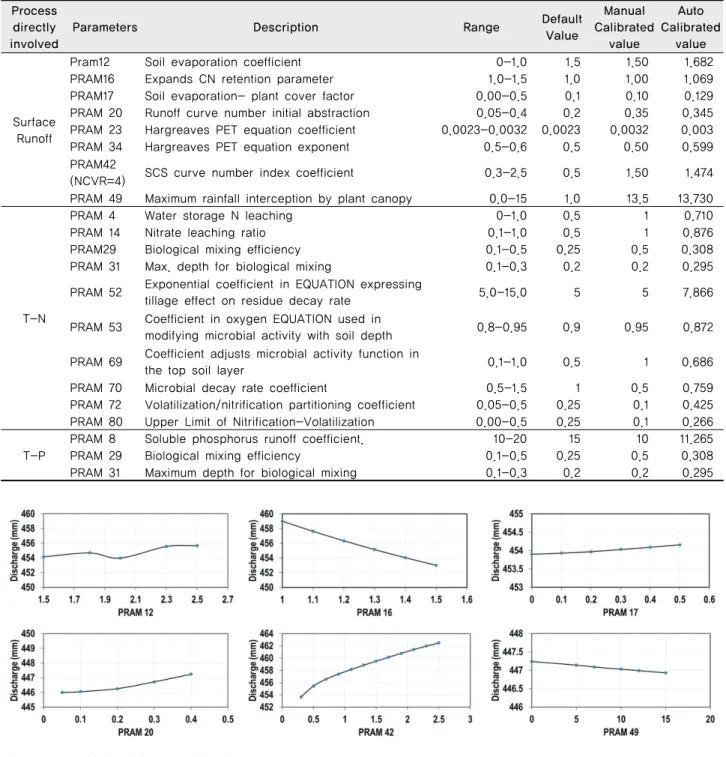
1. Sensitivity analysisThe effects of the parameters were assessed for APEX-Paddy model outputs of discharge (Q), total N loss in runoff (T-N), and total P loss in flow (T-P). Overall, 18 sensitive parameters
Fig. 5 The sensitivity of discharge influential parameters Process
directly involved
Parameters Description Range Default
Value
Manual Calibrated
value
Auto Calibrated
value
Surface Runoff
Pram12 Soil evaporation coefficient 0-1.0 1.5 1.50 1.682
PRAM16 Expands CN retention parameter 1.0-1.5 1.0 1.00 1.069
PRAM17 Soil evaporation- plant cover factor 0.00-0.5 0.1 0.10 0.129
PRAM 20 Runoff curve number initial abstraction 0.05-0.4 0.2 0.35 0.345
PRAM 23 Hargreaves PET equation coefficient 0.0023-0.0032 0.0023 0.0032 0.003
PRAM 34 Hargreaves PET equation exponent 0.5-0.6 0.5 0.50 0.599
PRAM42
(NCVR=4) SCS curve number index coefficient 0.3-2.5 0.5 1.50 1.474
PRAM 49 Maximum rainfall interception by plant canopy 0.0-15 1.0 13.5 13.730
T-N
PRAM 4 Water storage N leaching 0-1.0 0.5 1 0.710
PRAM 14 Nitrate leaching ratio 0.1-1.0 0.5 1 0.876
PRAM29 Biological mixing efficiency 0.1-0.5 0.25 0.5 0.308
PRAM 31 Max. depth for biological mixing 0.1-0.3 0.2 0.2 0.295
PRAM 52 Exponential coefficient in EQUATION expressing
tillage effect on residue decay rate 5.0-15.0 5 5 7.866
PRAM 53 Coefficient in oxygen EQUATION used in
modifying microbial activity with soil depth 0.8-0.95 0.9 0.95 0.872 PRAM 69 Coefficient adjusts microbial activity function in
the top soil layer 0.1-1.0 0.5 1 0.686
PRAM 70 Microbial decay rate coefficient 0.5-1.5 1 0.5 0.759
PRAM 72 Volatilization/nitrification partitioning coefficient 0.05-0.5 0.25 0.1 0.425 PRAM 80 Upper Limit of Nitrification-Volatilization 0.00-0.5 0.25 0.1 0.266 T-P
PRAM 8 Soluble phosphorus runoff coefficient. 10-20 15 10 11.265
PRAM 29 Biological mixing efficiency 0.1-0.5 0.25 0.5 0.308
PRAM 31 Maximum depth for biological mixing 0.1-0.3 0.2 0.2 0.295
Table 3 Sensitive parameters considered for calibration of the model
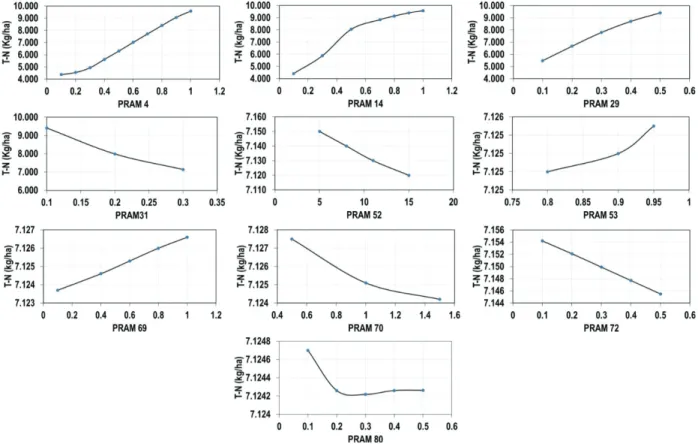
were detected using APEX-CUTE auto-calibration tools; among them, nine parameters are sensitive to discharge, ten parameters are sensitive to nitrogen yield, and three parameters are sensitive to phosphorus yield. However, PARM 29 and PRAM 31 both are susceptible to nitrogen and phosphorus yield (Table 3). In this study, MUSLE equation used for measuring sediment loss.
However, sediment loss influential parameters were not found in the sensitivity analysis. These APEX outputs are of
considerable interest to the national assessment.
Parameter importance (or sensitivity) can then be assessed by visual inspection of the scatter plots for objective function values or the model output variables versus each parameter value, as shown in Figure (4-6). However, during DDS optimization, it should be noted that a particular parameter value most likely changes simultaneously with other values. Therefore, the changes in different parameter values and significant
Fig. 6 The sensitivity of nitrogen yield influential parameters
Fig. 7 The sensitivity of phosphorus yield influential parameters
interactions among parameters also contribute to the changes in model output.
2. Manual Calibration
Based on the results of sensitivity analysis, The APEX- PADDY model was calibrated based on daily discharge (Q),
nitrogen yield (T-N), sediment yield (SS), and phosphorus (T-P) yield rates data that were measured at the outlet of the paddy field during the cropping period of 2013 and 2014. Table 4 shows a statistical summary of the calibrated model performance, and Figure 8(a-d) shows comparisons of the observed and simulated discharge, nitrogen yield, sediment, and phosphorus yield, respectively. The manually calibrated model satisfactorily
Statistical Index Manual calibration
2013 2014 Entire Period
Q
R2 0.81 0.71 0.78
NSE 0.87 0.40 0.65
PBIAS -8.04 15 5.41
T-N
R2 0.59 0.50 0.51
NSE 0.60 0.63 0.68
PBIAS 12.96 26 20.93
SS
R2 0.25 0.21 0.20
NSE -68.02 -41.77 -46.14
PBIAS -1104.11 -730.45 -859.66
T-P
R2 0.77 0.28 0.32
NSE -39.36 -31.23 -36.75
PBIAS -854 -409.6 -515.41
Table 4 Performance statistics for the manually calibrated APEX-Paddy model, including the coefficient of determination (R2), Nash Sutcliffe model efficiency equation (NSE), and Percent Bias (PBIAS) (Individual year and entire calibration period)
Fig. 8 Observed and simulated daily (a) discharge, (b) nitrogen yield, (c) sediment yield, and (d) phosphorus over the manual calibration period of the paddy the growing season in 2013, and 2014
simulated the discharge and nitrogen yield. However, the simulation results of sediment and phosphorus yield were not satisfactory level.
As depicted in Table 4, the performance of the paddy model is demonstrated to be satisfactory in predicting runoff discharge rate (R2 = 0.78, NSE = 0.65, PBIAS = 5.41%), which proves that the simulation effectively reflects the field data. These results show that the APEX-Paddy model successfully calibrated discharge. For T-N, the performance statistics demonstrated to be satisfactorily predicting the nitrogen yield (T-N) rate (R2 = 0.51, NSE = 0.68, PBIAS = 20.93%), proves that APEX-Paddy model successfully calibrated the nitrogen yield.
According to performance statistics, simulation data of sediment and phosphorus had shown the overestimated values, which demonstrates that the simulation is not effectively reflects the field data. Results indicate that the APEX-Paddy model did not successfully calibrate the sediment and phosphorus yield. It might be happened due to the limitation of the sediment routine of the model. It will discuss in detail later part of the article.
3. Auto-calibration
The model parameters modified using an auto-calibration tool (APEX-CUTE 4.1) for predictions of runoff, sediment, N, and P. Of the 900 iterations of APEX runs, the set of parameters that resulted in the best model occurred within the first 225
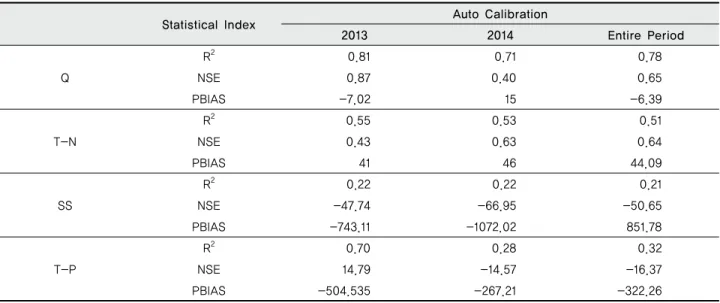
runs. The parameters from the best run were applied and used to calculate model performance. Table 5 shows a statistical summary of the model performance, and Figure 9(a-d) illustrates the comparisons of the simulation and observation, as shown in Figure 8 but for the results of auto-calibration.
Similarly to the results for manual calibration, while the automatic calibration systems also performed reasonably in the calibration of runoff and nitrogen yield, the performance statistics indicated the unsatisfactory simulation of sediment and phosphorus yield.
As shown in Table 5, the performance of the paddy model is demonstrated to be satisfactory in predicting runoff discharge rate (R2 = 0.78, NSE = 0.65, PBIAS = -6.39%), which proves that the simulation effectively reflects the field data. These results confirm that the APEX-Paddy model successfully calibrated discharge. For T-N, the performance statistics demonstrated to be acceptably predicting the nitrogen yield (T-N) rate (R2 = 0.51, NSE = 0.64, PBIAS = 44.09 %), shows that APEX-Paddy model successfully calibrated the nitrogen yield (T-N). The simulated value of sediment and phosphorus yield are not meet the statistically satisfactory level both individual management practice in two different years and the entire period as well, except the R2 value of T-P in 2013.
Simulation results of sediment and phosphorus had shown the overestimated values, which shows that the simulation is not effectively reflects the field data. It indicates that the APEX- Paddy model did not successfully calibrate the sediment and
Statistical Index Auto Calibration
2013 2014 Entire Period
Q
R2 0.81 0.71 0.78
NSE 0.87 0.40 0.65
PBIAS -7.02 15 -6.39
T-N
R2 0.55 0.53 0.51
NSE 0.43 0.63 0.64
PBIAS 41 46 44.09
SS
R2 0.22 0.22 0.21
NSE -47.74 -66.95 -50.65
PBIAS -743.11 -1072.02 851.78
T-P
R2 0.70 0.28 0.32
NSE 14.79 -14.57 -16.37
PBIAS -504.535 -267.21 -322.26
Table 5 Performance statistics for the Auto-calibrated APEX-Paddy model, including the coefficient of determination (R2), Nash Sutcliffe model efficiency equation (NSE), and Percent Bias (PBIAS) (Individual year and entire calibration period)
phosphorus yield. It might be happened due to the limitation of the sediment simulation component of the APEX-Paddy model. It is discussed in detail the “limitation” part of the article.
The manually calibrated model performed better than the automatically calibrated model in nearly all comparisons. For runoff, R2, and NSE values of automatically calibrated model were the same as the manual calibration. However, a little improvement has shown PBIAS in manual calibration in the entire period. For T-N, NSE and PBIAS values have demonstrated improved results in manual calibration in the whole period, whereas R2 value was the same as manual calibration. Previously, a study was conducted by the University of Wisconsin-Green Bay, USA (Kalk, 2018) for evaluating the APEX model to simulate runoff, sediment, and phosphorus loss from agricultural fields and showed that the performance of a manually calibrated model better than the automatically calibrated model.
4. Limitation of Model
The main limitation of the APEX-Paddy model is the
prediction of sediment yield. The APEX component for water-induced erosion simulates erosion caused by rainfall and runoff and by irrigation (sprinkler and furrow). To simulate rainfall/runoff erosion, APEX contains seven equations- Universal Soil Loss Equation (USLE); Onstad-Foster (AOF) version of USLE; Modified USLE (MUSLE & RUSLE); and three MUSLE variants, MUST, MUSS, and MUSI (Wischmeier and Smith, 1978; Onstad and Foster, 1975; Renard et al., 1997;
Williams, 1975)
In this study, MUSLE equation is used to simulate erosion and sediment yield. MUSLE estimates the sediment yield by calculating the tons of soil lost through sheet and rill erosion processes on a daily basis. This equation includes sheet and rill erosion that occurs when precipitation is sufficient to result in surface water runoff. The sheet and rill erosion may occur in upland condition only. However, paddy rice management practice is quite different from upland crop management.
Traditionally the paddy fields are earth-bermed by 10-30 cm in height and are flooded to 3-10 cm deep for the most of the Fig. 9 Observed and simulated daily (a) discharge, (b) nitrogen yield, (c) sediment yield, and (d) phosphorus over the
automatic calibration period of the paddy the growing season in 2013, and 2014
growing season in Korea. MUSLE or other erosion models do not works when a paddy field is inundated (ponded condition) because these models are developed for estimating soil erosion by surface runoff.
A tillage operation, while a paddy is inundated, will make the paddy water well mixed with topsoil to form dense, muddy water. The model reproduces what would happen when soils are tilled while having ponding water in the field, or puddled.
These conventional erosion methods become active after a
“destroy puddle” command in the OPS file (The operation schedule file). Sediment concentration of paddy water is influenced by puddling operation. After puddling, the sediment concentration of the paddy water becomes very high and then exponentially reduces over the next multiple days. Thus, if there happened storm events right after a puddling operation that creates overflow, a significant amount of sediment discharged from the paddy field. Conversely, if the storm events happened after some days of puddling operation and created overflow, a very minimum amount of sediment discharged from the paddy field, as shown in Figure 10.
The runoff occurring time is the main factor of sediment yield during the growing season, which is controlled by the weir height setup. When applying for long term simulation such as climate change forecasts, the modeling with the fixed weir height control setup may not simulate relevant sediment yield for the entire simulation period due to the different rainfall patterns at annual basis.
It is well known that up to 90% of the phosphorus transported from cropland is attached to sediment (Sharply and Beegle, 2001). Soil erosion rate directly influences the phosphorous yield calibration. Therefore, it is essential to calibrate phosphorus yield after get the soil erosion rate well-calibrated.
Ⅴ. CONCLUSION
The APEX-Paddy is the model developed to simulate water balance and quality behavior in the paddy. In this study, the performance of the APEX-Paddy model was evaluated to simulate discharge, sediment, nitrogen, and phosphorus yield using monitoring data at Iksan experimental paddy sites in Korea. Two years (2013-2014) paddy field experimental data were used to both manually and automatically calibrate the model.
The manual calibrated model was able to simulate runoff and nitrogen yield loss from the paddy management field in the study area, as indicated by the selected goodness of fit criteria.
For runoff, the R2, NSE, and PBIAS values are 0.78, 0.65, and 5.41%, respectively. For T-N, R2, NSE, and PBIAS values are 0.51, 0.68, and 20.93%, respectively. These results prove that the simulation effectively reflects the field data. The performance statistics of the automatically calibrated model were the same as the manual calibration for simulating runoff except for PBIAS (-6.39%). For T-N, comparatively worsen value of NSE Fig. 10 (a) Rainfall pattern, (b) Sediment inside the paddy field and sediment yield
(0.64), and PBIAS (44.09%) have found in automatically calibration system. However, R2 value was the same in both the calibration system. It seems that the manually calibrated model performed better than the automatically calibrated model in nearly all comparisons. However, the performance statistics demonstrated that the sediment yield is not properly predicted due to the limitation of sediment/ water erosion sub-routine in both of the calibration system. As the sediment yield directly influences phosphorus yield, the model is also not reasonably simulated the phosphorus yield.
APEX-Paddy model could be used to predictions of runoff and nitrogen yield in South Korea. Existing models are often less practical for nutrient loading estimates because they are either too sophisticated to simulate various farming conditions and best management practices (Jeon et al. 2005). Therefore, APEX-Paddy could be a useful tool for assessing the BMPs for reducing surface runoff and water-soluble nitrogen from the paddy fields in future climate projections. However, sediment sub-routine may need further improvement in the ability to better-predicting sediment and phosphorus yield as well.
Acknowledgment
This study was carried out with the support of the “Research Program for Agricultural Science & Technology Development (Project No. PJ01254903)”, National Institute of Agricultural Sciences, Rural Development Administration, Korea.
REFERENCES
1. Ahmad, S., A. Ahmad, C. M. T. Soler, H. Ali, M.
Zia-Ul-Haq, and J. Anothai, 2012. Application of the CSM-CERES-Rice model for evaluation of plant density and nitrogen management of fine transplanted rice for an irrigated semiarid environment. Precis. Agric. 13: 200-218.
doi:10.1007/s11119-011-9238-1.
2. APHA (American Public Health Association), 1995.
Standard methods for the examination of water and wastewater, 19th edn. American Public Health Association.
Washington, DC, USA, 99-153.
3. Choi, S. K., J. Jeong, and M. K. Kim, 2017. Simulating the effects of agricultural management on water quality dynamics in rice paddies for sustainable rice production―
model development and validation. Water 9(11): 869. doi:
10.3390/w9110869.
4. Choi, J. D., W. J. Park, K. W. Park, and K. J. Lim, 2013.
Feasibility of SRI methods for reduction of irrigation and NPS pollution in Korea. Paddy and Water Environment 11(1-4): 241-8. doi:10.1007/s10333-012-0311-9.
5. Choi, J., G. Kim, W. Park, M. Shin, Y. Choi, S. Lee, D.
Lee, and D. Yun, 2015. Effect of SRI methods on water use, NPS pollution discharge, and GHG emission in Korean trials. Paddy Water Environ 13: 205-213. doi:
10.1007/s10333-014-0422-6.
6. Douglas‐Mankin, K. R., R. Srinivasan, and J. G. Arnold, 2010. Soil and Water Assessment Tool (SWAT) model:
Current developments and applications. Trans. ASABE 53(5): 1423-1431. doi:10.13031/2013.34915
7. Duggupati, P., N. Pai, S. Ale, K. R. Douglas-Mankin, R.
W., Zeckoski, J. Jeong, P. B. Parajuli, D. Saraswat, and M. A. Youssef, 2015. A recommended calibration and validation strategy for hydrologic and water quality models. American society of Agricultural and Biological Engineers 58(6): 1705-1719. doi:10.13031/trans.58.10712.
8. Havlik, P., U. A. Schneider, E. Schmid, H. Bottcher, S.
Fritz, R. Skalsky, K. Aoki, S. De Cara, G. Kindermann, F. Kraxner, S. Leduc, I. McCallum, A. Mosnier, T. Sauer, and M. Obersteiner, 2011. Global land-use implications of first and second-generation biofuel targets. Energy Policy 39(10): 5690-5702. doi:10.1016/j.enpol.2010.03.030.
9. Hawkins, R. H., J. W. Timothy, E. W. Donald, and A.
V. Joseph, 2009. Curve number hydrology: state of the practice. Reston, VA: American Society of Civil Engineers, 106. ISBN 978-0-7844-1044-2.
10. Hargreaves, G. H., and Z. A. Samani, 1985. Reference crop evapotranspiration from temperature. Transaction of ASAE 1(2): 96-99. doi:10.13031/2013.267.
11. Hansen, N. C., T. C. Daniel, A. N. Sharpley, and J. L.
Lemunyon, 2002. The fate and transport of phosphorus in agricultural systems. Journal of Soil and Water Conservation 57(6): 408-417.
12. Hong, H. C., H. C. Choi, H. G. Hwang, Y. G. Kim, H.
P. Moon, H. Y. Kim, J. D. Yea, Y. S. Shin, Y. H. Choi, Y. C. Cho, M. K. Baek, J. H. Lee, C. I. Yang, K. H. Jeong, S. N. Ahn, and S. J. Yang, 2012. A lodging-tolerance and dull rice cultivar ‘Baegjinju’. Korean J Breed Sci 44(1):
51-56 (in Korean).
13. Jang, T. I., H. K. Kim, C. H. Seong, E. J. Lee, and S.
W. Park, 2012. Assessing nutrient losses of reclaimed wastewater irrigation in paddy fields for sustainable agriculture. Agricultural Water Management 104: 235-243.
doi:10.1016/j.agwat.2011.12.022.
14. Jeon, J. H., C. G. Yoon, J. H. Ham, and K. W. Jung, 2005.
Model development for surface drainage loading estimates from paddy rice fields. Paddy and Water Environment 3(2): 93-101. doi:10.1007/s10333-005-0007-5.
15. Kim, J. S., S. Y. Oh, and K. Y. Oh, 2006. Nutrient runoff from a Korean rice paddy watershed during multiple storm events in the growing season. J. Hydrol 327(1): 128-139.
doi:10.1016/j.jhydrol.2005.11.062.
16. Kim, M., M. S. Kang, I. Song, K. Kim, J. H. Song, and J. R. Jang, 2015. Polliutant Loads Estimation from Paddy Fields using CREAMS during Non-Cropping Season.
Journal of the Korean Society of Agricultural Engineers, Fall Meeting Conference Proceeding.
17. Kim, S. M., S. W. Park, J. J. Lee, B. L. Benham, and H. K. Kim, 2007. Modeling and assessing the impact of reclaimed wastewater irrigation on the nutrient loads from an agricultural watershed containing rice paddy fields.
Journal of Environmental Science and Health, Part A, 42(3): 305-15. doi:10.1080/10934520601144543.
18. Kiniry, J. R., D. J. Major, R. C. Izaurralde, J. R. Williams, P. W. Gassman, M. Morrison, R. Bergentine, and R. P.
Zenter, 1995. EPIC model parameters for cereal, oilseed, and forage crops in the northern Great Plains region.
Canadian Journal of Plant Science 75: 679-688. doi:
10.4141/cjps95-114.
19. Kalk, F. S, 2018. Evaluation of the APEX model to simulate runoff, sediment, and phosphorus loss from agricultural fields in northeast Wisconsin (Unpublished master’s thesis), University of Wisconsin-Green Bay, USA.
20. La, N., M. Lamers, V. V. Nguyen, and T. Streck, 2014.
Modeling the fate of pesticides in paddy rice-fish pond farming systems in northern Vietnam. Pest Manag. Sci., 70: 70-79.
21. Lee, D. G., J. H. Song, J. H. Ryu, J. Lee, S. K. Choi, and M. S. Kang, 2018. Integrating the mechanisms of agricultural reservoir and paddy cultivation to the HSPF-MASA- CREAMS-PADDY System. Journal of the Korean Society of Agricultural Engineers 60(6): 1-12. doi:
10.5389/KSAE.2018.60.6.001.
22. MAFRA (Ministry of Agriculture, Food and Rural Affairs), 2015. Agriculture, Food and Rural Affairs Statistical
Yearbook. Ministry of Agriculture, Food and Rural Affairs:
Sejong (in Korean).
23. McElroy, A. D., S. Y. Chiu, J. W. Nebgen, A. Aleti, and F. W. Bennett, 1976. Loading functions for assessment of water pollution from nonpoint sources. Environ. Prot. Tech.
Serv., EPA 600/2-76-151.
24. Morris, M. D., 1991. Factorial sampling plans for preliminary computational experiments. Technometrics 33(2): 161-174. doi:10.1002/ps.3527.
25. Moriasi, D. N., M. W. Gitau, N. Pai, and P. Daggupati, 2015. Hydrologic and water quality models: Performance measures and evaluation criteria. Trans. ASABE 58(6):
1763-1785. doi:10.13031/trans.58.10715.
26. Moriasi, D. N., J. G. Arnold, M. W. Van Liew, R. L.
Bingner, R. D. Harmel, and T. L. Veith, 2007. Model evaluation guidelines for systematic quantification of accuracy in watershed simulations. Trans. ASABE 50(3):
885-900. doi:10.13031/2013.23153.
27. Mudgal, A., S. H. Anderson, C. Baffaut, N. R. Kitchen, and E. J. Sadler, 2010. Effect of long-term soil and crop management on soil hydraulic properties for claypan soils.
J. Soil Water Cons. 67(4): 284-299. doi:10.2489/jswc.65.
6.393.
28. Matsuno, Y., K. Nakamura, T. Masumoto, H. Matsui, T.
Kato, and Y. Sato, 2006. Prospects for multi functionality of paddy rice cultivation in Japan and other countries in monsoon Asia. Paddy Water Environ. 4: 189-197. doi:
10.1007/s10333-006-0048-4.
29. Onstad, C. A, and G. R. Foster, 1975. Erosion Modeling on a Watershed. Transactions of the American Society of Agricultural Engineers 18(2): 288-292. doi:10.1007/s10 333-006-0048-4.
30. Ramirez-Avila, J. J., D. E. Radcliffe, D. Osmond, C.
Bolster, A. Sharpley, and S. L. OrtegaAchury, A. Forsberg, and J. L. Oldham, 2017. Evaluation of the APEX model to simulate runoff quality form agricultural fields in the southern region of the United States. Journal of Environmental Quality 46: 1357-1464. doi:10.2134/jeq 2017.07.0258.
31. Renard, K. G., G. R. Foster, G. A. Weesies, D. K. McCool, and D. C. Yoder, 1997. Predicting soil erosion by water:
a guide to conservation planning with the Revised Universal Soil Loss Equation (RUSLE). Agriculture Handbook No.
703, USDA-ARS.
32. Rosenzweig, C., J. Elliott, D. Deryng, A. A. Ruane, C.
Muller, A. Ameth, K. J. Boote, C. Folberth, M. Glotter, N. Khabarov, K. Neumann, F. Piontek, T. A. M. Pugh, E. Schmid, E. Stehfest, H. Yang, and J. W. Jones, 2014.
Assessing agricultural risks of climate change in the 21st century in a global gridded crop model intercomparison.
PNAS Science Journal 111 (9): 3268-3273. doi:10.1073/
pnas.1222463110.
33. Sharply, A., and D. Beegle, 2001. Managing Phosphorus for Agriculture and the Environment, The Pennsylvania State University, 112 Agricultural Administration Building, University Park, PA 16802, USA.
34. Seo, C. S., S. W. Park, S. J. Im, K. S. Yoon, S. M. Kim, and M. S. Kang, 2002. Development of CREAMS-PADDY model for simulating pollutants from irrigated paddies.
Journal of the Korean Society of Agricultural Engineers 44(3): 146-156.
35. Song, J., M. S. Kang, I. Song, K. Lee, and J. Jang, 2011.
Impacts of farming method on NPS pollutant loads from paddy fields using CREAMS-PADDY. Journal of the Korean Society of Agricultural Engineers, Fall Meeting Conference Proceeding.
36. Steglich, E. M., J. Jeong, and J. R. Williams, 2016.
Agricultural Policy/Environmental eXtender Model: User’s Manual, Version 1501. NRCS and AgriLife Research, Texas A&M System.
37. Takeda, I., and A. Fukushima, 2006. Long-term changes in pollutant load outflows and purification function in a paddy field watershed using a circular irrigation system.
Water Research 40(3), 569-78. doi:10.1016/j.watres.2005.
08.034.
38. Tang, L., Y. Zhu, D. M. Hannaway, Y. Meng, L. Liu, and L. Chen, 2009. A rice growth and productivity model.
NJAS Wagening. J. Life Sci., 57: 83-92. doi:10.1016/j.njas.
2009.12.003.
39. Tsuchiya, R., T. Kato, and J. Jeong, 2015. SWAT model improvement for discharge process in rice paddies. In Proceedings of the PAWEES-INWEPF Joint International Conference, Kuala Lumpur, Malaysia, 19-21 August 2015.
40. Williams, J. R., J. G. Arnold, J. R. Kiniry, P. W. Gassman, and C. H. Green, 2008. History of model development at Temple, Texas. Hydrol. Sci. 53(5): 948-960. doi:10.1623/
hysj.53.5.948.
41. Williams, J. R., and R. C. Izaurralde, 2005. The APEX model. BRC Rep (2005)-02, Blackland Res Center, Texas, A&M University, Temple, TX.
42. Williams, J. R., R. C. Izaurralde, and E. M. Steglich, 2012.
Agricultural Policy/Environmental eXtender Model:
Theoretical Documentation version 0806. Texas A&M AgriLife Research System.
43. Williams, J. R., 1975. Sediment yield prediction with Universal Equation using runoff energy factor. In: Present and prospective technology for predicting sediment yields and sources, 244-252, Agricultural Research Service, US Department of Agriculture.
44. Williams, J. R., and R. W. Hann, 1978. Optimal operation of large agricultural watersheds with water quality constraints. Texas Water Resources Institute, Texas A&M Univ., Tech. Rept. No. 96.
45. Wang, E., C. Xin, J. R. Williams, and C. Xu, 2006.
Predicting soil erosion for alternative land uses. J Environ Qual 35: 459-467. doi:10.2134/jeq2005.0063.
46. Wang, X., J. R. Williams, P. W. Gassman, C. Baffaut, Izaurralde, R. C., J. Jeong, and J. R. Kiniry, 2012. EPIC and APEX: Model use, calibration, and validation. Trans.
ASABE, 55(4): 1447-1462.
47. Wang, X and J. Jeong, 2016. APEX-CUTE 4 User Manual;
Texas A&M AgriLife Research, Blackland Research and Extension Center, Texas A&M University: Temple, TX, USA.
48. Wischmeier, W. H., and D. D. Smith, 1978. Predicting rainfall erosion losses―a guide to conservation planning U.S. Department of Agriculture, Agriculture Handbook No.
537.
49. Yin, L., X. Wang, J. Pan, and P. Gassman, 2009. Evaluation of APEX for daily runoff and sediment yield from three plots in the Middle Huaihe River Watershed, China.
Transactions of the ASABE, 52: 1833-1845. doi:10.130 31/2013.29212.
50. Yoon, K. S., J. Y. Cho, J. K. Choi, and J. G. Son, 2006.
Water management and N, P losses from paddy fields in southern Korea. Journal of the American Water Resources Association 42: 1205-16. doi:10.1111/j.1752-1688.2006.
tb05607.x.
51. Zhang, Z. J., J. X. Yao, Z. D. Wang, X. Xu, X. Y. Lin, G. F. Czapar, and J. Y. Zhang, 2011. Improving water management practices to reduce nutrient export from rice paddy fields. Environ Technol 32(2): 197-209. doi:10.1080/
09593330.2010.494689.