1. Introduction
1)The size of particulate matter in urban runoff is generally
†To whom correspondence should be addressed.
Department of Civil and Environmental Engineering, Kongju National University
E-mail: [email protected]
less than 50um, and the average TSS concentration is reported to be 50~200 mg/L (Cho, 2007). The source of particulate matter in urban runoff is sediments from green zones, particles accumulated in the dry season due to vehicles on the roads and in parking lots, and atmospheric deposition. Particulate matter in urban runoff that flows into rivers contains nutrients, hydrocarbons, heavy metals and other non-point source
Simulation of Various Baffle Types in a Constructed Wetland Sedimentation Tank using CFD
Taegyun Noh・Jechan Jeon・Lee-Hyung Kim†
Department of Civil and Environmental Engineering, Kongju National University
CFD를 이용한 Hybrid 인공습지의 초기침강지 저류판 구조 모의
노태균・전제찬・김이형†
공주대학교 건설환경공학과
(Received : 28 July 2016, Revised: 29 August 2016, Accepted: 29 August 2016)
Abstract
Constructed wetlands are widely applied in urban and rural areas for various purposes such as pollutants reduction, acquisition of eco-spaces and habitats, flooding reduction, acquisition of water resources and environmental education.
Since the design of constructed wetlands utilizes ecosystems, special consideration must be given to ecological mechanisms, environmental mechanisms and hydrological mechanisms. To ensure the sustainable functionality of constructed wetlands, it is necessary to achieve stable flow rate and velocity, and remove sediments to ensure sufficient space for detention. To enhance the efficiency of constructed wetland sedimentation basins, this study determined the optimal position for baffle installation, and applied Computational Fluid Dynamics (CFD) to the cross-sectional design of wetlands. CFD analysis revealed that the decrease in flow velocity with baffle installation enhanced the efficiency of sedimentation of particulate matters. Vertical baffles had higher sedimentation efficiency than those with an inclined angle. When vertical baffles were installed in the sedimentation basin of a hybrid constructed wetland to reduce non-point source pollutants in urban areas, the average flow velocity within the basin decreased by 10~30%, while the sedimentation efficiency improved by 1.3~1.5 times. The application of CFD to constructed wetlands is expected to improve the cost efficiency of designing hybrid constructed wetlands with high removal efficiency.
Key words : Baffle, Computational Fluid Dynamics, Constructed wetlands, Particles, Sedimentation
요 약
인공습지는 오염물질 저감기능을 포함하는 여러 가지 생태서비스 기능 때문에 다양하게 적용되고 있다. 그러나 인공습 지에 많은 입자상 물질이 유입하게 되면 유지관리의 어려움과 기능의 저하를 초래한다. 따라서 본 연구는 인공습지 내 입자상 물질의 제거효율 향상을 위한 침강지내 최적 baffle 설치방안을 도출하고자 수행되었다. 최적 저류판 설치방안 은 침강지내 유체와 입자의 흐름을 해석함으로써 도출가능하며, 이를 위해 전산유체역학(Computational Fluid Dynamics, CFD) 이론을 활용하였다. 연구결과는 baffle이 유속을 저하시키고 입자상 물질의 침강효율을 증가시키는 것으로 나타났으며, 경사각을 가진 저류판보다는 수직 저류판이 효과적인 것으로 나타났다. 이러한 연구결과를 활용하 여 공공지역 비점오염저감시설로 설치된 소규모 하이브리드 인공습지의 침강지 효율개선 방안을 도출하였다. 수직각을 이용한 저류판을 설치할 경우 침강효율이 1.2~1.3배 정도 증가하는 것으로 나타났다. 이러한 침강지 내 저류판의 설치 에 따른 결과는 인공습지의 전반적인 저감 효율을 증가시킬 뿐만 아니라 유지관리 빈도를 줄임으로써 비용효율적 인공 습지 설계에 기여할 것으로 평가된다.
핵심용어 : 인공습지, 입자상 물질, 저류판, 전산유체역학, 침강지
pollutants. They can cause a deterioration of water quality and have adverse effects on the photosynthesis, respiration and growth of aquatic organisms (Kim et al., 2008; Lee et al., 2009). To minimize the degradation of water quality caused by non-point source pollutants in urban areas, the Ministry of Environment has included various policies for the management of non-point sources pollutants in the Water Quality and Ecosystem Conservation Act, and is promoting Low Impact Development (LID) techniques (Moon, 2015). LID techniques refer to techniques used for the efficient management of post-development runoff and non-point source pollutants while maintaining natural mechanisms (infiltration, detention, evaporation/ transpiration) that existed before development (Yu, 2015; US EPA, 2000). LID techniques, which manage water circulation and non-point source pollutants using soil, media, and the physiochemical and biological functions of plants and microorganisms, can be in the form of wetlands, infiltration trenches, rain gardens and infiltration planters. Among the aforementioned LID techniques, wetlands have been introduced in various areas for runoff management due to their ecological properties, landscape aesthetics, ease of maintenance, and environmental value. In general, wetlands are classified into two categories, free water surface flow (FWS) and horizontal or vertical sub-surface flow (HSSF). For enhanced efficiency, hybrid systems comprised of both free water surface flow and sub-surface flow are being more widely used (Lee, 2011).
However, they cannot fully remove the particulate matter contained in runoff, and thus resulting to weaker wetland efficiency by causing the blockage of pores, low photosynthesis, and interference with the respiration of microorganisms. The manual on non- point pollutants removal equipment (MOE, 2014) by the Ministry of Environment requires the installation of a sedimentation basin in wetland design, including specifications such as a capacity equivalent to 10% of water quality volume, a depth of 1.2~1.8m, and a minimum length/width ratio of 2:1.
The management of sediments and vegetation in the sedimentation basin is a key area requiring maintenance to ensure normal pre-treatment function. According to the manual, sediments must be removed if more than 50% of the dredge is buried compared to the volume of the sedimentation basin, and must not exceed 10% of the water quality volume (WQv). Because the manual does not specify how much of the particulate matter must be removed from the sedimentation basin, they continue to enter the wetland, thus lowering the wetland efficiency. The large width of the flow entering the wetland also interferes with quantitative optimal design.
The development of CFD, however, has enabled the optimal design of wetland sedimentation basins (Hwang.,
2014). Schamber and Larock (1981) performed a finite element computation of turbulent flows in a rectangular sedimentation basis without baffles, while Yang (2003) employed numerical analysis to compare the sedimentation efficiency of normal settlers, inclination plate settlers, and inclination plate settler stick fins. Stovin and Saul (1998) used Fluent to predict the efficiency of sedimentation in storage chambers, and Koskiaho (2003) found that hydraulic efficiency is highly improved by the installation of baffles in wetlands. In Korea, the commercial CFD package Fluent was used to determine the flow characteristics of a sedimentation basin, and particle tracking was utilized to assess sedimentation efficiency (Lee and Kim, 2004). Another study used the particle tracking technique of the commercial CFD code FLOW-3D to review the flow characteristics and sedimentation efficiency of a sedimentation basin (Kim, 2010).
Most numerical analysis studies have applied particle tracking to predict sedimentation efficiency, but this requires heavy programs and time-consuming calculations. As such, the present study employed the Eulerian model in Fluent to determine the optimal position and size of baffles in hybrid constructed wetlands to improve sedimentation efficiency.
2. Materials and method
2.1 Simulation of Baffles for Enhanced Sedimentation Efficiency
A wetland with horizontal subsurface flow (HSSF), located in a university in Cheonan, Chungnam Province, was selected for numerical simulations. Fig. 1 shows the schematic of the selected HSSF wetland. The sedimentation basin has a size of 0.4✕2✕0.7 (W✕L✕D, m) and a capacity of 0.56 m3.
Three scenarios were set for numerical simulations of the behavior of flow and particulate matter in the basin. Case 1 is the existing wetland sedimentation tank without any baffles, Case 2 is the sedimentation tank with vertical baffles, and Case 3 is the sedimentation tank with baffles at an angle of 45˚ and 60˚. The position and shape of the baffles are presented in Table 1, with each baffle measuring 0.4✕0.4 (W✕H, m). The tank had a rectangular mesh, and the size of each mesh was set as 10 mm.
Fig. 1. Schematic of the HSSF wetland
Velocity-inlet conditions were applied to allow mixtures of fluid and particulate matter to flow at the inlet of the sedimentation tanks. As the velocity-inlet boundary condition, the flow velocity was set as 0.05 m/s based on the average inlet velocity (0.042 m/s) over ten observations of the HSSF wetland facility. Inflow was consisted of water and particulate metal which were 70% and 30%, respectively.
The outlet was assumed to have constant pressure, and the pressure-outlet boundary condition was set as 0 Pa.
Since silicon-solids are the main ingredient of the particulate matter, the materials were subjected to additional conditions.
Laminar flow was used instead of turbulent flow because viscosity is associated with low velocity.
2.2 Efficiency Assessment of Hybrid Wetlands with Baffle as Variable
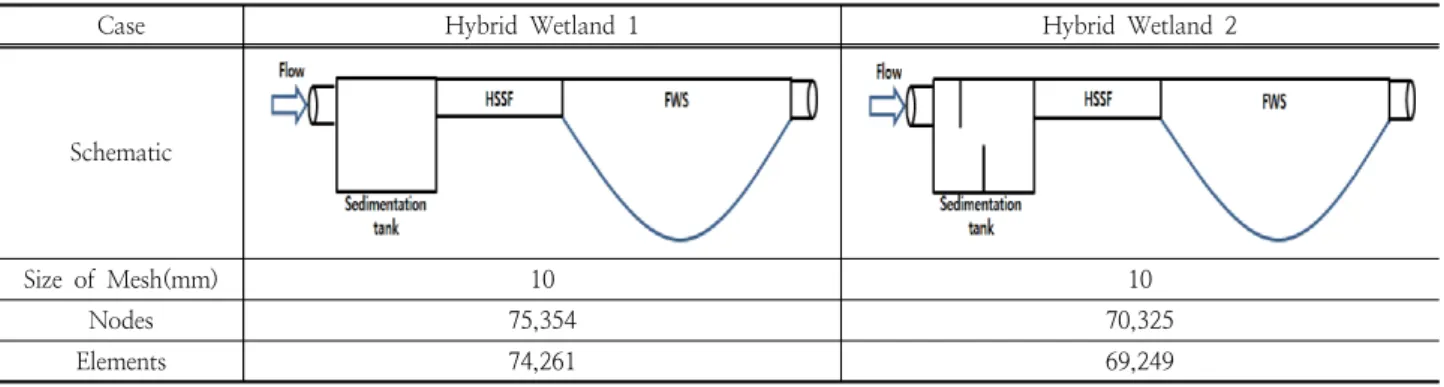
Using the optimal position and installation angle of baffles derived from applying CFD to the hybrid wetlands, the velocity of water and concentration of pollutants were simulated. Table 2 shows the two hybrid constructed wetlands with and without baffles. Numerical simulations were performed to obtain the flow velocity of water and concentration of pollutants for each case. The boundary conditions were the same as those applied in the prior baffle installation (Section 2.1).
3. Results and Discussion
3.1 Change in Flow Velocity in Relation to Baffle Installation
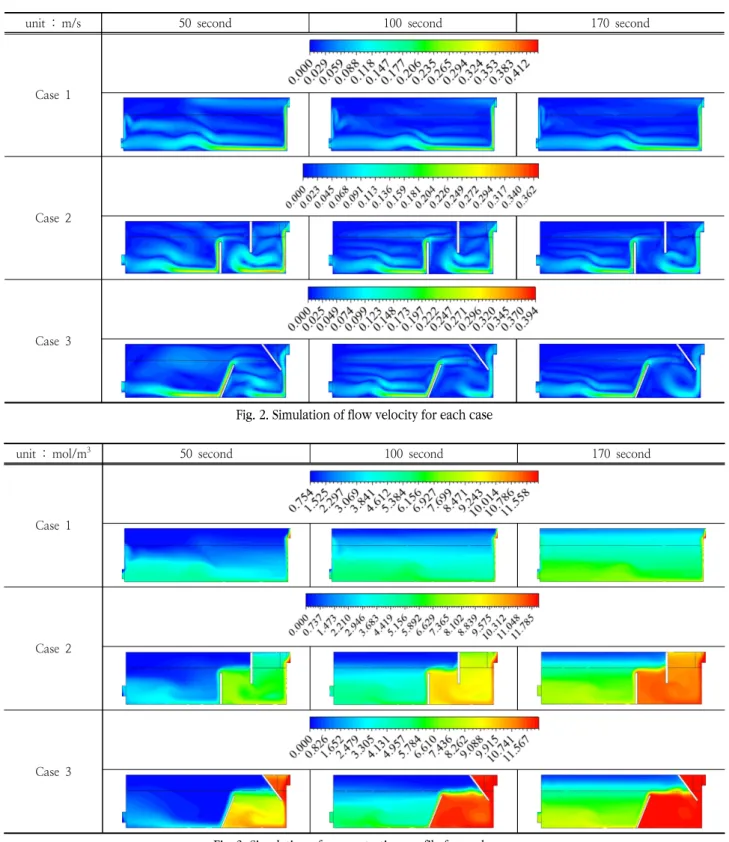
In general, gravity causes particulate matter to settle, and sedimentation velocity is affected by fluid viscosity, flow velocity, particle size and density. Sedimentation is greatly influenced by the flow velocity of water, and there tends to be less sedimentation at higher velocity. Fig. 2 shows the velocity profiles for hybrid wetlands in relation to the presence of baffles and installation angle. Compared to Case 1 without any baffles, Case 2 and Case 3 had slower flow velocities.
The outlet flow velocity of Case 1 was in the range of 0.088~0.118 m/s, but this fell to 0.048~0.093 m/s and 0.058~0.099 m/s for Case 2 and Case 3 respectively. The flow velocity decreased by 33% for Case 2 and 25% for Case 3. As shown in the simulation of flow velocity at 170 seconds in Fig. 2, the decrease in flow velocity is caused by eddy currents generated by the blocking of influent water by the baffles. The blocking from the baffles lowers the flow velocity of the water, and ultimately has a positive effect on particle sedimentation. The excessive blocking in Case 3 interferes with flow during heavy rain and may lead to flooding. As such, the concentration of particulate matter must be considered to ensure adequate flow velocity when designing sedimentation basins.
Table 1. Schematic of sedimentation and baffle for CFD simulation
Case Case 1: No baffle Case 2: Vertical baffles Case 3: Angles baffles
Sche- matic
Mesh
Size of Mesh(mm) 10 10 10
Nodes 11,328 10,361 10,462
Elements 11,066 10,100 10,206
Table 2. Schematic of Hybrid Wetlands and baffle for CFD simulation
Case Hybrid Wetland 1 Hybrid Wetland 2
Schematic
Size of Mesh(mm) 10 10
Nodes 75,354 70,325
Elements 74,261 69,249
3.2 Sedimentation Characteristics of Particles in Relation to Baffle Installation
To analyze the sedimentation characteristics of particles in relation to baffle installation, numerical simulations were performed using CFD. Fig. 3 shows the movement and changes of particles over time. The concentration of particles at the outlet was 3.481~6.681 mol/m3 for Case 1,
2.210~2.946 mol/m3 for Case 2 with vertical baffles, and 2.671~3.531mol/m3 for Case 3 with baffles installed at different angles. Case 2 and Case 3 exhibited higher sedimentation efficiency with most large particles settling, due to the blocking effect the baffles have on particulate matter entering through the inlet. Case 3 was expected to have higher sedimentation efficiency than Case 2 with the baffle at 60° preventing particles from overflowing, but had
unit : m/s 50 second 100 second 170 second
Case 1
Case 2
Case 3
Fig. 2. Simulation of flow velocity for each case
unit : mol/m3 50 second 100 second 170 second
Case 1
Case 2
Case 3
Fig. 3. Simulation of concentration profile for each case
a higher concentration than that of the tank with vertical baffles. The baffle at an angle of 60° generated eddy currents that caused sediments to float. Based on these results, we can see that baffles are effective in facilitating sedimentation of particles in sedimentation tanks, and that vertical baffles are better than angled baffles.
3.3 Application of CFD to Design High-Efficiency Hybrid Constructed Wetlands
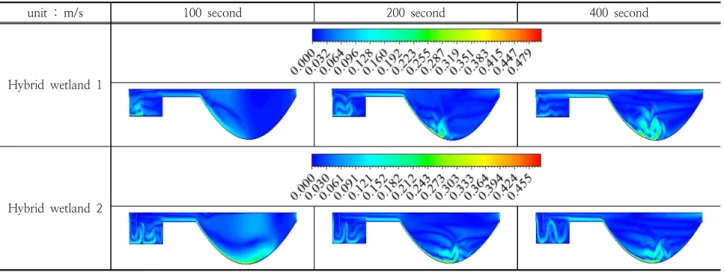
CFD was found to be highly efficient for the optimal design of baffles to facilitate the sedimentation of particles in sedimentation basins. CFD analysis was performed to improve the treatment of runoff in the hybrid constructed wetlands. Because the hybrid constructed wetland does not contain baffles in the sedimentation basin, two hybrid wetlands with vertical baffles (hybrid wetland 1) and angled baffles (hybrid wetland 2) were used in CFD simulations to examine the flow velocity of water and changes in the concentration of particles. Fig. 4 presents the results of CFD
simulations for water flow in the hybrid wetlands. Hybrid Wetland 2 with vertical baffles reduced the flow velocity of water by 10~30% compared to Hybrid Wetland 1. Fig. 5 shows the changes in concentration of particles in the two hybrid wetlands. Hybrid Wetland 2 with vertical baffles had a higher removal efficiency by 30~40% compared to Hybrid Wetland 1
4. Conclusion
Constructed wetlands are facilities that remove sediments, nutrients and organic matter based on biochemical and physical pollutant reduction mechanisms. The early removal of particles is important to maintain wetland efficiency.
When designing constructed wetlands, special considerations must be given to sedimentation basins, which function as a pre-treatment facility for the removal of sediments and pollutants. However, many constructed wetlands overlook the function of sedimentation basins, thus lowering the
unit : m/s 100 second 200 second 400 second
Hybrid wetland 1
Hybrid wetland 2
Fig. 4. Velocity profile for a hybrid wetland
unit : mol/m3 100 second 200 second 400 second
Hybrid wetland 1
Hybrid wetland 2
Fig. 5. Concentration profile for a hybrid wetland
overall efficiency and causing difficulties in maintenance.
Therefore, this study applied CFD to improve the sedimentation efficiency of sedimentation basins in constructed wetlands and to ensure the high efficiency of hybrid constructed wetlands. Baffles were installed to improve sedimentation efficiency, and the following conclusions were derived.
∙Optimal positions and shapes of the baffles were derived by applying CFD to analyze the flow of water and particles in sedimentation basins.
∙A CFD-based analysis of flow velocity in sedimentation tanks with and without baffles showed that baffles contributed to higher sedimentation efficiency by lowering the flow velocity of water. Vertical baffles decreased the average flow velocity by 33%, and were more efficient than inclined baffles since they generated less eddy currents.
∙The installation of vertical baffles in hybrid constructed wetlands, aimed at reducing non-point source pollutants in urban runoff, lowered the flow velocity of water by 10~30%. This decrease in flow velocity influenced the overall removal of pollutants, and hybrid constructed wetlands with baffles achieved a higher removal efficiency by 30~40% than those without baffles.
Acknowledgment
This study was supported by research funds from the Water Management Research Project (12 Technology Innovation C04) of the Ministry of Land, Infrastructure and Support.
References
Cho, Y.J., Lee, J.H., Bang, K.W., and Choi, C.S (2007). “Water quality and particle size distributions of bridge road runoff in storm event”, Environmental Engineering Research (EER), 29(12), 1353-1359.
Hwang, W.C., Bak, J.G., Kim, H.S., Lee, K.H., and Cho, J.S.
(2014). “Study on CFD Methodology for a Open Channel Type UV Reactor”, The KSFM J. of Fluid Machinery, 18(2), 54-59. [Korean Literature]
Kim, L.H., Lee, S.Y. and Min, K.S. (2008). “The 21st sustainable environmental policies for protecting the water quality and
aquatic ecosystems”, J. of Wetlands Research, 10(2), 53-66. [Korean Literature]
Kim, D.G., Kim, S.M., and Park, W.C. (2010). “Numerical analysis of flow and settling efficiency in a sedimentation basin”, J. of Korean Society of Water and Wastewater, 24(6): 713-722. [Korean Literature]
Koskiaho J. (2003). “Flow velocity retardation and sediment retention in two constructed wetland-ponds”, Ecologic.
Eng, 19(5): 325-337.
Lee, J.Y., Kang, C.G., and Gorme, J.B., Kim, S.S., and Kim, L.H.
(2011). “Development of Small HSSF Constructed Wetland for Urban Green space”, J. of Wetlands Research, 13(2), 199-208. [Korean Literature]
Lee, K.S. and Kim, S.H. (2004). “Estimation of Settling Efficiency in Sedimentation Basin Using Particle Tracking method”, Water engineering research, 37(4): 293-304.
[Korean Literature]
Lee, S.Y., Maniquiz-Redillas, M.C., Choi, J.Y. and Kim, L.H.
(2009). “Determination of EMCs for rainfall ranges from transportation land uses”, J. of Wetlands Research, 11(2):
67-76. [Korean Literature]
MOE (Ministry of Environment) (2014). “The Manual for Installation and Management of Nonpoint Source Control facilities”, 86-110. [Korean Literature]
Moon, S.Y. (2015). “Development and Performance Assessment of an Infiltration Planter for Roof Runoff Management”, Master’s Thesis of Kongju National University, Cheonan, South Korea. [Korean Literature]
Schamber, D.R. and Larock, B.E. (1981). “Numerical analysis of flow in sedimentation basins”, J. of Hydraulic Division, ASCE, 107(5): 575-591.
Stovin, V.R. and Saul, A..J. (1998). “A computational fluid dynamics(CFD) particle tracking approach to efficiency prediction”, Water Science and Technology, 37(1):
285-293.
US EPA (Environmental Protection Agency) (2000).
“Wastewater Technology Fact Sheet Free Water Surface Wetlands”, EPA 832-F-00-024.
Yang, W.Y. (2003). “Modeling on the Inclination Plate Settler Stick Fin”, Korean Association of Cadastre Information, 5, 139-149 [Korean Literature]
Yu, K.K. (2015). “Development and Performance Assessment of a Bioretention Technology Treating Urban Stormwater Runoff”, Master’s Thesis of Kongju National University, Cheonan, South Korea. [Korean Literature]