308
한국표면공학회지 J. Kor. Inst. Surf. Eng.
Vol. 41, No. 6, 2008.
<연구논문>
Characteristics of Oxide Layers Formed on Al2021 Alloys by Plasma Electrolytic Oxidation in Aluminate Fluorosilicate Electrolyte
Kai Wang
a, Bon Heun Koo
a*, Chan Gyu Lee
a, Young Joo Kim
a, Sunghun Lee
b, Eungsun Byon
ba
School of Nano & Advanced Materials Engineering, Changwon National University, Changwon 641-773, Korea
b
Surface Technology Research Center, Korea Institute of Materials Science, Changwon 641-010, Korea
(Received November 17, 2008 ; revised December 16, 2008 ; accepted December 30, 2008)
Abstract
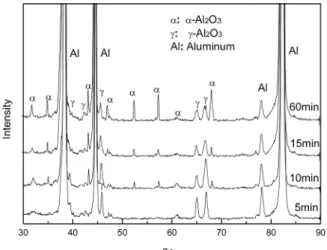
Oxide layers were prepared on Al2021 alloys substrate under a hybrid voltage of AC 200 V (60 Hz) combined with DC 260 V value at room temperature within 5~60 min by plasma electrolytic oxidation (PEO). An optimized aluminate-fluorosilicate solution was used as the electrolytes. The surface morphology, thickness and composition of layers on Al2021 alloys at different reaction times were studied. The results showed that it is possible to generate oxide layers of good properties on Al2021 alloys in aluminate-fluorosilicate electrolytes. Analysis show that the double-layer structure oxide layers consist of different states such as α-Al
2O
3and γ-Al
2O
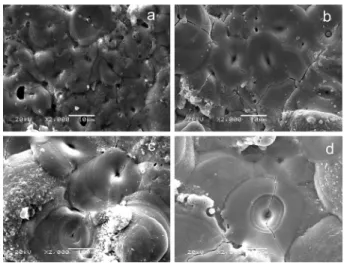
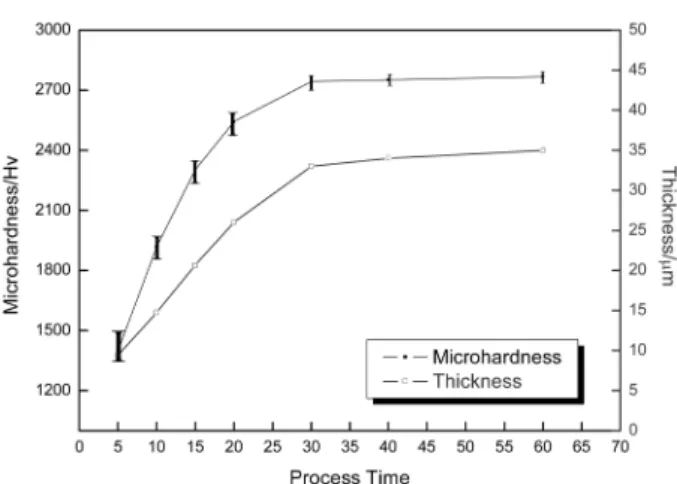
3. For short treatment times, the formation process of oxide layers follows a linear kinetics, while for longer times the formation process slows down and becomes a steady stage. During the PEO processes, the average size of the discharge channels increased gradually as the PEO treatment time increased.
Keywords: Plasma electrolytic oxidation, Al2021 Alloy, Aluminate fluorosilicate electrolyte, Oxide layer
1. Introduction
High strength aluminum alloys are widely used in automotive and aircraft industries, which allow reducing significantly the weight of the engineering constructions. In these fields, very often the main requirements for the components include high fatigue, corrosion and wear resistance. The first requirement is achieved usually by a proper material selection.
For example, 2021 is an aluminum alloy, with copper and magnesium as the alloying elements, which is used in applications requiring high strength to weight ratio, as well as good fatigue resistance. Due to poor corrosion resistance, it is often clad with zinc or silver for protection, although this will reduce the fatigue strength
1). Traditional anodizing process is another classical approach to increase the tribological properties of aluminum alloys. The process running at low temperature allows formation of a thick and
strongly adherent oxide layer with high hardness
2). However, the coating brittleness and the cracks induced during the anodizing process also will reduce the fatigue strength of the hard-anodized components
3).
The novel electrochemical surface treatment process, plasma electrolytic oxidation (PEO), has been proved an effective surface protection technique to produce oxide layers on Al alloys with high tribological properties. It is reported
4,5)that the PEO layer may cause no more than 10% reduction in fatigue limit of magnesium and aluminum alloys, which is substantially lower than the effect of anodizing. One of the most important factors affecting the fatigue strength of PEO layers is the internal residual stress. It is recognized that the compressive residual stresses retard the fatigue crack initiation in the layer and therefore the fatigue life of the coated components increases
6). Further researches showed that the PEO oxide layers offered attractive combination of wear resistance, corrosion resistance, mechanical strength, interfacial
*