인삼의 재식위치와 생육시기에 따른 생육특성 및 진세노사이드 함량 변화
권순구*·이충열*†·오동주*·이관영*·차선우**·이성우**
*부산대학교 생명자원과학대학, **농촌진흥청 원예특작과학원
Changes of Growth Characteristics and Ginsenoside Content by Growth Stages and Different Planting Position in Panax ginseng C.A. Meyer
Soon Goo Kwon*, Chung Yeol Lee*†, Dong Joo Oh*, Guan Ying Li*, Sun Woo Cha** and Seong Woo Lee**
*
Natural Resources & Life Science, Pusan Natl. Univ., Miryang 627-906, Korea.
**
Department of Herbal Crop Research, NIHHIS, RDA, Eumseong 369-873, Korea.
ABSTRACT : This study was conducted to investigate the effect of planting position on the growth characteristics, yield and ginsenoside content in Panax ginseng C.A. Meyer at different growth stages. Referring to shoot growth characteristics, stem length, stem diameter and leave area were higher at front than rear, increasing as the proceeding of growth stages. But a lower chlorophyll contents was caused at front compared to rear and decreased as the proceeding of growth stages contrar- ily. According to root characteristics, root length and main body length were higher at front, with a positive correlation to growth stages, which was also shown on fresh root weight and dry root weight with the maximum in August. Meanwhile, the effect of planting position on ginsenoside content could also be definite by the highest content at front showing high light intensity, increasing as the proceeding of growth stages as well.
Key Words : Panax ginseng, Planting Positions, Growth Stages, Root, Ginsenoside
INTRODUCTION
As a cool-season plant preferred to low temperature and light, Panax ginseng C.A. Meyer were cultivated in the inclined shading installation with high front and low rear.
So, the difference of ginseng growth environment came out according to the different planting positions (Kim et al ., 1982; Lee et al ., 1980, 1982; Park et al ., 1979) because the influent light intensities were different by this inclined structure (Kim et al ., 1982; Lee et al ., 1987). Especially, light saturation point of ginseng leave commonly increased to 22,000 lux in low temperature such as 15 ℃ , as reported before, and the optimum light of photosynthetic rate changed as the different temperatures by 11,000 lux at 20 ℃
and 9,500 lux at 25 ℃ as the optimum level, which also different among growth stages (Lee et al ., 1982; Jo et al ., 1985). Leaves photosynthesis cultivated at different light condition were different (Lee et al ., 1982) because light saturation point of leaves cultivated at front showing high
light was 10,000 lux but that at rear was 4,000 lux. Thus, we considered that ginsenoside as the important pharma- cological ingredient would also be affected as well by the different light condition. Meanwhile, ginsenoside content fluctuated strikingly according to the different climatic and cultivating environment (Kim et al ., 2009; Lee et al ., 2009;
Lee et al ., 2007; Lee et al ., 1987) and growth stages (Choi
et al ., 2009). Therefore, this study was practiced to investigate the characteristics of growth and ginsenoside content according to different planting positions at different growth stages.
MATERIALS AND METHODS
1. Variety and Cultivation
one-year-old domestic variety of Panax ginseng obtained from ginseng elite farmers were cultivated at Pusan National University's farmland (Bubukmyeon in Miryang city) in 2008. Decomposed compost (grass 70% + sawdust 20% +
†
Corresponding author: (Phone) +82-55-350-5503 (E-mail) [email protected]
Received 2010 January 21 / 1st Revised 2010 February 4 / 2nd Revised 2010 February 11 / Accepted 2010 February 16
manure10%) was completely manured by 2,000 ㎏ /10a and manufactured the furrows and ridges (height 25 ㎝ , width 90 ㎝ ) after mixing by rotary. Ginseng seedlings were planted at 15 ㎝ distance by ginseng transplanter, followed by covering over bed soil with rice straw to prevent from weeds and water evaporation. Gin- seng administrative standard established by Rural Develop- ment Administration was followed as well.
2. Shade material and plant density
Shade material was adopted to silver-coated shade plate by near-line form with front height at 180 ㎝ and rear height at 100 ㎝ . Planting density was 54 seedlings (6 lines
× 9 rows) every experiment plot (180 × 180 ㎝ ).
3. Investigation of growth characteristics
Three-year-old ginseng growing normally was sampled in June, July and August to investigate the growth characteristics of shoot and root, respectively. Leave area by area determinator LI-3100, Chlorophyll content as SPAD value by SPAD 502 (Minolta) for 3 times. Stem length from rhizome top to petiole bottom, and stem width at the widest part of stem were measured by vernier caliper.
According to root characteristics, root length from rhizome bottom to the end of root, and main body length from rhizome bottom to the beginning of supporting root, and root diameter at the widest part of main body by vernier caliper, were measured too. Fresh weight was measured after ginseng washed and dried with absorbent paper without peeling, followed by dry weight measure after drying for 7days at 50.
4. Ginsenoside analysis
High Performance liquid chromatography (HPLC) with
Perkin elmer series 200 Pump, Peltier column oven, UV/
VIS Detector, Vacuum Degasser, Column by ZORBAX Eclipse XDB-C18 (4.6 × 150 ㎜ , 5 ㎛ ) was linked to Series 600 LINK. All of the reagents such as H
2O, CH
3CN, CH
3OH were Burdick & Jackson products of SK Chemical (HPLC grade) and the standard used in HPLC analysis were products of Sigma (USA) and Extrasynthese (France).
Samples after growth characteristics investigation were dried to crush into powder, recirculation cooling in 70% methanol, separating by Di-ethylether and 1-butanol, measuring by HPLC.
RESULTS AND DISCUSSION
1. Growth characteristics of shoot by planting positions at different growth stages
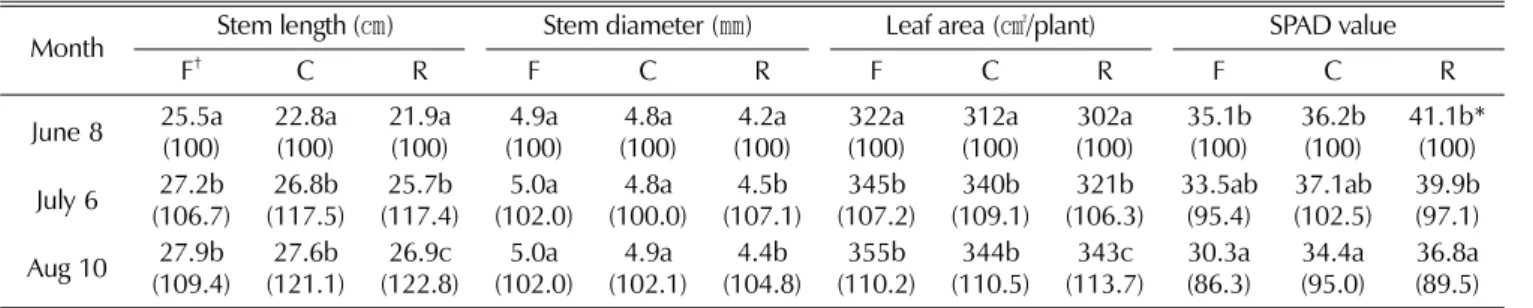
Referring to Table 1. as growth characteristics of shoot by planting positions at different growth stages, stem length were longer at front to center and rear by 25.5 ㎝ , 27.2 ㎝
and 27.9 ㎝ at growth beginning in June, July, and August, respectively and stem diameter were 4.9 ㎜ , 5.0 ㎜ , and 5.0 ㎜ at front in different growth stages, which were thicker than that at center and rear. According to Cheon et al., (1991), stem length and stem diameter of 2-year-old and 4-year-old ginseng were decreased as PAR decreasing, meanwhile, we found the report in Choi et al ., (1980) that stem length and stem diameter of 3-year-old ginseng was fine at center, different to our result that those were better at front with higher PAR, which is considered to be caused by the lower temperature and higher PAR by silver-coated shading plate compared to polyethylene shade net (Lee et al ., 2007), so it is better to ginseng growth at front with higher PAR. Leave area were also larger at front by 322 ㎠ , 345 ㎠ , and 355 ㎠ at different growth stages.
Table 1.
Growth characteristics of shoot by planting positions at different growth stages.
Month Stem length (
㎝) Stem diameter (
㎜) Leaf area (
㎠/plant) SPAD value
F
†C R F C R F C R F C R
June 8 25.5a
(100) 22.8a
(100) 21.9a
(100) 4.9a
(100) 4.8a
(100) 4.2a
(100) 322a
(100) 312a
(100) 302a
(100) 35.1b
(100) 36.2b
(100) 41.1b*
(100) July 6 27.2b
(106.7) 26.8b
(117.5) 25.7b
(117.4) 5.0a
(102.0) 4.8a
(100.0) 4.5b
(107.1) 345b
(107.2) 340b
(109.1) 321b
(106.3) 33.5ab
(95.4) 37.1ab
(102.5) 39.9b (97.1) Aug 10 27.9b
(109.4) 27.6b
(121.1) 26.9c
(122.8) 5.0a
(102.0) 4.9a
(102.1) 4.4b
(104.8) 355b
(110.2) 344b
(110.5) 343c
(113.7) 30.3a
(86.3) 34.4a
(95.0) 36.8a (89.5)
* Mean with same letters are not significantly different in DMRT (p < 0.05)
†
F: front, C: center, R: rear
SPAD value were 35.1, 36.2, and 41.1 in June, 33.5, 37.1, and 39.9 in July, 30.3, 34.4, and 36.8 in August at front, center and rear, respectively, which was corresponding to that SPAD value decreased when light intensity increased (Jo et al ., 1986; Park et al ., 1987). This result was similar to that of our study.
2. Growth characteristics of root by planting positions at different growth stages
As growth characteristics of root by planting positions at
different growth stages, root length were longer at front to center and rear by 24.0 ㎝ , 25.2 ㎝ and 27.1 ㎝ at growth beginning in June, July, and August, respectively and root diameter were 12.4 ㎜ , 14.3 ㎜ , and 16.6 ㎜ at front in different growth stages, which were thicker than that at center and rear. It was almost the same with growth characteristics of shoot that those was better at front than those at rear. Also, referring to Table 3, fresh root weight were shown that front > center > rear by 9.9 g, 14.2 g, and 18.1 g at front in different growth stages, same to dry root
Table 2.
Growth characteristics of root by planting positions at different growth stages.
Month Root length (
㎝) Root trunk (
㎝) Root diameter (
㎜)
F
†C R F C R F C R
June 8 24.0a
(100) 23.0a
(100) 20.8a
(100) 10.2a
(100) 10.0a
(100) 9.3a
(100) 12.4a
(100) 12.1a
(100) 12.5a*
(100) July 6 25.2b
(105.0) 24.8b
(107.8) 24.1b
(115.9) 11.5b
(112.7) 10.6b
(106.0) 9.6b
(103.2) 14.3b
(115.3) 13.3b
(109.9) 13.9b (111.2) Aug 10 27.1c
(112.9) 26.7c
(116.1) 26.4c
(126.9) 11.4b
(111.8) 10.9b
(109.0) 11.5c
(123.7) 16.6c
(133.9) 15.7c
(129.8) 15.1c (120.8)
* Mean with same letters are not significantly different in DMRT (p < 0.05)
†
F: front, C: center, R: rear
Table 3.
Root weight by planting positions at different growth stages.
Month Root weight (g) Dry root weight (g)
F
†C R F C R
June 8 9.9a
(100) 8.9a
(100) 8.2a
(100) 3.0a
(100) 2.7a
(100) 2.6a*
(100)
July 6 14.2b
(143.4) 11.4b
(128.1) 11.8b
(143.9) 3.5b
(116.7) 3.2b
(118.5) 3.3b
(126.9)
Aug 10 18.1c
(182.8) 16.0c
(179.8) 15.9c
(193.9) 4.8c
(160.0) 4.0c
(148.1) 4.0c
(153.8)
* Mean with same letters are not significantly different in DMRT (p < 0.05)
†
F: front, C: center, R: rear
Table 4.
Ginsenoside characteristics by planting positions at different growth stages.
Month Line Rb1 Rb2 Rb3 Rc Rd Re Rf Rg1 Rg2 Rg3 Rh1 Rh2 Total
June 8 F
†0.23a 0.05b 0.01a 0.11a 0.06a 0.27a 0.10a 0.34a 0.03a 0.04a 0.01
−1.25a*
C 0.17b 0.13a 0.02a 0.15a 0.08a 0.25a 0.05a 0.20b 0.01a 0.01a
− −1.07b R 0.16b 0.09a 0.01a 0.11a 0.07a 0.28a 0.05a 0.17b 0.02a 0.02a
− −0.98b July 6 F 0.24a 0.13a 0.02a 0.16b 0.10a 0.21b 0.11a 0.39a 0.04a 0.06a 0.01
−1.47a C 0.25a 0.17a 0.02a 0.28a 0.14a 0.32a 0.08a 0.21b 0.03a 0.01a
− −1.51a R 0.21a 0.11a 0.02a 0.17b 0.12a 0.27ab 0.08a 0.24b 0.03a 0.04a
−0.01 1.30b Aug 10 F 0.36a 0.17a 0.03a 0.17b 0.25a 0.40a 0.15a 0.50a 0.04a 0.08a 0.01
−2.16a C 0.27b 0.21a 0.03a 0.24a 0.15b 0.38a 0.09a 0.29b 0.03a 0.06a
− −1.75b R 0.25b 0.16a 0.02a 0.18b 0.21a 0.42a 0.08a 0.25b 0.03a 0.07a
−0.01 1.68b
* Mean with same letters are not significantly different in DMRT (p < 0.05)
†
F: front, C: center, R: rear
weight, which was also reported by Choi et al., (1980) and Lee et al. , (1983) that root weight was increased at front position.
3. Ginsenoside characteristics of root by planting positions at different growth stages
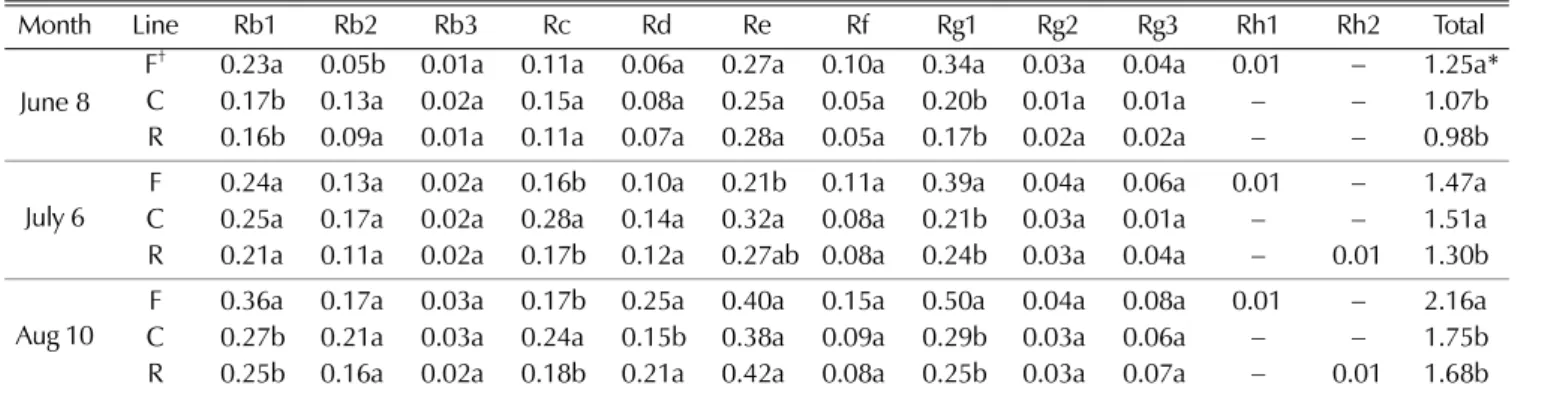
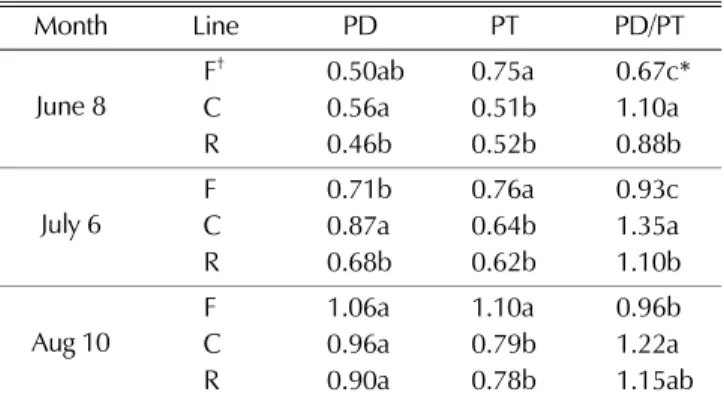
Ginsenoside characteristics of root by planting positions at different growth stages as Table 4 showed that the total content increased as growth stages proceeding by were 1.25%, 1.07%, and 0.98% in June, 1.47%, 1.51%, and 1.30% in July, 2.16%, 1.75%, and 1.68% in August at front, center and rear, respectively. Ginsenoside content changed by harvest times (An et al ., 2002) and it also showed difference by a variety of light intensity (Lee et al ., 1983; Cheon et al ., 1991). In this study, ginsenoside content were changed according to different planting positions in which inflowed light were different as well. PD/PT rate at front, center, and rear were 0.67, 1.10, and 0.88 in June, 0.93, 1.35, and 1.10 in July and 0.96, 1.22, and 1.15 in August, respectively, which revealed the same tendency with that PD/PT rate was lower in high light intensity (Cheon et al ., 1991).
ACKNOWLEDGEMENTS
This work was supported for two years by Pusan National University Research Grant.
LITERATURE CITED
An YN, Lee SY, Choung MG, Choi KJ and Kang KH. (2002).
Ginsenoside concentration and chemical component as affected by harvesting time of four-year ginseng root. Korean Journal of Crop Science. 47:216-220.
Cheon SK, Mok SK and Lee SS. (1991). Effect of light intensity and quality on the growth and quality of Korean ginseng (
Panax ginsengC.A. Meyer) III. Effects of light intensity on the quality of ginseng plant. Journal of Ginseng Research.
15:144-151.
Choi KT, Ahn SD and Shin HS. (1980). Variation of agronomic characters in ginseng plants cultivated under different planting position. Korean Journal of Breeding Science. 12:116-123.
Choi JE, Li X, H YH and Lee KT. (2009). Changes of saponin contents of leaves, stems and flower-buds of
Panax ginsengC.A. Meyer by harvesting days. Korean Journal of Medicinal Crop Science. 17:251-256.
Cheon SK, Mok SK, Lee SS and Shin DY. (1991). Effects of light intensity and quality on the growth and quality of korean ginseng (
Panax ginsengC.A. Meyer) I. Effects of light intensity on the growth and yield of ginseng plants. Journal of Ginseng Research. 15:21-30
Jo JS, Won JY and Mok SK. (1986). Studies on the photosynthesis of Korean ginseng III. Effects of the light transparent rate of shading on the photosynthesis ability of Korean ginseng plant (
Panax ginsengC.A. Meyer). Korean Journal of Crop Science. 31:408-415.
Jo JS, Mok SK and Won JY (1985). Studies on the leaf characteristics and the photosynthesis of korean ginseng. II.
Seasonal changes of photosynthesis of 4-year old ginseng (
Panax ginsengC.A. Meyer) Korean Journal of Crop Science.
30:398-404.
Kim JM, Lee SS, Cheon SR and Cheon SK. (1982).
Relationship between environmental conditions and the growth of ginseng plant in field I. Productive structures as affected by planting positions and ages. Korean Journal of Crop Science.
27:94-98.
Kim MJ, Li X, Han JS, Lee SE and Choi JE. (2009). Effect of blue and red LED irradiation on growth characteristics and saponin contents in
Panax ginsengC.A. Meyer. Korean Journal of Medicinal Crop Science. 17:187-191.
Lee JC, Choi JH, Cheon SK, Lee CH and Jo JS. (1983).
Studies on the optimum light intensity for growth of
Panax ginsengII. Effect of light intensity on the contents of saponin and free sugar in the ginseng leaf. Korean Journal of Crop Science. 28:497-503.
Lee CY. (2007). Effects of shading material of rain shelter on growth and quality in
Panax ginsengC.A. Meyer. Korean Journal of Medicinal Crop Science. 15:291-295.
Lee CH, Lee JC, Cheon SK, Kim YT and Ahn SB. (1982).
Studies on the optimum light intensity for growth of
Panax ginsengI. Effects of light intensity on growth of shoots and roots of ginseng plants. Journal of Ginseng Research. 6:38-45.
Lee JC, Cheon SK, Kim YT and Jo JS. (1980). Studies on the effects of shading materials on the temperature, light intensity, photosynthesis and the root growth of the Korean ginseng (
Panax ginsengC.A. Meyer). Korean Journal of Crop Science.
25:91-98.
Lee MK, Park H and Lee CH. (1987). Effect of growth
Table 5.
PD/PT ratio of ginsenoside by planting positions at different growth stages.
Month Line PD PT PD/PT
June 8 F
†0.50ab 0.75a 0.67c*
C 0.56a 0.51b 1.10a
R 0.46b 0.52b 0.88b
July 6 F 0.71b 0.76a 0.93c
C 0.87a 0.64b 1.35a
R 0.68b 0.62b 1.10b
Aug 10 F 1.06a 1.10a 0.96b
C 0.96a 0.79b 1.22a
R 0.90a 0.78b 1.15ab
* Mean with same letters are not significantly different in DMRT (p < 0.05)
†
F: front, C: center, R: rear
conditions on saponin content and ginsenoside pattern of
Panax ginseng. Journal of Ginseng Research. 11:233-251.
Lee SS, Kim JM, Cheon SK and Kim YT. (1982). Relationship between environmental conditions and the growth of ginseng plant in filed II. Light intensity under shading material and photosynthesis. Korean Journal of Crop Science. 27:169-174.
Lee SW, Kim GS, Lee MJ, Hyun DY, Park CG, Park HK and Cha SW. (2007). Effect of blue and yellow polyethylene shading net on growth characteristics and ginsenoside contents in
Panax ginsengC.A. Meyer. Korean Journal of Medicinal Crop Science. 15:194-198.
Lee SW, Kim GS, Yeon BY, Huun DY, Kim YB, Kang SW and Kim YC. (2009). Comparison of growth characteristics and ginsenoside contents by drainage classes and varieties in 3-year-
old ginseng (
Panax ginsengC.A. Meyer). Korean Journal of Medicinal Crop Science. 17:346-351.
Li X, Nam KY and Choi JE. (2009). Difference of the ginsenosides contents according to the planting location in
Panax ginseng
C.A. Meyer. Korean Journal of Crop Science.
54:159-164.
Park H, Jong HY, Jeung SB and Byung GC. (1987). Effect of growth light and planting density on yield and quality of
Panaxginseng