• 검색 결과가 없습니다.

Study on the Development of Convergence Class Model about Marketing and Business English in Mongolia University

N/A
N/A
Protected

Academic year: 2021

Share "Study on the Development of Convergence Class Model about Marketing and Business English in Mongolia University"

Copied!
7
0
0

로드 중.... (전체 텍스트 보기)

전체 글

(1)

Vol. 19, No. 10 pp. 610-616, 2018

Study on the Development of Convergence Class Model about Marketing and Business English in Mongolia University

Natsagdorj Bayarmaa, Keunsoo Lee

*

Dept. of Computer Science and Engineering (Computer System Institute) Hankyong National University

몽골 대학에서 상업영어와 마케팅 교과간 융합수업 모형 개발에 관한 연구

바야르마, 이근수*

한경대학교 컴퓨터공학과

Abstract A variety of creative convergence education studies have been conducted around the world, but the study of creative convergence education based on problem-oriented learning is insignificant. STEAM education development research for engineering human resources also recognizes important factors like ethics awareness and consideration, cooperation, leadership, and communication skills. This study developed a model of interdisciplinary classes between marketing and commercial English classes as a way to effectively learn to cultivate the creative and fusion talents required by modern society. A model was developed for the process of convergence classes to be developed for evaluation after class by designing courses, selecting subjects, designing classes, drawing questions, and developing problems, as well as for discussion of pre-convergence courses, class performance, and class evaluation. The Mongolian university discussed in this paper plans to introduce a suitable educational environment by developing a problem for interdisciplinary classes in marketing and business English. Based on the need to nurture talent required by the rapidly changing knowledge-based society, Mongolian universities should continue the strategy of fostering creative convergence talent through the convergence of technology. This is because creativity is the most important thing in the current situation.

요 약 세계적으로 다양한 창의융합교육 연구가 이루어지고 있으나, 문제중심학습 바탕으로 한 창의융합교육의 연구는 미미 한 실정이다. 공학적 인재양성을 위한 STEAM 교육 개발연구에서도 윤리의식 및 배려심, 협동심, 리더십, 소통 능력 등 인성 적 요소를 중요하게 인식하고 있다. 본 연구는 현대 사회에서 요구하는 창의 융합형 인재를 양성하기 위하여 효율적으로 학습할 수 있도록 하기 위한 방안으로 마케팅과 상업영어 교과간 융합 수업 모형을 개발하였다. 융합 수업의 과정에 대한 모형을 개발하여 수업과정 관련 교과 선정, 주제 선정, 수업설계, 수업 지도안 작성 및 문제 개발, 융합 수업 전 과정에 대한 논의, 수업 실행, 수업 평가의 단계를 설계하여 수업이 진행된 후 평가를 하였다. 마케팅과 상업영어 교과간 융합 수업을 위한 문제를 개발하여 몽골 대학에서 적합한 교육 환경을 도입하고자 한다. 빠르게 변화하고 있는 지식기방 사회에 요구하는 인재를 양성시키길 필요성에 따라 과학 기술의 융합을 통해 창의적 융합인재를 양성한다는 전략이 몽골대학에서도 계속 이 루어져야 한다. 현재 상황에서 무엇보다 "창의력"이 강조되고 있기 때문이다.

Keywords : convergence education, creativity, creative convergence talent, problem-oriented learning, STEAM

*
Corresponding Author : Keunsoo Lee(Hankyong National Univ) Tel: +82-31-670-5161 email: [email protected]

Received September 18, 2018 Revised October 1, 2018

Accepted October 5, 2018 Published October 31, 2018

(2)

1. Introduction

Convergence education creates a natural environment that nurtures integrated STEAM learning, which includes science (S), technology (T), engineering(E), the arts (A) and mathematics (M).STEAM offers a transdisciplinary and platform-enhanced educational process that promotes disciplinary depth and breadth, as well as a common language, across all disciplines.

It helps prepare students for careers that value creativity and innovation[1].

STEAM is an educational approach to learning that uses Science, Technology, Engineering, the Arts and Mathematics as access points for guiding student inquiry, dialogue, and critical thinking. The end results are students who take thoughtful risks, engage in experiential learning, persist in problem-solving[2].

It thrives on hands-on problem solving, critical thinking and communication skills. It also stimulates the discovery, understanding, application, integration, communication of future creations that will impact society, with benefits and risks, and address global challenges.

Dr. Hall then discussed the competencies critical for researchers in areas of convergence, focusing on those that allow for successful and effective outcomes.

•intrapersonal competencies – being able to understand oneself and how one might contribute to a research challenge is important in developing a robust team of researchers who can work with one another; possessing an open mind and being willing to learn and ask questions is also key

•disciplinary awareness and exchange - knowing one’s own field well enough to contribute; this means also being very familiar with and able to evaluate the key assumptions inherent with a discipline. Finally, being able to share and communicate assumptions and knowledge is critical.

•processes of integration – key skills include a spirit of collaboration, the development of shared frameworks with other team members, and being

able to grow/modify the nature of the collaboration (including who comprises the team) as the project progresses

•teamwork/management & leadership – salient points here include being able to build trust among team members and develop effective, open channels of communication in service of facilitating teamwork

•competencies of function – in contrast to disciplinary competencies, this involves being able to ensure that the proposed work gets done and that the knowledge that is generated is disseminated in an effective fashion[1].

2. Main body

2.1 The Critical Importance Of STEAM Education

Science and Technology have, over the last 50 years, become a major part of society and our individual lives. It has single-handedly changed the way we live and has opened up new possibilities for our future as a race that previously deemed impossible.

Accompanying these subjects, other subjects such as Engineering and Maths have also become majorly important for private companies who are developing roles to complete certain jobs, some of which do not even exist yet.

STEAM education has been developed, a term coined by the Rhode Island School of Design, to educate students in the practice of critical thinking.

With the rapid advances in technology, the standard of education has to keep up with the changing and developing times so that students and young people are able to become qualified to a level in which they can fill jobs to continue this increasingly important sector[3].

STEAM education is set up to teach students how to

thinking critically, enabling them to problem solve

effectively and use creative thinking to drive forward

and complete projects using new methods, tried and

(3)

tested solutions and using their own initiatives.

Creative leads manager, Matt Munoz from Big Assignments exclaims, “Some aspects of STEAM learning, especially critical thinking and problem-solving can pose major issues for some students, typically those in the younger years. There are a lot of factors that go into these issues but it always results in them wanting to follow more traditional routes of learning such as learning new languages and learning about history. Although these paths of learning are vital, it does mean that a lot of students feel like they cannot achieve a STEAM style of learning, another obstacle that will need to be overcome if we, as a society, want to progress”. Convergence of knowledge, science, and technology can benefit human society in many significant ways. In a sense, convergence can be viewed as the ultimate grand challenge, which if successfully achieved, can pave the way to achieve the numerous other grand challenges facing society[4].

This is because convergence provides added value and synergistic benefit to human endeavors to:

- Improve wellness and human development - Increase productivity and promote economic

development

- Achieve societal sustainability - Empower individuals and communities - Expand human knowledge and education - Achieve an innovative and equitable society

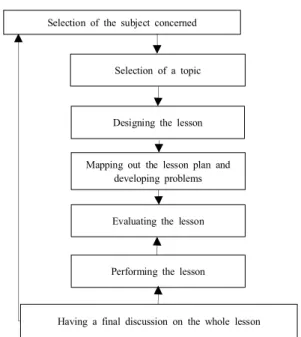
2.2 Developing Convergence Lesson Model This study adopted model of Forgaty which is concluded selection of the subject concerned, selection of topic, designing the lesson, mapping out the lesson plan and developing problems, evaluating the lesson, performing the lesson and having a final discussion on the whole lesson.

Core objectives and content selection, associated learning and practical content, drafting problems, identifying the characteristics of learners, finding the problems, setting up the roles and situation and determining the problem of BPBL is introduced in this

section. The procedures design problem for BPBL is shown in (fig.2) below.

Select the core objectives and content

Core objectives and content of BPBL for Micro-economic subject in Mongolian Universities can be selected. In the process of solving a given problem, learning objectives should be achieved [5]. In this study, learning contents and the suitable BPBL problem is designed[6].

Selection of the subject concerned

Having a final discussion on the whole lesson Selection of a topic

Performing the lesson Designing the lesson

Mapping out the lesson plan and developing problems

Evaluating the lesson

Fig. 1. process of convergence lesson

Fig. 2. The procedures of Convergence Instruction

(4)

To plan associated learning content and practical context

Learner-centered learning is actuated in educational scene all around the world. On the other hand, teaching methods used in Mongolian universities are mostly teacher-centered and passive.

Draft the Problem

The method for distributing a problem falls under three closely related teaching techniques: case studies, role-plays, and simulations. Case studies are presented to students in written form. In role-plays, students improvise scenes based on character descriptions given.

Today, simulations often involve computer-based programs. Regardless of which technique is used, the heart of the method remains the same: a real-world problem.

Identify the learners’ characteristics

Learners need to find and use their own sources of learning. However, at the beginning, tutor can give some information to help the learner to get started is useful.

Find the problem

Real problem development starts from an idea. Ideas can be drawn from current issues and interests of learners’ free imagination. After exploring the possibilities, this idea could be conceptually associated with the main process then link it back to the curriculum and educational content [13].

Set the role and situation

Problems should include the learners who will experience them and situations they are faced. Learners would be active and a positive problem resolvers during this learning process.

Create the problem

Created problem should include specific conditions that learners can solve the problem and review what

they need to do. The problem will be ready after modifications as in writing problem and reviewing. A good problem is related to curriculum and learning objectives.

2.3 Design of Convergence Lesson

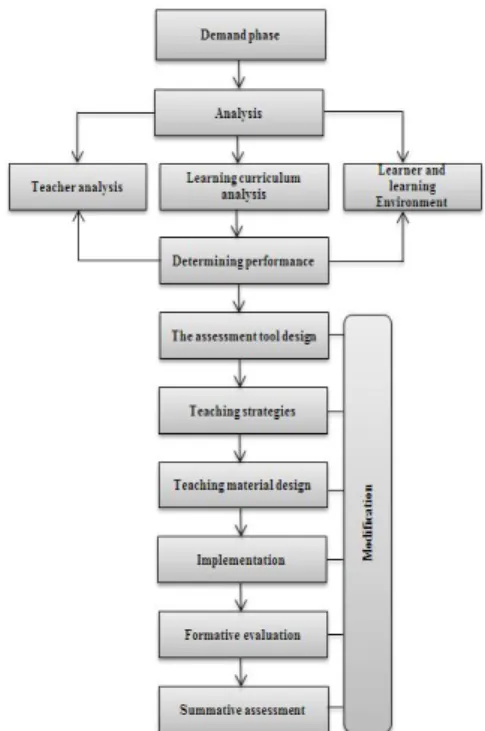
Design of Convergence Lesson had blended PBL is concluded demand phase, analysis, determinig performance, assessment tool design, teaching strategies, teaching material design, Implementation, Evaluation and Modification.

1) Demand phase

Phase to determine disadvantages of Mongolian University changes in teaching and distance learning conditions.

2) Analysis phase Characteristics of learner and teacher, learning environment and learning process will be analyzed.

3) Determining performance objectives. Deciding what the learner has to master after completing the study. Learning objectives should be defined before choosing appropriate courses for lesson.

4) The assessment tool design. Phase to develop assessment tools and items that can determine whether learners achieve learning objectives.

5) Teaching strategies. Teaching method should be determined and various material that is used during class should be prepared to achieve learning objective.

6) Teaching material design. When establishing a plan for PBL, all materials should be prepared for before learning. The materials needed for class refers to all tools of learning and media data to be used for classroom activities.

7) Implementation. Execution of PBL in engineering.

In the implementation phase, learner gains knowledge by self-direct choosing aside from seeing and listening.

8) Formative evaluations. Program is evaluated by

following steps, one to one evaluation, small group

evaluation and on-site evaluation. One-to-one evaluation

is evaluation of learning progress, advantage of

(5)

participation, occurring trouble of individual students compared to one individual student to prescribe for individual students.

9) Summative assessment: Phase determining the result of program's last study. Formative evaluation decides whether study program met the success criteria made at the beginning.

10) Program refining. Refining phase with content made from formative evaluation phase. Refined PBL is an improved method version by combining of self and co-learners evaluation of the program.

Fig. 3. Design of Convergence Lesson

2.4 Lesson Plan and Problem Designing PBL involves the real world problem. An instructor should think of a real, complex issue related to the course content. It’s seldom difficult to identify lots of problems in our fields; the key is writing a problem for students that will elicit the types of thinking, discussion, research, and learning that need to take place to meet the learning outcomes. Problems should be motivating, interesting, and generate good discussion[7].

In designing problems for problem-based learning, one could start off with analyzing student characteristics and students’ learning needs which will shed light on students’ prior knowledge, and which content/context would be familiar to students (this is likely to provide information on problem familiarity, difficulty and relevance), their learning styles (which will provide information for problem format) and comprehension capabilities (which will provide information on problem clarity). Such information needs to be incorporated into the presentation of the problem. Overall, in designing problems for problem-based learning, function characteristics/learning outcomes (not just content but also what behavioral skills, such as self-directed learning, critical thinking) need to be considered and the issues should be framed in the appropriate context and presented using the optimal feature characteristics/user interface.

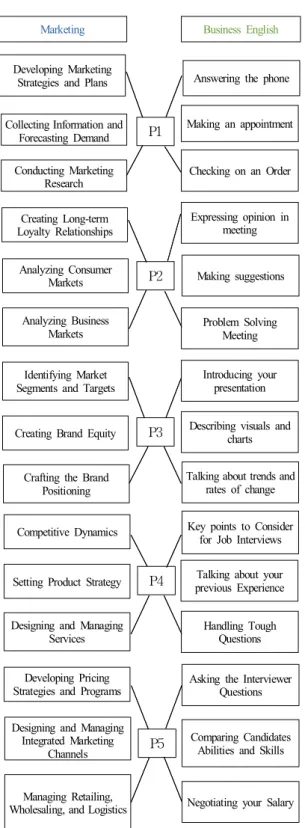
Essentially, the steps in designing problems are similar to writing a story[8]. Problems developed by analyzing learning contents are as follows (Fig3).

Problem 1

You are graduated from the Business University and has been working at the International Business Corporation for 10 years as a marketing manager. You have to do instruction for marketers at Smaller companies. plan and instruction easier to understanding and interesting. You resent it on the dates outlined below. The contents of instruction requires the functions of Developing Marketing Strategies and Plans, Collecting Information and Forecasting Demand, Conducting Marketing Research, Creating Long-term Loyalty Relationships, Analyzing Consumer Markets, Analyzing Business Markets, Identifying Market Segments and Targets, Creating Brand Equity, Crafting the Brand Positioning, Competitive Dynamics, Setting Product Strategy, Designing and Managing Services, Developing Pricing Strategies and Programs, Designing and Managing Integrated Marketing Channels, Managing Retailing, Wholesaling, and Logistics, and English for Telephoning, Meeting Essentials, Presenting for Success, Job Interviews, Successful Negotiations.

Date:

Place:

(6)

Setting Product Strategy

Designing and Managing Services

Developing Pricing Strategies and Programs

Designing and Managing Integrated Marketing

Channels

Managing Retailing, Wholesaling, and Logistics

Talking about your previous Experience

Handling Tough Questions

Asking the Interviewer Questions

Comparing Candidates Abilities and Skills

Negotiating your Salary P4

P5

Business English Marketing

Developing Marketing Strategies and Plans

Collecting Information and Forecasting Demand

Conducting Marketing Research

Creating Long-term Loyalty Relationships

Competitive Dynamics Crafting the Brand

Positioning Creating Brand Equity

Identifying Market Segments and Targets

Analyzing Consumer Markets

Analyzing Business Markets

Answering the phone

Talking about trends and rates of change

Key points to Consider for Job Interviews

Problem Solving Meeting

Introducing your presentation

Describing visuals and charts Checking on an Order

Expressing opinion in meeting

Making suggestions Making an appointment P1

P2

P3

Fig. 3. Problem for Convergence Lesson

3. Conclusion

The result from this study can be applied Convergence Class Model in Mongolian University.

This model was designed to help students to acquire critical thinking skills, problem solving skills, team capabilities, leadership and professionalism among students. Offered Convergence Class Model has designed 5 problems for this class. The main process of this class based on Problem Based Learning and problems has defined convergence content which are Marketing and Business English subjects. An approach enable to students to develop creativity which is relevant meaningful learning.

References

[1] Global Perspectives in Convergence Education November 2-3 2017 Washington DCWorkshop Report https://calendar.usc.edu/event/global_perspectives_in_con vergence_education#.W64BKFFR2Uk

[2] https://library.ucalgary.ca/c.php?g=255548

[3] BY BRENDA BERG “The Critical Importance Of STEAM Education” JULY 24, 2017.

https://stemdiversity.wisc.edu/featured/the-critical- importance-of-steam-education/

[4] Mihail C. Roco, William S. Bainbridge Bruce Tonn, George Whitesides "Convergence of Knowledge, Technology and Society"

[5] Jeong- Im, Choi, A Study on the problem design principle for Problem Based learning through the case analysis, Educational Technology Research , Vol. 20 , No.1.pp. 37-61. 2004.

[6] Hwang Jong-Hyu “Trinity of Microeconomics”

[7] Vincent R. Genareo PhD and Renee Lyons"

Problem-Based Learning: Six Steps to Design, Implement, and Assess" 2015.

https://www.facultyfocus.com/articles/course-design-ideas/

problem-based-learning-six-steps-to-design-implement-an d-assess/

[8] Nachamma Sockalingam PhD "Designing Problems for Problem-based Learning" MARCH 16TH, 2011.

https://www.facultyfocus.com/articles/course-design-ideas

/designing-problems-for-problem-based-learning/

(7)

Natsagdorj Bayarmaa [Full member]

•Feb. 2015 : Mongolian Educational Univ,. Dept. of Economy, M.A

•Sep. 201 ~ Jun. 2015 : Dornod Univer., Professor

•2015 ~ current : Hankyong National Univer., Department of Computer Science & Engineering (Computer system Institute) Studying at Doctor's course

<Research interests>

PBL, Educational Engineering, Engineering Design, Accounting, Economy, Marketing, and convergence education

Keunsoo Lee [Full member]

•Feb. 1988 : Soongsil Univ., Dept.

of Computer Science, M.S

•Aug. 1993 : Soongsil Univ.,Dept.

of Computer Science, Ph.D

•1989 ~ current : Hankyong National University., Dept. of Computer Science & Engineering (Computer system Institute), Professor

<Research interests>

Computer Vision, Image Processing, Fuzzy Theory, Motion

Understanding, Video Retrieval. Ubiquitous computing,

PBL, Educational Engineering, Engineering Design, and

convergence education

수치

Fig.  1. process  of  convergence  lesson
Fig.  3. Design  of  Convergence  Lesson
Fig.  3. Problem  for  Convergence  Lesson

참조

관련 문서

In this study, the purpose of the research is to present a cooperative convergence education Capstone design operational model that can promote community