Development of English Teaching Model Applying Artificial Intelligence through Maker Education
Myeong-Hee Shin
Professor, Talmage Liberal Arts College, Hannam University
인공지능활용 메이커교육 프로그램 적용 영어 교수학습 모형 개발
한남대학교 탈메이지 교양교육대학 교수신명희
Abstract The purpose of this study is to demonstrate how EFL learners can overcome the limitations of traditional classes and practice communication through the learning activity model. As a research method, it was conducted from March to June 2019 to develop and derive strategies and guidelines through model development, validation, and application. After two validity tests, the model was applied to the experimental group, resulting in an increase of self-direction, engagement, problem-solving, and participation. Moreover the post results showed significant results in all fields, the usefulness of this model was confirmed. However, continuous follow-up research is needed, including the development of software that can easily apply AI related to English learning to classes, and the presentation of convergence activities with more systematic maker education in learning activities.
Key Words : Artificial intelligence, Self-directed learning, Maker education, Cooperation, Problem-solving, Convergence activities.
요 약 본 연구의 목적은 EFL학습자들을 위해 구체적 학습활동 모형을 통해 교실 수업의 한계를 극복하고 의사소통의 기회를 창출해 내고자 하였다. 연구 방법으로는 모형개발, 타당화, 적용으로 전략, 지침 등을 개발하고 도출하고자 2019년 3월부터 6월까지 실시하였다. 사전학습에서는 인공지능을 활용하여 교실 밖 자기 주도적 학습을 유도하고, 본 수업에서는 문제 해결 능력을 향상시키고 학습 내재화를 목표로 협력과 참여를 통해 결과물을 만들어내는 메이커 교육을 적용한 학습자 중심활동으로 구성하였다. 두 번의 타당성 테스트 후 수정 된 모델을 실험 그룹에 적용한 결과 창의성을 제외한 자기 주도, 관심, 문제 해결 및 참여도가 유의미했고 사후 테스트 결과는 모든 분야에서 유의미한 결과를 나타냄으로 연구 기대효과의 유용성을 확인하였다. 다만 영어 학습과 관련된 인공 지능을 수업에 쉽게 적용 할 수 있는 소프트웨어의 개발과 방법에 대한 심화연구 그리고 학습활동에서 보다 체계적인 메이커 교육과의 융합활동 의 제시 등 지속적인 후속 연구가 필요하다.
주제어 : 인공지능, 자기주도 학습, 메이커교육, 협력, 문제해결, 융합활동
*This work was supported by the Ministry of Education of the Republic of Korea and the National Research Foundation of Korea (NRF-2018S1A5A2A01038142).
*Corresponding Author : Myeong-Hee Shin([email protected]) Received February 14, 2021
Accepted March 20, 2021 Revised March 10, 2021
Published March 28, 2021
1. INTRODUCTION
As the times change, the human resources that society needs will change, and education should change accordingly. In the era of the fourth industrial revolution, creative talent is needed.
Also, the knowledge learned does not remain only as itself, but should be used in real life[1].
English as a foreign language (EFL) emphasizes the ability of learners to express their opinions in real life in the context of learning, so the use of communication-oriented teaching methods is absolute[2]. Despite this trend of the times, 20th century professors are still educating 21st century learners in the 19th century educational environment. A representative limitation of the foreign language learning in the current EFL classes is that learners have fewer opportunities to communicate in English. Because of the limited context of dialogue text and reading skills acquired to achieve high scores. The interaction hypothesis allows learners to develop language skills[3]. Learners have to interact with others, but the question is how we can interact even when we are alone. To do so, we will have to create an environment where students can speak English not only in the classroom, but also at home. Therefore "using artificial intelligence" has recently been actively attempted in the education world.
As for the use of AI in the field of English as a foreign language, a number of studies have been conducted using AI technology educationally, such as developing a chatbot system for learning English, establishing a relationship with AI, analyzing learners' learning paths, and predicting academic achievement[4,5].
The direction of English education through artificial intelligence is that students should be able to self-directed learning and solve problems by themselves using artificial intelligence.
The theory of maker education, which has recently emerged with the fourth industrial
revolution, is also being actively studied in terms that learners can naturally acquire knowledge through experience. The Maker movement, which combines individual creative ideas with ICT and commercializes them, is turning into Maker education[6]. Maker education is a way to encourage learners to participate and solve problems related to real life based on constructivism by creating concrete outcomes according to learners' intentions[7]. Maker education has become possible for anyone to learn in a convincing and engaging way, while providing an opportunity for immerse thinking into the target language, cooperate with peers, and use digital tools to create creative and meaningful outcomes[8]. Even if there are some failures through the learner's active planning and creative activities, the results are obtained through challenges, so it seems that the value and effectiveness of the maker activities that allows students to solve problems together with the use of artificial intelligence will increase[9].
Therefore, maker education that provides the opportunity to apply the language the learners have studied with AI rather than theory through learner-centered learning activities in class[10], and at home, there is a need to create an environment in which students can practice what they have learned together with artificial intelligence[11]. Recently, educational contents using artificial intelligence voice recognition programs are expanding, and communication between humans and devices through voice recognition becomes free, enabling effective interaction[12].
Although research on the possibility of language education using maker education and artificial intelligence speakers is being conducted, research on instructional design for designing and conducting a class in an actual English class is still insufficient. Therefore, model development and provision of strategies in this study are significant. In this study, we intend to
develop an interactive learning model based on a maker education program using an artificial intelligence (AI) speech recognition program.
Also it can provide overall guidance in developing content that can effectively interact with English learning using artificial intelligence.
AI speakers operate mainly on speech utterances and have the advantage of providing verbal feedback to learners[13]. Verbal feedback relieves learners' psychological anxiety and improves the emotional variable, willingness to communicate[14]. The use of AI provides an opportunity for learners to practice communication by overcoming the limitations of classroom instruction, so that learners actively learn English speaking.
Therefore, specific research problems to achieve the purpose of the study are as follows.
1) What is the structure and contents of the class activity model in which the maker education using artificial intelligence is designed and applied?
2) Is the convergence English class model of artificial intelligence through maker education effective for learners' self-directed learning, interest, creativity, problem solving ability, and active participation ability?
2. Materials and Method 2.1 Subjects
This study was conducted with 160 students in the 1st, 2nd, 3rd, and 4th grades from July 1, 2018 to June 30, 2019. However, A total of 70 subjects in two groups with similar assumptions in the homogeneity test through a 25-item pre-test and t-test were selected as subjects for this study. There was no difference at the statistically significant (t =-.180, p =.843). These students completed 3 hours and 3 credits of elective general education of EFL courses a week
at University of D city. The subject of this study is to explore and develop basic principles for developing English teaching models designed and applied through maker education activities using artificial intelligence.
Group N M SD t p
Experimental 35 77.5 2.45
.-180 .843
Control 35 77.8 2.56
*p<0.05 **p<0.01 ***p<0.001 Table 1. Test of Homogeneity
2.2 Procedures
The research period was from March, 2019 to June 2019 for 15 weeks. The first two weeks were a general orientation period for basic knowledge of artificial intelligence and maker education.
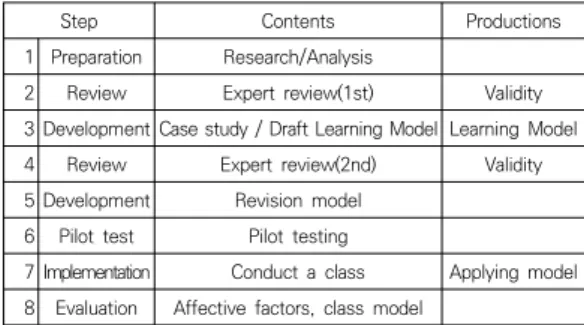
In order to complete the English teaching model designed and applied as a maker education program through more sophisticated artificial intelligence application project activities, the following 8 steps were taken: 1.
preparation, 2. 1st review, 3. draft development 4. 2nd review, 5. development 6. pilot test, 7.
class model implementation 8. evaluation. The class design was applied to the actual class after twice of expert validation based on prior literature. The expert review consisted of experts with over 10 year experiences in teaching and education technology related research and education. Expert review was conducted through questionnaires and interviews.
Step Contents Productions
1 Preparation Research/Analysis
2 Review Expert review(1st) Validity
3 Development Case study / Draft Learning Model Learning Model
4 Review Expert review(2nd) Validity
5 Development Revision model 6 Pilot test Pilot testing
7 Implementation Conduct a class Applying model 8 Evaluation Affective factors, class model
Table 2. Research Procedures
The experimental group conducted a pilot test with a draft design. The result was revised, supplemented, and reflected in the actual class.
The lessons in this study were designed and operated with flipped learning. The overall composition of the AI applying maker education program consisted of pre-learning, in-class, and post-learning. The maker education model applied to the main class used TMI[15], that is, T(Tinkering), M(Making), and I(Improving).
Tinkering is a warm-up stage, making is a stage of idea creation, making, and documentation, sharing is a stage of online and offline sharing, and Improving is a stage of revision and supplementation. The on-site evaluation was done to check the applicability of the actual class, and then the response evaluation was done for participating professors and learners.
2.3 Instrument and Data Analysis
The validation tool was modified according to the purpose and contents of this study based on universality, usefulness, and validity. The questionnaire was composed of 5 questions about education satisfaction for classes. In order to measure the self-directed learning ability and the affective domain through this teaching and learning model, the previous research test tool was used to reconstruct the questionnaire into five-stage Likert questions. The components of the test paper are self-direction, interest, creativity, cooperation, problem-solving, and participation.
To verify homogeneity among groups independent sample t-test and chi-square test were done and paired t-test and independent-sample t-test were conducted to identify changes in each group.
The processing analysis of this research result is analyzed using SPSS 18.0.
3. Result 3.1 Class Activity Model
3.1.1 Pre-learning
In the pre-learning stage, contents using artificial intelligence and materials that can be helpful for self-directed learning are provided to the LMS (Learning management system).
Class Learning Activity Interaction Strategy
Pre
(Movie) Imagine ‐ Hear the sound and imagine
what the movie is about Sort by scene order
Key Vocabulary(AI) Practice conversation with the topic in the video
Self-directed listening to English, speaking Pronunciation correction and interactive practice
With AI
&
teacher-student student-student by Chat room
Complete quizzes and task action
plans or summary
notes Table 3. Pre-learning model using artificial intelligence
Learners use Google assistant to learn pronunciation and practice expressions and phrases before this class. In addition, an assessment is performed to check whether learners have acquired and understood prior learning concepts using artificial intelligence.
3.1.2 In-class
The first step of this upcoming class model is a team discussion to clarify the concept of the pre-learning with relevant activities, in which the professor should promote students' interaction as a facilitator, sharing knowledge they know to develop deep learning through problem solving.
The second step is team activity, which is also the core of the project's activities as maker education. With students' activities, team interactions and problem solving, students produced something with common goals. By applying various creative techniques such as mind maps, brainstorming, role plays, and presentation, students have participated in the maker education to find solutions themselves.
Class Learning Activity Interaction Strategy
Intro
Motivation Performing various cooperative learning
No excessive tasks
or team activities Interaction
Main
Discussion Individual guidance
on topics Brain storm Mind map
Singing Ucc making Improve understanding
Presentation Summary
Team activities Maker education
teacher-student student-student
Feedback Cooperative
student- centered
Evaluation
In-Class attendance(10%)
Individual Discussion (20%)
Project (20%)Team
Participation Attitude
Interaction Achievement Table 4. Main-class model
The third step is to provide a key summary. In the process of solving problems through cooperative learning, teachers coach without giving answers, but at the end of the class, it is necessary to accurately convey whether the educational goal has been reached and what the core class contents are. Therefore, it is necessary to give learners a core summary of what they have learned. Fourth is the evaluation step. In addition to individual or team evaluation, a process-oriented evaluation such as formative assessment is necessary, taking into account the types that cannot be evaluated on an individual or team basis, and the evaluation must be performed each time.
3.1.3 Post-learning
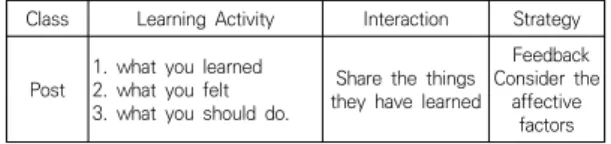
The final stage is post-learning, and reflection is a step in which each team performs a task and reflects on individual learning after each lecture.
At this stage, if learners are planning to receive continuous feedback from teachers through interactions with teachers on necessary content according to their level, teachers can induce the development of learners with advanced content.
Class Learning Activity Interaction Strategy Post 1. what you learned
2. what you felt 3. what you should do.
Share the things they have learned
Feedback Consider the
affective factors Table 5. Post-class model
3.2 Validity
The teaching model used in this study, developed through a prior literature review, has performed two internal verification tests on experts. For the review of expert validation, 3 people responded with 5 points Likert on the validity of the instructional design strategy and detailed guidelines.
Items N Expert
M SD CVI IRA
A B C 1st 2nd
Universality 1st 4 4 4 4 0 0.6
0.87 0.91
2nd 5 5 3 4.3 0.5 1.0
Usefulness 1st 4 4 3 3.7 0.6 0.3
2nd 5 4 3 4 1.0 1.0
Validity 1st 4 4 3 3.7 0.6 0.3
2nd 4 5 4 4.3 o.5 1.o
Table 6. Results of Validity
In the first validation, the IRV of the teaching-learning design strategy was 0.87, and the responses from experts are consistent, but the CVI value was less than 0.8, indicating that the need for modifications to the draft design came out. The 2nd expert validation is based on the revised class design strategy after the 1st validation. In the second validation, experts responded with 0.94 for IRV and 1 for CVI value, confirming the consistency of teaching-learning design strategy and educational usefulness.
3.3 Effectiveness Analysis
The self-directed learning ability and affective domain through this teaching model were measured by an independent sample t-test to see the difference in the results after the experiment between the experimental group and the control
group, as shown in Table 7. Significant differences were found in self-direction, interest, cooperation, problem-solving, and participation, excluding the creativity area (p<.05).
As a result of analyzing the paired t test to see the difference in the pre-and post-results of the experimental group, it was shown in Table 8.
Item Control (n=35)M SD Experimet.(n=35) M SD t p Self-
direction 4.50 0.49 4.11 0.63 2.430 .019*
Interest 4.40 0.48 4.12 0.55 2.051 .036*
Creativity 4.14 0.64 4.03 0.62 .133 .895
Cooperation 4.24 0.47 3.80 0.71 2.571 .012*
Problem
-solving 4.21 0.47 3.92 0.68 2.491 .061*
Participation 4.10 0.62 3.68 0.70 2.373 .025*
*p<0.05 Table 7. Difference after experiment
Item MPre (n=35)SD Post (n=35) M SD t p Self-
direction 3.77 0.50 4.11 0.63 -5.75 .000***
Interest 3.78 0.58 4.12 0.55 -5.74 .000***
Creativity 3.82 0.62 4.03 0.62 -2.48 .020**
Cooperation 3.55 0.76 3.80 0.71 -4.12 .000***
Problem
-solving 3.52 0.75 3.92 0.68 -4.60 .000***
Participation 3.38 0.58 3.68 0.70 -4.02 .000***
*p<0.05 **p<0.01 ***p<0.001 Table 8. Pre-and Post-test of Experimental Group
It is significant in the whole area, and it can be seen that the experimental group applying this teaching model has a positive impact on the students’ self efficacy through self-directed study, student’s interest for the class, creativity, desire to engage in cooperative learning, problem-solving, and group participation after the experiment.
4. Conclusion and Discussion
For the introduction of AI education in the educational field, above all, a formal teaching and learning model is needed. In the main class, the teaching methodology based on learners' learning activities rather than a teacher-centered approach is needed. This study presented an English education model applying artificial intelligence through the maker education case study.
After a total of two expert validity tests, the second verification was based on the corrected class design strategy after the first verification.
The experimental group showed more meaningful results than the control group, and the post results were also more significant in the difference between the pre- and post-results of the experimental group (*p<0.05, **p<0.01,
***p<0.001 ). In conclusion, it can be seen that classes that apply this model positively help students in self-direction, interest, cooperation, problem- solving, and participation.
First, the use of artificial intelligence is a task that the learner can perform before the main class, and enables learners to prepare the class independently. In addition, maker education, which creates results with the same goal in this class activity, can maximize the effect of cooperative learning through the process of communication and compromise in the activities between group members. However, research on how artificial intelligence related to English learning can be easily applied to classes, development of software, and convergence with maker education continue to require subsequent research in more systematic learning activities.
Since this study was conducted with 70 students in two classes at one university, a follow-up study that applied a larger number of students and longer class hours is necessary for generalization.
There is a limitation in not being able to analyze the fact that the class effect may vary slightly depending on the teacher's class management type and the evaluator's perspective.
REFERENCES
[1] D. Larsen-Freeman. (2009). The Cambridge Guide to Teaching English to Speakers of Other Languages, Cambridge University Press, 34-41.
DOI : 10.1017/CBO9780511667206.006
[2] M. Long. (1996). The role of the linguistic environment in second language acquisition. Second Language Acquisition,2(2), 413-468.
DOI : 10.1016/b978-012589042-7/50015-3
[3] Y. I. Kim. (2017). An Oral Health Promotion Behavior Model for Adolescents. The Korean Journal of The Korea Convergence Society, 11(2), 129-142.
DOI : 10.12811/JKCS.201.11.2.129
[4] J. K. Sim, & D. Y. Kwon. (2020). Development of Artificial Intelligence Education Content to Classify Emotion of Sentences for Elementary School. Journal of The Korean Association of Information Education, 24(3), 243-254.
DOI : 10.14352/jkaie.2020.24.3.243
[5] D. H. Lee. (2018) A study for the development of an English learning chatbot system based on Artificial Intelligence. Secondary English Education, 11(1), 45-68.
DOI: 10.20487/kasee.11.1.201802.45
[6] L. Martin. (2015). The promise of the maker movement for education. Journal of Pre-College Engineering Education Research, 1(5), 30-39.
DOI : 10.7771/2157-9288.1099
[7] G. D. Hong & H. K. Kim. (2017). Sensor-based convergence system in Ubiquitous Environment.
Journal of The Korea Convergence Society, 7(1), 1-6.
DOI : 10.22156/JKCS.2018.7.1.001
[8] D. Dougherty. (2013). The maker mindset. In Honey, M. & Kanter, D. E. (Eds.), Design, Make, Play: Growing the Next Generation of STEM Innovators (7-11). New York, NY: Routledge.
DOI : 10.4324/9780203108352-6
[9] A. Zongpei . (2019). Application and Practice of Artificial Intelligence in Maker Education and Teaching.
Advances in Higher Education, 3(2), 105-106.
DOI : 10.18686/ahe.v3i2.1423
[10] M. H. Shin. (2018). An Analysis of the Effects of On-Off line Convergence Learning Activities Based on Students’ Learning Styles. Journal of The Korea Convergence Society, 9(2), 85-90.
DOI : 10.15207/JKCS.2018.9.2.085
[11] Y. B. Yoon & M. A. Park. (2020) Artificial Intelligence and Primary English Education: With Special Reference to Chatbots, Elementary Education Research Center, 31(1), 77-90,
DOI : 10.20972/10.20972/Kjee.31.2.202006.1 [12] S. A. Javier, J. Sergio, & J. Anders. (2019). Computing
programs for generalized planning using a classical
planner. Artificial Intelligence, 272(1), 52-85.
DOI : 10.1016/j.artint.2018.10.006
[13] J. Underwood. (2017). Exploring AI language assistants with primary EFL students. Eurocall Research-publishing.ne, 317-321.
DOI : 10.14705/rpnet.2017.eurocall2017.733 [14] M. H. Shin (2019). Study of English Teaching Method
by Convergence of Project-based Learning and Problem-based Learning for English Communication.
The Korean Journal of The Korea Convergence Society, 10(2), 83-88.
DOI : 10.15207/JKCS.2019.10.2.083
[15] K. Peppler, R. E. Halverson. & B. K. Yasmin. (2016).
Makeology: Makerspace as learning Environment New York: Routle.dge
DOI : 10.4324/9781315726519
신 명 희(Myeong-Hee Shin) [정회원]
․ 2001년 : Vancouver College TESOL
․ 2008년 8월 : 한국외국어대학교 영어 학과 문학박사
․ 2006년 ~ 2010년 : 건양대학교 조교 수
․ 2010년 9월 ~ 현재 : 한남대학교 부 교수
․ 관심분야 : Intercultural communication, Teaching methodology. Convergence education, etc.
․ E-Mail : [email protected]