https://doi.org/10.5229/JKES.2019.22.4.164
− 164 −
eISSN 2288-9000
The Electrochemical Properties of SnO
2as Cathodes for Lithium Air Batteries
Yoon-Ho Lee and Heai-Ku Park*
Department of Chemical Engineering, Keimyung University, Daegu, 42601, Korea (Received October 8, 2019 : Revised November 20, 2019 : Accepted November 20, 2019)
Abstract : Nano-sized SnO2 powders were synthesized via a solvent thermal reaction using SnClO4, NaOH, and ethylene glycol at 150oC. TGA, SEM, FT-IR, XRD, and Potentiostat/Gal- vanostat were employed to investigate the chemical and electrochemical characteristics of the synthesized SnO2. The structure of SnO2 was amorphous, and when heat treated at 500oC, it was transformed into a crystalline structure. The morphology obtained by SEM micrographs of the as-synthesized SnO2 showed powder features that had diameters ranging 100 to 200 nm.
The electrochemical performance of the crystalline SnO2 as a Li-air battery cathode was better than that of the amorphous SnO2. The specific capacity of the crystalline SnO2 was at least 350 mAh/g at 10 mA/g discharge rate. However, there was some capacity loss of all the cells during the consecutive cycles.
Keywords : Lithium-Air Battery Cathode, Lithium-Air Battery, Tin Oxides
1. Introduction
Lithium secondary batteries are most often used in electronic devices for our everyday life. The per- formance of the lithium secondary battery depends largely on the cathode, anode, and electrolyte used in the cell. The batteries use a carbon-based mate- rial as the anode, and a transition metal oxide as the cathode in general. Therefore, the battery capac- ity is smaller than that of the lithium metal second- ary battery in terms of energy density, so that the capacity of the lithium secondary batteries can be limited. As a result, the performance of the lithium ion secondary battery as a power source for electric vehicles and electric power storage has reached a limit. To overcome this, a Li-air battery using a lithium metal directly as an anode, and manganese dioxide having a catalytic capability of oxygen reduction as a cathode, can be used to obtain a battery having improved capacity, as compared with a lithium ion battery. The theoretical energy density of the Li-air cell is 3,505 W/kg (using organic sol-
vent electrolyte), or 3,582 W/kg (using aqueous electrolyte). Its energy density is comparable to that of the methanol fuel cell (5,524 W/kg) and gasoline engine (11,860 W/kg), and it can also be used as secondary batteries for power storage and electric vehicles. In addition, due to the imbalance between power supply and the demand for alternative energy sources in the event of an emergency, the need for a high-capacity secondary battery is rising, and so much research has been actively conducted on Li- air batteries. Recently, Abraham and Jiang obtained an energy density of 1,300 mAh/g in a Li-air cell study using organic electrolytes.1-9)
Tin oxide has been used as an anode material for lithium batteries, and has excellent characteris- tics in terms of battery charge/discharge capacity that are twice as high compared to the conventional carbon-based anode. However, it has an initial irre- versible capacity of about 40 to 60%. In addition, tin oxide materials, such as SnO and SnO2, are not only large in initial irreversible capacity, but also structurally unstable when they are used as an anode of a lithium secondary battery, thereby affect- ing cycle life during charging and discharging.6)
In this paper, we have synthesized a tin oxide
*E-mail: [email protected]
nanomaterial that can be used as a cathode active material for a high-capacity Li-air secondary battery.
Then a Li-air secondary battery using the tin oxide nanomaterial as a cathode, the lithium metal as an anode, and LiClO4 salt in organic solvent (EC, PC) as an electrolyte was fabricated, and the chemical and electrochemical properties were investigated, employing XRD, SEM, Potentiostat/Galvanostat, etc.
2. Experimental
To synthesize nano-sized SnO2, 26.3 g of SnCl4·H2O (Yakuri) and 3.2 g of NaOH (Yakuri) were dis- solved in 200.0 mL of ethylene glycol (J.T. Baker).
The mixed solution was added to Autoclave (Parr Instrument, PARR-4843), and reacted at 150oC for 72 h to obtain a green opaque SnO2. The reacted mixture was then centrifuged, and washed three times with ultrapure water (Milli-Pore, Milli-Q plus), and finally, washed with ethanol. The washed SnO2 was dried in a vacuum oven at 120oC for 24 h, and used in the experiment (sample name:
SnO2 heat treated at 120oC). Some of the dried green SnO2 samples were converted to blackish brown powders by heat treatment at 500oC for 2 h in tubular furnace (Lenton), which was also used for electrochemical characterization (sample name:
SnO2 heat treated at 500oC).
SnO2, SPB (super P black), and PTFE (polytetra- fluoroethylene) at an optimum ratio (7:2:1) of IPA was mixed homogeneously with a centrifugal mixer (Thinky, are-310) using zirconia balls, and dip- coated on Ni metal foam that was used as a cur- rent collector, in order to allow O2 to flow through the electrode of the Li-air battery. The tin oxides on Ni foam dried for 24 h were used as a work- ing electrode. ECC-Air 3 electrode cell module of EL-CELL company was used to investigate the electrochemical properties of the fabricated elec- trode. Li metal (Foote) was used as a reference electrode and a counter electrode, respectively. The 1.0 M electrolyte was prepared by dissolving LiC- lO4 in a 1:1 mixture of propylene carbonate (PC, Merck) and ethylene carbonate (EC, Merck), and dripped in a glass fiber separator. The cell assem- bly proceeded in a glove box (VAC) filled with Ar.
The oxygen feed was supplied at a pressure of
1 kgf/cm2 using an oxygen cylinder of 99.995%.
Linear sweep voltammetry and constant current experiments were performed using a Solartron 1287 electrochemical interface.
We used FT-IR (JASCO, FT-IR 620), TGA (TA Instruments, SDT Q600), and DSC (TA Instru- ments, SDT Q600) to investigate the physical and chemical properties of the synthesized SnO2. SEM (FEI, Quanta 200) was used for the surface analy- sis, while XRD (Rigaku, D/ MAZX 2500V/PC) was used to examine the structure of the samples.
3. Results and Discussion
TGA and DSC were used to investigate the ther- mal properties of SnO2. The temperature was
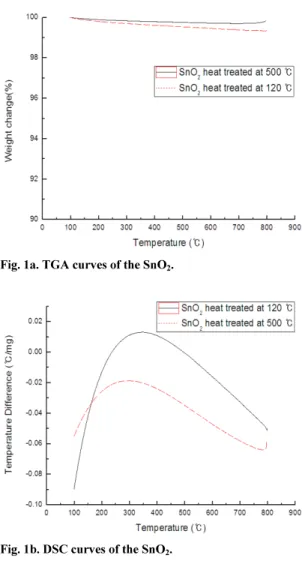
Fig. 1a. TGA curves of the SnO2.
Fig. 1b. DSC curves of the SnO2.
increased from room temperature to 800oC at a rate of 10oC/min, and the thermal change was measured.
Figs. 1a and 1b show the TGA and DSC results, respectively. Fig. 1a shows that the tin oxides heat treated at 120 and 500oC showed little change in weight, even at elevated temperatures. It seems that SnO2 was produced quantitatively at the synthesis temperature of 150oC. As shown in the DSC results in Fig. 1b, the overall exothermic reaction is accompanied by the crystallization of amorphous SnO2 as the sample is heated, and no other thermal change was observed. In other words, even if the temperature is increased further, the weight and thermal change due to oxygen in the atmosphere were not observed, and the chemical composition formed at the time of synthesis remained intact, and crystallization progressed only. This is also proven by the X-ray diffraction pattern results.
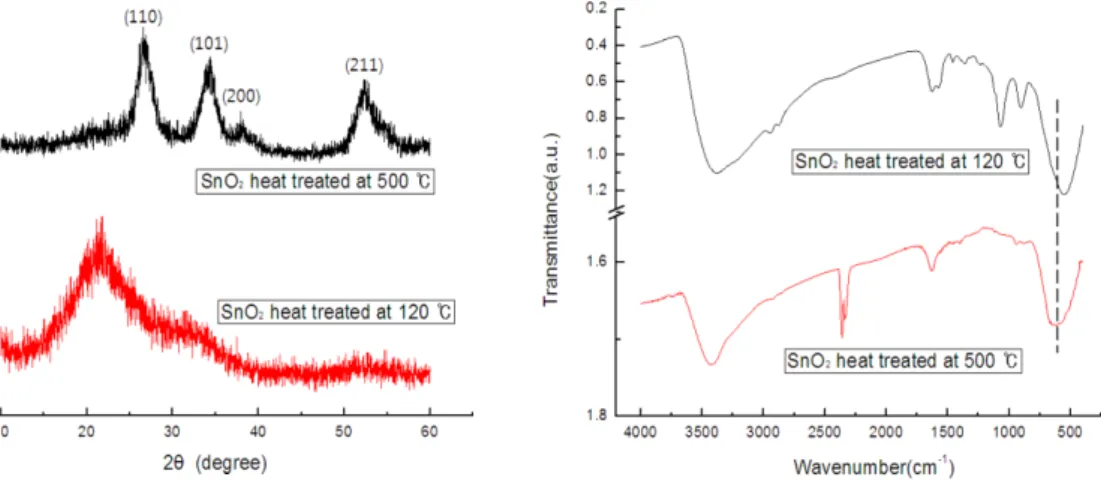
An X-ray diffractometer was used to determine the structure of the tin oxide. The XRD pattern in Fig. 2 shows that the sample dried at 120oC revealed a very broad band background peak, which is difficult to judge by a specific peak, indi- cating that amorphous SnO2 is mixed partially with the crystal form. However, the crystalline SnO2 heat-treated at 500oC is in good agreement with the peaks of SnO2 presented in XRD JCPDS (01-070- 6995).10) In other words, the amorphous SnO2 syn- thesized by solvothermal reaction at 150oC under- goes crystallization conversion, when it is heat treated at 500oC in atmosphere.
Fig. 3 shows the FT-IR spectra of SnO2 using KBr disc that were heat treated at 120 and 500oC.
Strong symmetric and asymmetric stretching vibra- tion peaks of Sn-O-Sn appeared at around 600 cm-1. The peaks near 3,400 and 1,600 cm-1 appear to be due to moisture adsorbed on the surface of SnO2. In addition, the peak at around 800 to 1,200 cm-1 of the tin oxide dried at 120oC shows that the sur- face of SnO2 is partially covered by Sn–OH bonds.
The peak at around 2,350 cm-1 is believed to be attributed to the trace amount of CO2 present in the device.11)
Figs. 4a and 4b show the surface SEM micro- graphs of SnO2 heat treated at 120 and 500oC, respectively. The SnO2 thermally treated at 120oC exists in powder form, and has a particle size of about 100 to 200 nm. The grain size of SnO2 heat treated at 500oC is about 600 nm. It can be seen that amorphous SnO2 particles are crystallized through heat treatment, and the grain size is increased, due to cohesion between small particles.
Also, it can be seen that the intergranular porosity increases as the particles agglomerate at 500oC.
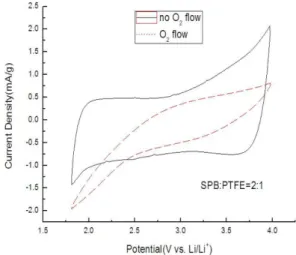
To investigate the electrochemical characteristics of tin oxides, the linear sweep voltammetry (LSV) was applied at a sweep rate of 1.0, 10.0, and 100.0 mV/s between 1.8 and 4.0 V (vs. Li/Li+). Fig. 5 shows the characteristics of the Ni metal foam electrode used as the current collector, while Fig. 6 shows the properties of the Ni foam coated with the super P Black (SPB) as a conductive material,
Fig. 2. XRD patterns of the SnO2. Fig. 3. FT-IR spectra of the SnO2.
and polytetrafluoroethylene (PTFE) as a binder. It can be seen that the oxidation and reduction reac- tion of the electrolyte occurs first on the surface of the electrode in the state where the oxygen is not supplied to the Ni foam. However, the oxidation and reduction reactions of the electrolyte are rapidly decreased when the Ni cathode is supplied with oxygen. That is, not only the redox reactions by oxygen, but also the electrolyte decomposition reac- tion is negligible on the Ni metal surface in the presence of oxygen.
The SPB coated electrode shows the electrochem- ical properties of typical capacitors in the absence
of oxygen, as shown in Fig. 6, in which the elec- trodes are impregnated with a conductive material.
On the other hand, as oxygen is supplied to the electrode, reduction and oxidation of oxygen occur on the SPB electrode surface.
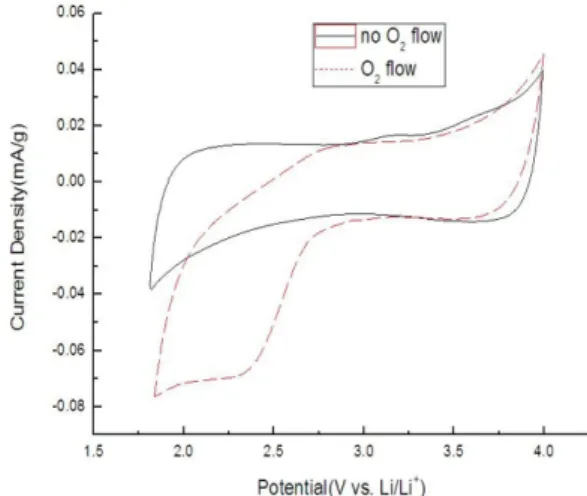
Figs. 7a-7c show the linear sweep voltammo- grams of the SnO2 electrode dried at 120oC, with the potential scanning rates varying from 1.0 to 10.0 and 100.0 mV/s. When the O2 is not provided, it can be seen that the oxidation-reduction reaction does not occur at the electrode, even though the Fig. 4a. SEM micrographs of the SnO2 heat treated at
120oC.
Fig. 4b. SEM micrographs of the SnO2 heat treated at 500oC.
Fig. 5. Linear sweep voltammograms of the Ni foam at a 1 mV/s sweep rate.
Fig. 6. Linear sweep voltammograms of the SPB at a 100 mV/s sweep rate.
scanning speed is changed, and the characteristics of the capacitor are shown only. On the other hand, when O2 was flowed into the SnO2 electrode, reduction and oxidation peaks were observed. At this time, the following electrochemical reaction occurs at about 3.0 V or less (vs. Li/Li+). That is, lithium metal is oxidized in the anode, and lith- ium ions and oxygen are reduced in the cathode, resulting in lithium dioxide.4,5)
(-) 2Li → 2Li+ + 2e−
(+) 2Li+ +O2 + 2e− → Li2O2
It can be seen that oxidation peaks corresponding to the reduction peaks are not apparent, which reveals that not all of the lithium oxides are oxi- dized when the applied potential is reversed. In addition, the potential interval between oxidation and reduction peaks becomes wider as the potential scanning speed increases. These are general phe- nomena that appear where the irreversible reaction occurs.
Fig. 8 shows the linear sweep voltammograms of SnO2 heat treated at 120 and 500oC with the potential sweep rate 1.0 mV/s, respectively. In the case of SnO2 dried at 120oC, only the reduction peaks appear under 2.5 V, and when the applied potential is reversed, the corresponding oxidation peak can be seen above 3.7 V. However, the SnO2 heat treated at 500oC shows that the reduction peak at which lithium ions form lithium oxides by bond- ing with oxygen at the electrode surface appears at 3.3 and 2.3 V. It can be seen that the correspond- ing oxidation reaction appears at a potential of about 3.2 V or more, as well. The peak at 3.3 V reveals that an additional site for lithium ion reduc- tion is available when amorphous tin oxides trans- form into a crystalline structure. In addition, the oxidation reaction of the lithium oxides on the crystalline SnO2 is more evident than the amor- Fig. 7a. Linear sweep voltammograms of the SnO2 at a 1
mV/s sweep rate.
Fig. 7b. Linear sweep voltammograms of the SnO2 at a 10 mV/s sweep rate.
Fig. 7c. Linear sweep voltammograms of the SnO2 at a 100 mV/s sweep rate.
phous one, and the redox reaction of the crystalline SnO2 is more reversible, compared to that of the amorphous.
The discharge characteristics of the lithium-air battery were investigated by applying a current of 10.0, 50.0, and 100.0 mA/g, using the as-synthe- sized SnO2 electrode. Fig. 9 shows the discharge curves obtained by applying three different current densities to the SnO2 electrodes dried at 120oC.
Comparing the three discharging curves, the lower the current density applied to the electrodes, the more uniform potential of the slope is maintained.
It can be seen that as the applied current decreases,
the reaction between lithium ion and oxygen occurs more actively. In particular, the maximum cell capacity is 350 mAh/g at an applied current density of 10.0 mA/g. This is generally observed in elec- trochemical reactions, because mass transfer reac- tions at high applied currents and charge transfer reactions at low applied currents dominate the over- all reaction. This is also referred to as the rate characteristic found in a battery.
Fig. 10 shows the discharge curves obtained by applying a current of 10.0, 50.0, and 100.0 mA/g, respectively, to the SnO2 electrode heat treated at 500oC. The discharge curve lasts for a relatively long period of time at the lower potential limit 1.9 V compared to that of the amorphous SnO2, and it is very flat at about 2.7 V at an applied cur- rent of 10.0 mA/g, which results in an increase in energy density. The discharge curves of the SnO2 electrode heat treated at 120 and 500oC show that the cell capacity was similar, regardless of the treating temperature, at a current of 10.0 mA/g.
However, as the applied current increased, the capacity of the SnO2 heat treated at 500oC elec- trode and the maintenance rate of the flat voltage are higher. This shows more efficient reduction of lithium ions and oxygen in the crystalline SnO2 electrode through heat treatment, resulting in an increase in cell capacity and rate capability at high Fig. 8. Linear sweep voltammograms of the SnO2 heat
treated at 120 and 500oC.
Fig. 9. Discharge curves of the SnO2 dried at 120oC.
Fig. 10. Discharge curves of the SnO2 heat treated at 500oC.
discharge rates. It could be assumed that the elec- tronic conductivity and mass transfer of the crystal- line SnO2 electrode are considered to affect the increase of the cell performances.
Fig. 11 shows the results of cycle life investiga- tion by repeatedly applying oxidation and reduction currents over 30 times by applying a current den- sity of 50.0 mA/g to the crystalline SnO2 electrode heat treated at 500oC. The battery has a relatively high capacity in the first cycle, but as the number of charge/discharge increases, the battery capacity sharply decreases. This is a result of the irreversible process in which the lithium oxides reduced during the discharge process are not oxidized during the charge process, which indicates that the oxidation reaction of the lithium oxides is poor, and should be addressed and improved in subsequent studies.
4. Conclusion
SnO2 was prepared via a solvothermal synthesis of SnCl4·H2O and ethylene glycol mixed solution by controlling the alkalinity using NaOH at 150oC.
The chemical and electrochemical properties of the as-synthesized tin oxide were investigated employ- ing TGA, DSC, SEM, XRD, FT-IR, and Potentio- stat/Galvanostat.
Firstly, as-synthesized SnO2 was amorphous, and transformed to crystalline SnO2 by heat treatment at 500oC.
Secondly, the cyclic voltammetry and charge/dis- charge profiles confirmed that the tin oxide could be used as a cathode material for Li-air cells. In particular, the SnO2 heat treated at 500oC showed better lithium-oxygen reduction reaction at higher applied current than the amorphous SnO2 dried at 120oC. In addition, the reverse reaction easily occurred, even when charging, and the reversibility was improved in a crystalline SnO2.
Thirdly, as a result of the cyclic test, the SnO2 electrode heat treated at 500oC retained the capacity of the initial discharge by more than 30%, even after 30 consecutive cycles.
Fourthly, a cell capacity of 350 mAh/g or more at an applied current of 10 mA/g was achieved.
When the battery system is improved through opti- mization of the electrolyte, the SnO2 material could be used as the cathode material of a Li-air battery.
References
1. K. M. Abraham, Directions in secondary lithium battery research and development, Electrochim. Acta. 38, 1233 (1993).
2. D. Guyomard and J. M. Tarascon, Li metal-free recharge- able LiMn2O4/Carbon cells: their understanding and opti- mization, J. Electrochem. Soc., 139, 937 (1992).
3. A. Momchilov, V. Manev, and A. Nassalevska, Recharge- able lithium battery with spinel-related MnO2 II. Optimi- zation of the LiMn2O4 synthesis conditions, J. Power Sources, 41, 305 (1993).
4. D. Capsoni, M. Bini, S. Ferrari, E. Quartarone, and P.
Mustarelli, Recent advances in the development of Li-air batteries, J. Power Sources, 220, 253 (2012).
5. K. M. Abraham and Z. Jiang, A polymer electrolyte- based rechargeable lithium/oxygen battery, J. Electro- chem. Soc., 143, 1 (1996).
6. S. Roberto, G. Delia, T. Francesca, P. Oriele, P. Annalisa, I. Neluta, B. Sergio, and A. N. Maria, Preparation and characterization of nanocomposite polymer membranes containing functionalized SnO2 additives, Membranes, 4, 123 (2014).
7. G. Girishkumar, B. McCloskey, A. C. Luntz, S. Swanson, and W. Wilcke, Lithium-air battery: promise and chal- lenges, J. Phys. Chem. Lett., 1, 2193 (2010).
8. J. B. Goodenough and Y. S. Kim, Challenges for rechargeable Li batteries, Chem. Mater., 22, 587 (2010).
9. K. West and A. M. Crespi, Lithium insertion into silver vanadium oxide, Ag2V4O11, J. Power Sources, 54, 334 (1995).
10. H. C. Chiu and C. S. Yeh, Hydrothermal synthesis of SnO2 nanoparticles and their gas-sensing of alcohol, J.
Fig. 11. Cycling performances of the SnO2 electrode heat treated at 500oC.
Phys. Chem. C, 111, 7256 (2007).
11. S. Fujihara, T. Maeda, H. Ohgi, E. Hosono, H. Imai, and S. H. Kim, Hydrothermal routes to prepare nanocrystal-
line mesoporous SnO2 having high thermal stability, Langmuir, 20, 6476 (2004).