• 검색 결과가 없습니다.

A Study on the Effect of Transformation Leadership on the Job Performance of Employees by AMO Model

N/A
N/A
Protected

Academic year: 2021

Share "A Study on the Effect of Transformation Leadership on the Job Performance of Employees by AMO Model"

Copied!
10
0
0

로드 중.... (전체 텍스트 보기)

전체 글

(1)

A Study on the Effect of Transformation Leadership on the Job Performance of Employees by AMO Model

Nan Li

1

, Gi-Young Jung

2

, Hyung-Ho Kim

3*

1

Professor, Faculty of Management, Jilin Engineering Normal University

2

Professor, Dept. of Business Management, Sehan University

3

Professor, Dept. of Air Transport and Logistics, Sehan University

AMO모델에 의한 직원의 직무수행에 미치는 혁신적 리더십의 효과에 관한 연구

이남

1

, 정기영

2

, 김형호

3*

1

길림공정기술사범학원 경영학부 교수,

2

세한대학교 경영학과 교수,

3

세한대학교 항공교통물류학과 교수

Abstract This paper analyzed leadership behavior and employee performance through empirical analysis method based on AMO theory. In this study, the ability of the leader (A), task motivation (M), and opportunity (O) were chosen as factors to analyze the relationship between transformative leadership and job performance of the subordinate staff, and the self-efficiency (O) and intrinsic motivation (M) were selected at the individual level and team atmosphere (O) at the organizational level to build a research model. 507 valid data were obtained from the survey and statistical analysis was conducted using SPSS23. Studies have shown that transformative leaders have a significant impact on employee performance. This study provides research results of empirical theory to understand the behavior of the leader in the performance of the employees and also suggests implications for the management of the company's human resources.

Key Words : Transformational leadership, Intrinsic motivation, Self-efficacy, Team atmosphere, Job performance, AMO theory

요 약 본 논문은 AMO 이론을 기반으로 한 실증적 분석 방법을 통하여 리더십 행동과 직원의 성과에 대하여 분석하였 다. 본 연구에서는 변혁적 리더십과 부하 직원의 직무 성과의 관계를 분석하기 위해 리더의 능력(A), 직무동기(M) 및 기회(O)를 요인으로 선택하였고, 개인 차원에서는 자기효율성(O)과 내재적 동기(M)를 조직 차원에서는 팀 분위기(O) 를 선택하여 연구 모형을 구축하였다. 설문조사를 통해 507건의 유효 데이터를 확보하였고 SPSS23을 이용하여 통계 적 분석을 실시하였다. 연구 결과 변혁형 리더가 종업원의 성과에 현저한 영향을 미치는 것으로 나타났다. 본 연구는 종업원의 업무수행에 대한 리더의 행동을 이해할 수 있는 실증적 이론의 연구결과를 제공하고, 기업의 인적자원관리에 도 시사점을 제시 하고 있다.

주제어 : 변혁형 리더십, 내재적 동기, 자기 효능, 팀 분위기, 작업 성과, AMO 이론

*Corresponding Author : Hyung-Ho Kim([email protected]) Received October 17, 2019

Accepted January 20, 2020 Revised November 11, 2019

Published January 28, 2020

(2)

1. Introduction

From the perspective of current practice, enterprises pay more and more attention to

"people", and human resource management plays an increasingly important role in the realization of enterprise development strategy. In the face of fierce market competition, the key to determining the success or failure of an organization is the "people" in the organization.

To maximize the effectiveness of human resource management, enterprise leaders need to make efforts in overall enterprise management, or leadership. In all management work, human leadership is the most important central work, which is also the primary cause of productivity difference between organizations. As the output result of an organization, the employee's working performance is not only a symbol of enterprise development, but also an important indicator to measure the effectiveness of leadership.

Therefore, the study of leaders and subordinates has always been the subject of management research. Burns' theory of transformational leadership, put forward in 1978, has aroused the attention of enterprises and scholars. Although many empirical studies have proved that transformational leadership has a positive effect on work results, its internal working mechanism remains to be further studied.In recent years, theories and academia have strengthened the research on the mechanism of transformational leadership in order to find relevant mediating variables of the effectiveness of transformational leadership.

2. Theoretical review 2.1 Transformational leadership

Since the 1980s, Transformational Leadership has gradually become a hot topic in western Leadership theories. Downton's "Rebel

Leadership" published laid the foundation of transformational Leadership theory. Subsequently, Burns first conceptualized transformational Leadership , defining it as "a leader seeks and motivates subordinates' potential motivation through high-level concepts and values, urges subordinates to devote themselves to work, and establishes a relationship of mutual encouragement and promotion between leaders and subordinates". Burns believes that transformational leadership is the driving force of reform. Leaders attach importance to the improvement of their subordinates' inner needs and arouse their consciousness to help them transcend their "ordinary selves" to meet their inner needs at a higher level, and then improve to "more selves". Bass, the Leadership in 1985 and the Performance Beyond Expectation "of deep extension of the connotation of transformational Leadership and transformational Leadership is considered" the task of Leadership in realized by making) meaning and importance of motivation and meet the needs of the high level, build the atmosphere of mutual trust, prompting the subordinate organizations and the collective interests above that of the individual, work results and generate more than expected.[1]" Based on Burns and Bass 'definition of transformational leadership, scholars began to define the concept of transformational leadership from different perspectives.

2.2 Job performance

Job performance is a very important concept in management. In terms of objects, performance can be divided into organizational performance and employee performance, with the two being interrelated and influenced by each other.

Organizational structure, leadership effectiveness

and other factors may have an impact on

employee performance, leading to the reduction

of employee performance and accordingly

affecting the performance of the whole

(3)

organization. At present, the research results of job performance are very rich, and the relevant theories of job performance are becoming more and more mature. Previous studies have shown that there are two main factors influencing employee performance: individual factors and external environmental conditions. Among them, the research on individual factors of employees mainly focuses on knowledge, personality, ability and motivation. The influence of external environmental conditions mainly focuses on leadership behavior, work characteristics and organizational culture. From the perspective of individual learning and ability, han yi proposed to divide performance into learning performance, innovation performance, relationship performance and task performance[2].

2.3 Self-efficacy

In the 1970s and 1980s, American scholar Bandura, based on the social learning theory, initially formed the social cognitive theory in the process of in-depth research on the internal factors (cognition, motivation, emotion, etc.) and behavioral changes of individuals when facing the environment. Bandura first proposed self-efficacy". In 1986, Bandura published the book Social Foundations of Thoughts and Action, which systematically elaborated the mechanism and theoretical framework of self-efficacy.

Self-efficacy is an individual's subjective judgment of his ability to complete a certain task at a certain level[3].

2.4 Intrinsic motivation

In 1918, Woodworth proposed the embryonic form of intrinsic motivation, and pointed out that individual perception and autonomous action would be driven by curiosity and self-protection and have the characteristics of self-reward. Since then, scholars have conducted extensive research on intrinsic motivation. Hunt is the first to

accurately use the concept of intrinsic motivation. He points out that the practice of an individual controlling the environment is a behavior influenced by intrinsic motivation. After synthesizing the two definitions of intrinsic motivation, genetic and behavior, Deci and Ryan argue that individual's intrinsic motivation comes from the endogenous feeling of competence and the need for self-determination on the one hand[4], and from the pursuit of the intrinsic value of the work itself on the other, i.e.

individuals inspired by the intrinsic motivation engage in a particular activity for enjoying the pleasure and satisfaction in the process, rather than for external reasons.

2.5 Organizational climate

The definition of organizational climate is derived from Tagiuri's definition of atmosphere in the study of organizational behavior , which holds that the atmosphere in the organizational environment is measurable, can reflect the internal environment of the organization, and can exert two-way influences on team members.

Organizational climate is the common cognition

and experience of team members on the working

environment, and it is also the key factor to

distinguish the differences between teams. In an

organization, organizational climate is the

common perception of team members to the

standards and rules within the organization or

team. It not only reflects the cognition of team

members to the internal environment, but also

reflects the characteristics and criteria of the

operation of the organization or team, which is

measurable . Although team atmosphere is

invisible, it has an important impact on the

attitudes, values and behaviors of team members

. Thus, the importance of organizational climate

in organizational behavior research.

(4)

3. Research design

Through the collation and analysis of the existing literature, it is found that New Retailing, which is integrated online and offline, has become a new development in the current retail industry. This led to the attention of some experts and scholars to New Retailing, which led to a series of literature research results. His theoretical research mainly focuses on the basic theoretical aspects such as the interpretation of connotation features, the analysis of the causes of development, the development path and trend research. Understanding these issues will not only help to lay the theoretical foundation of the

“New Retailing” research but also help to clarify the dynamics and prospects of the “New Retailing” development.

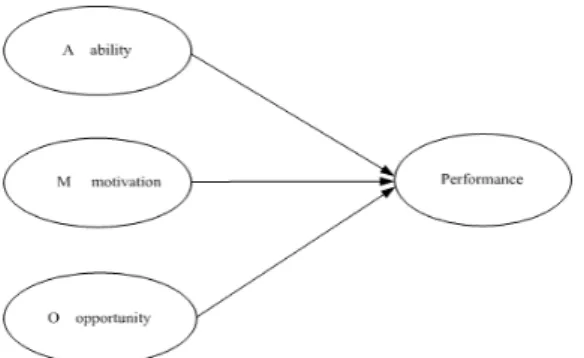
3.1 Theoretical selection and model construction The initial discussion about performance originated from the performance function put forward by Vroom (1964) : work performance =f (Ability × Motivation). Subsequently, scholars integrated and refined the basic framework of AMO (Ability, Motivation and Opportunity) model on this basis. As shown in Fig. 1. Compared with other theories, AMO model has three characteristics: completeness, generality and effectiveness in revealing the determinants of individual performance.

Through the review and analysis of literature, the application of AMO model in the research field is very convincing. This paper attempts to explore the mechanism between transformational leadership and employee work performance from the perspective of AMO theory. Subordinates' self-efficacy (A), intrinsic motivation (M) and team atmosphere (O) were selected as mediating paths between transformational leaders and subordinates' work performance. Therefore, as shown in Fig. 2. the research model of this paper is proposed.

Fig. 1. AMO theoretical model

3.2 Research hypothesis

3.2.1 individual-oriented transformational leadership and employee self-efficacy Transformational leaders can deal with the task needs in the work through intellectual stimulation and find ways to improve the work, so that employees can correctly view their own abilities and improve their self-efficacy.

Transformational leaders encourage continuous development and progress of subordinates and give appropriate authorization, thus enhancing their ability and motivation to complete tasks [5].

Self-efficacy plays a key role in job performance by influencing individual choice, effort and toughness. Previous studies have shown that self-efficacy of employees is of great significance to improve work performance. In view of this, hypothesis 1 is proposed.

H1: individual-oriented transformational leadership has a positive impact on employees' self-efficacy.

Fig. 2. research model

(5)

3.2.2 individual-oriented transformational leadership has a positive impact on the intrinsic motivation of subordinates. Individual orientation of transformational leadership behavior on subordinates individuals, by understanding the needs of the subordinates, ability and skills, and the subordinate authorization, give full play to their potential, cultivating and improving the capacity of subordinates and self-efficiency[6], transformational leadership can produce positive guidance, to subordinate to motivate subordinates initiative, encourage subordinates to take risks[7]. In view of this, hypothesis 2 is proposed.

H2: individual-oriented transformational leadership has a positive impact on the intrinsic motivation of subordinates.

3.2.3 Team-oriented transformational leadership and organizational climate

In a team, the attitude and behavior of the leader plays a crucial role in shaping the team atmosphere[8]. The organizational climate is a relatively stable quality of the internal environment of the team, which comes from the attitude and behavior of the team members, especially the team leaders[9]. Chinese scholar zhu shaoying et al. found through literature review and practical investigation that transformational leaders indirectly affect team performance by creating a good organizational climate[10]. In view of this, hypothesis 3 is proposed.

H3: team-oriented transformational leadership has a positive impact on organizational climate

3.2.4 Self-efficacy and employee performance Self-efficacy leads subordinates to believe that they can handle difficult situations at work and handle challenging situations without the help of a leader. Self-efficacy plays a key role in job performance by influencing individual choice,

effort and toughness.

Individual-oriented transformational leadership improves the performance of subordinates by increasing their self-efficacy[11]. Previous studies have shown that self-efficacy of employees is of great significance to improve work performance.

In view of this, hypothesis 4 is proposed.

H4: self-efficacy has a positive impact on the job performance of subordinates.

3.2.5 Intrinsic motivation and employee performance

From the perspective of intrinsic motivation, the focus on the work task itself and the expectation of the organizational goal will increase the subordinates' excitement for the work[12], which can motivate the subordinates to devote themselves to the work task and make them full of energy and concentrate on completing the work. According to the Motivation theory, employees' completion of work tasks can be divided into Intrinsic Motivation and extrinsic Motivation[13]: Intrinsic Motivation emphasizes the happiness and satisfaction brought by work tasks for subordinates. In view of this, hypothesis 5 is proposed.

H5: intrinsic motivation has a positive impact on the job performance of subordinates.

3.2.6 Organizational climate and employee performance

Chinese scholars liu bing et al. believe that organizational climate is the same psychological cognition of individuals in a team towards the same environment[14], such as the common cognition of team tasks and team problem-solving methods. Zhong fangbing et al.

proposed the relationship among organizational

climate, team performance and individual

performance from the theoretical level[15]. In the

existing research, the effect of team atmosphere

(6)

on performance has been verified. In view of this, hypothesis 6 is proposed.

H6: organizational climate has a positive impact on employee performance

3.3 Questionnaire design and variable measurement

This questionnaire consists of six parts: (1) statistical characteristics of sample population;

(2) transformational leadership; (3) work performance; (4) self-efficacy; (5) intrinsic motivation; (6) organizational climate. The first part of the questionnaire is mainly about demographic variables. After the questionnaire, the 5-point likert scale was used to measure the corresponding values of 1-5 (completely inconsistent with 1, completely consistent with 5). In the measurement of transformational leadership, this study USES the based on Podaskoff scholars such as Zhang scale dividing the hierarchical structure of the scale, job performance scale selection Williams and Anderson 7 item, choose Zhang self-efficacy and Schwarzer based on Chinese situation compiled the self-efficacy scale, employees' intrinsic motivation measurement using Guay and Valler and compiled by the 4 item scale, The TCI reduced scale with 14 items modified by Kivimaki and Elovainio was selected for organizational climate measurement. Therefore, we prepared the initial questionnaire of this paper. In order to test the rationality and reliability of the questionnaire, before the formal investigation, this study conducted a preliminary survey of the measured variables with a small sample. A total of 150 questionnaires were distributed and 138 valid questionnaires were recovered. SPSS23.0 was used for exploratory factor analysis. Among them, KMO value was 0.978, Bartlett spherical test value was 30002.697, df value of degree of freedom was 1128, and significance level p value was 0.000 (less than

0.05), which met the requirements of relevant indicators.

3.4 Data collection

In this study, formal questionnaires were distributed through the network. A total of 550 questionnaires were distributed, and 507 valid questionnaires were collected, with an effective rate of 92%. The number of scale items in this study is 48, and the sample size (507) has reached the standard of 10 times, so it can be used to explore the relationship between variables in the model.

4. Result analysis 4.1 Demographic variable analysis

Through the demographic analysis of 507

questionnaires, the results are as follows: in

terms of gender, the respondents are 253 males,

accounting for 49%, 254 females, accounting for

51%; In terms of the time spent working with the

direct leader, 139 persons have worked with him

or her for less than one year, accounting for

27.42%; 255 persons have worked with him or

her for 1-5 years, accounting for 50.3%,

accounting for the largest proportion; 72 persons

have worked with him or her for 6-10 years,

accounting for 14.2%; 41 persons have worked

with him or her for more than 10 years,

accounting for 8.09%. In terms of the age of the

respondents, there are 4 people aged 20 or

below, accounting for 0.79%; 25 people aged

21-30, accounting for 46.35%; 163 people aged

31-40, accounting for 32.15%; 98 people aged

41-50, accounting for 19.33%; and only 7 people

aged 51 or above, accounting for 1.38%. From

the perspective of working years, 35 persons

have worked for less than one year, accounting

for 6.9%; 186 persons have worked for 1-5 years,

accounting for 36.69%; 112 persons have worked

(7)

Hypothesis Model Unstandardized

coefficients Standardized

coefficients t-value Sig

Independent

variable Dependent

variable  Std.error 

H1 IT SE .629 .035 .629 18.188 .000

     ≺    

    

 

H2 IT IM .694 .032 .694 21.659 .000

     ≺    

    

 

H3 GT TC .787 .027 .787 28.662 .000

     ≺    

    

 

H4 SE IR .834 .025 .834 33.940 .000

     ≺    

    

 

H5

IM IR .715 .031 .715 22.977 .000

     ≺    

    

 

H6

TF JR .757 .029 .757 26.016 .000

     ≺    

    

 

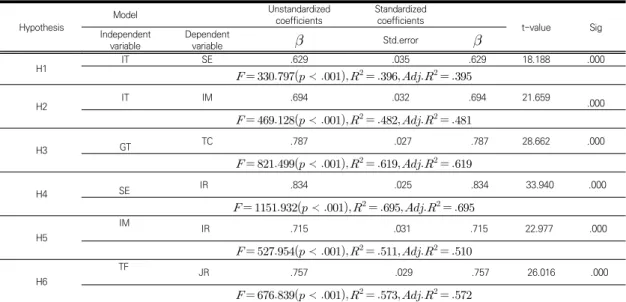
Table 1. Results of regression analysis

for 6-10 years, accounting for 22.09%; 126 persons have worked for 11-20 years, accounting for 24.85%; and 48 persons have worked for more than 20 years, accounting for 9.47%. In terms of the education level of the respondents, there are 77 people with high school (technical secondary school) or below, accounting for 15.19%; 105 people with college or higher vocational education, accounting for 20.71%; 271 people with bachelor's degree, accounting for 53.45; 48 people with master's degree, accounting for 9.47%; and fewer people with doctor's degree, accounting for 1.18%. In terms of the size of the team, 143 people with less than 10 members, accounting for 28.21, 96 people with 10-15 members, accounting for 18.93%, 43 people with 16-20 members, accounting for 8.48%, 17 people with 21-25 members, accounting for 3.35%, 208 people with more than 25 members, accounting for 41.03%. Finally, in terms of the nature of the enterprises in which the respondents are employed, 99 are state-owned enterprises, accounting for 19.3%;

238 are private enterprises, accounting for 46.94%; the number of foreign investors is relatively low, accounting for only 9, accounting

for 1.78%; 21 are joint ventures, accounting for 21%; 81 are public institutions, accounting for 15.98%; 59 are other types, accounting for 11.64%. From the perspective of demographic analysis data, the proportion of various factors of the respondents is in line with the needs of the survey.

4.2 Regression analysis to test hypotheses Based on AMO theory this study conducts multiple regression analysis and single regression analysis on the impact of transformational leadership style on job performance. The analysis results are shown in Table 1.

H1 hypothesis: correlation analysis results of

the influence of individual-oriented

transformational leadership (IT) on self-efficacy

(SE) show that F=330.797(p<0.001), which is very

significant in general studies, R

2

=.396,

Adj.R

2

=.395. IT has a significant impact on

SE(beta IT→SE=.629, t=18.188,p<.001), H1 has

been verified and the hypothesis is valid. H2

hypothesis: the correlation analysis results of the

influence of individual-oriented transformational

leadership (IT) on intrinsic motivation (IM) show

that F=469.128(p<0.001) is statistically significant,

(8)

R

2

=.482,Adj.R

2

=.481. IT has a significant impact on IM(beta IT→IM=.694, t=21.659, p<.001), H2 is verified and the hypothesis is valid. H3 hypothesis: the correlation analysis results of the influence of team-oriented transformational leadership (GT) on organizational climate (TC) show that F=821.499(p<0.001) is statistically significant, R

2

=.619, Adj.R

2

=.619. GT has a significant impact on TC(beta GT→TC=.787, t=28.662, p<.001), H3 has been verified and the hypothesis is valid. H4 hypothesis: correlation analysis results of self-efficacy (SE) on job

performance (IR) showed that

F=1151.932(p<0.001) was statistically significant, R

2

=.695,Adj.R

2

=.694. SE has significant influence on IR(beta SE→IR=.834, t=33.940, p<.001), H4 has been verified and the hypothesis is valid. H5 hypothesis: correlation analysis results of intrinsic motivation (IM) on job performance (IR) showed that F=527.954(p<0.001) was statistically significant, R

2

=.511, Adj.R

2

=.510. The effect of IM on IR(beta IM→IR=.715, t=22.977, p<.001) was significant, and H5 was verified and the hypothesis was valid. H6 hypothesis: the correlation analysis results of organizational climate(TC) on work performance (IR) show that F=676.839(p<0.001) is statistically significant, R

2

=.573, Adj.R

2

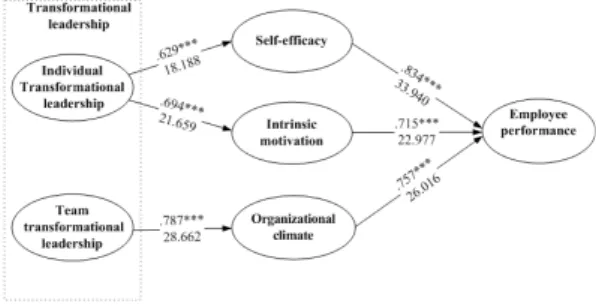
=.572. TC has a significant effect on IR(beta TC→IR=.834, t=33.940, p<.001), H6 has been verified and the hypothesis is valid. The results are shown in Fig. 3.

Note: * means P<0.05; * * P < 0.01; *** means P<0.001.

Fig. 3. The effect of transformational leadership on employee performance

5. Conclusions and implications

Scholars mostly regard transformational leadership as a holistic concept. This study introduces "level analysis" into the field of leadership behavior and verifies the role path of team-oriented and individual-oriented transformational leadership on subordinates' work performance from the perspective of AMO theory of performance through empirical analysis, which is innovative academically.

Through theoretical analysis and empirical examination of the impact of transformational leadership, self-efficacy, intrinsic motivation and organizational climate on employees' job performance, this paper draws the following conclusions: Firstly, individual-oriented transformational leadership has a significant positive impact on employees' self-efficacy and intrinsic motivation. Secondly, team-oriented transformational leadership has a significant positive impact on team atmosphere. Thirdly, self-efficacy, intrinsic motivation and team atmosphere all have positive effects on employees' work performance.

Therefore, transformational leadership can improve the work performance, can bring the expected benefits to organization, the organization and management, the leaders should attach importance to the leadership behavior of different influence on employees, effective ways to strengthen the management of positive leadership behavior, can improve the path of China's leaders in enterprise management.

Revelation: The leadership style of enterprise leaders is crucial to enterprise management.

Transformational leaders pay attention to the

leadership concept and philosophy, influence

employees through the quality of leaders, and

motivate subordinates to work hard for higher

organizational goals. Based on the AMO theory of

performance, leaders can consider improving

employees' work performance in terms of

(9)

subordinates' ability, motivation and the overall environment of the team.

REFERENCES

[1] J. M. Longshore & B. M. Bass. (1987). Leadership and performance beyond expectations. The Academy of Management Review, 12(4), 756.

DOI:10.2307/258081

[2] Y. Han & J. Q. Liao. (2006). Review of the theoretical research on task-performance and non-task-performance structure. Management Review, (10), 41-47+64.

DOI:10.14120/j.cnki.cn11-5057/f.2006.10.008 [3] Z. Q. Wu. (2001). Self-efficacy: a positive self-belief.

Psychological Science, 24(4) , 499-483.

DOI:10.16719/j.cnki.1671-6981.2001.04.041

[4] E. L. Deci & R. M. Ryan. (2004). Intrinsic motivation and self-determination in human behavior.

Encyclopedia of Applied Psychology, 3(2), 437-448.

DOI:10.1007/978-1-4899-2271-7

[5] R. Kark, B. Shamir & G. Chen. (2003). The two faces of transformational leadership: empowerment and dependency. Journal of Applied Psychology, 88(2), 246-255.

DOI:10.1037/0021-9010.88.2.246

[6] X. H. Wang & J. M. Howell. (2010). Exploring the dual-level effects of transformational leadership on followers. Journal of Applied Psychology, 95(6), 1134-1144.

DOI:10.1037/a0020754

[7] R. L. Ackoff. (1999). Transformational leadership.

Strategy and Leadership, 27(1), 20-25.

DOI:10.1108/eb054626

[8] R. F. Wang. (2009). Research and enlightenment on transformational leadership theory. Leadership Science,102(29), 2 9-31.

DOI:10.19572/j.cnki.ldkx.2009.29.011

[9] A. Manaf & L A. Latif. (2014). Transformational Leadership and Job Performance of SMEs Technical Personnel: The Adaptability Cultural Approach as Mediator. Mediterranean Journal of Social Sciences, 5(20), 648-655.

DOI: 10.5901/mjss.2014.v5n20p648

[10] S. Y. Zhu, E. S. Qi & Y. Xu. (2008). An Empirical Study of the Relationship among Transformational Leadership Style, Team Climate, Knowledge Sharing and Performance of Team Innovation. Soft Science, 22(11), 1-4.

DOI:10.3969/j.issn.1001-8409.2008.11.001

[11] L. F. Zhong, Z. Wang & M. Li. (2013). Transformational Leadership, Psychological Capital and Employee Job

Performance. Chinese Journal of Management,10(4), 536-544.

[12] H. Hu, Q. X. GU & J. X. Chen. (2012). The Effects of Transformational Leadership on Organizational Creativity and Innovation: Literature Review and Future. Nankai Business Review, (5), 26-35.

DOI:10.3969/j.issn.1008-3448.2012.05.004

[13] E. L. Deci & R. M. Ryan. (2004). Intrinsic motivation and self-determination in human behavior.

Encyclopedia of Applied Psychology, 3(2), 437-448.

DOI:10.1007/978-1-4899-2271-7

[14] B. Liu, F. T. Xie & Q. C. Meng. (2011). Empirical analysis of the influence mechanism of team atmosphere on team performance. China Soft Scienc e,(11), 133-140.

DOI:10.3969/j.issn.1002-9753.2011.11.014

[15] F. B. ZHong, C. Peng & Y. Chen. (2011). The Impact of Team Climate to Individual Creativity and Team Creativity. Value Engineering,30(15), 12-13.

DOI:10.14018/j.cnki.cn13-1085/n.2011.15.245

이 남(Nan Li) [정회원]

․ 2003년 7월 : 길림공정기술사범학원 마케팅학과(관리학사)

․ 2008년 12월 : 길림대학교 (기업 관리 석사)

․ 2018년 5월 ~ 현재 : 세한대학교 경영 대학원 박사과정

․ 2003년 9월 ~ 현재 : 길림공정기술사 범학원 공상관리학부 교수

․ 관심분야 : 마케팅, 산업디자인

․ E-Mail : [email protected]

정 기 영(Gi-Young Jung) [정회원]

․ 1984년 2월 : 조선대학교 공과대학 (공학사)

․ 1986년 8월 : 명지대학교 대학원 무 역학과(경영학석사)

․ 1990년 5월 : University of Bridgeport (경영학석사)

․ 1993년 5월 : Golden Gate University (경영학박사)

․ 1997년 3월 ∼ 현재 : 세한대학교 경영학과 교수

․ 관심분야 : 고객관계관리, 장소마케팅

․ E-Mail : [email protected]

(10)

김 형 호(Hyung-Ho Kim) [정회원]

․ 1989년 2월 : 경희대학교 전자계산공 학과(공학사)

․ 1992년 8월 : 경희대학교 전자계산공 학과(공학석사)

․ 2018년 2월 : 인천대학교 동북아물류 대학원(물류학박사)

․ 1998년 3월 ∼ 현재 : 세한대학교 항 공교통물류학과 교수

․ 관심분야 : 신경회로망, 항공운송, 시스템다이내믹스

․ E-Mail : [email protected]

수치

Fig.  1.  AMO  theoretical  model
Table  1.  Results  of  regression  analysis
Fig.  3.  The  effect  of  transformational  leadership  on  employee  performance

참조

관련 문서