
http://dx.doi.org/10.12925/jkocs.2018.35.3.807
혼합 생균제가 열 스트레스에 노출된 브로일러의 면역반응, 맹장 미생물과 성장능력에 미치는 효과
송영한․고용균
✝․엄경환․박병성
✝ 강원대학교 동물생명과학대학(2018년 8월 2일 접수: 2018년 9월 7일 수정: 2018년 9월 19일 채택)
Effects of Dietary Probiotic Mixture on Growth Performance, Caecal Microorganism and Immune Response in
Broiler Chickens under Heat Stress
Young-Han Song․Yong GyunGoh✝․Kyung-Hwan Um․Byung-Sung Park✝
College of Animal Life Science, Kangwon National University, ChuncheonGangwondo,
200-701, Republic of Korea
(Received August 2, 2018; Revised September 7, 2018; Accepted September 19, 2018)
요 약 : 본 연구는 열 스트레스 (heat stress, HS)에 노출된 브로일러에서 혼합 생균제의 급여가 혈 액 생체지표, 면역반응, 맹장 미생물 및 생산성에 미치는 영향을 조사하였다. 총 400마리의 브로일러 수 컷 (Ross 308)을 각각 100마리씩 4그룹, C (대조군, 실온 25℃), HS (열 스트레스 33℃), HSP (HS플 러스 혼합 생균제 500, 750 mg/kg) 그룹으로 배치하였다. 브로일러의 증체량, 사료섭취, 사료요구율 및 면역기관 무게는 HSP 그룹에서 HS 그룹과 비교했을 때 증가하였다. 혈액 IgG, lymphocytes 농도는 HS 그룹에서 HSP그룹과 비교했을 때 증가하였고, heterophil과 lymphocyte(H:L)비율, 코르티코스테론 농도 및 폐사율은 낮았다. 맹장의
Lactobacillus
는 HS 그룹과 비교했을 때 HSP 그룹에서 증가하였으나Escherichia coli (E. coli),
coliform bacteria, aerobic bacteria는 낮아졌다. 본 연구결과는 열 스트레스 에 노출된 브로일러에게B. subtilis
,S. galilaeus
및Sphingobacteriaceae
등 3가지 균주가 포함된 혼합 생균제를 급여해주면 면역반응 증진, 미생물 균형을 유지해줌으로써 폐사율을 낮추고 생산성을 개선할 수 있음을 시사해준다.주제어 : 혼합 생균제, 브로일러, 열스트레스, 성장능력, 면역반응, 미생물
Abstract : This study was investigated the effect of dietary probiotic mixture on blood biomarkers, immune responses, caecal microorganism and productivity in broiler chickens under heat stress (HS). A total of 400 broiler chick males (Ross 308) were divided into four groups of 100 heads each, group C (control, room temperature 25°C), HS (heat stress 33°C) and HSP (HS
✝
Corresponding author
(E-mail: [email protected])
plus probiotic mixture 500, 750 mg/kg of diet), respectively. Broiler body weight gain, feed intake, feed conversion ratio and immune organ weight increased in the HSP group compared to the HS group. The concentrations of blood IgG and lymphocyte were increased in the HSP group compared to the HS group, and the heterophil:lymphocyte (H:L) ratio, corticosterone concentration and mortality were low.
Lactobacillus
in the cecum increased in the HSP group compared to the HS group, but was lower inEscherichiacoli (E. coli)
, coliform bacteria and aerobic bacteria. These results indicate that feeding probitic mixture including three strains such asB. subtilis, S. galilaeus
andSphingobacteriaceae
to broiler exposed to heat stress can improve production with lowering mortality by improving immune response and microbial balance.Keywords : Probiotic mixture, broiler, heat stress, growth performance, immune response, microorganism
1. 서 론
기후변화는 대기온도를 상승시킴으로써 여름철 열 스트레스(heat stress, HS)에 노출된 동물의 생산성을 낮춤과 동시에 동물복지를 훼손하여 폐 사율을 높인다[1]. HS는 동물의 성장에 부정적인 영향을 주며 브로일러에서 체중, 사료섭취량, 사 료효율 등 성장능력을 낮추는 것으로 보고되었다 [2]. 조류는 환경과 열을 교환하여 생체 항상성 조절과 유지를 담당하는 열 조절의 행동학적 및 기계적인 적응 반응을 통해 체온을 유지하는 항 온성 동물이다[3]. 브로일러에서 고온 다습환경 조건은 브로일러 사육의 품질을 낮춤과 동시에 생산성을 제한한다[4]. 브로일러의 성장 후기 단 계인 28일령부터 도계일령인 32-35일까지의 높 은 환경온도는 동물복지를 손상함과 동시에 사료 섭취, 사료효율, 성장능력을 떨어뜨려서 생산성을 낮추는 것으로 알려졌다[5]. HS에 노출된 브로일 러는 소화기관으로의 혈류가 감소하여 사료섭취 와 관련한 기호성을 낮추며 영양소 흡수 이용율 이 감소한다[6]. 브로일러에서 HS의 부정적인 피 해를 극복하기 위해생균제의 공급을 비롯한 다양 한 영양전략이 제안되었다[7]. 생균제는 동물에서 정상적인 소화관 미생물의 카테고리를 나타내는 살아있는 미생물이며 HS로부터 브로일러의 유해 한 충격을 줄일 수 있다[8]. HS에 노출된 브로일 러에게 생균제를 급여해 주면 사료섭취량을 높이 고성장능력을 개선하는 것으로 알려졌다[9].
Kalavathy et al. (2008)는 생균제가 브로일러의 사료효율과 증체량을 개선하고 폐사율을 감소시 킨다고 했다[10].
브로일러에게 2개 이상의 살아있는 미생물을 함 유하는 혼합생균제를 급여해주면 성장능력 향상 을 위한 시너지 효과를 발휘하며[11], HS 하에서 가금의 동물복지와 생산성을 증진시키는 것으로 보고되었다[12].
Bacillus subtilis
KCTC2213,Streptomycesgalilaeus
KCTC31133,Sphingobacteriaceae
BRO29의 최소농도 3.5×10⁸ 포자/g의 동량의 혼합물을 함유하는 혼 합생균제가 개발되었다[13].B. subtilis
와S.galilaeus
균주는 영양소를 분해하는 효소 및 항 균물질을 생성하고,Sphingobacteriaceae
는 부엽 토양에 존재하여 생태환경 조절 및 식물의 영양 대사를 촉진하는 것으로 알려졌으며 이러한 균주 로부터 제조한 혼합생균제가 HS 하에서 산란계 의 생산성, 계란품질 및 동물복지를 증진시킨다는 보고가 있다[13]. 그러나 HS에 노출된 브로일러 의 성장능력 및 생산성에 관한 혼합생균제의 연 구결과는 보고된 것이 없다. 본 연구는 열 스트 레스에 노출된 브로일러에서면역반응, 맹장 미생 물 균형 및 생산성에 대한 혼합생균제의 급여효 과를 조사하였다.2. 재료 및 방법
2.1. 혼합 생균제의 제조
본 연구의 혼합 생균제는 경기도 김포시에 소 재한 (주)후인바이오에서 제조한 제품을 사용하였 다. 혼합생균제는 동결건조 포자를 형성하는
B.
subtilis
KCTC2213,S. galilaeus
KCTC31133,Sphingobacteriaceae
BRO29 (2%), 부형제로써Ingredients (%) Growth period
1-21 days 22-35 days
Corn grain 52.00 50.00
Soybean oil meal 34.00 25.00
Corn gluten meal 4.70 5.70
Wheat bran - 10.00
Soy oil 5.00 5.00
Lime stone power 1.25 1.25
Calcium phosphotate dibasic 1.70 1.70
Sodium chloride 0.25 0.25
DL-methionine (50%) 0.30 0.30
L-lysine HCl (78%) 0.30 0.30
Mineral mix.1) 0.34 0.34
Vitamin mix.2) 0.16 0.16
Total 100 100
Chemical composition
Metabolizable energy (kcal/kg) 3,100 3,150
Crude protein (%) 22.00 20.00
Calcium (%) 1.00 0.90
Available P (%) 0.45 0.40
1)Contained per kg of diet: Fe, 80 mg; Zn, 80 mg; Mn, 70 mg; Cu, 7 mg; I, 1.20 mg; Se, 0.30 mg; Co, 0.70 mg. 2)Contained per kg of diet: vitamin A (retinyl acetate), 10,500 IU;
vitamin D3, 4,100 IU; vitamin E (DL-α-tocopheryl acetate), 45 mg; vitamin K3, 3.0 mg;
thiamin, 2.5 mg; riboflavin, 5 mg; vitamin B6, 5mg; vitamin B12, 0.02 mg; biotin, 0.18 mg;
niacin, 44 mg; pantothenicacid, 17 mg; folic acid, 1.5 mg.
Table 1. Composition and nutrient analysis of basal diets 지렁이 분변토(98%)로 구성되어있다.
B. subtillus
KCTC2213,
S. galilaeus
KCTC31133 및Sphingobacteriaceae
BRO29는 지렁이 분변토부 터 분리한 균주로써 한국균주은행(KCTC)으로부 터 공급받았다. 제품 1 g은B. subtilis
KCTC2213,S. galilaeus
KCTC31133 및Sphingobacteriaceae
BRO29를 최소 3.5×10⁸ colony forming unit (CFU/g)의 동일한 양을 함 유하였다[13].2.2. 실험설계 및 사양관리
실험동물에 대한 과학적인 절차는 미국의 실험 동물 가이드라인[14]에서 제시된 과학적이고 윤 리적인 절차를 따랐으며 강원대학교 실험윤리위 원회 (IACUC)의 승인을 받아서 진행하였다(승인
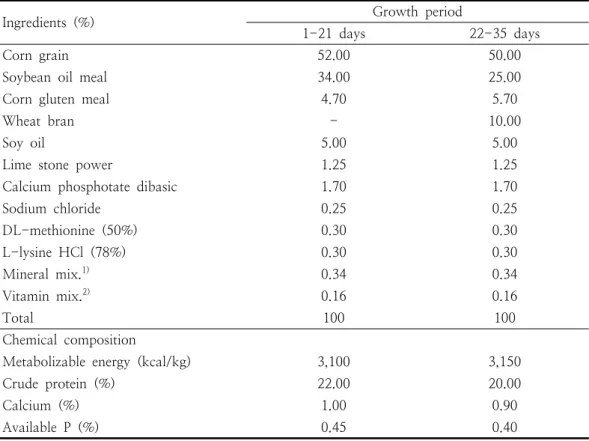
번호: KW-151117-1). 부화 당일 브로일러 수컷 (Ross 308) 400마리를 4처리구로 완전 임의배치 하여 35일 동안 사육하였다. 각 처리군은 총 100 마리를 이용하였으며 4반복 (반복 당 25마리)으 로 처리하였다. 브로일러는 4개의 처리 그룹으로 써, C(대조군, 실온 25℃), HS(열 스트레스 3 3℃), 그리고 HSP (Heat stress plus prebiotics, HS+혼합 생균제 500, 750 mg/kg of diet)로 구 분하였다. 실험사료는 미국의 가금양양소요구량사 양표준[15]에서 제시한 브로일러의영양소 요구량 을 충족하도록 배합하였다. 실험사료의 배합표 및 영양소 함량은 Table 1과 같다. 전체 실험기간 동안 브로일러는 24시간 연속조명을 실시하였으 며 음수 및 실험사료에 자유롭게 접근할 수 있는 표준상태 하에서 사육하였다. 깔짚은 10cm 깊이
의 왕겨를 사용하였다. 사육실의 온도는 입추 당 일에서 3일까지는 33℃로 유지하였고 그 다음부 터 주당 2-3℃씩 낮추었고 22일부터 27일까지는 일반 환경온도에서 상대습도 63%를 유지하였다.
HS는 28일부터 35일까지 온도, 습도가 자동으로 조절되는 사육실에서 12:00부터 16:00까지 각각 34±2℃, 70%로써 유도하였으며 그 이후에는 2 5℃ 실온으로 유지하였다.
2.3. 생산성 및 면역기관 무게
브로일러의 성장초기(1-21일)와 후기(22-35일) 및 총 사양기간에 따른 사양성적(사료섭취량, 증 체량, 사료효율)을 조사하였다. 폐사율은 매일 기 록하였으며 먹이통과 음수통에 접근할 수 없는 것으로 간주되거나 절름발이 중상을 보이는 개체 를 포함하였다. 도계 12시간 전에 실험사료를 철 회하였고 실험 종료 시에 생체중의 평균 범위에 해당하는 개체를 처리구별로 20%인 20마리(각 펜 당 5마리)씩 경추탈골에 의해서 스트레스를 주지 않고 안정적으로 희생하였다. 면역기관 흉 선, 비장, F 낭((F-sac, bursa of Fabricius) 무게 를 측정하여 생체중에 대한 상대적인 무게로 나 타냈다.
2.4. 혈액 코르티코스테론과 면역물질
사육 현장에서 각 개체로부터 혈액 5 ml를 상 완정맥(brachial vein)을 경유하여 채혈하여 K3 EDTA-coated test tubes 속으로 수집하였다. 모 든 혈액 샘플을 얼음에 저장하고 실험실로 이송 하여 4℃에서 3000 rpm에서 30분간 원심분리하
여 -20℃에서 보관하였다. 혈청의
immunoglobulin은 chicken IgG ELISA kit (Bethyl Laboratories, Montgomery, TX, USA), 코르티코스테론 농도는 HS EIA kit (Enzyme immunoassay kit, IDS, Boldon, UK)를 이용하여 측정하였다. Precision microplate reader (Molecular Devices Inc, New York, USA)에 의 해서 450 nm에서 흡광도를 측정하여 IgG의 량 을 계산하였다. 광학현미경을 통하여 heterophil (H)과 lymphocyte (L)를 구분하였으며 슬라이드 당 100개의 백혈구, 조류 당 총 200개의 세포를 카운트한 다음 H:L 비율을 계산하였다[16].
2.5. 맹장 미생물
도계 후 곧 바로 장내 미생물을 조사하기 위해 서 혐기적인 방법으로 맹장을 채취한 후 얼음 상
자 위에서 유지하였다. 맹장은 분석할 때까지 anaeroGen sachets (Oxoid, Hampshire, UK)가 갖춰진 sealed anaerobic jars (Oxoid, Basingstoke, UK)에서 혐기상태로 유지하였다.
맹장 내용물을 멸균된 혐기성 생리식염수 (phosphorus buffered saline; PBS 0.1 M, pH 7.0)로 혼합하여 10배 희석 (1:9, wt/vol) 한 다 음에 일련의 희석을 계속하였다. 모든 절차는 anaerobic chamber (5% hydrogen, 5% CO2, balanced nitrogen)에서 혐기상태로 이루어졌다.
배양은 희석된 10-2~10-7에서 각각 100 마이크로 리터를분주하여 멸균된 평판 선택배지 즉 McConkey purple agar (
Escherichia
), MRS agar, Oxoid, Basingstoke, UK (Lactobacillus
), SS agar, Difco (Salmonella
), Nutrient agar, Difco (Total aerobic bacteria), Violet red bile agar, Difco (Coli form)에서 실행하였다.Escherichia coli, Salmonella,
Total aerobic bacteria 는 37℃에서 24시간 호기배양 하였고Lactobacillus
는 anaeroGen sachets 가 갖춰진 sealed anaerobic jars 를 이용한 혐기상태 하에서 37℃ 48시간 정치배양한 후 각각의 평판배지에서 미생물 카운터로써 콜로니 수를 조사하였다. 모든 미생물 군락의 수는 맹장내용물 g 당 균수 (colony-forming unit, CFU/g of wet of cecum content)로써 상용로그를 취하여 제시하였다.2.6. 통계처리
모든 자료에 대한 통계처리는 SPSS/Windows version 21.0 (statistical package for the social science, SPSS Inc., Chicago, IL, USA)를 사용하 였다. 각 처리군의 평균에 대한 일원분산 분석을 진행하였고 던칸의 다중검정시험으로 95% 신뢰 수준에서 통계적인 유의차를 검정하였다(p<0.05).
3. 결과 및 고찰
3.1. 브로일러의 성장능력
HS 하에서 혼합 생균제를 섭취한 브로일러의 생산성은 처리군 사이의 유의한 차이가 있었다 (Table 2). 증체량, 사료섭취 및 사료 요구율은 C 와 비교할 때 HS 그룹은 각각 29.40, 17.40, 13.64% 감소하였으나(p<0.05), C와 HSP 그룹 사이의 차이는 없었다. 폐사율은 HS 그룹은 3.50%로써 매우 높게 나타났으나 HSP750 그룹
Item Treatments
SEM
P
-valueC HS HSP 500 HSP 750
Body weight 2,173a 1,534b 2,032a 2,187a 80.072 0.0273 Feed intake 3,287a 2,715b 3,255a 3,215a 140.2 0.0311 Feed efficiency 0.66a 0.57b 0.62a 0.65a 0.0141 0.0078
Mortality, % - 3.56 - - - -
C: control, HS: heat stress, HSP 500 (HS plus probiotic mixture 500 mg/kg of diet), HSP 750 (HS plus probiotic mixture 750 mg/kg of diet), a,b
P
<0.05.Table 2. Effects of dietary probiotic mixture on growth performance in broiler chickens exposed heat stress(g/head)
Items Treatments
SEM
P
-valueC HS HSP 500 HSP 750
Liver 2.19a 1.87b 2.23a 2.55a 0.077 0.0001
F-sac 0.13a 0.07b 0.12a 0.13a 0.002 0.0001
Thymus 0.23a 0.12b 0.22a 0.22a 0.005 0.0001
Spleen 0.15a 0.08b 0.12a 0.13a 0.005 0.0001
C: control, HS: heat stress, HSP 500 (HS plus probiotic mixture 500 mg/kg of diet), HSP 750 (HS plus probiotic mixture 750 mg/kg of diet), a,b
P
<0.05.Table 3. Effects of dietary probiotic mixture on organ weight in broiler chickens exposed to heat stress (g/100 g body weight)
Items Treatments
SEM
P
-valueC HS HSP 500 HSP 750
Corticosterone, ng/ml 0.67b 2.87a 0.42b 0.36b 0.03 0.0151 Heterophil (H), % 18.01b 27.43a 17.66b 17.85b 0.79 0.0271
IgG mg/ml 1.82b 2.56a 1.59b 1.76b 0.06 0.0001
Lym phocyte (L), % 70.61a 45.08b 71.08a 72.57a 3.01 0.0207 H : L ratios 0.26b 0.61a 0.25b 0.25b 0.00 0.0001 C: control, HS: heat stress, HSP 500 (HS plus probiotic mixture 500 mg/kg of diet), HSP750 (HS plus probiotic mixture 750 mg/kg of diet), a,b
P
<0.05.Table 4. Effects of dietary probiotic mixture on blood biomarkers in broiler chickensexposed to heat stress
은 정상적인 성장 및 체중을 유지하였다. 혼합 생균제는 HS를 받은 브로일러에서 증체량, 사료 섭취를 증가시켰고 사료 요구율을 개선하였다.
HS 하에서
B. subtilis
,S. galilaeus
및Sphingobacteriaceae
등 3 균주의 혼합 생균제를 섭취한 브로일러에서 생산성이 높았던 점은 이러한 혼합 생균제의시너지 효과에 의한 소장 융모 활성화를 통한 영양소의 생체이용율(분석하지 않 았음), 면역반응 증가(Table 4) 및 맹장 미생물의 균형(Table 5)을 경유한 신진대사의 활성화에 기 인한 것으로 볼 수 있다[12]. HS 하에서 혼합 생 균제의 급여가 산란계의 생산성을 개선하였다는
Items Treatments
SEM
P
-valueC HS HSP 500 HSP 750
Lactobacillus
7.65a 3.35b 7.87a 7.04a 0.12 0.0001E. coli
4.28b 5.07a 4.16b 4.09b 0.10 0.0001C oliform bacteria 4.77b 5.82a 4.55b 4.39b 0.15 0.0001 Aerobic bacteria 5.78b 7.14a 6.03b 5.81b 0.14 0.0001 C: control, HS: heat stress, HSP 500 (HS plus probiotic mixture 500 mg/kg of diet), HSP 750 (HS plus probiotic mixture 750 mg/kg of diet), a,b
P
<0.05.Table 5. Effects of dietary probiotic mixture on caecal microorganismin broiler chickens exposed to heat stress(CFU/g)
보고는 본 연구의 결과를 지지해준다[13]. HS를 받은 가금의 생산성 감소는 식욕부진, 사료섭취 감소, 대사작용 및 코르티코스테론증가 등 다양한 요인과 관련이 있다[17]. 가금에 대한 영양전략의 일환으로 사료에 생균제를 첨가하면 HS에 의한 더위 피해를 예방하여 동물에게 유익한 효과를 나타낼 수 있다[7]. HS는 면역반응을 억제하여 동물의 폐사율을 증가시키는 것으로 알려졌다 [18]. Rahimi와 Khaksefidi (2006), Hasan 등 (2015)은 브로일러에게 본 연구에서 사용된 생균 제와 다른 생균제를 사료 및 음수를 통하여 공급 해주었을 때 정상조건의 대조군 및 HS에 노출된 개체에 비해 체중증가를 보고하였다[19, 20].
3.2. 면역기관 무게
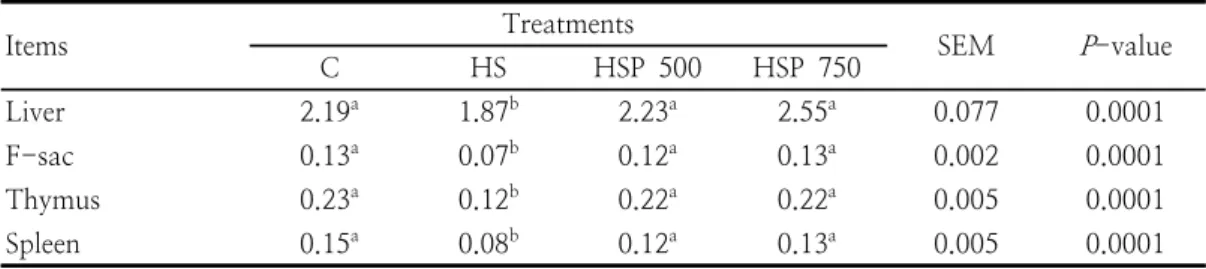
간, F-sac, 흉선과 비장의 상대적인 무게는 C, HSP 500, HSP 750 그룹과 비교할 때 HS 그룹 에서 각각14.61-26.66%, 41.66-47.15%, 45.45- 47.83%, 33.33-46.67% 유의하게 낮았다(Table 3, p<0.05). 생균제를 급여한 브로일러에서 면역 기관 무게가 증가한 점은 생균제가 소화기관을 경유한 사료섭취량을 자극하고 영양소의 흡수이 용율을 높임으로써 면역세포 조직의 발육을 촉진 시켰을 것으로 볼 수 있다[18].HS 그룹에서 사료 섭취량 감소로 영양소의 섭취 부족에 기인한 면 역세포 발육이 낮았을 것으로 생각된다[21].
Quinteiro-Filho 등[22]은 HS가 브로일러에서 면 역기관 무게를 감소하는 것으로 보고하였다. 열 스트레스에 노출된 브로일러에게 생균제 급여로 면역세포의 발육을 자극하여 폐사율을 낮추고 생 산성을 증가시킨다는 보고는 결과와 일치한다 [23]. 생균제에 포함된 미생물의 가장 중요한 역 할 중 하나는 침입하는 병원성 미생물에 대한 면
역력을 자극하는 것이다. 소화관의 정상적인 미생 물을 비롯한 다양한 생균제가 숙주동물에서 면역 을 자극하는 것으로 알려져 있다[24]. Abudabos 등(2016)은
Salmonella enterica
subsp로 항원 투 여 전과 후에 생균제로써Bacillus subtilis
PB6와Bacillus Cereus var. toyoi
두 균주를 사용하였을 때 면역기관 무게 차이가 나타나지 않았다고 하 였다[25].3.3. 혈액 생체지표
스트레스 호르몬인 혈액 코르티코스테론, IgG, heterophil, lymphocyte 농도 및 H:L 비율은 C, HSP 500, HSP 750 그룹과 비교할 때 HS 그룹 에서 나쁜 결과를 나타냈다(Table 4). 혈액 코르 티코스테론, IgG, heterophil 농도 및 H:L 비율 은 C, HSP 그룹과 비교할 때 HS 그룹에서 각각 4.28-7.97, 1.52-1.55, 1.41-1.61, 2.44 배 높았 으나 lymphocyte 농도는 36.16-36.58% 낮았다 (p<0.05). 본 연구의 결과는 HS에 노출된 브로일 러에게 혼합 생균제를 급여해주었을 때 면역기관 무게 증가(Table 3)와 함께 IgG의 농도가 증가함 을 발견했다. 이러한 사실은 브로일러에서 혼합생 균제의 섭취가 소화기관을 경유한 영양소의 흡수 이용율을 높임으로써 면역세포 조직의 발육을 촉 진시켰으며 이에 따라 IgG 분비량이 높아진 것으 로 볼 수 있다[18]. HS를 받은 산란계에서 H:L 비율이 증가하며 혼합 생균제급여로 이 비율이 낮아진다는 보고는 본 연구의 결과를 지지해준다 [13].HS는 H:L 비율, 코르티코스테론과 같은 특 이적 면역생체지표를 높여줌으로써 조류에서의 면역반응에 영향을 미친다[26].
3.4. 맹장 미생물
맹장 미생물 (Table 5) 가운데C, HSP 그룹과 비교할 때 HS 그룹에서
Lactobacillus
균수는 52.41-57.43% 낮아졌으나, 이와 반대로E. coli,
coliform bacteria, aerobic bacteria는 각각 1.18-1.24, 1.22-1.33, 0.20-1.18 배 유의하게 증가하였다(p<0.05). 그러나 C와 HSP 그룹 사이 의 차이는 없었다. 본 연구의 결과는 혼합 생균 제가맹장의 미생물 균형을 유지해줌으로써 유해 미생물의 침입을 억제하였으며 이전의 보고와 일 치한다[12]. 맹장 미생물은 주로Clostridia
와Lactobacilli
이며 생균제로써Lactobacillus
균주 는 미생물 균형을 유지해주고 HS에 의해 유발된 변화에 대한 토착 미생물의 자연적인 안정성을 유지해주는 것으로 알려졌다[26]. 스트레스가 많 은 환경에서는 장내 미생물 생태계의 안정화가 방해를 받아 돌발장애가 발생한다[19].4. 결 론
브로일러 수컷(Ross 308) 400마리를 4처리구 로 완전임의배치 하여 35일 동안 사육하였다. 처 리 군은 C(대조군, 실온 25℃), HS(열 스트레스 33℃), 그리고 HSP (Heat stress plus prebiotics, HS+혼합 생균제 500, 750 mg/kg)로 구분하였 다. 열 스트레스에 노출된 브로일러에게
B.
subtilis
,S. galilaeus
및Sphingobacteriaceae
등 3가지 균주가 포함된 혼합 생균제를 급여하여 생 산성, 면역반응, 맹장 미생물을 조사했으며 다음 과 같은 결과를 얻었다.1. 증체량, 사료섭취 및 사료요구율은 HS 그룹 에서 감소하였으나 C와 HSP 그룹 사이의 차이는 없었다.
2. 간, F-sac, 흉선과 비장의 상대적인 무게 는 HSP 그룹과 비교할 때 HS 그룹에서 낮았 다
3. 혈액 코르티코스테론, IgG, heterophil, lymphocyte 농도 및 H:L 비율은 HSP 그룹 과 비교할 때 HS 그룹에서 나쁜 결과를 나 타냈다
4. 맹장 미생물은 HSP 그룹과 비교할 때 HS
그룹에서
Lactobacillus
균수는 낮아졌으나E. coli,
coliform bacteria, aerobic bacteria 균수는 증가하였다References
1. B. Slimen, T. Najar, A. Ghram, M.
Abdrrabba, “Heat stress effects on livestock: molecular, cellular and metabolic aspects, a review”, Journal of Animal Physiology Animal Nutrition (Berl), Vol.
100, pp. 401-412, (2016).
2. M. U. Sohail, A. Ijaz, M. S. Yousaf, K.
Ashraf, H. Zareb, M.Aleem, H.Rehman,
“Alleviation of cycle heat stress in broilers by dietary supplementation of mannan- oligosaccharide and lactobacillus-based probiotic: dynamic of cortisol, thyroid hormones, cholesterol, creactiveprotein and humoral immunity”,
Poultry Science,
Vol.89, pp. 1934-1938, (2010).
3. J. L. M. Mello, M. M. Boiago, A.
Giampietro-Ganeco, V.Berton, L. D. C.
Vieira, R. A. I. Souza, F. B. I. Ferrari, H.Borba, “Periods of heat stress during the growing affects negatively the performance and carcass yield of broilers”,
Archivos de Zootecnia
, Vol. 64, pp. 339-345, (2015).4. A. M. Hassan, H. May AbdelAzeem, P.G.
Reddy, “Effect of some water supplements on the performance and immune system of chronically heat-stressed broiler chicks”,
International Journal of Poultry Science,
Vol. 8, pp. 432-436, (2009).5. M. A. Cooper, K. W. Washburn, “The relationships of body temperature to weight gain, feed consumption, and feed utilization in broilers under heat stress”,
Poultry Science,
Vol. 77, pp. 237-242, (1998).6. Y. A. Attia, S. S. Hassan, “Broiler tolerance to heat stress at various dietary protein/energy levels”,
European Poultry Science,
Vol. 81, DOI: 10.1399/eps.2017.pp. 171, (2017).
7. L. J. Lara, M. H. Rostagno, “Impact of heat stress on poultry production”,
Animals,
Vol. 3, pp. 356-369, (2013).8. S. Hemaiswarya, R. Raja, R. Ravikumar, I. S. Carvalho, “Mechanism of action of probiotics”,
Brazilian Archives of Biology and Technology,
Vol. 56, pp. 113-119, (2013).9. Y. A. Attia, A. A. Mohammed, A. S.
El-Shafey, Y. A. Rehab, W. K. Kim,
“Enhancing tolerance of broiler chickens to heat stress by supplementation with vitamin E, vitamin C and/or probiotics”,
Annals and Animal Sci
ence, Vol. 17, pp.1155–1169, (2017)
10. R. Kalavathy, N. Abdullah, S. Jalaludin, C. M. V. L. Wong, Y. W. Ho, “Effect of lactobacillus cultures and oxytetracycline on the growth performance and serum lipids of chickens”,
International Journal of Poultry Science
, Vol. 7, pp. 385–389, (2008).11. Z. F. Zhang, J. H. Cho, I. H. Kim,
“Effects of
Bacillus subtilis
UBT-MO2 ongrowthperformance, relative immune organ weight, gas concentration in excreta, and intestinal microbial shedding in broiler chickens”,Livestock Science
, Vol. 155, pp.343-347, (2013).
12. P. Zhang, T. Yan, X. Wang, S. Kuang, Y.
Xiao, W. Lu, D. Bi, “Probiotic mixture ameliorates heat stress of laying hens by enhancing intestinal barrier function and improving gut microbiota”,
Italian Journal of Animal Science,
Vol. 16, pp. 292-300, (2017).13. V. A. Zammit, S. O. Park, “Effects of probiotics on animal welfare, immune response, fecal ammonia, egg quality and performance of laying hens exposed to heat stress”,
Acta Agriculturae Scandinavica Section A-Animal Science,
In press.14. National Research Council Guide for the care and use of laboratory animals, 8th Edition. The national academies press.
Washington, DC. USA. (2010).
15. National Research Council Nutrient requirements of poultry. 9th Edition, Natl.
Acad. Press, Washington, DC. USA.
(2004).
16. H. W. Cheng, S. D. Eicher, Y. Chen, P.
Singleton, W. M. Muir, “Effect of genetic selection for group productivity and longevity on immunological and hematological parameters of chickens”,
Poultry Science
, Vol. 80, pp. 1079-1086, (2001).17. S. Sugiharto, T. Yudiarti, I. Isroli, E.
Widiastuti, E. Kusumanti,
“Dietarysupplementation of probiotics in poultry exposed to heat stress-A review”,
Annals of Animal Science,
Vol. 17, pp.591-604, (2017).
18. S. M. L. Kabir, “The role of probiotics in the poultry industry”,
International Journal of Molecular Science,
Vol 10, pp. 3531–3546, (2009).
19. S. Hasan, M. M. Hossain, J. Alam, M. E.
R. Bhuiyan, “Beneficial effects of probiotic on growth performance and hemato- biochemical parameters in broilers during heat stress”,
International Journal of Innovation and Applied Studies,
Vol. 10, pp. 244-249, (2015).20. S. H. Rahimi, A. Khaksefidi, “A comparison between the effects of a probiotic (Bioplus 2B) and an antibiotic (virginiamycin) on the performance ofbroiler chickens under heat stresscondition”,
Iranian Journal of Veterinary Research
, Vol. 7, pp. 23-28, (2006)21. M. U. Sohail, A. Ijaz, M. Younus, M. Z.
Shabbir, Z. Kamran, S. Ahmad, H.
Anwar, M. S. Yousaf, K. Ashraf, A. H.
Shahzad, H. Rehman, “Effect of supplementation of mannan oligosaccharide and probiotic on growth performance, relative weights of viscera, and population of selected intestinal bacteria in cyclic heat-stressed broilers”,
Journal of Applied
Poultry Science,
Vol. 22,pp. 485-491, (2013).22. W. M. Quinteiro-Filho, A. Ribeiro, V.
Ferraz-de-Paula, M. L. Pinheiro, M.
Sakai, L. R. M. Az, A. J. P. Ferreira, J.
Palermo-Neto, “Heat stress impairs performance parameters, induces intestinal injury, and decreases macrophage activity in broiler chickens”,
Poultry Science,
Vol.89, pp. 1905-1914, (2010).
23. S. T. Ahmed, M. M. Islam, H. S. Mun, H. J. Sim, Y. J. Kim, C. J. Yang, “Effects of
Bacillus amyloliquefaciens
as a probiotic strain on growth performance, cecal microflora, and fecal noxious gas emissions of broiler chickens”,Poultry Science
, Vol.93, pp. 1963-1971, (2014).
24. S. U. Mahfuz, M. J. Nahar, C. Mo, Z.
Ganfu, V. Zhongjun, S. Hui, “Inclusion of probiotic on chicken performance and immunity: A review”,
International Journal of Poultry Science,
Vol. 16, pp. 328-335, (2017).25. A. M. Abudabos, A. H. Alyemni, H. A.
H. Zakaria, Effect of two strains of probiotics on the antioxidant capacity, oxidative stress, and immune responses of
Salmonella
-challenged broilers”,Brazilian Journal of Poultry Science,
Vol.18, pp.175-180, (2016).
26. K. C. Mountzouris, P. Tsitrsikos, I.
Palamidi, A. Arvaniti, M. Mohnl, V.
Schatzmayr, V. Fegeros, “Effects of probiotic inclusion levels in broiler nutrition on growth performance, nutrient digestibility, plasma immunoglobulins, and cecal microflora composition”,
![Table 5. Effects of dietary probiotic mixture on caecal microorganismin broiler chickens exposed to heat stress(CFU/g) 보고는 본 연구의 결과를 지지해준다[13]](https://thumb-ap.123doks.com/thumbv2/123dokinfo/4918544.537213/6.892.151.746.879.1010/effects-probiotic-microorganismin-chickens-보고는-연구의-결과를-지지해준다.webp)
