• 검색 결과가 없습니다.

Development and Evaluation of Non-Hydrous Skin Analogue Liquid Crystal using Thermo-Sensitivity Smart Sensor

N/A
N/A
Protected

Academic year: 2021

Share "Development and Evaluation of Non-Hydrous Skin Analogue Liquid Crystal using Thermo-Sensitivity Smart Sensor"

Copied!
8
0
0

로드 중.... (전체 텍스트 보기)

전체 글

(1)

http://dx.doi.org/10.12925/jkocs.2014.31.3.367

Development and Evaluation of Non-Hydrous Skin Analogue Liquid Crystal using Thermo-Sensitivity Smart Sensor

Kwang-Ho Yoo

․Jae-Hwa Hong․So-Hee Eun․Tae-Hwa Jeong․Kwan-Young Jeong Skin research institute, Korea Kolmar Corporation, 170-7, Seojeong-Ri, Jeonui-Myun,

Yeongi-Gun, Chung-Nam, Korea

(Received June 30, 2014; Revised September 18, 2014; Accepted September 25, 2014)

Abstract : In this study, skin permeation enhancement was confirmed by designing it to have a structure and composition similarity to the intercellular lipids that improve miscibility with skin by cross-linked lipids poloxamer. The cross-linked lipids poloxamer was synthesized and analyzed by 1H NMR that structure dose had conjugated pluronic with ceramide3. Active component is released by modification of liquid crystal structure because PPO part, large-scale molecule block of pluronic, has hydrophobic nature at skin temperature of 35℃.

Conjugated pluronic with ceramide3 was synthesized using Pluronic F127 and p-NPC (4-nitrophenyl chloroformate) at room temperature yielded 89%. Pluronic(Ceramide 3-conjugated Pluronic) was synthesized by reaction of p-NP-Pluronic with Ceramide3 and DMAP. The yield was 51%.

This cross-linked lipids poloxamer was blended and dissolved at isotropic state with skin surface lipids, phospholipid, ceramide, cholesterol and anhydrous additive solvent. Next step was preceded by α-Transition at low temperature for making the structure of Meso-Phase Lamella, and non-hydrous skin analogue liquid crystal using thermo-sensitivity smart sensor, lamellar liquid crystal structure through aging time.

For confirmation of conjugation thermo-sensitivity smart sensor and non-hydrous skin analogue liquid crystal, structural observation and stability test were performed using XRD(Xray Diffraction), DSC(Differential Scanning Calorimetry), PM (Polarized Microscope) And C-SEM (Cryo-Scanning Electron Microscope).

Thermo-sensitivity observation by Franz cell revealed that synthesized smart sensor shown skin permeation effect over 75% than normal liquid crystal. Furthermore, normal non-hydrous skin analogue liquid crystal that not applied smart sensor shown similar results below 35℃ of skin temperature, but its effects has increased more than 30% above 35℃.

Keywords : poloxamer, ceramide, thermo-sensitivity polymer, thermo-sensitivity non-hydrous liquid crystal, skin permeation



Corresponding author

(Email: [email protected])

(2)

1. Introduction

Recently, in response to functional requirements such as increase in interest as to functional cosmetic, keeping skin moisture in skin care cosmetic, absorption of oil-soluble ingredients, the structure of LC (liquid crystal) lipid such as liposome, LC, gel and multi-layer emulsion are being studied[1~4].

To date, studies of how to trigger drug delivery effects that are similar in structure and composition of skin are implemented actively through the studies as to the structure and ingredients of skin with a structure proper to penetrate active ingredients in cosmetic composition effectively into the skin.

This LC emulsification is a unique mechanism, can capsulate skin beauty activating ingredients, reinforce lipid layer among skin cells as the ingredients are similar to skin lipid, prevent evaporation of skin moisture, and prohibit strange substances from the outside to penetrate into the skin [7,8].

However, this study entered a stagnant period, reaching its limit as of, which has been limited to the stabilization of active ingredients rather than percutaneous absorption. Therefore, we conducted a study that controls drug-releasing speed within non-aqueous skin analogous layer LC that has applied thermosensitive polymer with the structure of figure 1.

HO O O

O O

OH

X Y Z

One poloxamer molecule POP group

POE Group

Fig. 1. Poloxamer, the basic structure of thermosensitive polymer.

Poloxamer is tri-block copolymer structure in which POE unit, POP unit and POE unit are cross-arranged, and polymer chain is rearranged by the gap of each unit’s solubility

changes, which shows LCST (Lower Critical Solution Temperature) System [9-13].

This study synthesizes Ceramide 3-conjugated Pluronic with ceramide, a phospholipid ingredient, introduced to poloxamer, and introduced this inside the non-hydrous skin analogue LC layer to make thermosensitive smart sensor non-hydrous LC with lamella LC structure, which is stable.

2. Materials and Experimentals

2.1. Materials

A poloxamer was purchased from BASF (Germany), 4-DMAP(4-dimethylaminopyridine) was purchased from Sigma-aldrich(U.S.A), DCM(Dichloromethane) was purchased from Samchun(Korea), MC(methylene chloride) was purchased from Samchun(Korea), Ceramide 3 was purchased from Doosan(Korea), and p-NPC(4-Nitrophenyl chloroformate) was purchased from Fluka(U.S.A).

Phospholipid(DSPC) was purchased from Lipoid(Germany), Ceramide(CER3) was purchased from Doosan biotech(Korea), and cholesterol(CHOL) was purchased from Solvay (U.S.A). These materials were used without any pre-treatment. All other ingredients were of cosmetic grade such glycerin, oils, polymers, and emulsifiers etc. as commercial grades and without any pre-treatment.

2.2. Methods

2.2.1. Synthesis of Ceramide 3-conjugated Pluronic

It activated the hydroxy group at both ends

of pluronic, made it react with amine of

phospholipid head group like phosphatidylethan

olamine, and synthesized thermosensitive smart

sensor polymer with which skin forming lipids

such as phospholipid and ceramide are

combined as Fig. 2.

(3)

HO O O

O O

OH

99 65 99

p-NPC, DCM, K2CO3, 5h

O O O

O O

O

99 65 99

O O

NO2

O

NO2

P -NPC-Pluronic, Yield 89%

4-DMAP, DCM, Ceramide 3, rt, 24h

O O O

O O

O

99 65 99

O O O

HO HO

NH O

21

12

HO

HO NH

O

21

12

Ceramide 3-conjugated Pluronic, Yield 51%

Fig. 2. Ceramide 3-conjugated pluronic synthesizing mimetic diagram.

A reaction is substituting nitrobenzene group for hydroxy group by using bulky leaving group (p-NPC) to raise reactivity on both ends of pluronic. It solved pluronic 4g and p-NPC 1.2g with DCM 20mL, solved catalyst K2CO3 3g with DCM 10mL, slowly added and reacted them for 5 hours, and worked up to get p-NPC-Pluronic with the yield of 89%.

p-NPC-Pluronic 1g, 4-DMAP 0.5g, Ceramide 0.75g were soluble in MC 30mL, and were reacted at room temperature for 24 hours to get Ceramide 3-conjugated Pluronic with the yield of 51%.

p-NPC-Pluronic, Ceramide 3-conjugated Pluronic gained from this reaction was structure-analyzed with 1H NMR.

2.2.2. Non-hydrous skin analogue LC This study applied thermosensitive polymer to non-hydrous LC, as the lipid, ceramide 3, combined within the cosmetics are low with thermal conductivity with water, so that stabilizes active ingredient without any change in capsule wall, and developed it so that effective skin penetration is possible by emitting active ingredients with the capsule wall to be opened, forming thin layer when applying it on the skin, and inducing to skin

temperature.

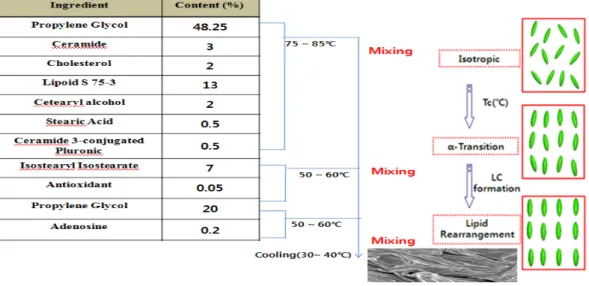
Production flow mapping was drawn in Fig.

3, and first, lipid composing LC such as phospholipid, ceramide and cholesterol and Ceramide 3-conjugated Pluronic were combined with the solvent without water and solved to be combined under isotropic status, and meso-phase lamella structure was formed according to self-assembly feature of lipids through α-transition by cooling down this, and ripened this to form stable lamella LC structure, and the composition is provided at Fig. 3.

In order to check out if Ceramide 3-conjugated Pluronic is stably introduced to non-hydrous skin analogous layer LC, thermosensitive smart LC structure stability was confirmed which was produced by using XRD (X-Ray Diffraction), DSC (Differential Scanning Calorimetry), PM(Polarized Microscope) and C-SEM (Cryo-Scanning Electron Microscope).

3. Results

Fig. 4 checked the results that considered

the influence of non-hydrous skin analogous

(4)

Fig. 3. Thermosensitive polymer non-hydrous skin analogous layer LC production flow mapping.

layer LC on structure stability by using XRD when it has introduced Ceramide 3-conjugated Pluronic.

As Fig. 4, even we introduced Ceramide 3-conjugated Pluronic to non-hydrous skin analogous layer LC, as for the XRD pattern, Q(Å-1) is expressed in integer ratio as 0.13, 0.26 and 0.39, which is keeping lamella LC well, and XRD peak intensity is intensified, which confirmed that stouter LC structure was formed.

Fig. 4. XRD patterns of the skin model LC for skin barrier repair

Fig. 5 shows the results that considered the influence of non-hydrous skin analogous layer LC on the structural stability according to temperature changes when it has introduced

Ceramide 3-conjugated Pluronic.

Fig. 5. DSC curves for skin model LC for skin barrier repair during heating process from 20℃ to 120℃.

As we can see from Fig. 5, we found out that as for DSC pattern, Tc (phase transitional temperature) showed single melting point motion, which was keeping stable structure without any lipid secession.

In addition, Tc was nearly similar to it as near 43oC, and only enthalpy (△H) increased, and formed stout LC as what was seen from XRD data.

Additionally, even though we have introduced

(5)

Fig. 6. Polarized microscope photographes and transmission electron microscope for a thermosensitive smart sensor LC.

Ceramide 3-conjugated

Pluronic Content (%) 0.1 0.3 0.5 1.0 2.0 5.0

Initial particle formation ◎ ◎ ◎ ◎ ◎ ◎

Status of particle after 1

month has passed(40℃) ◎ ◎ ◎ ◎ X X

Initial particle size (μm) 1~2 1~2 1~2 2~3 3~5 5~9

Particle size after 1 month

has passed (μm) 2~3 2~3 2~3 3~5 X X

◎ : Stable like an initial particle, △: Particle enlarged a bit, X : Phase separation Table 1. Results of Thermosensitive Smart Sensor LC Stability

thermosensitive polymer, the reason why phase transition occurs at the area in which phase transition temperature is higher than 33~35oC, the skin surface temperature, was that, as aforementioned, the LC wall itself has low thermoconductivity, so it keeps stability at a dense structure itself, but a thin layer is formed when actual cosmetics are applied on the skin, so it shows that it releases active ingredients with changes in LC structure due to the phenomena in which thermoconductivity increases.

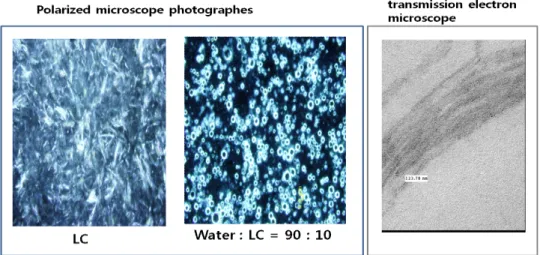
Fig 6 shows the results that have considered

non-hydrous skin analogous layer LC structure through a microscope when Ceramide 3-conjugated Pluronic is introduced.

As Fig 6, even when Ceramide 3-conjugated Pluronic is introduced to non-hydrous skin analogous layer LC, it keeps lamella structure well that is dense, and this is confirmed with PM and C-SEM. In addition, even when we input this thermosensitive smart LC into much water, it well forms Maltese-Cross form crystal and stable structure when introducing it into the cosmetics.

Table 1 is to decide proper bringing content

(6)

Types Ceramide 3-conjugated

Pluronic content (%) 25℃ 35℃ 40℃

Thermosensitive smart sensor LC

0 O O O

0.1 O O O

0.2 O △ X

0.3 O X X

0.5 O X X

1.0 △ X X

Transparency: ◎ Transparent ○ Fine and transparent △ Opaque- Unclear X Milk white Table 2. Test of Degree of Suspension at Skin Temperature

of Ceramide 3-conjugated Pluronic to non-hydrous skin analogous layer LC, confirming the stability of thermosensitive polymer having thermosensitive smart sensor LC 0.1%, 0.3%, 0.5%, 1.0%, 2.0%, 5.0%.

The stability test condition mixed 10% of thermosensitive smart sensor LC and 90% of purified water and was checked out.

As a result of test, when adding thermosensitive polymer content by 2.0% or more, separation occurred after 1 month at 40oC. Therefore, we could get conclusion that applying thermosensitive polymer content for 1.0% or lower is appropriate for LC stability.

When introducing thermosensitive smart sensor LC more than a certain content, deepening of suspension at 40oC is because too many thermosensitive sensors are introduced to the capsule wall, which makes the surface too sensitively react to outside temperature and capsules are opened near 32~38℃ at the cosmetics bulk itself before applying it on the skin and oil soluble substances are released, and the test results are shown at Table 2.

In order to check out any active ingredients are emitted at skin temperature, an experiment was conducted as follows. First, in order to make thin capsule wall that is similar to skin application, a specimen that has scattered by inputting 99% of purified water and

thermosensitive smart sensor LC and nano capsule was input 1% respectively, and confirmed the degree of release in active ingredients at 25℃, 35℃, 40℃.

When oil ingredient is released, suspension is deepened, so that we can judge this, and the results are shown at Table 2. Thermosensitive smart LC has fine and transparent property, and changes into milk white color at 35oC near the skin temperature, and from the features that have maintained transparency at room temperature and those releasing active ingredients by changing into milk white, we judge that 0.3~0.5% is the most desirable content.

3.1. Thermosensitive smart sensor

capsule’s drug delivery effect

By using adenosine, a water soluble wrinkle

declining active ingredients, we progressed a

test of drug delivery effect of thermosensitive

smart sensor LC. As for percutaneous

absorptive experiment, as Fig. 7, Dissolution

tester (ERWEKA DT800 Dissolution Tester,

Germany) has input the same amount as

thermosensitive smart sensor LC, nano capsule

sample 0.25g respectively, and enhancer cell

(ERWEKA, Germany) that equipped artificial

skin, which was 3D tissue cultured, filled

500ml of buffer solution with skin level pH

(5.0~5.5) herein, adjusted the temperature as

(7)

35oC that is similar to the body temperature of a real human, and measured the released amount of each adenosine by using HPLC (Shimadzu, LC-10VP,Japan) periodically for 12 hours.

Fig. 7. Thermosensitive smart sensor DDS measuring equipment.

Fig. 8. Thermosensitive smart sensor LC’s drug releasing test.

We drew the results which compared thermosensitive smart sensor LC drug release ability according to introduced amount of Ceramide 3-conjugated Pluronic in Fig. 8.

This experiment was tested by cosmetic mixture, 10% of thermosensitive smart sensor LC and 90% of purified water. As Fig. 8, from the curve of released amount of Adenosine, Ceramide 3-conjugated Pluronic content gained released amount of approximately 99.9% in 9 to 10 hours about initially inputted amount (0.04% weight %) in case of LC that has added 5.0%, 2.0%, 1.0%,

0.5%, which showed very excellent results in comparison with released amount generally atttained, and the cases, in which the Ceramide 3-conjugated Pluronic content was 0.3% and 0.1%, were 73% and 70%, and we could get better results than the LC specimen that has not introduced Ceramide 3-conjugated Pluronic, but the effect was not up to expectations.

Therefore, synthesizing formula stability and release test results, 0.5% of Ceramide 3-conjugated Pluronic was found out to be the most appropriate content for thermosensitive smart sensor LC.

4. Conclusions

1. Ceramide 3-conjugated Pluronic synthesis, which has motions on skin temperature was synthesized in 89% yield from Pluronic to p-NPC-Pluronic, and can be gained by introducing Ceramide, phospholipid ingredient, to p-NPC-Pluronic. Ceramide 3-conjugated Pluronic structure was analyzed with H1-NMR.

2. Applying Ceramide 3-conjugated Pluronic to non-hydrous LC to stabilize active ingredient, it was developed to enable effective skin penetration by releasing active ingredients as the capsule wall opens by responding to skin temperature with formation of a thin layer when applying on the skin.

Ceramide 3-conjugated Pluronic non- hydrous LC structure was confirmed with PM, C-SEM and XRD, and its stability was confirmed with DSC.

3. Results were gained that the drug delivery

effect of thermosensitive smart sensor

capsule increases in 34.4% DDS efficacy

than non-hydrous LC that has not

introduced Ceramide 3-conjugated Pluronic

as it was measured by making use of

HPLC (Shimadzu, LC-10VP, Japan).

(8)

Therefore, as we gather up the formula stability and release test results, we confirmed that 0.5% of Ceramide 3-conjugated Pluronic was the most appropriate content for a thermosensitive smart sensor LC.

References

1. B. D. Park. M. J. Lee, J. K. Lee, S. H.

Lee, The Preparation and Application of Lamella Liquid Crystal to Skin Care Product, J. Soc. Cosmet. Scientists Korea., 26(1), 93(2000).

2. M. Chorilli, P. S. Prestes, R. B. Rigon, G.R. Leonardi, L. A. Chiavacci, V.

H.Sarmento, A. G. Oliveira, M. V. Scarpa, Structural Characterization and In vivo Evaluation of Retinyl Palmitate in Non-ionic Lamellar Liquid Crystalline System, Colloids and Surfaces B:Biointerfaces., 85, 182(2011).

3. E. C. Cho, H. J. Lim, J. W. Shim, J.

O.Kim, I. S. Chang, Improved Stability of Liposome in Oil/water Emulsion by Association of Amphiphilic Polymer with Liposome and Its Effect on Bioactive Skin Permeation, Colloids and Surfaces A:Physicochem. Eng. Aspects., 299, 160 (2007).

4. M. Kuentz., Oral Self-emulsifying Drug Delivery Systems, from Biopharmaceutical to Technical Formulation Aspects. J. Drug Del. Sci. Tech., 21(1), 17(2011).

5. Y. W. Choi, B. S. Jang, N. H. Jeong, Preparation and Properties of Collagen- Liposome using Hydrogenated Phosphatidylcholine, J Korean Oil Chem Soc., 29(2), 295(2012).

6. A. J. Bevacqua, K. M. Lahanas, I.

D.Cohen, G. Cioca, Liquid Crystals in Multiple Emulsions, Cosmetics &Toiletries., 106, 53(1991).

7. R. Y. Lochhead, Emulsions, Cosmetic

&Toiletries., 109, 94(1994).

8. T. Gao, J. M. Tien, Y. H. Choi, Sunscreen Formulas with Multilayer Lamellar Structure, Cosmetics & Toiletries magazine., 118(10), 41(2003).

9. S. Bekiranov, R. Bruinsma, P. Pinus, Phys.

Rev. E., 55, 577(1997).

10. E.E. Dormidontova, Macromolecules, 35, 987(2002).

11. D.C. Kannan, J.L. Duda, R.P. Danner, Fluid Phase Equilib., 237, 86(2005).

12. S. Furyk, Y. Zhang, D. Ortiz-Acosta, P.S.

Cremer, D.E. Bergbreiter, J. Polym. Sci. A., 44, 1492(2006).

13. Y. Nagasaki, F. Matsukura, M. Kato, H.

Aoki, T. Tokuda, Macromolecules., 29,

5859(1996).

수치

Fig.  2.  Ceramide  3-conjugated  pluronic  synthesizing  mimetic  diagram.
Fig.  3.  Thermosensitive  polymer  non-hydrous  skin  analogous  layer  LC  production  flow  mapping.
Fig.  6.  Polarized  microscope  photographes  and  transmission  electron  microscope  for  a  thermosensitive  smart  sensor  LC.
Fig.  8.  Thermosensitive  smart  sensor  LC’s  drug  releasing  test.

참조

관련 문서