Investigation for the physio-chemical stabilities of Idebenone encapsulated with non-hydrous skin analogue
membrane and its transdermal penetration
Kwan-Young Jeong․Dong-Kyu Lee ✝
Skin research institute, Korea Kolmar Corporation, 170-7, Seojeong-Ri, Jeonui-Myun, Yeongi-Gun, Chung-Nam 339-850, Korea
✝ Department of Industrial Engineering Chemistry, College of Engineering, Chungbuk National University, Cheong-ju 361-763, Korea
(Received April 29, 2008 ; Accepted August 26, 2008)
Abstract : 오래전부터, 많은 여성들은 자신들의 젊음을 연장하고, 외모를 더 아름답게 가꾸 고, 이를 죽을 때까지 유지하는 것을 바래왔다. 이에 의사와 약사들뿐만 아니라, 많은 화장품 연 구자들도 노화와 관련된 기술개발에 총력을 기울여 왔다. 따라서, 이들 연구자들은 노화방지를 위한 새로운 원료를 찾고, 이를 안정화하고, 피부로 전달하는 기술개발에 항상 관심을 쏟아왔다.
뛰어난 노화방지 화장품 개발을 위해서, Ubiquinone의 일종인 ldebenone에 대해 연구하였고, 이를 비수계 피부유사막 기술을 가지고 캡슐화하고 약물전달하는 연구를 진행하였다. 먼저, 편광현미 경(PM, Polarized Microscope), X-선 회절분석(XRD, X-ray Diffractions) 및 시차주사열량계 (DSC, Differential Scanning Calorimetry)를 이용하여 Idebenone을 담지한 피부유사막 액정을 비 수계 조건에서 구조 및 열적특성을 조사하였다. 그 결과 비수계 조건에서도 규칙적으로 패킹 (Packing)된 지질이중층(Lipid bilayer)과 용매의 연속층으로 이루어진 고밀집된 라멜라(Lamella) 구조의 형성유무와 이때의 상거동을 확인할 수 있었다. 결론적으로 높은 극성도로인해 물분자와
접촉하면 불안정해지는 경향이 있는 Idebenone을 비수계 조건에서 각질층(SC, Stratum
Corneum)과 구조 및 조성이 유사한 피부유사막을 디자인하여 안정하게 캡슐화 하였다. 이를 적 용한 화장품은 모든 보관조건에서 유화입자의 안정성을 유지함을 확인하였고, Idebenone의 활성 역가 또한 40℃에서 6개월 동안 약 90%이상을 유지하는 우수한 결과를 나타냈다.
Key word : Idebenone, Skin analogue membrane, Lamella, Skin penetration, Stability
1. Introduction
In recent years, antioxidants have gained a lot of importance because their potential as an alternative method for skin aging in the cosmetic field. Additionally, the discovery of
✝
Corresponding author
(e-mail : [email protected])
the role of free radicals in cancer, diabetses, neurodegenerative disorders, aging and other diseases has led to a medical revolution which is promising a new paradiam of healthcare. Traditionally, herbal medicines with antioxidant properties have been used for various purposes and epidemiological datas also point at the widespread been used for various purposes.
Free radicals are highly reactive molecules
or chemical species containing unpaired- electrons that cause oxidative stress, which means an imbalance between oxidants and antioxidants in favor of oxidants and potentially lead to skin damage[1]. Oxidative stress can damage lipids, proteins, enzymes, carbohydrates and DNA in cells and tissues, resulting in membrane damage, fragmentation of random cross-linking of molecules like DNA, enzymes, and structural proteins such as collagens and even lead to cell death[2].
By this time, in the cosmetic fields, most of the researches have been focused on the development of antioxidants equipped with human antioxidant defense and their applications in cosmetic products. For instances, there are 1) enzymatic scavengers like superoxide dismutase(SOD), catalase (CAT) and glutathione peroxidase, 2) hydrophilic scavengers such as urate, ascorbate, glutathione and flavonoids, 3) lipophilic scavengers such as tocopherols, carotenoids and ubiquinol. Among them, ubiquinones are potent types of antioxidants which are very applicable in terms of their effectiveness for anti-aging and their mildness for transdermal applications.
Idebenone[2-(10-hydroxydecyl)-5,6-dimethoxy -3-methylbenzo-1,4-quinone] is a synthetic analogue of coenzyme q10. The chemical structure of idebenone is described in Fig. 1.
Fig. 1. Chemical structure of idebenone.
Idebenone is a potent antioxidant and thanks to its ability to inhibit lipid peroxidation, it protects cell and mitochondrial
membranes from oxidatives damages[3].
This drug has clinical applications in many central nervous system degenerative diseases associated with oxidative stress, such as Parkinson's and Alzheimer's diseases, as well as cerebral ischemia and brain aging[4,5]. P.
Rustin et al.[6] reported that idebenone showed a quite significant stimulatory effect(around 50%) on electron flow from succinate to oxygen and an activating effect of the succinate dehydrogenase. Rauchova et al.[7] studied the inhibitory effect of glycophosphate-dependent H
2
O2
generation by idebenone.Transdermal administration is limited by the SC, the outer layer of skin, considered as the main barrier to percutaneous absorption of drugs. The natural function of SC barrier is the protection of the body against the loss of endogenous substances such as water as well as against an undesired influence from the environment caused by exogeneous substances.
In the view of SC, Elias et al [8]
suggested the "brick and mortar" model.
The lipid matrix, the mortar region, is composed of highly organized bilayers, mainly containing ceramides(CERs), cholesterol (CHOL) and free fatty acid(FFA)[9]. This region is important to maintain the skin homeostasis such as a proper humidity and protection barrier.
Because of the above ambivalent properties of SC, it becomes more important to investigate the membrane model of SC and develop the skin analogue model membrane which has a similar structure and composition to SC in terms of its stabilities and drug delivery. And for its efficient delivery, we suggested an "elastic sandwich model" which the polar liquid phase is parallel to be located between densed lipid bilayers(DSPC, CERs, CHOL) and makes a channel to pass polar drugs. Therefore, the densed lipid bilayers have a proper elasticity due to the proper balance among these 3
lipids enough to release drugs as well as a proper occlusiveness. At the same time, protecting from the oxidation of idebenone in contacting with water, we choosed propylene glycol(PG) having a relatively low dielectric constant as a polar solvent without water.
In this paper, we chose distearoylphospha- tidylcholin(DSPC) among many phospholipids and PG among many penetrating enhancers and have performed the correlational studies on the mixtures of DSPC, ceramide 3(CER3) and CHOL as main lipids and PG which is used as a solvent instead of water, using DSC, small angle X-ray scattering(SAXS), and wide angle X-ray scattering(WAXS).
2. Experiments
2.1. Materials
A DSPC was purchased from Lipoid (Germany), a CER3 was purchased from Doosan biotech(Korea), a CHOL was purchased from Solvay(U.S.A). Idebenone (99.0%>) as the main active substance was purchased from Parling pharm technology (China). These materials were used without any pre-treatment. All other ingredients were of cosmetic grade such glycerin, oils, polymers, and emulsifiers etc. as commercial grades and without any pre-treatment.
2.2. Methods
2.2.1. Sample preparation for idebenone- loaded model matrix and its cosmetic application
1) For the preparation of idebenone-loaded model matrix, at first, 40g of DSPC, 3g of CER3, and 3g of CHOL were added to 148g of PG as a solvent under a moderate agitation. This mixture was heated to 80℃
and was continuously agitated until being completely melted 2g of idebenone was added to 4g of squalane and heated up to 60℃.
Above melted mixture was cooled to 60℃
with a moderate cooling speed, idebenone solution was added to it, and was very slowly cooled to 35℃ and stored below 10℃
for 1 week before being applied to a cosmetic sample.
2) Control sample was prepared to follow the below process. Components in water phase were weighed in a 500ml beaker, well-mixed with an agitator, and heated up to 80℃. Components including idebenone in oil phase were weighed in a 200ml beaker and heated up to 80℃. And oil phase was added to water phase under a moderate mixing, and then was emulsified with a mechanical homogenizer(TK homomixer, Tokushukika, Japan) under the mixing condition of 3,000rpm for 5 minutes. And then, it was cooled to 45℃, triethanolamine (TEA) was added and cooled again to 35℃.
3) Cosmetic sample using idebenone- loaded model matrix was prepared to follow the below process. Components in water phase were weighed in a 500ml beaker, well-mixed with an agitator, and heated up to 80℃. It was cooled to 45℃, TEA was added, and then, idebenone-loaded model matrix was added to it. Finally, it was emulsified with a mechanical homogenizer (TK homomixer, Tokushukika, Japan) under the mixing condition of 3,000rpm for 5 minutes and cooled again to 35℃.
2.2.2. Structural analysis with DSC and XRDs
Thermal analysis was made with a TA instrument(TA4100 model) from 20℃ to 15 0℃ at heating rate of 1℃/min after being cooled to a lower temperature. Sample quantities were about 10mg, which was sealed in an aluminium sample cell. This analysis was done under a nitrogen gas and it measured the melting temperature and enthalpy to confirm the formation of liquid crystal(LC) structure and its phase transitions.
XRD spectras were taken with x-ray
diffractometer(XDS 2000 model, SCINTAG INC., USA). During X-ray diffraction experiments the temperature of the samples deviated by maximum 1℃ from the adjusted temperature. XRD experiments were carried out with Ni-filtered CuKα-ray(λ=0.154nm) using photo detection, operating 35kV, 50mA under a room temperature.
2.2.3. Stability tests
Physical stability was investigated at various storage conditions such as 45℃, 25℃, 5℃, and cycle(from 40℃ to -5℃). Cosmetic samples were examined with an Polarized Microscope(PM, Olympus BX-51 model) using crossed polarizers at 25℃.
The recovery rate(%) of idebenone was investigated at various storage conditions such as 45℃, 25℃, 5℃, and cycle(from 40℃
to -5℃) with a high performance liquid chromatography (HPLC, Shimadzu LC-10VP model).
3. Results and discussions
3.1. Structural analysis (DSC and XRDs)
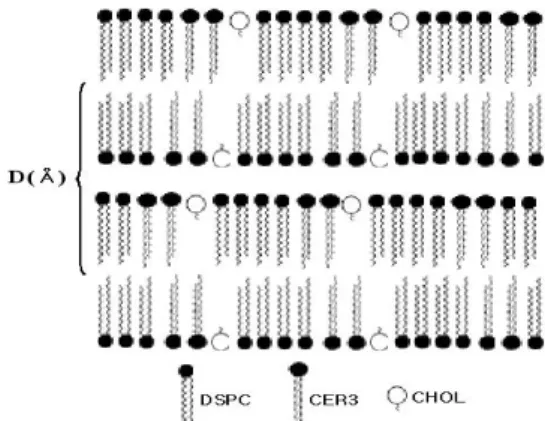
As seen in Fig. 2, CER3 supports the membrane rigidity due to its very similar molecular structure to DSPC and CHOL supports the membrane flexibility due to its bulky structure. However, because of the high crystallinities of two lipids, it is very important to investigate the compatibility of these lipids with DSPC in a non-hydrous condition.
DSPC showed the diffraction pattern for the 1st, 2nd, and 3rd order at q=0.130Å
-1
, 0.254Å-1
, 0.396Å-1
and its bilayer distance was calculated as 48.33Å which is slightly higher than the theoretical value (46.8Å), but the inducement of PG into DSPC made the diffraction pattern shifted to left side and its bilayer distance was calculated as 56.25Å as well as the dramatic decrease of theintensity. CER3 showed the SAXD pattern to have two coexisting crystalline lamellar phase: one is represented as long periodicity phase(LPP) at q=0.07, 0.141Å
-1
and another is represented as short periodicity phase (SPP) at q=0.165, 0.33, 0.493Å-1
. And the distance for LPP was calculated as 89.7Å and the distance for SPP was calculated as 38.06Å. CHOL showed the SAXD pattern to have a single crystalline lamellar phase at q=0.186, 0.369, 0.570Å-1
(the average distance adding up at these q values was calculated as 33.60Å which is almost same distance as Gomez-Fernandez et al[10]).Fig. 2. Schematic representation of the model membrane based on the DSPC/CER3/
CHOL when complexed with a polar solvent. The D value is the ordinate for the repeating distance in lamella structure.
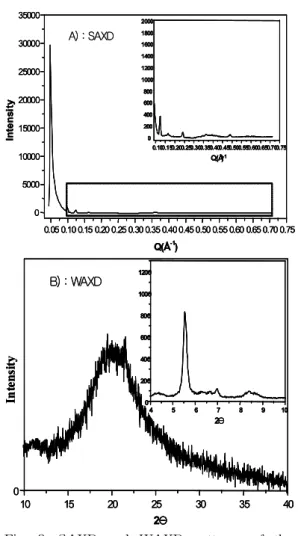
As seen Fig. 3(A), the model LC membrane showed the LPP patterns approximately at q=0.042Å
-1
, 0.085Å-1
and the SPP patterns about at q=0.12Å-1
, 0.24Å-1
, while the separated CER3 and CHOL peak also didn't exist. In this case, the distances of LPP and SPP were calculated as approximately 148.63Å and 52.13Å, respectively. It suggests that the model LC membrane forms the homogeneous lamellar structure being composed of DSPC/CER3/CHOL.
0.05 0.10 0.15 0.20 0.25 0.30 0.35 0.40 0.45 0.50 0.55 0.60 0.65 0.70 0.75 0
5000 10000 15000 20000 25000 30000 35000
In te n si ty
Q(Å
-1)
0.100.150.200.250.300.350.400.450.500.550.600.650.700.75 0
200 400 600 800 1000 1200 1400 1600 1800 2000
Q(Å)-1
A) : SAXD
0.05 0.10 0.15 0.20 0.25 0.30 0.35 0.40 0.45 0.50 0.55 0.60 0.65 0.70 0.75 0
5000 10000 15000 20000 25000 30000 35000
In te n si ty
Q(Å
-1)
0.100.150.200.250.300.350.400.450.500.550.600.650.700.75 0
200 400 600 800 1000 1200 1400 1600 1800 2000
Q(Å)-1
0.05 0.10 0.15 0.20 0.25 0.30 0.35 0.40 0.45 0.50 0.55 0.60 0.65 0.70 0.75 0
5000 10000 15000 20000 25000 30000 35000
In te n si ty
Q(Å
-1)
0.100.150.200.250.300.350.400.450.500.550.600.650.700.75 0
200 400 600 800 1000 1200 1400 1600 1800 2000
Q(Å)-1
A) : SAXD
10 15 20 25 30 35 40
0
In te ns it y
2Θ
4 5 6 7 8 9 10
0 200 400 600 800 1000 1200
2Θ
B) : WAXD
10 15 20 25 30 35 40
0
In te ns it y
2Θ
4 5 6 7 8 9 10
0 200 400 600 800 1000 1200
2Θ
10 15 20 25 30 35 40
0
In te ns it y
2Θ
4 5 6 7 8 9 10
0 200 400 600 800 1000 1200
2Θ
B) : WAXD
Fig. 3. SAXD and WAXD patterns of the skin model LC.
As seen Fig. 3(B), the model LC membrane showed a WAXD pattern at about 2θ = 21.3° ± 0.1(peak) and 2θ = 18.4° ± 0.6(diffused) in the main interaction between the main lipids and the solvent. In this case, there was one relatively narrow peak which corresponds to the interaction of well-arranged lipid complex, while the characteristic peaks of CER3 and CHOL didn't exist.
As seen in Fig. 4, the model LC membrane showed the monotectic thermal transition which has Tc at 45.5℃ and △H by 19.45 J/g, while the characteristic thermal transitions of CER3 and CHOL didn't exist.
The above results explain that the model LC membrane at this specific lipid ratio has a proper crystallinity to form a desirable lamellar structure.
Heat Flow(W/g)
Te m p erat ure(℃ )
2 0 3 0 4 0 5 0 6 0 7 0 80 90 1 0 0 1 1 0 1 2 0 1 3 0 1 4 0 1 5 0
-3 .5 -3 .0 -2 .5 -2 .0 -1 .5 -1 .0 -0 .5 0 .0
Heat Flow(W/g)
Te m p erat ure(℃ )
2 0 3 0 4 0 5 0 6 0 7 0 80 90 1 0 0 1 1 0 1 2 0 1 3 0 1 4 0 1 5 0
-3 .5 -3 .0 -2 .5 -2 .0 -1 .5 -1 .0 -0 .5 0 .0
Fig. 4. DSC curves for the skin model LC during heating process from 20℃ to 150℃.
3.2. Physiochemical stabilities of idebenone and idebenone-loaded cosmetics
Idebenone is very sensitive to UV light, pH, metal ion, and temperature etc and becomes much more unstable especially in contacting to water phase with them. Some researchers have reported the methods to protect active substances like idebenone and retinoids from contacting to water phase[11, 12]. However, we didn't use water phase to form our skin model membrane consisting of multilayer LCs and therefore, idebenone can be expected to be much more stable in cosmetics to apply the model membrane than cosmetics having continuous water phase.
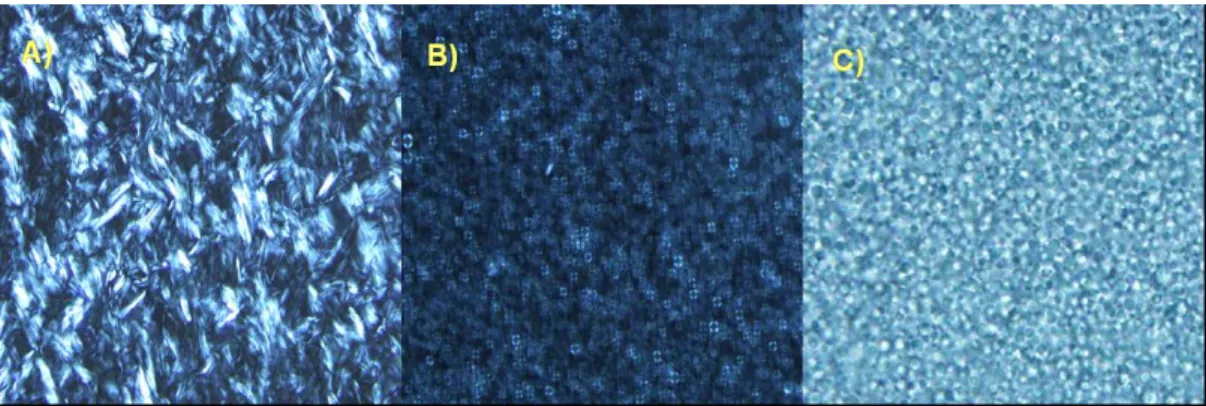
Fig. 5 shows a polarized microscope photograph(A) for the idebenone-loaded model LC, photograph(B) for the test cosmetics using 10wt% of idebenone-loaded model membrane, and photograph(C) for the control cosmetics using a normal O/W emulsion.
As seen in Fig. 5(A), the idebenone model LC showed a well-arranged LC
Fig. 5. Polarized microscope photographes for a idebenone-loaded model LC(A), a test sample(B) and a control sample(C).
structure having a desirable area and thickness. In Fig. 5(B) and (C), a test sample using the model LC showed maltese-cross liquid crystalline particles which surround with the interface of oil droplets containing idebenone and a control sample using a normal O/W emulsion showed common particles no forming LC.
The particles of both samples had almost 4~
5 μm sizes, showed homogeneous particle distributions relatively and therefore, both samples were determined to be well prepared.
However, at various storage conditions and for long-term stabilities, there were apparent differences between two samples.
As seen in Fig. 6, the particles of the control cream were quite good at first, but in more harsh condition(cycle and 45℃) except of 5℃, the particle sizes grew larger and the particle aggregation occurred, as well as even in the comparatively mild condition(2 5℃). This is the reason why idebenone has a very high polarity due to its cyclohexene group and hydroxyl group and is easy to move to the continuous water phase and at this time, it can break the O/W interface down to occur coalescence between emulsion particles.
As seen in Fig. 7, the positive cream showed excellent long-term stabilities in comparison to the control cream. This is the reason why the maltese-cross liquid crystalline phase protects from the separation of idebenone toward the continuous water phase and the coalescence of emulsion particles induced by its separation.
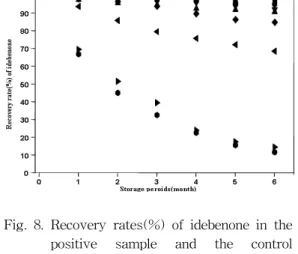
In addition to the stabilities of the idebenone-loaded cosmetics, idebenone recovery rate(%) at different storage conditions was investigated with HPLC. As expected previously to see the stability results, idebenone was very stable in the test sample and its recovery rate(%) was shown to maintain over 90% in comparison to the initial content of idebenone at all storage conditions in Fig. 8. On the other hand, idebenone was unstable in the control sample and its recovery rate(%) was shown to significantly decrease dependently upon the progress of storage periods and its reduction degree got to be sensitively affected by storage temperatures.
Fig. 6. PM images of the control sample at different storage conditions.
(A) : 5℃, 6 monthes, (B) : 25℃, 6 monthes, (C) : cycle, 6 monthes, (D) : 45℃, 6 monthes
.
Fig. 7. PM images of the test sample at different storage conditions.
(A) : 5℃, 6 monthes, (B) : 25℃, 6 monthes, (C) : cycle, 6 monthes, (D) : 45℃, 6 monthes.
Fig. 8. Recovery rates(%) of idebenone in the positive sample and the control sample, depending on storage temperatures and storage periods.
■ : 5℃, positive, ● : 25℃, positive, : 45℃, positive, ▲ : cycle, positive, ◆ : 5℃, control, ◀ : 25℃, control, ▶ : cycle, control, : 45℃, control.
4. Conclusions
In this study, we suggested a novel encapsulating method for idebenone which is an potent anti-aging challenger. Applying proper analytical measurements such DSC, XRDs, and PM, it could be confirmed to design a desirable liquid crystal having the structure and composition similar to intercellular lipid membrane on human skin.
In order to stabilize idebenone in cosmetic formulations, we introduced a noble stabilizing system, non-hydrous skin analogue membrane for encapsulating unstable active substances in contacting with water and were successful to stabilize idebenone and develop its application method in the practical cosmetics. This technology was exclusively being pended by our patent, and furthermore, we will progress on extending the development of various kind of cosmeceutical products and the development stabilizing
other unstable active substances.
References
1. H. Sies, Oxidative stress: oxidants and antioxidants, Exp. Physiol., 82, 291(1997).
2. K. B. Beckman and B. N. Ames, The free radical theory of aging matures, Physiol.
Rev., 78, 547 (1998).
3. I. Imada, T. Fujita and Y. Sugiyama, Effects of idebenone and related compounds on respiratory activities of brain mitochondria, and on lipid peroxidation of their membranes, Arch.
Gerontol. Geriatr., 8, 323 (1989).
4. G. Benzi and A. Moretti, Age and peroxidative stress-related modifications of the cerebral enzymatic activities linked to mitochondria and the glutathione system, Free Rad. Biol. Med., 19, 77 (1995).
5. M. Yamamoto, S. Kawabata and M.
Shimizu, Pharmacological effects of indeloxazine a new cerebral activator on brain functions distinct from other cerebral metabolic enhancers,
neuropharmacol., 28, 1291 (1989).
6. J. J. Briere, D. Schlemmer, D. Chretien and P. Rustin, Quinone analogues regulate mitochondrial substrate competitive oxidation, Biochem. and Biophys. Res.
Commun., 316, 1138 (2004).
7. H. Rauchova, M. Vrbacky, C. Bergamini, R. Fato, G. Lenaz, J. Houstek and Z.
Drahota, Inhibition of glycerophosphate- dependent H
2
O2
generation in brown fat mitochondria by idebenone, Biochem. andBiophys. Res. Commun., 339, 362 (2006).
8. P. M. Elias, Epidermal lipids barrier function and desquamation,
J. Invest.
Dermatol., 80, 44 (1983).
9. J. A. Bouwstra and P. L. Honeywell- Nguyen., Skin structure and mode of action of vesicles, Adv. Drug Delivery
Rev., 54 Suppl. 1, 41 (2002).
10. A. M. Jimenez-Monreal, J. Villalain, F.
J. Aranda, and J. C. Gomez-Fernandez, The phase behavior of aqueous dispersions of unsaturated mixtures of diacylglycerols and phospholipids,
Biochim. Biophys. Acta., 1373, 209 (1998).
11. J. Sjöblom, R. Lindberg, and S. E.
Friberg, Microemulsions-phase equilibria characterization, structures, applications and chemical reactions, Adv. Colloid and
Interface Sci., 65, 125 (1996).
12. N. O. Persson, K. Fontell, B. Lindman, and G. J. T. Tiddy, Mesophase structure studies by deuteron magnetic resonance,