Cite this article as: Kim YS, Kim JB. Valve-sparing root reimplantation in a case of progressive aortic root aneurysm after heart transplant. Interact CardioVasc Thorac Surg 2020;31:729–31.
Valve-sparing root reimplantation in a case of progressive aortic root aneurysm after heart transplant
Yun Seok Kim
aand Joon Bum Kim
b,*
a
Department of Thoracic and Cardiovascular Surgery, Keimyung University Dongsan Hospital, Daegu, Korea
b
Department of Thoracic and Cardiovascular Surgery, Asan Medical Center, University of Ulsan College of Medicine, Seoul, Korea
* Corresponding author. Department of Thoracic and Cardiovascular Surgery, Asan Medical Center, University of Ulsan College of Medicine, 88 Olympic-ro 43-gil, Songpa-gu, Seoul 05505, Korea. Tel: +82-2-30105416; fax: +82-2-30106966; e-mail: [email protected] (J.B. Kim).
Received 29 May 2020; received in revised form 10 July 2020; accepted 20 July 2020
Abstract
A mild-to-moderate aortic root aneurysm might be overlooked during the assessment of the donor heart. The use of the Z-score in such cases may be helpful in guiding clinical decision-making. To make a diagnosis of genetic aortopathy, a genetic panel study and matching with clinical criteria such as Ghent nosology are essential. Valve-sparing root reimplantation may be a viable option in cases with aortic root aneurysm developing after heart transplant.
Keywords: Aortic root aneurysm • Genetic aortopathy • Heart transplant • Valve-sparing root reimplantation
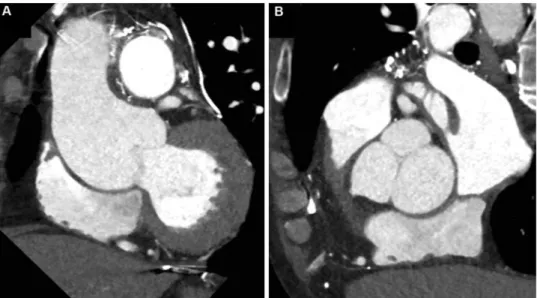
A 55-year-old man was referred for surgery due to severe aortic insufficiency (AI) with root aneurysm (Fig. 1). He underwent heart transplant 7 years ago, after being diagnosed with idiopathic hypertrophic cardiomyopathy. During the follow-up period, periodic transthoracic echocardiographic assessments revealed that the aortic root had enlarged gradu- ally from 4.1 to 6.5 cm along with worsening AI (Figs 1 and 2).
Review of the donor profiles revealed that he was a 27- year-old man, who was 180 cm tall and weighed 85 kg, and died of an acute cerebral haemorrhage without a known med- ical history. Transthoracic echocardiography of the donor showed that the diameter of the aortic root was 4.1 cm with mild AI, which was compatible with root aneurysm (Z- score = 3.28).
Root reimplantation was carried out in a standardized fashion using a 32-mm straight Hemashield
VRgraft (Boston Scientific Corp., Natick, MA, USA) (Video 1). Aortic cross- clamp, cardiopulmonary bypass and total procedural times were 105, 129 and 270 min, respectively. The patient was discharged after 8 days without complications. Next genera- tion sequencing panel test on the thoracic aortic aneurysm/
dissection was conducted from the aorta specimen, which included ACTA2, COL3A1, FBN1, MAT2A, MYH11, MYLK, NOTCH1, PRKG1, SKI, SLC2A10, SMAD3, SMAD4, TGFB2, TGFB3, TGFBR1 and TGFBR2. However, no significant varia- tion was detected. Up to latest follow-up of 1 year after sur- gery, the patient was stable and echocardiography demonstrated no AI.
DISCUSSION
Development of the root aneurysm in the donor aorta is a very rare complication after heart transplant [1]. The presence of an aortic root aneurysm is hardly highlighted during the assessment of the donor heart especially when the diameter is in the ‘mild- to-moderate’ range. The use of the Z-score may be the ideal method to guide clinical decision-making [2]. Though the aortic
Figure 1: Preoperative Doppler echocardiography demonstrates aortic root aneurysm and associated severe aortic insufficiency.
CASEREPORT
VC
The Author(s) 2020. Published by Oxford University Press on behalf of the European Association for Cardio-Thoracic Surgery. All rights reserved.
Interactive CardioVascular and Thoracic Surgery 31 (2020) 729–731 CASE REPORT – ADULT CARDIAC
doi:10.1093/icvts/ivaa163 Advance Access publication 30 September 2020
Downloaded from https://academic.oup.com/icvts/article/31/5/729/5913109 by KEIMYUNG UNIV MEDICAL LIBRARY user on 26 April 2021
root of the donor in the present case was within the borderline with its maximal diameter of 4.1 cm on transthoracic echocardi- ography, the Z-score of 3.28 indicated a significant root aneu- rysm. Subsequent genetic panel test did not demonstrate any significant variation. In order to make a diagnosis of genetic aort- opathy, however, thorough evaluation on the donor including re- view on demographic and clinical profiles, and on findings of physical examination as well as on family history of aortic cata- strophes are needed to match with clinical criteria, such as the Ghent nosology. For instance, an FBN1 mutation was reportedly found only in 66% of individuals who fulfilled the diagnostic cri- teria for Marfan syndrome [3]. The existence of unknown genetic variations should also be considered.
For treatment of the aortic root aneurysm, valve-sparing root reimplantation may be a more ideal option compared with Bentall procedure in patients with Marfan syndrome [4]. Despite the concerns that valve-sparing root reimplantation is
challenging in redo cases, its safety were found acceptable in prior studies [5].
Despite potentials risks associated with young donor hearts as in this case, such risks do not mean precluding heart donation, considering the issue of heart donor shortages and a huge num- ber of recipient candidates in desperate need worldwide. Rather, the lessons from the present case may be better interpreted as a need for preoperative vigilance in similar cases, and conse- quently, a more careful postoperative follow-up after heart transplant.
CONCLUSION
In conclusion, valve-sparing root reimplantation may be a viable option even in cases with aortic root aneurysm developing after heart transplant. A comprehensive assessment of the donor in- cluding clinical criteria for genetic aortopathy (i.e. Ghent nosol- ogy) and a genetic panel study may be needed prior to heart transplant whenever genetic aortopathy of the donor is sus- pected due to a high Z-score in its diameter for a guide to more careful follow-up on the aortic root.
Conflict of interest: none declared.
Reviewer information
Interactive CardioVascular and Thoracic Surgery thanks Shinichi Fukuhara and the other, anonymous reviewer(s) for their contribution to the peer review process of this article.
REFERENCES
[1] Chen IC, Wei J, Chang CY, Chuang YC, Lee SL, Lee WC. Successful treat- ment of aortic root aneurysm after orthotopic heart transplantation:
case report. Transplant Proc 2008;40:2852–3.
Figure 2: Preoperative computed tomography scan shows aortic root aneurysm (A). Tricuspid aortic valve shows asymmetricity with a central coaptation defect (B).
Video 1: Root reimplantation technique in a patient with aortic root aneurysm 7 years after heart transplant.
730 Y.S. Kim and J.B. Kim / Interactive CardioVascular and Thoracic Surgery
Downloaded from https://academic.oup.com/icvts/article/31/5/729/5913109 by KEIMYUNG UNIV MEDICAL LIBRARY user on 26 April 2021
[2] Loeys BL, Dietz HC, Braverman AC, Callewaert BL, De Backer J, Devereux RB et al. The revised Ghent nosology for the Marfan syndrome. J Med Genet 2010;47:476–85.
[3] Loeys BL, Nuytinck L, Delvaux I, De Bie S, De Paepa A. Genotype and phenotype analysis of 171 patients referred for molecular study on the fibrillin-1 gene FBN1 because of suspected Marfan syndrome. Arch Intern Med 2001;161:2447–54.
[4] Price J, Magruder JT, Young A, Grimm JC, Patel ND, Alejo D et al. Long- term outcomes of aortic root operations for Marfan syndrome: a com- parison of Bentall versus aortic valve-sparing procedures. J Thorac Cardiovasc Surg 2016;151:330–6.
[5] Lee H, Cho YH, Sung K, Kim WS, Park KH, Jeong DS et al. Clinical out- comes of root reimplantation and Bentall procedure: propensity score matching analysis. Ann Thorac Surg 2018;106:539–47.
CASEREPORT