연구논문
항균물질을 생산하는 토착 미생물 Paenibacillus sp. BCNU 5011의 특성화
최혜정1, 김야엘1, 방지훈1, 김동완2, 안철수3, 정영기4, 주우홍1*
Characterization of an Indigenous Antimicrobial Substance-producing Paenibacillus sp. BCNU 5011
Hye Jung Choi1, Ya Ell Kim1, Ji Hun Bang1, Dong Wan Kim2, Cheol Soo Ahn3, Young-Kee Jeong4, and Woo Hong Joo1*
접수: 2011년 3월 9일 / 게재승인: 2011년 3월 28일
© 2011 The Korean Society for Biotechnology and Bioengineering
Abstract:
1)Strain BCNU 5011 was isolated from forest soil samples collected in the Taebaek mountain in the Gangwon province, Korea. The biochemical, physiological and 16S rRNA sequence analysis strongly indicated that this isolate was most closely related to Paenibacillus polymyxa. A maximum production level of antimicrobial substances ofPaenibacillus sp. BCNU 5011 was achieved under aerobic
incubation at 30℃for 3 days in SST broth.Paenibacillus sp.BCNU 5011 showed a broad spectrum of activity against Gram positive and Gram negative bacteria, including methicllin- resistant Staphylococcus aureus (MRSA). Paenibacillus sp.
BCNU 5011 was also shown to inhibit the growth of different potential human pathogenic bacteria and fungi in vitro.
Peptide extract showed better antimicrobial activity than
1창원대학교 생명공학협동과정, 생물학과
1Interdisciplinary Program in Biotechnology and Department of Biology, Changwon National University, Changwon 641-773, Korea Tel: +82-55-213-3453, Fax: +82-55-213-3459
e-mail: [email protected]
2창원대학교 미생물학과
2Department of Microbiology, Changwon National University, Changwon 641-773, Korea
3조아제약(주)
3Cho-A Pharm. Co, LTD., Haman-kun 637-810, Korea
4동아대학교 생명공학과
4Department of Biotechnology, Dong-A University, Busan 604-714, Korea
solvent extracts. But active antimicrobial compounds might be included in both peptide extract and solvent extracts.
Further separation, purification and identification of active principles leads project to develop antimicrobial agents and anti-MRSA agents.
Keywords: Paenibacillus polymyxa, Antimicrobial activity,
Human pathogenic fungi, Methicllin-Resistant Staphylococcusaureus
1. 서론
미생물이 생산하는 많은 생리활성물질들은 효소, 화장품, 식품 및 발효 산업 그리고 의약품 산업 등 다양한 분야에 서 상업적으로 이용되고 있으며, 현재도 여러 분야에서 미 생물은 새로운 천연물질의 개발을 위한 잠재적인 소재로서 이들의 탐색과 응용을 위한 연구가 지속적으로 이루어지고 있다 [1]. 특히 제약 및 의약분야에서 임상적으로 사용되는 항생제는 대부분 미생물로부터 분리된 천연물질이거나, 이들 물질을 선도물질로 사용하여 합성된 반합성 물질이다 [2-4].
Bacillus 속 세균은 다양한 생리활성을 가지고 있어 광범
위하게 많은 연구의 소재로 다루어졌으며, 특히 Bacillus 속 이 생산하는 항진균 및 항균활성 물질에 관한 연구는 꾸준 히 진행되고 있다 [5,6]. Paenibacillus는 1993년 16S 리보 솜 RNA 염기서열을 토대로 계통학적으로 Bacillus 속에서 분리된 균주로 [7] 이 속에 속하는 균주들은 항균 및 항진균 활성 물질을 포함한 다양한 이차대사산물을 생산하고 있 는 것으로 알려져 있다. Paenibacillus polymyxa로부터 분리 된 항생물질은 대부분 펩타이드계로서 polymixin A, B, E (colistin), polipeptins, jolipeptins, gatavalin, gavaserin 그리 고 saltavalin은 그람양성 및 음성세균에 대하여 활성을 나 타내는 것으로 보고되어 있으며, LI-F 복합체와 fusaricidins A-D는 진균과 그람 양성 세균에 대하여 활성을 나타낸다고 보고되어 있다 [8-11]. 그 외 circulin, lantibiotic 등 [12,13]
도 생산되고 있음이 보고되고 있으며, P. kobensis M으로 부터 분리된 polymyxin M (mattacin), P. thiamunolyticus 로부터 octopygtin과 baciphelacin 등이 분리 보고되고 있 다 [14,15]. P. polymyxa 균주가 생산하는 polymyxin은 그람 음성 세균에 대한 강력한 항균효과를 나타냄으로써 1970년 대 초반까지 병원성 미생물에 의한 질병 치료제로서 많이 사용되어 왔으나, 신경독성과 간독성 등의 부작용을 동반하 여 그 사용이 줄어들었다 [16,17]. 그러나 polymyxin이 β- lactam계, aminoglycoside계 및 fluoroquinolone계 항생제에 내성을 보이는 Pseudomonas aeruginosa 및 Acinetobacter
baumannii 등의 다제내성 세균에 대해 탁월한 살균효과를
가진 것이 입증되면서 다시 주목을 받고 있다 [18,19].이에 본 연구에서는 새로운 천연생리활성물질 개발을 위한 연구의 일환으로 토양으로부터 methicillin-resistant
Staphylococcus aureus (MRSA)를 포함한 다양한 세균에
대한 항균활성과 인체 진균 감염증을 일으키는 피부사상균 에 활성이 뛰어난 Paenibacillus sp. BCNU 5011을 분리하 였다. Paenibacillus sp. 균주에 대한 항생제 내성 균주 및 항진균 활성에 관한 연구는 아직 미흡한 실정이며, 신규 항생물질의 연구가 절실한 시점에서 연구 가치가 뛰어난 균주로 사료된다. 따라서 신규 항생물질의 개발을 위한 기초 적 연구로서 Paenibacillus sp. BCNU 5011의 형태 및 생 리 ․ 생화학적 특성을 조사하였으며, 주요 활성물질 분리를 위한 과정으로 dichloromethane (DCM) 추출물과 펩타이드 추출물로 분리하여 항균 및 항진균 활성을 조사하여 그 결 과를 보고하고자 한다.
2. 재료 및 방법
2.1. 균주 선별 및 동정
항균 물질을 생산하는 균주는 태백산 일대의 토양을 채취 하여, 그람양성 세균, 음성세균 및 곰팡이 각 1종에 대한 스크리닝을 통해 최종적으로 선별하였다. Bergey’s Manual of Determinative Bacteriology의 방법 [20]에 준하여 분리 균주의 생리 ․ 생화학적 특성을 조사하였다. 형태학적 특징 을 조사하기 위해 균주 배양액을 원심분리하여 얻어진 균체 를 phosphate buffer solution (PBS, pH 7.2)로 세척한 뒤, 2.5% glutaraldehyde를 첨가하여 전고정시켰다. 회수한 균체는 세척과정을 반복한 뒤 1% osmium tetroxide를 첨가한 후 1시간 동안 후고정을 실시하였다. 13,000 rpm에서 1분간 원심분리하여 균체를 회수하고, 50~95%의 에탈올로 연속 탈수한 뒤 isoamyl acetate를 첨가하여 1시간 동안 반응시
켰다. 얻어진 균체는 건조한 뒤 sputter coater를 사용하여 2 mA로 3분간 금속 코팅을 한 후 주사 전자현미경 (SEM, JSM-5610, JEOL, Japan)을 이용하여 관찰하였다 [21]. 또한 분리 균주의 정확한 동정을 위하여 27F (5‘-AGTTTGATCC TGGCTCAG-3’)와 1492R (5'-ACGGCTACCTTGTTACG ACTT-3’) primer를 사용하여 RNA 중합효소 연쇄반응을 통하여 염기서열 분석을 실시하였다. 이를 바탕으로 미국국 립생물공학정보센터 (National Center for Biotechnology Information, NCBI)에 등록된 균주들의 염기서열과 비교하 여 계통적으로 상동성과 유연관계를 조사하였고, 근연 속과 종에 대한 유전학적인 유연관계에 대해 clustalX program 을 이용하여 phylogenetic tree를 작성하였다 [22,23].
2.2. 테스트 균주
항균활성을 측정하기 위하여 그람양성 세균 3종 (Bacillus
subtilis KCTC 10111 (ATCC 465), Bacillus cereus KCTC
3624 (ATCC 14579), Staphylococcus aureus IMSNU 11088 (ATCC 6538)), 그람음성 세균 5종 (Citrobacter freundii KCTC 2509 (ATCC 8090), Escherichia coli IMSNU 10080 (ATCC 10798), Klebsiella pneumonia KCTC 2208 (ATCC 13883), Pseudomonas aeruginosa IMSNU 10191 (ATCC 10145), Shigella sonnei KCTC 2518 (ATCC 25931)), 효 모 2종 (Candida albicans KCTC 7270 (ATCC 10231),Filobasidium neoformans KCTC 7902 (IFO 0545)) 그리고
인체 병원성 곰팡이 4종 (Aspergillus niger KACC 40280 (ATCC 4695), Epidermophyton floccosum KCTC 6921 (ATCC 10227), Trichophyton mentagrophytes KCTC 6077 (IFO 6202), Trichophyton rubrum KCTC 6375 (ATCC 28188)), methicillin-resistant Staphylococcus aureus 4종 (CCARM 3089, 3090, 3091, 3095), 기타 항생제 내성 균주 3종 (Salmonella typhimurium CCARM 8104, Streptococcusagalactiae CCARM 4504, Candida albacans CCARM
14020) 총 21종을 사용하였다. 이들 균주들은 한국생명공학 연구원 생물자원센터 (Korean Collection for Type Culture, KCTC), 한국농업미생물자원센터 (Korean Agricultural Culture Collection, KACC), 서울대학교 미생물연구소 (Institute of Microbiology Seoul National University, IMSNU) 및 항생제 내성균주은행 (Culture Collection of Antimicrobial Resistant Microbes, CCARM)에서 분양받았다.2.3. 항균 스펙트럼 조사
Paenibacillus sp. BCNU 5011 균주에 대해 17종의 세균
및 효모에 대한 항균활성은 disc diffusion 방법에 준하여 조사 하였으며 [24], 4종의 곰팡이에 대한 저해능 측정은 Whipps의 방법 [25]에 준하여 측정하였다. Whipps 방법 에 의한 저해능은 증식 저해율 (growth inhibition: GI)로 나타내었다.GI = (R1 - R2)/R1 × 100 GI:growth inhibition (%),
R1:배양 후 균사이의 거리, R2: 배양 전 접종 거리.
2.4. 항균활성 물질의 생산조건 및 부분정제
Paenibacillus sp. BCNU 5011이 내는 항균 물질의 최적 생산
조건을 조사하기 위하여 다양한 배지, 배양시간, 배양 온도, pH 등 배양조건을 달리하여 시간별로 배양 상등액을 회수 하여 항균활성을 측정하였다. 활성 물질의 부분정제를 위해 최적 배양 조건에서 1 L를 진탕 배양 하였고, 원심분리 를 (7,500 × g, 10 min, 4℃) 통해 배양 상등액을 회수하여, dichloromethane (DCM) 추출과 6 N HCl 침전을 통해 가장 항균물질이 많이 포함된 DCM 추출물과 펩타이드 추 출물을 얻었다.2.5. 최소 저해농도 (Minimum Inhibitory Concentration; MIC)
조사최적배양조건에서 얻은 DCM 추출물과 펩타이드 추출물로 그람양성 세균 3종, 그람음성 세균 5종, 진균류 6종 그리고 항생제 내성 균주 7종에 대하여 최소저해농도를 측정하였 다. 각 분획물을 고농도에서부터 2배수씩 희석시켜 paper disc (6 mm)에 10 µL씩 접종하였으며, 각 테스트 균의 최적온도 에서 24-72시간 배양하였다.
3. 결과
3.1. 균주의 분리 및 동정
태백산 일대의 토양시료에서 항균활성이 뛰어난 균주을 선 별하고자 4종의 테스트 균주에 대해 활성을 나타내는 균주 를 1차로 분리하였다. 분리 균주를 대상으로 세균, 진균 및 항생제 내성 균주에 대한 2차 항균 활성 조사를 실시하였으
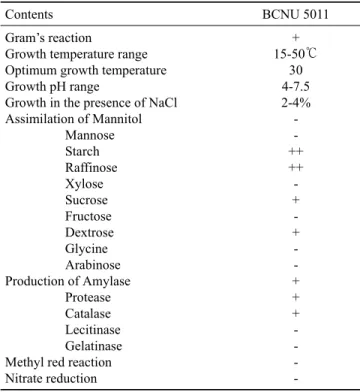
Table 1. Biochemical and physiological characteristics of Paenibacillus sp. BCNU 5011
Contents BCNU 5011
Gram’s reaction
Growth temperature range Optimum growth temperature Growth pH range
Growth in the presence of NaCl Assimilation of Mannitol
Mannose Starch Raffinose Xylose Sucrose Fructose Dextrose Glycine Arabinose Production of Amylase
Protease Catalase Lecitinase Gelatinase Methyl red reaction Nitrate reduction
+ 15-50℃
30 4-7.5 2-4%
- - ++
++
- + - + - - + + + - - - -
며, 최종적으로 활성이 뛰어나며 항균스펙트럼이 넓은 BCNU 5011 균주를 선별하였다. BCNU 5011은 그람양성, 간균으 로 15℃-50℃로 비교적 넓은 온도 범위에서 생육이 가능하 였으며, 1%의 starch, raffinose, sucrose, dextrose 등을 첨가 했을 때 생육이 좋은 것으로 나타났다. 또한 starch, casein 등의 기질이 첨가된 배지에서 amylase, protease 등 다양한 효소를 생산하는 것으로 조사되었다 (Table 1). 16S 리보솜 RNA 염기서열 분석결과, BCNU 5011 균주는 Paenibacillus 속으로 P. polymyxa와 99% 상동성을 보였으며, 계통적으로 도 Paenibacillus polymyxa의 subcluster에 속하는 균주로 확 인되어 Paenibacillus sp. BCNU 5011로 명명하였다 (Fig. 1).
Fig 1. Microscopic morphology of BCNU 5011 strain (magnificans
× 4,000).
3.2. 항균 및 항진균 활성 측정
그람양성 세균 3종, 그람음성 세균 5종, 진균 6종 그리고 항생제 내성균주 7종에 대해 항균활성을 측정한 결과, 효 모를 제외한 대부분의 테스트 균주에 대해 활성이 나타났 다 (Table 2). 특히 그람음성 세균인 P. aeruginosa에 대하여 저해환 21.47 mm로 우수한 항균활성이 관찰되었으며, E.
coli와 K. pneumonia에 대해서도 각각 16.33 mm, 16.73 mm
로 억제환이 관찰되었다. 또한 MRSA 균주에 대해서도 CCARM 3089에서 저해환 15.40 mm, CCARM 3091에 서 저해환 15.73 mm으로 비교적 뛰어난 항균력을 보였으 며, 항생제 내성 균주인 Sa. typhimurium CCARM 8104에 대해서도 우수한 항균활성을 확인할 수 있었다. 인체병원 성 진균 4종에 대한 활성 테스트에서는 Ep. floccosum와T. rubrum에 대해 각각 저해율 68.30%, 64.95%로 뛰어
난 저해율을 보였으며 A. niger와 T. mentagrophytes에 대해서도 저해율 43.05%, 49.95%의 활성을 나타내었다 (Table 3). 따라서 Paenibacillus sp. BCNU 5011 균주는 항생제 내성 균주를 포함한 세균 및 인체에 표재성 진균감 염증을 유발하는 진균에 대해서도 우수한 항균력을 가진 것 으로 확인되었다.Fig. 3. Antagonistic effect of Paenibacillus sp. BCNU 5011 on the growth of A, B. cereus B, S. aureus C, C. freundii D, E. coli E. K.
pneumoniae F, P. aeruginosa G, MRSA CCARM 3089; H, MRSA 3090; I, MRSA 3091; J, MRSA3095 after 24 h of incubation.
Table 2. Antimicrobial activity of Paenibacillus sp. BCNU 5011 against microorganisms, including methicllin-resistant Staphylococcus aureus and other antimicrobial resistant bacteria
Microorganisms Zone of
inhibition (mm) Gram (+)
bacteria
B. cereus B. subtilis S. aureus
12.20 ± 0.173 12.33 ± 0.208 14.13 ± 0.058
Gram (-) bacteria
C. freundii E. coli K. pneumoniae P. aeruginosa Sh. sonnei
15.67 ± 0.208 16.33 ± 0.153 16.73 ± 0.404 21.47 ± 0.252 11.47 ± 0.058
Yeasts Ca. albicans
F. neoformans
- -
Methicillin-resistant Staphylococcus aureus
CCARM 3089 CCARM 3090 CCARM 3091 CCARM 3095
15.40 ± 0.265 12.13 ± 0.208 15.73 ± 0.153 12.20 ± 0.173 Other antimicrobial
resistant bacteria
Sa. typhimurium CCARM 8104 St. agalactiae CCARM 4504 Ca. albacans CCARM 14020
15.20 ± 0.173 10.53 ± 0.153
-
Table 3. Effect of Paenibacillus sp. BCNU 5011 on in vitro growth of human pathogenic fungi
GI (%) GI category
A. niger Ep. floccosum T. rubrum T. mentagrophytes
43.05 ± 6.05 68.30 ± 2.40 64.95 ± 2.33 49.95 ± 4.73
2 3 3 2
Percent growth inhibition (GI) was determined after 7days of incubation. Values were categorized on a scale from 0 to 4, where 0
= no growth inhibition, 1 = 1 to 25%, 2 = 26 to 50%, 3 = 51% to 75% and 4 = 76 to 100%. The tests are in duplicate.
Fig. 2. Phylogenetic tree based on 16S rR N A suquences of Paenibacillus sp. BCNU 5011 and closely related species.
3.3. 최적 생산 조건 및 최소저해농도 조사
Paenibacillus sp. BCNU 5011 균주가 내는 항균물질의 최
적 생산조건을 검토한 결과 SST broth (2.0% soluble starch, 1.0% sucrose, 1.0% tryptone, 0.3% yeast extract, 0.5% NaCl) 에서 30℃, pH 6.8 조건으로 3일간 배양 시 항균물질을 가장 많이 생산하는 것으로 조사되었다. 이를 바탕으로 배양 상등 액에서 각종 용매로 분획실험을 실시하여DCM 추출과 펩 타이드 추출에 가장 많은 항균 물질이 포함됨을 확인 할 수 있었다. 본 실험에서 DCM 추출물과 펩타이드 추출물의 최소저해농도에 대한 측정결과는 Table 4에 나타내었다.Paenibacillus sp. BCNU 5011 균주의 펩타이드 추출물은
DCM 추출물에 비해 다양한 균주에서 상대적으로 다소 높은 항균활성을 나타내는 것으로 확인되었다. 우수한 항균활성 을 보였던 그람음성균인 K. pneumonia와 P. aeruginosa을대상으로 항균 효과를 조사한 결과 DCM 추출물과 펩타이드 추출물이 62.5 μg의 저농도에서 저해함을 확인하였으며, C.
freundii와 Sh. sonnei도 125 μg의 비교적 낮은 농도에서 저해
되었다. 또한 펩타이드 추출물은 항균효과가 미비했던 그람 양성 세균에 대해서 62.5-250 µg의 저농도에서 저해하는 것을 관찰할 수 있었으며, 항생제 내성균주에 대해서도 비 교적 높은 활성을 보였다. MRSA CCARM 3090과 Sa.typhimurium CCARM 8104은 125 µg의 저농도에서 저
해되었으며, 다른 항생제 내성균주에 대해서도 250-500 µg 농도에서 저해함을 확인하였다. Paenibacillus sp. BCNU 5011 균주는 다양한 그람양성 세균 및 그람음성 세균에 활성 을 나타내고 특히 그람음성 세균 대해서 우수한 항균효과를 가진 것으로 나타났다.Table 4. Minimum inhibitory concentration of Paenibacillus sp.
BCNU 5011 solvent extract against bacteria
Microorganism
Minimum inhibitory concentration (µg/disc) Gentamycin
(µg/disc) DCM extract
Peptide preparation Gram (+)
bacteria
B. cereus B. subtilis S. aureus
0.195 0.048 0.097
250 62.5 500
250 62.5 250
Gram (-) bacteria
C. freundii E. coli K. pneumoniae P. aeruginosa Sh. sonnei
0.195 0.048 0.390 1.562 0.048
1000 1000 62.5 250 500
125 250 125 62.5 125 Methicillin-
resistant Staphylococcus aureus
CCARM 3089 CCARM 3090 CCARM 3091 CCARM 3095
≥80 0.132
≥100
≥40 1000 1000
>1000
>1000
500 125 500 250 Other antimicrobial
resistant bacteria
Sa. typhimurium St. agalactiae
0.390
≥100
>1000
>1000
125 250
Fig. 4. Antagonistic effect of Paenibacillus sp. BCNU 5011 on the mycelial growth of the dermatophyte, (a) A. niger, (b) Ep. floccosum, (c) T. mentagrophytes, (d) T. rubrum after two weeks of incubation on PDA at 28℃.
4. 고찰
다양한 항균물질들이 지속적으로 분리 보고됨에도 불구하고 산업적으로나 의학적으로 사용 가능한 항생물질은 드물며, 임상적으로 처방되는 항생제들도 인체독성 야기, 장기투여시 내성 균주 출현 등의 부작용으로 제한적으로 사용되고 있다.
또한 최근 많은 문제가 되고 있는 약제 다제내성세균의 출현 은 기존의 항생제를 무력화시키고 있어 기존의 항생물질을 대체할 수 있는 신규 천연 항생물질의 연구가 절실히 필요한 실정이다. Paenibacillus 속 균주는 다양한 생리활성물질을 많이 보유하고 있으며, 특히 항생물질의 생산에 관한 연구가
Paenibacillus를 대상으로 이루어 지고 있다. 잘 알려져 있는
그람음성 세균에 대한 항균활성 외에 항생제 내성균주, 식물 병원균 및 인체병원성 진균 등에 관한 항균활성 물질 연구 가 Paenibacillus 속 균종의 탐색을 토대로 하여 현재 활발히 진행되고 있다. Paenibacillus polymyxa SCE2는 병원성 미생물에 대한 연구에서 곰팡이 및 E. coli에 대한 활성은 나타 나지 않았으나, 일부 효모와 MRSA 균주에 대하여 활성이 있음이 보고된 바 있으며 [26], Paenibacillus polymyxa Cp-S316의 항진균 활성물질은 4687.71 μg/mL 농도에서 식 물병원성 곰팡이에 대한 효과를 나타냄이 보고되어 있다 [27].또한 Paenibacillus brasilensis strain Sa3는 인체병원성 진균에 대한 연구에서 Candida albicans sorotype B에 대하 여는 활성을 보였으나, T. rubrum과 Aspergillus fumigatu 에 대해서는 항진균 활성을 나타내지 않았으며 [28], 김 치에서 분리된 P. polymyxa OSY-DF는 polymyxin과 lantibiotic을 생산하는 균주로 Paenibacillus sp. BCNU 5011 균주와 비슷한 배양조건을 가진 것으로 보고되 있으 며, 배양 상등액에서 그람양성 세균 및 그람음성 세균 그 리고 식중독 원인균에 대한 활성이 보고되어 있다 [13]. 그 리고 Paenibacillus sp. strain B2에서 분리된 polymyxin B가 포함된 펩타이드계 항생물질은 polymyxin B가 가지 는 그람음성 세균에 대한 억제활성 외에 그람양성 세균에 대하여도 활성이 있음이 보고되었다 [29]. 상기와 같이 다 양한 연구가 Paenibacillus 속 균종의 탐색과 이용 분야에 서 이루어지고 있는 것은 Paenibacillus 속 균종이 항생물 질의 보고임을 입증하고 있음에 틀림없다. 그러므로 국내 에서의 토착 Paenibacillus 속 균종의 탐색과 확보는 학문 적으로나 산업적으로 매우 의의가 높다고 판단된다. 본 실 험에서 분리된 Paenibacillus sp. BCNU 5011은 매우 넓 은 항균스펙트럼을 가진 균주로서, 이 균주가 생산하는 항 생물질들의 분리 정제 및 구조 동정은 다양한 분야에서 기 술적인 진보를 가능하게 할 것으로 생각된다. 특히 펩타이 드 추출물에서 상대적으로 항균활성이 높은 점에서 펩타이 드계 항생물질인 polymyxin과 tridecaptin 등이 포함되어 있을 것으로 판단된다. 항균스펙트럼에서도 이들 물질의 포함은 시사되고 있으며 최소한 이들 항생물질의 국산화는 가능할 것으로 판단된다. 국내 의약품 산업에서는 최소한 상용 항생물질의 국산화 또는 대체 항생물질의 개발은 기 술적인 축적과 경험을 공유한다는 측면에서 추진되어야 할 시급한 과제로 판단된다.
5. 결론
태백산 일대의 토양으로부터 분리된 BCNU 5011은 생리 ․ 생 화학적 분석과 16S 리보좀 RNA 염기서열 분석을 통해
Paenibacillus polymyxa와 근연종으로 확인되었다. Paenibacillus
sp. BCNU 5011 균주는 SST broth에서 30℃ 3일간 배양 시 항균물질을 가장 많이 생산하는 것으로 조사되었다.Paenibacillus sp. BCNU 5011균주는 MRSA를 포함한 다양
한 그람양성 세균 및 그람음성 세균에 대해 넓은 항균스펙트 럼을 보였다. Paenibacillus sp. BCNU 5011은 또한 상이한 잠재적인 인체병원성 세균 및 진균의 생육을 억제하는 것으 로 나타났다. 펩타이드 추출물은 유기용매 추출물보다 더 뛰어난 항균효과를 보였지만 항균활성 물질은 펩타이드 추출 물과 유기용매 추출물 둘 다에 포함되어 있을 것이다. 실제 적인 항균물질의 추후 분리, 정제 및 동정을 통하여 항균제 와 항 MRSA 제제의 개발이 가능할 것이다.감사
본 연구는 교육과학기술부, 한국연구재단 및 한국산업기술 진흥원의 지역 혁신인력양성사업에 의해 지원되었음으로 이에 감사드립니다.
References
1. Jung, J. H. and H. C. Chang (2009) Bacillus polyfermenticus CJ9, Isolated from meju, showing antifungal and antibacterial activities. Kor. J. Microbiol. Biotechnol. 37: 340-349.
2. Favre, B., B. Hofbauer, K. S. Hildering, and N. S. Ryder (2003) Comparison of in vitroactivities of 17 antifungal drugs against a panel of 20 dermatophytes by using a microdilution assay. J.
Clin. Microbial. 41: 4817-4819.
3. Gupta, A. K., Y. Kohli, A. Ki, J. Faergemann, and R. C.
Summerbell (2000) In vitro susceptibility of the seven Malassezia species to ketoconazole, voriconazol, itaconazol and terbinafine. Br. J. Dermatol. 142: 758-765.
4. Pfaller, M. A. and W. L. Yu (2001) Antifungal susceptibility testing. New technology and clinical applications. Infect. Dis.
Clin. North Am. 15: 1227-1261.
5. Choi, H. J., U. H. Yang, Y. E. Kim, Y. H. Choi, C. S. Ahn, Y. K.
Jeong, D. W. kim, and W. H. Joo (2010) Antifungal activity of Bacillus sp. BCNU 2003 against the human pathogenic fungi.
J. Life Sci. 20: 269-274.
6. Choi, H. J., C. S. Ahn, Y. K. Jeong, D. W. kim, and W. H. Joo (2010) Antifungal activity of Bacillus sp. BCNU 2002 against the human pathogens. Kor. J. Biotechnol. Bioeng. 25: 123-129.
7. Ash, C., J. A. E. Farrow, S. Wallbank, and M. D. Collins (1991) Phylogenetic heterogeneity of the genus Bacillus revealed by comparative analysis of small subunit-ribosomal RNA sequences.
Lett. Appl. microbiol. 13: 202-206.
8. Beatty, P. H. and S. E. Jensen (2002) Paenibacillus polymyxa produces fusaricidin-type antifungal antibiotic active against Leptosphaeria maculans, the causative agent of blackleg disease of canola. Can J. Microbiol. 48: 159-169.
9. Kajimura, Y. and M. Kaneda (1997) Fusaricidins B, C and D, new depsipeptide antibiotics produced by Bacillus polymyxa KT-8: isolation, structure elucidation and biological activity. J.
Antibiot. 50: 220-228.
10. Kurusu, K., K. Ohba, T. Arai, and K. Fukushima (1987) New peptide antibiotics LI-F03, F04, F05, F07, and F08, produced by Bacillus polymyxa. I. Isolation and characterization. J.
Antibiot. 40: 1506-1514.
11. Nakajima, N., S. Chihara, and Y. Koyama (1972) A new antibiotic, Gatavalin I. Isolation and characterization. J. Antibiot. 25:
243-247.
12. Govaerts, C., J. Orwa, A. Van Schepdael, E. Roets, and J.
Hoogmartens (2002) Characterization of polypeptide antibiotics of the polymyxin series by liquid chromatography electrospray ionization ion trap tandem mass spectrometry. J. Pept. Sci.
8: 45-55.
13. He, Z., D. Kisla, L. Zhang, C. Yuan, K. B. Green-Church, and A.
E. Yousef (2007) Isolation and identification of a Paenibacillus polymyxa strain that coproduces a novel lantibiotic and polymyxin. Appl. Environ. Microbiol. 73: 168-178.
14. Chung, Y. R., C. H. Kim, I. Hwang, and J. Chun (2000) Paenibacillus koreensis sp. nov. a new species that produces aniturin-like antifungal compound. Int. J. Syst. Evol. Microbiol.
50: 1495-1500.
15. Martin, N. I., H. Hu, M. M. Moake, J. J. Churey, R. Whittal, R. W. Worobo, and J. C. Vederas (2003) Isolation, structural characterization, and properties of mattacin (polymyxin M), a cyclyc peptide antibiotic produced by Paenibacillus kobensis M. J. Biol. Chem. 278: 13124-13132.
16. Pedersen, M. F., J. F. Pedersen, and P. O. Adsen (1971) A clinical and experimental comparative study of sodium colistimethate and polymyxin B sulfate. Invest. Urol. 9: 234-237.
17. Senturk, S. (2005) Evaluation of the anti-endotoxic effects of polymyxin-E (colistin) in dogs with naturally occurred endotoxic shock. J. Vet. Pharm. Ther. 28: 57-63.
18. Falagas, M. E. and S. K. Kasiakou (2006) Toxicity of polymyxins:
a systematic review of the evidence from old and recent studies.
Crit. Care. 10: R27.
19. Tankovic, J., P. Legrand, G. De Gatines, V. Chemineau, C. Brun- Buisson, and J. Duval (1994) Characterization of a hospital outbreak of imipenemresistant Acinetobacter baumannii by phenotypic and genotypic typing methods. J. Clin. Microbiol.
32: 2677-2681.
20. Sneath, P. H. A. (1986) Endospore-forming gram-positive rods and cocci, pp. 1104-1139. In: P. H. A. Sneath, N. S. Mair, M.
E. Sharpe, J. G. Holt (eds.). Bergey’s Manual of Systematic Bacteriology, Vol. 2, Williams & Wilkins, Baltimore.
21. Cho, Y. S., N. L. Schiller, H. Y. Kahng, and K. H. Oh (2007) Cellular responses and proteomic analysis of Escherichia coli exposed to green tea polyphenols. Curr. Microbiol. 53: 501-506.
22. Saito, N. and M. Nei (1987) The neighbor-joining method, a new method for reconstructing phylogenetic trees. Mol. Biol.
Evol. 79: 426-434.
23. Thompson, J. D., D. G. Higgins, and T. J. Gibson (1994) CLUSTAL W: Improving the sensitivity of progressive multiple sequence alignment through sequence weighting, position-specific gap penalties and weight matrix choice.
Nuclic. Acids Res. 22: 4673-4680.
24. Perez, C., M. Pauli, and P. Bazerque (1990) An antibiotics assay by agar well diffusion method. Acta. Biol. Med. Exp. 15: 113-115.
25. Whipps, J. M. (1987) Effect of media on growth and interactions
between a range of soil-born glass-house pathogens and antagonistic fungi. New Phytol. 107: 127-142.
26. Seldin, L., F. Silva de Azevedo, D. S. Alviano, C. S. Alviano, and M. C. de Freire Bastos (1999) Inhibitory activity of Paenibacillus polymyxa SCE2 against human pathogenic micro-organisms. Lett. Appl. Microbiol. 28: 423-427.
27. Wang, Z. W. and X. L. Liu (2008) Medium optimization for antifungal active substances production from a newly isolated Paenibacillus sp. using response surface methodology. Bioresource Technol. 99: 8245-8251.
28. Fortes, T. O., D. S. Alviano, Gl. Tupinamb, T. S. Padro’n, A. R.
Antoniolli, C. S. Alviano, and L. Seldin (2008) Production of an antimicrobial substance against Cryptococcus neoformans by Paenibacillus brasilensis Sa3 isolated from the rhizosphere of Kalanchoe brasiliensis. Microbiol. Res. 163: 200-207.
29. Selim, S., J. Negrel, C. Govaerts, S. Gianinazzi, and D. Van Tuinen (2005) Isolation and partial characterization of antagonistic peptides produced by Paenibacillussp. strain B2 isolated from the sorghum mycorrhizosphere. Appl. Environ. Microbiol. 71:
6501-6507.