279
1. Introduction
For the design of prevention and mitigation measures in process industries involving flammable substances, reliable safety data are required. An important property used to estimate the risk of fire and explosion for a flammable liquid is the flash point (FP) [1,2]. Flammability is an important factor to consider when developing safe methods for storing and handling solids and liquids [3]. For a given liquid, the FP is the temperature determined experimentally at which the substance emits sufficient vapor to form a combustible mixture with air. Flammable substances are commonly used in laboratories and industry;
thus, it is important to consider the physical properties of the substances to avoid any associated hazards. The lower flammable limit (LFL) provides information on the fundamental physical processes of combustion. Experimental FP data have become important in ensuring safe storage of flammable
substances and, for this reason, studies for predicting the FP of pure substances and mixtures are increasingly important.
Recently, several method have been developed for the prediction or estimation of low FP of pure compound and mixtures [4-6].
Methylcyclohexane, ethylbenzene, p-xylene, and their mixtures are frequently used in the tire, rubber, and polymer manufacturing industries [7-9], whereas 2,2,4-trimethylpentane is used as a solvent in the manufacture of chemicals, adhesives, and coatings, and as an ingredient in aviation fuel and gasoline [10]. It is also used as a fuel additive, non-polar solvent, and volatile organic compound. The separation of these compounds is one of the most dangerous processes in the petrochemical industry. To simulate and optimize the separation process, it is essential to describe FP data accurately. The purpose of this work was to obtain FP data for binary mixtures of 2,2,4-trimethylpentane with the three hydrocarbons (methylcyclohexane, ethylbenzene, and p-xylene), which are representative compounds of the main aromatic
* To whom correspondence should be addressed.
E-mail: [email protected]; Tel: +82-42-629-6771; Fax: +82-42-629-6779 doi: 10.7464/ksct.2020.26.4.279 pISSN 1598-9712 eISSN 2288-0690
This is an Open-Access article distributed under the terms of the Creative Commons Attribution Non-Commercial License (http://creativecommons.org/licences/
by-nc/3.0) which permits unrestricted non-commercial use, distribution, and reproduction in any medium, provided the original work is properly cited.
청정환경기술
The Measurement of Flash Point for Binary Mixtures of 2,2,4-Trimethylpentane, Methylcyclohexane, Ethylbenzene and p-xylene at 101.3 kPa
In Chan Hwang, and Se Jin In *
Department of Fire and Disaster Protection Engineering, Woosong University Woosong University, 171 Dongdaejeon-ro, Dong-Gu, Daejeon 34606, Republic of Korea
(Received for review September 17, 2020; Revision received November 10, 2020; Accepted November 10, 2020)
Abstract
Laboratories and industrial processes typically involve the use of flammable substances. An important property used to estimate fire and explosion risk for a flammable liquid is the flash point. In this study, flash point data at 101.3 kPa were determined using a SETA closed cup flash point tester on the following solvent mixtures: {2,2,4-trimethylpentane + methylcyclohexane}, {2,2,4-trimethylpentane + ethylbenzene}, and {2,2,4-trimethylpentane + p-xylene}. The purpose of this work is to obtain flash point data for binary mixtures of 2,2,4-trimethylpentane with three hydrocarbons (methylcyclohexane, ethylbenzene, and p-xylene), which are representative compounds of the main aromatic hydrocarbon fractions of petroleum. The measured flash points are compared with the predicted values calculated using the G
Emodels’ activity coefficient patterns: the Wilson, the Non-Random Two-Liquid (NRTL), and the UNIversal QUAsiChemical (UNIQUAC) models. The non-ideality of the mixture is also considered. The average absolute deviation between the predicted and measured lower flash point s is less than 1.99 K, except when Raoult’s law is calculated. In addition, the minimum flash point behavior is not observed in any of the three binary systems. This work’s predicted results can be applied to design safe petrochemical processes, such as identifying safe storage conditions for non-ideal solutions containing volatile components.
Keywords : Flash point, Seta closed cup tester, Binary system, G
Emodels
hydrocarbon fractions of petroleum.
In the present work, the FPs at 101.3 kPa were determined using a SETA closed cup flash point tester on the following solvent mixtures: {2,2,4-trimethylpentane (1) + methylcyclohexane (2)}, {2,2,4-trimethylpentane (1) + ethylbenzene (2)} and {2,2,4- trimethylpentane (1) + p-xylene (2)}. The experimental FP data for these binary systems were compared with predicted values from a variety of activity coefficient models: Wilson, Non-Random Two-Liquid (NRTL) and UNIversal QUAsiChemical (UNIQUAC) models [11-13].
2. Material and Methods 2.1. Materials
Commercial grade 2,2,4-trimethylpentane (C
8H
18,M = 114.23 g mol
-1, CAS-RN 540-84-1, 99.8%) and methylcyclohexane (C
7H
14,M = 98.19 g mol
-1, CAS-RN 108-87-2, 99.8%) were supplied from Aldrich Chemical Co. Ethylbenzene (C
8H
10,M = 106.17 g mol
-1, CAS-RN 100-41-4, 99.5%) and p-xylene (C
8H
10,M = 106.17 g mol
-1, CAS-RN 106-42-3, 99.9%) were supplied from Fluka Co. All components were dried using molecular sieves of pore diameter 0.4 nm. The water content of the chemicals, determined using a Karl-Fischer titrator (Metrohm 684 KF-Coulometer), was less than 6 × 10
-5g g
-1. The purity of the chemicals was assessed through gas chromatography. The purities, FPs, and UNIQUAC parameters of the chemicals are listed in Table 1 along with the reported values [14,15].
2.2. Procedure
SETA closed-cup flash point tester (Series 8 SETAFLASH, model 82000-0, Surrey, UK) was used to measure the FPs of the three miscible mixtures. The SETA closed-cup flash point tester was operated according to the standard test method, ASTM D 3278 [16]. The abovementioned tester comprises four components: a sample cup, a test flame device with a flame controller, a temperature-measuring system with a temperature controller, and a time controller. The injection volume was 2 mL, and the measured temperature range was set from 253.15.
to 573.15 K. The temperature of the liquid sample in the sample cup was regulated using the temperature controller, which had an accuracy of ± 0.1 K. The SETA closed-cup flash point tester was calibrated periodically using a standard tester solvent.
Approximately 2 mL of the sample mixture was weighed using a microbalance (Ohaus DV215CD) of precision 1 × 10
-5g. The heavier component of the binary mixtures was weighed first to minimize vaporization. The systematic error associated with the experiments was estimated to be less than 1 × 10
-4in terms of molefraction. A time interval of 15 min was imposed between measurements to attain a constant temperature and stabilize oscillations. The experimental procedure is described in detail elsewhere [17-19].
3. Results and Discussion
At the FP of a liquid solution, the Le Chatelier’s principle [20], which describes the lower flammable limit of a gas mixture, is expressed as follows:
i i
i
LFL
1 y (1)
where y
iis the vapor phase composition of a flammable substance i and LFL
iis the lower flammable limit of the pure component i. LFL
iis expressed in terms of the vapor pressure of i at its FP, i.e., P
isat,FP, as follows:
P
LFL
i P
isat,FP(2)
where P represents the ambient pressure. The FP of a pure substance is typically measured at the standard atmospheric pressure. Under this condition, the vapor phase behaves ideally.
In a liquid mixture containing flammable substances in the presence of non-condensable components of air, the vapor-liquid equilibrium of component i is described by the following equation:
isat i i
i
P x P
y (3)
Table 1. The purities, FPs and UNIQUAC parameters of chemicals used in this work.
Chemicals G.C. analysis
(wt %)
Flash Point (K)
at 101.3 kPa UNIQUAC
This work Reference
ar-value
bq-value
b2,2,4-trimethylpentane > 99.8 265.45 268.65 5.8462 4.9240
Methylcyclohexane > 99.8 268.45 269.15 4.7200 3.7760
Ethylbenzene > 99.7 295.35 294.15 4.5972 3.5080
p-xylene > 99.9 299.45 300.15 4.6578 3.5360
a
Ref. [14],
bRef. [15]
In Equation (3), γ
i, x
i, and y
iare the liquid phase activity coefficient, liquid molar fraction, and vapor molar fraction, respectively.
As proposed by Liaw et al. [21], one can substitute Equations (2) and (3) into Equation (1), resulting in Equation (4), which allows the evaluation of FPs for flammable liquid mixtures.
1
,
i sat
FP i
isat i i
P P
x (4)
The saturated vapor pressure variation with temperature for a pure substance i can be obtained using the Antoine equation as follows [22]:
C T C A B mmHg P
sat
/
) (
log (5)
The Antoine coefficients A, B, and C were adapted from the literature and are listed in Table 2.
According to being proposed by Liaw et al. [21], the substitution Equation (2) and Equation (3) into Equation (1) results in:
i sat
FP sat sat FP
sat sat FP
i i sat i i
p p x p
p x p
p
x 1
, 2
2 2 2 , 1 1 1 1 ,
(6)
satFP
P
i,, presented in Equation (6), can be calculated by substituting the FP of the pure component i into Equation (5).
Assuming that the solution is ideal, the activity coefficients of the liquid phase are equal to unity. Therefore, Equation (4) was reduced according to Raoult’s law and is expressed as follows [23]:
1
, 2 2 2 , 1 1 1 ,
satFP sat satFP
sat
i sat
FP i
isat
i
P
P x P
P x P
P
x (7)
The temperature that satisfies Equation (7) is determined to be the FP of the binary mixture. For non-ideal liquid mixtures, the activity coefficients (g
i) were estimated using the optimum binary interaction parameters of the Wilson, NRTL, and UNIQUAC equations, described below [11-13].
Wilson equation:
nk n
j j kj
ji n j
j j ij
i
x
x x
1 1
1
) 1
ln(
ln (8)
with
)
2
exp(
2
RT V
V
ij iii j ij
NRTL equation:
j
k kj k
k k kj kj
ij
k kj k
ij j
k ki k
j ji ji j
i
G x
G x x
G G x x
G x
G
ln (9)
with
RT g g
ij iiij
G
ij exp
ij
ij
UNIQUAC equation:
iR iC
i
ln ln
ln (10)
) ln 1 ( 5 ln 1 ln
i i i i i i C i
i
L
J L q J J
J
) ln
1 ( ln
j ij
j j
i R i
i
q S S
with
j j j
i
r
ix
J r
j j j
i
q
ix
L q S
i
l
l
li
j j j
i
i i
x q
q
x
RT u u
ij ii ij) exp (
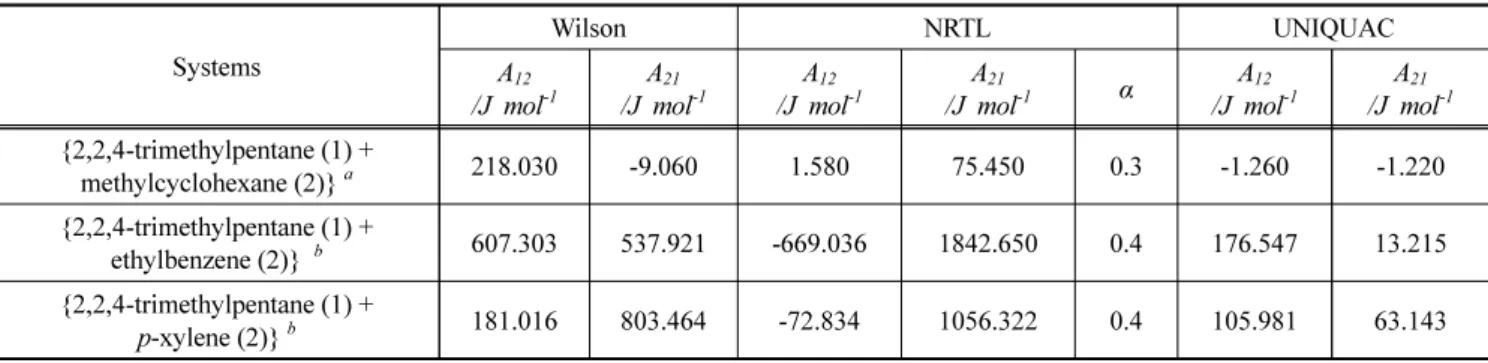
The FP data for {2,2,4-trimethylpentane (1) + methylcyclohexane (2)}, {2,2,4-trimethylpentane (1) + ethylbenzene (2)}, and {2,2,4-trimethylpentane (1) + p-xylene (2)} mixtures were determined over the entire composition range. The optimized binary parameters for the Wilson, NRTL and UNIQUAC model used to estimate the activity coefficients were taken from literature references and are provided in Table 3 [24-25].
Table 2. The Antoine coefficients of the components
Components Antoine coefficients
aA B C
2,2,4-trimethylpentane 6.96602 1339.49 229.033
Methylcyclohexane 6.83900 1278.57 222.168
Ethylbenzene 6.96580 1429.55 213.767
p-xylene 6.99053 1453.43 215.300
a
Ref. [15]
The optimized binary parameter is provided for the system {2,2,4-trimethylpentane (1) + methylcyclohexane (2)} from VLE data of the literature [24]. And the NRTL and UNIQUAC parameters are provided for the systems {2,2,4-trimethylpentane (1) + ethylbenzene (2)} and {2,2,4-trimethylpentane (1) + p-xylene (2)} in Ref. [25], thus the parameters of Wilson model were also made in this work.
The experimental binary FP data for the systems {2,2,4- trimethylpentane (1) + methylcyclohexane (2)}, {2,2,4- trimethylpentane (1) + ethylbenzene (2)} and {2,2,4-trimethylpentane (1) + p-xylene (2)} are presented in Table 4. The resulting binary data were compared with the predicted values from the activity coefficient models of Wilson, NRTL and UNIQUAC models.
The resulting binary data were compared with the predicted values from the activity coefficient models of the Wilson, NRTL, and UNIQUAC models. The binary parameters of each model equation were used to calculate the activity coefficients under the same conditions used in the experiments, and the initial temperature was assigned the numerical average temperature of each mixture. Subsequently, the FP was obtained by adjusting the initial temperature by satisfying Le Chatelier’s rule (Equation 4). The objective function (OF) used is expressed as follows:
min ) 1
i ,sat
FP i
sat i i
P P
OF x
i
(10)
For Raoult’s law, the activity coefficient was equal to unity based on the assumption of an ideal liquid phase. The average absolute deviations (A.A.D) between the experimental and calculated values are shown in Table 4.
The A.A.D is defined as follows:
Ni
ical i
N T D T
A A
1 exp
.
. (11)
where the T
iexpis the experimental lower FP of component i, and T
icalis the estimated lower flash point of component i.
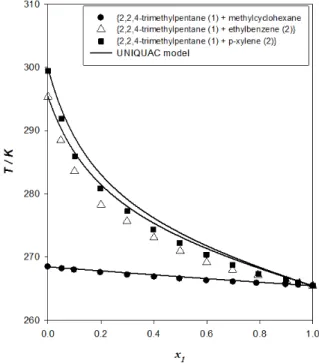
The experimental data from the analysis of each binary system at 101.3 kPa are plotted in Figures 1 to 4. As shown from the minimum values of A.A.D, in all cases, the experimental data agree well with the predicted values. In addition, minimum flash point behavior (MFPB) was not observed in any of the three binary systems. The proposed approach for predicting the FP of aromatic hydrocarbon blends with 2,2,4-timethylpentane proved to be accurate, having low deviations over almost the entire range of mixture compositions.
For the investigated systems, the A.A.D values between the predicted and measured FP values were less than 1.99 K, except when calculated by Raoult’s law. The Wilson model yielded results closest to those of the experimentally determined binary systems {2,2,4-trimethylpentane (1) + methylcyclohexane (2)}
and {2,2,4-trimethylpentane (1) + p-xylene (2)}. The minimum Table 3. The optimized binary parameters of the Wilson, NRTL and UNIQUAC equations for each binary system
Systems
Wilson NRTL UNIQUAC
A
12/J mol
-1A
21/J mol
-1A
12/J mol
-1A
21/J mol
-1α A
12/J mol
-1A
21/J mol
-1{2,2,4-trimethylpentane (1) +
methylcyclohexane (2)}
a218.030 -9.060 1.580 75.450 0.3 -1.260 -1.220
{2,2,4-trimethylpentane (1) +
ethylbenzene (2)}
b607.303 537.921 -669.036 1842.650 0.4 176.547 13.215
{2,2,4-trimethylpentane (1) +
p-xylene (2)}
b181.016 803.464 -72.834 1056.322 0.4 105.981 63.143
a