ISSN: 1738-7167
DOI: http://dx.doi.org/10.7731/KIFSE.2015.29.2.039
Seta Flash 밀폐식 장치를 이용한 Water-Methanol과 Water-Ethanol계의 인화점 측정
하동명 · 박상훈* · 이성진**
†
세명대학교 보건안전공학과, *에스텍 E&C, **세명대학교 임상병리학과
The Measurement of Flash Point of Water-Methanol and Water-Ethanol Systems Using Seta Flash Closed Cup Tester
Dong-Myeong Ha · Sang Hun Park* · Sungjin Lee**
†
Department of Occupational Health and Safety Engineering, Semyung University
*STEC E&C
**Department of Clinical Laboratory Science, Semyung University (Received March 13, 2015; Revised April 27, 2015; Accepted April 28, 2015)
요 약
인화점은 액체 혼합물의 화재와 폭발의 위험성을 특징짓는 주된 성질이다. 인화점은 가연성 액체에 불꽃이 가해졌을 때 점화가 발생하는 가장 낮은 온도로 정의된다. Seta flash 밀폐식 장치를 이용하여 이성분계 수용성 혼합물인 water- methanol 계와 water-ethanol계의 인화점을 측정하였다. Wilson 식과 UNIQUAC 식과 같은 활동도 모델식을 활용한 방 법을 이용하여 인화점을 계산하였다. 이 계산치와 라울의 법칙에 의한 계산치를 비교하였다. 그 결과, 활동도 계수 모델 식에 의한 계산치가 라울의 법칙에 의한 계산치 보다 측정값에 보다 근접하였다.
ABSTRACT
The flash point is the major property to characterize fire and explosion hazard of liquid mixtures. The flash point is the lowest temperature at which a liquid gives off enough vapor to form a flammable air-vapor mixture. The flash points of two aqueous mixtures, water-methanol and water-ethanol, were measured using Seta flash closed cup tester. A prediction method based on activity coefficient models, Wilson and UNIQUAC equations, was used to calculate the flash point. The calculated flash points were compared to the results by the calculating method using Raoult’s law. The calculated values based on activity coefficients models were found to be better than those based on the Raoult’s law.
Keywords : Flash point, Seta flash closed cup, Water+methanol, Water+ethanol, Wilson, UNIQUAC
1. Introduction
The flash point is the important property of the flamma- ble liquid mixtures to analyze the safety in chemical pro- cesses(1). The flash point is the lowest temperature at which a liquid gives off enough vapor to form a flammable air- vapor mixture. Generally the lower the flash point tempera- ture has the greater the fire hazard(2).
The flash point can be measured using either open cup tester or closed cup tester. Generally the flash point mea- sured by open cup tester results in a higher value than that
measured by closed cup tester, because open cup tester per- mits the emission of the low-boiling-point component in the mixture into the surrounding atmosphere prior to the application of the flame(2,3). On the contrary, the mixture in closed cup tester is separated from the surrounding atmo- sphere, thereby inhibiting mass transfer between the mix- ture and the surrounding atmosphere. Reliable and consistent flash point can be obtained using closed cup tester, particu- larly for multicomponent mixtures(3,4). Therefore the flash point by closed cup tester are most widely used to charac- terize flammable substance hazards in practice.
†
Corresponding Author, E-Mail: [email protected]
†
TEL: +82-43-649-1286, FAX: +82-43-649-1537
United Nations (UN) recommended the worldwide implementation of Globally Harmonized System of Classi- fication and Labeling of Chemicals (GHS) in 2008 and the flash point of liquid mixtures is the crucial reference prop- erty in the classification of flammable liquids within it(5). Unfortunately experimental flash point data of liquid mix- tures are scarce. Particularly the flash points of the mix- tures that have non-flammable component, such as water, have seen little study and the data that did exist was incon- sistent.
Deriving the flash point data using closed cup tester is a time-consuming work and the cost of obtaining the flash point data is vary high(5). Therefore various alternative meth- ods to predict the flash point of liquid mixture have been proposed.
Affens and McLaren(6) developed a predictive model for the flash points of alkane mixtures by combined Raoult’s law, Dalton’s law, and Le Chatelier’s rule. The model bet- ter predict the flash point of the hydrocarbon mixture.
However, its application is limited to ideal solutions.
White et al.(7) reduced Affens and Mclaren's model to a simpler equation by ignoring any dependence of the lower flammable limit (LFL) on temperature. However, the equa- tion of White et al. is only valid for ideal solutions.
Liaw et al.(8) developed a mathematical model for the flash point of highly non-ideal solutions using activity coefficient models. Surely, the Liaw’s model needs the binary interaction parameters of activity coefficient model to calculate the flash points. Without the binary interaction parameters, the Liaw’s model is not able to predict the flash points for the binary solutions.
Ha et al.(9) predicted the flash point of the binary flam- mable mixtures using the optimizing methods based on the van Laar and NRTL equations.
Methanol is mixed with water and injected into high per- formance diesel and gasoline engines for an increase of power and a decrease in intake air temperature in a process known as water-methanol injection. Ethanol is miscible with water and is a good general purpose solvent. It is found in paints, tinctures, markers, and personal care prod- ucts such as perfumes and deodorants.
The purpose of this study was to measure and predict the flash point to aid in evaluating the safety of such binary liquid mixtures (water-methanol and water-ethanol). The flash points for two systems, water-methanol and water- ethanol, were measured using Seta flash closed cup tester.
The prediction methods based on activity coefficient mod- els, Wilson and UNIQUAC equations(10), were used to esti-
mate the flash points. The calculated results were compared with the experimental flash points. Also the results were compared to the results by the calculating method using Raoult’s law.
2. Experimental Section
Two binary aqueous solutions (water-methanol and water-ethanol) were selected for the experimental samples.
Methanol and Ethanol were purchased from CARLO Erba Reagents (Italy) with a minimum purity of 99.9%. Water (HPLC grade) was supplied by J.T. Baker, USA. All these chemicals were used without any purification.
The Seta flash closed cup tester manufactured by Koehler Instrument Company (USA) was used to determine the flash point of binary liquid solutions at different compositions.
The basic system configuration of the Seta flash closed cup tester was presented in our previous paper(11). The tes- ter consists of a sample cup, time controller, test flame device, flame controller, thermometer, temperature control- ler, etc. The Seta flash closed cup tester was operated according to the standard test method, ASTM D 3278(12).
3. Flash Point Calculation of Binary Aqueous Mixture
3.1 Flash point prediction using activity coeffi- cient model
The vapor-liquid equilibrium relation of the component i can be expressed as the following equation(10).
(1) where Pi is the partial vapor pressure of component i, P0i is the vapor pressure of component i, αi is the activity of component i, γi is the activity coefficient of component i and xi is the mole fraction of component i in the liquid phase.
Assuming vapor-liquid equilibrium in Seta flash closed cup tester, the Clausius-Clapeyron equation can be applied to binary systems(10).
(2) where T is the flash point in absolute temperature, ΔHi is the enthalpy of vaporization of component i, and R is the gas constant.
The enthalpy of vaporization is a function of tempera- ture and is calculated using Watson equation(10) in this study.
P
i
= Pi 0
αi
= Pi 0
γi
xi
dlnP
i
--- = dT ΔHi
RT
2
---Integrating Equation (2), and Substituting Equation (1) results in :
(3)
where P0i, 0 is the saturated vapor pressure of component i, T is the flash point of binary aqueous mixture, and T0 are the flash point of pure flammable component.
Below we assume that a flash occurs at the lower limit of flammability in the fuel-air system without the additive,
(5) where the subscript 2 indicates the flammable component.
Substituting Equation (5) into Equation (3) results in :
(6) The activity coefficient (γ2) of component 2, which were presented in Equation (6), can be calculated using two activity coefficient models, Wilson and UNIQUAC equa- tions. These equations being described as :
Wilson equation :
(7)
where Λ is as following
(8)
UNIQUAC equation :
(9)
where,
(10)
(11)
The binary parameters of Wilson and UNIQUAC equa- tions were abstracted from the literature(13) and are listed in Table 1.
The temperature (T) which satisfies Equation (6), was determined to be the flash point of binary aqueous mix- ture. The results are presented in Table 2~3.
3.2 Flash points prediction using Raoult’s law Under an ideal solution assumption, the liquid phase activity coefficient of component 2 is equal to unity. There- fore Equation (6) was reduced to Raoult's law, this being described as :
(12)
The temperature (T) which satisfies Equation (12), was determined to be the flash point of binary aqueous mix- ture. The results are presented in Table 2~3.
4. Results
4.1 Experimental results
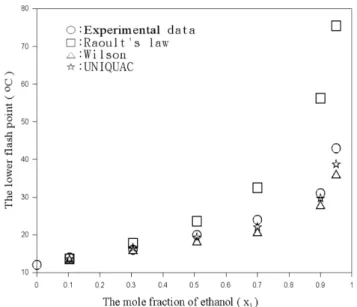
The flash points of binary aqueous mixtures, water (1)- methanol (2) and water (1)-ethanol (2), are listed in Table 2~3 and Figure 1~2.
The concentrations of component i are given in mole fraction, xi. As shown in Figure 1 and Figure 2, the flash points of the systems plotted as a function of mole frac- tion.
As can be seen from the figures, the non-flammable component (water) inhibits the flash. The flash point of aqueous mixtures will be vary depending on the composi- tion of the non-flammable component. The more non-flam- mable component was obtained as having a the higher the flash point temperature.
P
i
= ln(Pi 0 0 ,
γi
xi
) + ΔHi
---R 1T
0
--- − 1T---
⎝ ⎠
⎛ ⎞
ln
P
2
= P2 0 0 ,
= constant1 T--- = 1
T
0
--- + R/ΔH(
2
)⋅ln(γ2
⋅x2
)γ
1
= − x(1
+ Λ12
x2
) + x2
Λ12
x1
+ Λ12
x2
--- − Λ
21
Λ21
x1
+ x1
---⎝ ⎠
⎛ ⎞
ln ln
γ
2
= − x(2
+ Λ21
x1
) + x1
Λ12
x1
+ Λ12
x2
--- − Λ
21
Λ21
x1
+ x2
---⎝ ⎠
⎛ ⎞
ln ln
Λ
12
= v2
v1
---e−
λ
12−λ
11--- RT
, Λ
21
= v1
v2
---e−
λ
21−λ
22--- RT
γ
i
= Φi *
xi
--- ln + z2---q
i
θi
Φi *
--- + l
i
− Φi *
xi
--- xj
lj
j=1
∑
m
ln ln
− q'
i
θ'j
τji
j=1
∑
m
⎝ ⎠
⎜ ⎟
⎛ ⎞
ln + q'
i
− q'i
θ'j
τij
θ'k
τkj
k=1
∑
m
---
j=1
∑
m
τ
ji
= qji
− qij
---RTl
j
= z2--- r(
j
− qj
) − r(j
− 1), z = 101 T--- = 1
T
0
--- + R/( ΔH
2
)⋅ln( )x2
Table 1. The Binary Parameters of Wilson and UNIQUAC Equations for Each Binary SystemParameters Systems
Wilson* UNIQUAC**
A12 A21 A12 A21
Water (HPLC grade)-methanol (99.9%) 433.0681 271.1382 697.5569 −404.8062 Water (HPLC grade)-ethanol (99.9%) 960.9534 307.4162 188.6515
−0
86.5941*Wilson : A12 = λ12 − λ11, A21 = λ21 − λ22.
**UNIQUAC : A12 = g12 − g11, g21 = g21 − λ22.
4.2 The comparison of the experimental and cal- culated flash point
The calculated flash points were presented in Table 2~3.
The average absolute error (AAE) included in the tables is defined(14) as :
(13)
where N is the number of experimental data, the Tiexp is the experimental flash point of component i, and Tical is the cal- culated flash point of component i. The AAE is a measure of agreement between the experimental flash points and the calculated flash points.
A comparison between the experimental data and the cal- culated results of water-methanol system is presented in Table 2. The AAEs of the results calculated by the methods using the Wilson and UNIQUAC equations are 1.47oC and 0.85oC, respectively. The AAE of the results calculated by the method based on Raoult’s law is also
8.66oC.
As shown in Table 3, for water-ethanol system, the AAEs between the experimental data and the results calcu- lated by the methods using the Wilson and UNIQUAC equations are 2.53oC and 1.54oC, respectively. The AAE of the results calculated by the method based on Raoult’s law is also 11.98oC.
It is clear that there is a good agreement between the measured flash points and those calculated by the activity coefficient method performed in this study, as can be seen from the AAEs. The activity coefficient method is also more accurate than the method based on the Raoult’s law.
AAE = T
i exp
− Ti cat
---Ni=1
∑
N
Figure 2. The comparison of flash points of experimental and calculated for water (x1)-ethanol (x2) system.
Table 2. The Experimental and The Calculated Flash Points for Water (x1)-Methanol (x2) System
Mole fractions Flash points (oC)
x1 x2 Exp. Raoult’s law Wilson UNIQUAC
0.000 1.000 10.0 - - -
0.102 0.898 11.5 11.85 11.77 11.80 0.315 0.685 16.0 16.69 15.76 16.07 0.500 0.500 21.0 22.63 19.79 20.66 0.700 0.300 26.0 33.15 25.73 27.66 0.900 0.100 46.0 60.99 41.19 44.56 0.950 0.050 58.0 85.12 55.99 59.28
A.A.E. -
08.66 01.47 00.85
Table 3. The Experimental and The Calculated Flash Points for Water (x1)-Ethanol (x2) System
Mole fractions Flash points (oC)
x1 x2 Exp. Raoult’s law Wilson UNIQUAC
0.000 1.000 12.0 - - -
0.103 0.897 14.0 13.68 13.49 13.57 0.305 0.695 16.0 17.75 16.04 16.56 0.508 0.492 20.0 23.55 18.35 19.33 0.700 0.300 24.0 32.52 20.83 21.99 0.900 0.100 31.0 56.25 28.02 29.72 0.950 0.050 43.0 75.51 36.15 38.70
A.A.E. - 11.98
02.53 01.54
Figure 1. The comparison of flash points of experimental and calculated for water (x1)-methanol (x2) system.
5. Conclusion
The flash points for two aqueous mixtures, water-metha- nol and water-ethanol, were determined using Seta flash closed cup tester.
The experimental data were compared with the calcu- lated values based on the Raoult’s law and are generally in bad agreement with those.
On the other hand, the flash points calculated by the method using the Wilson and UNIQUAC equations are very similar to the experimental data. The activity coeffi- cient method can thus be useful to calculate the flash point of binary aqueous mixture and to help analyse the fire and explosion hazard.
Acknowledgments
This paper was supported by National Emergency Man- agement (2014).
References
1. T. Khalili and A. Z. Moghaddam, “Measurement and Calculation of Flash Point of Binary Aqueous-Organic and Organic-Organic Solutions”, Fluid Phase Equilibria, Vol. 312, pp. 101-105 (2011).
2. A. Z. Moghaddam, A. Rafiei and T. Khalili, “Assessing Prediction Models on Calculating the Flash Point of Organic Acid, Ketone and Alcohol Mixtures”, Fluid Phase Equilibria, Vol. 316, pp. 117-121 (2012).
3. L. Y. Phoon, A. A. Mustaffa, H. Hashim and R. Mat, “A Review of Flash Point Prediction Models for Flammable Liquid Mixtures”, Ind. Eng. Chem. Res., Vol. 53, pp.
12523-12565 (2014).
4. D. White, C. L. Beyer, C. Fulper and J. Leonard, “Flame Spread on Aviation Fuels”, Fire Safety Journal, Vol. 28,
No. 1, pp. 1-23 (1997).
5. H. J. Liaw, V. Gerbaud and Y. H. Li, “Prediction of Mis- cible Mixtures Flash-Point from UNIFAC Group Contri- bution Methods”, Fluid Phase Equilibria, Vol. 300, pp.
70-82 (2011).
6. W. A. Affens and G. W. Mclaren, “Flammability Proper- ties of Hydrocarbon Solutions in Air”, J. of Chem. Ind.
Eng. Chem. & Eng. Data, Vol. 17, No. 4, pp. 482-488 (1972).
7. D. White, C. L. Beyler and C. Fulper, “Flame Spread on Aviation Fuels”, Fire Safety Journal, Vol. 28, pp. 1-31 (1997).
8. H. J. Liaw, Y. H. Lee, C. L. Tang, H. H. Hsu and J. H.
Liu, “A Mathematical Model for Predicting the Flash Point of Binary Solutions”, J. of Loss Prevention in the Process Industries, Vol. 15, pp. 429-438 (2002).
9. D. M. Ha and S. J. Lee, “Measurement of Flash Points for n-hexanol + n-butyric acid and n-butanol + propionic acid by Seta-flash Closed Cup Method”, Journal of the Korean Society of Safety, Vol. 29, No. 6, pp. 76-80 (2014).
10. C. R. Reid, J. M. Prausnitz and B. E. Poling, “The Prop- erties of Gases and Liquids”, 4nd ed., McGraw-Hill, New York (1998).
11. D. M. Ha and S. J. Lee, “Prediction and Measurement of the Lower Flash Points for Flammable Binary Solutions by Using a Setaflash Closed Cup Tester”, Korean J.
Chem. Eng., Vol. 28, No. 5, pp. 1161-1165 (2011).
12. R. C. Lance, A. J. Barnard and J. E. Hooyman, “Mea- surements of Flash Points : Apparatus, Methodology, Applications”, J. of Hazardous Materials, Vol. 3, pp. 107- 119 (1979).
13. J. Gmehing, U. Onken and W. Arlt, “Vapor-Liquid Equi- librium Data collection”, Vol. I, Part 1-7, DECHEMA (1980).
14. D. M. Ha and S. J. Lee, “The Flash Point Measurement for Binary Flammable Mixture”, KIGAS, Vol. 18, No. 5, pp. 60-65 (2014).