JKSCI
Design and Implementation of a Big Data Analytics Framework based on Cargo DTG Data for Crackdown on Overloaded Trucks
1)
Bum-Soo Kim*
*Researcher, Dept. of Future Technology and Convergence Research, Korea Institute of Civil Engineering and Building Technology, Gyeonggi, Korea
[Abstract]
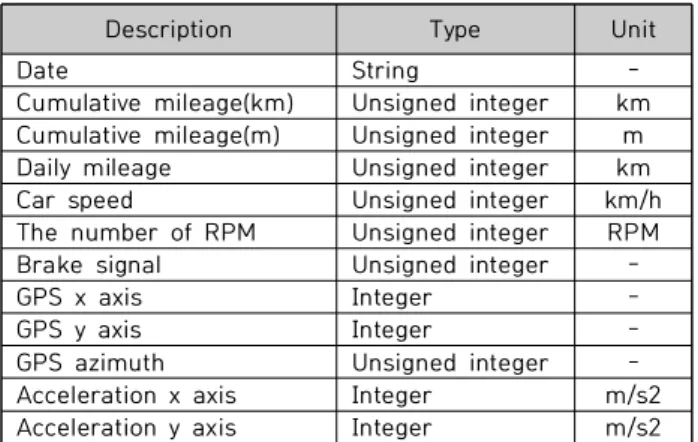
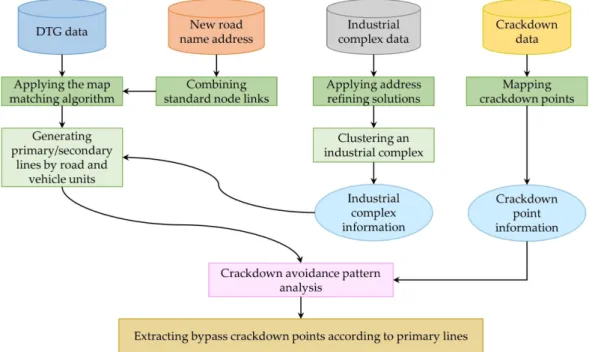
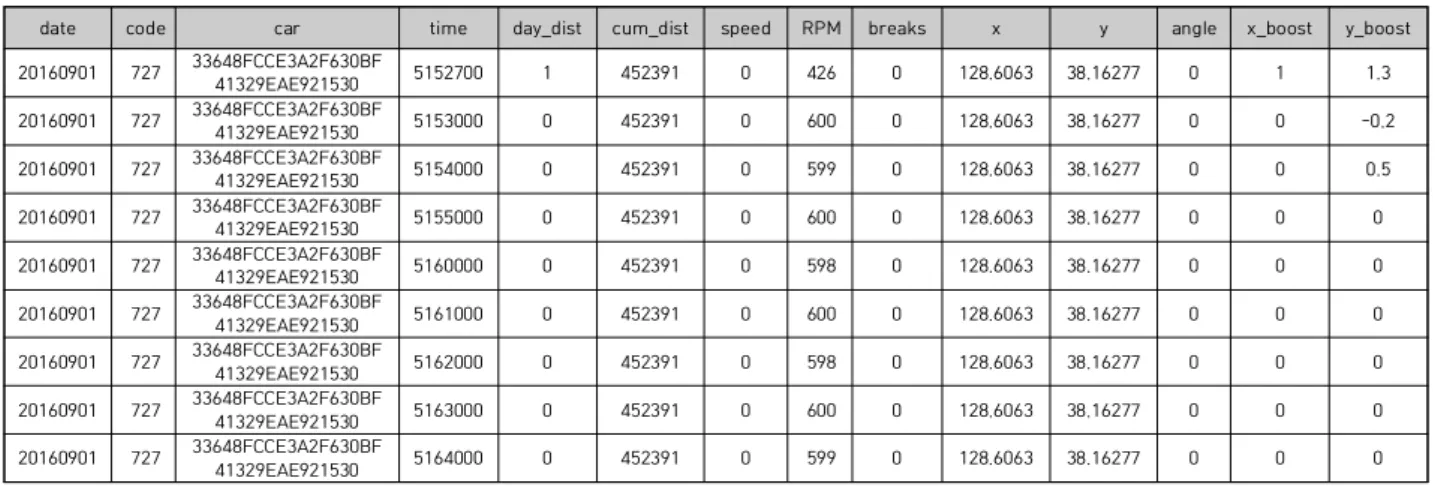
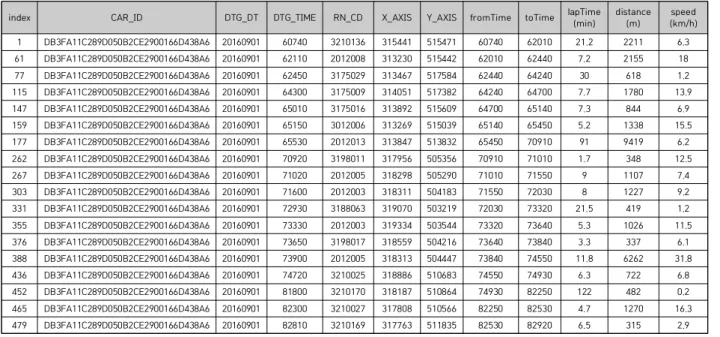
In this paper, we design and implement an analytics platform based on bulk cargo DTG data for crackdown on overloaded trucks. DTG(digital tachograph) is a device that stores the driving record in real time; that is, it is a device that records the vehicle driving related data such as GPS, speed, RPM, braking, and moving distance of the vehicle in one second unit. The fast processing of DTG data is essential for finding vehicle driving patterns and analytics. In particular, a big data analytics platform is required for preprocessing and converting large amounts of DTG data. In this paper, we implement a big data analytics framework based on cargo DTG data using Spark, which is an open source-based big data framework for crackdown on overloaded trucks. As the result of implementation, our proposed platform converts real large cargo DTG data sets into GIS data, and these are visualized by a map. It also recommends crackdown points.
▸Key words: Big data, Cargo DTG, Spark framework, Preprocessing, GIS
[요 약]
본 논문에서는 과적 화물차량 단속을 위한 대용량 화물 DTG 데이터 분석 플랫폼을 설계 및 구 현한다 . DTG(digital tachograph)는 차량운행기록을 실시간으로 저장하는 장치로서, 차량의 GPS, 속 도, RPM, 제동유무, 이동거리 등 차량운행 관련 데이터가 1초 단위로 기록된다. 차량 운행 패턴 및 분석을 하기 위해서는 DTG 데이터의 빠른 처리가 필수적이며, 특히 대용량 DTG 데이터를 가 공 및 변환하기 위해서는 빅데이터 분석 플랫폼이 필요하다 . 본 논문에서는 오픈소스 기반의 빅 데이터 프레임워크인 스파크(Spark)를 이용하여 과적차량 단속을 위한 대용량 화물 DTG 데이터의 분석 플랫폼을 구현하였다. 구현 결과, 실제 대용량 화물 DTG 데이터를 GIS 데이터로 변환하여 지도상에 표현하고 단속 추천 지점을 보여준다 .
▸주제어: 빅데이터, 화물차 DTG, 스파크 프레임워크, 전처리, GIS
∙First Author: Bum-Soo Kim, Corresponding Author: Bum-Soo Kim
*Bum-Soo Kim ([email protected]), Dept. of Future Technology and Convergence Research, Korea Institute of Civil Engineering and Building Technology
∙Received: 2019. 11. 25, Revised: 2019. 12. 16, Accepted: 2019. 12. 16.
∙The preliminary version of this paper was published in Proc. of the Korea Society of Computer and Information Summer Conference 2019, Jeju, Korea, pp. 287–288, Jul. 2019.
Copyright ⓒ 2019 The Korea Society of Computer and Information http://www.ksci.re.kr pISSN:1598-849X | eISSN:2383-9945