Print ISSN: 2288-4637 / Online ISSN 2288-4645 doi:10.13106/jafeb.2020.vol7.no1.19
The Liquidity of Indian Firms: Empirical Evidence of 2154 Firms
Eissa A. AL-HOMAIDI1, Mosab I. TABASH2, Waleed M. AL-AHDAL3, Najib H. S. FARHAN4, Samar H. KHAN5
Received: September 08, 2019 Revised: November 01, 2019 Accepted: November 15, 2019
Abstract
This paper aims to empirically study the determinants of liquidity of Indian listed firms. To account for profit persistence, we apply a (pooled, fixed and random) effect models to a panel of Indian listed firms that covers the time period from 2010 to 2016. This study consists of 2154 firms operating in Indian market. Liquidity (LQD) of Indian firms is measured by liquid assets to total assets, whereas bank size, capital adequacy, profitability, leverage, and firm age are used as internal determinants. Further, economic activity, inflation rate, exchange rate, and interest rate are the external factors considered. The findings reveal that leverage, return on assets, and firm age are the essential internal determinants that impact the liquidity of Indian listed firms. Furthermore, among the internal determinants, the results indicate that firm size, leverage ratio, return on assets ratio, and firm age are found to have a significant positive association with firms’ LQD, except leverage ratio and firm age has a negative relationship with firms’ LQD. From this result, this article has provides helpful ideas and empirical evidence on the inner and external determinants of the companies mentioned in India is very useful to bankers, analysts, regulators, investors and other stakeholders.
Keywords :Firms Liquidity, Internal and External Determinants, Panel Data, Fixed and Random Effect, India
JEL Classification Code : C22, G11, G32
1.Introduction12
India is improving its economic sector. Its economy is considered after the United State and China on the purchasing power, but India dynamically builds its manufacturing plan. “After India liberalized in 1991, the services sector was long the fastest growing part of the economy, contributing significantly to GDP, economic growth, international trade and investment” (Bhunia, 2010).
“During 1950-1951, the India manufacturing region has
1 First Author, Department of Commerce, Aligarh Muslim University, Aligarh, India. Email: [email protected]
2 Corresponding Author, College of Business, Al Ain University, UAE.
[Postal Address: 30 Street, Al Ain, Abu Dhabi, 64141, UAE]
Email: [email protected]
3 Faculty of Commerce, Banaras Hindu University, Varanasi, India.
Email: [email protected]
4 Department of Commerce, Aligarh Muslim University, Aligarh, India.
Email: [email protected]
5. Emirates Canadian University College, Umm Al Quawain, UAE.
Email: [email protected]
ⓒ Copyright: Korean Distribution Science Association (KODISA)
This is an Open Access article distributed under the terms of the Creative Commons Attribution Non-Commercial License (http://Creativecommons.org/licenses/by-nc/4.0/) which permits unrestricted noncommercial use, distribution, and reproduction in any medium, provided the original work is properly cited.
contributed entirely about 8.98% to GDP, but by 1965-1966, it has raised to 14.23%. India is relying upon on their agriculture zone that has been contributing approximately 50%
of its GDP at that time. National Account stated that the manufacturing sector was arisen in growth from 2.7% in 1998-99 to 6.1% in 2002-03. The manufacturing sector grew by 8.9% in 2004-05, comfortably out-performing the sector's long term average growth rate of 7%. In the year 2014, Make It India has been launched to amend their manufacturing industry in their future” (Hoyt, 2018).
This research investigates the determinants of liquidity of Indian listed firms over the time period from 2010 to 2016. Furthermore, the objective of this study achieve by two sub-objectives as to investigate the relationship between internal determinants with the liquidity of India listed firms;
and to investigate the association between external determinants with the liquidity of Indian listed firms.
Liquidity is a dependent factor, while independent variables are internal determinants namely, (bank size, capital adequacy, profitability, leverage, and firm age); and external determinants namely, (Economic activity (GDP), exchange rate, inflation rate, and interest rate).
The investigation is organized as follows. Section two presents the relevant literature review of the current research.
Section three discusses the methodology and data collections of the study. Hypotheses testing is formulated in section four. Findings and their interpretation are shown in sections five. The last section concludes the study.
2. Literature Review
Different scientists have studied the magnitude of liquidity management and the review of prior literature demonstrates that there is an important link between the profitability of companies and management of liquidity using distinct variables chosen for evaluation (Bagchi &
Chakrabarti, 2014). Bagchi and Chakrabarti (2014) revealed a powerful adverse correlation between liquidity leadership and performance of companies, but company size has a beneficial connection to profitability of companies. Kaya (2015) indicated that company-specific determinants influencing the Turkish financial performance firms are the firm size, company age, ratio of losses, current ratio and rate of premium development. Hamidah and Muhammad (2018) revealed that firms’ profitability has the strongest influence on firms’ performance and liquidity and leverage have a significant effect on companies performance. The results also indicate that liquidity ratio, leverage ratio, and profitability have a strong association with firms’
performance. Ismail (2016) showed that current liquidity and money conversion indices have a significant and positive influence on firms’ financial performance (ROA).
Further, findings suggest that “high current ratio and longer cash conversion cycle lead firms towards better performance." Du, Wu and Liang (2016) suggested that
“firm’s sufficient liquidity can increase its market value”.
Bibi and Amjad (2017) proposed that money gap has a substantial and negative connection with asset return, while the current ratio has a favorable and substantial connection with the profitability of companies. Findings also indicated that the sales log and the complete asset log have a favorable and substantial connection with the profitability of companies. Sandhar, Janglani and Acropolis (2013) showed that liquidity ratios have a diminishing profitability relationship. It also stated that CR and LR had a negative relationship with (ROA and ROI), whereas Cash Turnover
Ratio (CTR) had a negative association with ROI and ROA.
Azhar (2015) showed that “debtor’s turnover ratio, collection efficiency and interest coverage ratio reveal a significant influence while quick ratio, absolute liquid ratio and creditor's turnover ratio show an insignificant impact on the profitability of selected sample utilities”. Chukwunweike (2014) indicated that current ratio has a positive and substantial on profitability of firms. “There is no important particular connection between the acid test ratio and the profitability of companies”. Akenga (2017) revealed that current ratio and money reserves have a major impact on asset returns (ROA) with a level of significant 5% (p-value
< 0.05). The debt ratio has shown to have no significant impact on ROA. Lyroudi, Carty, Lazaridis and Chatzigagios (1999) found that there is a positive but considerable relationship between CCC and current ratio and LR. Lyroudi K, and Lazaridis (2000) showed that there is a strong positive association between CCC and ROA. The results also revealed that there is a significant and positive association between CCC and CR and LR.
However, Velmurugan and Annalakshmi (2015) revealed that liquidity position of a firm depends on “firm size, return on investment, inventory turnover ratio, growth in sales, leverage and assets turnover ratio." Eljelly (2004) found liquidity has a strong negative association with firms’
profitability. Furthermore, the size of the firm has also indicated to have a noticeable impact on firms’ profitability.
Wang (2002) revealed that CCC has a significant and negative association with firms’ profitability measured two indicators namely, (ROE and ROA). Ajao and Small (2012) showed that liquidity management measured by “credit policies, cash flow management and cash conversion cycle”
has a significant influence on firms’ profitability and it is concluded that “managers can increase profitability by putting in place good credit policy short cash conversion cycle and an effective cash flow management procedures”.
Niresh (2012) suggested that there is no significant correlation between liquidity ratio and profitability among the listed manufacturing companies in Sri Lanka. Bagchi (2013) indicated that there is a negative association between the indicators of liquidity management with firms’ financial performance, but company size has a strong positive relationship with firms’ profitability.
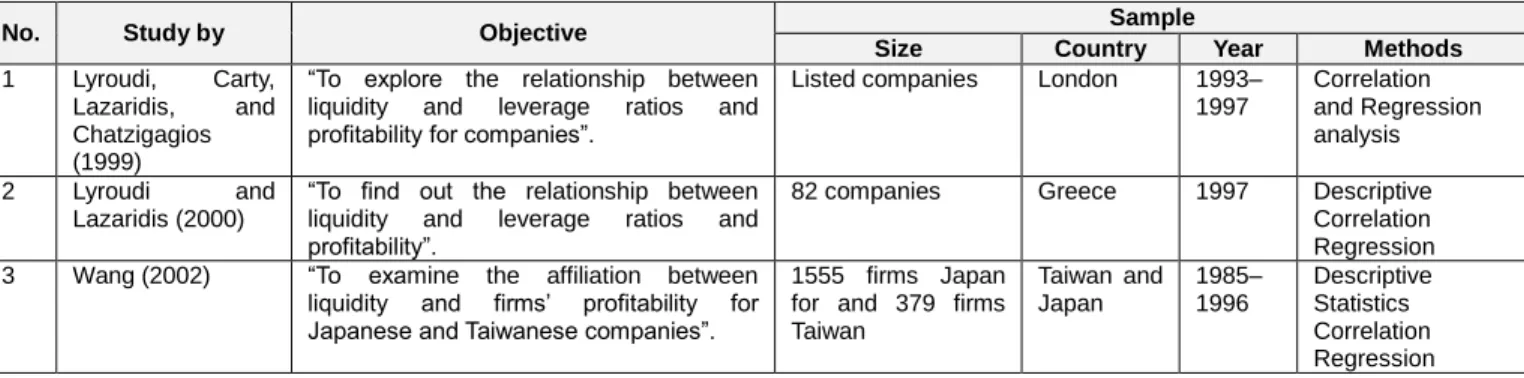
Table 1: Some of the Previous Studies in Different Countries
No. Study by Objective Sample
Size Country Year Methods
1 Lyroudi, Carty, Lazaridis, and Chatzigagios (1999)
“To explore the relationship between liquidity and leverage ratios and profitability for companies”.
Listed companies London 1993–
1997
Correlation and Regression analysis
2 Lyroudi and
Lazaridis (2000)
“To find out the relationship between liquidity and leverage ratios and profitability”.
82 companies Greece 1997 Descriptive Correlation Regression 3 Wang (2002) “To examine the affiliation between
liquidity and firms’ profitability for Japanese and Taiwanese companies”.
1555 firms Japan for and 379 firms Taiwan
Taiwan and Japan
1985–
1996
Descriptive Statistics Correlation Regression
4 Eljelly (2004)
“To investigate the relationship between liquidity and profitability for a sample of 29 companies in Saudi Arabia”.
29 companies Saudi Arabia
1996 to 2000
Descriptive Correlation Regression 5 Owolabi, Obiakor
and Okwu (2011)
“To investigate the relationship between liquidity and profitability in selected quoted companies in Nigeria”.
Selected Quoted Companies
Nigeria 2003 to 2009
Correlation Coefficient Regression analysis 6 Niresh (2012) “To find out the cause and effect
relationship between liquidity and profitability”.
31 listed
manufacturing firms
Sri Lanka 2007 to 2011
Descriptive Statistics Correlation Matrix 7 Ajao and Small
(2012)
“To measures the relationship between liquidity management and corporate profitability using data from selected manufacturing companies quoted on the floor of the Nigerian Stock Exchange”.
12 manufacturing companies /
Nigeria 2005- 2009
Descriptive statistics
8 Sandhar, Janglani and Acropolis (2013)
“To analyze the working capital management in terms of profitability and liquidity.
to find out the relationship between liquidity with profitability”.
Some companies listed in the NSE
India 2008 to 2012
“Regression analysis Correlation analysis”
9 Bagchi and
Chakrabarti (2014)
“To investigate the impact of liquidity management on profitability of Indian Fast-Moving Consumer Goods (FMCG) firms, as well as the relationship among them”.
18 FMCG firms India 2001-
2002 to 2010- 2011
“Descriptive Statistics, Correlation, and Regression analysis”
10 Chukwunweike (2014)
“To determine the correlation between current ratio, Acid-test ratio, and return on capital employed and profitability”.
2 companies Nigeria 2007 to 2011
Correlation Coefficient 11 Azhar (2015) “To investigate the relationship impact of
liquidity and Management Efficiency on profitability of selected power distribution utilities in India”.
23 firms India
2006 until 2013
Correlation and Regression analysis 12 Kaya (2015) “To examine the firm-specific factors
affecting the profitability of non-life insurance companies operating in Turkey”.
“24 non-life insurance
companies”
Turkey 2006–
2013
Descriptive Statistics Correlation Regression 13 Demirgüneş
(2016)
“To analyze the effect of liquidity on financial performance”.
1 firm Turkish 1998 to
2015
DOLS Estimation 14 Du, Wu and Liang
(2016)
“To analyze the correlation between corporate liquidity and firm value by using evidence from China’s listed firms”. “To investigates the relation among corporate liquidity, R&D and firm size”.
Listed firms China 2013 “Correlation and Regression Analysis”
15 Ismail (2016) “To investigate the impact of the liquidity management on the performance of the 64 Pakistani non-financial companies”.
64 non-financial companies
Pakistan 2006- 2011
Descriptive, Correlation and Regression 16 Bibi and Amjad
(2017)
“To investigate the relationship between firm’s liquidity and profitability, and to find out the effects of different components of liquidity on firms’ profitability”.
“50 listed firms of Karachi Stock Exchange”
Pakistan 2007 to 2011
“Descriptive, Correlation and Regression Analysis”
17 Akenga (2017) “To establish the effect of current ratio, cash reserves and debt ratio on financial performance of firms listed at the Nairobi Securities Exchange (NSE)”.
30 firms Kenya 2010 to
2015
Descriptive Statistics and Correlation Regression 18 Kobika (2018) “To establish the relationship between the
profitability and the liquidity of listed manufacturing companies in Sri Lanka”.
26 listed
manufacturing companies
Sri Lanka 2012 to 2016
“Descriptive Statistics Correlation Analysis”
19 Hamidah and Muhammad (2018)
To examine the dynamic relationships amongst the liquidity, leverage, and profitability with company performance in Malaysia.
21 companies Malaysia 2010 to 2014
“Correlation and Regression Analysis”
3. Research Methodology
3.1. Sample Size and Data Collection
The objective of the study aims to identify the association between internal factors and external determinants with liquidity of firm listed on Bombay Stock Exchange (BSE) in India. A sample of 2154 firms was selected among 5129 listed companies in India. Liquidity of
Indian listed firms is measured by (liquid assets to total assets), whereas firm size, capital adequacy ratio, profitability, leverage, and firm age are used as internal determinants. Further, external factors are regarded: GDP, rate of inflation, exchange rate and interest rate. This study was based on secondary data sourced from ProwessQI database of the listed firms for the time period of seven years from 2010 to 2016. Further, market values of the company shares were extracted from the website of the BSE.
3.2. Model Specification
A panel data of 2154 listed firm for seven years is used in the current study. The panel used is analyzed employing both (linear regression with pooled, fixed, and random) effect models. Building on this model, one model has been advanced to examine the factors that may affect listed firms’
liquidity in India which are as follows:
LQDit=
αi+ β1LOGASit+ β2CADit+ β3PROFit+β4LEVit+ β5FAGEit+ β6GDPit+ β7INFit + β8EXCHit+
β9INTRTit+ εit (1) Where LQD = liquidity ratio (liquid assets to total assets);
𝛼_𝑖 is a constant term; 𝑖= 1,..., N and 𝑡 = 1,..., T. all other variables are as defined in Table 2.
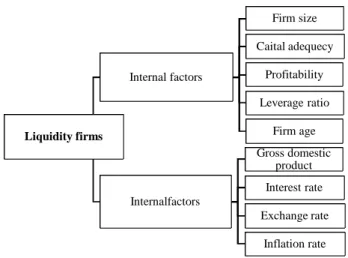
Figure 1: Liquidity Determinants of Indian Listed Firms
3.3. Measurement of Variables
Internal factors have been categories into five proxie s namely, firm size, capital adequacy ratio, profitability (ROA and ROE), leverage ratio, and firm age, while in ternal factors have been categories into five proxies na mely, firm size, capital adequacy ratio, profitability (RO A and ROE), leverage ratio, and firm age, while Four categories of internal determinants include GDP, rate of inflation, rates of exchange, and rate of interest.
Table 2: Definition of Variables
Variables Notation Measurement Data source Panel A: dependent variables
Liquidity LQD 𝐿𝑄𝐷𝑖𝑡= Liquid assets to total assets
Prowess QI Database Panel B:Independent variables : (Internal)
Assets size LOGAS Natural logarithm of total assets
Prowess QI Database Capital
adequacy
CAD 𝐶𝐴𝐷𝑖𝑡= Equity to total assets
Prowess QI Database
Profitability ROA
ROE
𝑅𝑂𝐴𝑖𝑡= Net profit to total assets
𝑅𝑂𝐸𝑖𝑡= Net profit to total equity
Prowess QI Database Prowess QI Database Leverage LEV 𝐿𝐸𝑉𝑖𝑡= Debt to equity
ratio
Prowess QI Database Firm age FAGE Number of years since
establishment
Prowess QI Database Panel C: Independent variables: (External)
Economic
activity GDP Annual real GDP
growth rate World bank
Inflation
rate IFR Annual inflation rate
(IFR). World bank
Exchange
rate EXCH Average exchange rate
in a year World bank
Interest
rate INTRT Lending interest World bank
4. Hypotheses
To achieve the objectives of this study, the following hypotheses are stated:
H1: Firm size has a positive association with the liquidity of the listed firm in India under the period from 2010 to 2016.
H2: Capital adequacy has a positive association with the liquidity of the listed firm in India under the period from 2010 to 2016.
H3: Profitability has a positive association with the liquidity of the listed firm in India under the period from 2010 to 2016.
H4: The leverage ratio has a positive association with the liquidity of the listed firm in India under the period from 2010 to 2016.
H5: Firm age has a positive association with the liquidity of the listed firm in India under the period from 2010 to 2016.
H6: GDP growth has a negative association with the liquidity of the listed firm in India under the period from 2010 to 2016.
H7: The inflation rate has a positive association with the liquidity of the listed firm in India under the period from 2010 to 2016.
Liquidity firms
Internal factors
Firm size Caital adequecy
Profitability Leverage ratio
Firm age
Internalfactors
Gross domestic product Interest rate Exchange rate
Inflation rate
H8: The exchange rate has a negative association with the liquidity of the listed firm in India under the period from 2010 to 2016.
H9: The interest rate has a negative association with the liquidity of the listed firm in India under the period from 2010 to 2016.
5. Empirical Results 5.1. Descriptive Statistics
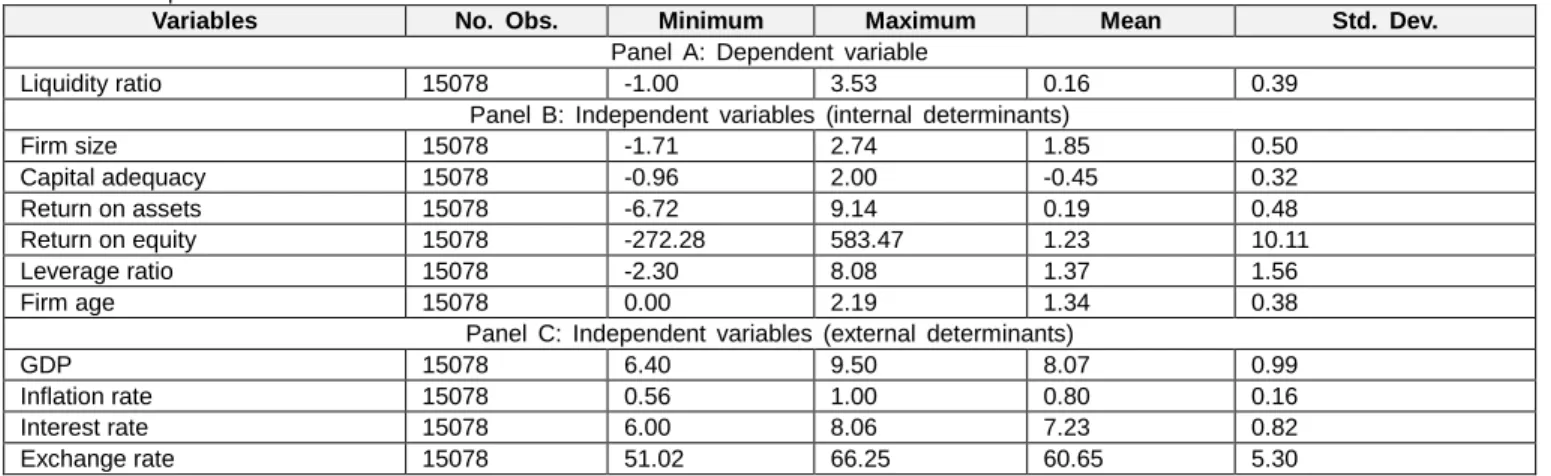
Table 3 reveals the outcomes of the descriptive statistics of the current research for the period from 2010 to 2016.
The descriptive statistics present the mean, maximum, minimum, and Std. Dev respectively. The liquidity ratio
shows the minimum value of -1.00%, while the maximum value is 3.53%, and the mean value is 0.16%, (S.D is 0.39).
For firm-specific determinants, the mean value of firm size is 1.85, capital adequacy, return on assets (ROA), return on equity (ROE), leverage ratio and firm age are -0.45%, 0.19%, 1.23%, 1.37%, and 1.34% with standard deviation of 0.50%, 0.32%, 0.48%, 10.11%, 1.56%, and 0.38%
respectively. With respect to internal variables, rate of interest has a mean value of 8.07 with a standard deviation of 0.99 and (Min. = 6.40, Max. = 9.50) and the average value of exchange rate is 60.6 (Min. = 51.02, Max. = 66.25).
External variables show mean values is 8.07 and 0.80 for GDP and inflation rate (S. D=0.99 and 0.16) respectively.
The gross domestic product (GDP) varies between a minimum of 6.40 and a maximum of 9.50. Likewise, inflation rates between 0.56 and 1.00.
Table 3: Descriptive Statistics
Variables No. Obs. Minimum Maximum Mean Std. Dev.
Panel A: Dependent variable
Liquidity ratio 15078 -1.00 3.53 0.16 0.39
Panel B: Independent variables (internal determinants)
Firm size 15078 -1.71 2.74 1.85 0.50
Capital adequacy 15078 -0.96 2.00 -0.45 0.32
Return on assets 15078 -6.72 9.14 0.19 0.48
Return on equity 15078 -272.28 583.47 1.23 10.11
Leverage ratio 15078 -2.30 8.08 1.37 1.56
Firm age 15078 0.00 2.19 1.34 0.38
Panel C: Independent variables (external determinants)
GDP 15078 6.40 9.50 8.07 0.99
Inflation rate 15078 0.56 1.00 0.80 0.16
Interest rate 15078 6.00 8.06 7.23 0.82
Exchange rate 15078 51.02 66.25 60.65 5.30
5.2. Correlation and Multicollinearity Diagnostics
Table 4 shows that capital adequacy, firm size, leverage ratio, exchange rate, firm age, and Gross domestic product (GDP) have an adverse relationship with liquidity ratio, while return on assets, return on equity, inflation rate, and interest rate have a positive association with firms’ liquidity.
Concerning the variance inflation factor (VIF) results, its
show that all independent variables have a small correlation which shows that in this study there is no multicollinearity issue. To analyze more carefully, this study used the variance inflation factor (VIF) to test multicollinearity issues.
The findings revealed that the variance inflation factor (VIF) values for all independent variables do not exceed 7.91 which suggest that there is no multicollinearity between variables (see Table 5).
Table 4: Correlation and Multicollinearity Diagnostics
Variables
Liquidity Capital adequacy Firm size Leverage ratio Return onassets Return onequity Exchangerate Inflation rate Interest rate Firmage GDP
Panel A: Pearson correlation
Liquidity 1
Capital adequacy -0.01 1
Firm size -0.01 -0.02 1
Leverage ratio -0.28 -0.01 0.12 1
Return on assets 0.19 -0.03 0.07 0.00 1
Return on equity 0.00 0.00 0.00 -0.02 0.06 1
Exchange rate -0.02 0.03 0.00 0.01 -0.05 0.03 1
Inflation rate 0.01 -0.02 0.00 -0.01 0.03 -0.02 -0.64 1
Interest rate 0.02 -0.02 0.00 0.00 0.05 -0.02 -0.70 0.35 1
Firm age -0.02 -0.01 0.00 0.00 -0.01 0.00 0.01 0.01 -0.01 1
GDP -0.01 0.02 0.00 0.01 -0.04 0.02 0.69 -0.22 -0.46 0.02 1
Panel B: Multicollinearity Diagnostics
Variance inflation factor 1.03 1.05 1.03 1.05 1.04 7.88 6.93 7.91 1.02 4.05
5.3. Regression Analysis
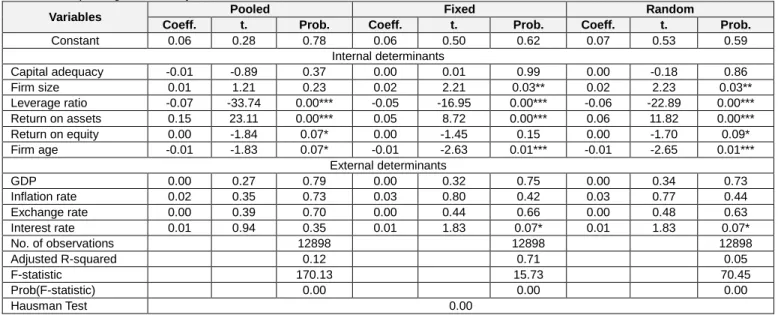
Tables 5 shows regression analysis outcomes between variables. The Adjusted R2 of the fixed effects model is 71%.
This suggested that independent variables are contributing 71% of the variation in liquidity ratio. The findings reveal that leverage ratio, return on assets, and company age have a
statistically significant impact on liquidity in (pooled, fixed and random) effect models, while firm age ratio, and the interest rate ratio in fixed and random effects models have a statistically significant effect on liquidity. However, the return on equity ratio has a significant but negative influence on liquidity ratio in pooled and random effects models at the level of 10%.
Table 5: Multiple Regression Analysis
Variables Pooled Fixed Random
Coeff. t. Prob. Coeff. t. Prob. Coeff. t. Prob.
Constant 0.06 0.28 0.78 0.06 0.50 0.62 0.07 0.53 0.59
Internal determinants
Capital adequacy -0.01 -0.89 0.37 0.00 0.01 0.99 0.00 -0.18 0.86
Firm size 0.01 1.21 0.23 0.02 2.21 0.03** 0.02 2.23 0.03**
Leverage ratio -0.07 -33.74 0.00*** -0.05 -16.95 0.00*** -0.06 -22.89 0.00***
Return on assets 0.15 23.11 0.00*** 0.05 8.72 0.00*** 0.06 11.82 0.00***
Return on equity 0.00 -1.84 0.07* 0.00 -1.45 0.15 0.00 -1.70 0.09*
Firm age -0.01 -1.83 0.07* -0.01 -2.63 0.01*** -0.01 -2.65 0.01***
External determinants
GDP 0.00 0.27 0.79 0.00 0.32 0.75 0.00 0.34 0.73
Inflation rate 0.02 0.35 0.73 0.03 0.80 0.42 0.03 0.77 0.44
Exchange rate 0.00 0.39 0.70 0.00 0.44 0.66 0.00 0.48 0.63
Interest rate 0.01 0.94 0.35 0.01 1.83 0.07* 0.01 1.83 0.07*
No. of observations 12898 12898 12898
Adjusted R-squared 0.12 0.71 0.05
F-statistic 170.13 15.73 70.45
Prob(F-statistic) 0.00 0.00 0.00
Hausman Test 0.00
Notes: ***, ** and * show significance at the level 1%, 5% and 10% respectively.
The outcomes with respect to internal determinants also showed that company size and returned on assets ratio have a positive impact with liquidity in pooled, fixed and random effects, while capital adequacy, leverage ratio, return on equity, and firm age has an adverse effect on liquidity in models of pooled, fixed and random, except capital adequacy has a negative impact on liquidity in (pooled and random) effect models and it has a positive impact in fixed effects model. Concerning the internal factors, the outcomes indicated that GDP, inflation rate, exchange rate and rate of
interest have a positive impact with liquidity ratio in pooled, fixed and random effects models. The findings similar to Bagchi and Chakrabarti (2014) and Hamidah and Muhammad (2018) revealed that liquidity management has a strong negative relationship with firms’ profitability.
Consistent by Almaqtari, Al‐Homaidi, Tabash and Farhan (2018) and Al-Homaidi, Tabash, Farhan and Almaqtari (2018) who discovered that the leverage ratio had a major effect on profitability. Similar to Al‐Homaidi, Tabash, Farhan and Almaqtari (2019) who found that the liquidity
ratio had a substantial influence on the measured profitability (ROE). Supported by Al-homaidi, Tabash, Farhan and Almaqtari (2019) who found that return on assets has a significant impact on liquidity. Inconsistent with Homaidi, Almaqtari, Ahmad and Tabash (2019) who revealed that firm age has a positive and insignificant impact on return on assets. Furthermore, the Hausman test was adopted to select the suitable model estimation between models of (fixed or random) effect. The P-value results indicate that the fixed-effect model is suitable as the random-effect model because the Hausman P-value test is less than 0.05 (P = 0.00 < 0.00).
5.4. Robustness Regression
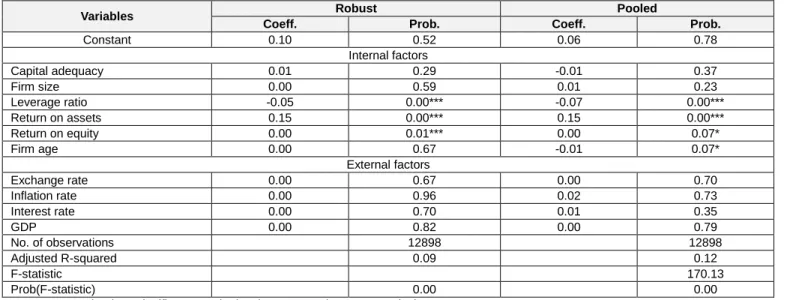
Table 6 reveals the comparing results between regression of Ordinary Least Squares (OLS) model and robust regression model; the results are closely matched.
Coefficient estimates are not extremely deviated from OLS regression in case of robust regression. This indicates an appropriate implementation of regression assumption.
Further, the results indicate that data are not contaminated with outliers or influential observations.
Table 6: Robust Regression
Variables Robust Pooled
Coeff. Prob. Coeff. Prob.
Constant 0.10 0.52 0.06 0.78
Internal factors
Capital adequacy 0.01 0.29 -0.01 0.37
Firm size 0.00 0.59 0.01 0.23
Leverage ratio -0.05 0.00*** -0.07 0.00***
Return on assets 0.15 0.00*** 0.15 0.00***
Return on equity 0.00 0.01*** 0.00 0.07*
Firm age 0.00 0.67 -0.01 0.07*
External factors
Exchange rate 0.00 0.67 0.00 0.70
Inflation rate 0.00 0.96 0.02 0.73
Interest rate 0.00 0.70 0.01 0.35
GDP 0.00 0.82 0.00 0.79
No. of observations 12898 12898
Adjusted R-squared 0.09 0.12
F-statistic 170.13
Prob(F-statistic) 0.00 0.00
Note: ***, ** and * show significance at the level 1%, 5% and 10% respectively.
6. Conclusion and Implications
This paper investigates the determinants of liquidity of Indian listed firm over the time period from 2010 to 2016.
The investigation uses (pooled, fixed and random effects) effect models. A sample of 2150 firms was chosen among 5129 listed firms on the Bombay Stock Exchange in India.
Internal factors include bank size, capital adequacy, profitability, leverage, and firm age. While economic activity (GDP), inflation rate, exchange rate, and interest rate are the external determinants considered.
The findings reveal that leverage ratio, return on assets, and firm age have statistically significant relationship with liquidity in pooled, fixed and random effect models, while the firm size and interest ratio have a statistically significant association with liquidity in fixed and random effect models.
However, the return on equity ratio has a significant negative relationship with liquidity ratio in pooled and random effects models. The results with regard to internal determinants also show that firm size and return on assets ratio have a positive association with liquidity in pooled, fixed and random effect, while capital adequacy ratio, leverage ratio, return on equity ratio, and firm age have a negative relationship with liquidity in pooled, fixed and
random effects models, except capital adequacy ratio ratio has a negative association with liquidity in pooled and random effect models and has positive in fixed effect model.
Concerning the external determinants, the outcomes reveal that economic activity (GDP), rate of inflation, exchange rate, and interest rate have a positive relationship with liquidity in (pooled, fixed and random effect) models.
There are three practical implications for the current research. First, it aims to fill a current gap in the liquidity literature of listed companies. Second, as a methodological contribution, it offers fresh empirical evidence using distinct statistical instruments. Finally, this research provides helpful ideas and empirical evidence on the inner and external determinants of the companies mentioned in India is very useful to bankers, analysts, regulators, investors and other stakeholders. The present study's value provides an interesting insight into the inner and external variables of the liquidity of listed companies in India. In India, however, few empirical studies have examined this problem, this research is the best of the author's understanding. First, try to explore this problem using various statistical analytical instruments and panel data from Indian listed companies that were not regarded in previous research. This research, therefore, attempts to bridge a current gap in the liquidity body of corporate literature in India.
Conflict of Interest
The authors declare that there is no conflict of interest in this paper.
References
Ajao, S., & Small, S. (2012). Liquidity management and corporate profitability: Case study of selected manufacturing companies listed on the Nigerian Stock Exchange. Business Management Dynamics, 2(2), 10–25.
Akenga, G. (2017). Effect of liquidity on financial performance of firms listed at the Nairobi Securities Exchange, Kenya. International Journal of Science and
Research, 6(7), 279–285.
https://doi.org/10.21275/ART20175036.
Al-homaidi, E. A., Tabash, M. I., Farhan, N. H., &
Almaqtari, F. A. (2019). The determinants of liquidity of Indian listed commercial banks: A panel data approach.
Cogent Economics & Finance, 7(1), 1–20.
https://doi.org/10.1080/23322039.2019.1616521.
Al-Homaidi, E. A., Tabash, M. I., Farhan, N. H. S., &
Almaqtari, F. A. (2018). Bank-specific and macro- economic determinants of profitability of Indian commercial banks: A panel data approach. Cogent Economics & Finance, 6(1), 1–26.
https://doi.org/10.1080/23322039.2018.1548072.
Almaqtari, F. A., Al‐Homaidi, E. A., Tabash, M. I., & Farhan, N. H. (2018). The determinants of profitability of Indian commercial banks: A panel data approach. International Journal of Finance & Economics, 24(1), 168–185.
https://doi.org/10.1002/ijfe.1655.
Azhar, S. (2015). Impact of liquidity and management efficiency on profitability: An empirical study of selected power distribution utilities in India. Journal of Entrepreneurship, Business and Economics, 3(1), 31–49.
Bagchi, B. (2013). Liquidity-profitability relationship:
Empirical evidence from Indian fast moving consumer goods firms. International Journal of Applied Management Science, 5(4), 355–376.
https://doi.org/10.1504/IJAMS.2013.057109.
Bagchi, B., & Chakrabarti, J. (2014). Modeling liquidity management for Indian FMCG firms. International Journal of Commerce and Management, 24(4), 334–354.
https://doi.org/10.1108/IJCoMA-10-2012-0065.
Bhunia, A. (2010). A trend analysis of liquidity management efficiency in selected private sector Indian steel industry.
International Journal of Research in Commerce and Management, 1(5), 9–21.
Bibi, N., & Amjad, S. (2017). The relationship between liquidity and firms’ profitability: A case study of Karachi Stock Exchange. Asian Journal of Finance &
Accounting, 9(1), 54–67.
https://doi.org/10.5296/ajfa.v9i1.10600.
Chukwunweike, V. (2014). The impact of liquidity on
profitability of some selected companies: The Financial Statement Analysis ( FSA ) approach. Research Journal of Finance and Accounting, 5(5), 81–90.
Demirgüneş, K. (2016). The effect of liquidity on financial performance: Evidence from Turkish retail industry.
International Journal of Economics and Finance, 8(4), 1–18. https://doi.org/10.5539/ijef.v8n4p63.
Du, J., Wu, F., & Liang, X. (2016). Corporate liquidity and firm value: Evidence from China’s listed firms. In SHS Web of Conferences (Vol. 3, pp. 4–7).
Eljelly, A. M. A. (2004). Liquidity-profitability tradeoff: An empirical investigation in an emerging market.
International Journal of Commerce and Management, 14(2), 48–61.
Hamidah, R., & Muhammad, K. H. B. N. (2018). The effect leverage, liquidity and profitability on the companies performance in Malaysia. Journal of Humanities, Language, Culture and Business, 2(7), 9–15.
Homaidi, E. A. Al, Almaqtari, F. A., Ahmad, A., & Tabash, M. I. (2019). Impact of corporate governance mechanisms on financial performance of hotel companies: Empirical evidence from India. African Journal of Hospitality, Tourism and Leisure, 8(2), 1–21.
Hoyt, J. (2018). The benefits and challenges of manufacturing in India. Retrieved from https://www.globig.co/blog/the-benefits-and-challenges- of-manufacturing-in-india
Ismail, R. (2016). Impact of liquidity management on profitability of Pakistani firms: A case of KSE-100 Index.
International Journal of Innovation and Applied Studies, 14(2), 304–314.
Kaya, E. Ö . (2015). The effects of firm-specific factors on the profitability of non-life insurance companies in Turkey. International Journal of Financial Studies, 3(4), 510–529. https://doi.org/10.3390/ijfs3040510.
Kobika, R. (2018). Liquidity management and profitability:
A case study analysis of listed manufacturing companies in Srilanka. Global Scientific Journal, 6(9), 484–494.
Lyroudi, K, Carty, D. M., Lazaridis, J., & Chatzigagios, T.
(1999). An empirical investigation of liquidity: The case of UK firms. In Annual Financial Management Association Meeting in Orlando.
Lyroudi, K., & Lazaridis, Y. (2000). The cash conversion cycle and liquidity analysis of the food industry in Greece. https://doi.org/10.2139/ssrn.236175.
Niresh, J. A. (2012). Trade-off between liquidity &
profitability: A study of selected manufacturing firms in Srilanka. Journal of Arts, Science & Commerce, 4(4), 34–40.
Owolabi, S. A., Obiakor, R. T., & Okwu, A. T. (2011).
Investigating liquidity-profitability relationship in business organizations: A Study of selected quoted companies in Nigeria. British Journal of Economics, Finance and Management Sciences, 1(2), 1–19.
Sandhar, S. K., Janglani, S., & Acropolis. (2013). A study on liquidity and profitability of selected Indian cement companies: A regression modelling approach.
International Journal of Economics, Commerce and Management, I(1), 1–24.
Velmurugan, R., & Annalakshmi, S. (2015). Determinants of liquidity of the select Indian tractor companies. Global Journal for Research Analysis, 4(4), 59–61.
Wang, Y. (2002). Liquidity management, operating performance, and corporate value: Evidence from Japan and Taiwan. Journal of Multinational Financial Management, 12(2), 159–169.